
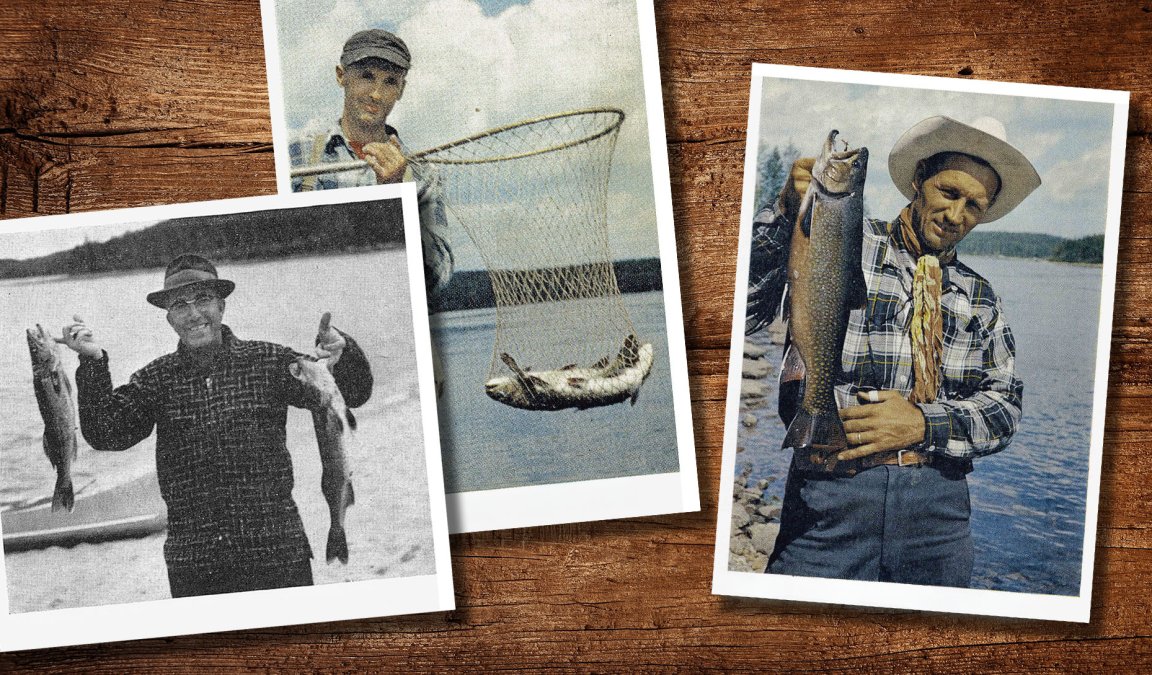
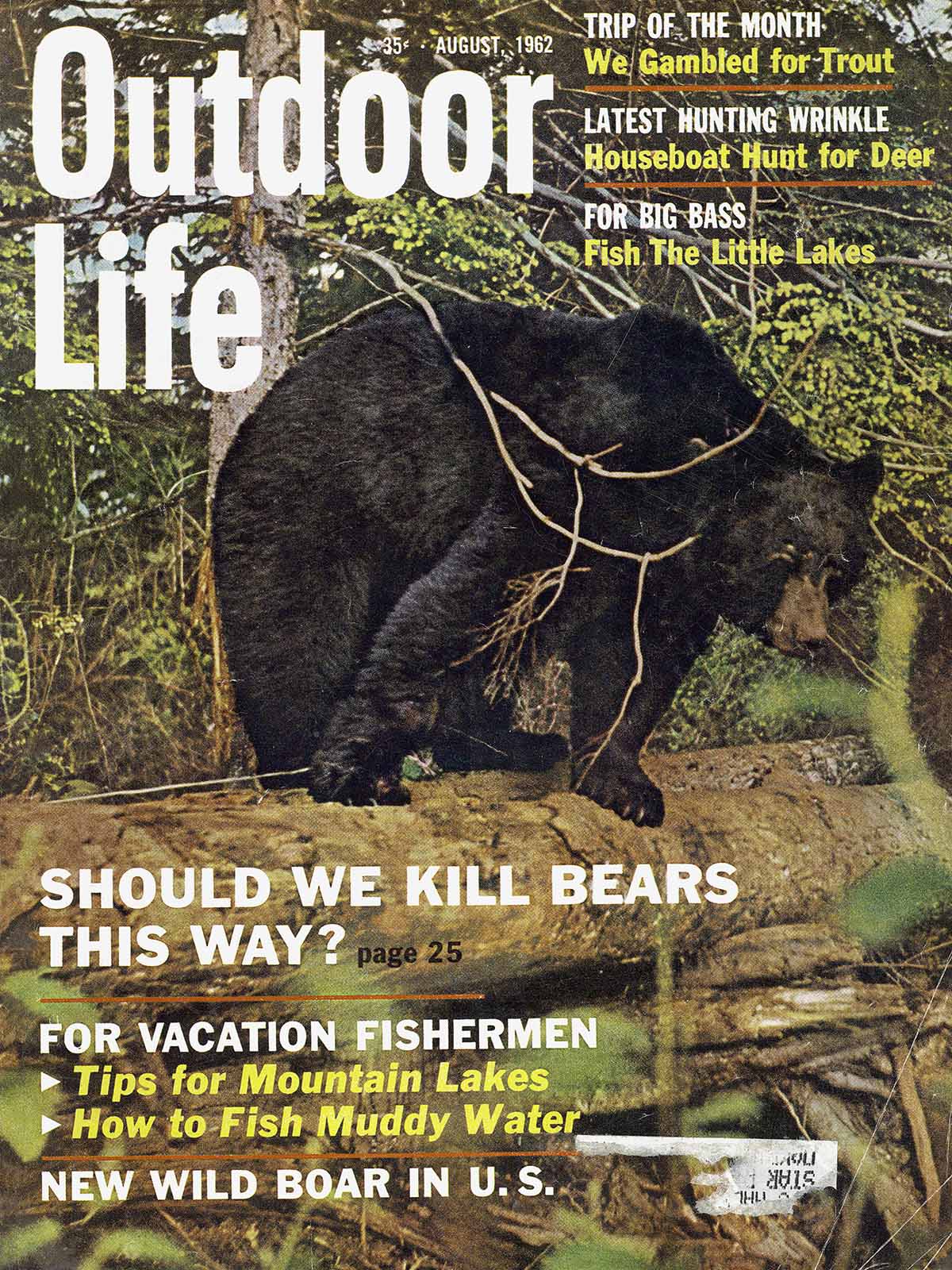
This story, “We Gambled for Big Trout: 262 M’Goose,” appeared in the August 1962 issue of Outdoor Life.
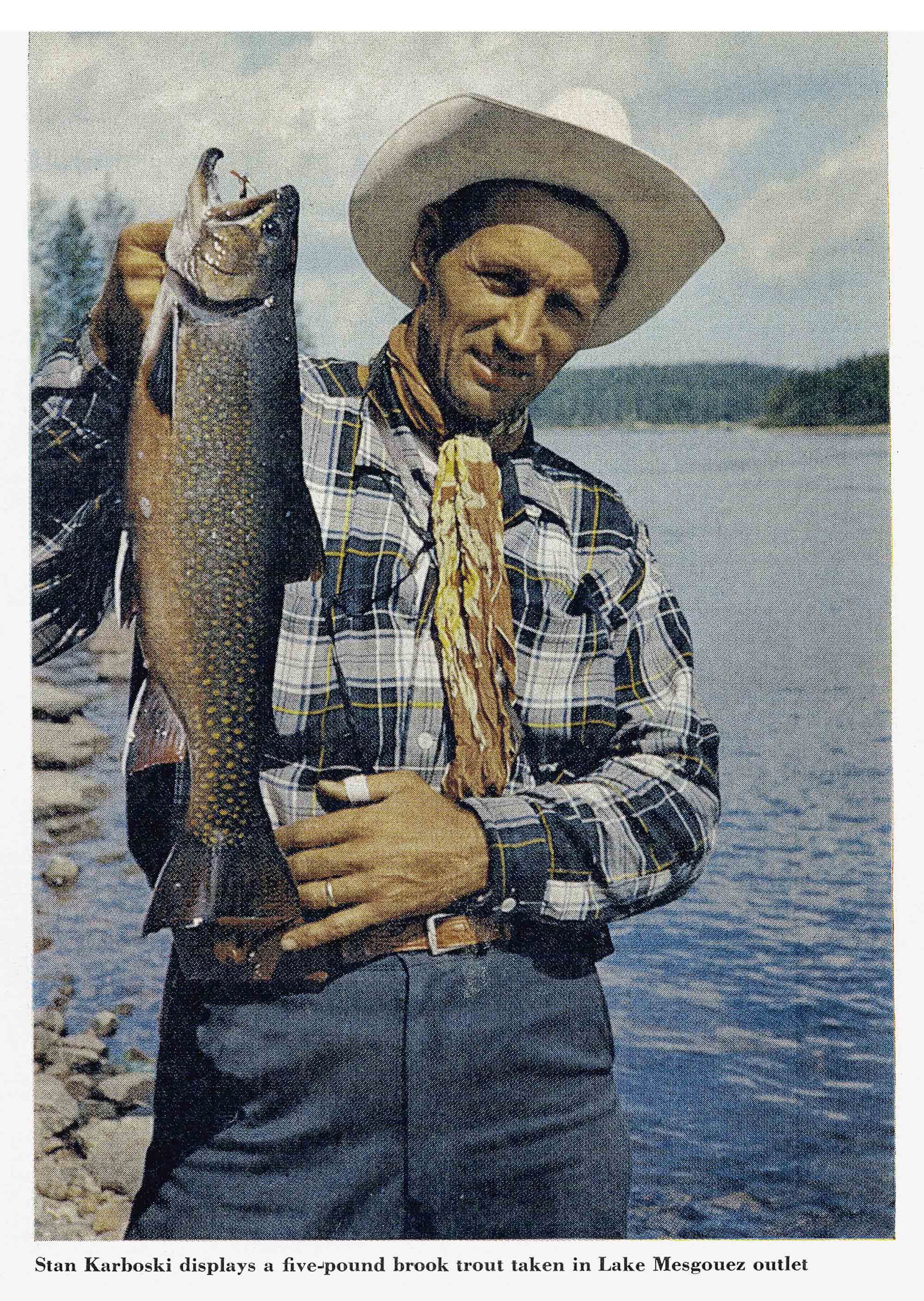
“THEY’RE here!” Ed Lukens shouted. He was dancing up and down on top of a big boulder, a grin a foot wide on his face. I could see his rod bent around in a tight arc and the taut line knifing through the current.
“So our gamble has paid off,” I thought to myself as I scrambled toward Ed with a net. A few minutes later I slid the net under Ed’s fish—five pounds of glistening brook trout.
“Look at that trout,” Ed exulted. The early morning sun picked out brilliant flashes of red laced with white below an almost black back. Bud Carpenter walked up to join Ed and me in inspecting the prize. Then the three of us turned toward the fourth member of our party, Stan Karboski. Fishing from a rock upstream, Stan was netting a perfect mate to the fish at our feet.
That clinched it. We’d hit a hotspot.
The previous afternoon, sitting around the table in the pilots’ lounge back at Cache Lake, we hadn’t been so sure. Reg Phillips, manager for Fecteau Air Service there, had played it honest. “Lac Mesgouez looks as if it might be a pretty good spot for fishing,” he told us, “but I can’t guarantee a thing. We’ve never fished it.”
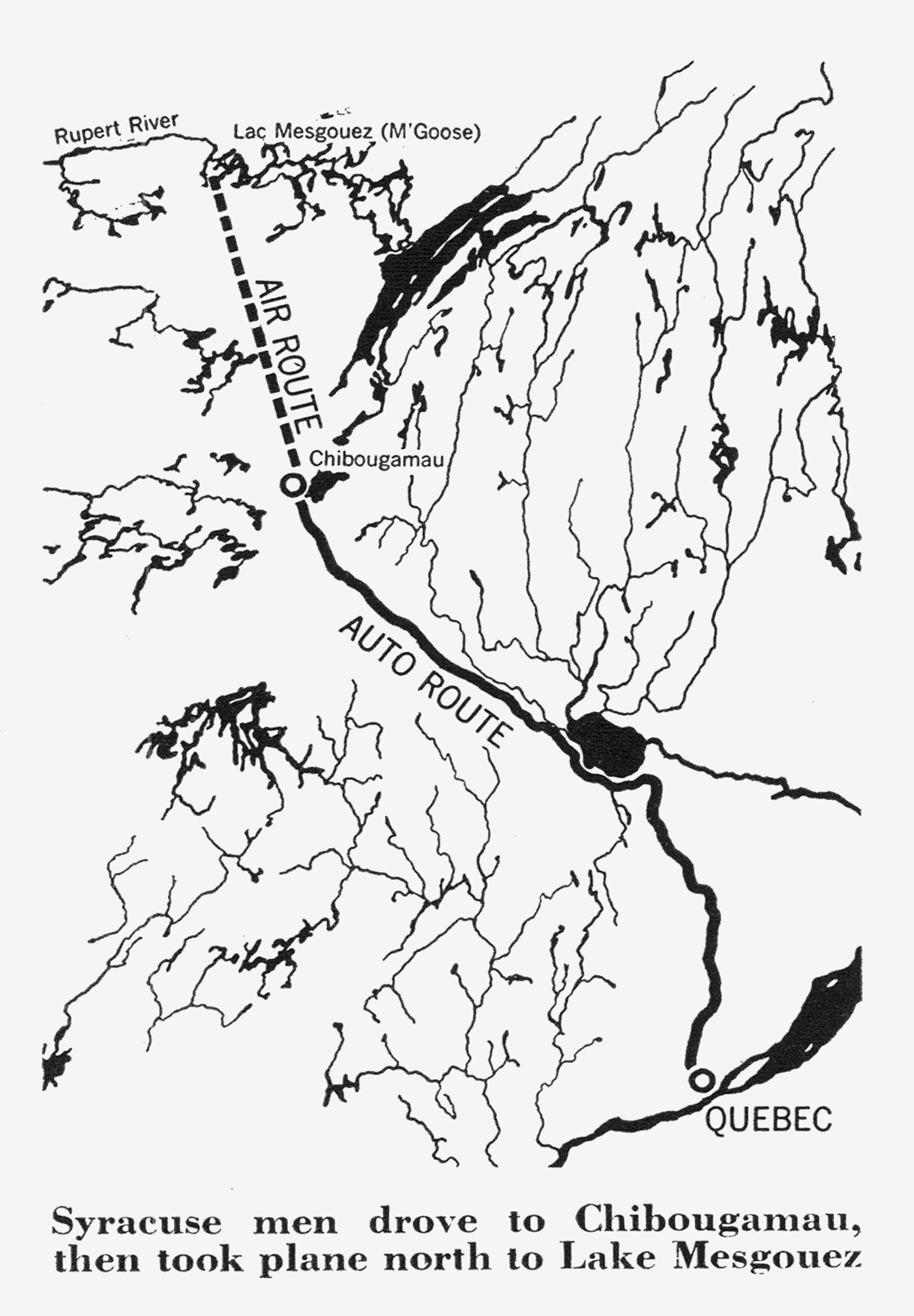
After some debate, Stan slapped his thigh and said, “Let’s go there.” No one vetoed the idea, so we piled all the gear in two Beaver float planes, strapped a canoe over a pontoon on each one and took off for this lake some 118 miles away. This was on August 19, 1961, and we planned to spend the rest of that month in a bush camp.
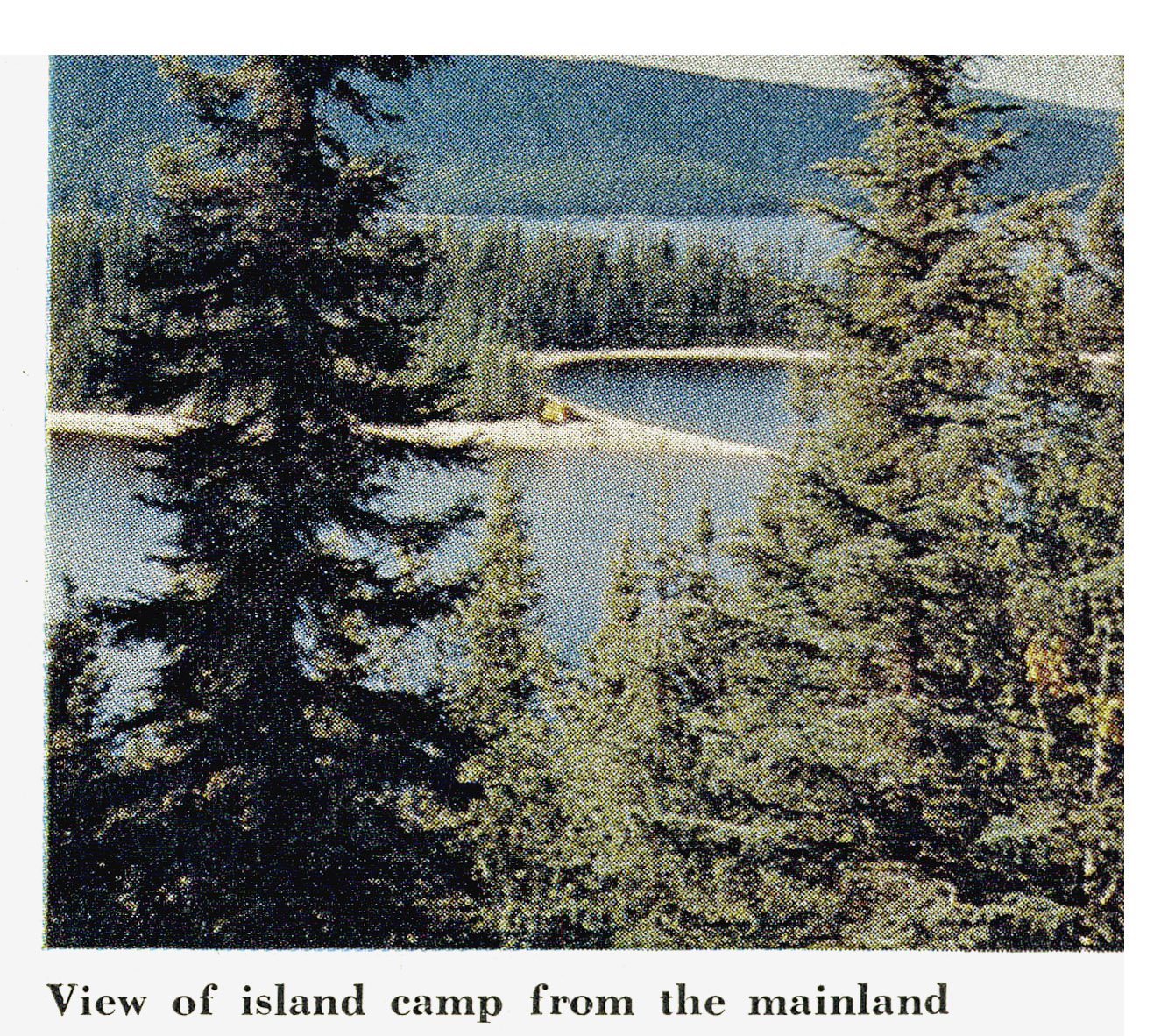
Reg’s instructions were to aim for a small island near the outlet of the lake, which he’d pointed out on the map. “It has sand beaches all around and a naturally enclosed harbor you can taxi a plane right into,” he said. “I first noticed it from the air on trips farther north, and I sat down there once to look it over. It should make an ideal camping place.”
He also pointed out that there were a lot of blank spaces on the map in the area we were going into and suggested we employ a technique we’d used on other occasions—photographing the section we intended to operate in with a Polaroid camera before landing. This gave us a more detailed guide to the area once we were on the ground in poorly mapped country. The prime requisites for good pictures were clear visibility and sufficient altitude.
Our destination, Lake Mesgouez, is part of the Rupert River system in northern Quebec, located about a third of the way to James Bay from the source of that turbulent river at Lake Mistassini. This area of Quebec is about 450 miles north of the U.S. border at northern New York and some 120 miles northwest of the nearest town in the Canadian bush. The only permanent inhabitants of the country are seminomadic Cree Indians who trap the waterways in the winter and congregate in the summer at trading posts such as Mistassini Post and Rupert House. You travel in this country by plane or canoe. There’s no other way.
Our party was composed of four upstate New York men, all of whom had previous bush experience. Hardware merchant Bud Carpenter from Camden had also been a restaurant proprietor for many years, so he headed our kitchen department. Stan Karboski, first sergeant of a Ranger Battalion in World War II and now in the farm supply business in nearby Parish, could pick up a canoe like a veteran voyageur. He was a handy man to have around for guys like me, a deskbound Syracuse lawyer. Rounding out the group was “Big Ed” Lukens, Syracuse teacher and athletic coach.
We had driven the 800 miles from our homes via Quebec City, Laurentides Park, and Lake St. John to the end-of-the-road mining town of Chibougamau. We brought with us all the food and equipment necessary to sustain four men in the wilderness for at least two weeks, including two car-topped canoes (aluminum 17-footers with square sterns) and 3½-horse outboard motors to power them.
This had become sort of an annual expedition with Ed and me. We usually played it loose, often waiting until we arrived at a jumping-off place like Chibougamau before we decided which trout lake we’d fly to. We’d accumulated our own outfit over the years and generally operated without guides. This year Stan and Bud had elected to take pot luck with us in the vast Canadian wilderness where there are at least 10,000 fabulous fishing spots waiting to be found.
Reg Phillips had suggested Mesgouez (pronounced something like “M’Goose”) as a likely place to try, but he disclaimed any responsibility for what we found there. Just in case our luck was bad, Reg added, he’d make it a point not to be around when we came out. Ed and I would have forgiven him for one bad guess, however, because he’d steered us to some tremendous squaretail fishing the previous summer at up-to-then unfished Lake Frotet in the Broadback River headwaters.
We knew that the Rupert was reputed to have brook trout its entire length, and that lake trout, walleyes, northern pike, and whitefish are all common to this watershed. We also knew that Mesgouez offered an extensive lake area to explore and that below it in the river were several miles of chutes and rapids where brookies would be likely to be holed up during the hot, low-water conditions of late August. We knew Reg wanted someone to go in and really fish this place but was hesitating to push it for fear it would turn out to be a dud.
On the way in our young bush pilot, Brian Magill of Winnipeg, told us he once stopped at Mesgouez to pick up some Cree, who showed him a very large lake trout. This sounded encouraging.
Our flight path took us just a few miles east of Lake Assinica, where brookies up to 10 pounds were reported in the summer of 1960. A few minutes later we passed directly over Lake Frotet, where Ed and I caught brookies to six pounds on a 1960 trip.
A panorama of rolling green forest and sparkling lakes was unfolding beneath us. As we left the Broadback watershed we picked up that of the Marten River, a tributary of the Rupert. A little later we were over the outer reaches of Lake Mesgouez, which later investigation indicated is really two or three major lakes separated by rapids. A few minutes later Brian tipped the plane up on the left wing and we could see the island Reg had mentioned. It was indeed a beautiful spot.
While the other plane went in to land, we circled at about 3,000 feet. I had the Polaroid camera cocked, and as Brian made a wide clockwise circle around the island I shot a series of views of the country for several miles around, using our intended campsite as a base point. At the same time, Ed cased the area with binoculars, committing as much as he could to memory. Luckily, we had a clear, bright day, and the Polaroid pictures (they’re quickly “developed” right in the camera) were excellent. As we came around by the lake outlet we could see frothing rapids downriver. Ed, pointing out the side window, grinned at me and indicated big fish with his hands. Then Brian headed her in.
By the time we taxied up to the beach, Stan and Bud already had their plane unloaded and the pilot was heading out to take off again. Brian went over the pictures and oriented them with our copy of the Mistassini aerial chart. It was obvious the map left a lot to the imagination.
“Gotta get home for supper,” Brian said. “See you in two weeks.” A few minutes later he roared overhead, wings waggling in the traditional salute, and disappeared over the ridge to the south.
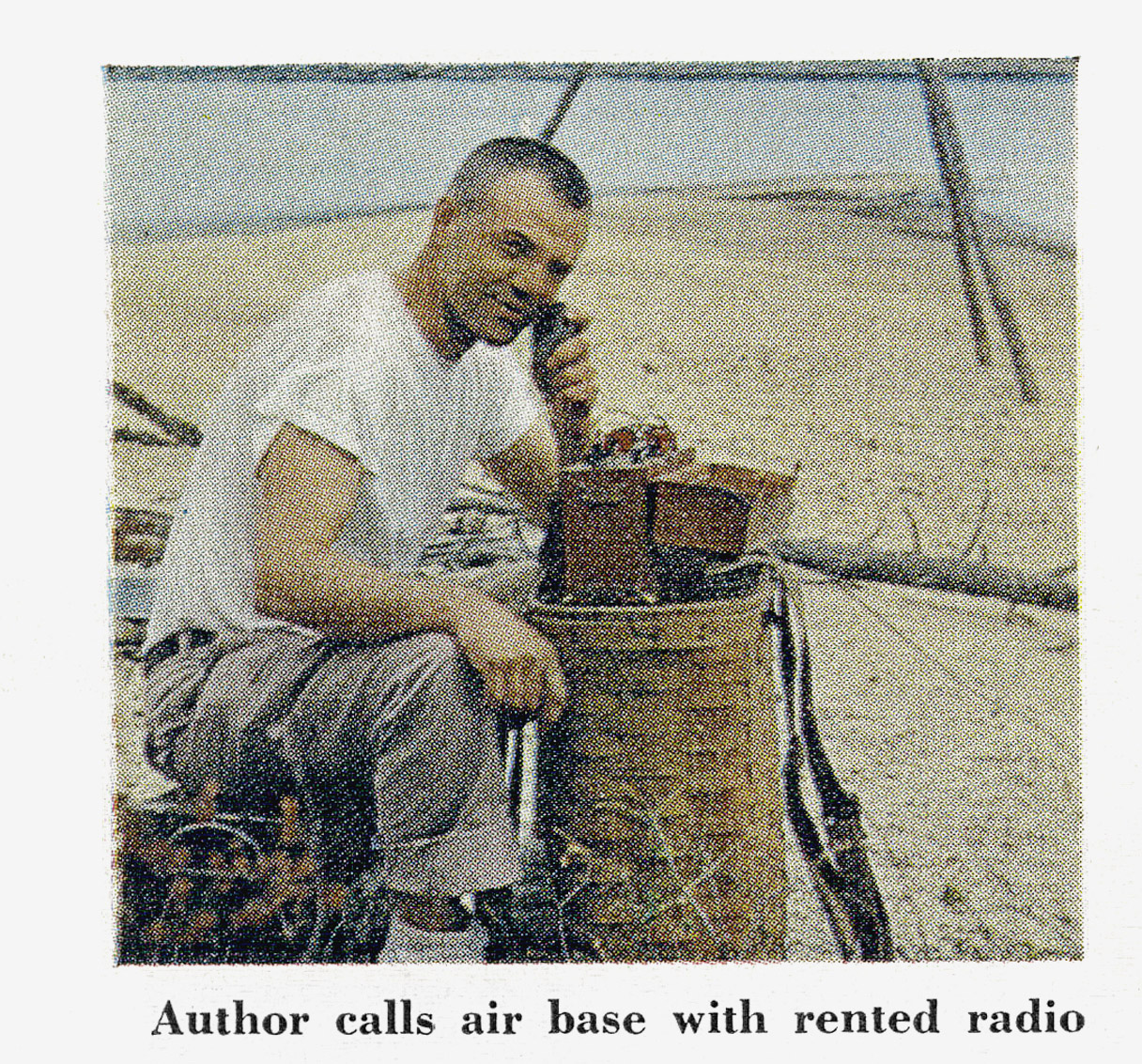
Well, we were here, for better or for worse. A feeling of the immensity of this vast country came over us as we walked up the beach to look for a campsite. We had one means of contact with the outside — a small, dry-cell-powered transceiver radio rented from the air service for $1 a day. Paul Mailhot, the dispatcher at Cache Lake, had gone over the operation of it and instructed us how to string up the aerial. He said many bush parties, including Cree, used these sets, and that they had no trouble operating at ranges of 200 miles or more.
Our agreement was that in case we lost contact, the air service would send the planes within 15 days. If the fishing turned out bad or some emergency developed, we could call them at an earlier date. Paul minimized our fears that we might not be able to get through. “You should have no trouble,” he said. “Call us every day. If things sound real good, we might even come up and join you.” He assigned us the call sign CJQ 262 Mesgouez.
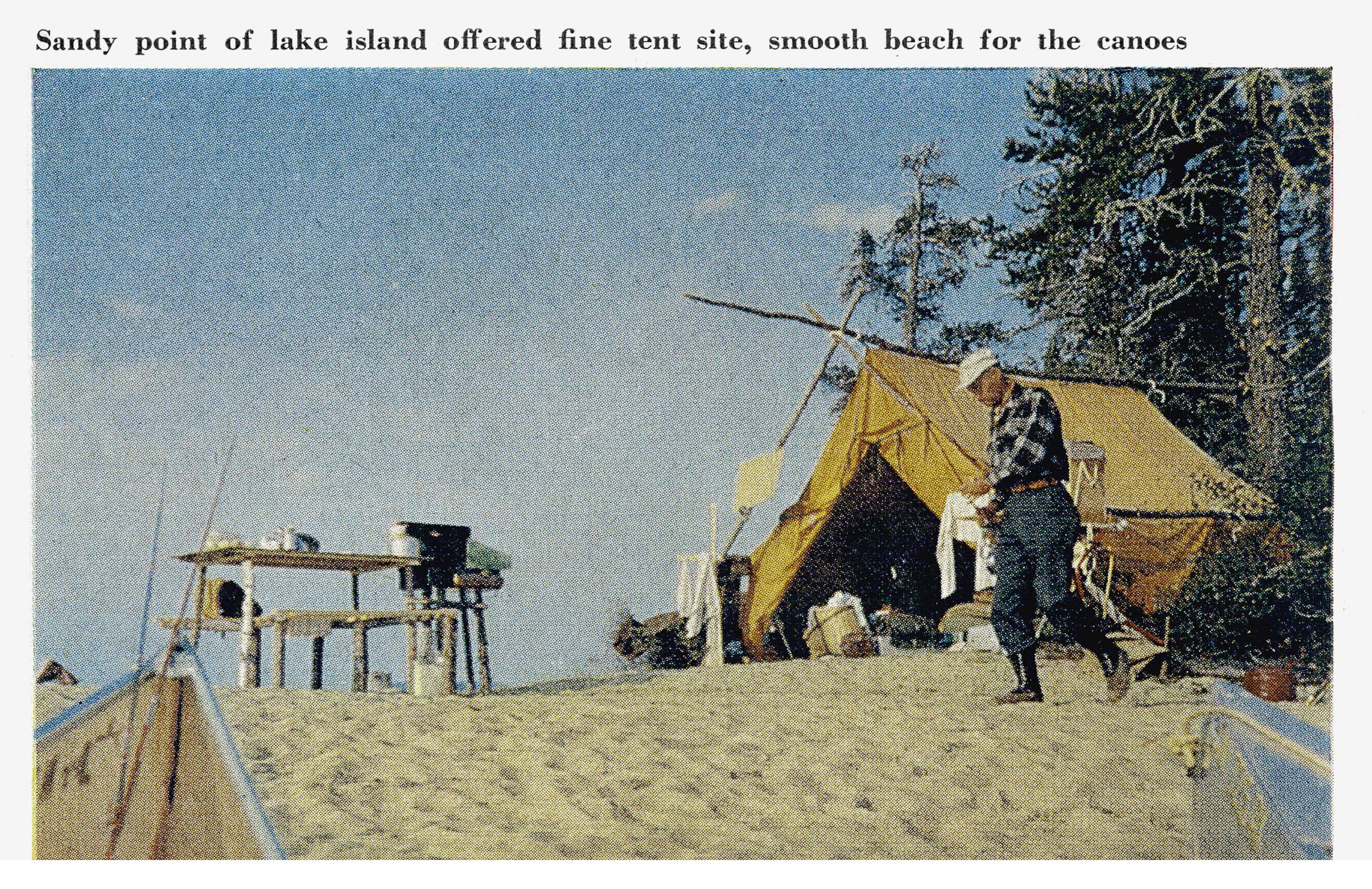
The island had a sandy point where remains of matted spruce tips told us an Indian had camped. We decided this was the best site available. By the time we’d cut poles and put up our 10 x 12 wall tent it was time for chow. Bud whipped out a quick meal. We gave the dishes a fast rinse and headed for the canoes.
In the remaining hour or so of light we trolled the lake near camp. No luck. We hit our sleeping bags tired and wondering what we’d got ourselves into. “I’m heading for those rapids in the morning,” Ed announced as Bud put out the lantern.
We were up and had a fire going by 6 a.m. No one said much, but we all wanted to get down to those rapids as fast as possible and find out what we’d bought. We pushed away from the beach about 7 and revved up the little kickers for the run down the lake. It was about a mile to the outlet. As we neared it we noticed something that hadn’t been evident from the air. There was a 200-yard stretch of fast water down through a rocky neck where the water left the lake. By mutual consent we cut short our trip to the main rapids and pulled in to the rocky shore. It was about 10 minutes later, while I was still trying to tie on a lure, that Ed’s shout split the air.
In the next hour we took several squaretails in the three to five-pound class, enough to convince us this was real fishing. As is often the case in these waters, small to medium red-and-white or gold lures seemed to be the best producers. When the initial action slacked off, Stan and I took a canoe across to the other shore. Almost immediately we picked up a couple of eight-pound pike, and I had a walleye follow on one cast. Things looked good now, and we began to relax.
At noon we ran back up to camp for lunch. After lunch, Bud and Stan took a canoe to explore a long draw of water in back of camp while Ed and I strung up the radio aerial and called Cache Lake. Paul almost immediately recognized our “262 M’Goose” identification and came back loud and clear. We reported all well.
Bud and Stan came back from their exploring a little later. They’d had little action, so we decided to have a go at the main rapids next morning.
Underway early the following day, we stopped at the outlet for a few casts and then rode the current down through the rocky neck. Below the outlet the river flattened out again with an occasional spot of current. About half a mile farther down, a small island split the channel and two blazed trees on it formed an arrow pointing downstream. We pulled over and saw a flattened milk tin jammed into one of them. Closer inspection revealed a series of Indian characters scratched in the paint by a knife point. The Rupert has been a canoe route to the bay for centuries, and this was obviously a message left by Crees for a following party. Later we were to learn its probable subject matter.
Farther downstream we began to hear the roar of the rapids and see water kicking up. The current began to pick up considerably, so we pulled in behind a rocky point. A short hike to the beginning of the white water showed us several hundred yards of rapids and small chutes with numerous exposed boulders and good pockets along the shore. A few casts confirmed our idea that this should be good trout water. The pockets off the edge of the fast water were full of brookies from 10 inches up to three pounds. For several minutes they hit on almost every cast.
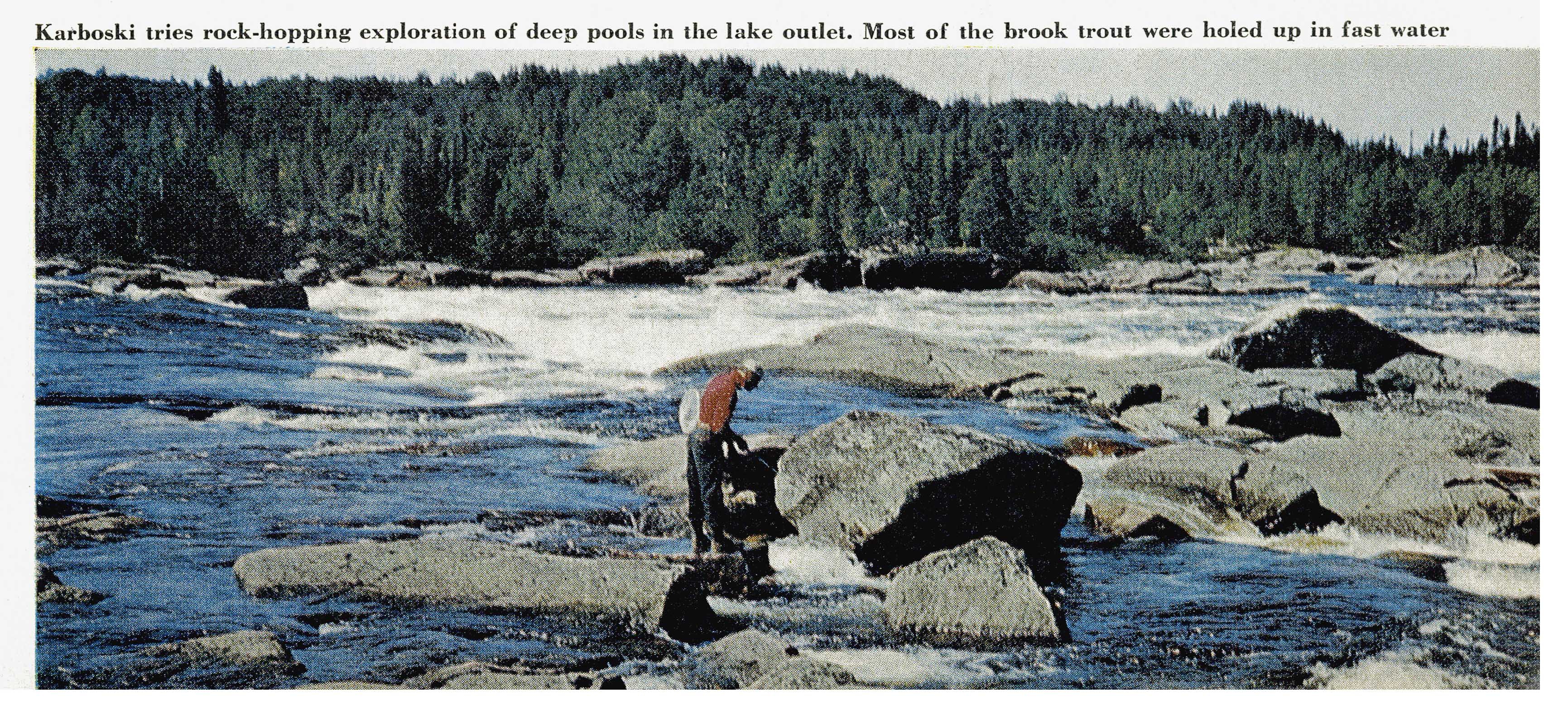
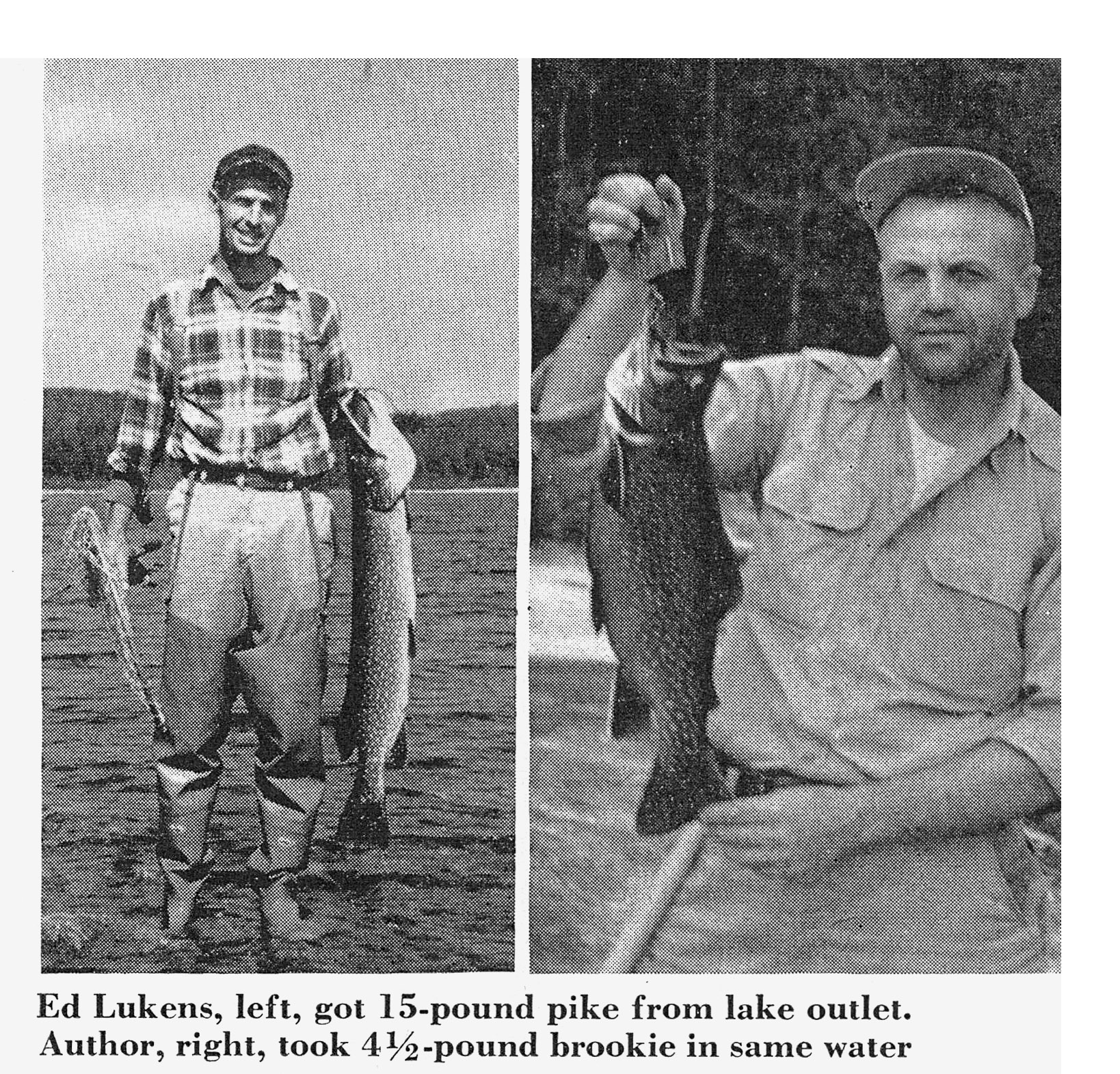
The shoreline here was mostly solid rock. It was very open, almost park-like, and very easy going. A few jack pines struggled for a foothold and the bare stretches were like walking on a sidewalk. In the deeper holes we raised fish of three pounds or so, and Ed picked up a four-pounder in the deep water off a submerged ledge. By lunch time we’d covered about a mile of water as beautiful as any of us had ever seen. Bud, Stan, and I were breaking out some lunch when Ed rounded the corner above us dragging a 15-pound pike. “Couldn’t leave him in there to eat all those nice trout,” he explained.
Early that afternoon we ran into the first signs of disaster. A lone paddle of Cree design lay along the shore where higher water had dropped it, followed by a can of motor oil, and odds and ends of gear washed out of a canoe. It was a sure bet someone had dumped, most likely in a rough piece of water a few hundred yards above where the paddle came ashore. The condition and position of the debris along the shore indicated this had probably happened about two months before, during the high water after ice-out.
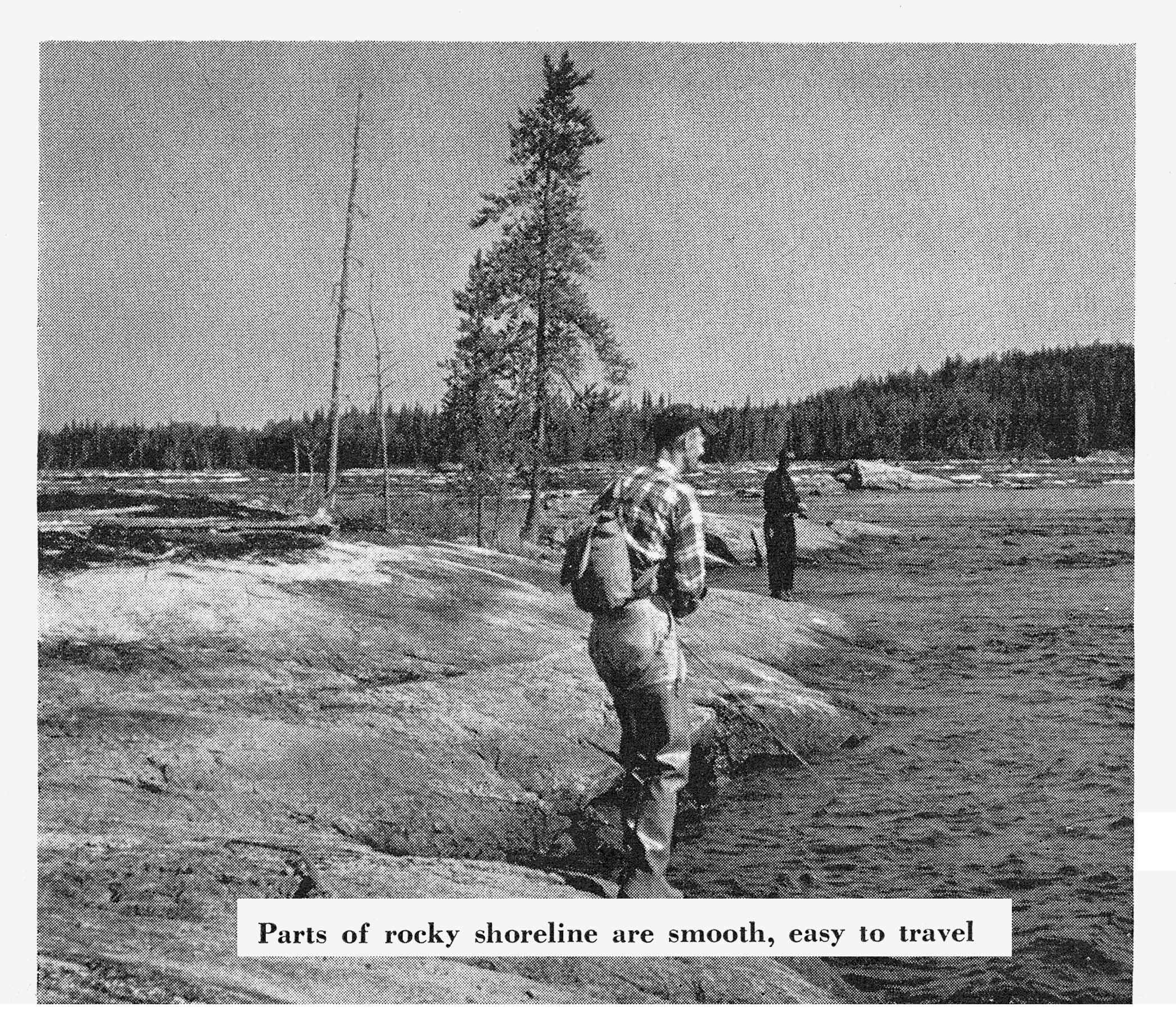
The shore now alternated between open sandy or rocky beaches and jumbled boulders ranging from a foot to many feet in diameter. Rock hopping became the order of the day, requiring strict attention to business, as this was no place to break a leg.
We came on a stretch where the river ran fast and deep along a rock shelf before dropping over a series of chutes and falls. This turned out to be one of the real hotspots for large trout. Here, in a distance of 100 yards or so, we took and released many fish weighing four to five pounds. Sometimes as many as three of us had a fish on at the same time. They readily hit hardware lures, and when these palled a fly intrigued them.
We tried the other side of the rapids the following day, and in half a mile or so we caught and released 150 trout of the type the average angler would give his right arm to catch. There was a series of chutes, pools, exposed boulders, and small cascades in which vividly colored brook trout vied with each other to hit our lures.
A surprise awaited us back at camp that afternoon. The marks of two canoes showed in the sand, and footprints of barefoot children proclaimed we’d been visited by Cree neighbors. As was to be expected of these people, nothing had been disturbed. Brian had predicted that any Cree in the area would see our planes come in and visit us in a day or so. Our visitors never returned.
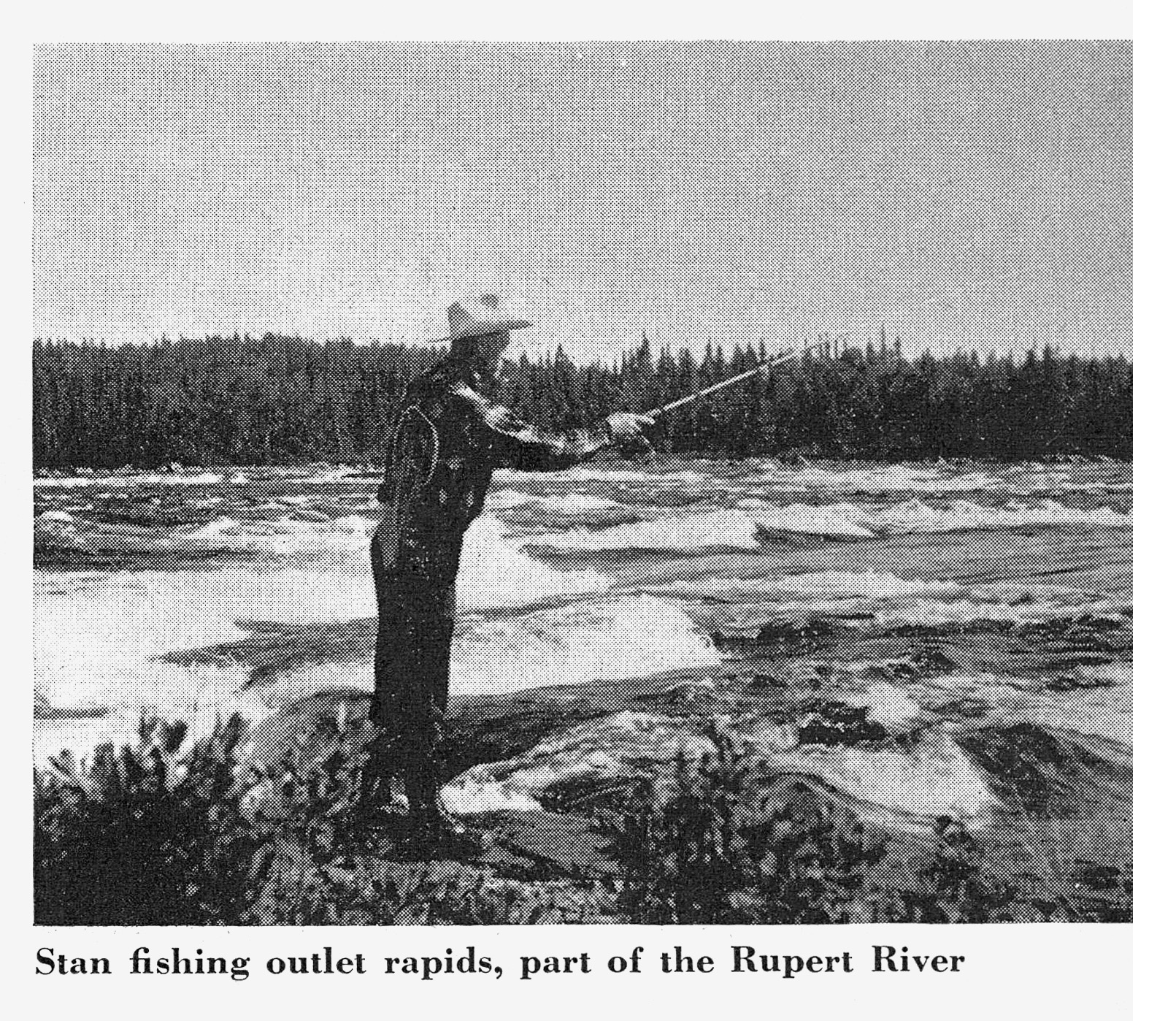
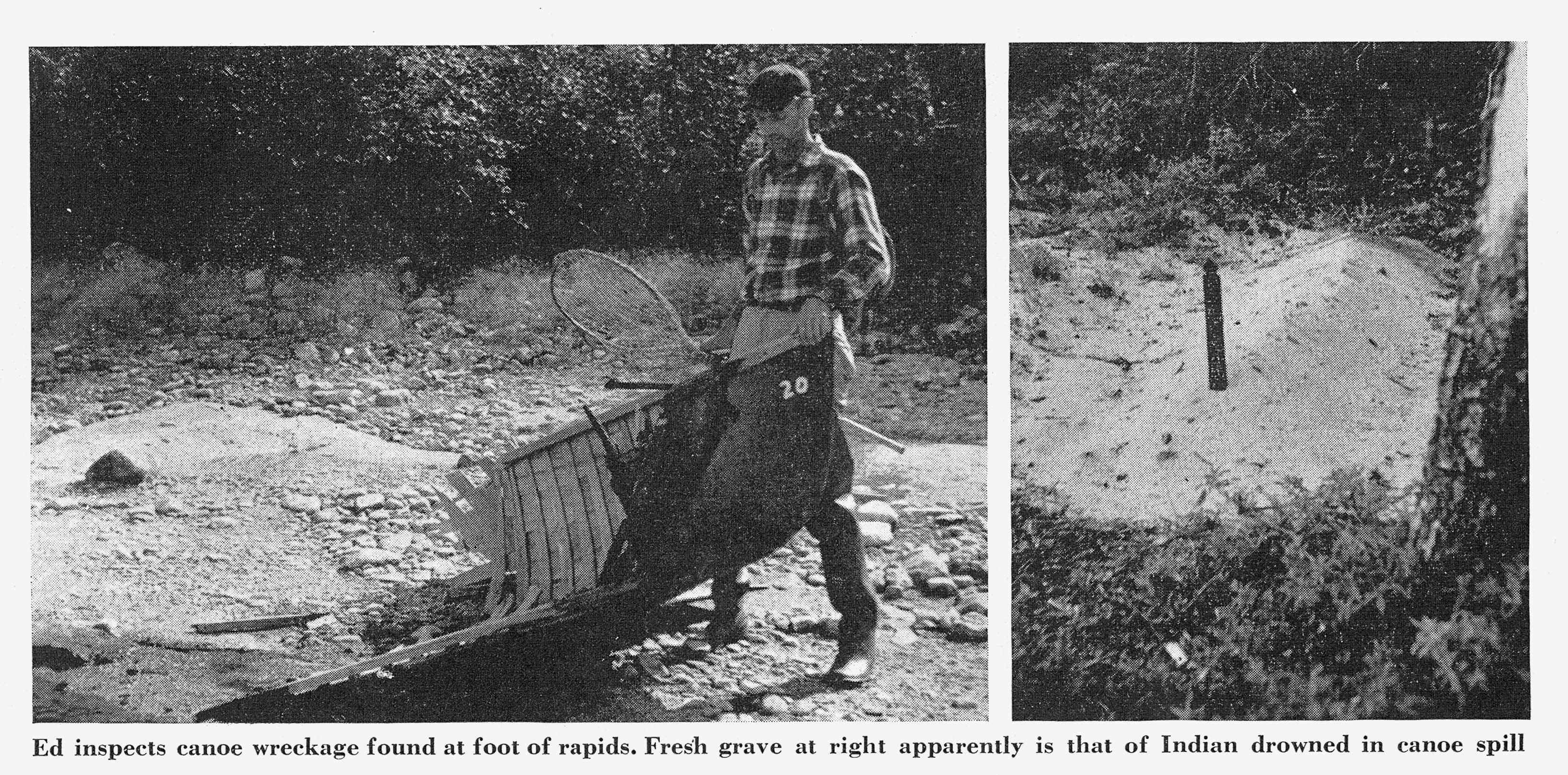
Subsequent hikes farther down the lake outlet brought us to a truly spectacular section of high cliffs overlooking the river where it plunged some 20 feet over a double fall. Below this, where the water flattened out in an area of many exposed boulders, trout up to five pounds lurked among the rocks. In a little cove below the falls, five feet of smashed canvas and wood testified to the fate of the canoe that had dumped.
That night we called Paul at Cache Lake and reported finding the wrecked canoe. He told us this was probably the wreckage from a canoe accident two months before in which two Cree were drowned. Only one body had been recovered. The message we’d seen scratched on the milk tin upriver no doubt referred to this wilderness tragedy. The following day, while exploring near the east end of Lake Mesgouez, we came on a fresh grave at an Indian campsite. A hand carved and painted marker stood at one end. Possibly this was the grave of one of the canoe victims.
A large expanse of deep water in the eastern part of the lake looked like the place to troll for lake trout, but we didn’t have time to properly test it. Our subsequent efforts to locate these gray fighters in other parts of the lake bore no fruit. It did appear that good-size brookies were widely distributed through the lake. We saw one of six pounds or more coming clear out of the water after insects in a stretch of current between two islands at a point about 12 miles east of our camp. He ignored our lures.
On Sunday, a rainy day, we decided to take it easy. After a leisurely breakfast we putted down to the outlet. While Stan and Bud fished the shore, Ed and I sat in a canoe casting into the tail of the current. We’d been doing this for some time when we noticed our two mates in deep conference. We pulled over and could see Stan shaking his head while Bud looked glum.
“Bud had a prize brookie on,” Stan said. “Got away.”
“I got him up along the ledge here,” Bud said. “His tail was on that crack there and his head on that other one.” He motioned toward the place in the ledge where there were two cracks about three feet apart. Guesswork put the weight of the lost fish at close to 10 pounds.
Bud had the whopper hooked with one hook of a treble behind a small gold spoon. He’d played it for about 20 minutes and worked it up along the ledge. When Bud reached for his net behind him, the trout got its tail on the rock and threw the hook.
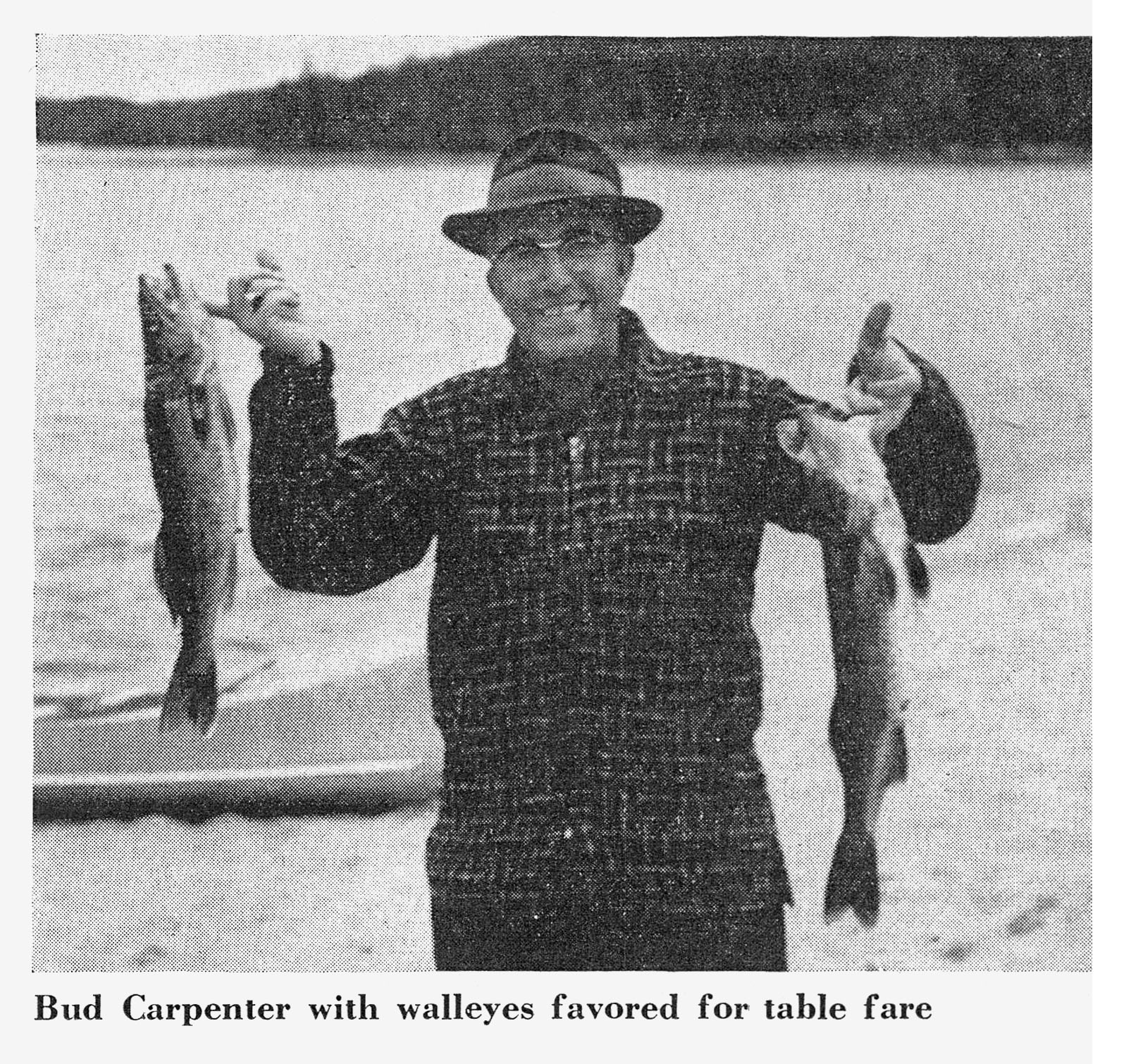
During the second week of our stay there was a noticeable slackening of interest on the part of the fish. We could often look down and see good trout which would indifferently follow a lure and then break off. Stan got to be quite expert at dredging up large walleyes from a couple of deep holes. Some of these went six pounds, and they provided excellent table fare. We also tried the northerns for eating and found them very good. Bud cast to what he thought was a big trout one day and broke his rod tip on a 12-pound pike.
These were bright, clear autumn days and the water was low. There were no flies or mosquitoes. Although the fish are concentrated in the rapids at such times, there were periods when they wouldn’t hit.
Our campsite proved to be an excellent choice. The sandy point, swept by a breeze most of the time, was ideal for beaching the canoes. Firewood was plentiful. On hot days the beach was fine for sun bathing after a quick dip in the bracing water. We had brought in some sections of hardboard and a bundle of furring slats from which we constructed a very serviceable table and benches. Bud’s meals were super. In the evenings we were treated to sensational auroral displays. We listened with interest to the chatter on the radio from other camps. One mining camp seemed to be living mainly on T-bone steaks and shrimps, judging from the grocery lists they called in.
The auroral activity apparently caused some magnetic disturbances in the atmosphere, so that for three days we were almost blacked out on the radio. When we got through, we asked them to send the planes at 9:30 the next day, Saturday.
The weather was poor next morning and our radio call confirmed it would probably be early afternoon before we could expect the planes. The first one arrived at 2:30 and the pilot said he wasn’t too sure the other one would make it. Stan and Bud departed and Ed and I began to resign ourselves to putting up the tent again. We were starting to sort the gear when Brian came roaring in at treetop level.
“Get that stuff in the plane and let’s get out of here,” he greeted us. “She’s really socking in.”
Looking back, it was a wonderful trip. Good companions, good country, good fishing. We had caught and released several hundred trout, many of prize proportions. Except for a couple we ate, they’re all still there. We brought none out.
This virtually untapped area of virgin wilderness is but a few hours away by air and readily accessible to a major portion of the U.S. population. A number of first-rate flying services operate throughout this eastern Canadian bush country. The rate for a Beaver is 65¢ a mile. You have to pay about $10 extra to have your canoe flown in. A Beaver float plane, work horse of the north, lugs a 1,500-pound pay load. No special lightweight camping equipment is needed. Air services will gladly help you plan a trip or refer you to a reliable outfitter. Their safety records are excellent.
If you don’t care to be your own outfitter, the Quebec government runs fine fishing camps on Lake Mistassini, a tremendous producer of brookies up to eight pounds or more, lakers to 50-odd pounds and big northerns. There are a number of private outfitters working out of Chibougamau and vicinity who run established camps or will take parties into virgin territory. Lake Assinica in the Broadback headwaters has attracted world-wide attention for its giant squaretails the past two years. Other nearby waters, such as the Temiscamie River (northeast of Mistassini) and Lake Albanel are known to contain trophy brook trout. The roads to this region are macadam as far as St. Felicien and good gravel above there.
The cost of our 17-day trip was under $250 per man, two thirds of which was for flying. You could cut this last item in half and still reach a lot of good spots.
And remember, there are numerous authentic stories up that way of brook trout and lakers taken by Cree, which in all probability exceeded official rod-and-reel records for these species. All you have to do is go and get them.