
This story, “Stinky Creek,” appeared in the December 1954 issue of Outdoor Life.
“Think I can put you up to grizzly, moose, and plenty of goat. After that, you take it. Can’t guarantee trophies, but most of my clients come out satisfied,” wrote Bert Dalglish, of Hazelmere, Alberta.
That was good enough for Mac and Ede McCormick, my wife Ethie, and me. A fair chance at those animals was all we asked.
A hunting trip to Canada is a hoop we don’t jump through every day. We started showing up at our Redlands, California, rifle range to shoot the 200 and 300-yard targets and the running deer. Ede had miniature goat silhouettes pinned up in her garden. She kept her rifle handy to dry-shoot them while waiting for her cakes to bake. She was as cheery as a robin. Her first hunt, but she made up in zing what she lacked in know-how.
Mac was a sober-faced, meticulous customer, as much at home forking a nag and palming up a rifle as getting outside a stack of pancakes. He mothered two horses in a corral back of his house, graining and haying them each day as lovingly as you’d bathe a baby. If he was late for a date, he’d give as an excuse, “I had to feed and bed down, first, didn’t I?”
My wife Ethie could slam back the bolt of her rifle as fast as the bobbin on her sewing machine, but she hadn’t grown up in the saddle like the McCormick pair. She thought horses had automatic transmissions like a car. One day, toughening up for the trip, she mounted a high-voltage Tennessee walker. He coiled up like a spring and sailed Ethie, mouth open, into a tree.
“Couldn’t the big dope see I was only trying to get a leg up?” she snapped.
In two cars heavy with saddles, we quit Redlands in the early-morning dark and drove north through Banff, Jasper, and Edmonton to Grande Prairie, Alberta. Bert Dalglish met us at a cracker-box hotel smothered behind a high, yellow, false front.
Bert was medium short, mild-spoken, and husky. “Pleased to meet you folks,” he drawled. “My four Indian guides’ll take good care of you. I’m the cook. A happy hunt depends as much on what goes into your stomach as what you shoot. Bought new tents and stoves just for this trip. Want everything right.”
Leaving Grande Prairie, we poked along over chuckholes, overnighted at Beaverlodge, and turned in by the mailbox at Bert’s Hazelmere ranch a day later.
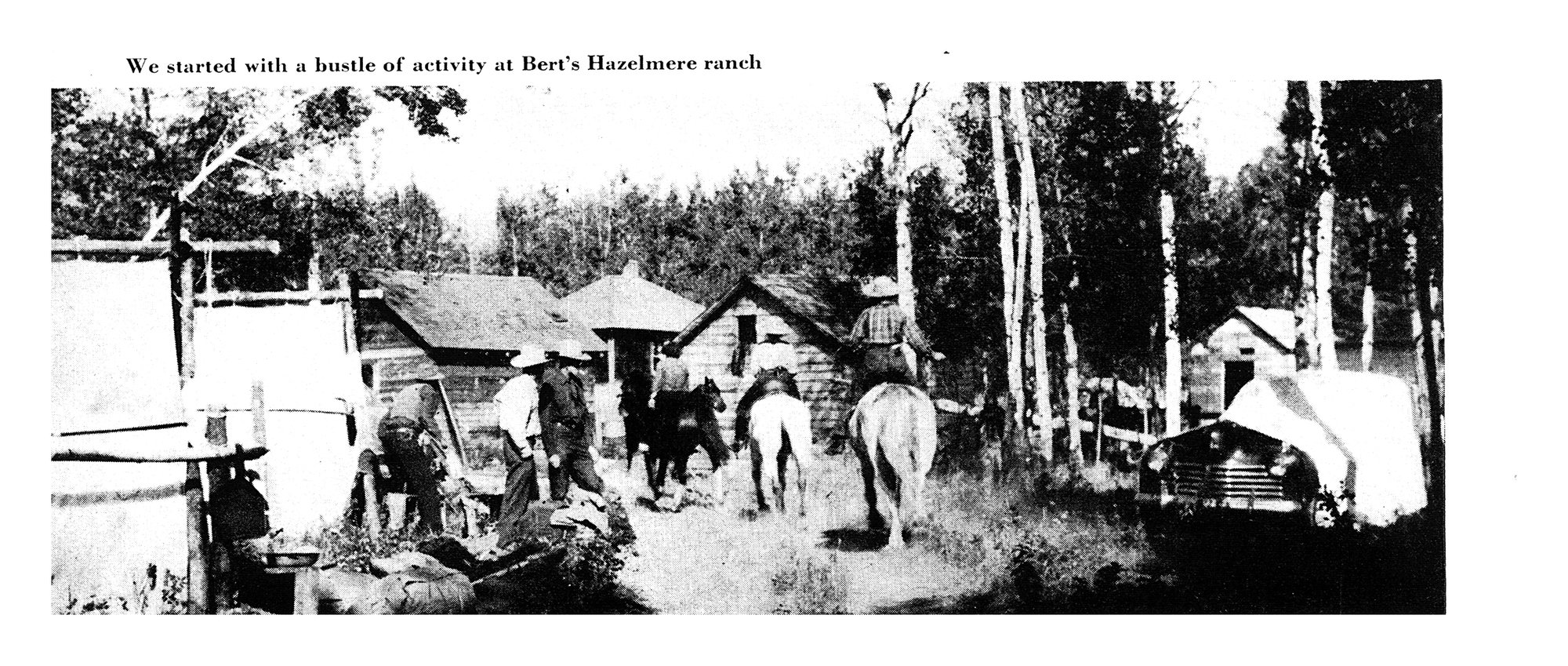
Pitched on both sides of a shady lane were the gleaming new tents. We stopped in front of the saddle rack. Cases of canned stuff, bags of flour, sacks of potatoes, onions, boxes of oranges, grapefruit, tarps, bedrolls, camp chairs, rope, axes, saws, pots, pans, knives and forks, stoves — the myriad items that make a 28-horse pack trip a luxurious adventure were strewn on the grass.
“Don’t let this mess scare you,” Bert said. “It may not look as if we’ll be packed by tomorrow, but we will. It’s always like this at the start. Take the pick of tents. Leo and Steve will help unload.”
Mac nosed his car under the aspens. I backed mine against the icehouse. We opened the petcocks to drain the radiators. Leo ambled up, an enigmatic smile on his bronze face. He walked with a crouch, as if someone had just yanked a horse from under him.
I opened the rear of the car and pointed to four scabbarded rifles. “How long do we pack before we hunt?”
Leo gathered up the gun cases, breathing heavily, needle sharp eyes glancing upward. He thought a minute, then, as if he’d found the answer in the blue, he blurted, “Pack five days. Stinky Creek, hunt.” A black 10-gallon hat topping him like a beehive, he rocked after Ethie to the tents.
Steve, the guide assigned to Mac, was twice as tall as Leo, a mountain of muscle. He grabbed all of Mac’s duffle in a full arm clutch and strode off behind Ede.
In adjoining tents, the two feminine hunters chatted like newly wed wives setting up housekeeping. They blew up sleeping bags, took out clothes, and put cosmetic cases on spare pack boxes.
Our meals that night and the next morning — August 28 — were served in Bert’s red ranch house, cooked by Jean, his wife. If they were a sample of what Bert himself could do, we wouldn’t get jippy stomachs on this trip.
At 3 o’clock in the afternoon the guides started out with strings of haltered horses and we four hunters followed across grain fields and over the potholed highway until 6 p.m., when we pitched camp in a grove of quaking aspen. The packsaddles, bridles, and packs came by truck.
“Made it short today,” Bert said. “Have to get the knots out of you city folks before we get down to business.”
My legs did feel as numb as if they had been left in a freezer when I slid off Ruby, the roan Morgan mare with a white spot on her forehead. “You can’t get an argument out of me,” I said.
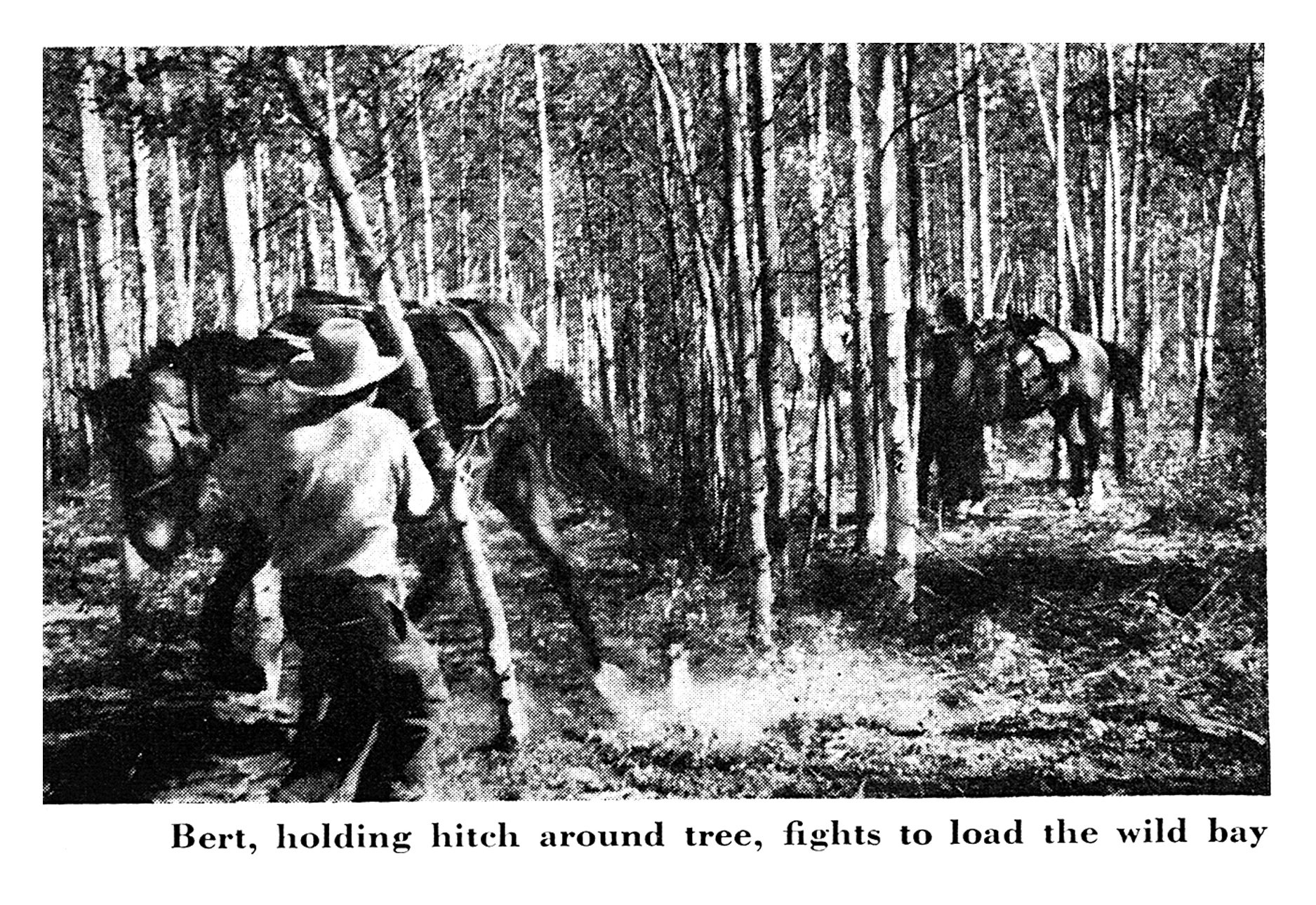
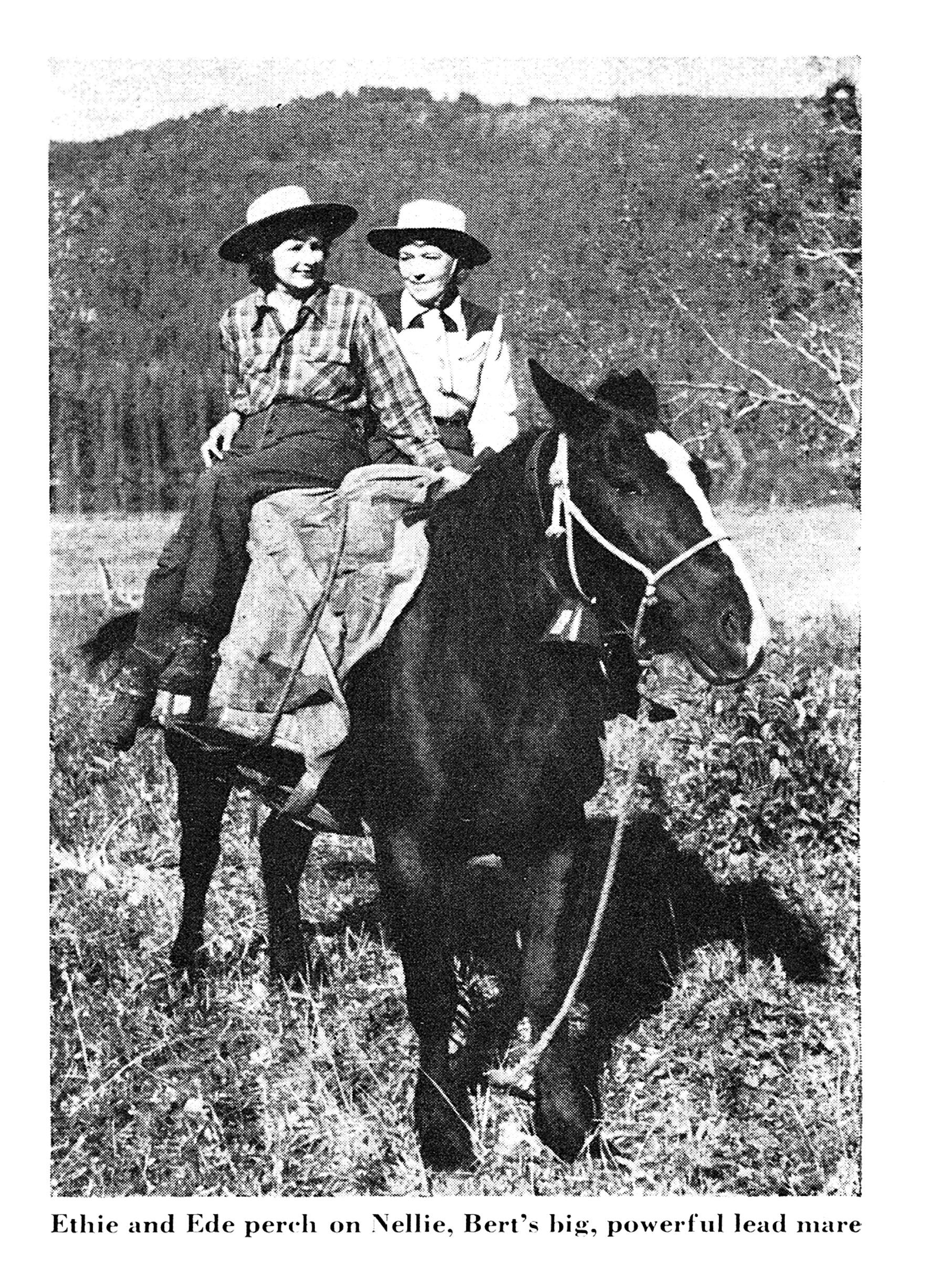
Next morning the aspen, sifted with dust, rang with the shouts of Bert and the guides. Horses sunfished, reared, and rolled on their backs. Except for huge black Nellie, the lead mare, these horses hadn’t been saddled for a year, and every animal in the bunch hated the feel of the cinch and the weight of the pack on its spine. Some broke halters and ran off to be roped again; others yanked against the spring of a sapling until they settled down. Bert had to blindfold and hog-tie. One wild bay, which had never felt a packsaddle, hoisted so much canned goods to the sky that Bert gave up, finally lashing the sheet-iron stoves on him. As it later developed, that wasn’t such a bright idea.
Finally, about noon, the long line of heavily packed, mountain-trained horses stepped nervously down an aspen-yellowed slope to the flat along the Wapiti River.
“May have trouble getting across,” Bert said, jogging up to me. “Had to rent some of these horses. Shortage. This bunch never traveled together before. Heavy packs’ll make ’em act their age in a day or so.” He gave his mare a dig. “If any of the danged cusses skip upriver, snub ’em back. Ruby’s a dandy round-up horse.”
“Y’bet.” But if I’d known what I was in for I wouldn’t have been so willing to take the job.
Ede, Mac, and Ethie walked their nags to the ford, slumped in saddles, and looked at the swift, shallow water.
Big Nellie stepped gingerly into the 300-yard-wide stream and glanced around. Not a horse followed her. Six were high-tailing it upriver along the scrubgrown bank. Another six galloped back toward Hazelmere as if wide open on a mile track. Still another big bunch streaked downriver.
I gave Ruby a jab in the belly and charged after the upriver bunch. I caught up with them, finally, and drove them back. Then I chased those legging it toward Hazelmere. After tailing them for a mile I shooed them back to the ford. By that time the first string had scooted upriver again.
But, like kids whose naughtiness has lost its fun, the three strings finally decided to be good and waded into the river behind Nellie. By that time we had lost two hours.
Ede, Mac, and Ethie urged their horses into the cold water, then the guides, Bert, and I. If Ruby had stumbled I would have pitched off and drowned happily, without a gurgle.
About halfway across, the wild horse packing the stoves slipped on the saucer-sized brown rocks and fell. Panicky from the rattling hardware, he splashed in a humping gallop to the opposite bank as if the water were boiling. Ede, Mac, Ethie, and I reached the muddy shore. Leo rode up.
“We go Two Lake trail,” he grunted. “Stinky Creek.” He kicked his pony up the steep grade, through towering yellow birch, hemlock, and spruce. Nellie and the wild horse followed, Bert staying behind with us.
Suddenly, as we were starting up the trail, we heard a boom like an avalanche. A twisting bay body with arched neck and flailing legs came tumbling down the mountain, banging from tree to tree like a marble in a pinball machine. It was the wild horse packing the stoves!
On top first was the horse, then the stoves. He rolled onto a soft spot and slid like a bear down a snowbank into a copse of aspens. Many trees paralleled the ground before growing upward. His neck wedged between one of them and the ground. The more the horse kicked and writhed, the tighter he jammed himself into the natural vise.
Bert shook his head, jumped off his mare, and walked to the aspen. The guides leaped from their ponies. Ede, Ethie, Mac, and I watched.
Steve stepped up to the kicking, hard-breathing horse, grabbed the head, and yanked. But it was like prying a turtle from its shell. Then Leo lassoed the jabbing legs and got a bight around a tree. But all four guides — yanking, jerking, and heaving for half an hour — could no more budge the wild bay than they could turn over the mountain.
Finally Bert yelled, “You’ll have to cut down the aspen.” Leo nodded. He stood at one side, Steve at the other, ducking the flying hoofs. Axes flashed in the sun, chips flew, and at last the crooked tree fell. The wild horse leaped up, stood a minute dazed, then trotted up behind Nellie.
The horses plodded up the grade and almost immediately another commotion started up ahead. Saplings bent, broke, rocks crashed, small stones showered down. Over all was the din of stoves!
The wild horse eventually piled into a spruce 50 yards to the right. Bert whirled his gray Stetson, leaped off his mare, ran and grabbed the halter.
“The ornery cuss can’t even stick on the trail. Take off those stoves,” he shouted, “or we’ll never get to Stinky Creek!”
Leo loosened the cinch. The stoves slid to the ground.
“Put ’em on Nellie,” Bert said. “She’ll have to carry double until this critter gets some sense.”
The horses staggered up the steep, rocky trail, through yellow birch, poplar, and hemlock. Then we plopped through a soupy meadow dim with fog. We pitched camp on Moose Creek at 9 p.m.
Ede piped up. “I’m not tired.”
I didn’t say anything. I was bushed. I could have hit the sack without taking off my hat.
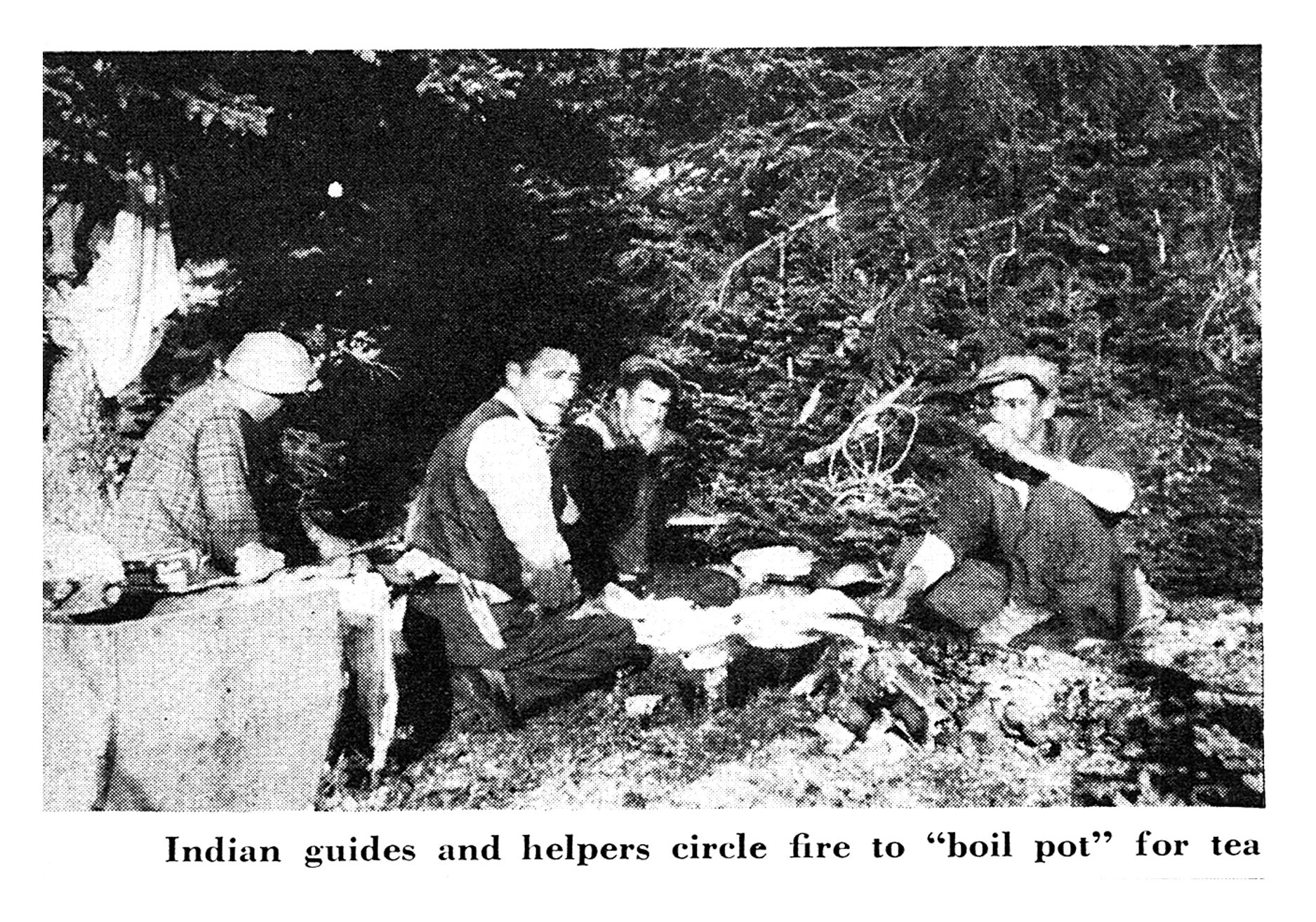
Next day we clumped past brick-red Indian paintbrush, wild rhubarb and blueberry bushes, through muskeg, and colonnades of hemlock as high as a church. Nellie packed the stoves without a murmur, the wild bay trotting beside her like a colt. At noon we gnawed ham sandwiches and drank canned milk in our saddles. The guides stopped a few minutes, late in the afternoon, to boil the pot for tea.
On one stretch of soggy muskeg, horses belly down, feet whooshing, I heard the rattle of stoves. Ethie was riding in front of me.
“What’s the matter now?” I called. “Nellie allergic to sheet iron too?”
“Look!” cried Ethie.
Nellie came charging out of the muskeg and into the hemlock, her pack flopping, stoves clanging like cymbals.
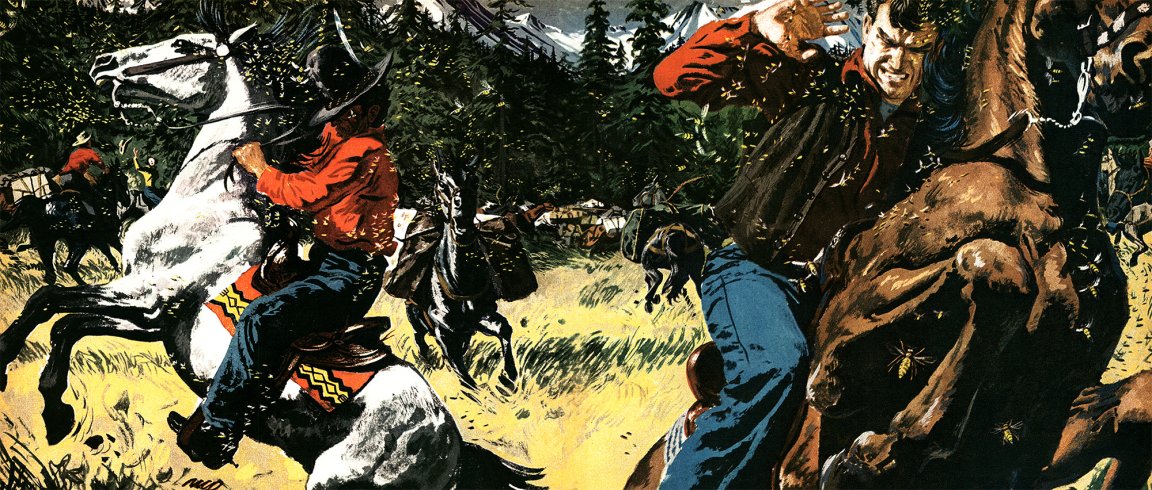
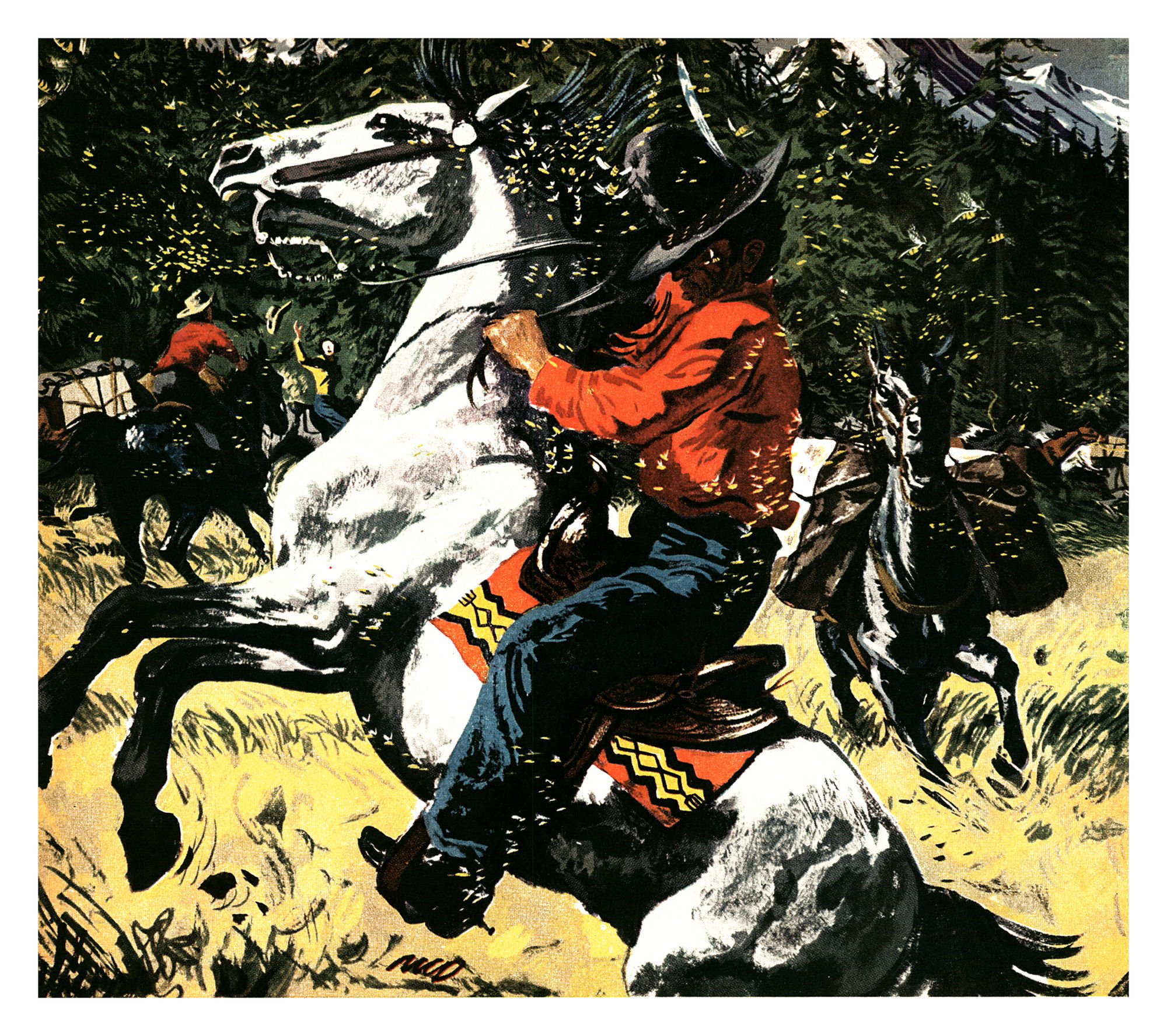
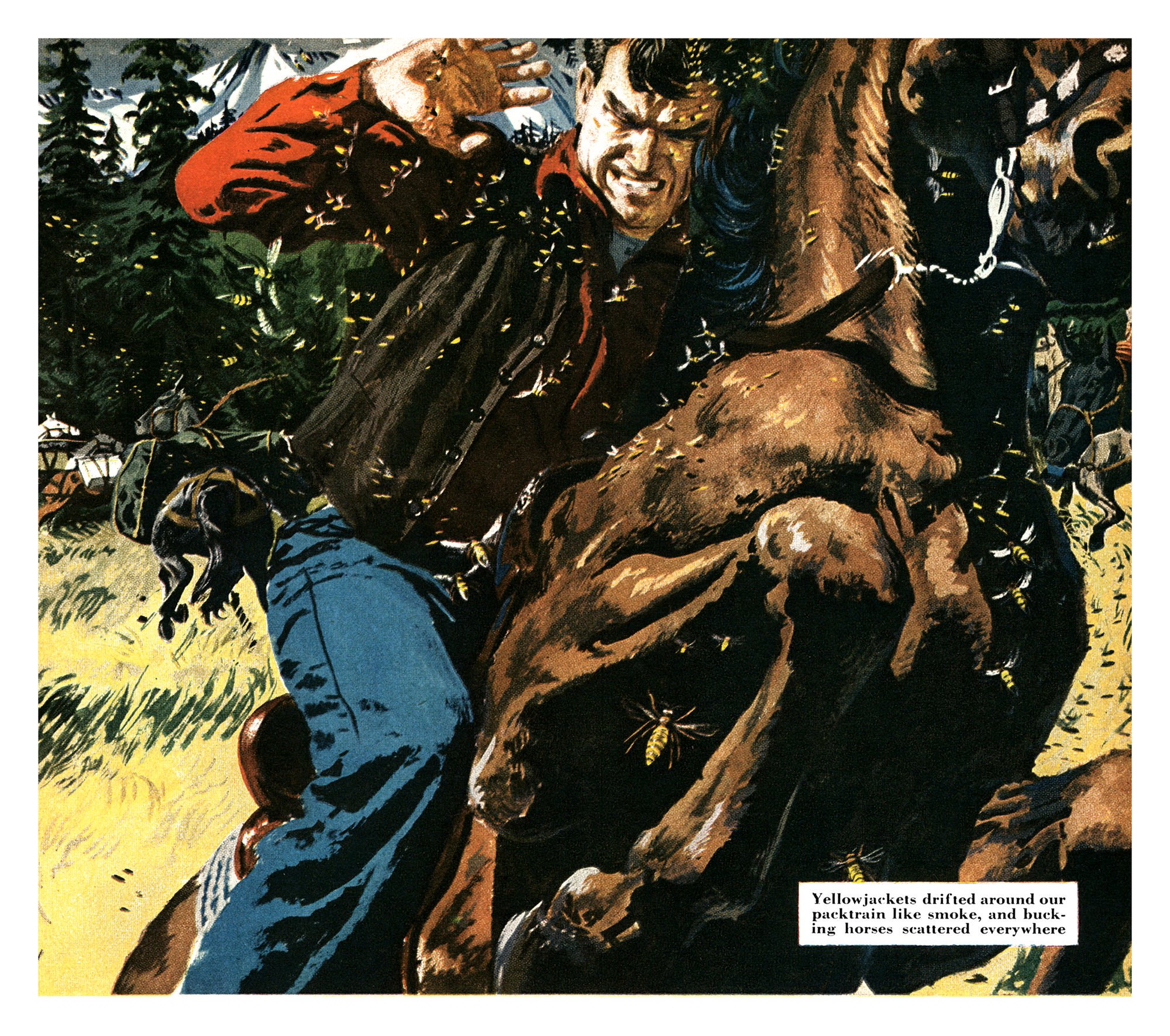
The number two horse plunged off the trail, and dived into the thick-needled branches. Bert whirled his Stetson like a buckaroo, his mare rearing. The guides’ ponies sunfished every which way. Mac’s horse likewise. Ede’s ran as if locoed.
Ethie cried, “Yellowjackets!”
Her rusty white took off like a polo pony, hightailing it for the trees to brush off the wasps burning its skin.
Then Ruby began to dance, feet stabbing, yellowjackets swarming about her like smoke. She sailed and skidded down a muddy hill in 20-foot leaps, jumped a stream at the bottom, and raced up the opposite bank. I stood in the stirrups and leaned on the reins, but I couldn’t hold her.
After those few frantic minutes, the yellowjackets quit the race. Ruby ran out of steam and stopped. I glanced around and spotted Bert. His face was sober.
“How d’you like yellowjackets?” he said. “I don’t,” I panted.
Bert nudged his mare. “The yellow devils sure can ambush a packtrain!”
Three days later, in the afternoon, my nostrils caught a strange odor. As our horses plodded from a spruce thicket to a brown-matted meadow, it got more pungent.
“What the devil?” I reined close to Bert.
He grinned, the big Stetson low on his forehead. “Stinky Creek.”
“You mean — ?” I couldn’t believe anybody would make a base camp here.
“Sure. Lots of game.” Bert cantered ahead.
As Ruby clumped ahead over the frost-burned grass, the smell grew worse. It smelled like hydrogen sulphide, carrion, and sewer gas blended into one.
“Whew!” I held my nose.
Ede sang, “Stinky Creek, here we come!”
Late that evening the smoky mess tent was filled with enough cooking smells to outdo Stinky Creek. We put down baked ham, mashed potatoes, dehydrated parsnips, bannock, and stewed peaches, all cheffed by Bert.
Afterward, in our tent, I said to Ethie, “How do you like Stinky Creek?”
“It’s beautiful,” she bubbled. “Little meadow surrounded by peaks. And the leaves all beginning to turn — ”
I shook my head. “But doesn’t that sulphur smell get you?”
“Bert says it’s just the natural smell of sulphur springs, and when the wind changes we won’t notice it.”
Mac and I were the dragtails on this hunt, I decided. Grumbling about cold water swimming. Kicking about smells. Ede and Ethie thought everything was fine.
On opening day of the hunting season the four of us were in the saddle by 7 a.m. and hit the timber with the guides. Bert stayed behind to slick up camp.
For two hours we climbed, heavy green branches lashing our faces and clouting our knees. On a slope beside the trail, a silver fox lifted a front paw daintily, stared, trotted on.
We climbed to 7,000 feet. Wind whistled across the slippery, grassy mountain. A deep gully lay between us and a burn, starting to grow new shoots. We got off our horses and began to eat lunch.
Suddenly Steve, Mac’s guide, hissed, “Grizzly.”
I focused my binoculars and felt my jaw stiffen. A young grizzly was digging roots, zigzagging toward us.
“Yours, Mac. Go collect him.” I whispered.
Whether he thought it was too much work to shinny down the 500-foot gully, or that there would be plenty more grizzlies, or that he should be a gentleman and let Ethie and me have first blood, I will never know. Anyway, Mac said: “You and Ethie knock him over.”
I didn’t argue. Perhaps I wasn’t so much of a gentleman. Anyway, there wasn’t time for a pow-wow. “Okay,” I said.
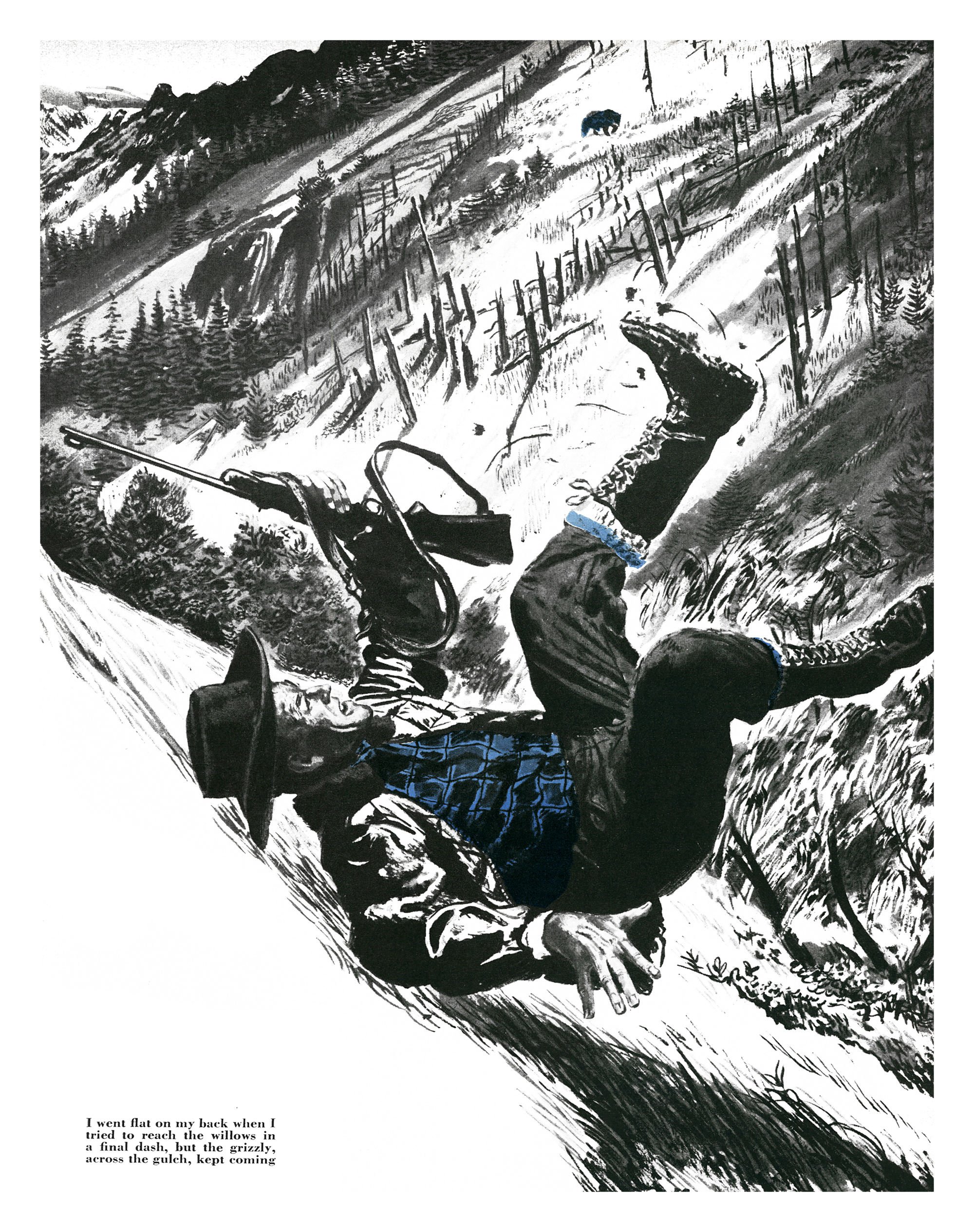
Ethie’s .30/06, and my .300 Winchester were on the ground beside us. We picked them up and pussied down the vertical slope, heels digging so as not to fall into the gulch.
Halfway down I began to sweat. I opened my jacket and began to slip it off. Underneath was a red-and-black wool shirt. Leo scowled. “Bear no like red. Keep on coat.”
I started to grumble, but changed my mind. I steamed, skidded, clutched short grass to keep from falling, stumbled again. With one eye on the bear, I saw he was still rooting, head down, working slowly toward us. I forgot Ethie and Leo. Near the bottom of the gulch I spotted a clump of scrub willows, headed for it, and fell on my back, rifle in the air. I picked myself up, finally, and shouldered into the leaves. Then I remembered Ethie. Somehow I knew that she was on the other side of the willows.
I later learned that she was there, watching me through the screening leaves and wondering if I was waiting for her to shoot. But I couldn’t see her and had no way of guessing her intentions without reading her mind, which I never do.
Still watching the bear, I got in my sling and scrunched back on my heels. I didn’t want to slide on down into the gulch when my rifle recoiled.
Leo squatted beside me. “No be nervous,” he whispered.
He was only trying to help. But I could have bit him. If he hadn’t brought it up I wouldn’t have remembered. Again I jabbed in my heels, tightened my sling, settled my seat.
The grizzly was still head down, rooting, a small target through the Lyman 48 peep. He edged toward us, each minute growing larger. My finger reached for the trigger, took up two thirds of the pull. Why wait?
But the longer I waited, the easier the grizzly would be to hit. Sweating like a wrestler, I sucked in a lungfull of air. I couldn’t hold off too long. The wind might shift. But I waited. The grizzly came closer — step, step, step, each one enlarging him in the peep ring.
I was gripping my rifle like a sledge. “Easy now,” I told myself. I felt the firm pull of the sling, felt my heels solid on the grass, my elbows hugging my shins, the stock smooth against my cheek. I pressed the trigger. At almost the same instant, Ethie’s rifle roared.
The grizzly jumped and ran. I fired again and the bounding bear shuddered and ran on. Had I shot over him, under him? No dirt had kicked up. I steadied the front sight and squeezed again. I barely heard the boom. The grizzly hit the burn like a sack of potatoes heaved from a truck.
Leo half slid, half tumbled into the gulch, Ethie and her guide appeared behind him. I tore out of the sling and followed.
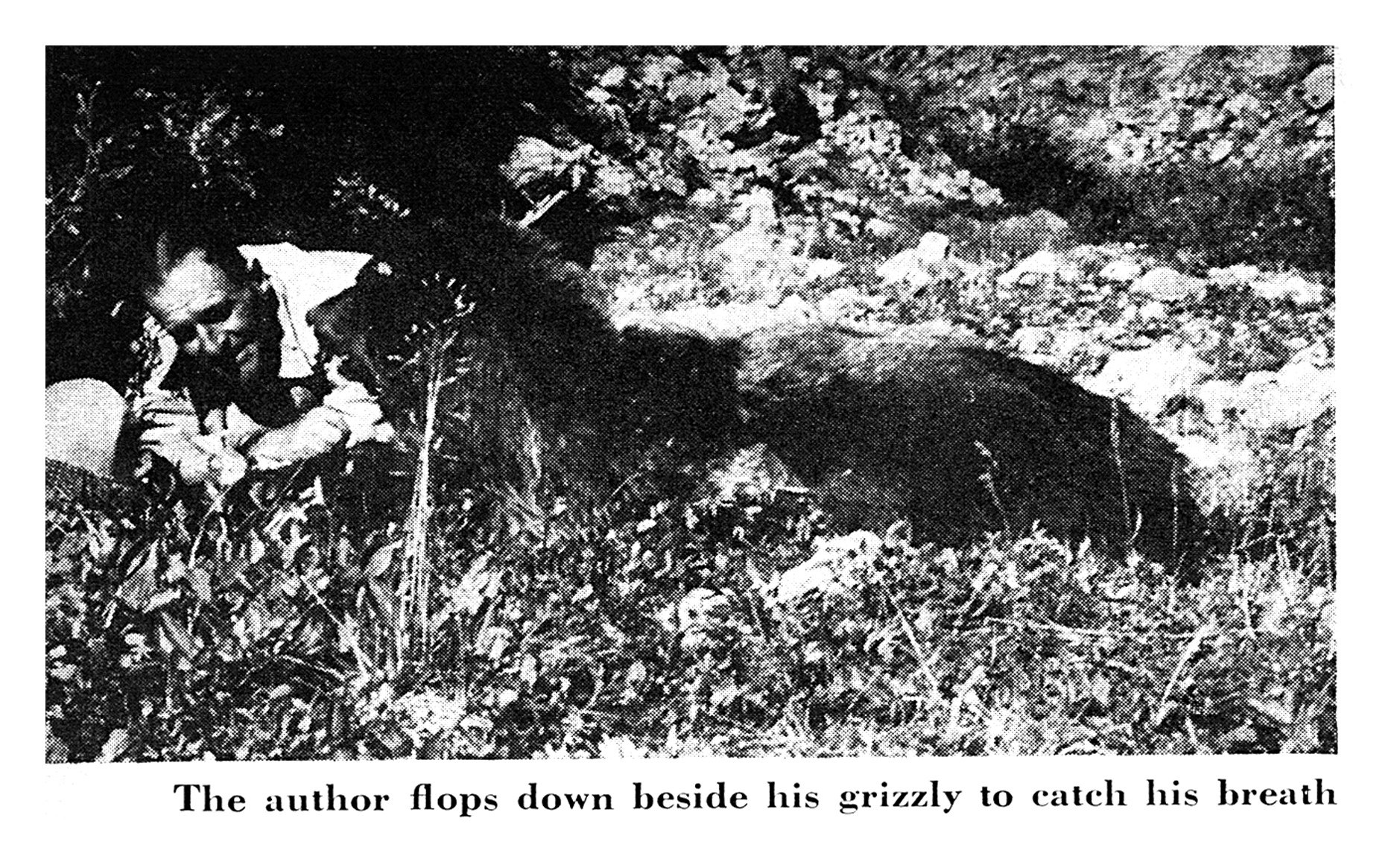
When I got to the burn, Leo, grinning, was holding the grizzly’s head, smoothing the velvety fur.
The sharp-toothed mouth opened. Snapped shut.
“My golly!” Leo grunted. “Dat bear no dead yet!” But that was its last move.
That evening, Ede said to me, “You’ve got a grizzly already. Now what do you think of Stinky Creek?”
“I can still smell it.”
A few mornings later clouds of black mist hung tent-high. The air was damp in our nostrils. Nobody was hankering to go hunting, but Leo put the finger on me at breakfast.
“Heap good for moose,” he grunted. “Take poncho.”
He saddled Ruby, and we headed for a burn grown with hemlock saplings and crisscrossed with fallen timber. At noon Leo boiled the kettle. We washed down sandwiches with tea, then prowled the burn again. It began to rain, a drizzle at first, then with buckets of water pouring down.
My seat was sore. My boots and hat were as soaked as if I’d spent the morning in the creek. The cold rain stung like hard-flung shingle nails.
About midafternoon, Leo pulled up beside me. “Moose,” he whispered.
I stared through the slanting sheet of water. At first I could spot nothing. Then I caught the flash of palms in a point of hemlock about 300 yards away.
Scrambling off Ruby into the tall, sopping grass, I threw back my poncho and slid the .300 from the scabbard.
“Some way to get closer?” I glanced at Leo. “I can’t hit him from here.”
“No. Wind bad.”
I couldn’t pick up the moose’s black body, but I could the long nose and palms. I wanted a good moose. But it seemed like a waste of ammunition to try to hit this one in the beating rain. I shook my head.
Leo scowled. “Can hit,” he said. No use to fight with the guide. Finally I nodded. At that distance, the moose’s nose, half hidden by hemlock branches, looked about as wide as a one-inch board. I knew about where to hold, but how was I to shoot? Not prone. Saplings were in the way, and the grass.

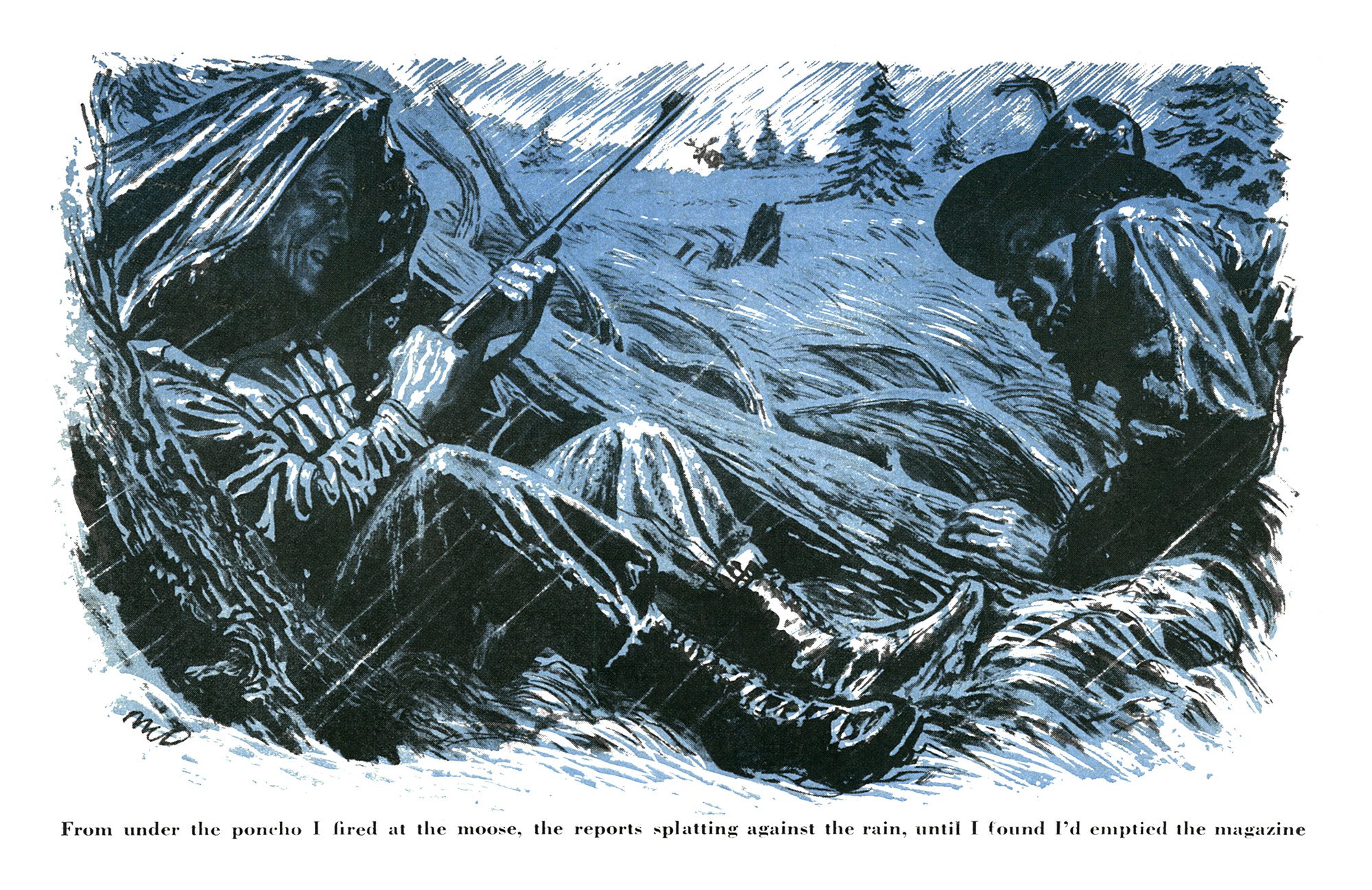
I sat down in the mud. Under the poncho, I slipped my arm into the sling, stuck my heels into the ooze, ran my elbows below my knees, and tried to pick up that black head in the Lyman 48. It blurred. I wiped out the ring with my handkerchief, slipped off the safety, and sucked in a deep breath.
The rifle report sounded dead in the rain. The moose didn’t budge. Then, the stock cold against my face, trigger finger oily wet, and water dripping from my hat, I fired some more.
The moose’s head was as still as if mounted on a wall.
“What’s the matter?” I yelled to Leo through the storm.
“Take heap killing.”
When I looked again the moose was broadside, head and shoulders out of the thicket. Now I had something to aim at. But I tightened up more than a kid who had never shot a gun. A thin icy tremor chased up my arms, down my legs, and into my soggy feet. My feet slipped, the sling bound, the poncho slapped my face. I jerked the trigger.
No noise. I opened the bolt. The magazine was empty. I tried to reach more shells but, tangled in the poncho and tight in the sling, I couldn’t get them from my pocket. Leo dug them out.
Three more times I triggered off shots. In the rain the noise sounded like hitting a frog in the belly.
The moose vanished then and Leo waved his arm at me. “Come.”
We got to the outer rim of the thicket and Leo plunged in. I followed him, like a deflated balloon in the dripping poncho. In a few yards he stopped. A big grin warmed his wet face. There, huge, black, and lying dead as a dinosaur, was the moose.
When we rode into camp in the dark, Leo told everybody about it.
Ede said, “Now what do you think of Stinky Creek?”
“Doesn’t smell quite so bad.” I kissed the white spot on Ruby’s nose. She was bushed from crawling over so much fallen timber.
For days it rained, smothered the tents in fog. Then it snowed. We hunted from early morning until dark. Bert had a real job, feeding the four of us and the four guides. They had set up a lean-to close by, refusing to sleep in the new wall tent Bert had brought for them.
One morning Ede said, “I want to shoot something. I’m tired of just hunting and not seeing anything. I want that goat. Need the head for our breakfast nook.”
Leo grinned. “We get um.”
So that day we hunted the mountain amphitheaters, the guides glassing slopes, peaks, and ledges; the horse tied, or cropping grass; Mac and I arguing about rifles; Ede and Ethie dozing, stretched out in the sun.
After lunch Leo began to shake as if he’d seen a phantom. He swung around and pointed: “Goats!”
I looked along his arm. There were six of them gleaming, stark white against the black cliffs.
We rushed for horses, galloped to the foothills, yanked rifles from scabbards, each pocketed a box of shells. I stuck an extra box in Leo’s jacket. He strode ahead.
We clambered over big boulders, across slides, now and then a spot of grass. We were panting, slipping back, then hustling to catch up. I noticed that Steve and the other two guides hadn’t come with us, but I didn’t think much about it then.
At last we were as high as we could get. Leo stationed us 10 feet apart in line.
“Ready!” he commanded. We were a squad of G.I.’s. He pointed to a goat for each to shoot at. Mine was lying on a ledge above the others. “Shoot when drop hand,” Leo scowled.
It was too steep to shoot prone. So we squatted. We couldn’t lean forward because we had to shoot almost straight up. We hung our elbows in the air.
I tried to steady the .300 on the pinch of white 275 yards up the mountain. My arms wobbled. The barrel bobbed up, down, over, back, and then began again. I grinned. I could never hit that goat.
Leo dropped his hand.
I pressed the trigger, the gold bead well above the goat’s shoulder. The bullet kicked up a spit of dust. High.
Ede, Ethie, and Mac had fired their salvo at the same time.
My goat jumped up. Quickly I chambered another shell. I held a little lower, froze the bead for a split second, and pressed again.
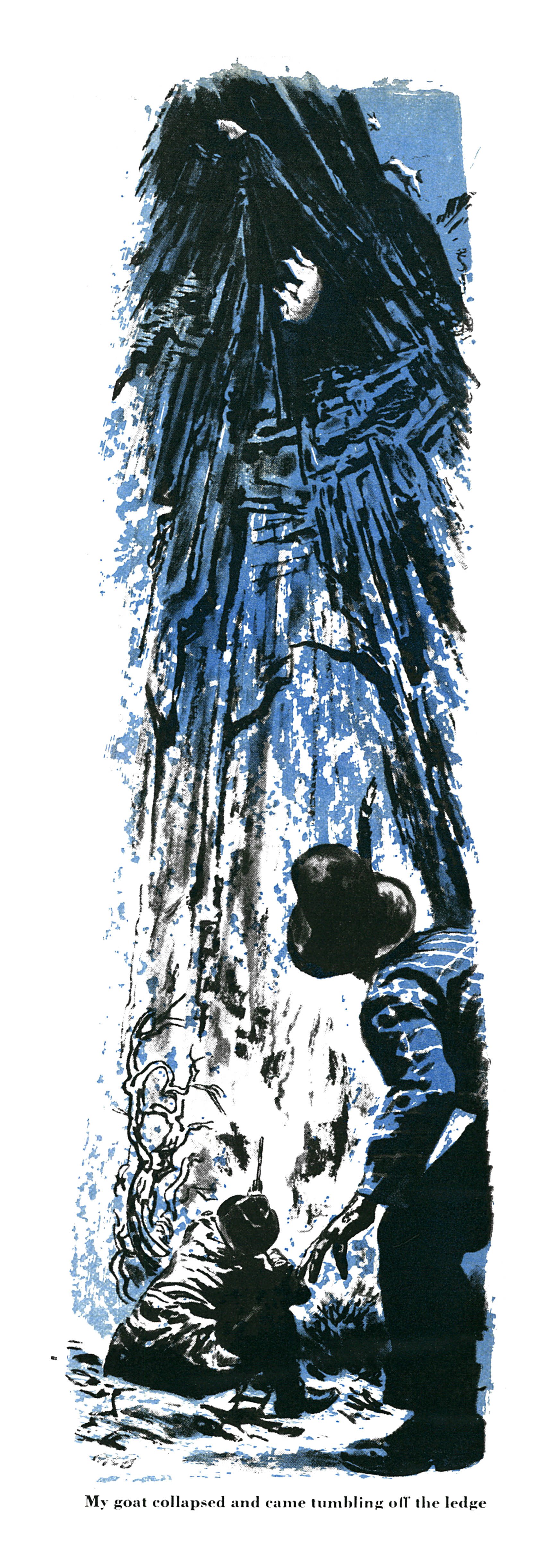
I didn’t really believe what I saw. Like a slow-motion picture the goat began to fall, somersaulting from the ledge, hitting horns, rump, horns; pitching, whirling, dropping from pinnacle to pinnacle.
The barrage on the left began again. Mac was ramming shells through his .30/06 Winchester fast. The barrel jumped. Ethie was shooting, fussing, grumbling, reaching for shells, aiming again. The goats ran along ledges, over rocks.
Ede was loading the magazine of her .30/06 Model 70, whipping back the bolt to shoot again.
Then the shooting stopped. The goats dodged behind a crag. Echoes died away in the mountains. Mac growled, “I shot 22 times. All misses. Didn’t think I could do it.”
Ede laughed so hard she almost fell over. From the empties beside her it looked as if she had a machine gun.
“What’s the matter with me?” Ethie moaned. “Lousy shooting.”
“Buck up,” I told them. “It was a mile to those goats. My shot was crazy luck.”
I headed toward the bottom of the cliff. If there was a nubbin of horn left on my billy I would eat my pants. But when I found him the sharp, curled-back rapiers were unscratched.
Leo was holding up his hand. “More goat,” he said. He pointed to a ridge less than 200 yards on the right in good shooting range. After all the racket I couldn’t believe that another herd would show up so soon, but I didn’t count on the guides’ ingenuity.
A long, white face peered over the ridge, then another and another. Then a dozen goats trotted down on our side, in single file — nannies, kids, billies.
Leo whispered, “Shoot.”
Mac’s Winchester barked. A goat, white against the lava chunks, dropped as if electrocuted.
Ethie blazed at a billy on the right, bullet bashing through it and blowing up on the shale. The billy pitched forward, got up and limped along the ridge.
Kneeling, Ede squinted and fired. Then she let her rifle fall and gasped. Her goat’s head was ruined by the shot.
Ede shut her eyes. “Don’t worry,” I soothed. “It’ll make a nice rug. Mac’s goat is all in one piece. One head is as good as two.”
Mac raced up for his trophy. Ethie leaped over the rocks, finished off her billy, and yelled for Leo to come and skin it.
Then the mystery of the reappearing goats was solved. The three missing guides came out on top of the ridge. They had climbed up from the other side and driven the goats toward us.
That evening, after a meal of young goat, Mac, Ede, Ethie, Bert, and the guides stood outside the mess tent watching the northern lights. It was a picture to rave about. Fiery streamers poured down the inverted bowl of sky like red-hot lava.
Read Next: My Greatest Day in 30 Years of Guiding Backcountry Hunts
Ede said to me, “Now what do you think of Stinky Creek? You got a grizzly. A moose. We all got goats, even if I did shoot the head off mine. And now — fireworks. What more do you want?”
“I love Stinky Creek,” I said. “Flows with milk and honey. I could stay here the rest of my life.”