
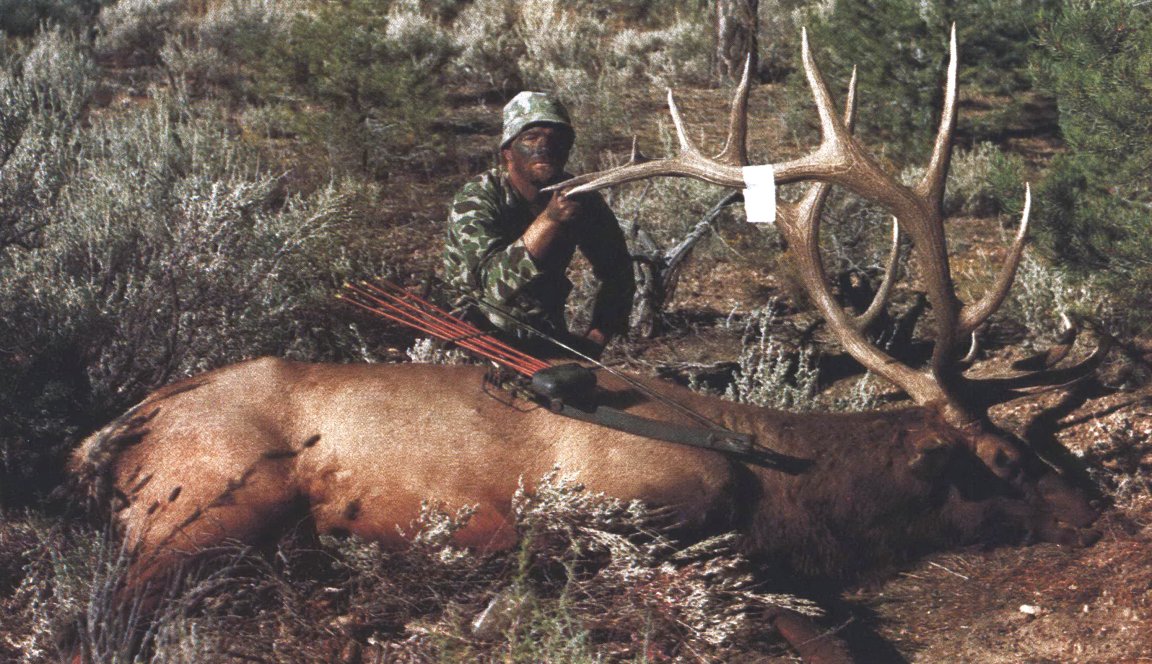
This story about bowhunter Jay Elmer was originally published in the November 1981 issue of Outdoor Life.
Many hunters dream of taking a world-record animal, but for most of us it remains just that—a dream. For Jay Elmer, the dream came true—twice!
Taking one record animal may be no big deal. Anyone can get lucky once. But two times? And in consecutive years? That’s what Jay Elmer did. In 1979, hunting with bow and arrow, he killed a bull elk larger than the world record at that time. Before that animal could be recognized officially, Jay returned to the field in 1980 and took an even larger bull.
Lucky? No, he’d planned for those animals and drew on skills from a lifetime of hunting to get them. Maybe the story of Jay Elmer’s two for the record will help you plan for a dream come true.
Hunting has been a way of life for Jay, the oldest of 14 children. At 5 years of age, he began hunting with his dad, but before long he was hunting on his own. First for rabbits and squirrels, then for deer. In the eighth grade Jay bought his first rifle and that year killed a deer with it.
“In high school I didn’t do the things most guys do,” says the soft-spoken Elmer, now 36. “I ran around with guys 10 years older than me. Instead of going to dances and running around town, we were always off hunting.”
Jay grew up near Sedona, Arizona, at the mouth of spectacular Oak Creek Canyon, 30 miles south of Flagstaff. Today he owns a plumbing business in Sedona. Over the years he killed deer, antelope, elk, and bear. For a 10-year period Jay filled almost every tag he got, often with trophy-class animals. As his success grew, hunting seemed to lose some of its zest.
“I still loved to get out, but I had to put the challenge back into it,” Jay said. “So in 1974 I started bowhunting. With a bow you have to get close. It puts a real thrill and challenge into hunting.”
While scouting that first year, two weeks before the season, Jay and his brother Bill saw three large bulls.
“I kind of had my heart set on one of those bulls,” Jay said. “On opening morning I had 13 bulls in one bunch parade right in front of me. But all were spikes and two-points. It was tempting, believe me, but just killing an elk wasn’t all important. So I controlled myself. I wanted one of those big bulls, but I never saw them again.”
Not until his third year of bowhunting did Jay finally score. In 1976 he killed a bull that scored 351, at that time good enough for 11th place in the Pope and Young bowhunting records.
For those unfamiliar with scoring, antler measurements are the basis for record-book placement, and they’re a good way to judge the comparative size of animals in the field. Most hunters will never see a bull that will score 351. The average five-point measures about 200, the average six-point between 250 and 275. Most hunters would consider anything over 300 to be huge. Minimum score to make the Pope and Young archery book is 240. The Boone and Crockett minimum is 375.
From then on, Jay decided, he’d take nothing smaller than his first bull. That meant looking for an area with bigger bulls and fewer hunters. Localities with the most elk don’t necessarily have the biggest bulls. Trophy bulls often stay in isolated pockets where cover and terrain give them the needed protection to grow old.
Jay found such a spot near Flagstaff. At best it was marginal elk country. It looked so bad that no other bowhunters had touched it. The junipers and jack pine were thick enough to choke a snake. It was dry and hot. During his first year of scouting there in 1976, Jay didn’t see one elk. The second year he scouted and hunted the whole season and saw a single cow.
But he stuck with it. He wasn’t after just any elk. He wanted a big one, and based on sign, he knew at least one lived there. Big tracks told him that, but Jay looks for something else, too.
“A big bull’s front hooves are larger than the rear hooves,” he claims. “As the animal walks along, you can see the rear tracks outlined inside the front tracks. I don’t know why the front hooves are bigger. Maybe a trophy bull needs extra support for his heavy rack.”
Rubs, where this particular bull had shredded trees with his antlers, also impressed Jay.
“I held my arms straight over my head, and the rubs still reached several feet above my fingertips,” Jay said, his voice quivering with excitement. Jay is about six feet tall, so he can reach close to eight feet high.
“Then there was the pine branch three inches in diameter and ten feet long. It was lying thirty yards from the nearest pine tree. You just know it took one tremendous bull to tear it off and throw it that far.”
Finally, late in the first day of the 16-day season in 1978, Jay saw his first bull in the new area. He had a good shot at the giant animal, but his arrow glanced off a branch “just as a bullet might.”
Still Jay didn’t give up. In such dry country elk use water holes, so he checked some of them for tracks and built blinds and stands at those he thought the bull was using. One day a five-point bull ran right under his tree stand and stopped nearby to bugle. Jay didn’t shoot. He eventually spent the entire season hunting the bull he’d shot at, but he never saw it again.
On opening morning of the next season Jay and his wife Cheryl took stands at a water hole. Bulls bugled on a nearby ridge for half an hour before a six-point ran from the trees behind Cheryl and into the water. She shot, but the bowstring hit her sleeve and her arrow splashed into the pond. The bull fled.
Then a bull that Jay thought would score 350 came within 30 yards of his stand. Another bull almost as big walked by no more than 30 feet away and waded into the water. Most hunters wouldn’t have hesitated, but Jay was determined to hold out for an elk larger than his first. He decided to give Cheryl a crack at them. He heaved a baseball-size rock into the water hole. The bull stood belly deep, looking straight up. Jay stifled a laugh and threw another rock. This time the bull was up to his ribs in water, staring skyward. The other elk stood on the bank.
Finally Jay got so frustrated that he stood and waved his arms. The bulls trotted by Cheryl but she missed.
After that Jay started hunting a long ridge not far away. On the fifth day of the season he saw a big bull. He spent the next three days working on that animal, trying stalk after stalk, but he couldn’t get close enough for the shot he wanted.
Unlike most bowhunters Jay does little calling. He listens for bugling bulls and then stalks them. This way, he thinks, he can hunt a particular bull for a long period without spooking him. He wears camouflage clothing and smears his face and hands with black camouflage paste to be as inconspicuous as possible.
He tries to anticipate the elk’s route and to put himself in the animal’s path. That’s when knowing the lay of the land pays off. Jay studies maps before the season, looking for water sources and landforms; then he drives every road and trail to get intimate knowledge of the country and to look for elk crossings. To avoid spooking animals, he does little walking before the season. He tries to discern patterns the elk follow, particularly where they water and bed, and which routes they follow. With this background he often can plan a stalk to ambush a moving bull. If he starts a stalk and can see it’s not perfect, he backs off.
“You arrive at a point when you have to decide if it’s a good stalk or not,” Jay says. “If it’s not, get out of there and try another approach. Once you rile a bull, odds are he’s going to be twice as hard the next time. I may try several stalks in a single morning.”
Jay hunts only early and late, when elk are moving on their own and can be seen more easily. He doesn’t want to be in the woods when animals are bedded, because he thinks his chances of shooting a bedded elk are zero. And he thinks it’s a disaster to rouse a bull from its bed.
On the evening of the eighth day of the 1979 season, Jay found the trail of three elk. Then he heard a bull grunt. Thick scrub oaks and jack pines blocked his view, but he judged the animal to be 500 yards away. He slowly moved toward it. About halfway there he glimpsed brown and chocolate elk hair moving through the trees toward him. Jay stepped into a shadow. As the animal came within 40 yards, walking fast and steadily, Jay could see this was the bull he’d been working on for the past three days.
He nocked an arrow, but it caught on his bowsight and clattered across the pins. The bull jerked his head up and stared, straining to see through the screen of shadowy branches. Then, strangely, the bull walked toward Jay. At 25 yards, he tore into a little oak tree with his antlers. The elk turned, started into a small opening, saw Jay, and turned toward him. Jay slowly pulled the string back, aimed, and released his arrow. The bull whirled and crashed away. Jay waited a few minutes, then started trailing carefully. He found the bull dead, about 400 yards away.
The bull officially scored 384⅝, four inches larger than Doug Kittredge’s world record.
One world-record elk should be enough for any hunter, but Jay Elmer wasn’t finished. Last year he returned to the same place. No one but his friends had hunted there, and he knew big bulls still lived there. On his fourth day of hunting he found some tracks, which he thought were made by 15 to 20 cows and five bulls. That afternoon he and Cheryl took stands there. Thirty minutes later a herd of elk crashed through the jungle of limbs and brush. A seven-point bull brought up the rear about 70 yards from Jay. He guessed it might score close to 400.
The next day Jay got an early start. He loves to hunt with his wife, but this time they both knew that wouldn’t work. This was his bull. Nothing was said. Jay just slipped away quietly into the black forest alone.
By sunup Jay had caught up with the animals. Three of the bulls were calling back and forth. He followed them about a mile and sneaked within 50 yards in thick junipers, but he could see only legs. Four times he started to stalk in for the shot, and four times he backed off. The last thing he wanted to do was to shoot prematurely. He would accept only a close-range, sure-kill shot. To get that, he had to make a perfect stalk.
After his fourth try, the time was 8:30. Getting late. The elk would bed soon. Jay knew he had only one more try. While scouting he’d seen where elk had traveled into a ravine. He decided these animals would go there, so he circled ahead and stood behind two pine trees 30 yards to the side of the ravine.
Twenty minutes later a dozen cows and calves walked within 25 yards. The wind was right and they couldn’t catch his scent. The big bull that he wanted came within 50 yards, but Jay could see only the polished-ivory tips of the great antlers.
For five minutes the cows and calves milled around Jay. Then a lone cow walked directly behind him and stopped 15 feet away. Jay felt helpless. He couldn’t move. Moments later a large six-point bull emerged from the dense trees to the side and strolled to the nearest cow. Apparently the bull Jay wanted saw this and decided to run off this interloper. The antlers, and then the massive body, appeared over the mound. The bull walked rapidly toward Jay—40 yards, 30, then 20. Jay drew his bow. The bull froze, facing head on. His head was down, covering most of his chest. Waiting for the animal to turn broadside, Jay began to quiver. The 78-pound bow would wait no longer. With the 20-yard sight pin just under the bull’s nose, Jay released the string. The arrow hit dead center in the chest. The elk crashed away for 50 yards, smashing logs and trees in his path. Then he plowed into the ground like a crashing airplane.
Read Next: The Real Story Behind the Casey Brooks Bull, the Pending World Record Elk
Not until he walked up to this great animal and saw clearly the size of the antlers with the seven beautiful polished-ivory tips on each side did Jay feel nervous. His knees began to shake. He knew he’d outdone even himself.
Because Pope and Young records are updated only every two years, Jay’s 1979 bull would never be recognized as a world record. The magnificent animal at the hunter’s feet now was even bigger. It measured 389⅝.
Jay Elmer’s bulls now hold the No. 1 and 2 spots in the Pope and Young record book. Could one hunter ask for more? Knowing Jay Elmer, I figure he’ll be going for a bigger one this year.