
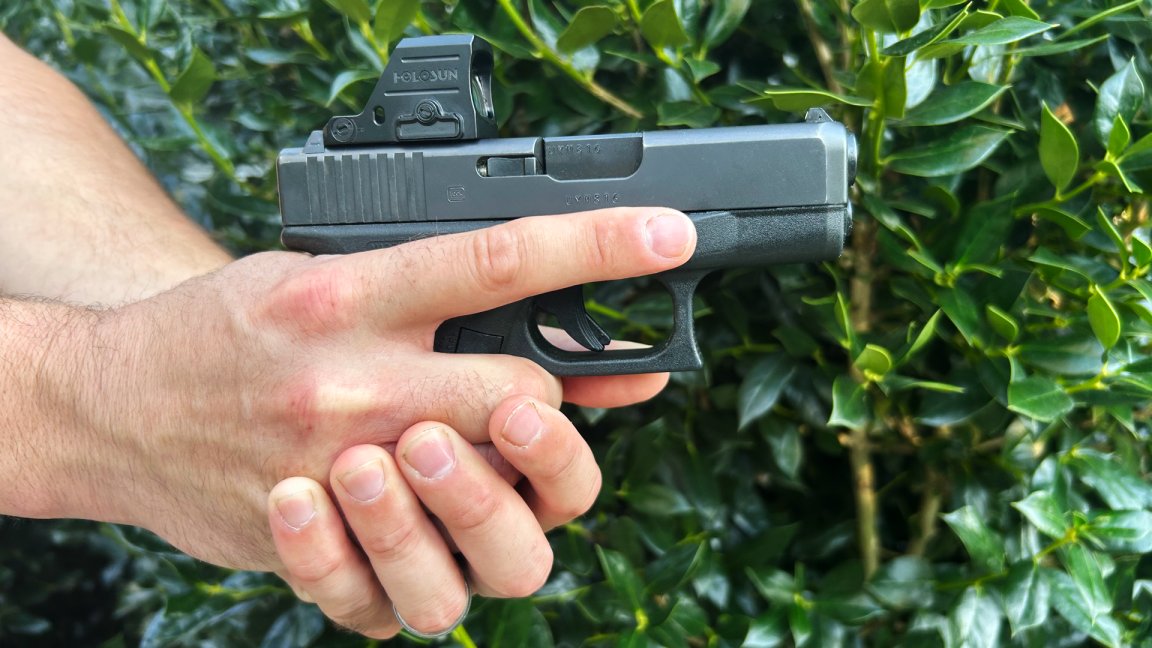
The world of Practical Pistol Competition has evolved light years in just a few decades. I started shooting USPSA (United States Practical Shooting Association) in the early ’90s. At that time, shooters were just starting to experiment with optics on pistols.
Back then, we called them scopes. Nowadays, I get corrected all the time because they are “dot optics.” Yeah, I know. I’m that old.
When I actively competed in USPSA, I was by no means a high-level competitor. I was a C or B Class shooter, but I loved competition and, more importantly, the camaraderie at the range.
The early days of dot optics on an Open Division pistol usually consisted of a ring mount that was drilled and tapped onto the dust cover of the pistol. The optic itself varied in size and weight depending on the manufacturer and the version of the optic.
At one point, there was even an optic that looked more like a beer can attached to your pistol than an optic.
Well, times have changed.
More USPSA divisions, slide-mounted optics, smaller optics and stronger optics have opened up a whole new way to compete and remain competitive.
Carry Optics Division
Here is where things get interesting.
In this USPSA division, you can pick a striker-fired, DA/SA (Double Action/Single Action) or DAO (Double Action Only) pistol in 9mm or larger, use a magazine up to 140mm, add a slide-mounted optic, and you’re ready to play.
Yes, I know it’s a tad more complicated than that, but these are just the “Cliff Notes” of the division.
When it comes to optics, this is where things get complicated. Some optics are not strong enough to handle the strains of competition shooting. Some require the shooter to unmount the optic to change batteries. And, perhaps worst of all, some have windows that are too small, making fast target acquisition difficult.
Those are all issues we have had to deal with—until now.
In Comes Holosun
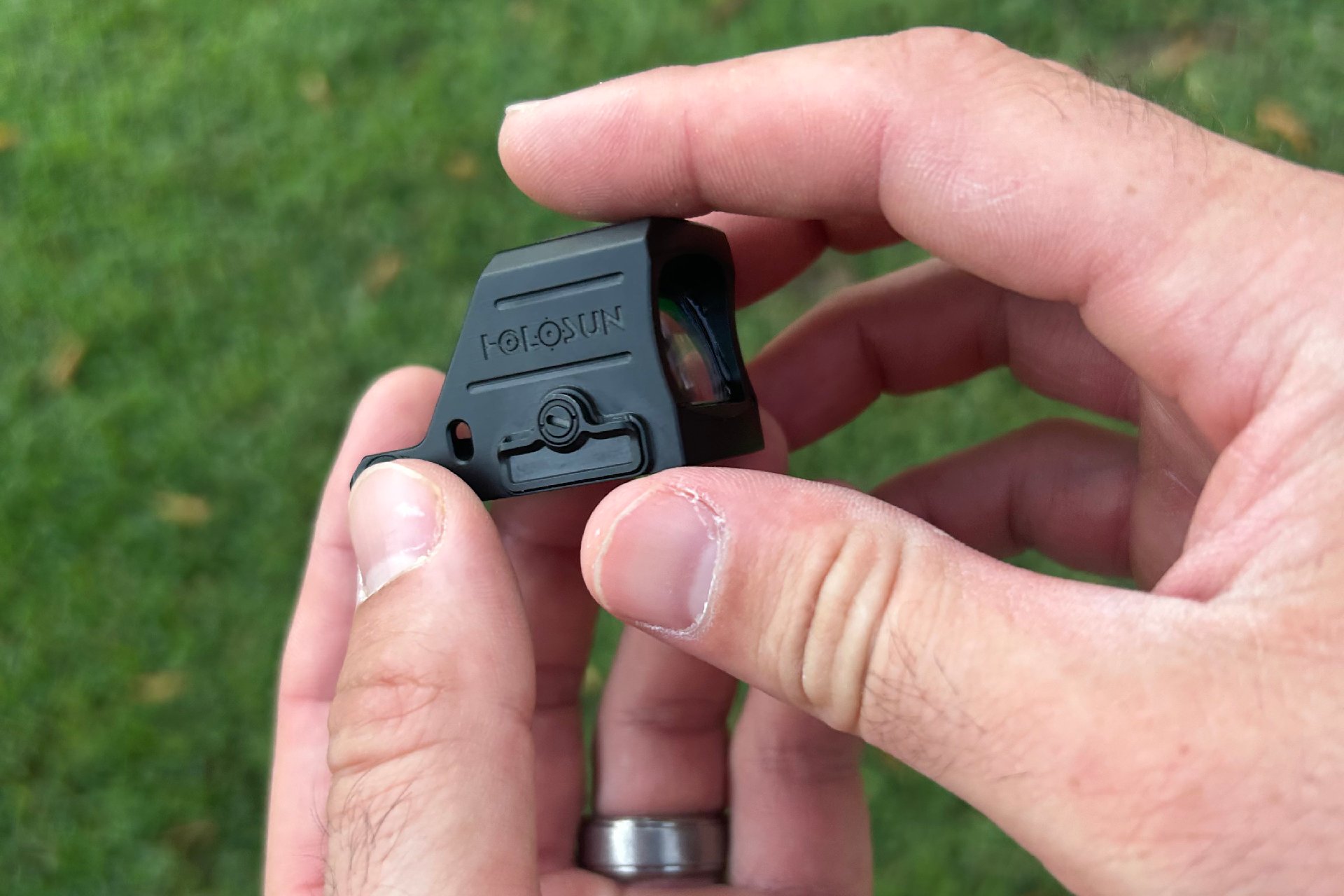
Just when I thought I had to settle for second best, Holosun released its new HE507 ProMax, designed with the competition shooter in mind.
Holosun has been a driving force in the dot-optic market for the past few years. More law enforcement agencies are issuing Holosun optics to their officers, and there’s a good reason for that.
They are strong, reliable and easy to use and zero.
It seems like all my law enforcement friends are issued Holosun optics, and many buy them for their privately owned firearms. I guess if Holosun is trusted by law enforcement, I can trust it at the range.
The new HE507 ProMax is geared toward the competition world and has a plethora of features that make it an interesting choice for the hard-charging competitor.
The HE507 ProMax is available with three emitter/reticle colors: red, green and gold. My personal preference is green. I tend to see green much better in the desert environment where I normally shoot, but I wouldn’t be entirely against red or gold.
Here are some of the most important features of the HE507 ProMax:
- High Visibility Green Performance Reticle: The high-contrast green reticle improves visual pickup in bright environments while maintaining sharp clarity during fast target transitions.
- Gold Performance Reticle System: The high-contrast gold reticle features a 2 MOA dot and selectable 8, 20 or 32 MOA circles for precision or rapid engagement.
- Gold Super LED Technology: The 590nm gold emitter enhances reticle visibility against bright targets and complex backgrounds.
- Red Super LED Technology: The 650nm red emitter delivers a bright, efficient reticle with excellent clarity in varying lighting conditions.
- Performance Reticle System (PRS): The selectable reticle system allows shooters to run a precise 2 MOA dot or bold 8, 20 or 32 MOA circles, individually or combined, to match different speed and precision shooting styles.
- Expanded Competition Window: The large viewing window increases the field of view for faster target acquisition and improved sight tracking during rapid transitions.
- Forward-Leaning Sunshade: The integrated forward-leaning sunshade reduces glare and washout in harsh lighting to maintain a clear and consistent reticle.
- RMR Footprint Compatibility: The industry-standard RMR footprint allows direct mounting to a wide range of optics-ready pistols and adapter plates.
- Solar Failsafe Technology: The solar panel supplements battery power and automatically adjusts brightness in changing light conditions.
- Shake Awake Technology: Motion-activated illumination powers the optic on when movement is detected and powers it down during inactivity to conserve battery life.
- Lockout Mode: This prevents accidental brightness or reticle adjustments by locking the control buttons once your preferred settings are selected.
- Side-Loading Battery Tray: The CR1632 side-mounted battery allows quick replacement without removing the optic from the slide.
- 7075 Aluminum Housing: The hard-anodized 7075-T6 aluminum construction provides strength and durability for demanding competition or duty use.
- IP67 Weather Resistance: The sealed housing protects the optic from water and debris, with IP67 waterproofing and 5,000G vibration resistance.
What Matters to Me
After all that technology and marketing talk, let me share the features that are most important to me and why.
Expanded Competition Window: This is one of the most important features for me. Having a large window allows me to find the target quickly and transition to my next target with the same speed.
Yes, I know the competition world is completely different from the EDC (Every Day Carry) world. In competition, bigger is usually much better.
Forward-Leaning Sunshade: This is one very cool feature. I have found myself shooting courses of fire when the sun is at some awkward position, shining directly onto my lens and causing massive glare.
This sunshade might not eliminate glare, but it sure helps mitigate it. Anything that helps me see my reticle clearly when the sun is working against me is a good thing.
RMR Footprint Compatibility: You must admit it: the RMR footprint is one of the most common and prevalent footprints in handguns today.
Even though there are handguns that offer other mounting options, the RMR footprint seems to be king in the industry.
Modern pistols allow the use of several different optics through plates or other mounting systems, but the RMR footprint remains one of the most popular footprints available today. That makes the HE507 ProMax an easy optic to consider for a wide variety of competition pistols.
Side-Loading Battery Tray: I love the fact that I can replace the battery without removing the optic.
I know these optics rarely need to be re-zeroed after being removed and reinstalled, but heck, this is so much easier. Why make something more complicated than it needs to be?
Finally, the Performance Reticle System (PRS): This is the most important feature in my book.
I like having the freedom to choose the reticle I want for a specific course of fire. Sometimes you have a course of fire with close paper targets. Other times, you have farther, more difficult targets with No-Shoots or Hard Cover.
Then there are plates—or the dreaded Texas Star.
No matter which course of fire you must deal with, the HE507 ProMax has a reticle option that can help you adapt.
That flexibility is what really catches my attention. Instead of having one reticle and learning to make it work for everything, the PRS gives the shooter the ability to select a reticle configuration that fits the situation.
My Competition Combination
Being a big fan of the Springfield Armory Echelon, the HE507 ProMax seems to be tailor-made for this pistol.
This is going to be the combination I will be using for local competition soon, and I’m looking forward to seeing how the two work together when the timer starts and the pressure is on.
One of the things I have always enjoyed about competition shooting is that there is always something to improve. It doesn’t matter whether you are working on your draw, transitions, reloads, movement or simply learning to shoot more accurately under the clock.
The equipment is part of that equation.
A good pistol and optic combination should work with you, not against you. The optic needs to be durable enough to handle the abuse of competition while also giving you a clear and usable sight picture when you need it most.
Drill With Your Setup
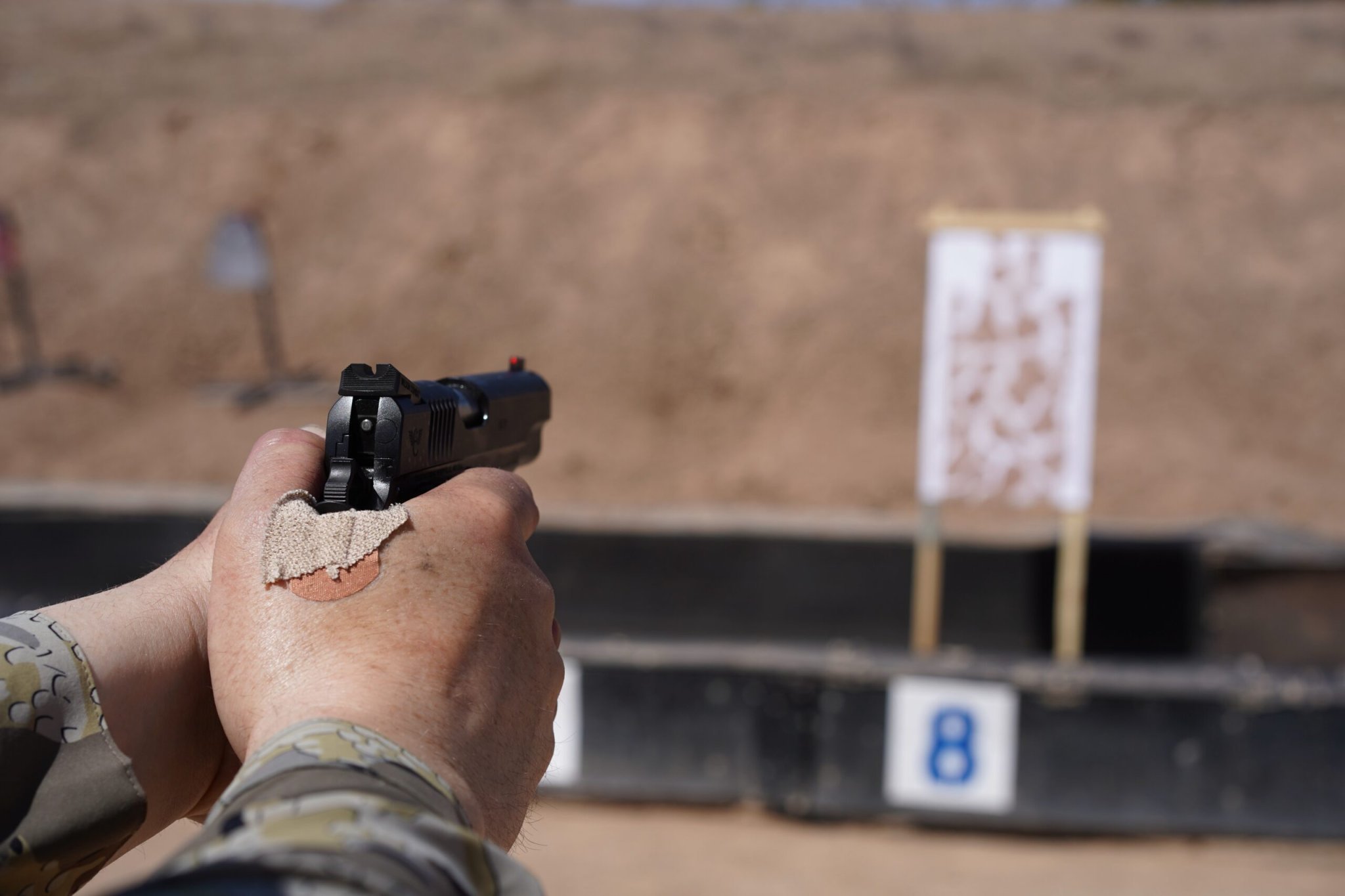
Once you have your rig ready, it’s time to run a couple of simple drills. These are easy to set up and, more importantly, give you a way to measure your progress.
The first drill I would recommend is the “Bill Drill.” This drill was developed by Bill Wilson to improve accuracy and speed.
How to Shoot the Bill Drill
Distance: Stand 7 yards away from the target.
Start: Begin with your gun in a holster, or at a low-ready position for beginners.
Action: Draw and fire six fast rounds into the target.
Goal: Land all six shots inside the A-zone, the center scoring area of an IPSC or USPSA silhouette target.
Scoring the Bill Drill
Clean Run: A run only counts as clean if every shot hits the A-zone.
Expert Time: Advanced shooters aim to finish the entire drill in under 2 seconds.
Intermediate Time: Most regular shooters aim for 3 to 3.5 seconds.
Beginner Time: New shooters should focus on accuracy first, often taking around 6 seconds.
Another drill I highly recommend is the El Presidente. This drill has its roots in the early days of Gunsite, and it’s a really fun drill that combines target transitions and reloads.
How to Shoot the El Presidente
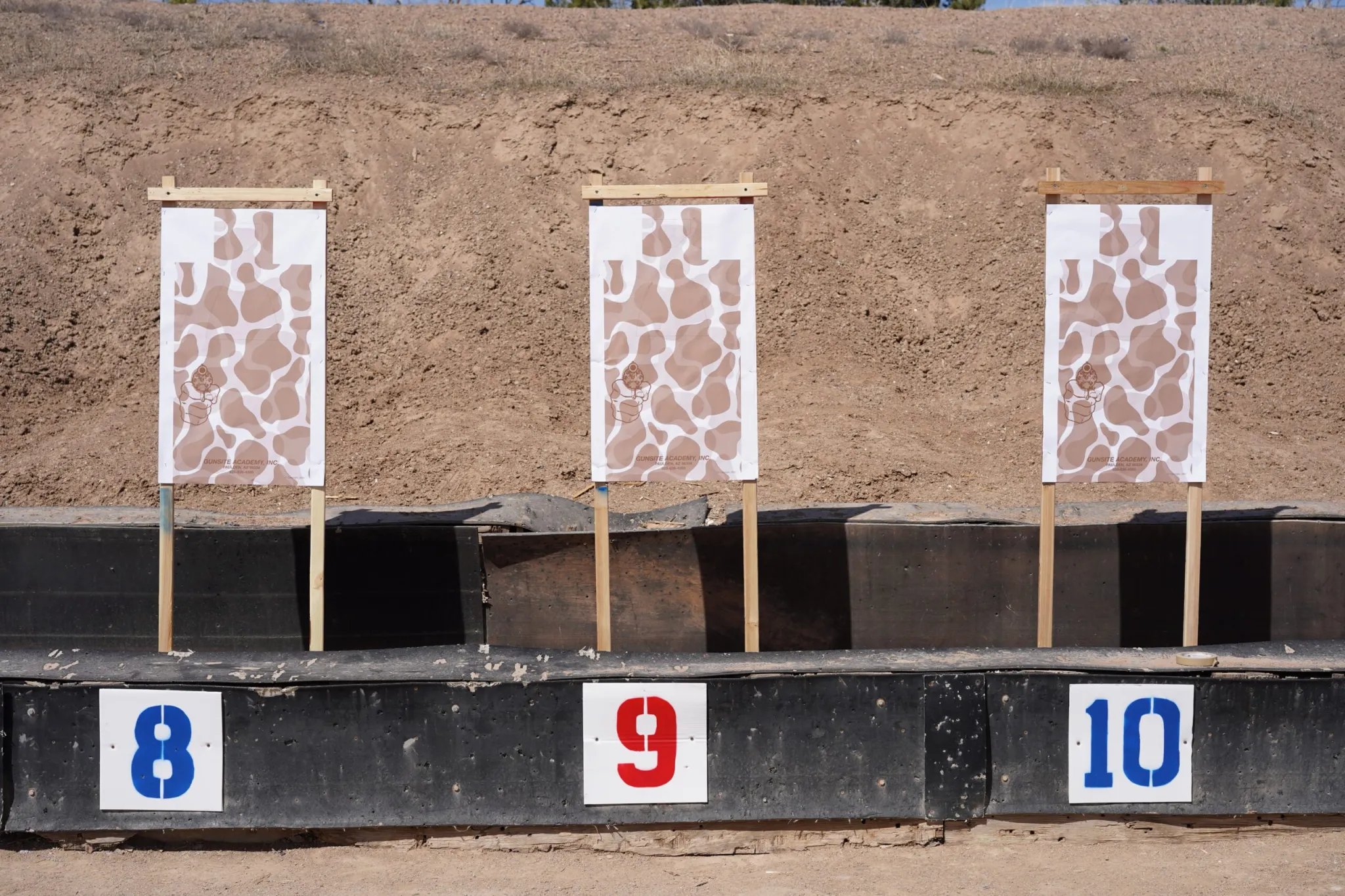
Targets: Three silhouette or IPSC/USPSA targets placed in a line, spaced about 1 yard apart from shoulder to shoulder.
Distance: 10 yards, or 10 meters, from the targets.
Starting Position: Stand facing directly away from the targets, up range, with your back to them.
Gun State: Holstered handgun loaded with six rounds in the magazine, plus one in the chamber if appropriate for the pistol and division.
On the start signal, usually the beep of a shot timer, turn 180 degrees to face the targets.
Draw your pistol and fire two rounds into each of the three targets, for six rounds total.
Perform a reload.
Fire two more rounds into each of the three targets, for 12 total rounds.
How to Score the El Presidente
Classic Par Time: Under 10 seconds.
Accuracy Standard: All 12 hits should land in the critical center, or A-zone, of the targets. Hits outside the scoring area or exceeding the established time are counted against the shooter.
These two drills can also be run with IDPA targets, USCCA targets or the classic Gunsite target.
These two drills are also a perfect example of where the Performance Reticle System can help. By selecting the appropriate reticle for each drill, you can tailor the sight picture to the type of shooting you are doing and work on improving both accuracy and speed.
For me, the Holosun HE507 ProMax brings together many of the features I want in a competition optic: a large viewing window, multiple reticle options, a practical mounting footprint, a side-loading battery, a sunshade and a housing designed to withstand the abuse of hard use.
Most importantly, the Performance Reticle System gives the shooter flexibility. Competition is all about adapting to what is in front of you. One stage may demand speed. The next may demand precision. Sometimes you need both.