|
|
November 15, 2009 by
Fifty-three hours. That’s how long I sat on a plastic deck chair inside a 4-by-4-foot ground blind, looking over the same 40 acres of Saskatchewan woods before I finally killed a buck on Friday.
This hunt for a big Canadian buck was the toughest hunting challenge of my life, and I hardly moved a muscle. Mentally straining, psychologically crushing, I sat in the same seat—actually two, since I moved blinds after the first two days in the field—for 12 hours a day straining to see a bruiser buck step out of the poplar forest.
By the end of the day my back hurt, my knees throbbed and all that unfulfilled anticipation wore me down.
Problem was, the weather was so balmy—at least by Saskatchewan standards—that the deer weren’t moving much, and the bucks weren’t actively cruising the bait sites. I guessed they were nearby, but working does at night. Perhaps rattling might draw one out of the woods, I suggested to my guide, but he shut me down. Don’t rattle in the blinds, he said. Scares away the does and the bucks won’t hear anyway.
Thursday was the worst. I sat a new stand on Wednesday, and because it was new real estate to me, and because a dozen does and tiny bucks worked the area, I had plenty to see. Late that evening, well after legal shooting light, I saw a buck come into the clearing. He looked wide, but had weak brow tines, at least what I could see in the shadows. I returned to the blind on Thursday, saw the same does but not a single buck. I felt like I was in some sort of back-woods penitentiary, unable to move or make sounds lest I scare away the buck just out of sight.
So when I returned to the blind on Friday, my last full day of hunting, I smuggled in some synthetic rattling antlers. I just had to take control of this situation. After four hours on stand, I pulled out the horns, slammed them together and watched all the does flee the clearing. Maybe my guide was right.
But less than 10 minutes later a smallish 4x4 buck appeared, head up and walking stiff-legged like he was expecting to get his butt kicked. I passed him up, then another buck came in. After another five minutes I heard crashing behind me, like a UPS truck was driving through the woods. I got my rifle ready just as a big buck ran out of the cover.
All I could tell was that he was wide. It happened too fast to count points. He didn’t look like he was going to stop, and because he was barely quartering away, I held on his front shoulder. I sneaked the bullet—Winchester’s new bonded Power Max—behind his rib and took out the top of his heart.
He’s no monster, but he’s really nice 4x4. Unlike most of these deep-woods bucks, which are heavy and tall, but narrow, this guy is wide. With weak brow tines. Probably the same buck I saw Wednesday night.
I’m headed home. The 525-mile drive is the last thing my butt needs after sitting all week. But at least I get to see the scenery change.
[ Read Full Post ]
November 12, 2009 by
Finally, we've broken the seal on Saskatchewan bucks. After two days of all-day sits on stand, the four of us hunting together return to camp each evening a little dejected.
We've seen some decent bucks, but no clear-and-present shooters. Until tonight. Check out the photo of the bruiser that Jon LaCorte put down just as legal light faded this evening.
LaCorte is the reason I'm hunting Saskatchewan right now. Jon, the senior product marketing manager for Nikon's Sport Optics Division, has hunted this camp near Meadow Lake three times previously, and he's been baffled by the lack of action this week.
We've seen some chasing, some very hot does and some junior bucks with big, swollen necks and grand ideas of their romantic potential.
Jon has been on the same stand, about 30 feet up in a spruce tree, for the past three days. Finally, he saw a buck worth shooting, but the interesting thing about Jon's experience is that it happened in such low light.
"I'm not blowing smoke, guys, but I got this buck because of optics," Jon said when he returned to camp, the bruiser on the back of his 4-wheeler. "I spotted him with optics and I nailed him with optics."
Jon made a great shot with his .300WSM and 180-grain Winchester E-Tip bullets. The buck went about 20 yards and piled up. What a deer. Check out the bladed brow tines and the sky-high G2. Main beam length is also tremendous, thanks to a curve that maintains its mass all the way around the bend.
I'm on stand again in a spot where I saw some decent bucks. I'm hoping I see one anywhere near the caliber of Jon's great deer.
[ Read Full Post ]
November 8, 2009 by
I climbed down from my stand this morning after a 3-hour sit, my tag still intact and still in my pocket.
I had a pretty good buck—a heavy 3x4 with a bladed brow tine—come screaming to my rattling at first light. He ran, then walked directly beneath my stand on the timbered edge of a picked cornfield. I drew my bow, but I just couldn’t let an arrow go.
It wasn’t that he wasn’t a great deer. In most places in America this would be a career bow deer, a 120-class 2-1/2-year-old. But I’m in Illinois‚ Golden Triangle and I’m determined to shoot a 140-inch or better deer, or go home bloodless.
As I walked back to the pickup, I mused over the task I had set to achieve: To kill a Pope & Young buck in three days in one of the hottest whitetail counties in the nation. That meant plenty of time on stand, but it also meant getting spectacularly lucky and getting a big boy to walk inside of 30 yards of me. Long odds, indeed.
I may not have perforated a deer, but I learned a lot. I learned to trust rattling at this chasing stage of the rut. I learned that big deer do indeed grunt like rooting hogs. I learned to love the stand and the way the day unfolds from a single vantage point. I learned to love watching plucky squirrels and nervous turkeys and to pay close attention to any doe that seems edgy because it means a big buck is probably nearby.
And I learned to love this part of the Midwest, with deep limestone creeks and fertile upland cornfields and great, genuine people. With luck, I’ll return to Brown County. I saw an awful lot of bucks that will be real bruisers next year. And, thanks to me and my restraint, they’ll be waiting for my return.
[ Read Full Post ]
November 7, 2009 by I am not a patient hunter. I'm successful largely because I cover lots of ground and prepare to hike longer and farther and higher than the other guy. Make me mobile and '‚m going to get game.
So it's a special kind of torture for me to spend all day in a treestand, unable to get on the ground and make my own luck. We were told in our orientation here in Illinois that "walk-abouters" weren't tolerated here. And I understand it. We have so many folks on stand that if someone started meandering around the woods would screw everyone up.
I say this as a preface to my day, which started with the expectation that I'd again be 12 hours sitting on a seat the size of a phone book 25 feet in the air. If it was a day like yesterday, with action every moment, I can handle the sit. But today started eerily silent and only got colder. Deer just weren't moving, either because of the warm windy conditions or because of all the corn harvesting going on up on the ridge above me.
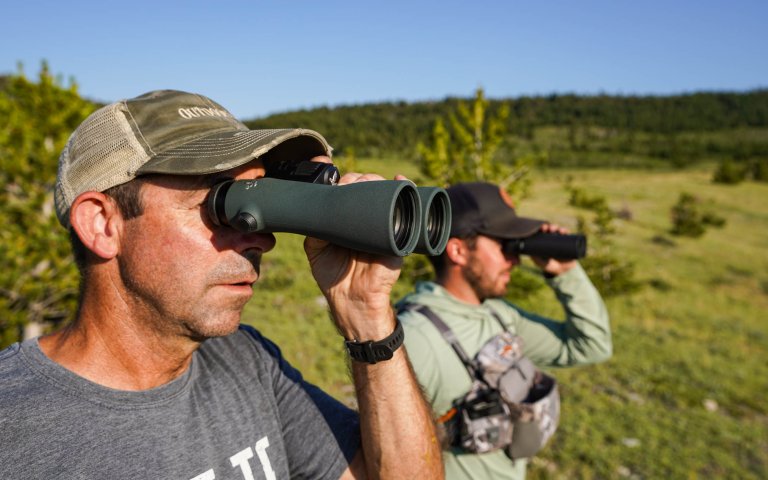
After a solid four hours of nothing, I started glassing the landscape, trying to put antler tines on every oak brush and hawthorn around the La Moine River valley. Miraculously I saw a buck, a smaller 3-point (these Midwesterners call it a 6-point) bedded along the river bank. Then my binos resolved a doe and a smaller buck, looking over his shoulder. I panned and my heart jumped in my throat. There was an Illinois bruiser, wide and tall. Not real heavy but a solid 160-class buck, methodically tailing a doe.
He was 200 yards away, but he might have been two miles. I was bound by the prohibition on cross-country travel, plus the oak leaves were crunchy as potato chips. Still, I picked out an approach that might put me in bow shot, and the thought crossed my mind more than once: It's better to ask forgiveness than permission. Who would know if I just made a careful stalk, arrowed the buck and then told my guide that I had shot it from my stand?
I was torn, but eventually I did the right thing, and went in for lunch, the first time I have come off stand in the middle of the day this entire hunt. Back at camp we strategized a stand that might put the bruiser on my evening spot. I set up on a freshly picked cornfield, but you know the rest. I saw only does and junior bucks, including a 3-point with a busted antler on his left side.
I have two hours to hunt in the morning before I drive to St. Louis for my flight home. I'd love to spend another couple days here, but I have to be in northern Saskatchewan for another whitetail hunt by Sunday night. I'll try to report from the field, though the chances of getting email access from camp are pretty slim.
Wish me luck for the morning sit. I only need about two hours to sluice a big boy, maybe three if I can't go on walk-about.
[ Read Full Post ]
November 6, 2009 by I have heard whitetail bucks grunting only once before, and I thought it was pigs coming through the brush. Turned out to be a big Texas bruiser that blew past me so fast I couldn't swing my rifle.
Well, these Illinois bucks grunt like a whole pen full of hungry hogs. I heard three different grunts today during my 12 straight hours on stand. I grunted back to two of them, had them coming in, then they broke and disappeared in heavy brush. But the sound of that guttural, throaty roar will stay with me a long time.
The guys who are on their return trip here to Illinois‚ Golden Triangle warned me about the grunting. "Dude," said one of them, "you might doze off on the stand, but you have to keep your ears open. It sounds like a cabin full of old men snoring."
He was right. So tomorrow, I'm going to start the dialog, breaking out my grunt tube and see if I can draw one of those bad boys in.
I'll also have my rattling bag and my bleat can. Today I got a buck to come charging through an overgrown willow patch when I hit the bleat. Then he must have hit my scent trail because he stopped cold and disappeared in the jungle. A couple hours later I rattled in a ratty 9-point. His right side was perfect, and would have made around 150 inches with an equivalent left side. But the other side was busted off almost slick.
But he came in on a rope to the rattle and stared at me at 35 yards long enough to make me wish he was just a little big bigger.
But, as the waterlogged farmers around here say, this is tomorrow country. I'm hoping it brings me a great buck.
[ Read Full Post ]
November 5, 2009 by It's starting, folks. The whitetail rut, that is.
I spent 12-1/2 hours on stand in some of the best big-buck country in America- Illinois' Brown County- and saw little bucks bird-dogging does, larger bucks intimidated by something I couldn't see up the ridge, and does starting to get good and squirrelly.
I didn't see anything I wanted to drop the hammer on. I'm hunting Richardson Farms, where a 140-or-better rule dictates what we'll kill, but I didn't see anything over that threshold. My stand today overlooked a rank CRP field and backed up against a cedar ridge. A perfect pinch point for cruising deer.
Half hour after I got settled, a good 2-1/2-year-old 8-point (back in Montana, I'd call it a 4-point, four on a side). He'll be great next year, but I let him walk, and he put on a show, posing in the rising sun and then striding right below my stand.
Late in the day another 8-point cruised by. In between, I had consistent action from little guys. They are actively working rub lines, but the fact that they're nervous and edgy means that the big boys are just off stage.
I'll be back on stand in the morning, and will try to shoot of a report tomorrow night. Hopefully I'll be typing with bloody fingers.
[ Read Full Post ]
November 3, 2009 by
As I was hastily slicking meat off the second front quarter of a Milk River whitetail, I had a sudden epiphany. What was I doing, butchering a meaty doe in fading light, risking slicing off a finger or a thumb, in such a hurry to leave home? I had shot this doe over the weekend with my son Ellis at my side, after a great sneak – a really satisfying father/son moment as Ellis picked out the deer and helped recover and field dress it. I should be savoring this moment as I turn deer into venison, not hurrying to finish the chore.
After all, it’s early November, and there is nowhere else I’d rather be in the world than home here in Eastern Montana, looking for an outsized whitetail or mule deer.
Then I recalled why I was finishing all my chores at the last minute. I’m leaving tomorrow for Illinois, and a date with some of the largest whitetails in America.
I’ll be traveling tomorrow, on the way to St. Louis, then Quincy, and eventually Cooperstown, Illinois, and the heart of the Golden Triangle of monster buck fame. I’ll be bowhunting with Tim and Jeff Richardson on their Richardson Farms for the balance of the week.
It’s a hunt I’ve been looking forward to all year, a chance to encounter a really massive corn-fed whitetail. I’ll try to post updates from the field, but internet access is iffy. I’m encouraged by reports that the chase phase of the rut is just starting in the Midwest. Here’s to straight shooting.
[ Read Full Post ]
October 30, 2009 by
By a new measure of bliss, my wife should be ecstatic. So why does she glare at me so savagely as I pack my hunting bag? Maybe she just hasn’t been surveyed. There’s renewed interest in the question that men have been asking for millennia: What do women really want? And results of new surveys are turning almost as many heads as zombies are.
The bliss quotient of women made the cover of a recent Time magazine, and it’s the topic of a new book written by marketing guru Michael Silverstein, called “Women Want More: How to Capture Your Share of the World’s Largest, Fastest-Growing Market.”
Now, I shudder to think that marketers can tell me more about my spouse than I already know, but in a revealing New Yorker interview Silverstein implies that American women want to be more Swedish.
If that conclusion eludes you as it did me, then maybe you’re not as tuned in to your spouse as you should be. That’s a particular problem to those of us with AAD, or autumnal affective disorder, which tends to make us distracted and hyperactive as hunting seasons approach.
Silverstein tells The New Yorker that he went to Sweden and met women with “idyllic lives” and suggests that American women can take a page from these satisfied Scandinavian spouses. Here’s his take:
“The Swedish woman says, ‘We have a house here, but we have something in the country that we go to (where) my husband goes out and hunts for dinner.’ He comes back with dinner and he has shot it! They are happy. American women don’t have anyone hunting for them—that’s the real problem.”
If that’s the case, then the solution to all our domestic discontent should be resolved within the next month, as so many American husbands go out to hunt for their women. I’ll be sure to let you know just how happy my wife is to see me neglect the kids, household chores and even basic hygiene.
[ Read Full Post ]
September 30, 2009 by
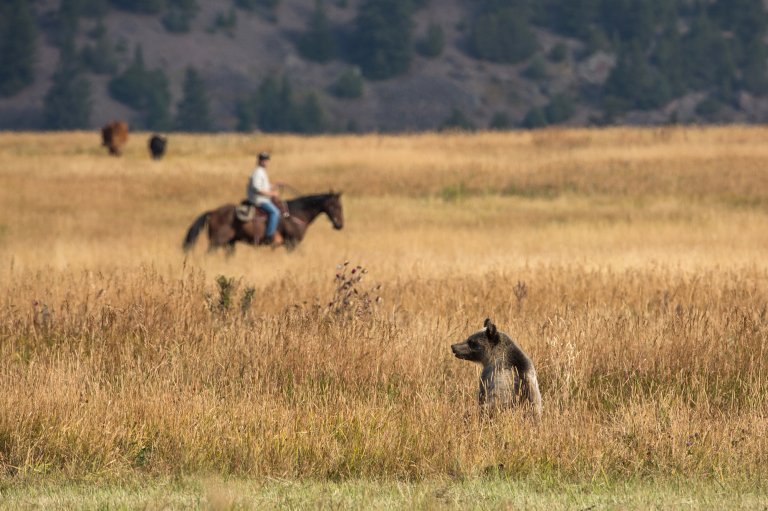
It won’t save a single cub, sow or boar, but last week the status changed for the 600-and-some grizzly bears that roam in and around Yellowstone National Park.
The Yellowstone population of grizzlies was reclassified as “endangered” and if it won’t make a lick of difference to the bears, the designation could affect how and where you hunt in one of the most wildlife-rich regions of America.
Management of Yellowstone’s iconic bears has had fits and starts ever since park managers threw them out of the garbage dumps a generation ago. Though their population has increased three-fold over the past 20 years, there’s still much to be done to help grizzlies reoccupy their historic range in Wyoming, Idaho and Montana. But simply changing their legal designation is a feel-good gesture that may have plenty of consequences—intended and unintended—for hunters and public-land recreationists.
PREMATURE RECOVERY
The real story about the legal designation of Yellowstone’s grizzlies has little to do with the bears themselves and everything to do with political grandstanding.
That was the case back in March 2007, when the Bush administration declared the population recovered and removed them from Endangered Species Act protection. The fact is that they weren’t ready to be managed by the states as just another wildlife species. As much as many of us want the chance to hunt grizzlies in the Lower 48, Yellowstone’s population is too vulnerable to begin hunting anytime soon.
But last week’s ruling by a federal judge in Montana that restored Endangered Species Act protection for grizzlies was another political stunt that won’t do anything to decrease the number of grizzlies that are killed every year.
The judge sided with environmental groups who argue—probably correctly—that Yellowstone’s grizzlies will remain vulnerable as long as the white-bark pine is in trouble. Now, here’s where the case gets weird, so bear with me.
The pine tree is a high-elevation grocery store for grizzlies and other wildlife. It produces high-protein nuts that fatten pre-hibernation grizzlies. As long as the up-country food is available, grizzlies stay in the high country, away from the fatal attractions of foothills civilization. But the pine has been decimated by beetles and forest fires—both intensified by global warming, say some scientists—and lately bears have been roaming in search of food. Those forays often result in encounters with humans’ cars, cattle, cat food and cow calls, and the encounters rarely turn out well for the bears.
Environmentalists who cheered the judge’s decision were clear: It was a victory in the war on global warming—one of the first times the ESA has addressed climate change. The recovery of grizzlies was added as an afterthought. More political grandstanding.
UNACCEPTABLE MORTALITY
Grizzlies don’t have an easy time reproducing even in the best of times. They reach sexual maturity late in life and they don’t have cubs every year. So every bear that dies from unnatural causes is a real drag on population increases.
And Yellowstone’s grizzlies find plenty of ways do die unnaturally. So far this year at least 20 grizzlies have died, and 18 of them were human-caused mortalities. Some were hit on highways, others were euthanized by game wardens after they killed livestock or became conditioned to human food. Others were killed by hikers and hunters recreating in bear country.
It’s important to note that so far in 2009 only one grizzly was killed by a hunter who mistook it for a black bear. And only one grizzly was killed by a hunter who shot the bear in self-defense after an attack.
Those statistics are important, because you can bet that now that Yellowstone’s grizzlies are back under federal protection, environmentalists will argue that hunters are the real bottleneck to recovery. There will be proposals to end black bear hunting seasons around the national park. There will be limits on early-season elk hunting when grizzlies are foraging for hibernation. There will be widespread travel restrictions in bear country.
And that’s where I have trouble with the new endangered designation. I can accept that global warming has an impact on bear habitat. I can also understand that roads and subdivisions can negatively affect bear recovery.
So bear managers should find ways to slow declines of white-bark pine. They should slow traffic through bear-crossing zones. They should do a better job of educating foothills dwellers about the importance of storing garbage. Maybe they should even limit visitation to Yellowstone National Park.
HUNTERS AS GRIZZLY ADVOCATES
But realistically, how many of those bear-saving measures will be implemented? Precious few; the bottlenecks are just too immense, and the political opposition too fierce. So instead, you can expect to hear claims that hunters are the biggest threat to grizzly bear recovery. We are low-hanging fruit for environmentalists who want to show that they’re serious about reducing grizzly mortalities. And who want another stage to grandstand on.
So here’s my proposal. Use hunters as ground-level advocates for grizzly bears. Require backcountry hunters to report every grizzly sighting. Require hunters to pass a grizzly bear identification and behavior exam. Require backcountry hunters to carry and know how to use bear spray. Aggressively investigate every claim of self-defense that results in a dead or wounded grizzly, not just by game wardens but also by federal law enforcement agents.
Get tough on hunters. But don’t use the new Endangered Species Act designation as a tool to lock us out of grizzly country.
[ Read Full Post ]
September 25, 2009 by
What may turn out to be the largest bighorn sheep ever taken in the United States was harvested last week in Montana’s Missouri River Breaks.
I’m still chasing down the Utah hunter, Pat White, who connected with the remarkable ram, but preliminary reports indicate that it’s likely to be a new Montana state record, topping Jim Weatherly’s 204-7/8-inch Rock Creek ram shot in 1993. The world-record bighorn ram is a 208-3/8-inch Alberta monster shot in 2000 by Guinn Crousen.
Early measurements indicate that White’s ram, shot early last week, stretches 205 inches, with 44-1/2 inch horns and bases that measure a whopping 16 inches. As the photo indicates, the horns carry that mass well down their remarkable length. The ram will be officially scored after the mandatory 60-day drying period, but bighorn horns don’t generally shrink as much as deer or elk antlers do, so you can expect the final score to be close to the preliminary measurement.
The ram was harvested in District 482, on the south side of the Missouri River, in Dog Creek, west of the legendary Whisky Ridge, a maze of gumbo knobs and cliffs that has produced several record-book sheep over the past decade.
The hunter, Pat White, drew the only non-resident sheep tag for District 482, and reportedly backpacked some 10 miles in to a remote drainage, where he found and shot the ram, then packed meat and cape out in 90-degree heat.
In an interesting twist, White was accompanied by John Lewton, pictured here with White, a taxidermist and self-described sheep zealot who has been charged with trespassing, felony sale of wildlife and use of a two-way radio while sheep hunting. The charges stem from an undercover investigation last year in which Lewton and two accomplices guided an undercover agent to a Missouri Breaks ram that was later killed by the undercover agent. That ram, taken in District 680 just north of Whisky Ridge, scored 204 inches and, had it been taken legally, would have been a contender for the next Montana state record.
The sting operation was sparked by Lewton’s involvement in the harvest of the last nine Governor’s Tag rams in Montana, according to Montana Fish, Wildlife & Parks. Lewton, who is not a licensed outfitter, reportedly invited himself on these hunts, helping the hunters find and field judge record-book rams.
I asked FWP contacts whether Lewton’s involvement with White’s hunt will tarnish the potential record status of the ram. They said it’s too early to tell, but are looking in to the relationship between the two men.
Lewton’s case is expected to go to trial sometime next year.
[ Read Full Post ]
|
|