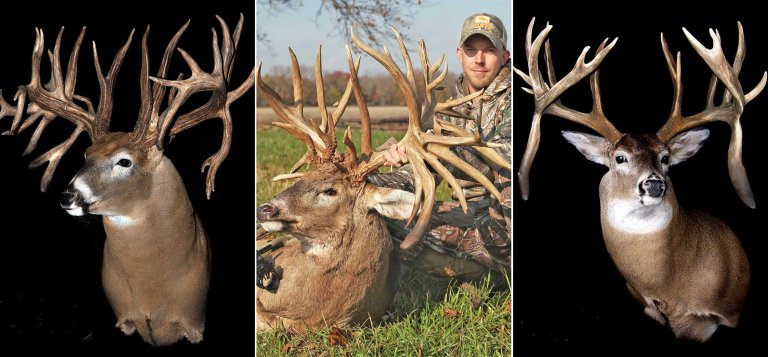
Craig Dougherty investigates the ugly side of deer farming, including this outrageous 561-inch buck.
We put together a countdown of the highest-scoring whitetail bucks ever killed according to Boone and Crockett records.
![]() | Black FawnThink albino deer are rare? Check out these photos of a black fawn taken by a... |
![]() | Record QuestFor the last four years, I have been haunted by the memory of a single deer. This... |
![]() | Let 'Em WalkOf all the variables that contribute to record racks, age is the most important. There’s... |
![]() | First Deer IIIt's a season of firsts! At least it has been for these fortunate hunters. |
An Early Rut?The fall buck shuffle is heating up! Check out this activity around one scrape last... |
![]() | Rut Myth BustersWhat you don't know about the rut. |

Archery equipment has come a long way since the days when longbows and recurves dominated the market. And as equipment has improves so has the ability for bowhunters to make long-range shots, but does that mean we should take these shots?
There are a lot of bowhunters who practice daily and train at triple-digit distances. I personally think long range shooting is both fun and challenging. It’s incredible to watch the arch of an arrow and it’s seemingly sudden drop once it reaches its long distance target. [ Read Full Post ]
A basic food plot will provide valuable nutrition to deer and add important biodiversity to most woodland landscapes. But, there is a big difference between a basic food plot and what can really be done with a food plot if you set your standards high and know what you are looking for. Here are a few things to think about when building your next plot.
Basic food plots provide deer with 1-2 tons of green matter per year. You plant them with anything that will grow and forget about them until hunting season.
Advanced food plots provide deer with 3-5 tons of highly nutritious, easy to digest nutrition per year. They are planted with scientifically developed, food plot blends designed for deer not cattle. The plots are planted on well-prepared seed beds, they are limed when necessary, and are given a generous shot of fertilizer in spring and late summer. They are also sprayed with grass specific herbicides during the growing season and mowed to keep broad leaf weeds down. [ Read Full Post ]

It’s a one in a million shot.
The photo came from the camera of Colorado University-Boulder student Andy Duann and the story behind it is a strange one. It all started a week or so ago when a bear wandered onto the university campus. This rightfully alarmed some of the coeds and the authorities were contacted.
The authorities came, and after finding the bear relaxing in a tree, took action. They placed mats commandeered from the athletics department under the bear’s tree, then darted him with a heavy tranquilizer. Student Duann saw the activity from the fifth floor of a nearby building and bolted downstairs camera in hand.
He took more than 300 photos of the bear relocation effort; the one above was the absolute best. The photo went viral, spawned a ton of memes, a Facebook page, and countless tweets. That bear photo is just too cute! [ Read Full Post ]

It seems like everyone is planting food plots these days; and for good reason. Wildlife benefits from them and they make for great hunting. Food plotters spend endless hours pouring over seed catalogs in hopes of finding the perfect food plot forage. Unfortunately they don’t spend nearly as much time thinking about the soil they are going to plant in.
A week ago I blogged about the importance of doing a soil analysis before planting, but that’s only the half of it. First, you have to find good dirt to work with. If you are going to hunt the plot, it has to be built correctly.
The higher quality the dirt, the better your plot will grow. Trouble is, most of the good dirt is tied up growing agricultural crops and most food plotters are forced to work with what the farmers don’t want. So how do you find good dirt for your food plots? [ Read Full Post ]
The undercover sting went off without a hitch, and the Tennessee Wildlife Resources Agency (TWRA) caught their suspect in the act of making an illegal sale. We’re not talking cocaine, moonshine or illegal weapons; the TWRA was after this man’s jerky. That’s right, jerky. [ Read Full Post ]

It wasn’t long ago when women’s apparel was non-existent in the hunting industry. Now you can watch husband and wife teams like Lee and Tiffany on T.V. You can be sure to see a story in just about any hunting magazine about a woman’s giant whitetail or a young girl’s first turkey. It’s great to see companies dedicated to women’s apparel. After all, hunters spend time in bad weather, long hours on the stand and cramped up in a ground blind – shouldn’t women also be dressed in comfortable, high-tech clothes? [ Read Full Post ]

After absorbing more than 1,000 close range shots, this buck was still on its feet.
Pound a few dozen broadheads into most life-size 3-D archery targets and they start blowing foam chunks. In our search for the perfect target, we put a Rinehart Broadhead Buck through the wringer, pummeling it with more than 1,000 shots at 10 yards. We used a PSE Axe (342 fps, 97.42 ft.-lb. of kinetic energy) to deliver arrows tipped with scary-sharp Tru-Fire T1-100 fixed-blade broadheads. We limited our shooting to just one side of the vitals. Shooting a foam target at 10 yards with an arrow delivering 97.42 ft.-lb. of kinetic energy would not be considered “normal use.” But, hey—this is a torture test. [ Read Full Post ]