
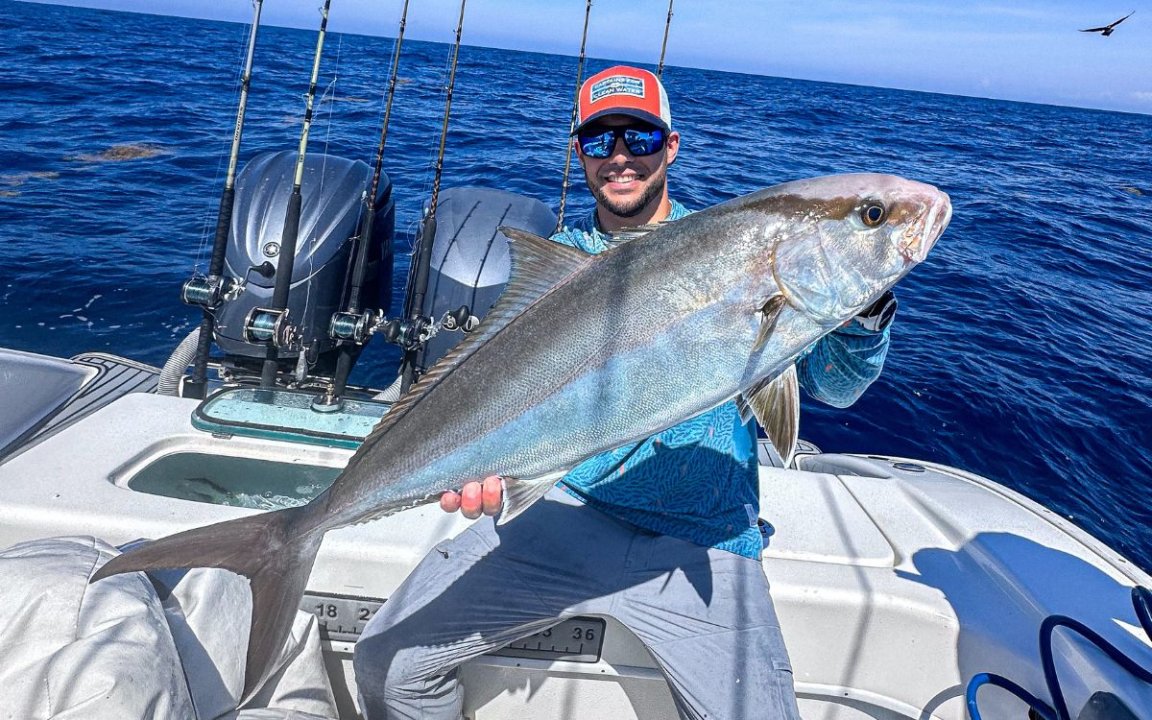
As a freshwater angler who occasionally travels for saltwater fishing excursions, I’m always looking for a fish that scratches the itch like a giant smallmouth does when I’m fighting them in strong current on light line. The exhilaration, the screaming drag, the line whistling in the breeze under the strain of a fish that just won’t quit — that’s what I’m looking for.
Throughout my travels, I’ve found that very few fish really satisfy the feeling I’m chasing. I’ve had great fights from striped bass off the coast of New Jersey, been dogged by giant lake trout, and landed my fair share of Susquehanna river muskies, but the only fish I’ve found that really did it for me was a bonefish on the flats in the Bahamas. Strip setting into an eight-pound rocketship on an eight wt fly rod unleashes that feeling of being outgunned that really spikes your adrenaline.
Then I hooked into my first greater amberjack last week in the Gulf and I think it might be my new favorite saltwater fish.
An Offshore Trip for the Books
I found myself in Gulf Shores, Alabama thanks to a trip put together by Visit Alabama’s Beaches and Strike Footwear. While there, I came to realize how much Gulf Shores has to offer an angler looking for a one of a kind fishing trip. We had some incredible local caught fish at a variety of restaurants, stayed in a beautiful house from Harris Vacations along the 32 miles of beachfront availability, and spent two days on the water chasing a bite that I’ll never forget.
The night before our offshore trip, I struggled to sleep. Having never fished the Gulf before, delusions of grandeur danced through my head as I dreamed of catching exotic fish (or at least they would be exotic to me). When the alarm finally went off, I jumped up, got ready, and hustled downstairs to wait for the rest of the crew. Thankfully, everyone involved loves fishing as much as I do, so I didn’t have to wait long. We arrived at Zeke’s Landing and Marina and quickly crawled aboard the Tide Ryder, a 36’ Cape Horn with three Yamaha 300’s on the back owned by Southern Bend Charters.
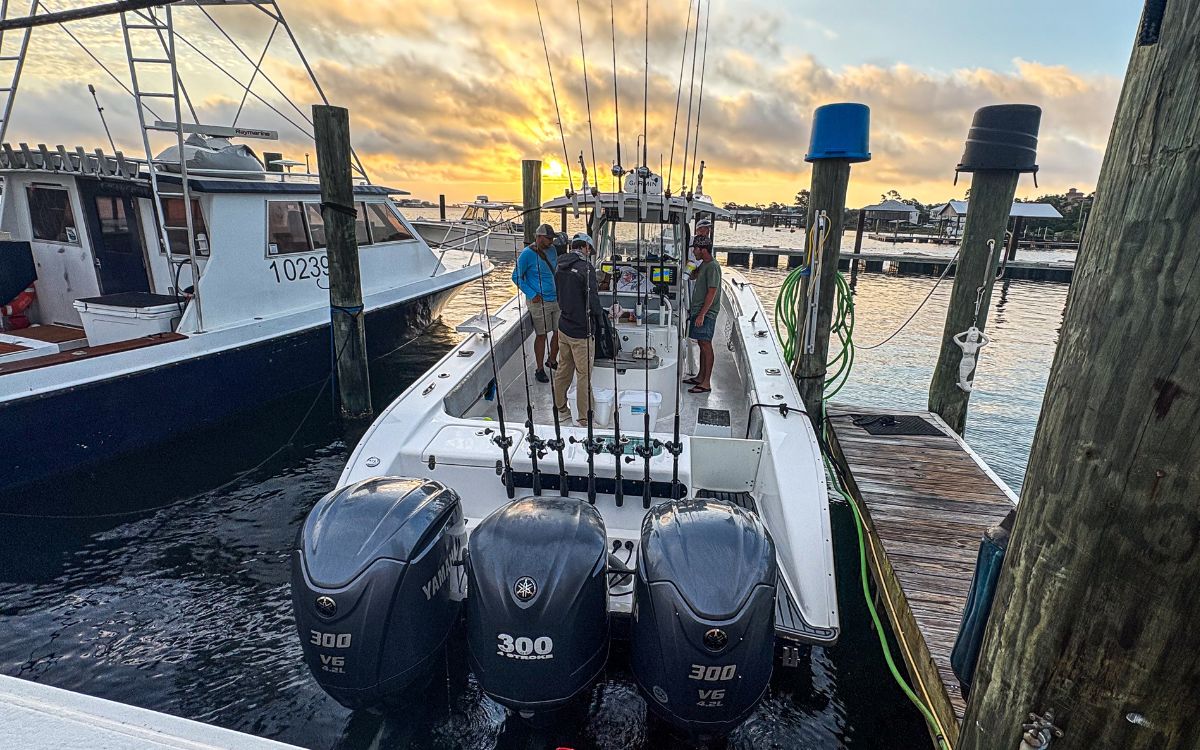
We pushed off and made our way to the inlet to catch some live bait on Sabiki rigs before making the ~20 mile run out into the Gulf. With four dozen or so cigar minnows and pilchards in the livewell in just a few minutes, we strapped in for the trek to the first offshore wreck. I settled into a bean bag up front and let the time pass me by like the saltwater spray from the building waves. After 45 minutes or so, we arrived at the first spot and received word from Captain Buddy Paul to drop our double hook rigs to the bottom.
For the first hour or so, our goal was simply to load the cooler with some vermillion snapper so we could have fresh fish when we arrived back at the dock later in the day. I’ll admit, dropping chunks of squid on a double hook rig isn’t exactly my version of an exhilarating bite, but it was well worth it a few hours later when it was time for the fish fry.
After the cooler had some weight to it, we moved a few miles to a new piece of offshore structure and that’s when things really heated up. The first mate, Landon, dumped a few handfuls of cigar minnows and pilchards into the water to see if that might fire up the bite. And boy did it.
A Fired Up School of Reef Donkeys
As a school of amberjack swarmed on the graph, we peered over the edge of the boat and to everyone’s surprise, the massive school was rushing to the surface in pursuit of baitfish. Typically, amberjack are caught deeper in the water column, so to have the school busting bait on the surface was a treat.
I pitched out a weightless pilchard on a circle hook and watched a 20-pounder inhale it as it hit the water. Within seconds, I was educated as to why they’re known as ‘reef donkeys’. On a spinning rod with a 4000 size spool with the drag locked down, I was just along for the ride. The amberjack never shook its head, it simply took off for the bottom. The drag squealed for a minute straight before I was finally able to turn the fish just before it reached the bottom structure where it would have broken off. As I cranked with every ounce of energy I had, I gained a few yards of line here and there, then lost it just as quickly when it made another run. After a grueling battle that lasted five or six minutes, I was able to get the fish to the surface and into the boat.
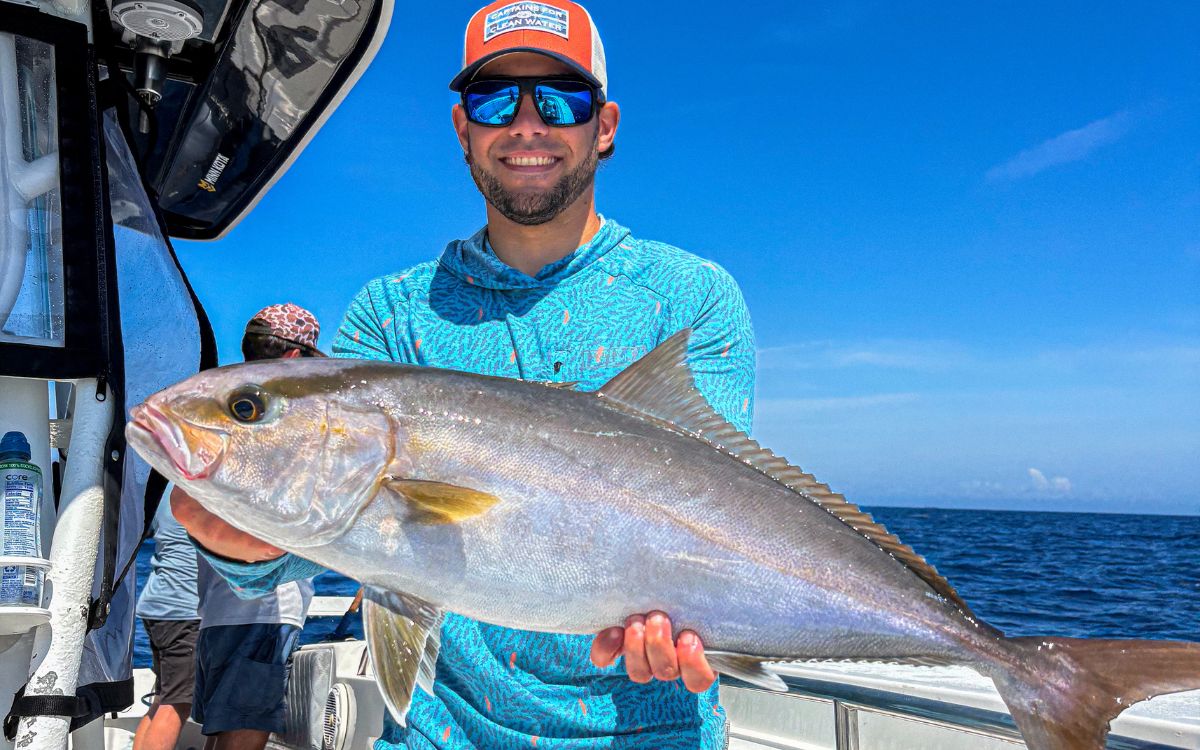
Since amberjack were not yet in season, we quickly released the fish and I was right back on the rod with another pilchard as my offering. After the first fish whooped my butt, I quickly realized that I didn’t want to miss a second of the action. As I pitched out, I turned to see three others in our crew hooked up with rods bent in half. The excitement was palpable and we began shouting and cheering each other on. I was in the middle of my battle cry when my rod doubled over again. This time, with a larger opponent on the end of my line.
If I thought the first fight was grueling, this second battle was a war of attrition. My muscles strained under the constant pressure and I struggled to turn the reel handle after seven or eight minutes of consistent action. Eventually, the fish finally showed some signs of weakness and I started to gain some line. With each strained crank of the reel handle the fish got closer and closer to the surface. Finally, the leader was within reach and we swung the fish onto the deck.
I was exhausted, but in the very best way. My forearms were cramping as I held up the beautiful amberjack for a few quick photos before the release. As tired as I was, I was right back on the rod within seconds, rigging up another pilchard to do it all over again. Schooling fish can be finicky, and you never know how long the bite will remain hot.
Moments later, I was bowed up again, fighting with every ounce of energy I could muster. This fight was similar to the first, but more difficult due to the fatigue setting in. After several minutes of a back and forth battle, I was again able to hoist another beautiful ‘reef donkey’ over the gunnel and onto the boat deck.
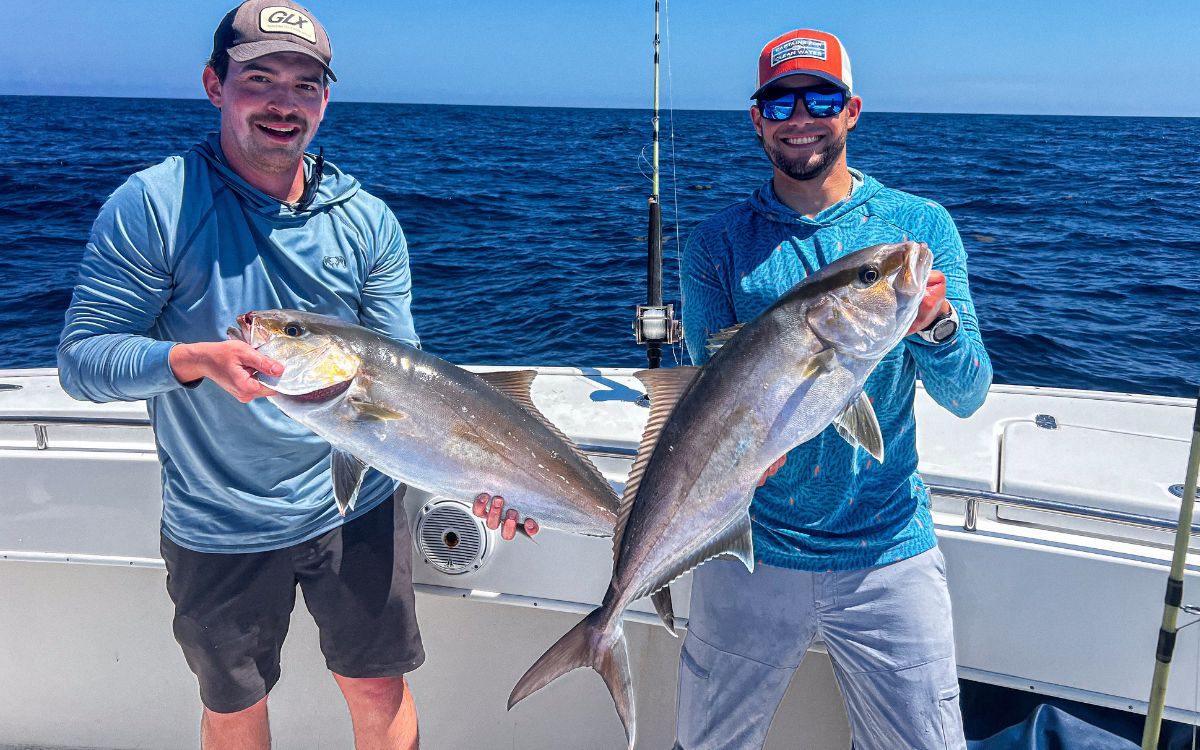
After Gordon Brown of Darby Communications and I released our double, we were able to hook up once or twice more, but I ended up losing those battles and was dragged into the bottom structure by amberjack that were more prepared for the fight than I was. As the bite died off, we took a tally in the boat and our best estimate was that we landed 15 amberjack in a half hour of electric action. It will go down as one of the hottest bites I’ve experienced in my life. And as quickly as it got started, it died off. That’s what makes offshore fishing for schools of amberjack so much fun. You just never know when or for how long the action will persist.
Don’t Overlook the Greater Amberjack
Now, you might be wondering how on earth I could say these fish are underrated in the Gulf, but to my surprise, the locals on our trip weren’t as enamored by the action as I had been. They informed me that they tire of catching them and often find themselves wishing they could get away from a school just to keep catching fish to fill the cooler like grouper or snapper.
I was flabbergasted at first, but had to take a step back and remind myself that not every angler is in it just for the fight. While I can understand their perspective, I have to say, I freaking loved catching amberjack. The fight, the unrelenting power and will, and the sheer size of those fish is something to behold. If you’re an angler looking for a bite and fight of your life, you can’t go wrong with a trip to Gulf Shores in pursuit of greater amberjack.