
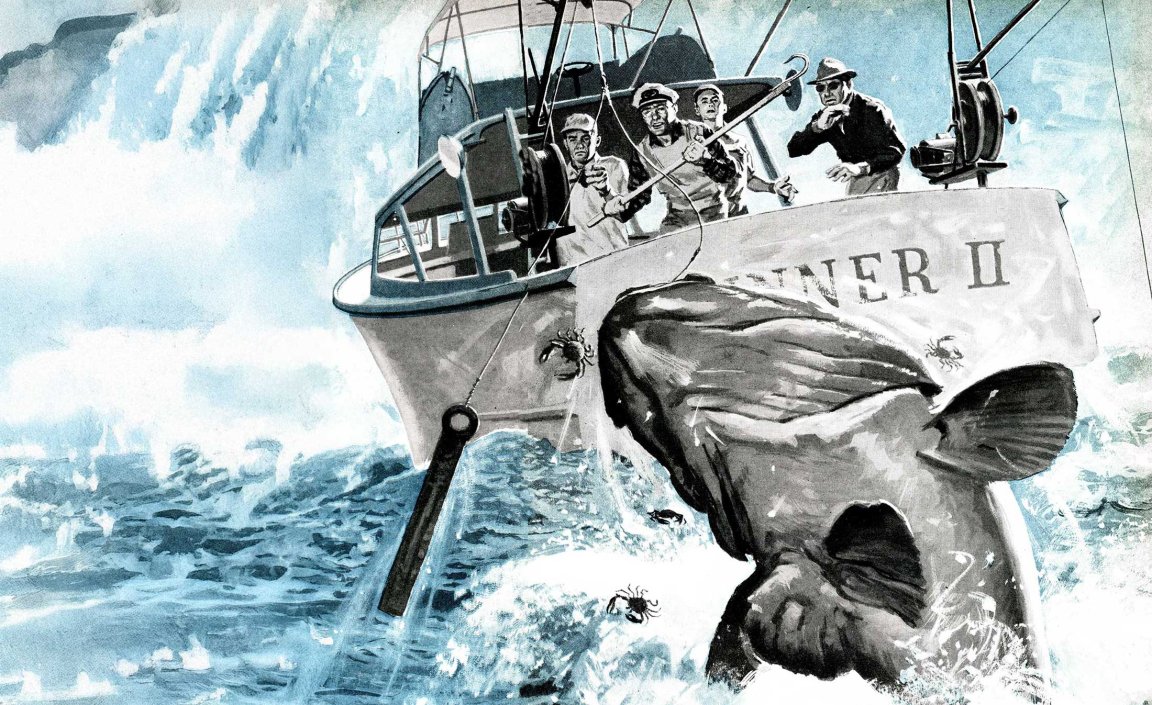
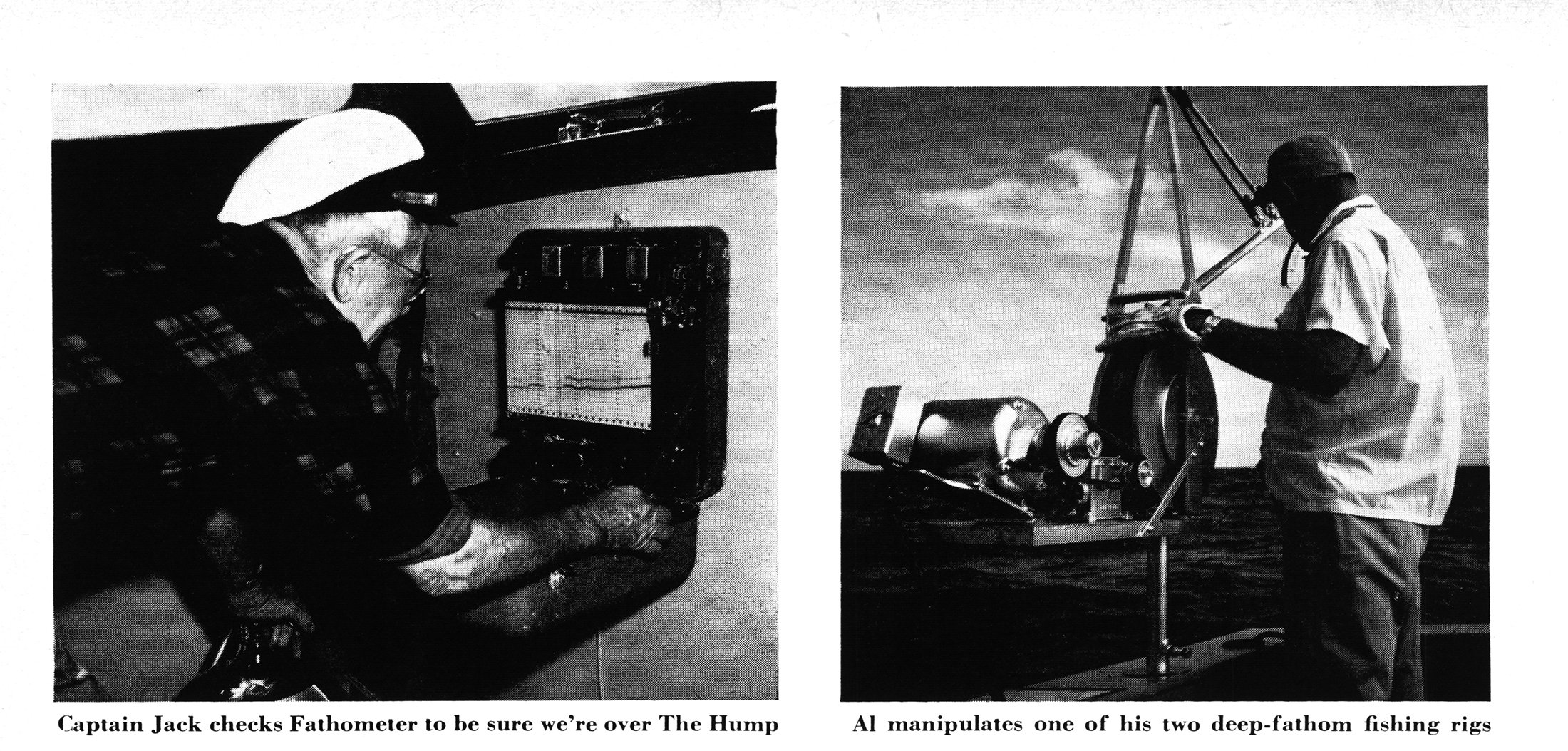
AS THE GUNNER II nosed into the 3½-knot current of the Gulf Stream, the double line on the Fathometer ran straight across the chart, telling us that, 800 feet below, the bottom was smooth.
“The top line is mud,” Capt. Jack Carpenter explained. “The lower line is the solid rock of the bottom. That means there’s about 48 feet of mud down there.”
Suddenly the lines began to climb, almost straight up for 100, 200, 300 feet. Then, just as abruptly, they leveled off again at about 288 feet down.
“This is it,” said Al. “We’re over The Hump.”
“I’ll drop a flag marker,” said Captain Jack. “Don’t want to lose this place after all the trouble we’ve had finding it. It’s only 400 feet long and half that wide, and that’s not big, out in the middle of this ocean.”
Al Pflueger, owner of the Gunner II, Capt. Jack Carpenter, Harold Graves, who heads up a stereoscopic instruments company in Portland, Oregon, and I were about 18 miles offshore from Islamorada, Florida, on the Florida Keys, and The Hump we’d been seeking is a mount that rears up from the floor of the Atlantic Ocean. The mount is supposed to be fairly easy to find, for with almost any kind of a tide running, choppy seas make up and a whitecapped rip fingers The Hump. But this day was so calm and the tide so slow that no rip was forming, and finding that small mount on the wide expanse of ocean had been like trying to find the hook eye of a tiny trout fly at dusk.
The Hump has a history. Time after time boats have come into the docks at Islamorada with stories of great battering rams of fish hooked out there, fish that popped the most powerful lines, froze the most expertly machined reels, tore tackle to bits.
“Swordfish,” guessed some anglers. Yet giant swordfish have been hooked and boated on lighter gear than they were using.
“Huge marlin,” said others. But again, great hulks of marlin have been taken quite often on regular sport tackle.
“They’re not ‘running fish’, whatever they are,” still others said. “They’re not fish that take the bait and swim off, pulling laterally to get away. They’re something that goes down and just breaks the tackle by pure brute force. Giant squid, perhaps.”
“Maybe even a coelacanth,” another fisherman suggested, naming the strange, prehistoric creature caught some years ago off the South African coast, which had been believed extinct for millions of years.
And so the bets went on, ranging from the best known and most likely swimmers of Florida coastal waters to strange and unknown denizens of the unexplored depths. Inquisitive and frustrated anglers went on trying every method they knew to bring up one of those monsters, methods varying from primitive but efficient handlines, which were inevitably snatched away from scorched gloves, to regular trolling tackle, which usually resulted in a cut-off.
One angler went out equipped with some barrels, tying his line to them. When he had a hit on his handline, he struck hard to set the hook, felt the heft of the fish, then dropped the line over, thinking to tire his catch in this way and eventually get it up. The barrels went off, skidding along the surface, then disappeared. A couple of them never reappeared; the others came bobbing to the top some time later, the lines scraped, torn, and cut from being pulled across rocks.
So the game went on. Time and again average fish were boated—tilefish, groupers, snappers, a shark—but nothing over 100 pounds. What was smashing up tackle out there over The Hump had to be bigger than that.
Al Pflueger had long been curious about the tackle-busters on The Hump. Al operates one of the largest taxidermy businesses in the United States, at Miami, Florida. His staff can make lifelike mounts of anything that swims, and the skins of great fish are sent to him from all over the world by gamefishermen and ichthyologists. Al can identify and give you the scientific name of almost any fish known, and is recognized as one of the nation’s top authorities. He seems to have been born with a natural curiosity about fish, and he spends most of his time studying them.
For some years he has been particularly interested in deep-fathom fishing from the scientific viewpoint, and has had the Gunner II especially rigged to find out what is down in the depths. He couldn’t have chosen a better teammate than Capt. Jack Carpenter. Over the years, Jack has guided the great names in sport fishing to most of the hotspots of the seas. Strangely, in all those years, he picked up a rod to fish for himself only twice. On those two occasions, two days apart in 1941, he took an 825-pound and an 880-pound bluefin tuna, the latter still standing as the world record in the 80-pound-line test class.
Harold and I felt we were in good company, with these two, in our jaunt to see what we could find out about The Hump.
“Deep-fathom fishing is fascinating,” Al said. “Last year, for instance, we caught a shark that had lights in back of its eyes. It’s called the cow shark, a very deep dweller and a strange one, too. It has a deep-emerald color behind the pupil of its eye. It even shines in the daytime. The first one we caught was terrific. I looked over the side and saw this green light coming up through the water, growing more vivid all the time. Then I saw it was the eye of this shark.”
“Do other deep fish have it, too?” I asked.
“As far as I know, only the cow shark, the oilfish, and the dog shark,” he said. “Nobody seems to know why.”
“The Japanese landed a shark that had a bill like a sawfish,” Jack Carpenter broke in, “and once I saw a dead squid whose two longest tentacles measured six feet. Its head was a foot and a half long.”
“Max Lerner caught a five and then a 6-foot squid on hook and line, off Cabo Blanco,” Al said.
“In Bermuda,” I contributed, “Louis Mowbray used a modified version of the Japanese long-line rig to catch a lancet fish, the first of that species in perfect condition ever taken in the Atlantic.”
Al had evolved his apparatus from first a long handline to a hand-operated winch, and finally into a slick, electrically operated machine with a slightly Rube Goldberg look, two of which were now mounted on the gunwales, one on either side of the cockpit.
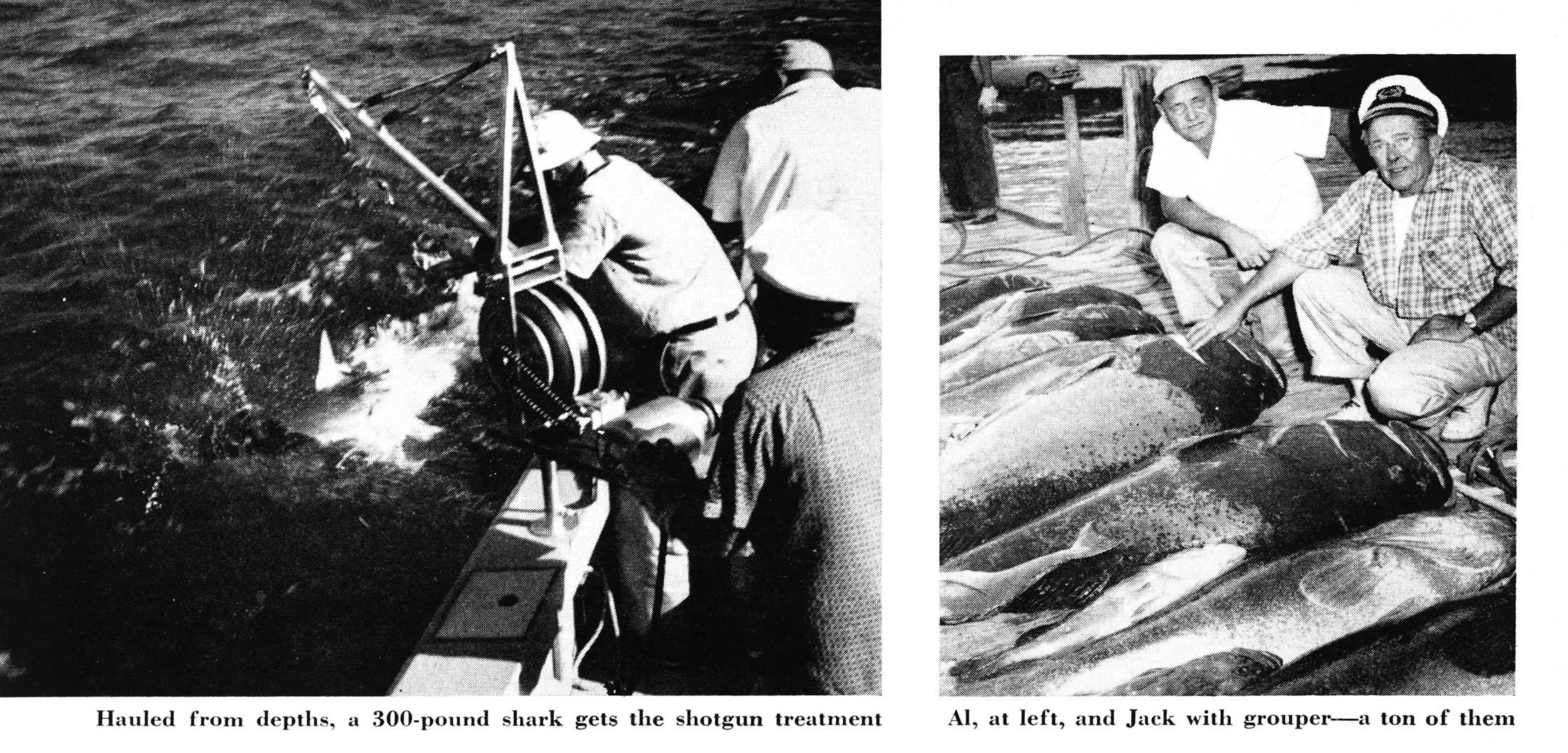
The four-foot-long metal bars used as rods, and the entire frameworks, are so solid as to be almost unbreakable. Wound on the huge spools was 5,000 feet of 500-pound-test stainless-steel line, with seven-strand twisted cable for the leaders, testing out at the same 500-pound breaking strength as the line. For fishing in 300 feet of water, where there is no current, the outfits call for five-pound sinkers, but as the water gets deeper or the current increases, the weight of the sinkers is upped to as much as 30 pounds to get the bait down to the desired depth.
Hooks are from sizes 6/0 to 12/0 and are of triple strength.
The big reels run on 32-volt current, but can be operated exactly as game-fishing reels with star drags. They can be thrown into free spool, the drags can be tightened or loosened, and all the while the electric motors keep ticking away, ready to pull fish up as they tire.
“We’ll drift,” said Jack, when he had got the marker overboard. “Then when the tide gets stronger, I’ll run one engine real slow and head the boat into the tide. That way we can hold her in one spot.”
The first baits that we used were four-pound jack crevallé, one to each of the rigs.
“Let’s go,” said Al, and he and Jack each pushed a button to put the reels in free spool.
We leaned over to watch the baits sink. Down they went, down and down, and when at last the heavy weights hit bottom, Jack and Al pressed buttons on their rigs to bring the weights up about two feet. We waited.
Almost immediately Al’s rod shook violently.
“Got ‘im,” Al shouted as he thumbed the button to start the line up and set the hook.
The stiff rod began beating up and down, and at the same moment, “Strike!” yelled Jack, and his rod also went into a dizzy downbeat.
This was something to see. Both those “rods,” really solid iron bars, were dancing up and down like bamboo, line paying out protestingly over the tips, reels squeaking as they lost line, groaning as they gained. And those two men, who have fished the waters of the world for gamefish, were glued to that deep-fathom gear with as much enthusiasm as if they were battling those monsters on the lightest of tackle.
“He’s coming up,” Al yelled.
Staring through the clear water, I saw a small, silvery spot far below. It turned brownish, grew rapidly, and then suddenly, 25 feet away from the boat, a fish bounced out of the water in a froth of bursting bubbles.
“It’s a coney grouper,” Al said. “Not very large, though,” he added as the electric winch pulled the fish over to the boat and then swung its 30 pounds over the side.
At the same time, Jack was boating his fish, this one a long, pale-gray tilefish that weighed about 20 pounds. Tilefish are most commonly found along the 100-fathom curve, and there are three members of the family—the true tilefish, the gray, which we caught, and the sand. The true tile is also found in Florida waters, but the gray is there in greater numbers.
“That’s 20 pounds of good eating,” said Jack. “Both of these fish are delicacies.”
“They’ve been down there feeding on crabs till they’re fit to burst,” said Al, “and that’s what makes fish flesh worth eating.”
The next drop brought a strike to Al’s bait before it hit the bottom, and the fish fought back so hard I thought it was going to tear the rig apart. Then everything went slack. Al brought the line up.
The leader was cut clean through just above the hooks. “That was a big shark,” Jack commented.
After that, for a long time, there wasn’t a strike.
“No wonder things are quiet,” said Al suddenly. “We’ve drifted off The Hump. The marker is 200 feet back.” We pulled the lines in, ran back, and dropped the baits over again.
Wham!
Al’s rod went into all kinds of bobs and bends, swipes and swoops, and the feet of the rig strained at their holdfasts. This was a big one, all right. The reel protested violently and the motor croaked, then the big reel gave line, took some, and held even. But that fish wanted out and he went out. He took line, faster and faster, and then there was a loud Ping and everything went slack.
When Al brought his line in, we saw that the hook was broken off at the bend.
“Either a bad hook,” Jack said, “or a mighty sharp-toothed fish.”
Al put on new terminal tackle, baited the hook, dropped it down until it hit bottom, then buttoned it up for a couple of feet. There was an immediate strike. He pushed the button again, and the fight between monster and machine was on. This fish was even bigger than the last one. It fought harder and longer, and for a while it looked as if it was going to win, for once more everything went slack.
“Guess the hook must have come out,” I said.
“There he is, back there,” said Harold Graves. “He’s back there on the surface.” A big, bloated-looking creature lay on the top, about 40 feet from the boat.
“It’s a big Warsaw grouper,” said Al. “We brought him up so fast his air bladder blew up and his stomach turned inside out, so he can’t get down again. If such a fish is returned to the water headfirst and with great force, it will often retract its stomach and go on down. But if it’s left floating helplessly on top like that it would soon fall prey to a shark or be killed from above by sea birds.”
Within limits, fish have the ability to adapt to depth changes. Most are not called upon to do so to any great extent because everything they need to sustain life is usually found where they normally live. The more primitive fishes have the air bladder openly connected to the esophagus, but the higher-evolved, spiney-rayed fishes, such as we were dealing with, have no such connection. They can control the air in the bladder as they change depths, by secretion. But if they are brought up rapidly—as on rod and reel and as with the tackle we were using—the air expands beyond the point of control. When that happens, the fish “fall” upward to the surface, bloated, ruptured, and even exploded. Their stomachs turn inside out and their eyes protrude out of their sockets.
We went over and pulled the big grouper aboard. He was even bigger than he had looked.
“He’ll go 125 pounds,” said Al. “We’re getting into the big ones now.”
Once more Jack ran the boat back to the flag and sent his bait on its way. He had a strike on the way down.
This fish fought like the other only harder, but finally it came up and much closer to the boat. I saw it coming, and at first I thought it was a big turtle. But when it hit the top and the bursting bubbles subsided, it looked like a brother of the first one.
“A bit bigger,” said Al. “He’ll go a good 150.”
This was not my first experience with deep-fathom fishing. Eight years earlier I had spent a day with Thorvald Sanchez, Cuban sportsman, on his Siboney II. Thorvald wasn’t interested so much in big fish at great depths as in finding new areas where either shrimps or snappers congregated in sufficient quantity to provide commercial fishing. He had rigged an outfit which was a sort of pygmy cousin of the one Al uses. An automobile spring served as the rod, a pair of bicycle wheels, hand-manipulated, ran the big spool which held 1,500 feet of 100-pound-test Monel wire line, and the 250-pound-test leaders made of piano wire carried two big hooks which were baited with chunks of dead fish. A seven-pound lead weight took the baits down to the 1,200-foot-deep bottom off Punta del Este on the Isle of Pines.
With that rig, and at that depth, our biggest fish had been a 22-pound snapper and one lonely, 50-pound sand shark, and the number of small fish was an eye-opener to me, particularly the snappers. We took several only five and six inches long, ample proof that fish of this species must spawn and live a great deal of their lives way down there in the depths.
“I was surprised sharks didn’t bother us more, that time,” I told Al. “Maybe they don’t like to go so deep.”
“I’ve seen photographs of an unnamed six-foot shark at about 4,000 meters,” he said, “and in the Gulf of Aden one was taken at 1,800 meters. There are even records of sharks in the deep, abyssal regions, the netherlands of the seas, water below 6,540 feet or 1,090 fathoms. But in general, you can pretty well name the fish you’ll find at certain depths. At 100 fathoms you can bet on gray tilefish, Warsaw grouper, silk and blackfin snappers, all the shallow-water sharks, vermillion snappers, and the great mako sharks; and at night oilfish move up to that depth temporarily.”
“That sounds like a good fishing depth,” I said.
He went on to say that at 300 fathoms and more, oilfish may be found in the daytime, along with spiny dogfish, cow sharks, queen snappers, and Aprion snappers running to 500 pounds.
“We’ve fished for oilfish in Bermuda, with long lines,” I said. “Those things really tear up tackle.”
Oilfish are so named because of the purgative effect they produce when eaten. They are also known as tapioca fish because their flesh, just under the skin, looks like tapioca. They are rare, grow as large as 100 pounds, and are terribly strong. Their eyes are two inches across, with a one-inch black center, and they have thin, very sharp teeth. Usually they are taken only by commercial fishermen using extremely long handlines.
“With heavy gear and real luck you might be able to land a 100-pounder,” said Captain Carpenter. “But if they grew any bigger, you’d never land one.”
“Maybe that’s the scoundrel that’s breaking up the tackle on The Hump,” I suggested.
“Could be,” they agreed.
They both dropped their baits overboard again and put thumbs to the buttons to run them down. We found right then that those 100 and 150-pounders we’d seen so far were just hors d’oeuvres. Jack’s next fish was a Warsaw grouper that went 200 pounds. Al landed a 250-pounder, and he no sooner got his bait overboard again than he was into something that outfought all the others put together. But finally the sturdy gear pulled him to the surface. It was another Warsaw grouper—300 pounds.
“They get bigger and bigger,” I said. Al and Jack were too busy to answer, and also too breathless. Though the machines did the work, it still took the three of us, giving our best efforts, to haul those brutes over the gunwale.
Next time the baits went over they had simultaneous hits. The two rigs strained harder than ever, both reels losing line. Jack and Al tightened the drags. And, as if the lines were tied together, both went slack the same instant. When the lines were reeled in, two of the big hooks, one on each outfit, were straightened out.
“We must have had twins on,” grinned Jack as he put on a new hook, baited it, and let it down. In seconds the rod started bobbing up and down, with heavy emphasis on the down. Then it plunged almost to the surface, gave a tremendous shudder, jumped back with a thud, and vibrated like a piano wire for a few seconds.
“Sure busted something that time,” said Jack.
“I’ve got one,” shouted Al as his rod went into the same kind of dance.
It ended the same way, too, with that hard down pull, shudder, and whanging vibrations. This time, when they brought the lines in, both hooks had been broken off at the bend.
“Now we’re really into heavy stuff,” said Al. “This calls for bigger hooks.” They rigged up with triple-strength 10/0 hooks.
Al got to the bottom first and brought the hooks up a couple of feet. The moment it stopped there was a strike.
What had happened before was child’s play. This fish took off on a 100-foot run against the heaviest drag Al had yet placed on the reel. But it finally pulled the fish to a stop, though it kept yanking and tugging, and Al got back some line. Then it went off again, showing all the strength of a hippo, slowly but steadily. Again the drag stopped him and pulled him upward and toward the boat.
“He’s the biggest one yet by 100 pounds,” Al said.
“He’s coming now,” said Harold. “I can see him down there.”
I looked into the water at what appeared to be a distorted blimp that changed, as it came higher, to the proportions of a fish, moving up fast. It hit the surface surrounded by bubbles bursting so hard you could hear them. Lying out there on his side, his air bladder inside out, this Warsaw grouper bulged a good foot above the surface. Jack and Al grabbed the leader and tried to lift.
“Can’t make it,” Jack said. “You fellows help.”
Harold and I jumped to the line. We heaved, got the head of the fish up, heaved some more, and had him coming. There was a nervous moment when he balanced on the gunwale, but we hauled again and skidded him into the boat.
“He’s a good 500 pounds,” puffed Al. “Look what’s coming out of his mouth.” An orange-colored crab with long, spidery legs had popped out of the fish’s mouth. Then another, and still more, poured from his inside-out stomach. We took 36 crabs out of that fish.
“Look at this,” said Jack. He reached down and pulled a two-foot long, whitish eel, twice as thick around as a pencil, from the lining of the stomach. “It’s petrified. Never saw anything like that before.”
Minutes later Jack hooked another Warsaw, again a 500-pounder.
Then something different picked up his bait. This fish, instead of playing the customary bottom-hugging tactics, moved forward through the water. “Must be a shark,” said Jack. “There he is.”
About 100 feet away something was thrashing the surface into whitecaps, and in the midst of spray we saw the tail of a shark flailing away. The motor drew him slowly our way and we soon saw that it was a sand shark, going about 300 pounds. A couple of 00 shotgun blasts took care of it.
By the time both rigs had hooked another 500 pounder each, daylight was running out, and we were all good and tired from heaving those big creatures aboard.
“Guess we’d better go,” Al said.
“Let’s make one more drop,” said Jack.
Read Next: The Legendary Shark Fishing Record That’s Never Been Broken
Al’s line got down first, and right off he had a strike that rocked the boat. This fish had the bit in its teeth. It made a 500-foot run, dodged, twisted, and yanked, turned over on the leader, brushed the wire against rocky outjuttings, and all but tore the machine from its moorings. That fish just didn’t want to come up. After half an hour, however, Al started to regain a bit of line.
“When he reaches a certain point where his bladder can’t take it,” Al said, “he’ll start his fall upstairs. Then we’ll have him.”
Up and up he came, then we saw him deep down, a twisted, whitish form that seemed as big as a submarine. He wasn’t atom-powered, but he was the next thing to it. Then he blew up.
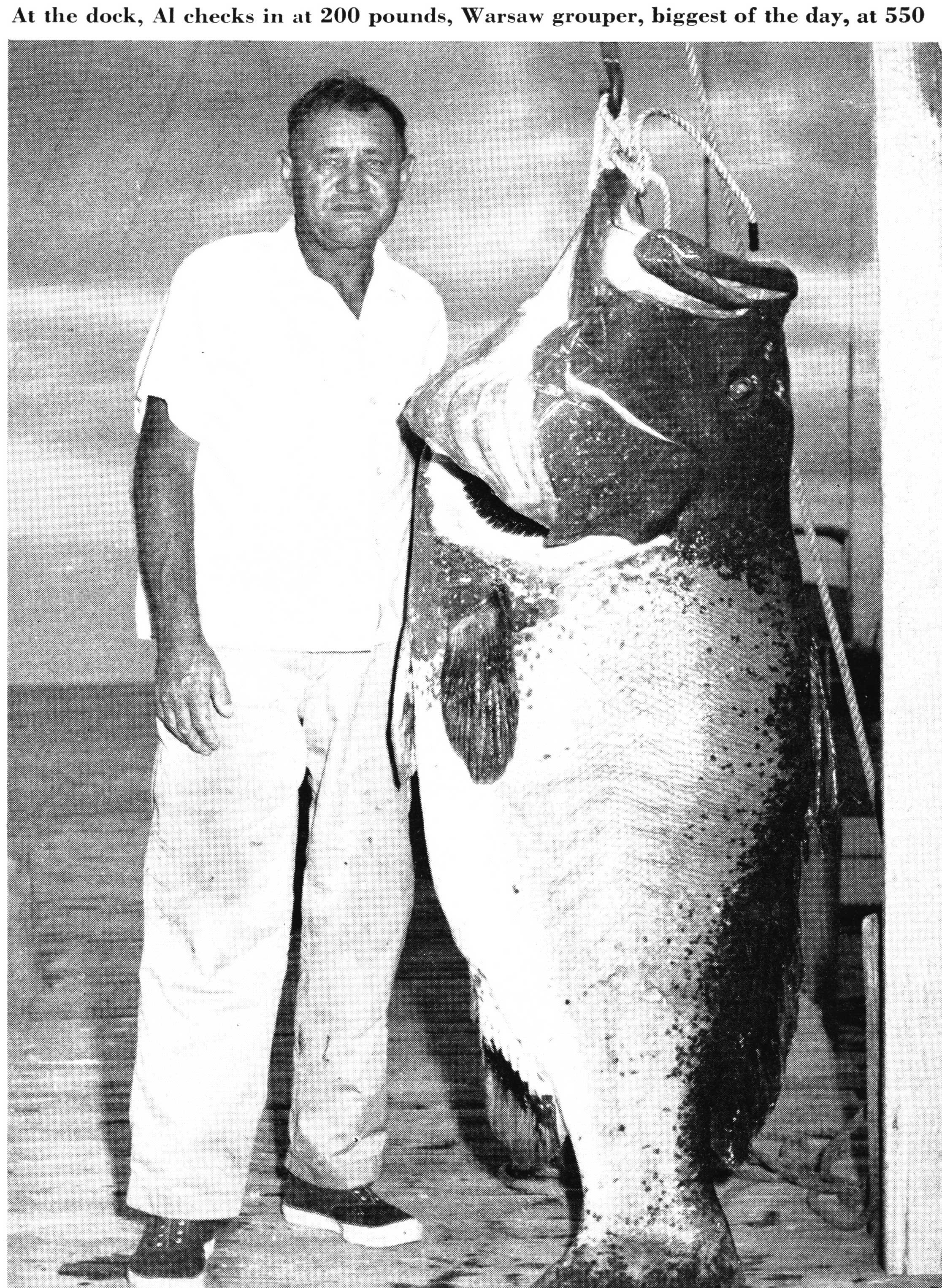
We saw crabs come shooting out as he emptied his stomach, and an eel, and then we fell back because he came so fast it looked as if someone had thrown him at us. He busted out only 10 feet away, a gigantic Warsaw that had the bulky form of a registered Angus bull—all body and no legs. But this baby had fins which, though dwarfed by his great frame, were big enough to make that machine take a full hour to bring him in.
“It’ll go 550 pounds,” said Al. “We’d better go in before we hook something that anchors us here for the night.”
When my head hit the pillow that night, I closed my eyes and immediately I was down along the jagged slopes of The Hump. I saw orange-colored, long-legged crabs slithering across the bottom. I saw great hulks of Warsaw grouper, mouths open wide enough to swallow a man, and in the dim background the outline of a long, heavy-shouldered fish with a broad bill—1,000 pounds, I knew—one of the greatest fighters in the ocean, the mighty broadbill swordfish. As I watched, an extra big Warsaw swam close to that great fish, opened its mouth and inhaled, and then the swordfish was gone. Only the tip of its tail stuck out the Warsaw’s mouth.
It rocked me, that sight. I jumped up in bed.
“Warsaw grouper!” I shouted. “They are the ones that break things up.”
“Go back to sleep,” came drowsily from Al. “Of course it’s the Warsaws. Today we found out.”
This story was originally published in the December 1960 issue of Outdoor Life.