
This story, “Destination: Frog Island,” appeared in the February 1975 issue of Outdoor Life.
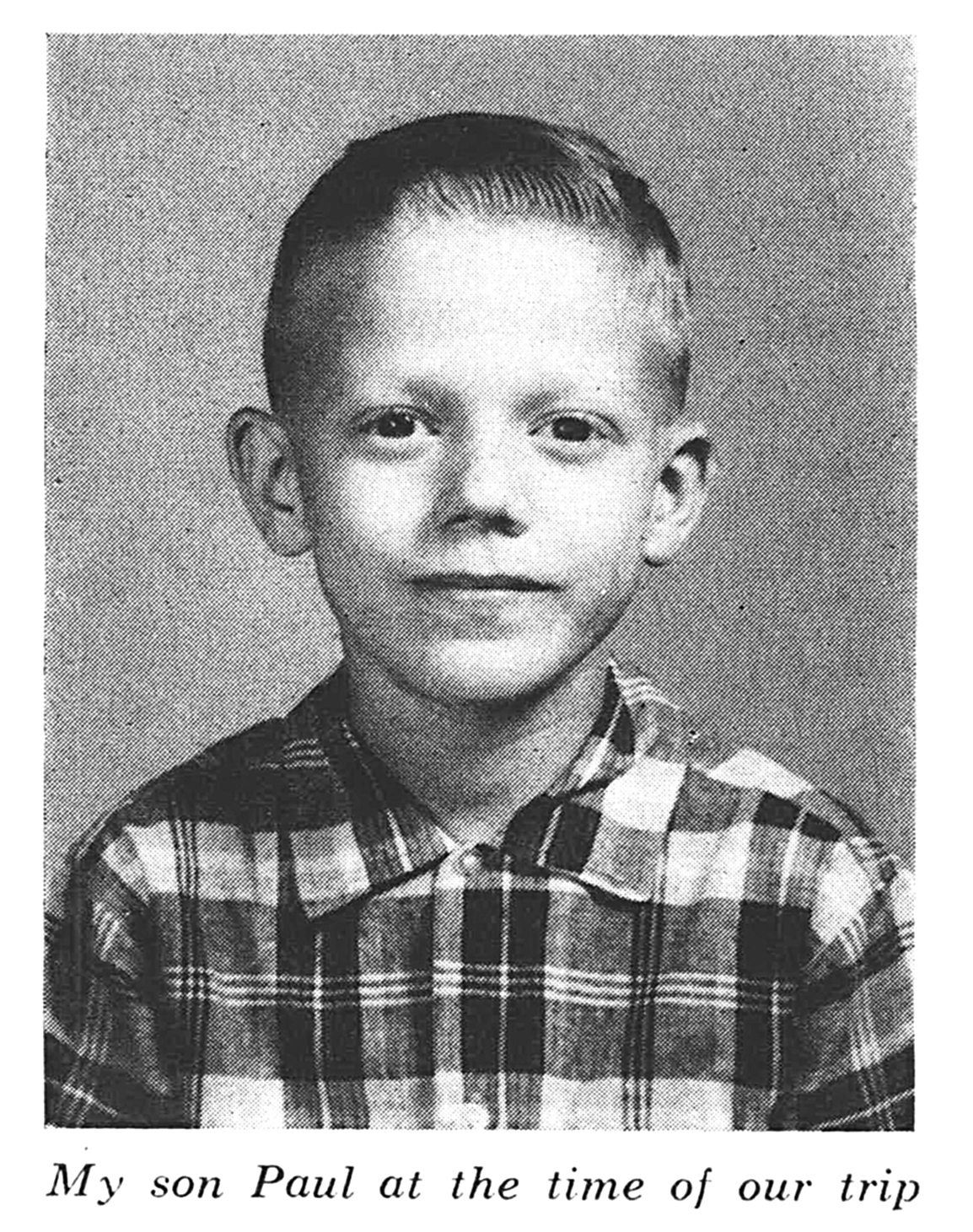
My eight-year-old son Paul sat on the middle seat as our rented 12-foot cypress boat plied a sluggish northwesterly course to Frog Island. We headed for a tall pine on the island’s southeastern tip. The pine stood some 50 feet inland and was a landmark for an old Prohibition whisky cache as well as a marker for the island’s only eastern and southern boat entrance, just wide enough to squeeze a boat through. Our new three-horsepower out-board, with no neutral position, sounded like a twenty-dollar lawnmower without the muffler. While the motor was running, the only possible way to communicate with anyone else in the boat was to collapse your lungs with high-heaven screams, or gain his attention with a paddle tap on the shoulder and then talk to him with hand signals. Perspiration streaked our brows as the mid-evening June sun bore down upon us. The summer of 1960 seemed to be throwing everything it had at us. No breeze stirred, and a summertime lull seemed to envelope our surroundings.
Paul turned on his seat, trying to shade his face from the blistering sun. The seat wobbled as he turned and Paul half rose to examine his perch. He didn’t know that the middle seat was the boat’s live-box. I shut off the motor and explained to him that the live-box was a built-in compartment with holes bored through its bottom, which was also the boat’s hull, to permit water to circulate inside and keep a catch of fish alive and fresh.
“Then what’s down in there now?” he yelled.
“Oh — dear Lord!” I shot up a prayer. “Please, don’t let there be a water moccasin in here with us!”
After a careful but shaky approach to the live-box, I was greatly relieved to see a strip of oily rag floating around in the box’s murky depths in a most convincing snakelike manner. It was a few moments before I could muster the strength to pull the starter cord — and a while before my pulse returned to near normal and my heart stopped pounding like a parade drum.
My eyes roamed over our gear, scattered from bow to stern. There was our shiny new $6 two-man floorless pup tent along with four tightly rolled quilts from home. These would be our bedding, two for each of us — one quilt as our mattress and the other to crawl under along with an assorted variety of bugs, ants, katydids, and other creatures that often crawl under camping covers.
Our tacklebox was an old toolbox that we had discovered in the woods and coveted home. A few dents smoothed out and a couple of coats of green paint had made it worthy. We had cane fishing poles, a coffee can of nightcrawlers, which we’d dug behind our garage, a trotline and three-dozen shiny new hooks, and half a pound of juicy beef liver as trotline bait.
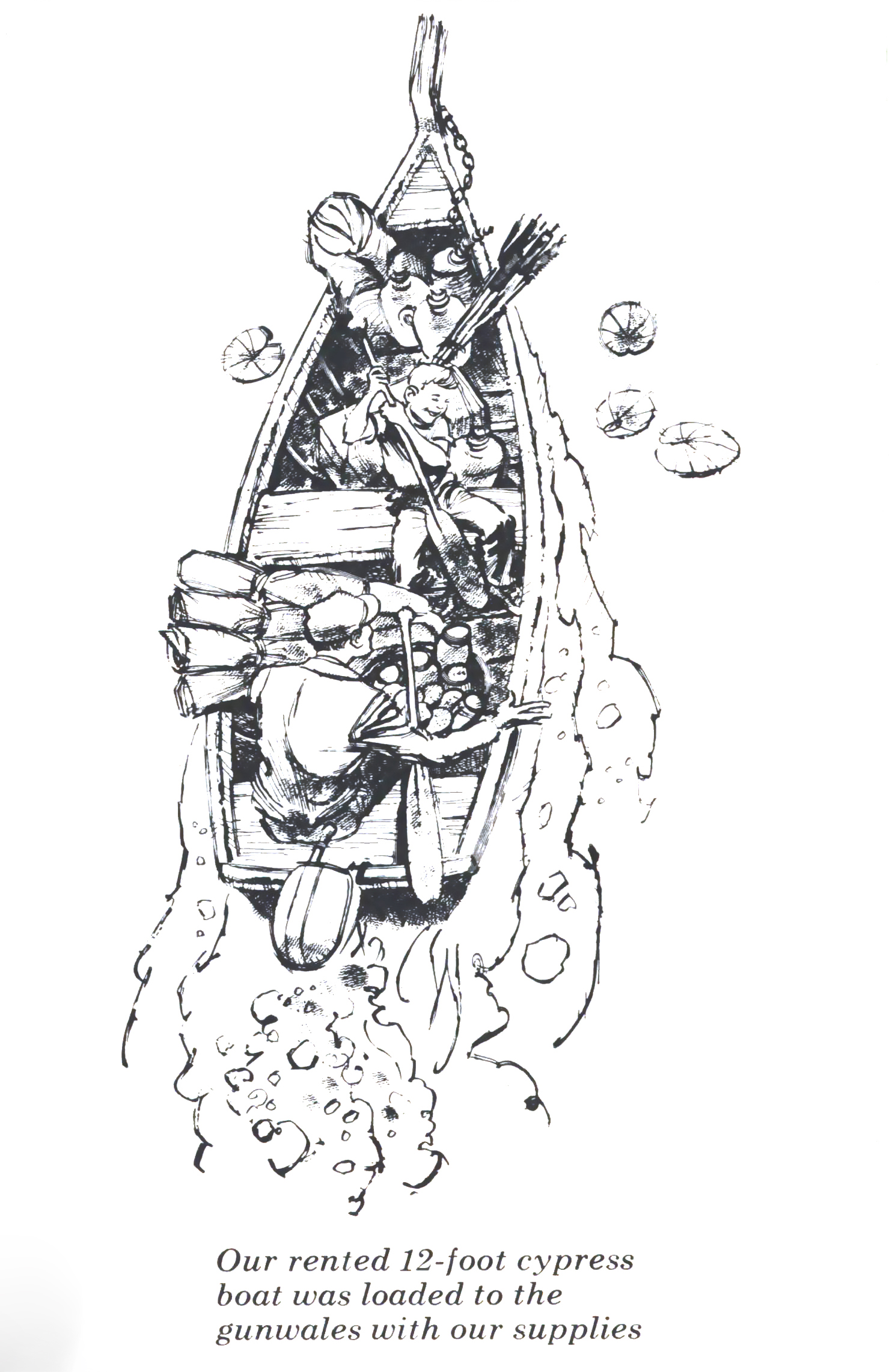
Beneath my feet was a dishpan brimming with pint jars of meal, shortening, coffee, bread, a serving-for-six can of beef stew, two cans of pork and beans, eight large Irish potatoes, two raspy-skin white onions, a candle, dishcloths, knives, forks, spoons, plates, and two tin coffee cups. Behind Paul were two one-gallon jugs of water to be used for drinking and dishwashing.
Our small ice chest held three quart-size blocks of ice that we had frozen at home. Newspaper lay over the ice for insulation. On top of the old newsprint lay a pound of bacon and half a dozen eggs carefully wrapped in some of the best pages of a Sears & Roebuck catalog.
A can of fuel for the motor, two gallon jugs of used motor oil, and a bundle of dried cattails, which we had pulled up from the edge of a bayou, lay in the bow. Tonight we would soak the cattails in the oil, stick them in stump tops, and set them afire. With luck, fish would be attracted by the fire-seared bugs and insects and would hit our short-lined baited hooks.
I cut the motor as we steered the boat through the narrow opening to the island. The bow made a soft sighing sound as it slipped up on the sand. For a moment we sat and listened to the silence around us, unbroken except for the sound of a cypress gumball kerplunking into the bayou and an occasional splash of a fish. Though the sun was still two hours high, those were the only sounds we heard.
About 20 feet in front of our boat we cleared an area for our tent, and to the left we cleared another spot for our campfire. A few feet from our campfire site we dug a hole for our dishwater and empty tin cans, which we would burn and then smash flat and bury before our departure the next day. I took great pains in explaining to Paul that to enjoy the wonders and treasures of the outdoors we had to do our part in keeping the bayous, lakes, rivers streams, and woodlands clean. We picked up fist-size pine cones and resinous pine knots, and gathered an ample supply of firewood from a large downed oak. Amid the fire circle we stacked pine needles haystack fashion, then built around them with small twigs. Around these we placed four pieces of oak in a diamond shape and then put small limbs and branches crosswise and upward. Tonight our campfire would bring out the essence of camping as its flames shadow-danced in the sand. We unloaded the boat and pitched the tent, guying and ditching it in case of rain. We placed a layer of pine needles and moss inside, and our bedding was spread over this soft mattress.
Having no table, we scouted to the north and found what appeared to be an old whisky-cache lid, about three feet square-just right to serve our purpose. Four cuts from a sapling served as table legs, and once they were driven into the soil with the lid on top, our table was complete. We placed our utensils on the table, then slipped our groceries into a sack and tied it to a limb.
The hoot of an owl pierced the evening silence, echoing back and forth across the bayou. A moment later the lonesome notes of a whippoorwill reminded us that purple shadows were now stalking the island and night was not far away.
“Will the owls hoot all night?” Paul asked.
“Sometimes they do,” I answered. We looked at our campsite with pride and a feeling that we were now a part of all this and not just
two overnight visitors.
“Boy! It looks good, doesn’t it?” Paul asked with a touch of enthusiasm. I agreed that it did and knew that tonight would be long remembered by both of us. For this was Paul’s first camping trip.
Many nights, after a hard day’s work selling insurance, I would sit at the kitchen table with Paul, a map of Caddo Lake spread out before us. We would plan and talk and dream. We were, I felt, prisoners even in the confines of our new home in Shreveport, Louisiana, 23 miles south of Jeems Bayou and Frog Island.
Paul already knew how to handle a .22 rifle and had a steady aim. He had his own pocket knife, which he would laboriously sharpen on a very· worn stone. He had accompanied me on woodland jaunts many times, and I frequently piggy-backed him (when he was much younger) through briers and brush. He was quick to learn, and curious about and amazed at jumping fish, bellowing frogs, and hooting owls. I wanted our first camping trip to be something special, so we decided to camp on an island.
Frog Island was so named because of its shape and abundance of bullfrogs. The island is about a quarter-mile long, less in width, and located in the Jeems (James) Bayou section or northern portion of Caddo Lake. The sprawling body of water was once the stamping grounds of the Caddo Indians.
Caddo Lake’s more southern and deeper waters often whitecap with the slightest breeze, while Jeems Bayou, shallower and with abundant cypress stands, usually has a more serene surface. The lake still holds a grip on a part of yesterday. During the late 1890’s and early 1900’s, oil was discovered beneath the lake’s waters and its surrounding woodlands and plateaus.
Signs of the old oil boom — rotting oil-well foundations, pilings, and other clues — can still be seen. Beneath the surface lie abandoned steam boilers, bull wheels, and other items, many of them near enough to the surface to remain hazardous to today’s boatmen. Yet these sunken and rotting relics of the black-gold days provide havens for largemouth bass, white perch, bream, catfish, buffalo, eels, and an occasional alligator.
I grew up in Caddo, a mile north of Oil City or “town” as it was called. My free hours and weekends were spent either on Jeems Bayou with friends or roaming the adjoin-ing woodlands building lean-tos and log cabins.
So Jeems Bayou, with its cypress stands, coves and sloughs, islands and ponds, was a little bit of heaven to me. Frog Island was a place to get lost, to roam, to explore, or just to lie down in the shade of a tree on a summer day and enjoy the solitude. Frog Island was often (and still is) a topic for argument. During the rainy fall and spring seasons the protruding northern tip of the mainland was inundated, and thus the island was truly an island. In summer’s lower water the tail of the “frog” became a thin strip of land connecting the island with the northern shore.
Frog Island was a haven for boot-leggers during Prohibition, a place to hide and a spot to bury whisky. Our campsite on this trip with Paul was on top of one such whisky cache. The caches were holes some three feet square and deep, lined with moss and leaves atop which the bottled booze was placed. A trapdoor-type lid covered the hole, and a perfect camouflage job of logs, brush, and debris covered the cache.
Pine, oak, gum, hickory, and cypress forested the island. Large grape-vines snaked across the ground and climbed eerily up the trees. Mosquitoes, snakes, lizards, owls, hawks, quail, rabbits, squirrels, and a variety of birds either inhabited or visited the island.
The island’s trees fringed the shore in such hedgerow fashion that a stranger could fish from a boat 15 feet offshore without being aware that an island was there. So thick was this curtain of timber that there existed, to my knowledge, only two places of entry large enough for a boat — one on the southeast side and the second on the northwest.
Paul was anxious to do whatever we should do next, and as another owl hooted, much closer now, he asked, “Hadn’t we better set out the trotline?”
“Yes,” I answered, mopping my brow. “First, though, we ought to put our torches out in those stumps. It’ll be getting dark much sooner on this side of the island. Then we can put out our trotline. Then there’s one other thing we need to do before coming back to camp to have our supper.”
“What’s that?” my son asked. “You’ll see. Let’s get started.”
Paul stepped into the boat and made his way to the stern to raise and lock the outboard since we would now paddle.
“I bet this is an old boat, isn’t it?” he asked, eyeing the chipped and split gunwales.
“I bet it is,” I agreed. Age, weather, and much use had taken their toll on the old homemade cypress craft. Its bow stem was a piece of carved cypress that protruded about a foot above the bow gunwales and then curved outward, giving it the appearance of something the Vikings left behind.
Paul paddled from his live-box seat while I Indian-paddled from the pointed bow. I tossed the package of beef liver to Paul, the signal for him to cease paddling and begin slicing the meat into thumb-size chunks. He baited the trotline hooks and hung them over the edge of a can within my reach. We set the north end of the trotline with the first 18 hooks to drop about five feet; the remaining 18 would dangle about eight feet below the surface, which would put them from two to four feet off the bottom.
“The torches are out, the trotline is ready, and now …” Paul paused, waiting for me to speak of “the other thing we had to do.”
“Over there,” I said, pointing with the paddle. “Those big lily pads — that’s where the biggest frogs will be tonight. But we need to see if the entrance is blocked by a log.” The huge pads were inside a circle of stumps and snags, and there was only one entrance. A log was there but off to the side and not blocking the opening.
The shadows had grown into darkness, and although a moon would shine tonight, it would be two hours before it rose. We turned and headed for camp, guided by glimpses of our flickering kerosene lantern hanging from a limb at our campsite’s small entrance. By the time we paddled the last 100 yards we’d counted eight owls hooting, one of which, we decided, must be the grandaddy of them all.
Once ashore we lighted the fire, lowered our groceries from the limb cache, and began preparing supper — peeling spuds, slicing onions, and laughing at our “KP.” At home my wife would have had to sue me for divorce to get me into the kitchen. And Paul? His dear life would have to be threatened before he would peel potatoes in front of his sister. Now it was a different story.
Paul then discovered a crisis: our dented coffeepot had been left behind. And no wonder. What with such invectives from family and neighbors as “Don’t you drown that boy!” — “Don’t you let an alligator get him” — “Don’t let him cut himself with that knife,” I wondered how we got away with as much gear as we did.
My camping partner came up with a solution.
“Make the coffee in the baitcan,” Paul exclaimed.
I swallowed a hard “Ugghhh!”
We hastily dumped the nightcrawlers into a wet towel, covered them with moss, and rolled the bundle up. Using mud, water, sand, and moss we scrubbed the baitcan until I was convinced it was clean enough so that we wouldn’t wake up with leprosy, Brown’s warts, or something else that, with my luck, couldn’t be cured. I put the bait-bucket coffeepot on the fire.
Black mosquitoes began to swarm forth from the island’s nooks and crannies, sending us to our bug dope, which we rubbed on our faces, necks, arms, and hands.
We sat down near the fire, our pie-tin plates brimming with steaming onioned pork and beans, french fries, toasted bread, and boiling “nightcrawler” coffee. The coffee’s aroma seemed to have a rather quieting effect on the owls, for it was well after supper before they hooted again.
(In our haste to make coffee, we decided to “just dump a little” into the pot rather than waste time using a spoon to measure. The next morning when we reached the mainland where we’d rented our boat, the camp operator remarked, “Man, oh man! What kind of coffee did y’all make over there last night?” “Worm-bucket coffee,” I answered slyly.)
With the supper dishes washed and put away, we relaxed on the matted pine straw and watched the stars twinkle through the thick canopy overhead. Already the big frogs had begun to “Barummppphh” all around the island, and we could tell from the sounds that there were many large frogs in the chorus.
At the moment I was as much boy as my son was. I thought of the peace and quiet here away from the bumper-to-bumper city traffic and the pressures of everyday life. I told my son that being in the outdoors and learning its secrets — loving it and its inhabitants — is the kind of life that keeps you out of trouble.
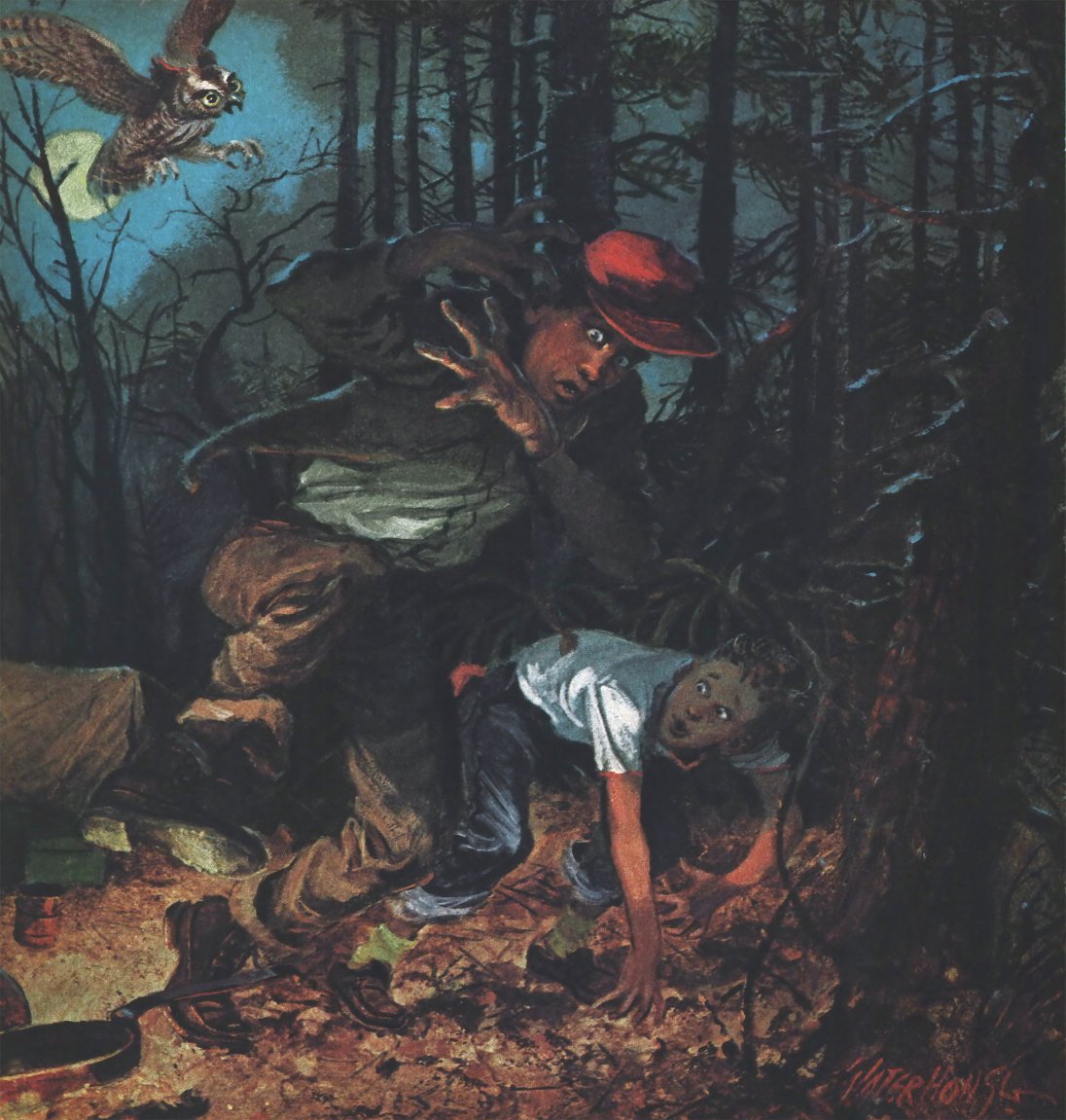
We began to doze, but not for long. Above our heads a whistling shriek ripped the night. Instantly we came to our feet, with an unexplainable weakness in the knees. An owl had dropped in on us, perching himself like a lord in the pine behind us. Paul and I had almost had a good try at walking on water.
his bug-eyed nocturnal creature couldn’t have picked a better time to scare the wits out of us. We moved the boat slowly through the small passageway into the field of lily pads, and it sounded as if every frog in creation was out and bellowing. Paul sat quietly with a flashlight while I guided the boat, a carbide lantern strapped to my head. Frog eyes glared and glistened from lily pads, snags, and stumps.
“I never heard such a racket!” Paul exclaimed, a little shaky. “Daddy look! Look at that big ol’ frog!”
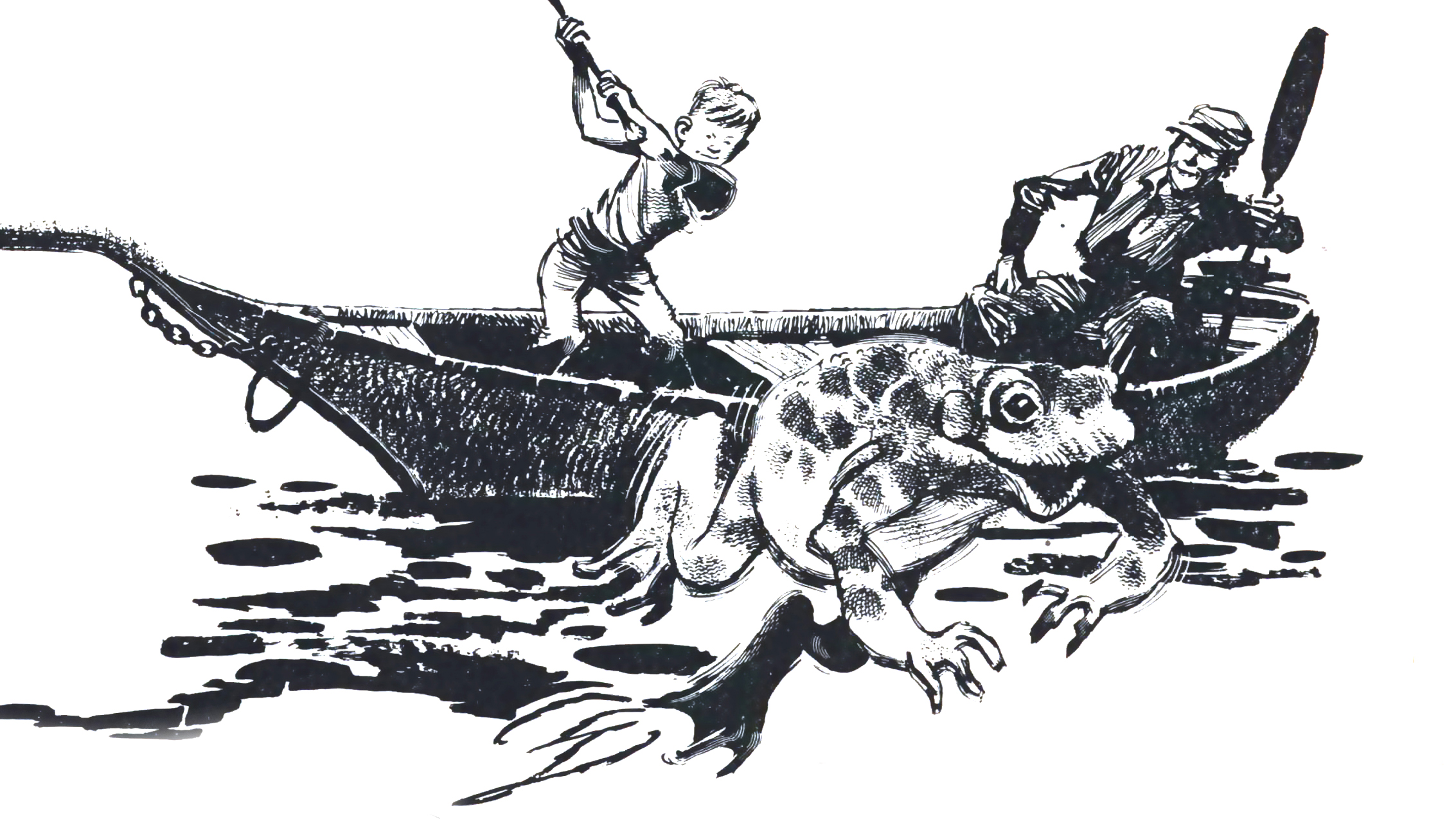
“He’s all yours,” I said. The monstrous frog sat perched on a large lily pad near Paul’s end of the boat. Paul had been frogging with me before, but only along streams, and never by boat. I had, however, briefed him time and again at the old kitchen table on how to paddle-slap a frog on a lily pad or soft mud along a shoreline. I am not much on frog grabs, since to use them you have to be nearly on top of the frog and he must be perched on something at least partly solid. If not, the instant the grab touches him either it pushes him down through the lily pad or mud or he is gone in a flash. So the paddle it was.
I moved the boat closer as Paul turned and shined his light into the big luminous eyes.
“Easy,” I said. “Hold it … hoolllldd it … now!”
Paul’s paddle, previously raised above his right shoulder, came down on the frog with a rifle-shot crack, splashing water in all directions, including ours, and exploding the lily pad to smithereens. Quickly he tossed the paddle into the boat and shot his arm elbow-deep below the surface and grabbed the sinking frog. “Boy, he’s a big one,” Paul said as he tossed the frog into the boat. We gloated over this monster, which our later measurements showed to be 21 inches from nose to hind toes. Within 20 minutes our pillow-case frog sack held a dozen frogs, and we headed back to camp.
We cleaned them all, iced eight of them in our chest, and floured the four others and dropped them into a waiting skillet of sizzling grease. Once again the bait-bucket coffee came into play. We ate the meaty backs as well as the legs. Half an hour later we took to the boat and went out to our torch cattails, lighting them one by one. Then we paddled the boat back a distance and sat watching the sky light up from the long, smoky tongues of flame. It would take a while for fish to begin to surface around the torches to feed on seared insects. We paddled to the trotline and retrieved three catfish, about a pound each, one from the shallow end and two from the deeper hooks. The next morning we would take two more from the trotline.
A few minutes later the fish began to surface around the burning cattails, and we slowly glided the boat up to the outer edge of light. We had already baited our lines and set the cork bobbers about six inches above the hook.
Fins sliced the water as fish boiled to the surface, scooping up the insects hitting the water, their wings scorched by the flames. Half an hour later we returned to camp with one nice-size perch, half a dozen bream, and a 1 1/2-pound largemouth. We cleaned the fish and put them on ice for the trip home.
We turned the lantern down, banked the fire, and crawled exhausted but happy into our tent. We flopped down — soot-faced and smelling of smoke — on our soft bedding. Soon the bellowing frogs, hooting owls, and a chorus of crickets died away as we dropped off into a deep sleep.
Cawing crows and screaming blue jays awakened us. A bright June sun was crawling up the cypress stands to the east, and a whiff of breeze stirred the thin blanket of fog around the island. We washed our faces and feet in the bayou’s cool water and began cooking a breakfast of bacon, eggs, toast, and coffee.
After cleanup chores we struck camp and loaded our gear into the boat. We decided to explore some of the island to the north before going home.
Read Next: The Unmaking of an Ozark Stream, and One Last, Giant Bass with My Grandpa
We hadn’t gone far when we reached a gradual slope that led to the west. We climbed up and found the remains of an old oil well. Below the slope on the west was a small cove of beautiful clear water, all silt and sediment strained out by the moss along the inland shore. Along the cove’s banks grew a fringe of tall green cattails.
We stood looking and taking in the beauty of the cove and the surrounding woods when suddenly a small and delicate doe stepped from the cattails and made her way to the water. We stood motionless and watched her as she drank, finished, lifted her head, then turned and disappeared into the brush. She was the first deer I had ever seen in Louisiana.
Halfway across the bayou on our way to the mainland, we turned and looked back at the island. The tall pine, our landmark, stood silent and serene in the morning sun and seemed to whisper and beckon to us to come back — come back soon.