
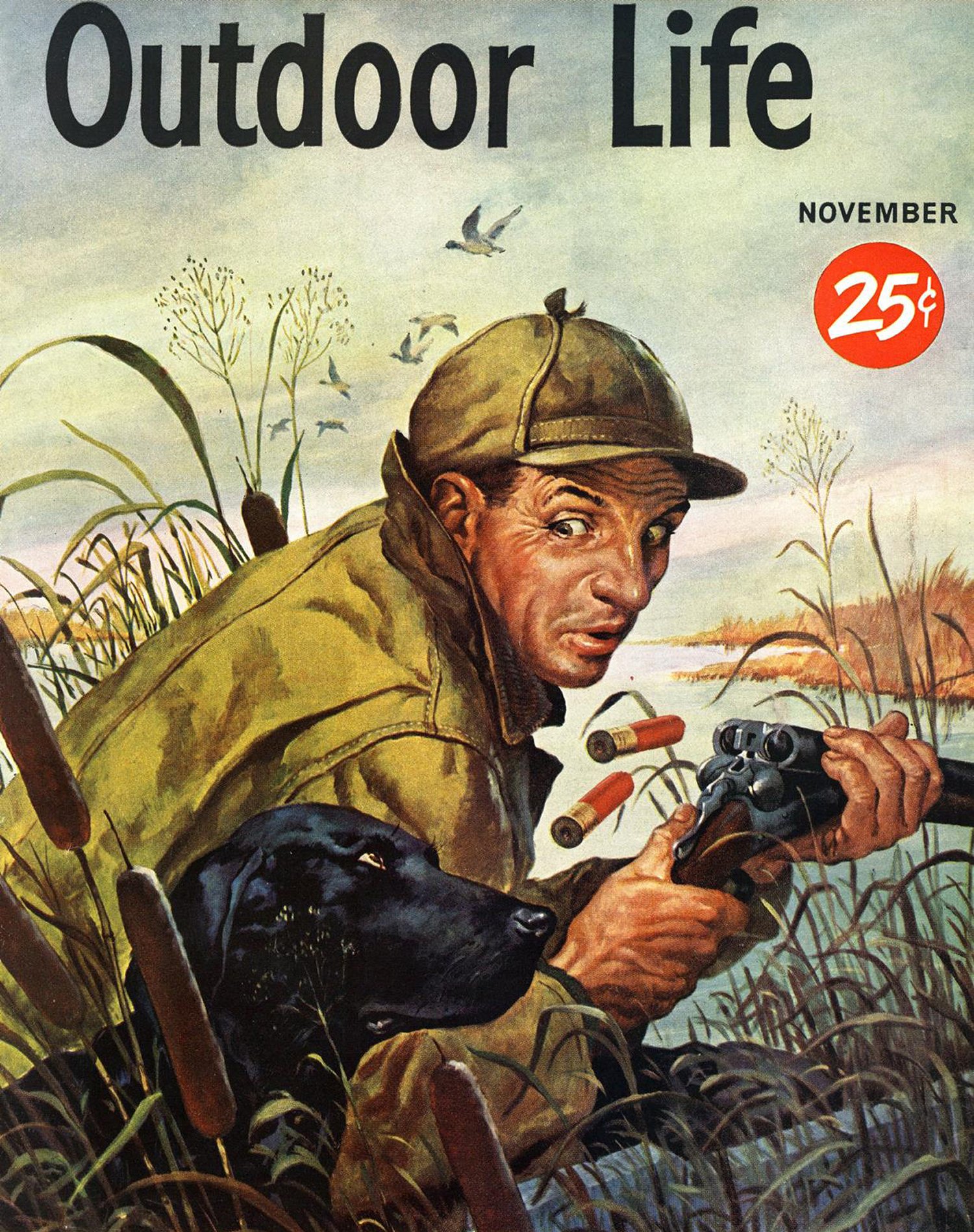
This story, “Livernose’s Lost Lake,” appeared in the November 1951 issue of Outdoor Life.
I looked up in frightened awe at the 300-foot waterfall, tumbling in lacy and fearful beauty down the rocky escarpment. “I wouldn’t climb the face of that cliff,” I declared, “for all the trout in California.”
“I would,” Carl Gorman said, and he did.
It’s quite a climb to the Lost Lake, tucked under the chin of Mount Tallac — the mountain of the Holy Cross. The lake is a deep amethyst beauty, sided by rock walls and a swampy jungle of intertwined alder, and it’s populated by the fightingest trout I’ve ever seen. Trout without a name.
The lake doesn’t show on California maps of the Sierra range. But the chain of lakes below it is shown, and also the fork of the creek which flows out of it. The map, though, gives you no inkling that the left fork drops 300 feet over pinnacled Sierra rock under the shadow of 10,000-foot-high Mount Tallac.
It all started when Gorman and I tried to run down a Paiute Indian legend. I was operating a garage and a fishing resort on California’s mile-high Lake Tahoe in 1930 when I first heard the tale. I got it direct from a bleary old scoundrel with a pursed, toothless mouth. He pointed a trembling finger at the face of Mount Tallac, where the glacier snow melted in summer and left a white patch in the form of a cross.
“Big fish,” he grunted, “below cross of the gods. Me younger, me ketchum.”
Being twenty-nine at the time, I figured I was young enough to “ketchum.”
Jim Addington, who worked with me at the time, went in with me on the first trip. After climbing a fifty-foot waterfall at the head of Lake Cascade we found a small lake under the cross of Mount Tallac. It was a dream lake, no doubt about that, with a 300-foot waterfall tumbling into one end in a spray of feathery mist. We caught some foot-long Eastern brook trout there — they had undoubtedly been planted by the California fisheries, either by plane or packtrain.
They were nice trout, beautiful trout. But when I told my source about them he sniffed his nose and gave me the sour eye.
“Wrong lake,” he said disdainfully. “White man damn lazy.”
I went to work on my aged friend, and this time I put time, effort, and tobacco into it. It seemed that the lake with the “big fish” lay above the one Addington and I had found, at the head of the waterfall. All I had to do to get to it was to climb the big cliff. There was a path, the Paiute said, “driven into the rock by the feet of my braves.”
A thing like that eats on a man’s mind. It shouldn’t, but it does. Finally he has to do something about it. In my case there was a delay of three years. Then I met Carl Gorman while on a prospecting trip. Carl was a small, thin man, dark haired, with a grin that lit up reckless eyes and a staccato way of clipping off words. I told Carl about the old Paiute and his lake.
“What’s holding us up?” he said. “It’s July — let’s go.”
We started in, equipped with packsacks, grub, and fishing tackle. We had fly rods, and I took along a five-foot casting rod with level-wind reel and 100 yards of nine-pound-test silk line.
“Why two rods?” Gorman demanded.
“I’m playing a hunch,” I said, remembering the forty-foot granite walls on the lower lake.
As it happened, a movie set blocked our way to Lake Cascade and we had to detour. That turned out to be a blessing, because we managed to avoid a back-breaking climb at the head of that lake. The country moved upward in an almost solid floor of granite, broken occasionally by funereal glades of big pine. Deer tracks were plentiful, and I saw a grouse run, wing down, in an attempt to draw us away from a hidden brood. On our right rose a perpendicular cliff of astonishing height. To our left, Tallac’s cross of snow shimmered in the July sun.
The way was steep but the footing good on deer trails, except in alder tangles along low spots of the stream. By 10, we were at the fork in the stream the Paiute had mentioned. I started up the left branch, as he had directed.
“Where does this right fork go?” asked Gorman.
“The lake,” I said, “is this way. If you want to explore the whole damn country, count me out.”
“O.K.,” he said. “Get moving before I tromple on your heels.”
Within a quarter hour we came to the lake Addington and I had found. I’d gladly have settled for what it offered.
From its granite walls one could look down into purple water that seemed bottomless. A pothole lake in granite, with a 300-foot waterfall. But Gorman would have none of it. “Let’s find that other lake,” he urged.
You can’t spout off to a guy about a lake, lug him 200 miles, and then back out. “Lead on, Daniel Boone,” I said. “I’ll follow.”
But then we ran into the cliff over which the waterfall tumbled. Two men would have no trouble with it if they were trained mountain scalers, tied together with rope and equipped with the gear used for a full-scale assault on the Matterhorn. What I had was two rods, a packsack, and a nervous belly. If any old braves had beaten any paths here, they had bulged out again during the years since the Paiute nation was in flower.
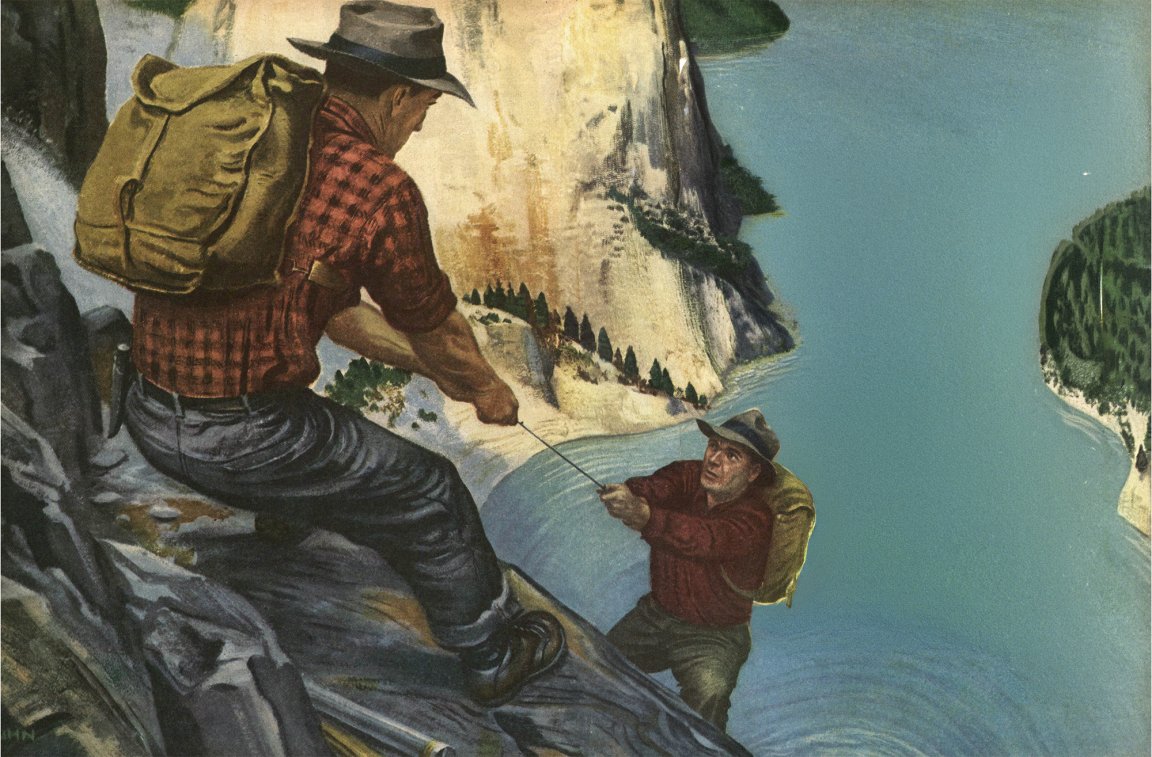
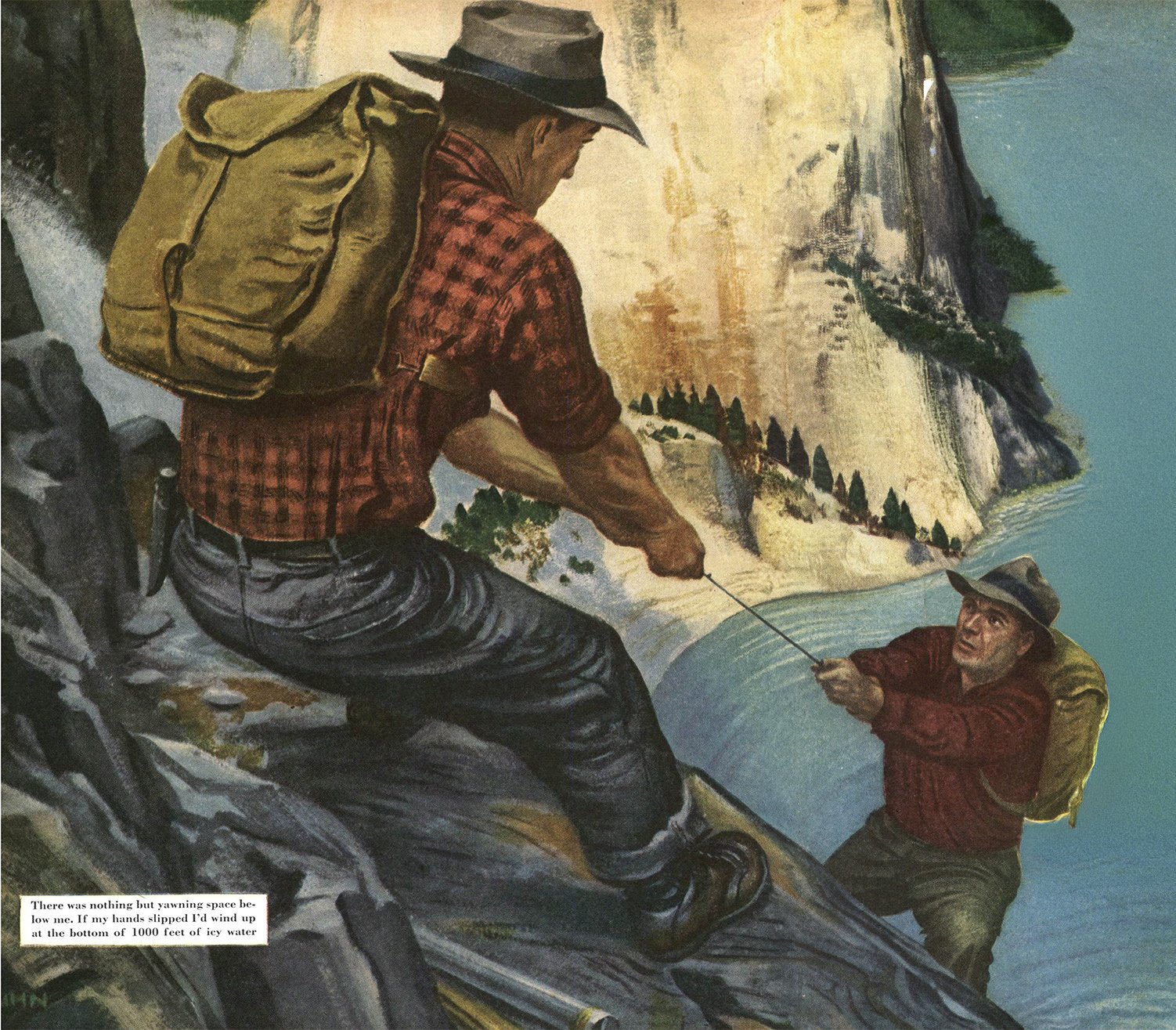
All we found was a crevasse that led us 300 feet up to the waterfall, on a slanting and perilous course. Here we perched at road’s end with the spray from the falls dripping from our chins. By that time I had concluded that as there was no way up and — since I couldn’t turn around — the best thing to do was to get it over with quickly by jumping out into space with a wild scream. Gorman had other ideas.
“We can make it,” he chortled, “if we can get to the top of this ledge.” The ledge was ten feet straight up. “I’ll stand on your shoulders,” Gorman said, “and shinny up. Then I’ll pull you up with your casting rod.”
Being pulled up the face of a ten-foot wall with a slender casting rod may not seem to be a death-defying operation. It becomes so, however, if there is a 400-foot drop below, ending in a lake. A man would hit bottom in a hundred feet of water and splatter. My heartbeat had stepped up to about that of a hummingbird by the time I made it.
The ledge, wide enough to be safe, led to a jumbled escarpment that offered finger and toe holds. Another hundred feet and we were on the top.
“Now,” Gorman said, peering about, “where’s that lake?”
“I didn’t say there was a lake,” I told him. “The Paiute said that.”
“There’s one up here sure as you live,” Gorman declared. “This water comes from somewhere.”
We hadn’t gone a hundred yards before we found ourselves in an alder thicket, knee-deep in mossy mud and ooze. We tried to sheer out of the swamp, only to be blocked by closely encroaching walls. I was willing to wade through hell with a steam hose, but no more wall climbing! When Gorman began to inspect the cliffs with a critical eye I stampeded through the alders like a scalded moose.
Without warning I broke out onto a lake shore. Gorman came up.
“Aha!” he ejaculated with relief. “There she is.”
The puddle was hardly a hundred yards across, enclosed in high granite walls except for the spot where we stood among the alders. A landslide had tumbled timber into the thing, giving the lower end the look of a logging pond. The upper end was clear and blue — and unreachable below its thirty-foot walls.
Gorman said, “Gad!” and began to rig his rod.
He seemed to like what he saw. To me it looked like the end of a fishing trip. In those alders a man would have to roll-cast, toss the line straight up and give it an overhand reverse, or switch it back and forth and roll it along the face of the growth. Playing a fish among the fallen trees would be impossible. They were too small and waterlogged to walk on, even if they had been within reach of the shore, which they were not. We could wade out about three feet. There we began operations. To me it seemed hopeless, but there was nothing to do but make the best of it.
“And this,” I said, “is what lies at the end of three years of dreaming. If I hadn’t come I’d always have thought of it fondly.”
“Start dreaming again, sonny boy,” Gorman said, as he rolled one out. It lit on the far side of a tree trunk and snagged in the bark.
I laid out a No. 12 Queen of the Waters that drifted down on the nigh side of the tree Gorman was snagged into. The fly cocked on the placid surface, thistle-dry. Gorman cussed as he twitched at his own rig.
There was a swirl under my fly. It was one of those strikes that come up easy, fan the water with a broad tail, suck a fly down without letting the angler know quite how it happened. I automatically lifted the tip, set the hook. When I felt the weight of the fish I yelled. “Yowee! Get that line out of the way, Carl.”
The fish jumped, flashing red, walked across the water on its tail, leaped over Gorman’s line as pretty as you please, swapped ends, and buzzed off in the opposite direction with a run that pulled a sharp V in Gorman’s line. Gorman yanked his fly free and I gave the big trout everything the two-pound leader would take. He came up in a skittering leap, dived under a log with my line rasping on the bark — and then was gone.
“Well, I’ll be damned,” Gorman said in awe. “Did you see that!”
“No,” I said. “I’m blind. Was it a trout or an alligator?”
“Trout,” he said firmly. “No question about it. I’m absolutely sure it was a trout.”
We couldn’t raise another fish. Either there were no more before us or the first one had put them down. “Now,” I said triumphantly, “I’ll show you why I brought this other rod. I’m going up on the bluffs and cast out.”
“You might as well,” Gorman grinned. “You’re a total loss here.”
I went. By wading along shore, holding on to the alders, I made it to the rocky ledge and climbed its slant where it met the growth. The water was deep here, indigo-blue. A stream of considerable volume came from the backbone of the range, to drop into the head of the lake. I put on a red peacock-skirted spinner, weighted it with buckshot, tossed it far out, and let it sink deep. A slow, stop-and-go retrieve brought a terrific strike.
This fish put on a show. The upward pull of the line from my high perch kept it in the air more than it was in the water. It pinwheeled, flashing red in the sunlight. When I finally whipped it down it lay inert on the surface, thirty feet below me.
“Reel him in, reel him in!” Gorman was yelling from the end of the lake. “I’ll bring the frying pan.”
A hell of a time to get hungry.
I reeled him up and prayed. He hung limp, the heart fought out of him. When a man catches a fish like this he sits down and admires it. Seventeen inches long, wide as your hand, fat as butter, red-spotted, without the vermiculations common to the Eastern brookie, or its pale-blue markings. Its fins were all red, and there was red on its belly. It didn’t have the blue-gray patches common to the German brown trout. And it certainly wasn’t a rainbow or a cutthroat. I didn’t have enough trout savvy in those days to inspect the vomer bone for teeth, or to make a scale count. And while I know that high-mountain water can do strange things to the markings and colorations of trout, to me that fish was, and is, the trout of the Piutes.
We took three more, between sixteen and eighteen inches, on the casting rod. After that Gorman took a nineteen-inch beauty by climbing down the cliff near the falls, a thing that I refused to undertake. That seemed to be it for the day. We cooked over a cone fire, using a frying pan so small that we had to cut the trout into three sections. We drooled as we waited for each panful to brown, and we ate them hot with our fingers. Piute trout have a yellow-gold flesh, tinted with pink streaks. Flavor? Oh man!
I’ve regretted not staying the rest of the day at the lost lake, and the night too, for that matter. But the 300-foot cliff had me worried. I have always planned to go back, and I will, someday.
Full of fish, I prodded Gorman. “Suppose you tell me,” I said, “how we are going to get down that cliff without a rope.”
“Easy!” he said cheerfully. “Did you notice that the stream that dumps in here is twice as large as the one we traveled up?”
I sat up and looked at it. “You’re right. What about it?”
“Chances are that the thing splits somewhere in those alders. The right-hand fork below the other lake comes from here, too. Look at the lay of the land — it adds up.”
He was right as rain. We traced the creek flow through the alder swamp, located the right branch, and followed it down. It wasn’t easy going and we went through some weird places, but there were no hair-whitening drop-offs. I cussed out the Paiute, though, recalling how he had insisted I take the left-hand fork of the stream. Later, in talking to him, I realized that the old boy had done his best to give me a straight steer, but simply didn’t know his right hand from his left.
“I go by the sun,” the old man said disgustedly. “White man damn fool.”
I wonder if he wasn’t awful close to being right.
This story has been minimally edited to meet some contemporary standards.