
We may earn revenue from the products available on this page and participate in affiliate programs. Learn More ›
Mid-summer bass fishing isn’t easy. In fact, it can be some of the toughest fishing of the year. The water temperatures have spiked, causing bass and other gamefish to head for deeper, cooler waters.
Their primary feeding patterns and areas may still be on shallower flats and rock piles, but they’re only spending short amounts of time in those areas, rather than hunting them continuously like they do in the spring and fall. Early mornings and late evenings are the best times to fish those locations during the summer, but that doesn’t mean you can’t go catch big bass during the middle of the day.
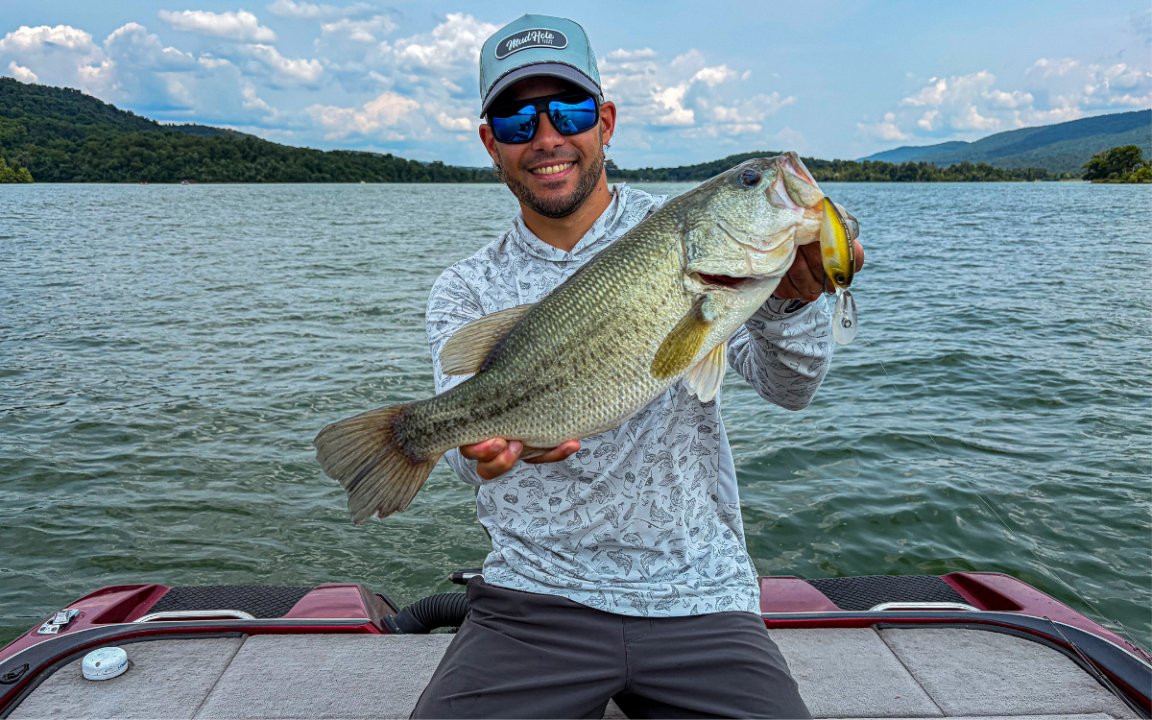
It simply requires you to change up your strategy and target deeper water. Contrary to popular belief, bass don’t stop feeding during the middle of a hot summer day, they just feed differently. To catch big bass in their favorite mid-summer hiding places, I’ve found a deep diving crankbait to be my go-to. Here’s everything you need to know about throwing a deep diving crankbait this summer.
The Deep Diving Crankbait
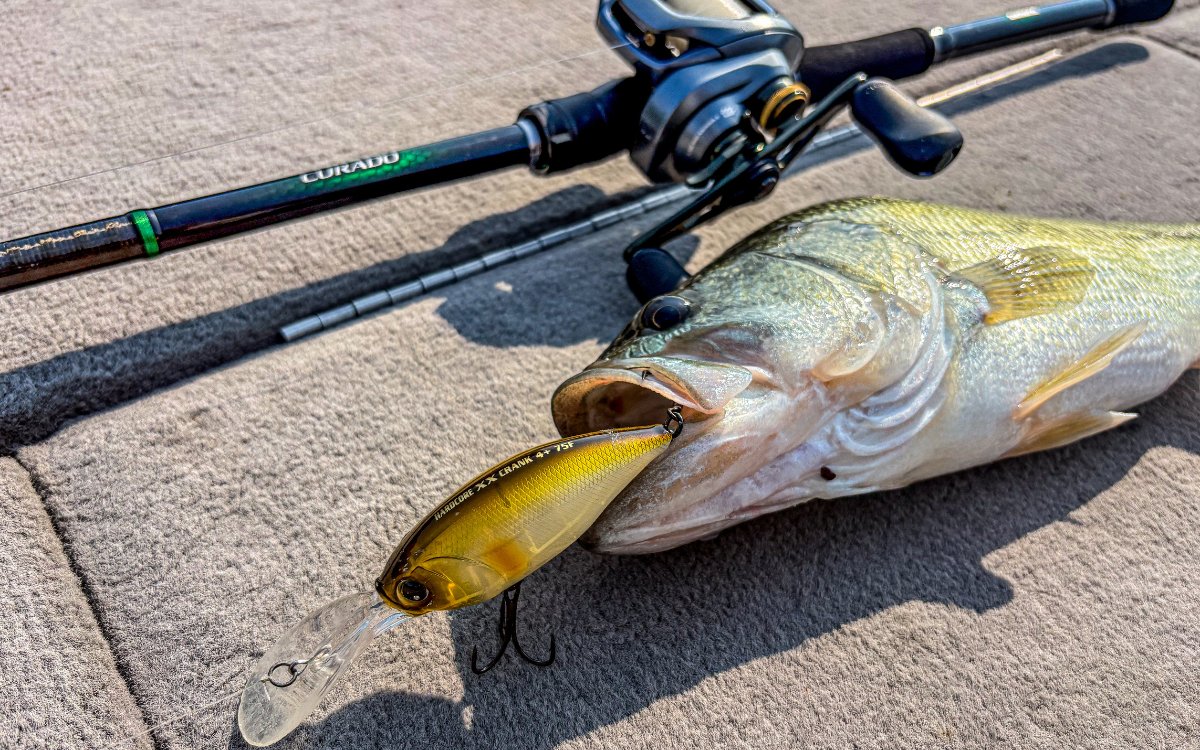
The deep diving crankbait, in short, is a piece of hard plastic with two treble hooks attached to the body, that’s made to mimic the shape of a baitfish. On the nose of the bait is a large, concave bill, that helps the bait dive down in the water column and deflect off of rocks and cover. Contrary to squarebill crankbaits, deep diving crankbait bills are designed to cut through the water with a flatter bill design, rather than a more vertical design. This flatter design helps the bait dive deeper into the water column.
That bill design also helps this bait deflect off of large boulders and underwater structure differently than a squarebill would. Where a squarebill is incredibly erratic, a deep diving crankbait offers a more methodical wobble, even as it deflects off of cover. The key to triggering a bite on a deep diving crank comes down to retrieval speed and cadence, rather than erratic deflections in shallow water.
For a mid-summer bass, that slow, methodical wobble perfectly represents an easy meal in the form of a panfish or baitfish that simply strayed too far from its school. By speeding up, and then slowing down throughout your retrieve, you’ll get the bass to follow the bait, and then strike out of pure instinct. When the “food” is fleeing at a rapid pace, they don’t have very long to decide whether or not they’ll pass up a free lunch. That’s what makes a deep diving crankbait so effective this time of year, rather than a slow-moving jig, Texas rig, or Carolina rig that they have time to inspect, the deep diving crankbait is one of the only mid-summer options to force a reaction bite.
How to Select and Rig a Deep Diving Crankbait
Similar to other hardbaits, rigging a deep diving crankbait isn’t rocket science. But there are options you can (and should) consider to up your odds. First and foremost, I always recommend swapping out the factory treble hooks for something a little higher quality. By no means is this a knock on any singular bait manufacturer, but in almost every case, to save money on the production line, they’ll be opting for cheaper treble hooks. My favorite replacement treble hook is the Owner Stinger treble. With a good pair of split ring pliers, you should be able to swap both hooks within a minute or two.
If you’re really looking to go down the rabbit hole, you can even upgrade your split ring on the nose of the bait for different actions based on the shape you choose. I’ll admit, I’ve done this, but don’t find it necessary.
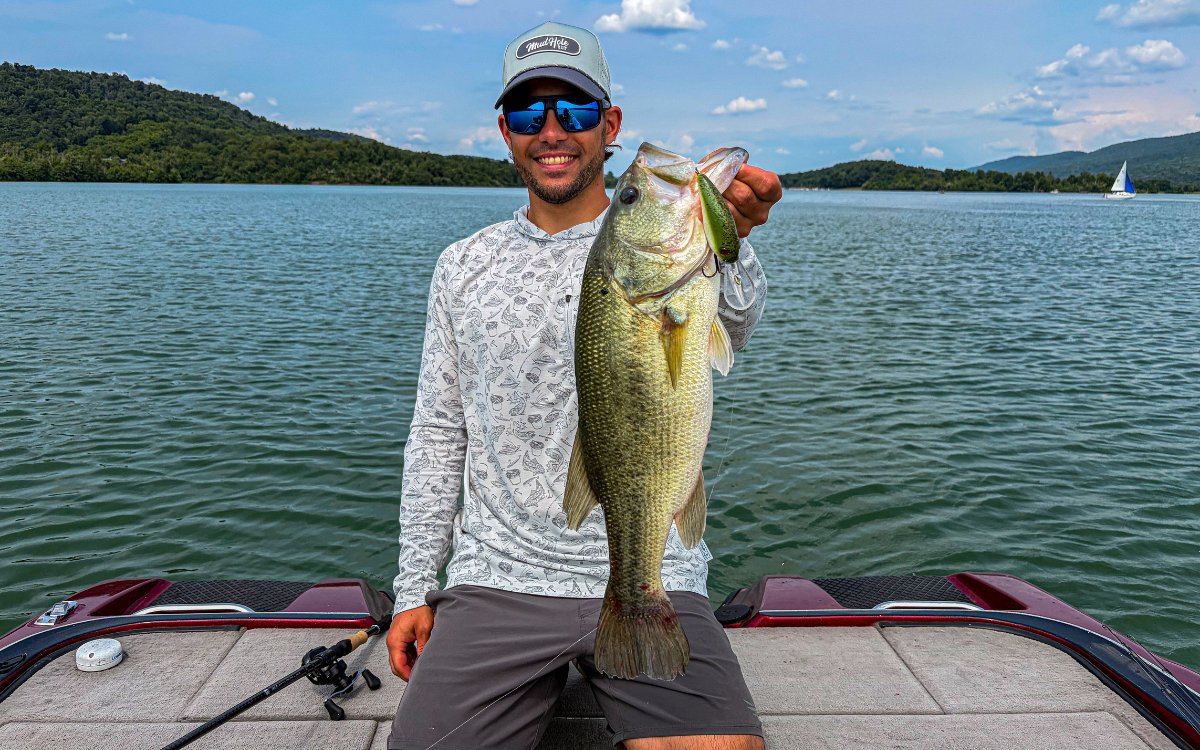
Aside from the terminal upgrades, the second most important choice is the deep diving crankbait itself. The color, size of the bait itself, and size of the bill can all make a difference. In most cases, I stick around a 3” to 4” crankbait body size, and a bill that runs anywhere from 15 to 25 feet. Thankfully, most packages will give you a good idea on the depth ranges with it printed front and center. As for your color selection, it’s really no different than any other bait. In clear water scenarios, try to match the baitfish in that particular body of water to the letter. In dirty water, lean more heavily on bright colors like a chartreuse. Since the fish won’t be staring the bait down, your goal is to simply give them a quick target to hit, so whatever stands out the most should be your first choice.
What Makes a Deep Diving Crankbait So Effective?
As I hinted to above, the key to a deep diving crankbait is its ability to elicit a reaction strike in deep water. By now, most bass have likely seen plenty of lures hopped, skipped, and dragged past their deep water homes. They’ve grown tired of the drop shot baits, crawfish imitators, and big curly tail worms, simply because they’ve seen so many since the spawn ended.
But a deep diving crankbait looks and feels different. First off, it’s not something many anglers are throwing anymore. With forward-facing sonar, many anglers have learned to rely on slower moving baits that they can cast directly to a bass. Those anglers seem to have forgotten, or haven’t tried using a crankbait with their FFS units yet though. You can pick up the bait just as well on the screen, and you can watch bass track the bait, giving you the ability to change up your retrieve in real-time to try to trigger a strike.
Whether they’re in shallow water or out deep, bass are reactive, predatory fish, and that deep diving crankbait whizzing past their head is something they just can’t tolerate. Sometimes, they bite it so aggressively that it’s truly like they are mad at it. In the end, a deep diving crankbait simply fills the gap that slow, methodical lures can’t achieve. It’s difficult to get a chatterbait, spinnerbait, or other fast-moving lure down into 20 feet of water, so a deep diving crankbait is often your only option for a reaction bite. And they flat out work.
How to Fish a Deep Diving Crankbait
Rather than simply cast and reel, the best deep diving crankbait anglers know to add their own cadence to the retrieve. For me, I like to add a stop and go every few seconds, all the while feeling for a good piece of cover to cause a deflection. The stop-and-go method is effective in areas where cover is more sparse and the bass might be tracking the deep diving crankbait waiting for a reason to react. When it comes to a screeching halt in their face, that’s typically enough to warrant a bite.
But, in areas where cover is more readily available, adding your own cadence becomes a little less necessary. Rather, if you know you’re casting past a large stump or boulder field, cast out beyond the target, slowly work your bait to it and purposefully hit the backside of the cover. This will load the rod and cause the bait to deflect. By simply resuming a slowed reeling pace during this deflection period, you’ll be able to detect the bite and set the hook.
For most of my mid-summer fishing, I try to target roadbeds, deep rock piles, steep banks with rock veins, or deep stump fields or laydowns. These areas will hold bait, typically have current to help cool the water temperature down and keep a steady supply of baitfish rolling through, and inevitably hold some of the biggest bass you’ll catch all year.
The Gear You Need to Fish a Deep Diving Crankbait
Picking the Right Rod
Outside of the deep diving crankbait itself, the rod you use is a critical component. Unlike many other techniques out there, you really can’t get away with throwing a deep diving crankbait on any old rod in your arsenal. Instead, most serious bass anglers lean toward glass cranking specific rod options. These are built with a gradual taper, a sturdy backbone, and they are made to absorb and redistribute the shock of your crankbait deflecting off of rocks or cover. These rods also help you keep the bass hooked by maintaining pressure on the lure throughout the fight thanks to the gradual taper.
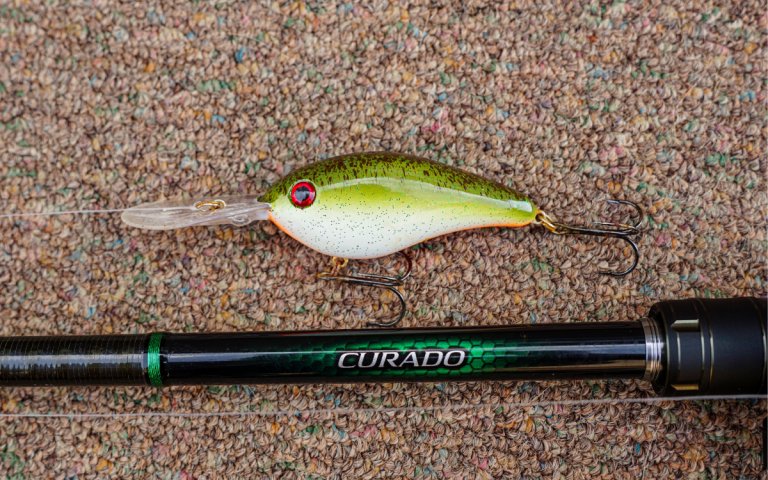
I’ve tried many different glass rods throughout the years, but my favorite currently is the Shimano Curado Glass Crankbait rod. For deep diving crankbaits, I opt for the 7’4” medium heavy moderate rod. This option gives me the ability to launch a deep diving crankbait out into the depths and plenty of backbone to swing a hookset home.
Shimano Curado Glass Crankbait Casting Rod
Picking the Right Reel
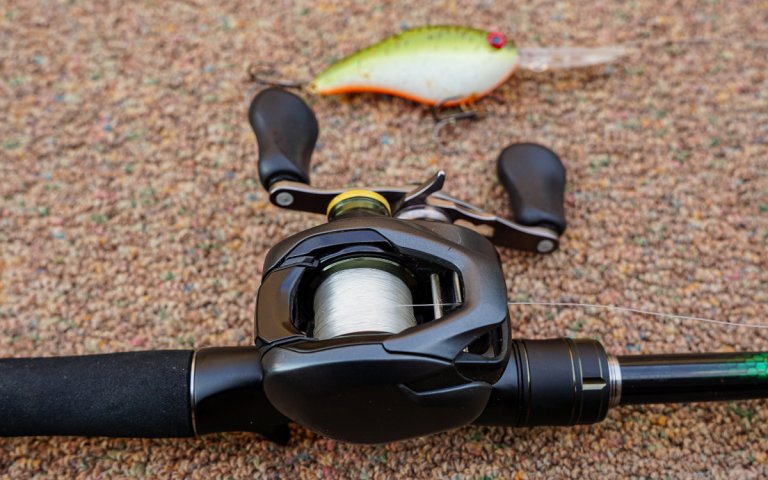
The reel you choose for your crankbait setup is important as well. When deep cranking, you’ll want a reel that allows you to control the speed of your retrieve, while also offering a quality drag system to help reduce the number of lost fish during the fight. For deep cranking applications, many anglers choose a low gear ratio as it gives you the most control of your cadence while methodically covering the bottom. My go-to reel is the Shimano Curado 200 M in a 6.2:1 gear ratio. The deep spool holds a ton of line for those long casts, and the drag is impressively smooth.
Shimano Curado 200 M Casting Reel
The Best Deep Diving Crankbait
Deciding upon the best deep diving crankbait is like arguing with someone about the best pizza toppings, it all comes down to personal taste. With that said, the action and depth is important, so try to find crankbaits with different bill shapes and lengths. At a minimum, you’ll want a couple crankbaits that will run 10- to 15-feet, and a few others that will dive down into the 20-feet range. For my fishing, I tend to lean heavily on the Strike King 6XD and the Megabass Deep-X 300, but I’ll throw a wide variety until I find which one the bass want on any given day.
Strike King 6XD
Line
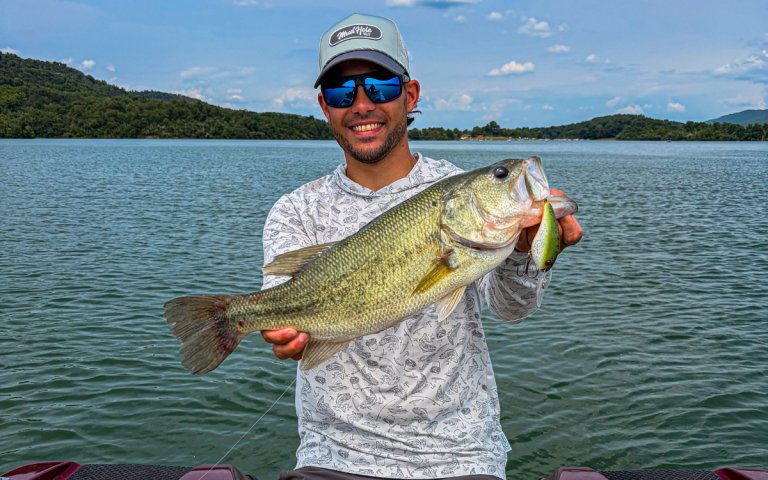
When spooling up your deep diving crankbait reel, I’ll always point you toward fluorocarbon line. Some anglers may opt for high-end monofilament for certain applications, but you’re better off with the abrasion resistance of fluoro. As for pound test, I almost exclusively use 10 pound, unless I’m fishing around some terribly thick laydowns where I’ll need heavier line. The 10 pound allows the bait to get to depth quickly and can hold up to the abuse of rocks and stumps throughout a day of fishing. My favorite option nowadays is a newer option from Berkley called GinClear. This new fluoro formula offers a low memory which allows me to make farther casts and cover even more water. So far, I’ve been pleased with the results.
Final Thoughts on How to Fish a Deep Diving Crankbait
The deep diving crankbait may be one of the most overlooked summertime lures. They’re proven, and yet, many modern anglers seem to ignore their existence. Perhaps that’s because it’s difficult for bank anglers to use them effectively. Whatever the reason may be, the fact that they aren’t thrown very often is fine by me. It just means the bass won’t be as accustomed to seeing them. If you’re looking for a new and fun way to target deep bass this summer, tie on a deep diving crankbait and head offshore. You won’t be disappointed.