
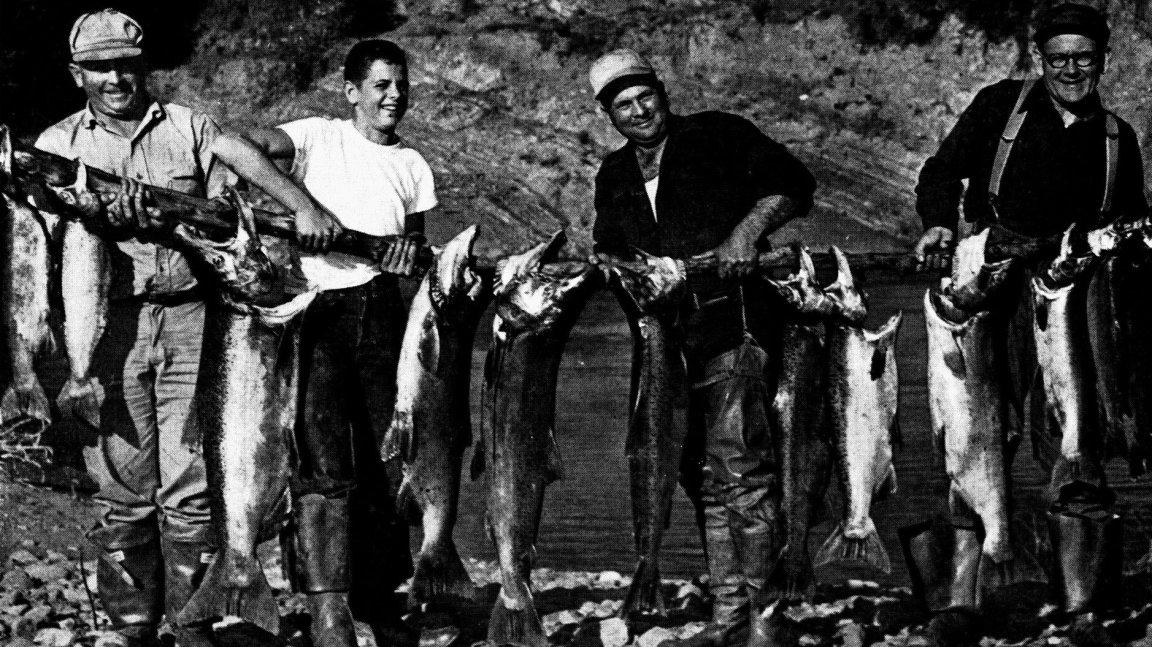
This story, “Day For Thanksgiving,” appeared in the November 1958 issue of Outdoor Life. Eel River Chinook and coho are now federally listed.
There were six of us, Jay and Neil Ventioner, young Bob Hoopes, my father Bill Brown, and my kid brother Duane, and I, sitting around the kitchen table in our home in Benbow, California, making strawberries.
That calls for an explanation. To make a strawberry you start with a skein of salmon roe, either fresh or cured, cut off a piece about the size of the end of your thumb, tie it in a four-inch square of cloth as fine and sheer as a nylon stocking, and snip away the surplus. The result is called a strawberry because that’s what the gob of orange-colored roe looks like. If borax has been added to the roe to toughen it, the berry keeps the same color and texture when dunked. The borax also causes it to “milk” in the water, making it more attractive to hungry fish.
With a quart of these strawberries, on the South Fork of the Eel River in northwest California in November and December, you can catch king, silver, and chub salmon (chub being the local name for a small buck king) about as fast as you can land ’em. Now and then a buck king weighing 40 pounds or more will grab a berry. A little later on, in January and February, the strawberries take sea-run steelheads.
So this was a strawberry party, in preparation for a fishing trip. Tomorrow would be Thanksgiving Day. Jay, my hunting and fishing partner, and his brother Neil had driven over from Richvale despite warnings that we’d had heavy rains, were likely to get more, and the river might be too muddy for good fishing. “You can always take young kings on strawberries, even in muddy water,” Jay reminded me on the phone. “We’ll be on deck this evening.” So here we were, parked around the table, making plans for morning. Things were looking better all the time, too. The weather had turned sharply cold at dark, the threat of rain was ended, and we could count on ideal conditions for our expedition.
I’d have to see another river better than the Eel and its two branches, the South and North Fork, for salmon and steelheads before I’ll believe one exists. Though the run of kings and silvers starts as early as October, November and December are usually the top months. By Thanksgiving we can count on the river being chock full of salmon, and, if the weather’s right, fishing is really hot. Jay and I have been making an annual pilgrimage to the South Fork around this time for several years, and most of the time it’s paid off.
“Where’s the best bet for tomorrow?” dad asked me as he wrapped a ball of roe.
“The Forbidden Hole,” I said. Of all the hotspots along the South Fork, that hard-to-get-to, little-fished piece of water is my favorite.
“Who’s going to carry the fish out?” dad grunted. “You need a mule if you want to pack just one salmon out of there.”
“I’ve got that licked,” I told him. “I’ll admit it’s quite a walk in, over the mountain and all, but if you travel light it’s not too rough. Why don’t you, Jay, and Neil hike in, and Duane, Bob, and I float in with the rubber raft? We could put in at the mouth of the East Branch, portage Benbow Dam, drift down to the Forbidden Hole, and when we’re through fishing load the fish in the raft and float out to Briceland Bridge at Garberville.”
Dad admitted this would solve the problem, and everybody agreed it was a good plan. When we finished preparing the strawberries, Bob left for his home in Garberville, and Duane and I made last-minute preparations for an early morning start — lashing the rubber raft atop the car, setting out tackle, checking camera gear, oars, pump, and patch kit.
We picked up Bob right after breakfast the next morning. It was foggy and freezing, a disagreeable combination that seemed to knife through all the layers of clothing we could pile on.
Bob and Duane, both only 17, are regular fishing buddies, and old hands at this float business. When we pulled up at the mouth of the East Branch they were just a few minutes getting the raft off the car, inflating it the last few pounds (I always store and carry it low in pressure so there’s no chance that sun or a warm day will expand it to bursting), and tying oars in the locks.
Our raft is inflated in two sections, divided by an inflated seat, so there’s no danger of sinking in case of a sudden puncture. We stowed the tackle and extra paddle in the forward compartment, I took the seat and the oars, Bob and Duane perched on the big inflated tube, and we pushed out into the water below East Branch.
The river immediately above Benbow Dam, varying from swift to quiet, is a terrific place in January and February for steelheads, but not much good for salmon. The two fish, running in from the sea, seem to behave differently. Once a salmon makes it over the fish ladder to the top of the dam, he zooms off for some upstream destination. Steelheads loiter in the calm water above the dam, and they’re willing to do business as long as they stay.
Though we didn’t expect much action until we portaged around the dam and hit the fast water and deep holes below it, Bob and Duane went to work without delay. Both were using 8½-foot glass rods with sensitive tips but plenty of backbone for handling big fish. Bob was using an open spinning reel with 12-pound-test monofilament line, while Duane used an enclosed reel with 10-pound-test line. Each wore a fishing vest with plenty of pockets for leaders, sinkers, and a few favorite lures, and each carried a potato sack in the back of his vest to lug fish home in. The boys gave the river a thorough going over, but we weren’t surprised when nothing happened. Then the roar of water plunging over Benbow Dam and the column of mist rising into the frosty air above the gorge reminded us that we were nearing our portage. We landed to the left of the dam and stopped briefly to chat with Jack Andrews of the California Department of Fish and Game, stationed there to count and check fish as they passed through a trap near the top of the ladder. The salmon run was approaching its peak, he told us, and while we watched, several lunker kings went through, two or three big enough to scare a man back to shore.
“Let’s get going,” Duane urged.
We made an easy carry around the dam and put the raft back in the river at the foot of the fish ladder. There were rapids coming up now, so Bob and Duane knelt on the canvas floor, facing downstream, and held the sides of the raft as high as they could to keep us from shipping water.
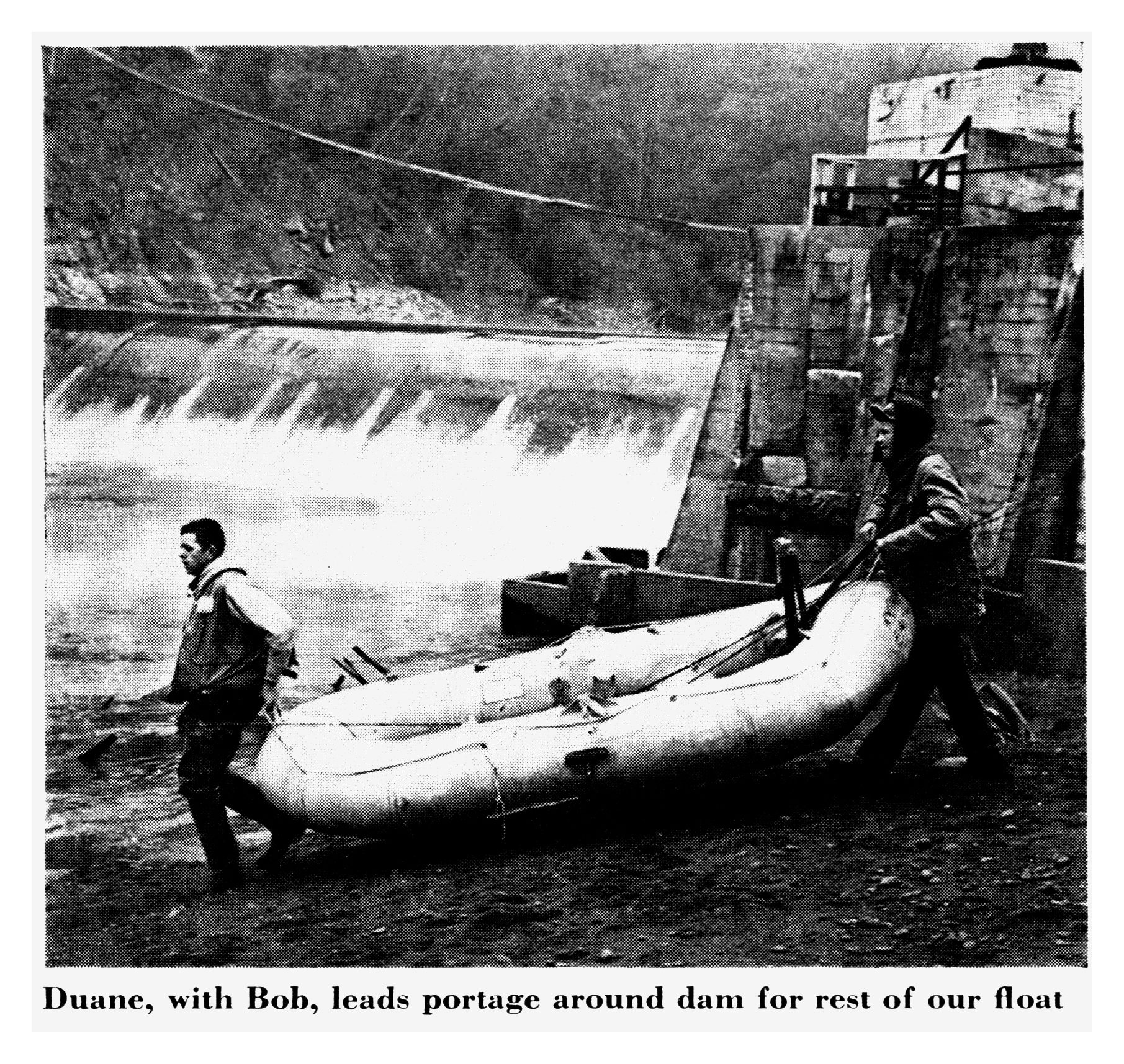
Fishing is prohibited for 3,000 feet below the dam. We made a fast, fairly dry run through that stretch, then shot on into the Boundary Hole, the first fairly deep spot beyond the closed area.
The hole is a spooky place, with high mountains on both sides and giant redwoods shading it along the south bank. The timber is dense, the rocks are moss-covered, and there isn’t even a game trail alongshore. But it’s a top-notch place for salmon and steelheads in season, and we weren’t surprised to see several fishermen casting from the north bank.
Another half a mile would take us down to the Forbidden Hole and if dad, Jay, and Neil were on schedule we’d find them there. But the Boundary Hole looked too good to pass up, so we beached the raft on the south bank and stepped out. Bob moved a few yards downstream, Duane a little farther above, and I stayed by the raft. I was still rigging up when one of the fishermen across the river, Vic Haberstock of Garberville, coaxed a 25-pound king into a smashing strike right in front of me. The fish took him downriver at a fast clip. It was 45 minutes later when I saw Vic return with his salmon.
Before I could get started Duane was fast to a chub. I saw him check and turn it at the end of a long downstream run, and then Bob yelped “Fish on!” and I turned my attention to him. The antics of his fish hinted at something bigger than a chub, so I laid my rod aside and picked up my camera.
The salmon battled upstream and down, fighting the reel drag and the strain of the rod every inch. The current favored the fish but it finally weakened. When Bob brought it within reach, still thrashing and kicking up spray like a mill wheel, it turned out to be only a 6½-pounder after all.
We were admiring it when, 100 yards upstream, Duane’s rod jackknifed to the savage strike of a buck king. Again I grabbed my camera, but he said “Don’t bother, just a smoker.”
A smoker is a salmon that’s been in fresh water long enough to turn a bit dark, losing the silvery color of a fish just in from the sea. It’s the first step in the strange process that ends with all Pacific salmon dying after they’ve spawned. Smokers never put up as good a scrap as sea-run bucks, because when they begin to lose color they also start to lose their zip. But we don’t look down our noses at them, for they make very fancy eating when they’re smoked. Eventually a smoker turns gray or black, and its beautiful orange-red flesh bleaches out almost white. If we catch one at that stage we throw him back. Duane fought the fish for 40 minutes before he finally got a hand in its gills and skidded it up on the rocks. It was a big, reddish, 20-pound buck, a fit candidate for the smokehouse.
When I had the pictures I wanted, we agreed it was time to keep our appointment at the Forbidden Hole. We climbed aboard the raft once more and shoved off into the treacherous, boulder-strewn water below the Boundary Hole. We were getting along fine when, rowing desperately to avoid a rock, I caught one of the little oars on a snag and snapped it off at the blade.
With the current spinning us like a top, I thought for a minute we were in trouble, for there’s no boat on earth harder to manage than a rubber raft under such conditions. But Bob grabbed the spare paddle and dug in on the side opposite the unbroken oar, and between us we managed to straighten out and head for quiet water. There we converted the paddle into an oar by whittling the grip off and lashing it in the grommet with fishline.
The Forbidden Hole, as I said earlier, is my favorite fishing spot the whole length of the South Fork. It’s an almost inaccessible place, reached either by a tough hike or by floating. While a few of our friends have floated it many times, to my knowledge not many outsiders have tried it. Because it’s the first really deep pool, much deeper than the Boundary Hole, where fish can rest below the dam just a mile upstream, it’s a favorite spot for them to drop back to and catch their breaths. Not all of the migration finds its way over the fish ladder at the dam, so many salmon spawn every year in Forbidden Hole. As a result, there’s a heavy concentration there as long as the run lasts.

We floated into it now, wondering whether dad, Jay, and Neil had made it on time and what kind of luck they were having. As we drifted, Bob picked a promising spot across the river, close under a thicket of overhanging willows, and let go his first cast.
He laid his half-ounce, lead-and-spinner lure exactly where he wanted it, a good 65 yards away, and I noticed he didn’t pick up the reel’s bail until he felt the sinker hit bottom. Then he gave his rod tip a quick snap and started the spinner back. That’s the right technique for salmon, for once they come into fresh water they lie on bottom, and you have to go deep to tempt them. They almost never rise to take a bait or lure — at least, not in the Eel.
Bob worked his spinner back, just off bottom, and when it was halfway in his rod tip jerked down in response to a sudden blow, and the show was on.
Duane reeled in, and as the fish went charging upstream, I headed the raft into shore. It was a safe bet Bob would have his hands full for at least half an hour, and he’d do better from the bank. The fish was still boring stubbornly upriver when we touched shore. Duane grabbed a tree branch to steady the raft and Bob clambered out, fighting the salmon with one hand and losing more line than he could afford. Once ashore he started upstream at a run; then the fish turned back and we drifted out of the way. “See you later, Bob,” I called. “We’re going down and check on the others.”
Just then I caught sight of Jay, standing knee-deep in rapids, his rod bent in a sharp arc. I thought he was hung on a snag, but as the current carried us nearer I could see the rod tip whip up and down.
“Must be a buck king,” Duane decided.
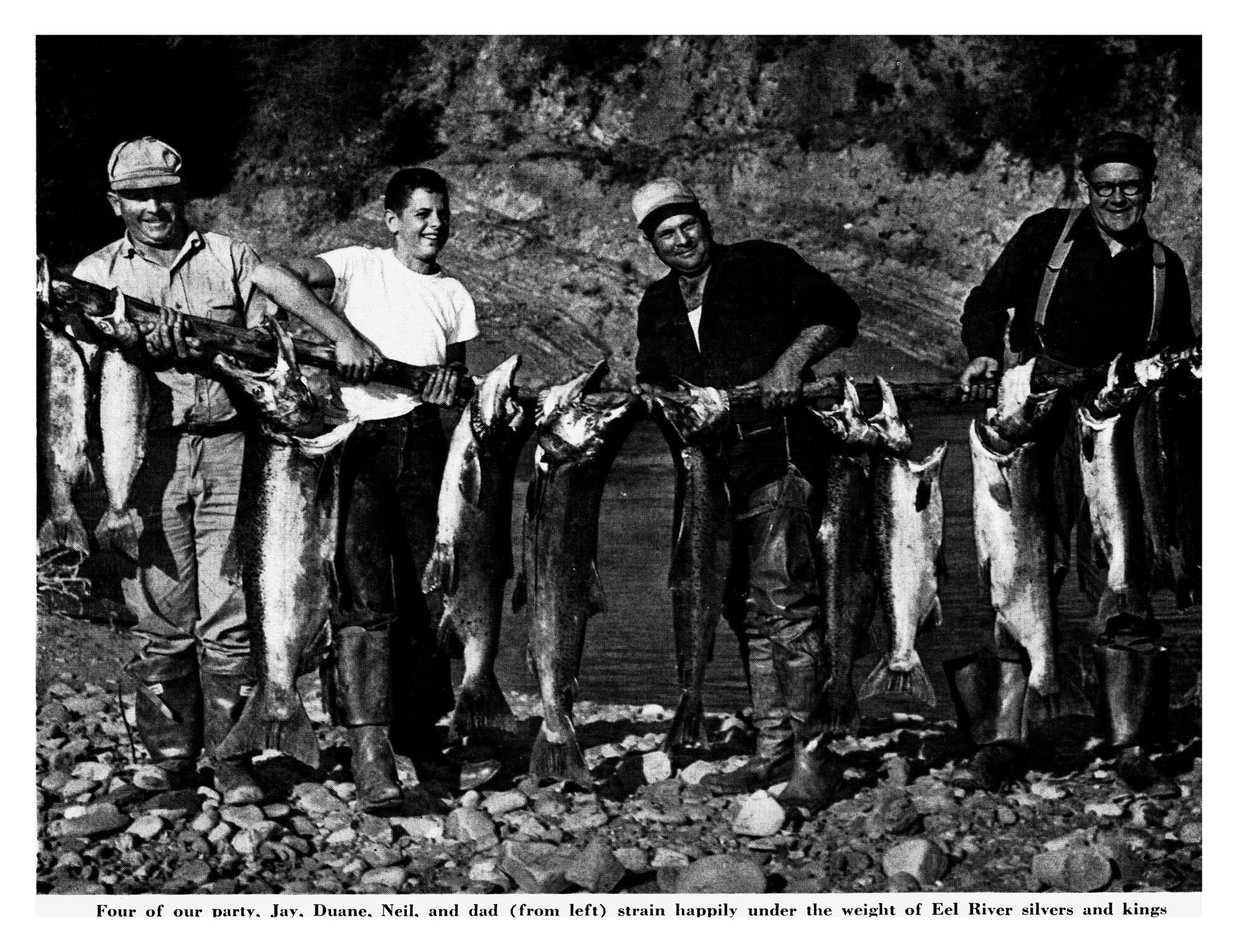
We asked Jay how many fish he and Neil and dad had caught, but he was too busy to pay any attention, so we drifted around behind him and pulled the raft up on shore to see for ourselves. Duane took one look and let out a low whistle. There were some mighty big salmon lying there on the bank.
“I hope you’re keeping score,” I told Jay. The limit is three fish per man.
“I’ve still got one to go,” he replied, without turning his head. “This one, if I land him.” Then he added, “These strawberries are sure the right medicine.” We asked him how long they’d been fishing.
“Only a little while,” he replied, and went on to tell how the three of them had been delayed by dense fog somewhere on the mountain.
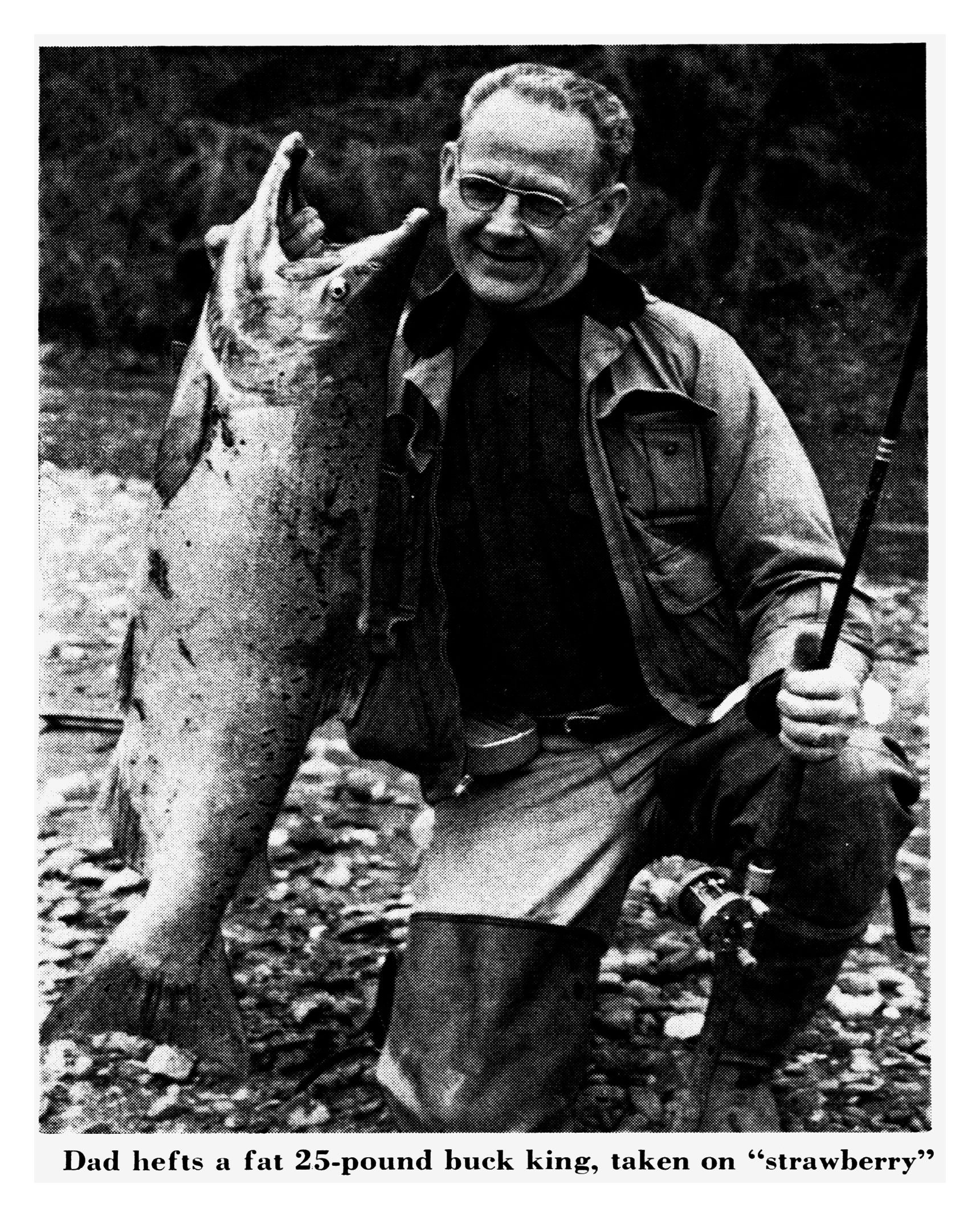
I decided it was time I quit fooling around and start catching a fish or two on my own. Instead of using a strawberry, which I knew would work, I decided to try a silver wobbler with a ¾-ounce sinker. I tossed it out into the deepest part of the hole, and as soon as I felt the sinker touch bottom I picked up the lure with a quick flip of the rod tip. It took two casts to get a strike. The fish was a 15-pound female silver, as full of fight as a leg-caught wildcat. Pound for pound, silvers are better scrappers than kings. I finally took the starch out of her, and as I was working her into an eddy away from the main current dad came along. “Nice fish,” he said, and when I turned around he was putting a 30-pound buck king in the boat.
“Yours or mine?” I inquired.
“Both,” he answered with a satisfied grin.
I found a good spot to beach my silver, where a spring had laid down a bar of hard sand. It’s a rule of our fishing parties that everybody lands his own fish, and while it isn’t always easy, there’s a lot of satisfaction when you bring it off. We do it the hard way, and bare-handed too. It’s illegal to use a gaff in Humboldt County, where we were fishing. We could carry a landing net, but for fish the size we were after it would have to be at least 30 inches across, and who wants to lug that big a net in rough, wild country?
Picking ’em up isn’t too difficult if it’s done right. The first rule is to play the fish until he’s whipped to a frazzle. In the final stages of the fight, you keep his head guided toward shore and keep steady pressure on him. That way even a 40-pounder, thoroughly tired, will wiggle up halfway out of the water and lie on his side or belly. That’s the time to reach for him.
A salmon’s teeth can shred your fingers — it’s happened to me plenty of times — so to play it safe we wait until he opens his gill covers and shows the red fan of gills inside. Then we slide two or three fingers into the gills with a quick easy motion, lift him, turn away from the river, and keep going. That’s all there is to it.
Just as I picked up my silver, I heard dad, standing only a few feet away, mutter, “Caught on a snag, and on the first cast.”
When I looked at him he was backing out of the water with a turn of line wound around his arm, to break free. Then a lightning bolt in reverse exploded out of the river over by the far bank, and I’ve never seen a fisherman move faster than dad did to get the line unwound from his arm.
He was using a nine-foot glass rod and 20-pound-test line. The line was tight as a fiddle string, and about that time the salmon did a barrel roll close to the top, sounded, and lit out upstream. I’d have run with him alongshore to save line, but not dad. He put both thumbs on the reel’s spool, leaned back until his rod took a shape about like a carpenter’s square, and hung on.
“I’ll turn him,” he said grimly, and then added as an afterthought, “if the line holds.”
The line held. Three hundred feet up the pool the king switched ends and started back, coming like the wind. Dad got back a fair share of his line, and the two of them started all over on even terms. It wasn’t until the fish was beached almost an hour later that I had a chance to confirm what I was sure had to be true: dad had worn his thumbs raw enough to bleed on that first long run. But I guess it was worth it, for after that he and the salmon both knew who was boss.
Neil came back while I waited for dad to produce picture material, and dumped a 32-pound king in the boat. “That fixes Jay and me with our limit,” he announced, “and if your dad trounces that one, he’ll have his three and we can start the hike out.”
I stayed with him and kept my camera ready, hoping his fish would do a war dance or two on top before it quit, but no soap. Little by little the surging power went out of its rushes, and at last dad led him up on a shelving beach, wheedled his great head out of water, and slid a hand into the gaping gills.
“The biggest king I’ve seen in five years,” dad gloated, and then added, “but my arms are ready to drop off.” Back in Garberville that afternoon, scales showed that his fish weighed an even 40 pounds.
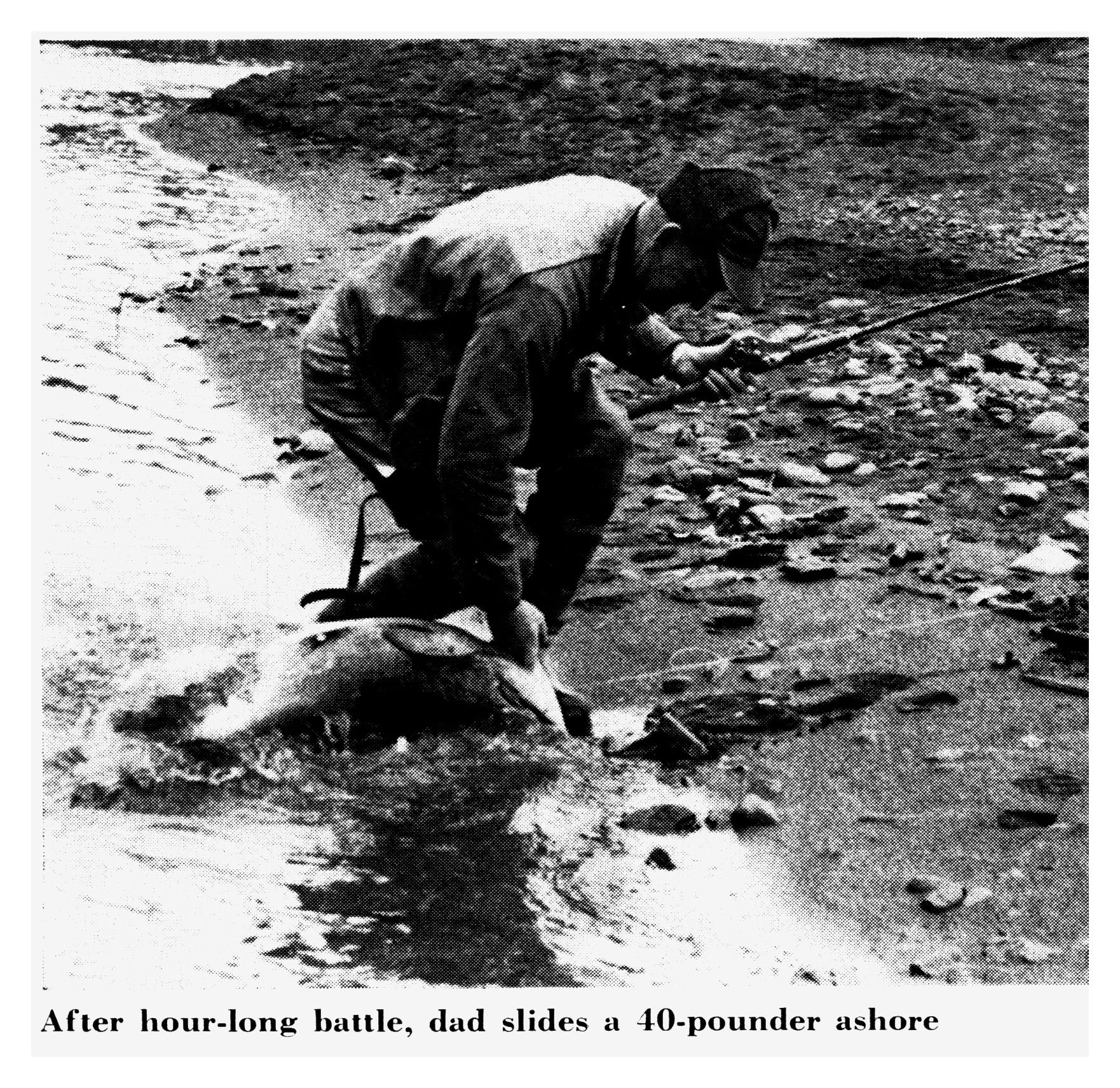
Dad, Jay, and Neil put away their gear then, and climbed up out of the canyon, stopping a couple of times to look back and see how we were making out. Floating the river, with any luck we’d still be home before they were, but I knew that dad preferred to hike.
I figured Duane and Bob must be close to their limits by now, but I still had two fish to go. Duane was out of sight downriver, Bob was above me. I’d decided to troll up and meet him. I left all the extra gear on shore to lighten the boat for the row against the current. I’d have to keep to the eddies to make headway but that’s where big fish often lie. The sun was out now and the day had turned warm as I pushed the raft into the current and let the river take line until my lure was bumping bottom. Then I propped the rod between my knees and started to row.
Bob was fishing from a point that jutted into the river, and I was within 30 yards of him when my tip arched sharply down and slapped the water. I grabbed the rod but the line was slack.
“Snag,” I called to Bob, “or maybe I was a little slow.” I started to reel in, with the current drifting the raft back downstream, turning lazily and out of control. I had only a few feet of line left in the water when a fish ripped into my lure in a savage, reckless strike.
I didn’t even have to set the hooks. He took care of that. “Fish on!” I shouted, loud enough that Duane heard me far downstream.
The salmon sounded and went under the boat. I dipped my rod to keep line from fouling as he went round and round like a dervish, close to the bottom. I knew by that time that I was fast to a lunker king. When he stopped and lay on bottom, sulking, it was as if I were anchored to a rock. The raft bucked the current and the line literally sang; then the fish suddenly whirled and headed downstream, towing me with the current.
I fought him with my rod bent like an oxbow, Bob following along the bank, carrying his fish. When we got close enough to Duane I saw him reach under my coat for my camera. “How do you work this thing?” he yelled. I shouted back instructions. “Take a couple for practice, then shoot when he jumps,” I said.
But the fish never jumped. He didn’t even splash. He kept on going downriver, sounding and lying on bottom briefly a couple of times, until we were at the lower end of the pool with the Salmon Hole Rapids coming up. I knew I’d foul my line or smash up if I got in those rapids, so I braced the rod between my knees and rowed for shore with everything I had. It was a long gamble, but better than risking the rock-strewn white water below.
Duane grabbed the bow rope and I caught the rod in both hands and tested the line. The fish was still on. Bob came along and grabbed the raft and held it to free Duane for camera work, but there wasn’t much to photograph. The fish kept enough pressure on to hold the raft out in the current and Bob’s arms began to tire; mine were turning numb. I decided I could do better on shore, but as I started to step out, the salmon took off on another lunging downstream run that pulled me right back into the boat.
I held the rod high, braked the spool until my thumb smoked, and let him go. Fifty yards down the pool the steam went out of him, so I turned him and started him back. That run had been a doozy, but it was also the last solid punch he had left. He came in as meek as a lamb, and when I inched the front half of his burly, silver-sided body up on a sloping bar he just quivered and lay on his side, gasping. He came within a couple of pounds of being as big as dad’s.
We loaded our gear and over 250 pounds of fish into the raft — we confirmed the weight on scales at a Garberville market — and started the float home. The boat was too full of salmon for Duane and Bob to kneel on bottom, as they usually do in fast water, and halfway through the Salmon Hole Rapids we shipped a big wave that soaked us to the skin and filled the raft until our load of fish was floating in a foot of water. But it’s next to impossible to swamp a boat of that kind, and we went bouncing right on.
Read Next: How I Almost Drowned During a Coast Guard Rescue in a Freak Storm while Salmon Fishing
Bob’s mother was waiting for him at the mouth of Sproul Creek, a mile below the Forbidden Hole, to take him home in time for a family Thanksgiving dinner. He staggered a little under the weight as he packed his fish up the steep bank to the car.
Duane and I shoved off again. The rapids below Sproul Creek are tricky but not dangerous. The current spun us up on rocks two or three times, but each time it obligingly spun us off again. Then we were in the smooth water above Garberville and could see Jay’s pickup parked at Briceland Bridge, backed down close to the river, ready for loading. Jay, Neil, and dad would be along shortly. All that was left to do was weigh and dress our catch. It had been a great Thanksgiving Day for all concerned.