
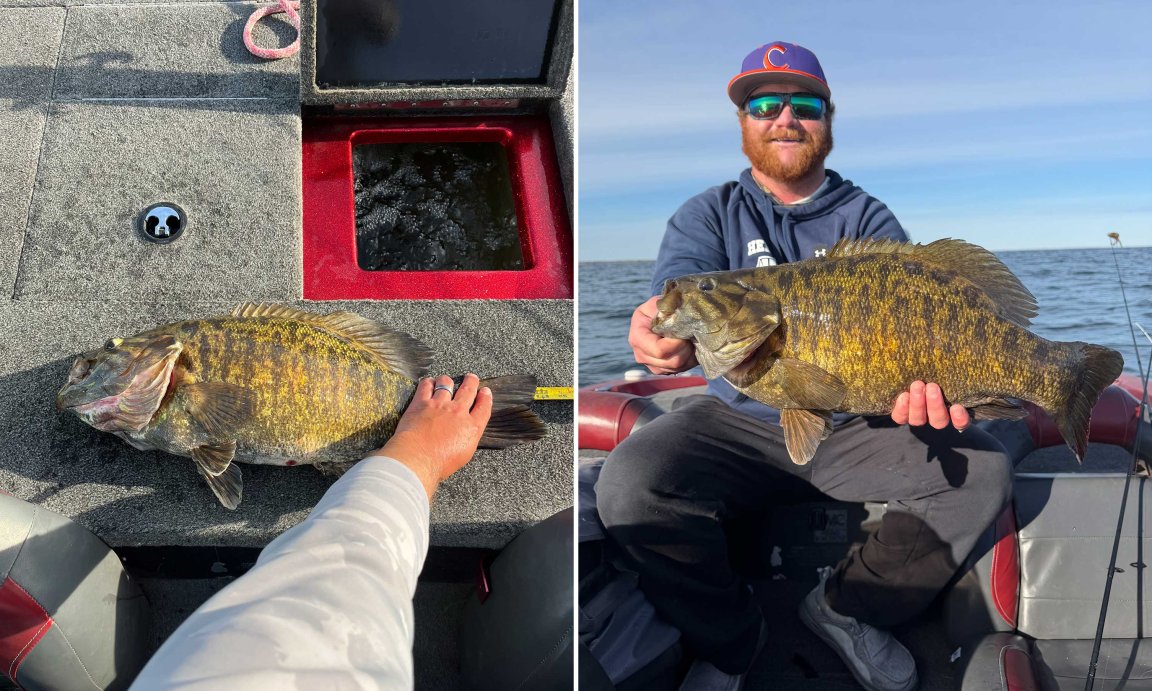
On the morning of October 30 Austin Schiefer and his fishing buddy Ted Johnson launched their bass boat into Green Bay, a huge Wisconsin portion of Lake Michigan. They started about 7:30 working a reef area in 18 feet of water about two miles from shore. Before long, they’d go on to break a 76-year-old fishing record.
“It was a spot we’d fished previously and caught nice smallmouths on,” Schiefer tells Outdoor Life. “We used forward-facing sonar and were targeting big bass.”
The morning started windy, ideal conditions for clear water bass on Green Bay. The duo was catching bass, but about mid-day the wind died and the water got calm.
“That’s not the best conditions for Green Bay,” says Schiefer, who works for UPS when he’s not producing his own line of soft plastic lures (Schief’s Custom Baits). “There were plenty of bass on the reef, but they were finicky and wouldn’t take the lures I was casting.”
Johnson, however, was catching bass using a different type of soft plastic. He suggested to Schiefer that he try one of the lures he was doing well with, and to go lighter with his tackle.
“The bite was light and deep, so I changed to the setup that Ted suggested,” says Schiefer, from Menasha, Wisconsin.
Schiefer changed over to a Deps Sakamata Shad Soft Jerkbait, which is a 5-inch lure, and the productive hue was “champagne-pepper.”
He threaded the lure onto a 3/32nd-ounce jighead and made a long cast with the lightest 7-foot spinning rod he owns. His reel was spooled with 8-pound test Power Pro braided line with a 10-pound test fluorocarbon leader.
“I wanted to make a long cast and sort of swim the lure back as it sank, a pendulum like retrieve,” says Schiefer. “We could see fish on bottom with sonar, but they’d rise up to take lures. Except they were refusing my lures just before they’d hit – until I cast that Deps Jerkbait.”
It was about 2 p.m. and as Schiefer’s lure sank he felt a hit. But the fish didn’t fight like a smallmouth. The battle wasn’t fast and furious and there were no jumps. Just a couple minutes of it taking drag, and rugged deep pulling and rolling – so much so that Schiefer thought perhaps he’d hooked a freshwater drum.
“But as I worked it to the surface I got a look at it in that clear water about 10 feet down, and I saw that it was a huge smallmouth,” he says. “I knew it was a monster, and when I got it to the boat Ted netted it.
“I got lucky, because the hook was bent when I took the lure out of its mouth.”
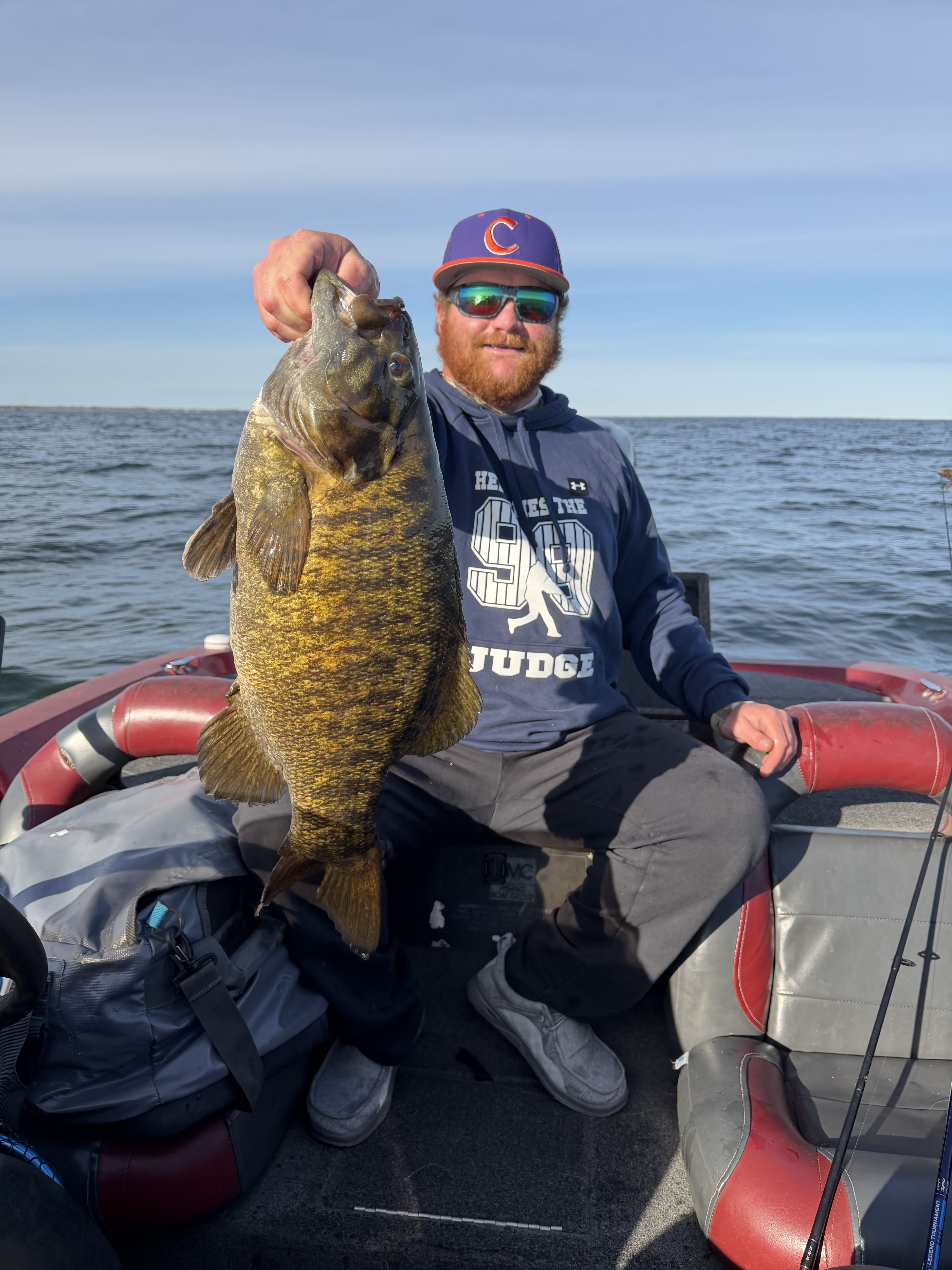
Schiefer had caught big smallmouths previously, but nothing over 7 pounds, so he knew his catch was important. They put the lunker bass in their boat livewell and tried to contact Wisconsin’s Department of Natural Resources. But it was Friday afternoon before Halloween, and no one from the DNR was available.
The anglers quit fishing and trailered their boat to a grocery store where the bass was weighed at 9 pounds, 11ounces on certified scales. It measured 23.75 inches long. The smallmouth easily topped the 1950 Wisconsin record smallie weighing 9 pounds, 1 ounce. That fish was caught by Leon Stefonek in Oneida County’s Indian Lake.
To qualify as a state record bass, the DNR required the fish to be weighed and examined by state biologists. That didn’t happen until the next day, when DNR fisheries staff weighed and inspected the fish.
They discovered the bass was a male, not a female – which usually are the larger of the two fish genders. Additionally, Schiefer’s 9.70-pound smallmouth had nothing in its stomach, again unusual as most bass in autumn are feeding heavily for the coming winter.
Schiefer will have a skin mount made of his smallmouth bass record, which he says has been officially recognized by DNR as Wisconsin’s heaviest bronzeback of all time. He’s also considering having replica mounts made of the fish.
Read Next: 7 Forward Facing Sonar Tips: Settings, Mounting, and Techniques Explained
“I think a replica mount of the bass would be nice for the National Freshwater Fishing Hall of Fame in their Hayward museum, and maybe one for Bass Pro Shops, too,” he says.
“My only regret in all of this is I didn’t release the fish alive. I couldn’t with the DNR requirements for weighing and inspecting the fish for the record… I’ve had some sleepless nights because of that. I did everything in my power to keep from killing that bass.”