
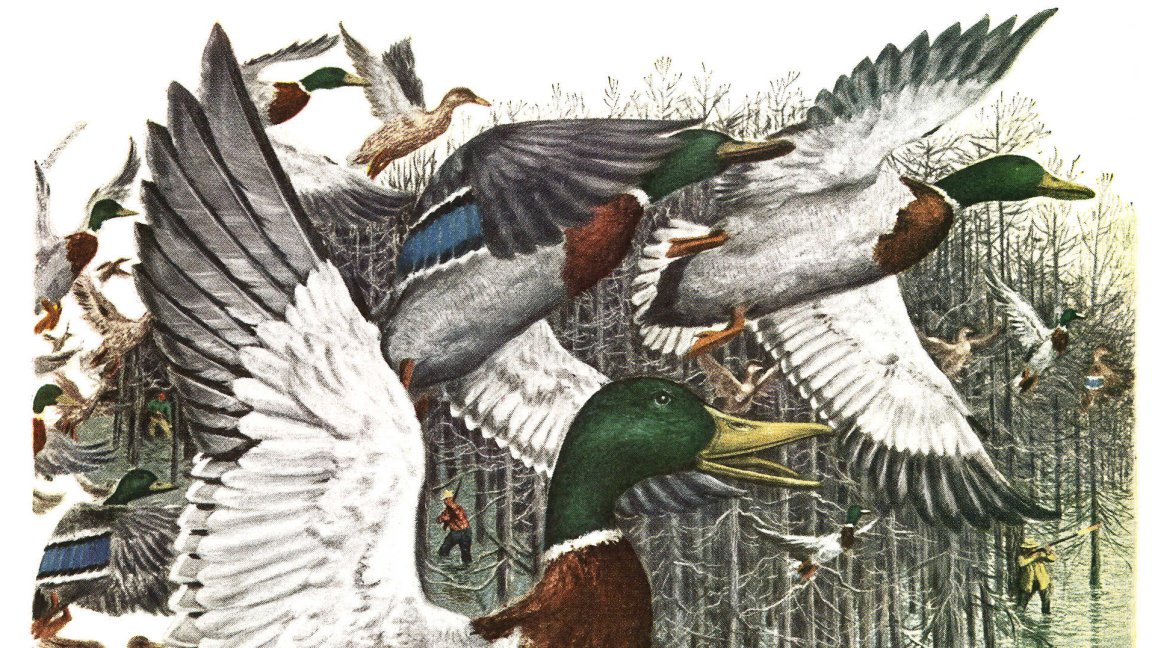
This story, “Greenheads on the Obion,” appeared in the November 1951 issue of Outdoor Life.
“Duck shootin’?” Jim exclaimed. “Why don’t you come down on the Obion bottoms with my boy and me tomorrow? It’s been twenty years since you’ve seen anything like the ducks on them bottoms right now.”
“No, I don’t think so, Jim,” I said thoughtfully. “Thanks for asking me, but you know I’m a Reelfoot Lake duck hunter, by habit and preference.”
That’s the simple truth, too. I love that strange, cypress-grown, lotus-fringed lake in northwestern Tennessee as I love no other fishing and hunting spot on earth, and when autumn rolls around and the crisp, cool days herald the arrival of another duck season it pulls me like a lodestone.
That was why I was back now in my boyhood town of Milan, fifty miles southeast of the lake. It was the first week in December and the duck season was open. I had returned, as I have each fall for more than thirty years, for my Reelfoot hunt. I started shooting there in 1918 and I haven’t missed a season since. And now here was Jim, trying to sweet-talk me with tales of greener pastures.
Well, I wouldn’t be turned aside. Reelfoot meant too much to me. Yet I could feel a small flame of temptation burning inside, melting the edges of my resolution. Jim was by no means the first hunter who had ranted to me about the mallard flight on the flooded Obion bottoms.
“I tell you that swamp is fair crawlin’ with greenheads,” he went on. “You see ’em strung out across the sky like beads on a string, and when they come down through the pin oaks it sounds like a windstorm blowin’ up.”
I nodded, but I wasn’t thinking of Obion or the pin-oak swamps. I was thinking of Reelfoot as it was in the old days.
You couldn’t drive a car in to the lake when I started hunting there. Had to use a buckboard. The limit was twenty-five ducks a day, and if a man could hit a boxcar at thirty paces he couldn’t fail to get his limit. We didn’t bother with blinds. Didn’t need any. We shot from trees, stumps, half-submerged cypress logs, and from boats pushed up into the grass. Mallards and black ducks — blackjacks, we called ’em — filled the sky. When they came down through the green cypress tops it did sound like a windstorm blowing up, just as Jim had said.
Related: What Really Happened to the Duck Hunters Who Were Killed on Reelfoot Lake?
He broke in on me again. “Ain’t no ducks left up at Reelfoot compared with what we got down at Obion,” he declared, eying me hopefully.
He sort of had me there. Reelfoot isn’t like it used to be. But it’s still a mighty good place to hunt ducks, and a man doesn’t turn his back on such a spot as soon as game starts to get a little scarce, any more than he deserts the woman of his youth when he discovers a touch of silver in her hair.
“I reckon there was 5,000 mallards went out of them pin oaks in one bunch yesterday,” Jim persisted.
“Now wait, Jim,” I protested. “You’ve been taking too much branch water with your bourbon. It’s hurt your ability to count.”
Jim flared up. “I don’t mix no branch water with my whisky and you know it,” he retorted. “An I don’t drink no bourbon as long as I can get good white mule. Anyway, that ain’t got nothing to do with duck huntin’ down on them bottoms. You don’t need no blocks, and you don’t hafta set cramped in a blind all day while your guide goes tomcattin’ over two counties. You can move around. You can wade any place you damn please.”
“You get your butt wet, too,” I reminded him.
“So what?” Jim scoffed. “What’s a little dunkin’? You can find a dry ridge and hunt swamp rabbits while you’re dryin’ out. You can even shoot squirrels in the pin oaks when the ducks ain’t flyin’.”
I was weakening. Maybe the Obion bottoms and their mallard flight were something I should see. After all, Reelfoot would keep for another day or two.
“Tomorrow be a good day?” I asked guardedly. “How about ice in the swamp?”
Jim gave me the grin of a man who has brought about the downfall of a pious neighbor. “Won’t be no ice the way the weather is,” he predicted. “Better talk your cousin Ralph into comin’ along, too. Do him good to see a few ducks.”
Ralph’s love for duck hunting is akin to mine. I knew how he’d react. “He’ll come,” I promised.
“It’s forty miles over to Obion,” Jim reminded me. “We’ll have to get an early start.”
“Name your poison.”
“Oughta be on the river at daylight.”
We drove out of Milan in the predawn darkness of a cool, cloudy December morning. A blanket of fog was drifting on the surface of the Obion when we parked beside it an hour later and started to transfer our gear into Jim’s small, cozy inboard boat.
Related: Should You Switch to a 20-Gauge for Duck Hunting? We Field Tested the 12 vs 20 Gauge for Lethality
We towed two duck boats. “Need ’em to get back into the swamp,” Jim explained. “Lot of cricks comin’ in along the river and they’re too fast and deep to wade. Once we get back in the bottoms we’ll be all right on foot.”
Flooded bottomland stretched endlessly on both sides of us where we made the inboard fast to a tree and took to the duck boats, Jim and I in one, Ralph and Jim’s boy in the other. Half a mile back in the swamp, working our way among the trees with oars and pushpoles, we came across an unoccupied duck blind.
Those river-bottom blinds are frail and shaky. They’re built in the pin-oak groves, a wobbly platform nailed to two trees. The floor is only a few inches above water and rarely more than a couple of boards wide. A flimsy railing and a screen of brush and cane three or four feet high completes the structure.
They’re cramped and offer mighty little shelter, but in that far-reaching waste of flooded timber this one looked good to me. It’s the custom down in that country to occupy a vacant blind until the owner comes along to claim it. That’s what I wanted to do, and I started to head for it.
Jim would have none of it. “We didn’t come here to set in no damn blind,” he announced. “We come to wade. Anyway, the ducks ain’t in this part of the swamp. We was all through here twice this week and never seen a mallard. They’re back in farther. We’ll show you.”
“This looks like a good spot to me,” I argued. “There’s pin oak here, and where there’s oak there’s acorns. Ducks are as likely to feed one place as another.”
“You don’t know these river-bottom ducks,” Jim contradicted. “They have their feedin’ places picked and they come back to ’em regular.”
“This blind looks good to me,” I insisted. I didn’t add that any place with a dry floor would look good to me at that point. On a few occasions I’d waded flooded bottoms like these. I knew what it was like. You balanced yourself with a crude staff, probing for holes, submerged logs, protruding roots, and other natural pitfalls. It had been years since I’d tried it. I was older and heavier now, and I had doubts about my ability. But I wouldn’t admit that. Anyway, Jim was firm, and I knew I’d lost the argument.
We heard voices coming through the timber a few hundred yards ahead. We poled out into a little opening to find two men in a duckboat taking possession of a blind almost identical with the one we’d just passed.
The man at the oars was thin and stooped. I set him down as the guide. The other one was portly and pompous, with an air about him that marked him as the self-satisfied possessor of a sizable chunk of worldly goods.
We came within hailing distance, exchanged greetings, and watched them as we pushed our boat along. The guide moved away from the blind and started to put out blocks. The hunter proceeded to settle himself comfortably. He set his gun against a tree, hung his raincoat on a nail, lighted a cigar, squatted down, and leaned back against the rail of the blind.
The rail broke with a sharp crack. The hunter was too far back on his heels to regain his balance. He clawed the air frantically for a second or two, then fell backward through the brush and cane and splashed into four feet of icy swamp water like a giant frog.
“What did I tell you?” Jim gloated. “A damn duck blind is nothin’ but a booby trap! Look at that poor sap. His guide will find a log and build a fire on it as big as your hip pocket, and he’ll set there for the next three hours and try to dry out. But it won’t do him much good. His shirttail’ll be wet when he gets back to town tonight. I’d rather wade for my ducks.”
I was laughing too hard to answer him.
A little deeper in the swamp, in two or three feet of water, Jim announced that now was the time to abandon ship. We pulled up our hip boots, tied the two duck boats to trees, cut a stout pole apiece, and went on afoot, probing and feeling our way along.
We hadn’t waded far when we came to one of those dry ridges common to Tennessee river bottoms. About 100 yards wide, it lifted a few feet above the swamp, a dry island in drowned timber, grown thick with gum, pin oak, wild grape, and sawbrier tangles. It was the kind of place where you find swamp rabbits. But we weren’t interested in rabbits at that point, and we started to pick our way across, dodging stumps and thickets, with one eye turned toward the treetops where ducks might be expected to come into sight.
Read Next: Has Hot Cropping Ruined Duck Hunting? Here’s What the Data and Biologists Say
We were halfway up the ridge when I saw a yellowish dog trotting down the slope. I could hardly believe my eyes. What business could a dog have back here in the swamp, miles from any human dwelling, with 1,000 acres of swimming water between him and the nearest upland? Suddenly I realized it wasn’t a dog at all but an exceptionally big red fox, and I knew why he was there. There’d be crippled ducks in the bottoms and he was on the prowl for them.
I can’t imagine why he failed to see or hear us, but I didn’t waste time wondering about it. My charge of chilled sixes caught him in the head at thirty yards. He never knew what hit him.
Half a mile beyond the ridge we came into a grove of pin oak, flooded only a foot or so, where acorns lay thick on the bottom. The water here was roiled and cloudy and strewn with duck feathers, and I knew even before Jim stopped us that this was the place we’d been aiming for.
“Look good?” he asked dryly.
“There’ve been mallards here,” I admitted.
“There’ve been more ducks feedin’ here than you’ve seen in a hell of a long time,” he snorted, “and they’ll be back for another acorn or two before the mornin’ is over.”
We picked ourselves four stands alongside the trunks of big trees, within calling distance of each other, and settled down to as listless and uneventful an hour of duckless duck hunting as I’ve ever put in.
Occasionally a duck or two winged over. But they were high and not interested in anything in our corner of the swamp. Nothing Jim and his boy could do with their duck calls had the slightest effect. Those few strays just vanished in the distant sky.
Ralph and I had Jim between us, where we could reach him with our talk, and at the end of the hour we began to pour it on. Had all the mallards pulled out last night? Was the shooting over with in this part of the country? How about the rest of Tennessee? And Arkansas, across the river? And so on. We didn’t mention Reelfoot outright but we hinted plenty, and at last I sprung it. “Jim, we’re skunked,” I said dismally. “That fox is all we’re gonna kill today. I knew I should have gone to Reelfoot.”
He ripped off a string of oaths, but I didn’t hear them for just then I looked off to the west, toward the Mississippi. The air above the timber was black with ducks. They were coming up over the swamp as far as the eye could see, bunch after bunch, strung in skeins and webs across the cloudy sky. At first I could scarcely believe my eyes.
“Here they come!” I yelled. “Over in the west. Lay on that duck call, Jim. And don’t anybody shoot, please. Let ’em light down. This is a sight I want to see.”
They must have been a flight of newly-arrived migrants, following a few residents in to the feeding place. Mallards were over the trees now like blackbirds flocking in a cat-tail marsh. It was like the old days at Reelfoot, the days when we drove in with buckboards and shot without blinds.
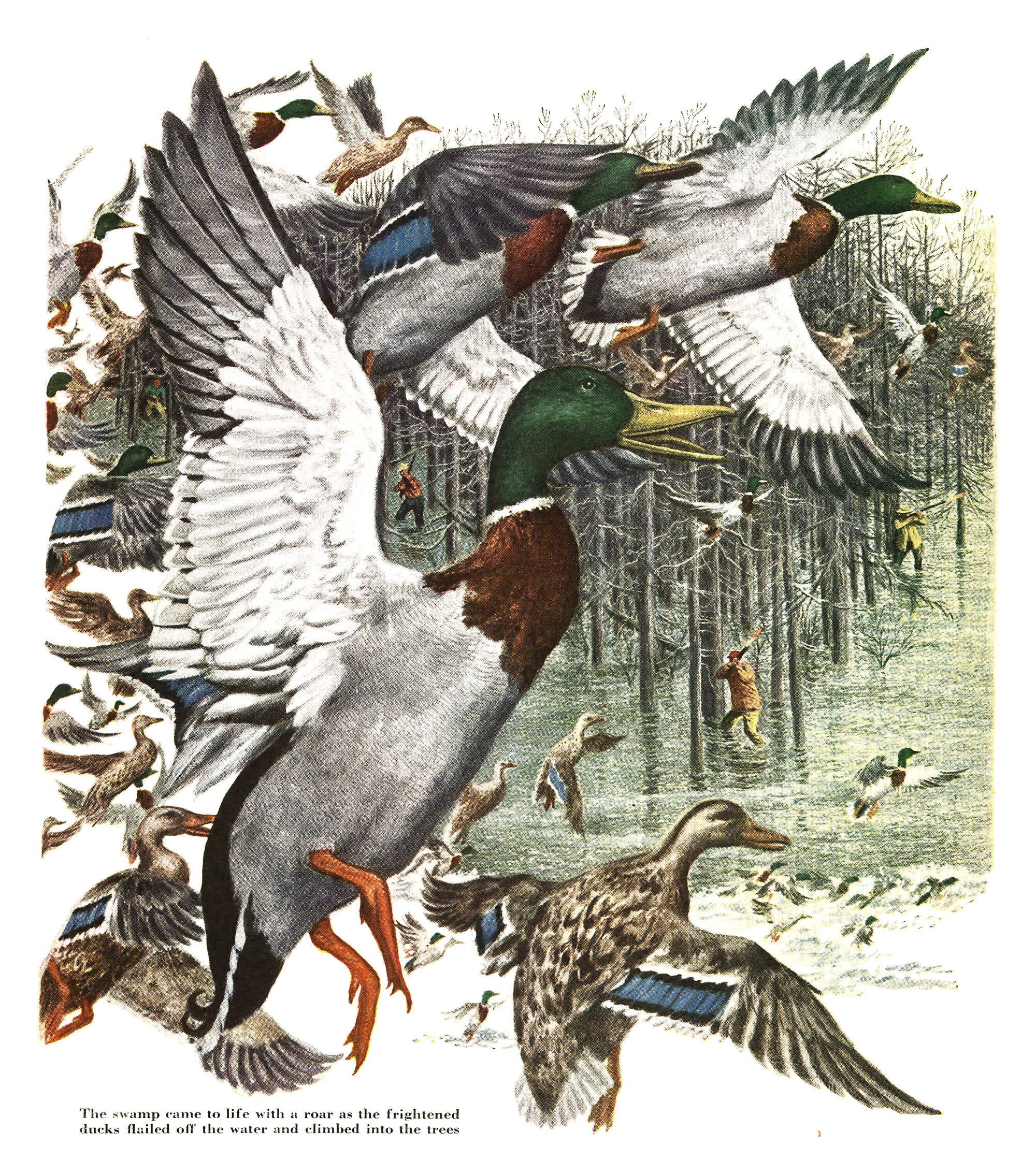
Jim and his boy were making duck talk, coaxing, cajoling, jollying them down. The nearest birds heard and responded. They set their wings and came slanting through the pin oaks like falling leaves, and then ducks were tumbling all around us and the noise was like a windstorm blowing up.
Nothing else like it has happened to me in all the years I have hunted wildfowl. I’ve had ducks come in to decoys singly, in pairs, and by the dozen. I have watched bands of ten and 200 hurtle through the treetops. But never had I seen 1,000 ducks, or maybe 2,000, slash down to the water in three or four minutes, in a circle 300 yards across with me in the center.
I’ve never had buck fever, but I think I came as close to it that day as I ever shall.
The last mallard tumbled in and the racket died away. There was no noise now save a subdued gabbling and splashing as the birds swam and fed. The four of us were standing glued to our tree trunks, motionless and silent. I don’t know about the others, but I’d almost forgotten my gun. Absorbed in the incredible spectacle around me, I wondered how long it would last and what would break the spell.
Greenhead drakes swam past within a dozen feet. A pair of susies upended and dabbled for acorns so close I could have pitched marbles at them. Then directly in front of me an old girl spun suddenly on the water and gave me an astonished stare. She figured me out, her bill flew open and she sounded off like an alarm clock with laryngitis.
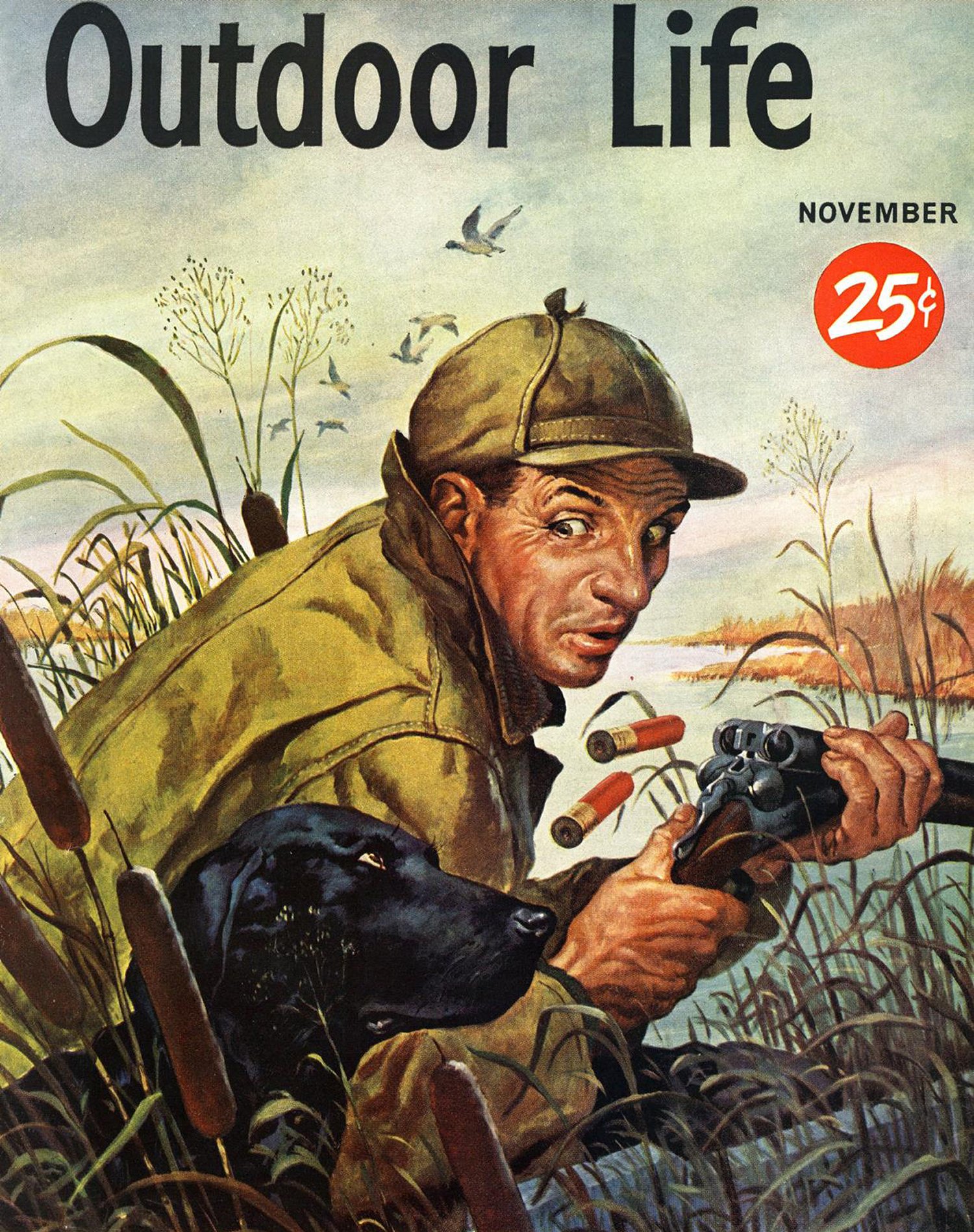
That did it. The swamp came to life with a roar as that great congregation of ducks flailed off the water and climbed into the trees. Then our guns punctuated the racket, and here and there a mallard dropped back to drift quietly under the pin oaks.
I got three shots off in thirty seconds. Three ducks crumpled. The rest did equally well.
A few mallards came winging into that feeding ground almost as soon as we finished picking up, and we knocked off one more apiece to round out our limit of four. The shooting was over with in ten or fifteen minutes. But it wasn’t the shooting that mattered. It was the spectacle we’d seen.
“This is the way to hunt ducks,” Jim announced positively as we started to thread our way back through the swamp to the boats. “A blind is all right if you’re too old to get out and wade, but what does a man want with one when he’s in his prime?”
Read Next: Our Obsession With Greenheads Could Ruin Duck Hunting as We Know It
I started to answer, but just then I stepped on a slimy log in three feet of muddy water. For a minute I had my hands full without talking back to Jim. And anyway, I didn’t feel much like giving him an argument.
“All right,” I said with a meek grin, “you don’t have to rub it in. Any time a man shows me what you’ve shown me today I’ll gladly hunt by his methods — within reasonable limits, of course.”