
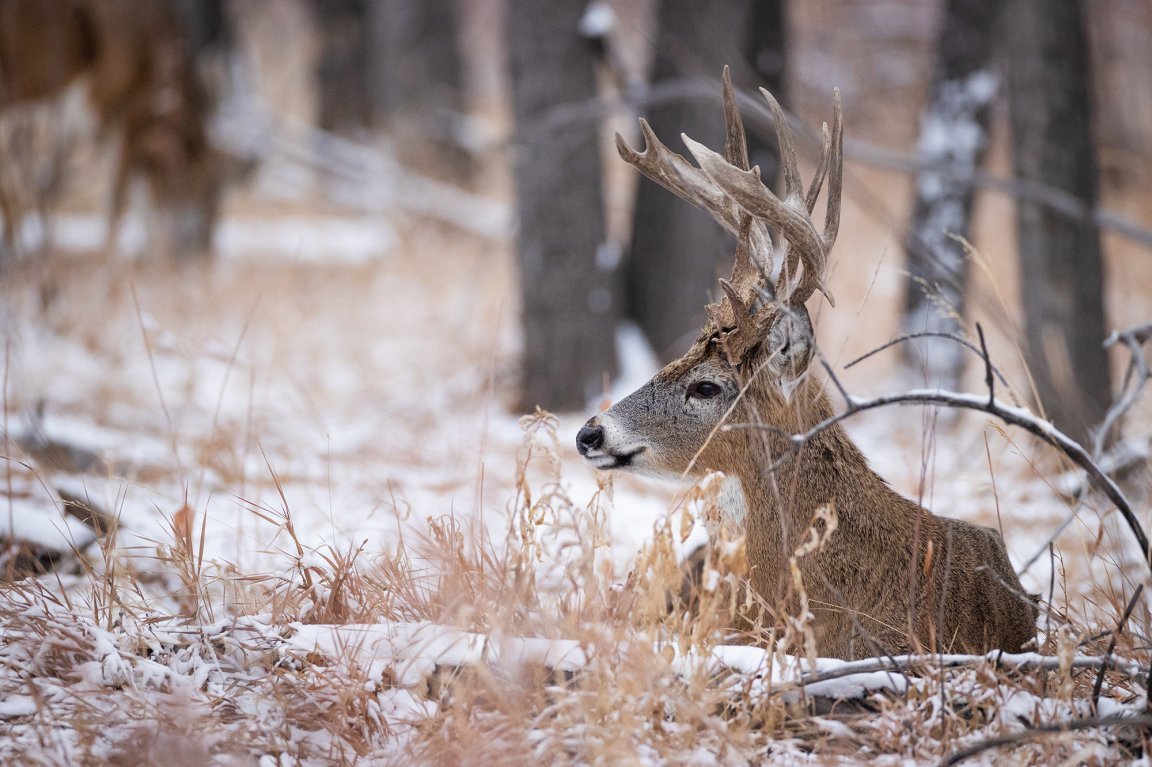
The big whitetail buck and I badly startled each other. In the steady rain patter, he apparently didn’t hear me until I’d stillhunted very close to his cedar clump shelter. I almost came unglued when he exploded into view, too spooked to even snort.
After the rifle’s roar shattered the forest stillness, I heard a couple more rhythmic thumps as the by-now invisible deer continued bounding. So much for my semi-frantic snapshot.
But then came a distant, wood-splintering racket, followed by silence. Without snow, it took awhile to slowly, alertly follow up. I found the heart-shot buck. That terminal crash noise came from his failing to clear a windfall when the carburetor quit for keeps.
That’s stillhunting at its best. Unlike the prolonged tedium of trail watching or waiting out a drive, stillhunting’s uptight anticipation is an ongoing thrill. When the action does come, it’s often sudden, without warning. Don’t hunt this way if you have a weak heart.
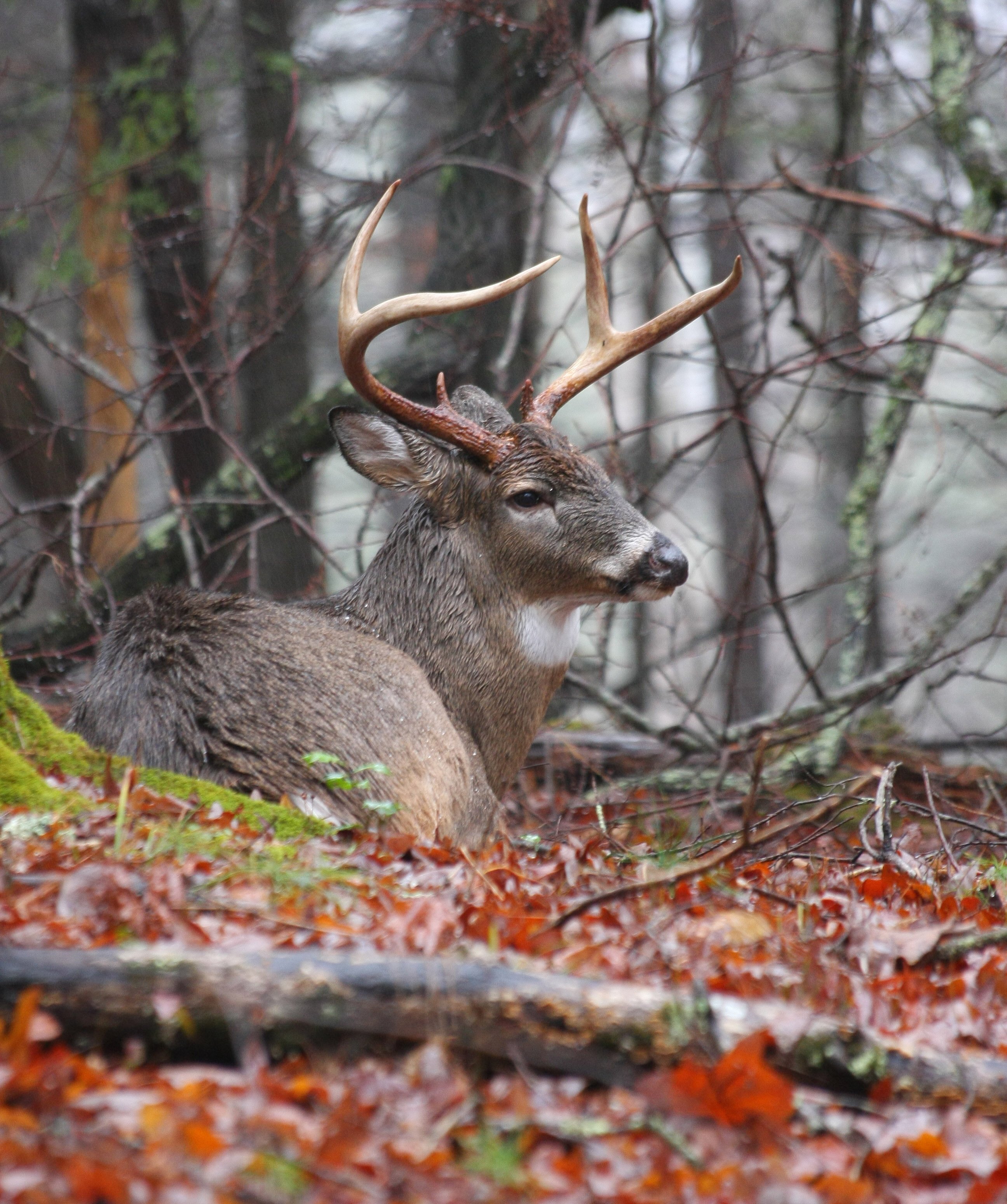
Very old-timers like my 87-year-old father tell me that forest stillhunting was far more common decades ago. Maybe today’s urban hunters don’t trust their stealth and woodcraft skills. Although not an easy way to take woodland game, including elk, the bottom-line reality is that stillhunting can produce game when other tactics cannot.
Obviously, a lone-wolf hunter can’t make drives to himself. Even when sufficient manpower is available, effective drives require thorough knowledge of both the terrain and how local deer use it. If game chooses not to move because it fed well last night, lacks sexual ambition just now or doesn’t like the prevailing weather, trail watching is usually hopeless. For that matter, many mule deer and most elk and moose simply don’t stick that much to established trails.
The stillhunter is free of such vagaries. Instead of hoping game will come to him, he goes to it — although stillhunting is not the stalking of game already located. Tactically, he has two top priorities. First, to move quietly and alertly, his course basically dictated by wind, terrain and possibly sun direction. Second, to discover game before it sees, hears or smells him. The stillhunter must play a lone-hand game — two hunters seem to make not twice, but four times the noise of one hunter.
Slow movement is a must. A stillhunter covering ground too quickly simply can’t look well enough for concealed game. He also can’t help making extra noise to be picked up by critters who depend on acute hearing every day of their lives to stay out of trouble. They easily detect high frequency noises (including any rustles, squeaks or metallic clinks from our gear and garb) that we often can’t hear.
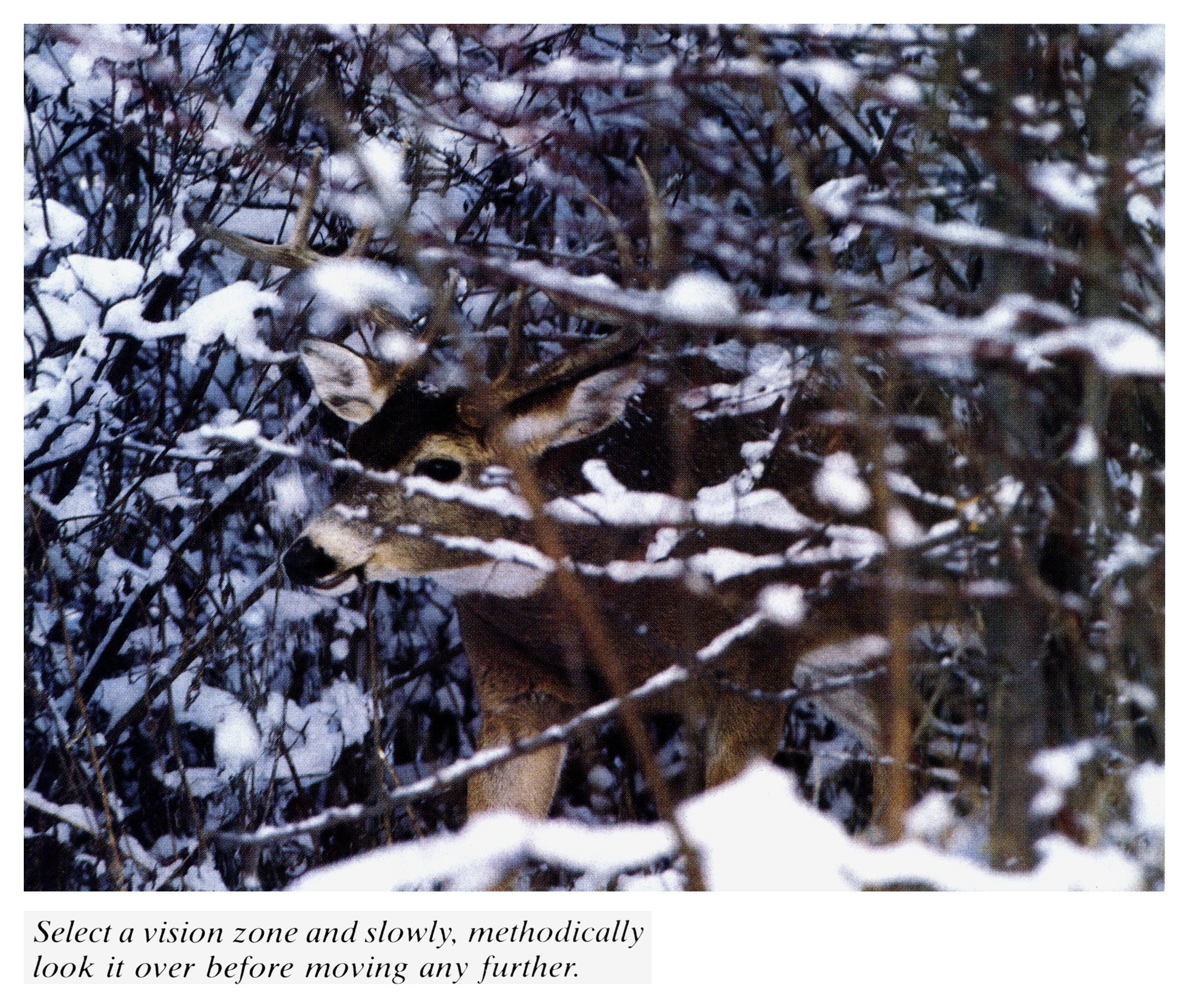
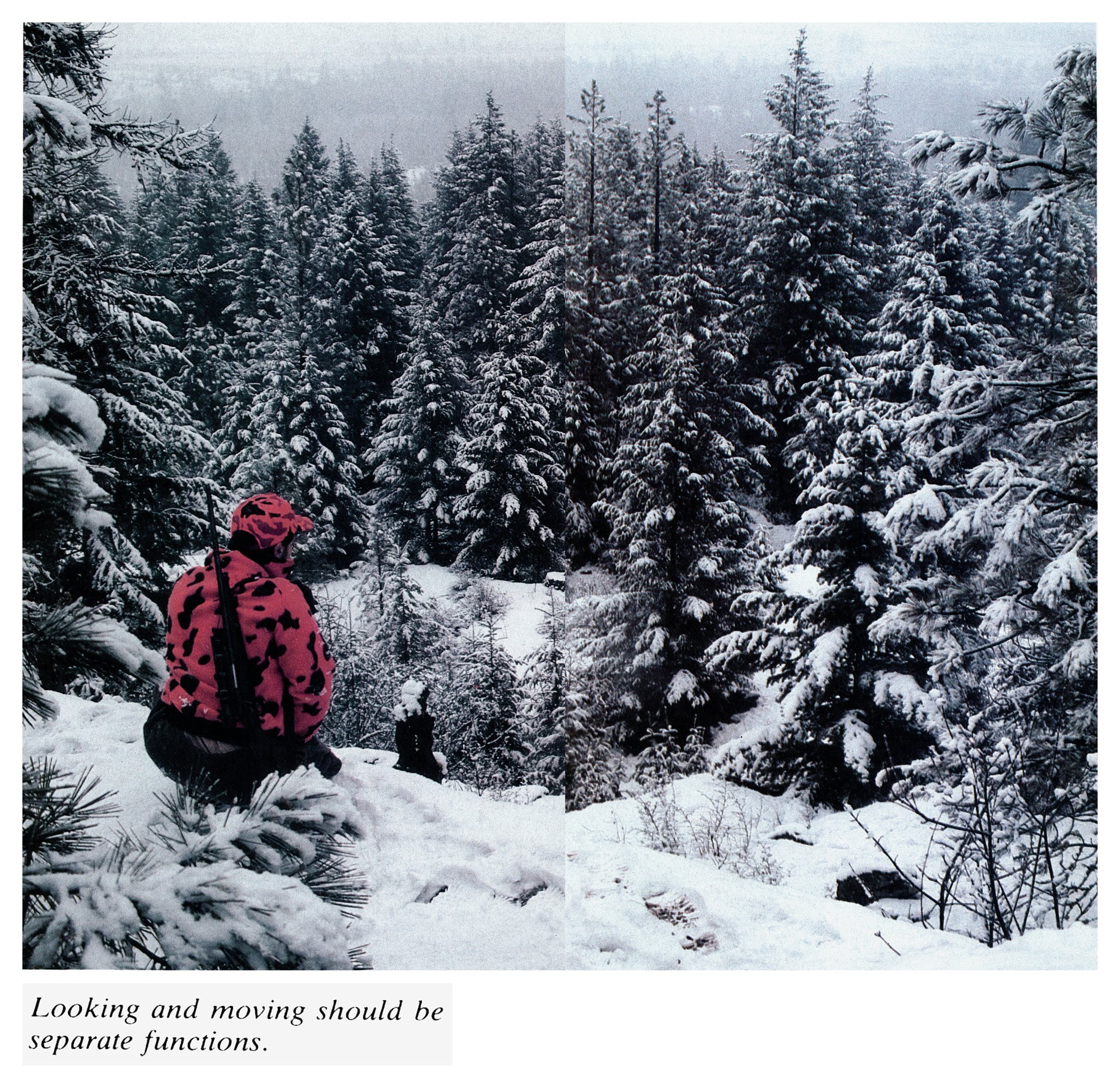
The real trick in stillhunting is to do the looking and the moving as two separate functions. If you forget everything else, remember that! When you attempt to look for game and move your feet at the same time, sooner or later you will make unwanted noise — snapping a brittle twig, tripping noisily or whatever.
Don’t follow any set rhythm of taking a set number of steps, then stopping. Instead, consider the area that you can see from where you stand as one vision zone. I never move until this zone, of up to 180° ahead and to both sides, has been totally studied.
A vision zone may range out only 50 feet in dense woods or 200-plus yards in more open country. Depending on the extent of the zone, terrain and cover, it may take 30 seconds or several minutes of methodical looking. Often a promising area is worth the time to just sit for extra eyeballing.
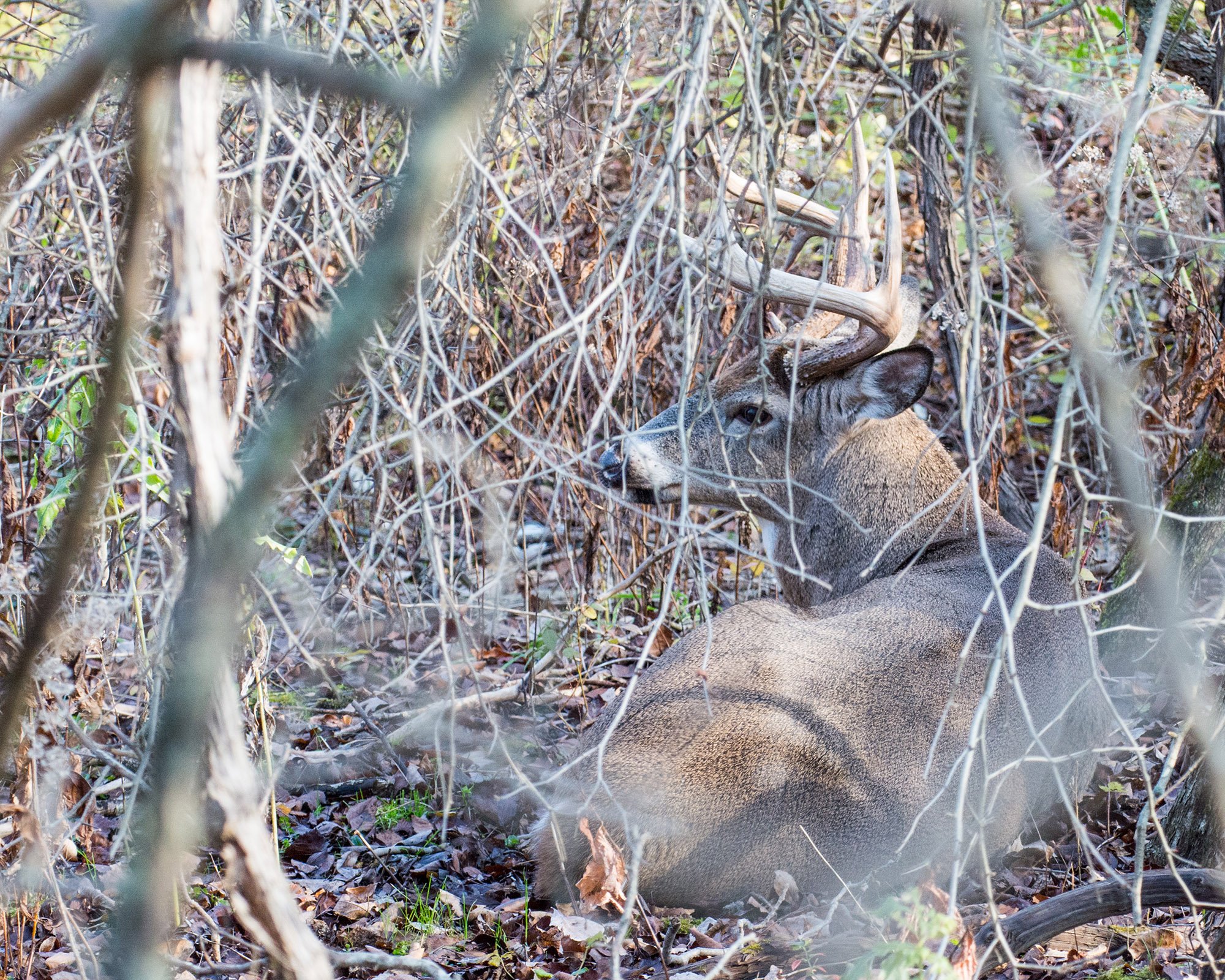
Don’t expect to see a full-blown deer or elk looming up ahead like calendar artwork. Look for just parts of the animal as clues. Most forest visuals are vertical lines — tree trunks, etc. An out-of-place horizontal line may be a log or the outline of a deer’s back. A smudge of dull yellow may be autumn leaves or an elk rump. Wide-field binoculars help greatly on such details.
Once, while hunting in the Cascade Mountains, my eye caught a tiny movement ahead. A broad leaf twitching with the breeze? But there was no breeze and, in that evergreen thicket, no deciduous leaves. I waited some minutes, then spotted the movement again for what it was — a blacktail doe’s ear twitching as its owner listened. When she finally moved, right behind her came a shootable buck.
After searching a visual zone (and listening, too), select a route for the next few feet or yards, based on avoidance of brush contact or other potential noise. Footwork is important. Short steps are quietest. They offer best control of shifting your balance if you ease your foot down and feel a twig likely to snap under full weight. Also, only with short steps can you come down slowly and silently on your toes or the ball of your foot. Long steps force the heel down first, making it much more likely that you will snap twigs or make a soft but tell-tale thud.
Want some expert stillhunting lessons? Simply watch a house cat on the prowl for birds or field mice. Slow movement, long look-listen pauses, obvious patience and great concentration are what make felines the finest stillhunters in nature. Once, in Washington’s mountains, I watched a mountain lion on the prowl. This best-of-all deer hunter resembles a magnified house cat at work.
Big or small, hunting cats are superb at using concealment. You should do likewise. Very often, unseen game ahead will hear you. By moving slowly with minimum noise, you may sound much like just another deer. But the listening quarry will be watching in your direction for visual confirmation. Don’t slow yourself any more than necessary. I use camouflage makeup to make my pale face less visible against dark forest backdrop.
If you can move quietly in some kind of concealment, use that route rather than an easier-looking, more open course. Stick to shadows; avoid sunlit patches. When possible, hunt with the sun behind you. Go over ridgetops with caution, using brush or timber cover. If the hilltop lacks cover, try crawling. Of course, stillhunting must be done into the wind or at least across it — never downwind. Although human sense of smell is pretty pathetic, sometimes the barnyard odor of elk ahead can be detected.
Often a stillhunter has the option of following fresh game tracks. Except under ideal conditions, such as new snow, one-man tracking demands so much attention that the stillhunter is distracted while he should be looking for actual game. More than once, deer or elk have surprised me, costing me a shot simply because I was distracted by some interesting tracks. If you start trailing, remember that the maker of these tracks may be bedded down somewhere ahead and almost certainly watching his backtrail. To get anywhere close to it will require extremely good stillhunting.
The lay of the land can be friend or foe. Ridges and hills offer chances to surprise game on the other side. Flat country is tougher because it offers few elevation advantages to the hunter. Although knowing the area always helps, it’s not truly essential for stillhunting. Once, a young stillhunter in our party, new to the place, nailed a whitetail buck the second morning. A fast learner, he capped that next year by pussyfooting close enough to a Cascades bull elk to take him with a bow.
The inexperienced stillhunter is often tempted to work mature evergreen timber, where dense shade means little underbrush. But closely spaced conifers self-prune their branches profusely, forming a noisy layer of dead twigs. Such forests can be hunted only when there’s enough wind noise to cover the hunter’s snap-crackle-pop progress. Unless soggy from rain or wet snow, dead leaves are another audio booby trap.
Some timber is open enough to have a good growth of clover or grass, particularly attractive to elk. By contrast, dense coniferous forests contain little ground-level browse to attract feeding game, but they often provide good escape cover when hunting pressure is on. In unseasonably warm weather, the cool shade of thick evergreen timber invites game. In cold weather, the evergreen canopy traps radiant ground heat for considerably warmer bedding than more open forests.
Where evergreen timber is lacking, game makes the best of thick brushy cover or tall grasses — the latter is commonly a deer favorite. In real cold or after rain, any warming sun draws game to south or west-facing slopes.
Best time of day for stillhunting depends on several factors. Stillhunting as early as light permits may find game feeding or on the move to bedding. Ground litter then is less noisy, thanks to the night’s dampening dew. But if overnight frost has made fallen leaves ultra-brittle or has crusted the snow, better wait for some midday thawing.
Though rain or a moderate wind helps mask hunter movement sounds, strong winds are a mixed blessing. With their hearing impaired by too much wind, restless animals change location often rather than staying put. That aids the stillhunter, because moving game is far easier to see. But wind-jittery animals, up on their feet and watching for danger they can’t hear, can spot the hunter more readily. Fortunately, a stiff wind covers his extra noise if the stillhunter sticks to thicker cover for extra concealment.
Worst of all are those dead-calm Indian summer days, when even your shadow seems to make a racket in the dried-out forest. The only option, then, is to hunt terrain where game can be spotted at a considerable distance (example: from one ridge to another).
Some cover simply can’t be stillhunted. Swampy terrain is impossibly noisy, all the more if there’s any ice to be broken. Dry, fluffy snow can be fairly quiet for walking. But typical autumn snow, heavy and wet, is composed of oversize, many-pointed flakes. Each step compression-shatters untold thousands of such crystalline flakes. That accounts for the appallingly loud squeakiness. Until it’s settled, breaking its flakes in the process, such snow is no good for stillhunting. The settling process may take two or three days unless a thaw speeds it.
Snow characteristics may vary with terrain. North-facing snow is little affected by the weak sun of late autumn, but snow on southern and western slopes settles quickly with a few hours of sun.
The stillhunter must remember that weather affects game’s likely location. The first serious snowfall often causes deer to hole up in the shelter of thick, low-branching evergreens, where they may stay 48 to 72 hours, believe it or not, even during the rut. Hungry when they finally leave cover, deer then are likely to feed during the day. But until they start moving, the pristine snow will be barren of tracks, leading to the false conclusion that all game has moved out.
Of course, game does move out of high country when big snowstorms hit. Hunting deer and elk on such vertical migration routes is often considered a trail-watching game. The stillhunter can cover more territory to learn where game is moving — and if it’s moving.
Gear and clothing are critical in stillhunting. Soft leather boots with crepe soles are almost moccasin-quiet but treacherous in steep, wet or rocky terrain. Classic, Maine-style, rubber shoepacs make quiet steps. Their rounded sole edges are not as likely to shear-snap noisy twigs as stiffer, sharp-edged soles do. With any other rubber footwear, wear enough socks to prevent empty space around the foot from audibly pumping air at each step.
Harder, composition soles with lugs are necessary to maintain life and limb in rough country. Alas, such footwear is noisier. The only consolation is that in country steep enough to require lug-soled boots, the stillhunter has a longer “working range” across canyons, etc., and is not quite as vulnerable to making noise as the close-range, flatland hunter. At times, I’ve carried soft sneakers in my daypack to slip on after climbing a ridge that demanded lug-soled, ankle-supportive boots. Another useful trick is to wear a pair of knit leg warmers running from knee-height to ankles. These muffle twig noise and grass swish.
Clothing choice is very simple. Whatever the material, it must be soft. Nylon, corduroy and stiff denim are too noisy. Wool and flannel are the great favorites for quiet movement. Some synthetics like orlon and acrylic are almost as good, depending on weave and nap. Rubberized raingear makes less noise than nylon or vinyl. Because a hat’s brim snags noisy branches, wear a cap. Again, wool or knitted acrylic is quietest. I made a simple, woolen pack cover to keep my backpack from imitating a snare drum when I hunker through overhanging branches.

For quiet carrying, a firearm’s barrel length is more critical than weight per se. Although carbines are best, one of my favorite woods rifles has a 24-inch barrel. I find a 26-inch barrel is just too easy to bang against branches. A timber riflescope should have at least a 30-foot field at 100 yards — more would be better, because forest shots are often at close-range game on the run. Yellow shooting glasses contrast brown deer and elk better against evergreen backgrounds.
Pocket hardware like keys, coins and cartridges must be handkerchief-wrapped to eliminate tell-tale clinking. When I rendezvoused with my deer-hunting daughter in the woods, her sardonic greeting was, “Hello, Santa!”
“Well before I saw you,” she continued, “I could hear you playing ‘Jingle Bells’. What’s in your pockets?”
A ring of unwrapped keys, that’s what. And deer probably could hear it twice as well as she could.
Although usually not physically taxing, stillhunting is tiring if you do it right. What wears you out is the strain of constant vigilance. And I mean constant! About the time you relax or daydream, up bounds a buck or bull that makes good his escape because you weren’t mentally prepared to react quite fast enough. But if you’re a dedicated hunter, the high-tension hours of stillhunting are memorable whether you score or not.
This story, “Deer on the Prowl,” appeared in the January 1990 issue of Outdoor Life. Read more from this series: