
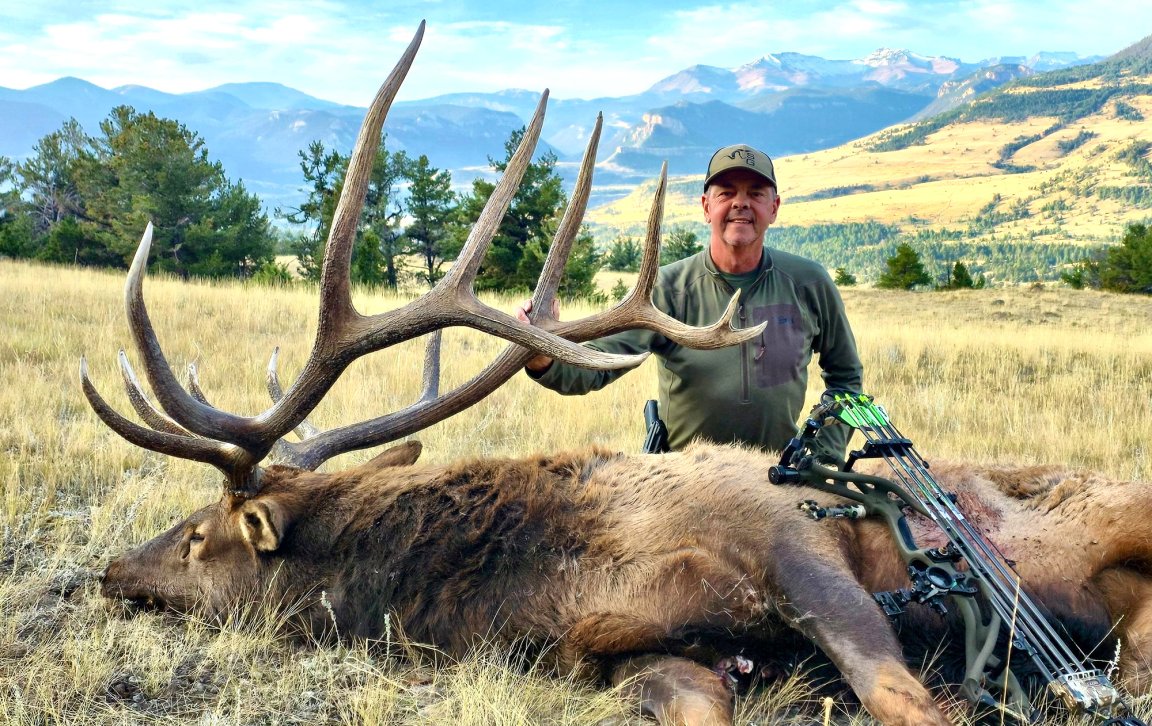
In late August a Wyoming bowhunter was found not guilty of wasting a game animal after he killed a bull elk in September 2025. Upon discovering that a bear, likely a grizzly, had disturbed his elk, Ron Niziolek of Cody left the meat, took the skull, and backed out of the area.
A tip from another hunter and a subsequent investigation by the Wyoming Game and Fish Department ultimately resulted in two citations for Niziolek: one for wasting a game animal and a second for possessing the parts of a wasted animal (the skull and antlers).
Niziolek, 63, says he was transparent about his actions when questioned by law enforcement last year and that he cooperated with the investigation. By leaving the meat, he says, he had been acting on guidance from the investigating warden’s predecessor, past calls with other WGFD employees, and a WGFD instructional video that shows hunters backing out from a bear-disturbed animal.
The bowhunter, who works full time as a computer draftsman at a local engineering company and occasionally writes for hunting publications, testified that he was disappointed a bear appeared to have spoiled the meat.
“We pride ourselves on not only taking what’s legally required, but taking everything we can from the animal,” Niziolek tells Outdoor Life. “So whether it means one more backpack load or whatever, that’s just what we do, and all my friends do. We live off [game meat].”
The two-day trial in Park County Circuit Court concluded Aug. 28, when Niziolek was cleared of both misdemeanor charges by the unanimous vote of six jurors. Although the bowhunter says he could have simply paid the two citations and moved on, he fought the charges on principle.
“I have no problem with the investigation. If I had called something like that in [to a warden], I would want it investigated,” Niziolek says. “But I obviously had trouble with their conclusion because of the lack of legal clarity … The problem I had with this whole thing is the conflicting opinions from different Game and Fish personnel on what you’re supposed to do in this instance.”
Jordan Winter, the Powell-area game warden who investigated and cited Niziolek, declined to comment to Outdoor Life when reached by phone. Winter did confirm he testified at the trial, which was covered in a piece published by the Powell Tribune on Thursday. Winter began working as the area’s game warden in 2022.
A spokesperson for WFGD acknowledged OL’s request for clarity on the law surrounding game meat recovery when a grizzly has disturbed a hunter’s animal, but did not provide it by press time.
A Bull, a Bear, and Conflicting Guidance
Niziolek was bowhunting with friends on public land in Park County, Wyoming, on the evening of Sept. 19, 2025, when he arrowed a bull elk just before dark. He and Adam and Mary Miles, the married couple he was hunting with, watched the bull run about 100 yards downhill and bed. The bull’s head was still up by nightfall, so the trio decided to back out to the nearby Switchback Ranch, which Adam manages, and return first thing in the morning.
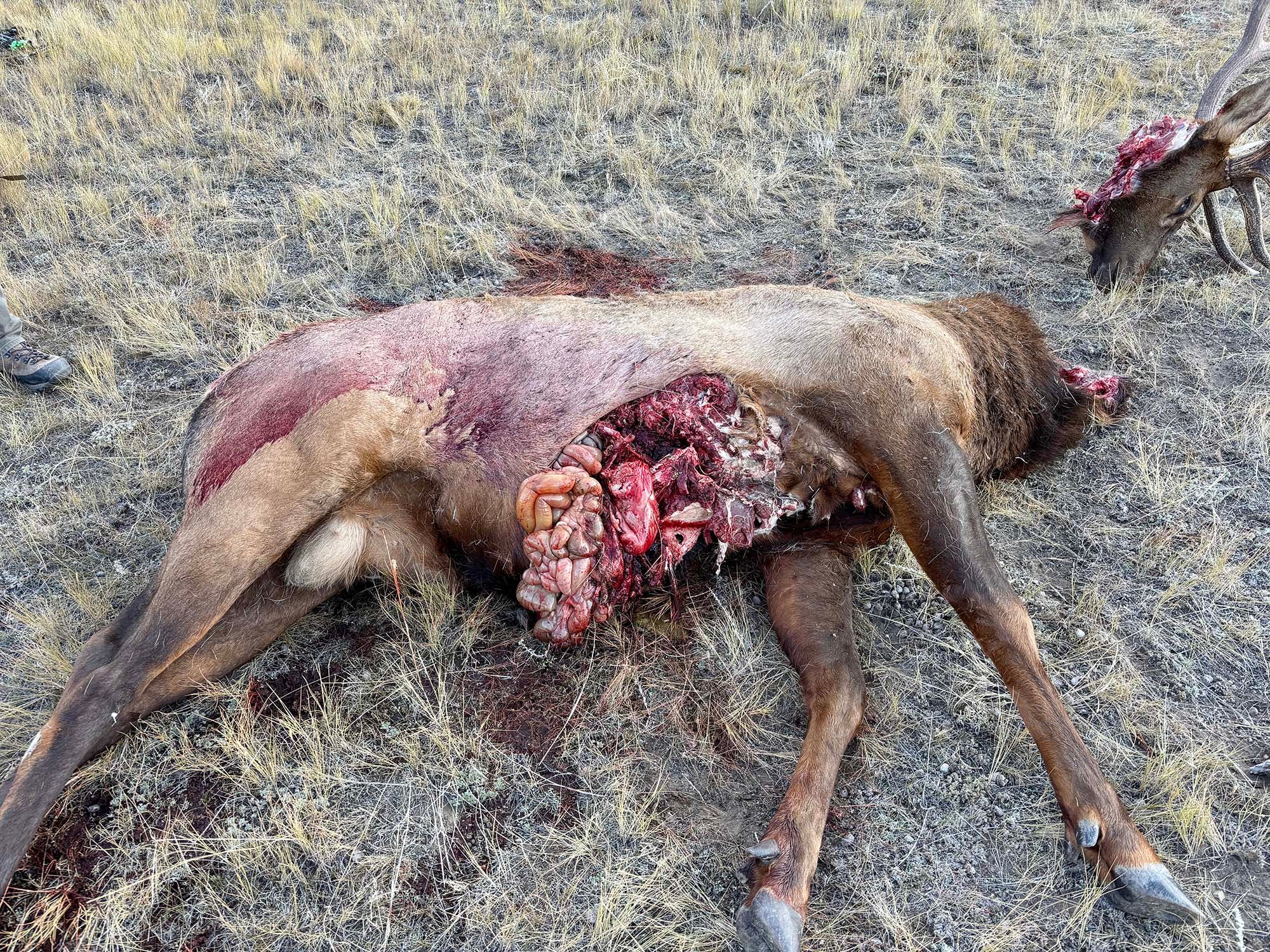
The bull was lying dead where they’d last seen him. It wasn’t until the party walked up to the elk that they realized the abdominal cavity, which had not been visible from their line of approach, had been split open. Two piles of fresh bear scat were beside the carcass.
“A Wyoming Game and Fish official, the [then] warden [for the area], told my friend Mary in 2016, ‘Do not eat any of the meat from an elk that a bear has fed on,’ because of the danger of disease — trichinosis specifically,” says Niziolek. “He said, ‘If you can get in without a bear confrontation, it’s okay to go in and grab the head, but don’t risk it if there’s a chance of a confrontation.’ Because if you do that, then you’re in trouble for harassing an endangered animal and potentially killing it or having it kill you.”
Mary Miles testified about this exchange at trial.
“I was told by the Game and Fish game warden that once a bear bites into an elk … and they urinate and sometimes defecate on the carcasses as well to claim it … the risk of disease is so high, you don’t want to take any of the meat,” she told jurors, according to reporting by the Tribune.
Park County lies within the Greater Yellowstone Ecosystem, which has the second-largest concentration of grizzly bears in the Lower 48. Niziolek says he’s hunted in bear country since 1983 and is familiar with both bear safety and applicable hunting regulations.
“We went to the carcass before we knew it had been disturbed. We had our pistols with us, and we thought, ‘We’ll take a few minutes, we will get some photos, and we will get out,’” says Niziolek. “Once we’re done with photos, Adam’s like, ‘I can have this head off in three minutes,’ instead of the hour and a half that we’d have been there to butcher it. It looks like the elk’s in the wide open, but there was timber all the way around, pretty much. So we didn’t know if a bear’s laying in the timber and he’s going to come charging out. So we got out of there. But we thought we conformed to every law, rule, regulation, and advice that they had given us.”
Niziolek took a single photo of the spilled guts, and in hindsight wishes he had taken video, too. He says WGFD suggested during the trial that perhaps a bird, not a bear, had disturbed his elk.
Related: Grizzly Bear Attacks Montana Bowhunter, Who Drove Himself Home Despite ‘Significant’ Injuries
“I snapped that photograph just as ‘Hey, in case something ever does come up, at least we’re going to have some proof,’” says Niziolek, adding that the Mileses spotted a big grizzly roaming the area within 24 hours. “Knowing how it went now, I should’ve had it on video. I should’ve walked two steps from the carcass and shown the pile of grizzly poop. I should’ve walked ten more steps, showed the second pile of grizzly poop. But who thinks it would ever come to what it did?”
An out-of-state hunter came across the headless carcass of Niziolek’s bull on Sept. 21, 2025 and ultimately reported it on Sept. 26 to WGFD. Niziolek says game warden Winter visited the site 11 days after the kill, when the sign was stale and only bones remained.
Winter didn’t contact him until November 2025, Niziolek says.
“I was up front, I told them, ‘Yes, that’s my elk. And here’s why we didn’t take it.’ I showed them photos. They confiscated my phone for a week,” he says, adding that Winter also took his European mount. WGFD kept the skull until the trial concluded. “I’m cool with it. I don’t like him taking my phone or the elk, but, hey, it’s part of the investigation. Let it play out. It’s gonna be fine.”
It wasn’t until February that Niziolek was cited, and he decided to go to trial.
“This happens quite a bit up in this area of the country. I’m not so sure why my experience made news, except I wasn’t just going to roll over and take it like a lot of people would do.”
A Legal Gray Area
Wyoming law is clear that hunters must take edible portions of meat — defined as all four quarters above the shanks, backstraps, and tenderloins — from a big game animal.
“It doesn’t really matter if it was a grizzly bear or not,” deputy Park County prosecuting attorney Larry Eichele told the jury during trial. “What if it was a bird? What if somebody was afraid of bird flu? What if it was a weasel or a skunk? ‘I don’t want to get rabies.’ What if it was a fox or a coyote [with] canine distemper, a wolf, a black bear, a grizzly bear?”
In any of those cases, Eichele said, a hunter isn’t allowed to choose whether to take the meat.
“But also under [Wyoming] statute, it says if you fail to take the meat, the department may require substantive proof of why you didn’t. And that’s one of the issues I have, because I thought we provided that,” Niziolek says, referring to an additional regulation on retrieving game animals and the photo of the disturbed carcass he provided to Winter.

Niziolek says the entire investigation could have been a positive learning experience on how to proceed with bear conflicts, but that it turned sour.
“I think [this case] could likely have a chilling effect where people who might otherwise contact Game and Fish and be cooperative may not contact Game and Fish, just for fear of being cited … or getting in trouble and having to go to trial,” says his attorney, Sarah Miles.
Miles is the sister of Adam Miles and sister-in-law of Mary Miles, who were hunting with Niziolek last year.
“I can’t even really say that calling Game and Fish would have changed the outcome,” says Sarah Miles. “I think it’s still very possible they would have said, ‘No you wasted it,’ or ‘You have to take it,’ and put everybody at risk. I don’t know that I would ever advise anybody to do anything different than what Ron did in those circumstances.”
Niziolek says he worked closely with WGFD for 40 years as an engaged citizen. He served as president of Bowhunters of Wyoming and participated in WGFD working groups.
“We’ve been super friendly, super helpful, and I’ve gone out of my way to help with things,” says Niziolek. “But how they acted with this whole thing … They ruined my trust in that agency.”