
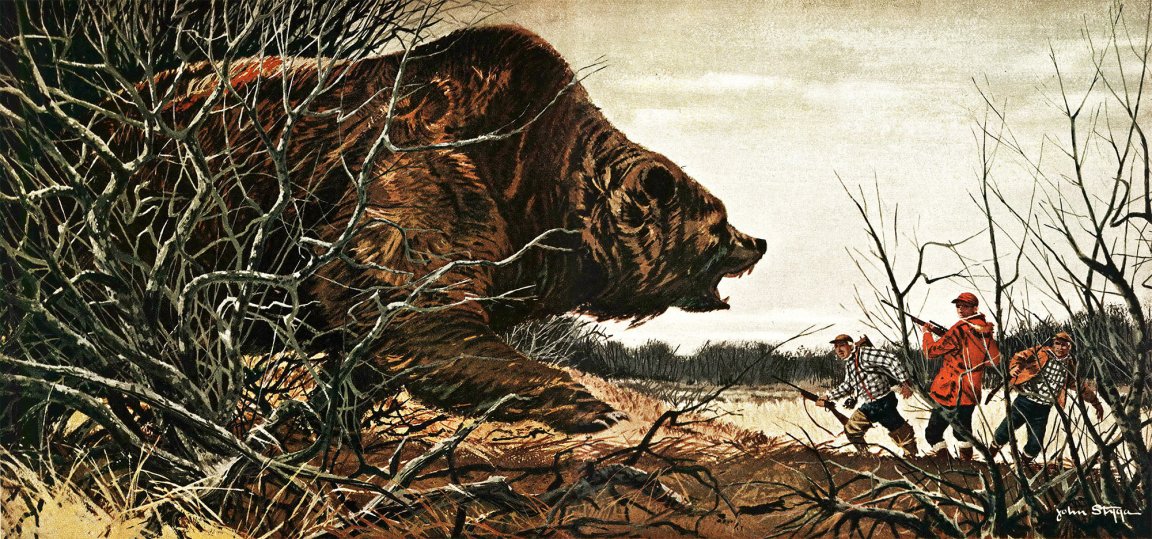
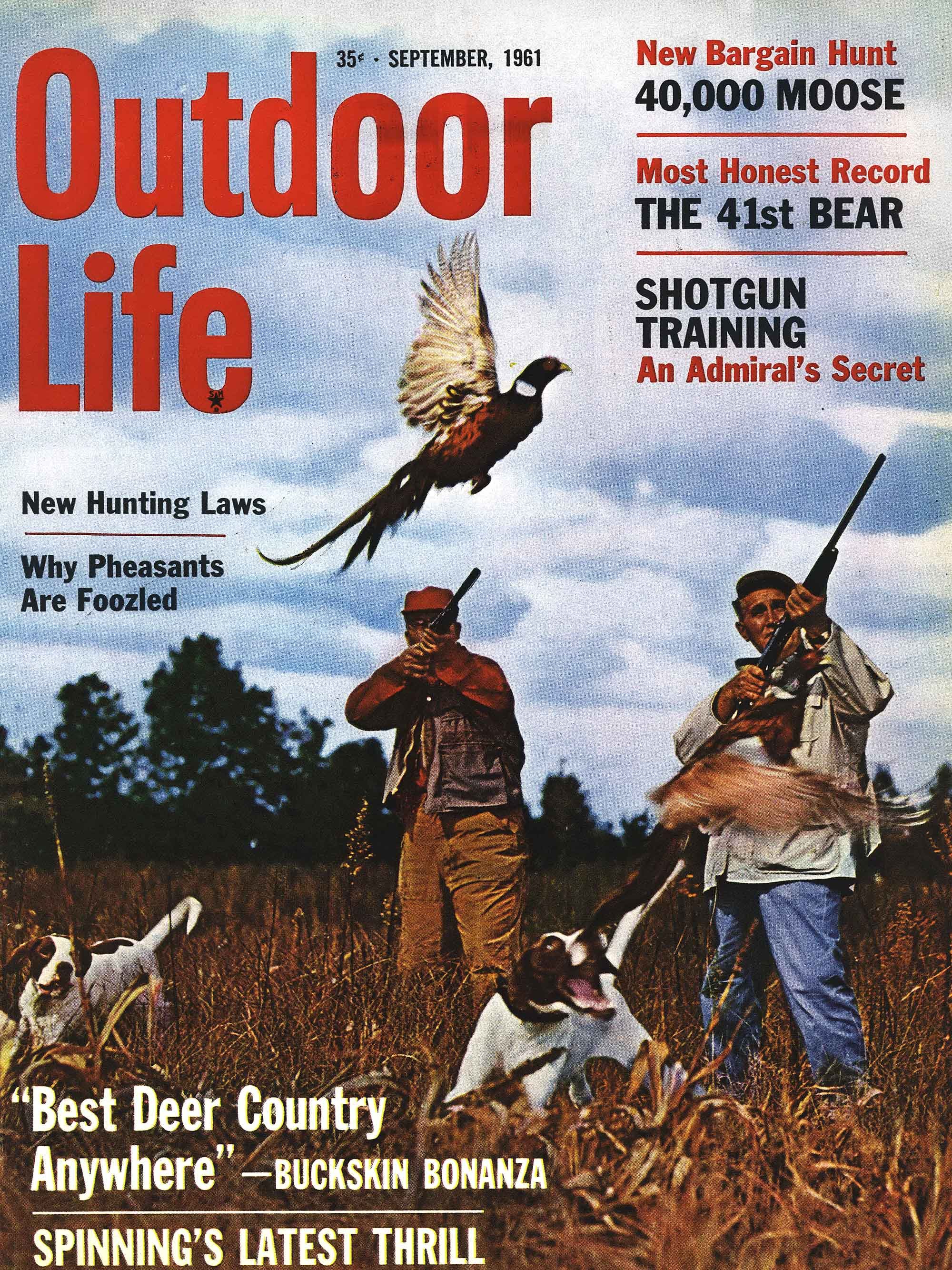
This story, “The 41st Bear,” appeared in the September 1961 issue of Outdoor Life.
John Yenter turned away from a 20X spotting scope and looked me right in the eye. He said, “Bill, you’re absolutely crazy. Forget your foolish specifications and collect that bear. You’re acting like a decrepit old desk hand, not a hunter.”
I had just refused to go after the 39th bear that failed to meet my specifications, and John, my hunting partner, was again giving me a piece of his mind. He never uses profanity, but he can do a blistering job without it. He had killed his bear like an expert, and now I, the junior member, was giving him trouble. Being six years older than I am, he felt perfectly justified in straightening me out.
It started months ago back in York, Pennsylvania, where my job — director of purchases for a large manufacturer of air-conditioning equipment — classifies me as a professional desk hand. I guess I look the part — gray, balding, and past several of man’s milestones.
My business associates in Borg-Warner are fond of trying to decide whether I was born a penny-pincher, which made me a purchasing agent, or the other way around. While they were debating that issue, I was concentrating on a 60-day toughening-up routine of golf, bowling, hiking, and calisthenics to convert my body from paper-shuffling to hunting condition. This was important because John C. Yenter, a building contractor from Tyrone, Pennsylvania, and I were planning a Kodiak bear hunt. We had so completely enjoyed our polar bear hunt in Norway’s frozen arctic region (“Desk Hand vs. Polar Bear,” Outdoor Life, December, 1957) that John decided his work with West Virginia Pulp & Paper Company could wait while we took a brown-bear hunt.
I wrote down some rigid specifications for my trophy brown bear and made a silent vow to live up to them. I wanted a male with a 10-foot-square hide, brown in color, a perfect pelt, and weighing 1,000 pounds or more.
Research indicated that Kodiak Island raised the largest, brownest bears, and a spring hunt would be my best bet for a trophy with a full-grown, unrubbed pelt. The idea was to get a bear fresh out of hibernation — before he ruined his pelt with mating-season fights or started to shed his winter coat. We scheduled our hunt for late April and early May, which appeared to be the prime time for Kodiak brownies.
We met our outfitter, Alf Madsen, in Kodiak Village, on April 27. We knew that most Kodiak bear hunting is done from the salt-water bays around the island, but records show that more big bears are taken in the interior. So we were bound for Karluk Lake, in the center of the southern part of the island.
The flight up the valleys, around and between the snow-covered mountains, was a sight so beautiful that we almost forgot we were in a little single-engine pontoon plane and at times many miles from any water to sit down on. We were in camp and ready to hunt on the morning of April 28.
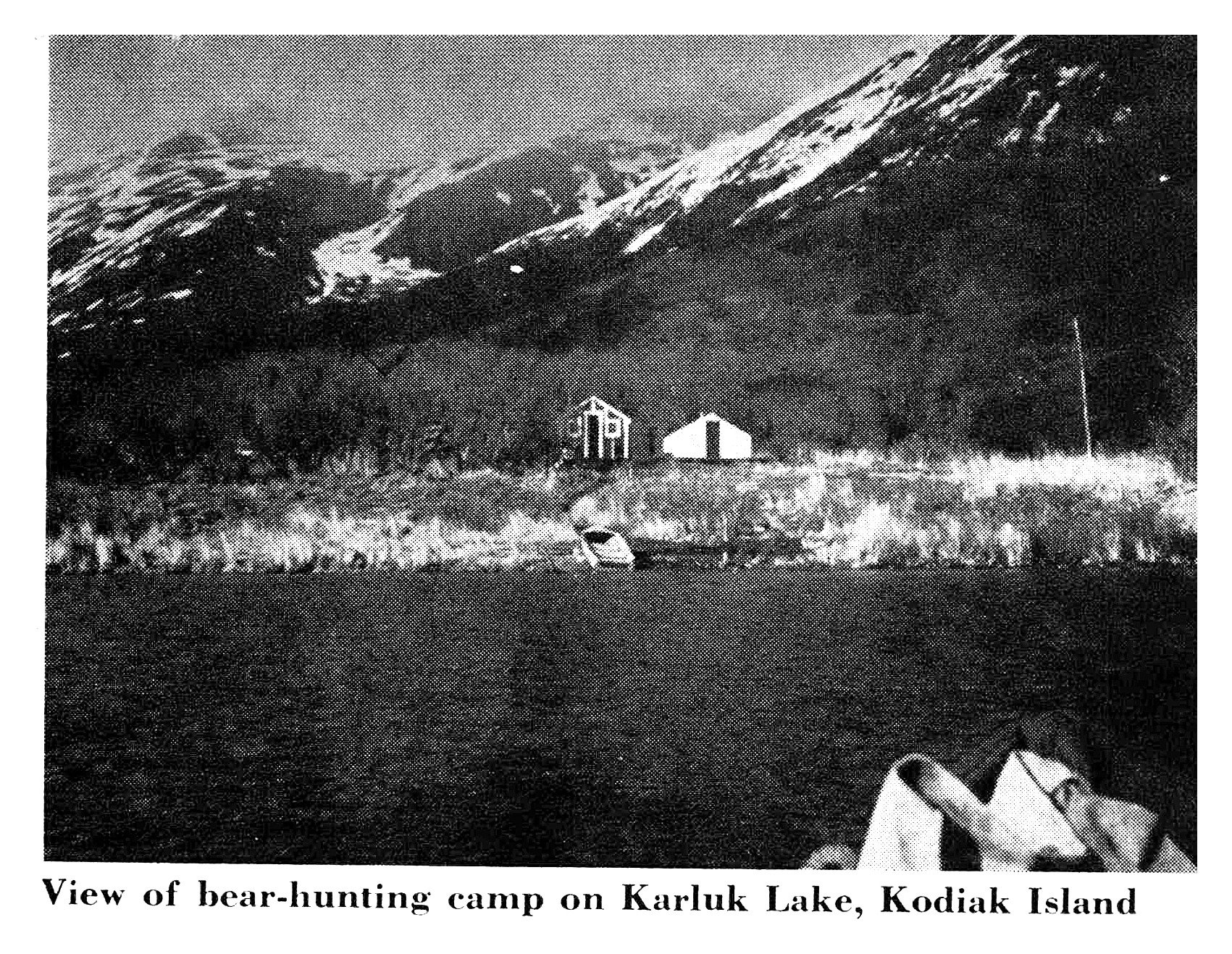
Our camp consisted of one frame cabin, one tent cabin, and an outhouse, without door, 100 yards north on the main bear trail. All the camp equipment, including two outboard boats for lake travel, had been flown in.
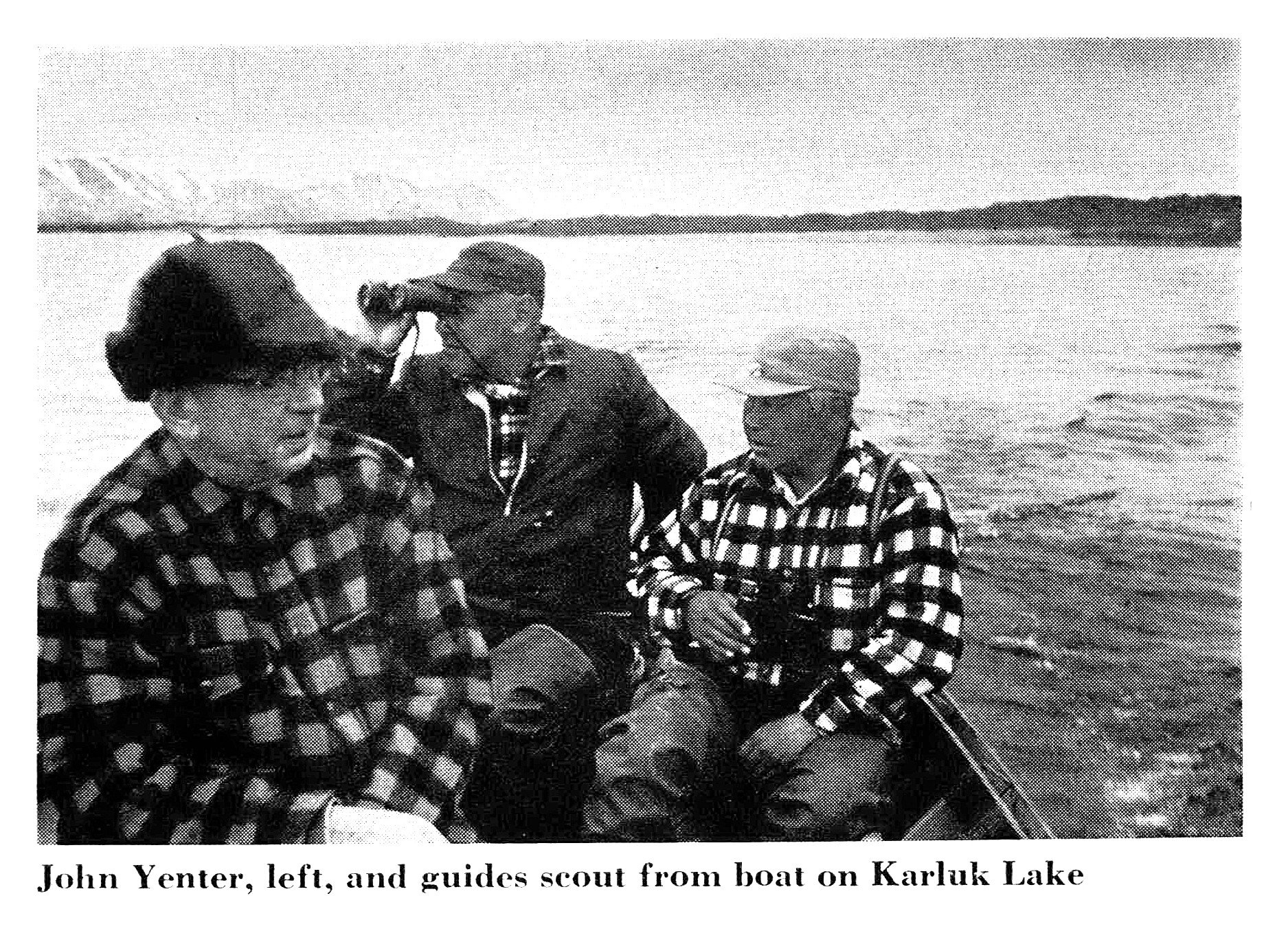
Karluk Lake looked a lot like one of the fjords of Norway. The blue water of the lake was now entirely clear of ice, but there were deep snowdrifts on the mountain peaks above the lake. If we’d never seen a bear, the wild beauty of the place would have repaid me for the trip in full.
We started the hunting campaign with all energy, and in two days we saw and classified 16 bears. I refused to stalk any of them because they failed to meet my specifications. John eventually suggested that I was displaying the stubbornness of a mule, rather than the calm judgment of a purchasing agent.
Our guides were by reputation the best on the island, and they soon proved that they deserved their standing. Some would call them Aleuts, but in reality they were members of the Koniaga Tribe, which has been considerably diluted by the Russians who owned the island until we bought Alaska from Russia in 1867. Our guides were proud of their Russian and Koniaga lineage, but they’re loyal United States citizens.
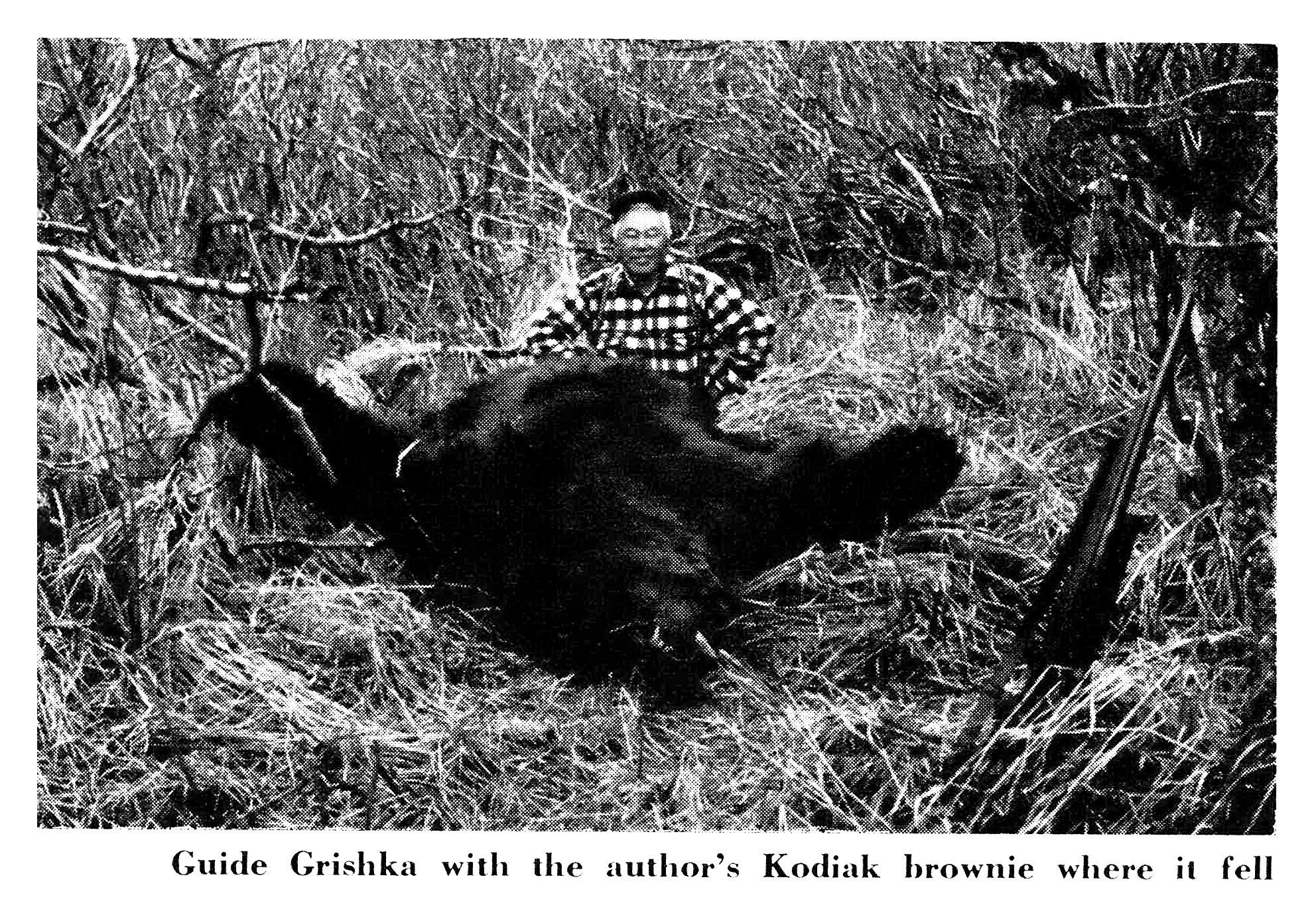
My guide was Grishka Nicoli, and John’s was Nick Malutin. These guides spoke their native Koniaga language, which is spoken only and not written. They also spoke fluent Russian and awkward English. They spend about three months of the year as hunting guides and four months as commercial salmon fishermen. For the rest of the year they’re Koniaga gentlemen of leisure. Like my hunting partner John Yenter, the guides were convinced that I was entirely too meticulous in my trophy specifications.
The only encouragement I had came from Kim Clark, who had become a very important part of our expedition. His full name was Webster Kimberly Clark, and he was a refuge biologist employed by the U. S. Fish and Wildlife Service. Kim had been reared in Greenfield, Massachusetts, had studied at the universities of Michigan, Massachusetts, Missouri, and Yale. He has a Doctor’s degree. Clark had done a vast amount of field research and had become one of the top authorities on North American bears. He was stationed on Kodiak Island by the federal government to study Kodiak bears.
Kim Clark had read my stories in Outdoor Life.* When Kim learned from outfitter Alf Madsen that I was planning a Kodiak hunt, he met me in Kodiak Village and asked if he could join the group to observe and record the data on bears killed. We were glad to have a man of his ability and knowledge.
During the early part of our stay on Karluk Lake, Kim worked alone and permitted us to hunt as hunters, not as scientists. He was a great addition to our expedition, because his lectures at night permitted us to do practical field work the next day in connection with our hunt. Between hunting, field and night classes, we were extremely well occupied.
Had it not been for Kim encouraging me to stick to my specifications, I might have given up. He encouraged me because accurate field data on a big male brown bear just out of hibernation is apparently very scarce.
By the third day my partner John was adjusting his own specifications to suit the bear that was in sight. We were glassing a brownie on the shoreline across the lake, and through the glasses it looked good — perfect hide, pleasing color, but slightly under my requirements as to size. John wanted it.
In a few minutes we were on our way across the lake, approaching very quietly so as not to alarm the bear. We landed several hundred yards from the bruin, and John started stalking the animal with his guide. In spite of the skill they displayed, the bear caught the man smell. He was on his way up the mountainside before John could shoot. He and Nick stood on the shore watching the occasional motion of a bush which indicated that the bear was going higher and away.
The bear was 150 yards from the lake shore when he came into a little opening in the brush where we could see him. At that point he made the biggest and last mistake of his life. He stopped and looked back. At that moment John fired. The bear fell. Two more shots finished him completely. John’s performance was a credit to him, to his .375 H. & H. Winchester, Model 70 rifle, and its Bausch & Lomb scope sight.
It was without question a big bear, the color was excellent, the 8½-feet-square hide was prime and perfect. John was a thoroughly happy hunter.
With his bear hide strung up to dry, John concentrated on the wonderful trout fishing near camp, with time out now and then to think up some new criticisms of my ideas about a proper trophy.
At the end of the ninth day we sized up the situation and found that we had glassed 40 bears, killed one. I was still holding out for a bigger and better one.
The weather was perfect for the first three days, which was probably why we saw so many bears. There was rain every day after that, and visibility was often too poor for good work with binoculars. There’s no climate on Kodiak, just a vast assortment of unexpected and undesirable weather.
When we started out the 10th morning, we found that what had been rain at the lake camp during the night had been snow above the 1,500-foot level on the mountain. In spite of that, our hunting began early, and at 8:30 we saw a bear that looked very interesting. He was a mile from the lake shore, 1,600 feet higher, just above the new but temporary snow line.
Trying to get a better look at the bear, we moved up the bed of Cottonwood Creek. This took us out of sight of the bruin momentarily, but we knew exactly where he was because the snow line established his elevation and the pass made in the mountains by the creek marked his location the other way. Yet, an hour’s looking from our new position failed to locate him.
We then climbed up high on the right bank of Cottonwood Creek, and from there we glassed constantly until noon. We felt sure that the bear was there because we certainly would have seen him if he’d walked away.
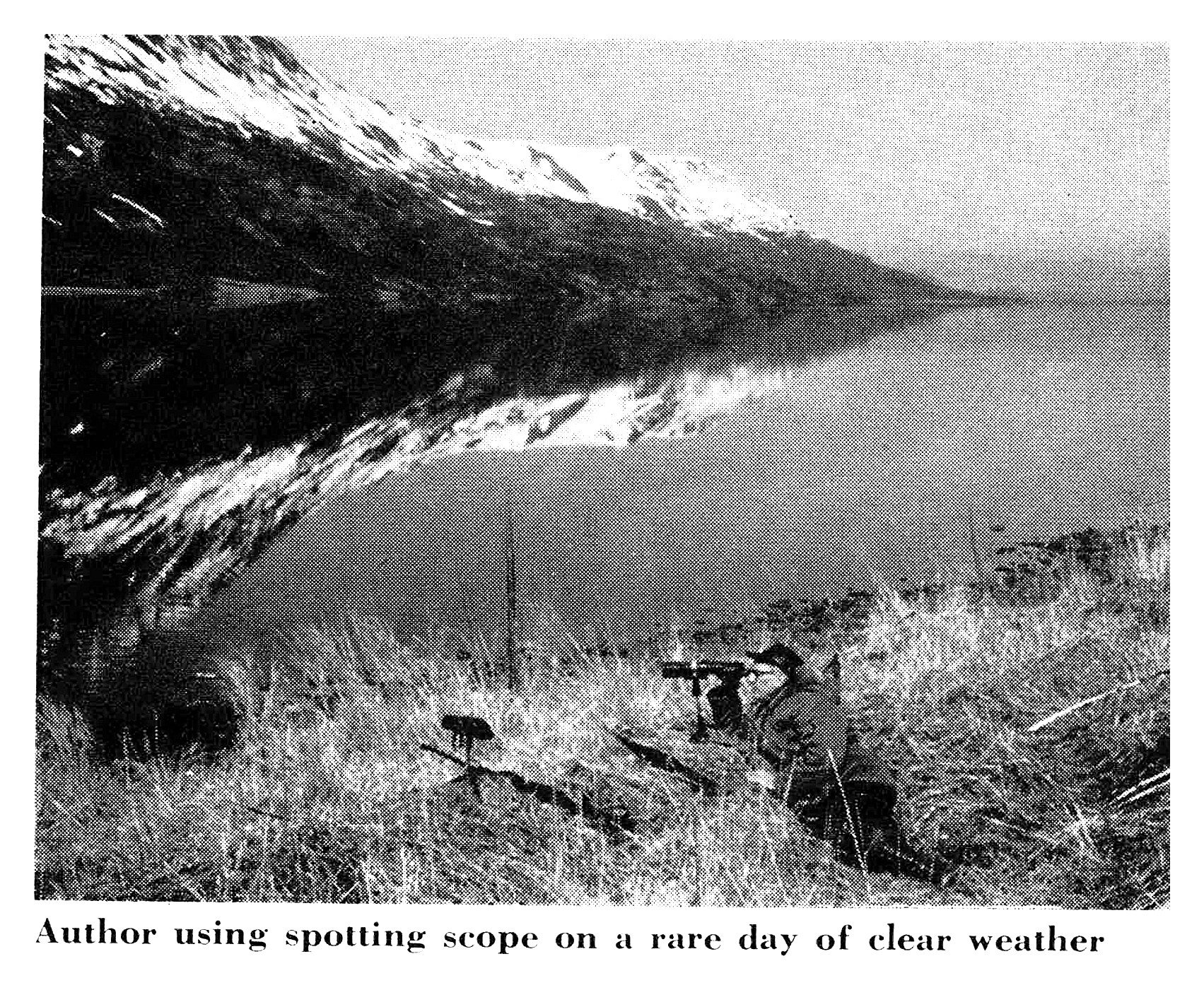
At noon we abandoned that position and moved to a spot across the lake, a mile farther away, which gave us a better perspective and a view of more of the ground area. We took turns eating and resting, but we were constantly looking. The rain returned in full force and it was a very uncomfortable situation.
We never saw a sign of the bear until 4 o’clock, when suddenly he stood up and was in plain view again. It was now evident that we’d first seen him when he finished his morning feeding, and he’d bedded down for the day. Now he was up feeding again.
After a few minutes of careful observation, the guides decided that this bear would meet every point in my specifications. This was a fine display of skill on the part of the guides and is something I could never hope to duplicate. To the inexperienced, a bear two miles away through a 20X Bausch & Lomb telescope is just a bear, but my guide was able to classify him very accurately as to sex, size, and condition.
I knew enough by now to trust this guide’s judgment, and in a few minutes we were on our way back across the lake to start the stalk.
Before we reached the far shore the clouds had dropped so low that the mountains were completely obscured.
Since John had killed his bear, we decided that he’d stay with the boat and the two guides would accompany me on the climb up the mountain. It took a few minutes to strip for action, which meant down to heavy underwear, a sweat shirt, rain suit, and hip boots. This sounds like unusual mountain-climbing equipment, but the first mile of our climb would be accomplished by wading up the creek. It was much easier that way than climbing through the murderous alder thickets on either side.
By 5:30 we’d accomplished the most difficult part of the climb and were at about the same height as the bear and 500 to 800 yards to the right of him. At this point we climbed out of the creek and dived into the alder thicket. All alder thickets are nasty, but this one was the worst that I’d ever seen.
Soon we picked up a prominent bear trail, a path so worn that one of the guides called it “a bear highway.” It was obviously the main bear trail on that particular mountainside, and we felt sure that my bear was on it. We had no idea which way he was traveling, so it was possible that we’d meet him at any moment. It was also possible that he’d park a few yards off the trail to observe and properly take care of anything that might be using the bear highway. It’s this kind of thinking that prevents daydreaming on brown-bear stalks.
Grishka, who was in front of me, explained that he’d lead and watch ahead. Nick would bring up the rear and watch behind us and to the sides of the trail. I was free to watch any angle that suited my fancy. I think this was a polite way of telling me that they didn’t trust my powers of observation.
I was planning what I’d do if certain things happened. I realized that any shooting would be at very close range because of the thick alders and the heavy fog. While my guides were both carrying .348 Winchesters with open sights, I was carrying a .375 Winchester with a Bausch & Lomb scope. No scope is ideal equipment for a quick shot at 10 yards, and I wished for an old-fashioned V notch and front post.
Nick must have been reading my mind. He said, “Bill, if we meet the bear and you have trouble with your rifle, just throw it down and grab mine. I’ll be right behind you.”
Nothing could have done me more harm than that speech. I knew now that he had no more confidence in my equipment than I had, and I was scared stiff. I had enough acid in my stomach to pickle a ton of iron castings.
We soon came out into the little open spot on the mountainside that we’d marked as the location of the bear when last seen almost two hours before. This clearing was about 100 feet in each direction — no alders, just dead grass almost knee high. We spent 20 minutes searching the open area and forcing our way into the brush around the edges, trying to pick up a trail or some sign of the bear.
Suddenly my head was gripped by Grishka, a powerful man but only five feet tall. He pulled my head down to his level, slapped his wet face against mine. Pointing to the right, he whispered in my ear, “Bear there. Shoot!”
About 75 yards away, through a little opening in the brush, I could see a dark spot. It could have been a bear. As I dropped to one knee, my perfect guide braced his knees to my back to steady my position. His 9X binoculars were tight to his eyes and just above my head as he watched the bear.
When I picked up that brown spot in my 2½X scope, I couldn’t tell whether it was a bear or not. If it was, I couldn’t for the life of me see which way he was pointing.
In a whisper, I asked Grishka, “Which end is the head on?”
After a full minute’s careful observation through his glasses, he put his mouth to my ear and said, “Other end. Shoot!”
That concise data from Grishka was fed through my fire-control center down to the trigger finger, and my gun fired. I was so excited I didn’t hear the report of the rifle, nor was I conscious that there was any recoil. But I did hear the bullet hit something, and then a fraction of a second later I knew it was a bear. He roared his complete disapproval of the whole situation.
Then it seemed that the brown bulk went up in the air several feet. An instant later it was on the ground and for a split second was completely still. At that moment I fired my second shot, and the bear’s reaction to that was a quick lunge to the right, toward the alders. I fired my third shot as he disappeared.
Grishka had said the first shot was good, but I didn’t see how he could possibly know. The bear had disappeared into the brush just as though he hadn’t been touched.
Both guides were now running as hard as they could to the right — in the same general direction the bear was going when we last saw him. It was quite obvious that they were attempting to get ahead of the bear before he reached the creek bed, which was 600 yards away. I caught them quickly and stayed right with them, not due to any bravery on my part, but simply because it was obviously much safer to stay close to them and their two rifles.
Our travel in the next few minutes was parallel to that of the bear, and we could follow his location by the noise he made. I thought — and hoped — that the amount of noise was due to the fact that he was badly wounded, running blind and knocking brush to one side.
A few seconds later we were on the edge of the creek where we could look down a steep bank to the water 100 feet below. Then I realized that the noise of the bear was not to my left, as it had been, but almost back of me and getting closer. I turned to face the noise. A second later that bear came into sight less than 20 yards away.
It was the most stirring sight a thrill hunter could ever hope to see. That bear was coming at us at top speed, and it looked as though he knew exactly what he was going to do when he got there.
I slammed the gun to my shoulder and looked at the bear in the scope sight. The contour of the ground was such that I could see the back of his neck, so I selected a spot where the neck joins the shoulders. The crosshairs settled on that spot. I tightened on the trigger, adding pressure and waiting for the recoil.
But the bear rolled dead as Caesar before my rifle went off. I lowered the weapon still cocked and loaded. I never have felt so cheated in all my life. In another 1/10th of a second I could have been the Man Who Stopped the Charging Brownie.
Later examination showed that the first shot had gone very effectively into his side just back of the ribs, forward under the spine, just grazing it, cutting the main blood vessels just back of the heart. Clearly the bear had been too far gone to make a determined charge. He was only making a blind run with his last spark of life, and we happened to be in his path.
That bear was coming at us at top speed, and it looked as though he knew exactly what he was going to do when he got there.
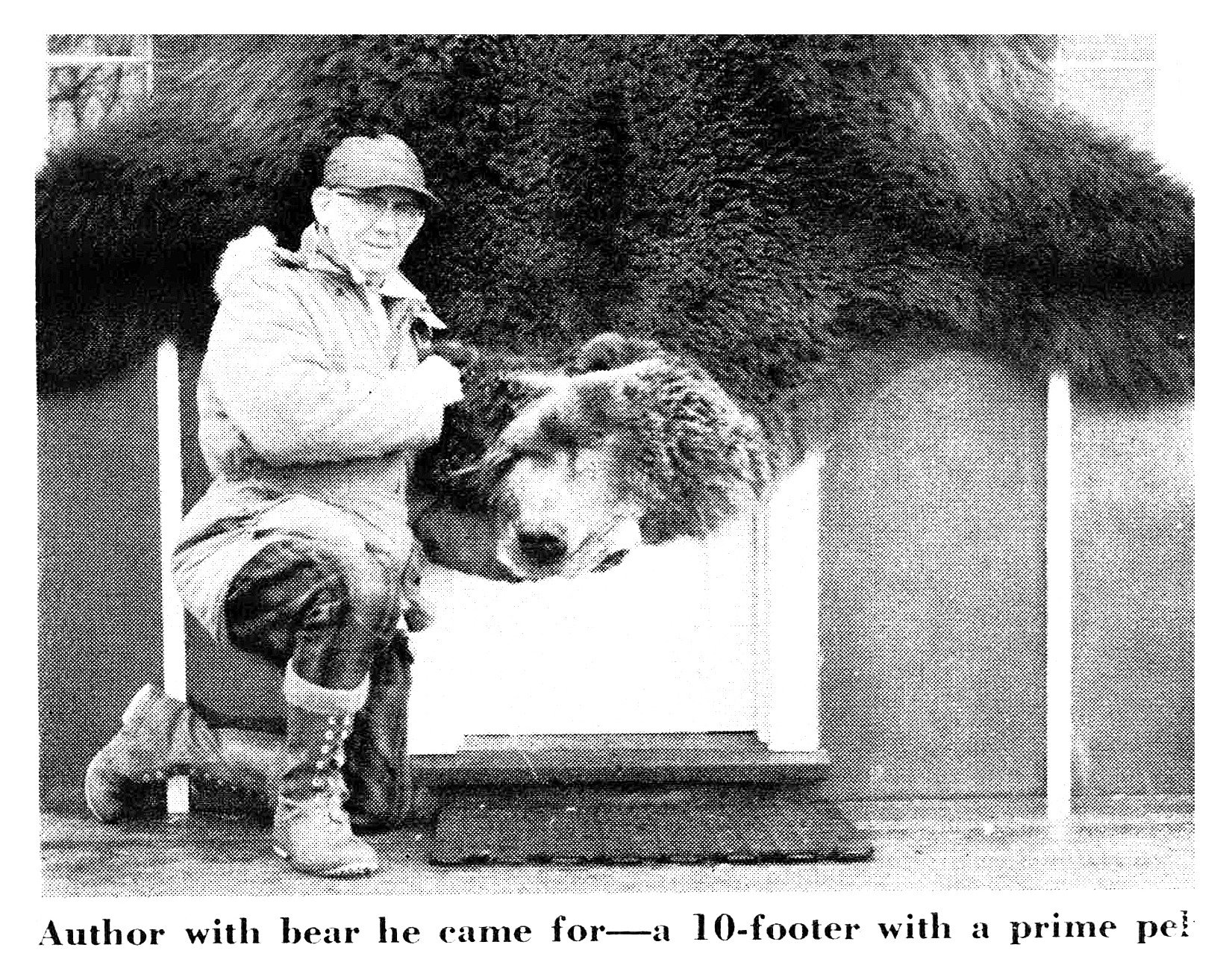
I examined the bear closely, and was glad that I’d stuck to my specifications. It was a male, the color dark brown, the hide in perfect condition, and the size was enough to flatter any desk hand. It was the 41st bear we’d seen on this trip.
Suddenly I realized that it was beginning to get dark. We’d have to leave the bear and return the next day to do the skinning. I was worried about what might happen to the hide overnight, but Grishka said, “We leave strong man smell here. Nothing bother.” With a grin he added, “The strongest thing here is white-man smell of your sweat shirt. We leave it.”
I peeled off the shirt and he tied it to a limb above the bear. When we returned the next morning the shirt and the bear were there and nothing had bothered it.
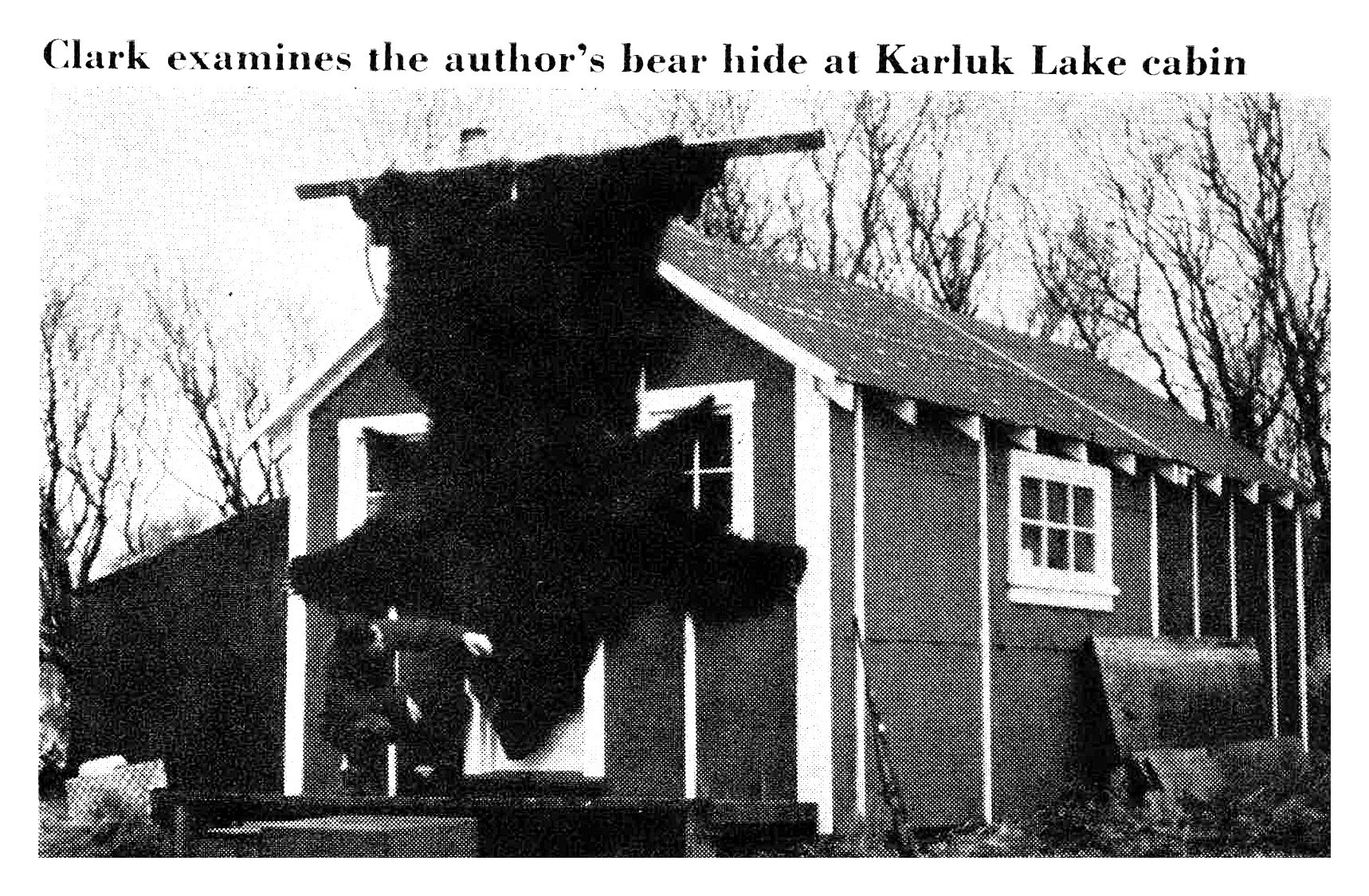
The guides, Kim Clark, and I left camp early next morning and climbed the mountain to skin the bear. John remained in camp. He and the cook, Pete Unger, had planned a fishing trip.
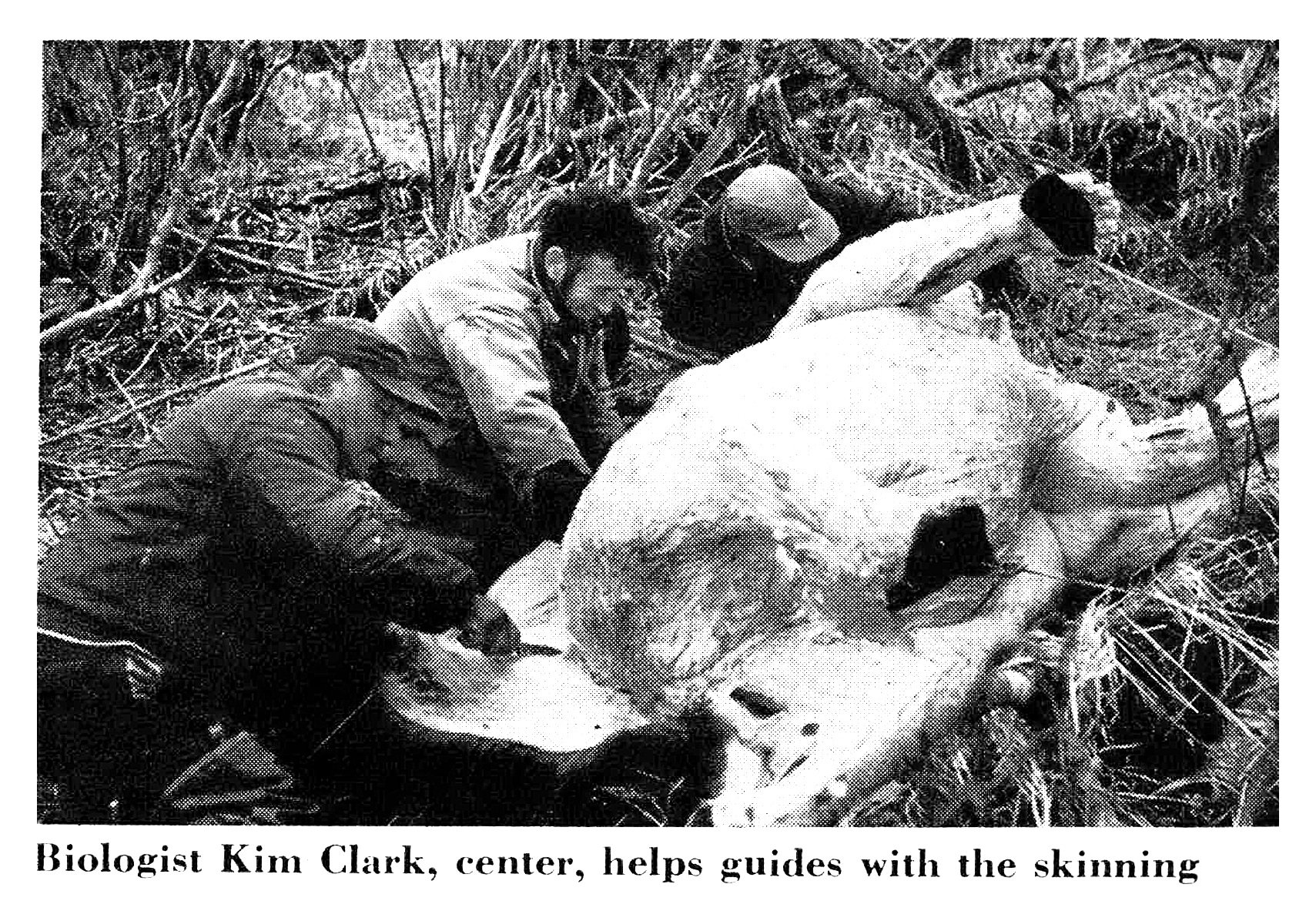
Kim was keenly interested in the bear from our description so we went in loaded with camera equipment, scales, surgical instruments, test tubes, and specimen bottles. Very few Kodiak bears have ever been accurately weighed and examined, and this is especially true of big bears just out of hibernation.
My bear was an ideal specimen for studying the effects of hibernation, because he evidently had just come out of that lethargic state. The stomach was found to be about 1/10 full, and the contents weighed 16 pounds. Carefully separated and weighed, we found that the contents were 55 percent blue-joint grass, 20 percent nettle, 20 percent wild celery, and 5 percent poque, which is a parasitic growth on the roots of the alders. There was no animal matter present.
The intestine was then examined and the length was accurately determined to be 77 feet 6¾ inches. It was then split from end to end for internal examination. There was no food in it. This indicated two things: first, that the bear had not been out of hibernation long enough for food to pass through the stomach into the intestine, and second, that he had gone into hibernation with the intestine completely empty, which conformed to the generally accepted theory. Further examination revealed there wasn’t a sign of ulcer, scar, scab, or scale in the stomach or intestine.
We also observed that there were no parasites of any kind in the entire digestive tract. This is one of the strange results of hibernation, because this bear during the six months of feeding eats carrion of all kinds, specializing in dead fish. He also digs up and eats worms, insects, and roots. When winter comes, he’s literally and actually a fur coat full of worms. There are thousands of them, including 10-foot-long tapeworms. The bear knows instinctively that he cannot go into hibernation with any food in his body; it would ferment and cause serious trouble before spring.
So when winter approaches he goes on a bedtime diet of certain plants and berries. Then, after a few days of fasting, he’s completely empty. The worms go with the food, and he goes to sleep physically clean. His stored body fat keeps him going till spring.
Every piece of this bear was carefully weighed. He weighed 840 pounds at the time he was killed. Kim Clark figured his weight when he was fattened for hibernation in the fall would have been about 1,300 pounds.
His age was estimated at ten years. The rough field measurement of the skull indicated a Boone and Crockett rating of 28½, against the world record of slightly above 30 inches. Unless the skull shrinks more than an inch during the drying period that must precede official scoring, the trophy should rate a place on the Boone and Crockett record list. This was in every respect an outstanding bear. I learned a lot from him, and much more from Kim Clark.
The skull and all the data collected were sent to Dr. Robert Rausch, Arctic Health Research Center, Anchorage, Alaska, where it became a part of their records.
Read Next: We Stalked a Cannibal Brown Bear That Was Trying to Kill a Cub
We were glad to work with Dr. Kim Clark and Dr. Rausch, but in a way it was unfortunate. I can’t enlarge on the size of this bear as the years roll on and the hunt becomes a fond memory. This is one Kodiak that will never experience any post-mortem growth.
*H. L. Consley, who has become known to Outdoor Life readers as the Desk Hand, is the author of “Desk Hand in the Yukon,” in the January, 1956, issue; “Desk Hand Afloat,” November, 1956; “Desk Hand vs. Polar Bear,” December, 1957, and “Desk Hand in the Arctic,” August, 1959.