
PAPPY NEVER cared too much for Uncle Frank. In the first place, he was mom’s relative; in the second, he was always bragging about something. One time it would be about how much money he was making. Next it would be his ’26 Buick touring car.
Now it was about his new dog, a German shepherd. For an hour he entertained us with tales of the ferocity and fighting ability of the breed. As time went on, the stories became wilder and harder for me to believe, but pappy apparently was swallowing them all, hook, line, and sinker.
“They ought to be deadly on coons,” pappy ventured.
“Coons,” snorted Uncle Frank. “Why, one bite and it would be the end of the coon. Did I tell you about the German shepherd that killed two wolves?”
“Twice,” I said. I might have added that I’d seen the movie too, but pappy gave me a dirty look, so I kept quiet.
“I’ll tell you what we’ll do,” said pappy enthusiastically, as though the idea had just struck him. “We’ll take your dog and Old Blue out tonight. Old Blue can still trail all right, but his teeth aren’t so good any more. We’ll let Blue tree the coon, and then tie him up and shake the coon down for your dog to kill.”
Too late, Uncle Frank saw the trap he’d talked himself into. He must have taken some consolation from the thought that his dog could handle two like Old Blue—and Old Blue killed coons—but it was noticeable that his boasting was considerably toned down for the next couple of hours.
About 10 o’clock we got our lights and dogs and started. Pappy put a jug of cider in the back of his hunting coat in case he got thirsty. I took the .22 in case the coon took refuge on a treetop too big to climb, and Uncle Frank carried the ax because, as pappy said later, he would hate to trust him with the jug.
In those days, coons weren’t as plentiful in western Pennsylvania as they are now. Sometimes we’d have to walk all the way to the Clarion River to get one started, but that night we were lucky. We’d only gone about four miles when Old Blue struck a track. He took up Smith Run toward Huckleberry Ridge, turned west near the Cobler Farm, and headed back toward Canoe Creek, finally treeing on a white oak just across the creek from Japes Spring.
While not a den tree in the strict sense of the word, the oak was hollow, and there was a hole a small coon could squeeze into. We had lost a coon at this tree the season before, and I was afraid it might happen again, but I needn’t have worried. No amount of dieting would have enabled this particular coon to get into that hole.
It was 20 feet to the first limbs, but from there the climbing wouldn’t be bad, so pappy cut a sapling and leaned it against the oak for a ladder. As the youngest, I was elected to climb. They gave me a boost as high as they could reach, and I didn’t have much trouble shinnying up to where I could reach a limb.
Pappy tossed me a stick with a fork on the end, and I started beating the limb the coon was on. Sometimes they’ll jump when you do that, but this one made me climb out and push him off.
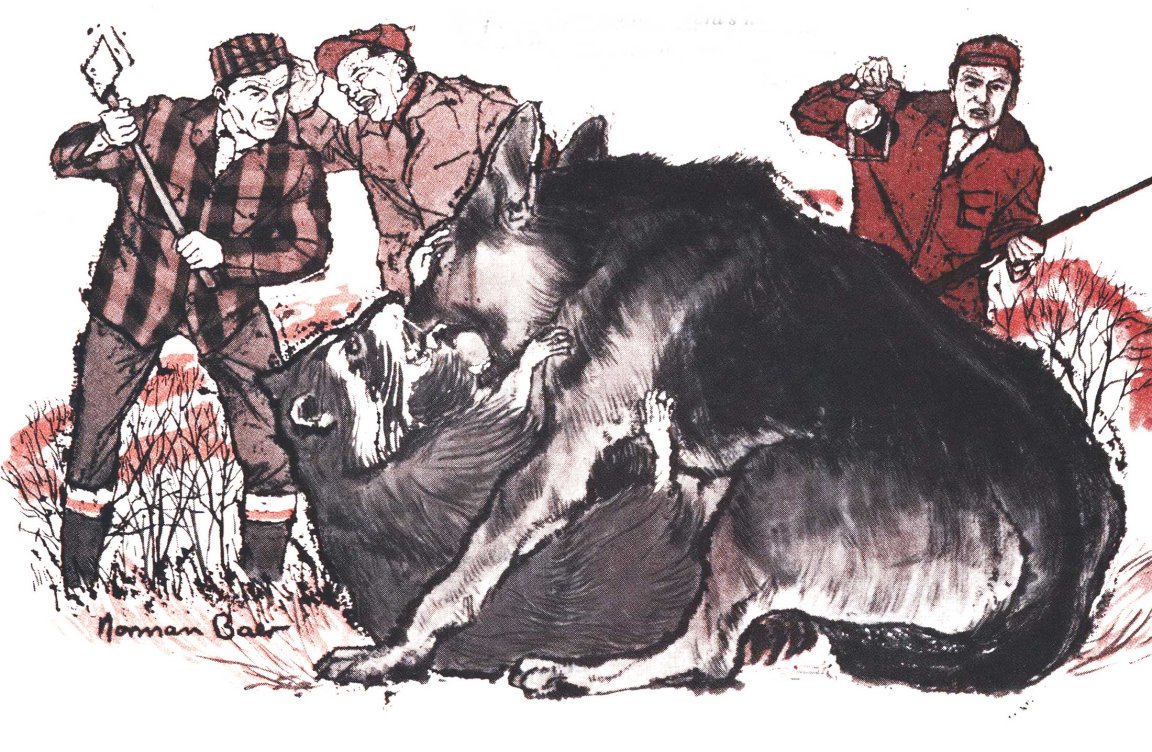
Old Blue was bawling his head off at missing all the fun. Uncle Frank’s dog made a dive at the coon, which was lying on its back, and then he started bawling too. I don’t think he bit the coon at all, but there wasn’t any doubt that the coon got its teeth onto the end of the shepherd’s nose. It dug its front claws into the dog’s face to steady itself, and started working its hind feet. At every kick the hair flew. Right then the shepherd lost all interest in coon hunting. Uncle Frank was dancing around them waving the ax.
When the shepherd finally threw the coon off, pappy was laughing so hard he could scarcely loosen Old Blue. When he got around to it, Old Blue caught the coon within 100 yards, and by the time we arrived it was all over.
The shepherd had made the same mistake a lot of inexperienced dogs make. He had tackled the coon while it was on its back. Grabbing a coon by the belly is about like grabbing a buzz saw.
Old Blue had learned his lesson years before. He never attacked a coon on its back. He knew it wasn’t going anywhere with its feet in the air, so he kept at a safe distance till it turned over and started to run. Then he grabbed it across the back, and usually killed it without any damage to himself.
It takes a big dog, and an experienced one, to kill a coon, but practically any dog that will chase a cat can be taught to hunt them. There is a great difference between coonhounds and coon dogs. A coonhound is just what the name implies, a hound that trails and trees coons. Most common are black and tans, redbones, and blueticks; but Plott hounds, treeing Walkers, bloodhounds, otterhounds, and foxhounds also are used.
Coon dogs include Airedales, collies, bird dogs, or any other breed or mixture. Generally speaking, they don’t give tongue on a trail, hence the name silent trailers. Their sense of smell is usually inferior to the hound’s yet a good silent trailer will get just as many coons as a hound, maybe more under some conditions. The silent trailer’s method of hunting is different from a hound’s, but equally effective.
A hound hunts tracks; a coon dog hunts coons. A good coonhound will take the first trail it strikes, and stick to it. It may have been six hours since the coon passed, but what is time to a coonhound?
The coon dog doesn’t waste any time cold-trailing. He can’t smell a track unless it’s smoking hot, but when he does strike one, he usually gets the coon. There’s no time for the coon to wade in the creeks to throw the dog off the trail, or to make for a den tree or rock ledge. The first thing the coon knows, the dog is right behind and the ringtail has to climb something quick.
For years coon hunters have been arguing which were better, hounds or silent trailers. Plenty can be said for both. Hounds, because of their superior noses, will find more coons where they are scarce. They also seem to work better in marshes and high weeds such as are found on the banks and islands of the Allegheny River between Warren and President.
On the other hand, along the steep hills of the Allegheny’s eastern tributary, the Clarion, most coons live in the rock ledges which often start at the water’s edge. At the first bawl of a hound, these coons take for a hole in the rocks, and a silent trailer will tree twice as many as a hound.
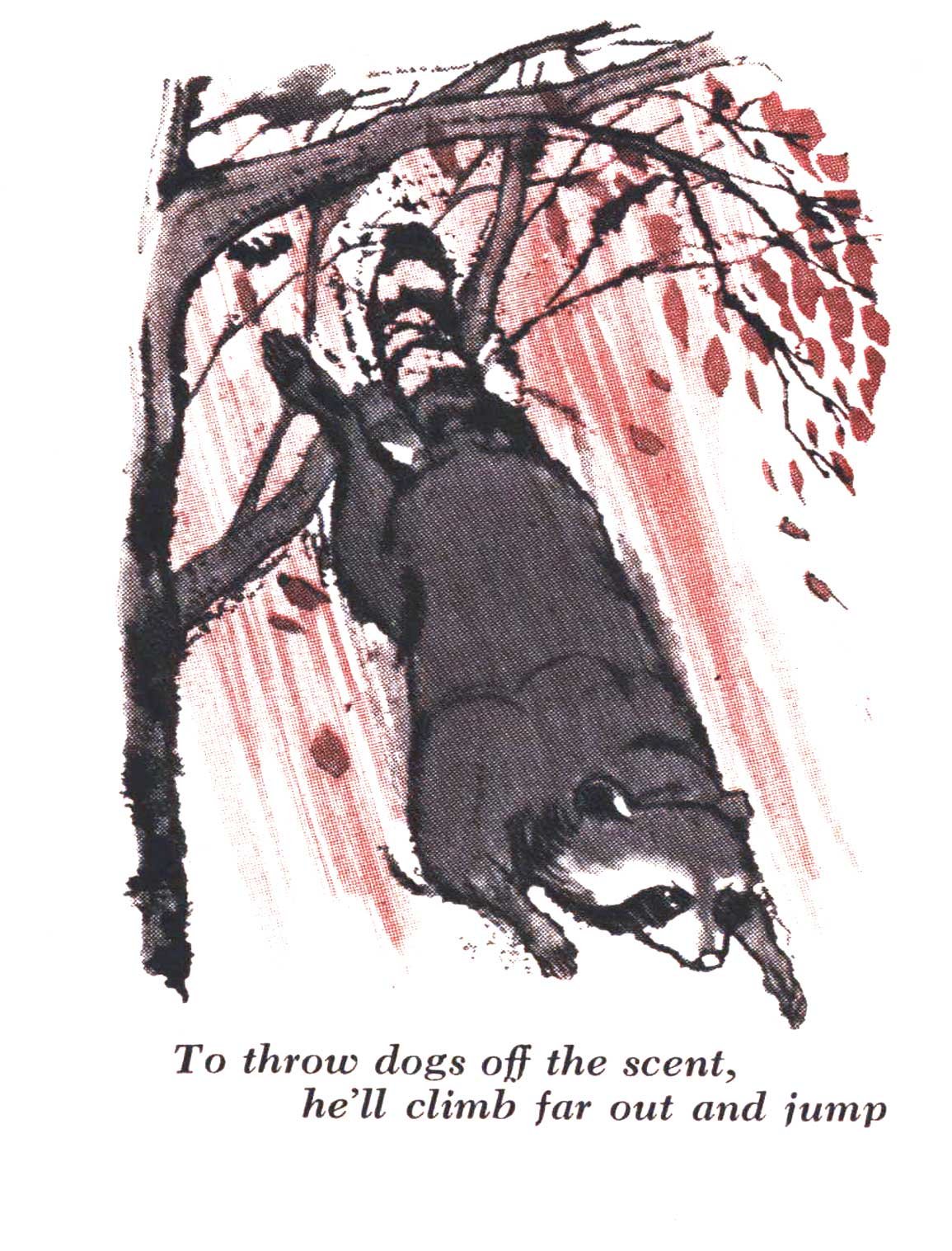
A coon is just as tricky as a fox when it comes to throwing hounds off its trail. A favorite method is to climb a tree, run out on a limb, jump off, and continue on its way. This trick is particularly effective in fooling young dogs which think they have the coon treed. Experienced hounds learn to circle around the tree to make sure there’s no trail leading away, but even they get fooled. Sometimes a coon will climb a tree overhanging the water, jump in, and swim away without leaving a trail. Occasionally they’ll cross from one tree to another. They don’t climb as well as a squirrel, but where trees are interlaced with wild grapevines, I have known coons to travel as much as 100 yards before descending.
However, water is a coon’s greatest ally when it comes to throwing a dog off the scent. A coon isn’t as aquatic as a mink or muskrat, but it spends a lot of time in or around the water hunting for crawfish and fresh-water clams, and it’s an excellent swimmer.
One moonlit October night, I was bait-fishing for walleyes near Hunter Bridge on the Allegheny River. A couple of coonhounds were working along the other shore, but they lost the track. Five minutes later, a coon emerged from the river 50 yards below me. It was just a little one, and the river is nearly 1,000 feet across at that point, but the coon didn’t seem the least bit tired. When I took after it, it jumped back into the river and swam toward an island a quarter of a mile downstream. There were plenty of trees it could have climbed, but it evidently felt safer in the water.
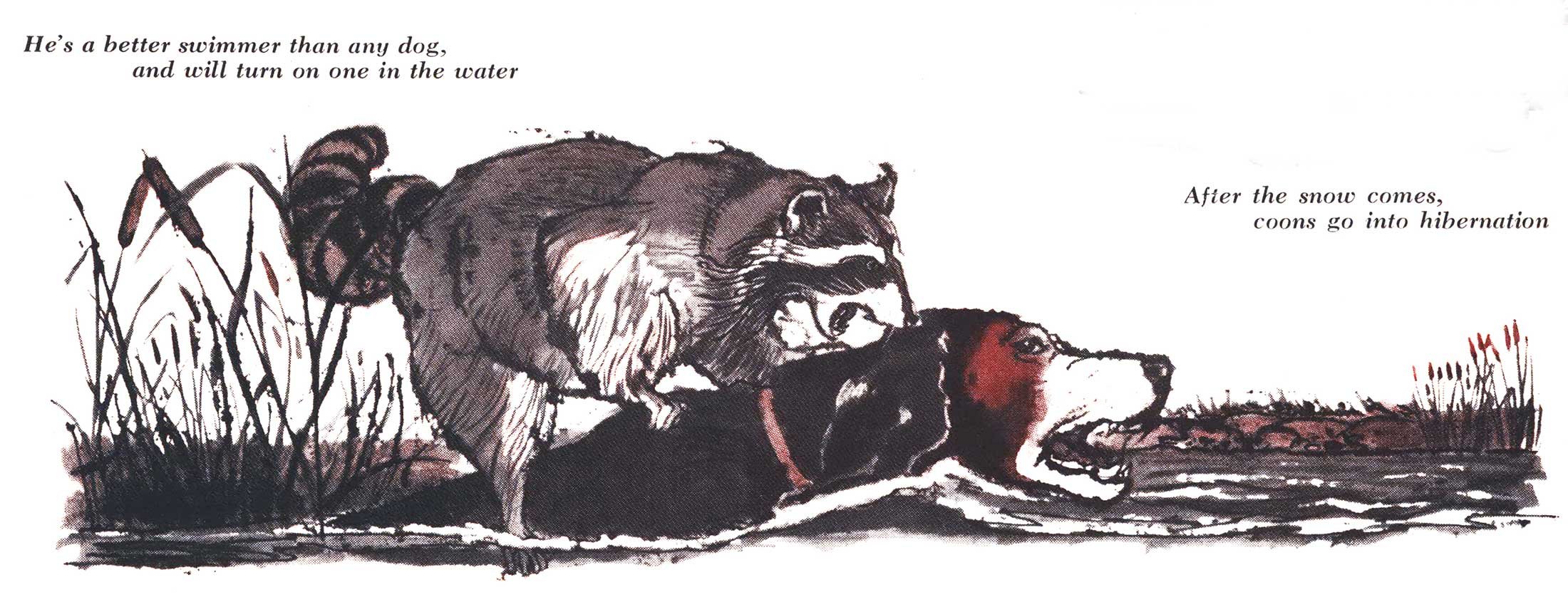
A lone dog that follows a coon into deep water is taking a big risk. He can’t shake it, and he can’t pin it down. His only chance is to drag it to shore. Unless the shore is very near, this is usually impossible, for a coon is a far better swimmer than any dog. It is a lot better underwater diver too, and can remain under twice as long, so when a coon and a dog go under together only the coon comes up.
If two or three dogs are together they’ll usually handle a swimming coon, because they’ll keep pulling it off each other, but I once lost a three-year-old black and tan in the Geneva Marsh near Lake Erie, and there were four other dogs with him at the time.
The marsh is a tangle of lily pads, cattails, and dead brush which has been washed in during the spring floods. The water is from two to six feet deep, but the mud beneath is practically bottomless.
The way it started, Charley Parker, who at times hunted with me, saw a lot of coon sign while duck hunting. A few nights later, he and a couple other fellows returned with his bluetick coonhound. They got a little coon within half an hour, and then the hound chased one into the marsh and didn’t come back.
At the time I had three hounds, two blueticks, and a black and tan. Bill Best had a redbone, and his pappy-in-law had a big collie that was a silent trailer and one of the best coon fighters I’ve ever known. We loaded the five of them in the pickup and drove up to Geneva to teach those swamp coons a lesson.
It didn’t take the hounds long to strike a track, and within 15 minutes they were fighting the coon. They were out in the marsh a couple hundred yards from solid footing. We couldn’t see them, but we could follow their progress by their barking and their yelping occasionally as the coon scored. Suddenly the barking ceased.
“Darn it,” said Bill. “They’ve killed that coon out there where we’ll never be able to get it.”
One by one, the exhausted dogs dragged themselves out of the marsh and lay panting on the shore. First came Bill’s redbone with one ear ripped and bleeding, then my two blueticks, and finally Rover, the collie, with his long hair plastered with mud. But the black and tan didn’t appear.
We thought he might have crossed the marsh to the other side, but although we searched and called the rest of the night, we never found him. Of course, I don’t know that the coon drowned him. He may have become so exhausted from the fight he wasn’t able to make his way back through the muck, or he might have had heart trouble. But we didn’t take the other dogs back for any more revenge.
Still, a lot of fellows hunt that section regularly, and most of their hounds live to a toothless old age. Charley’s bluetick and my black and tan just happened to be unlucky.
Next to the hound vs. silent trailer controversy, the biggest dissension splitting the ranks of coon hunters is what to do when the coon is treed. Some say it must be shook down and killed by the dog. Others use a rifle. Pappy belonged to the first group, but he always looked glum when the fur buyer docked him several dollars on a skin because it was chewed. A dog seldom tears the tough hide of an adult coon, but his teeth leave bloody marks which lower its value.
I like to use a .22 rifle. The coon is easily and quickly dispatched without me risking my neck climbing the tree. The small caliber bullet hole in the head doesn’t affect the value of the pelt, and the meat is fit to eat, instead of being a chewed-up mess like a lot of pappy’s coons.
As to the relative sportsmanship of the two methods, you’ll have to decide for yourself. Pappy always claimed that he liked to give the coon a fighting chance, but I think he just liked the fight. Even a big coon doesn’t have much of a chance with an experienced hound. I only know of two that got away from Old Blue, and in both cases, two coons had refuge on the same tree, and the hound was busy with the other.
The practice of coons running together and treeing on the same tree occasionally enables the hunter to make a double. After you’ve shot or shook down your coon, it will pay to examine the tree, and those nearby, with a flashlight. There may be another.
Coons traveling together are most likely to be young animals, litter mates from the previous spring. But sometimes a pair of adults, or two adult females, will travel together. I never found a combination of an adult and a young one, so maybe these adults are litter mates from the season before. Occasionally, you may tree a female with a late litter of young ones the size of cats. Five young ones is the most I ever treed at a time, but there may be as many as eight. The female will be unfit for food, and her pelt will be worthless, but take a young one for frying; you’ll have some of the best meat you can get.
When you skin them you’ll see why you needn’t feel guilty about killing these youngsters. They have practically no fat, and without a thick blanket of fat a hibernating animal like a coon can’t live through the winter.
In the early fall, coons gorge themselves to put on fat for cold weather. They’ll eat almost anything, but beechnuts are their favorite. These are rich, have soft hulls, and are often quite plentiful. Second choice is corn, which also is good for putting on weight. White-oak acorns are a close third.
These foods are more common along the ridges, so forget about the tracks you’ve been seeing along the creeks. Hunt where the animals are feeding and you’ll have better luck.
After the ground starts freezing at night, things change. The corn has been harvested; what nuts haven’t been eaten have been carried away by squirrels, and coons are traveling the streams again. There are clams in the water, occasionally a dead or disabled fish, and wild fruits and berries along the shore. But the coon’s chief reason for traveling along the water is to keep its feet warm. A coon living in a den far back from the river will make a considerable detour so it can walk in a warm spring run part of the way.
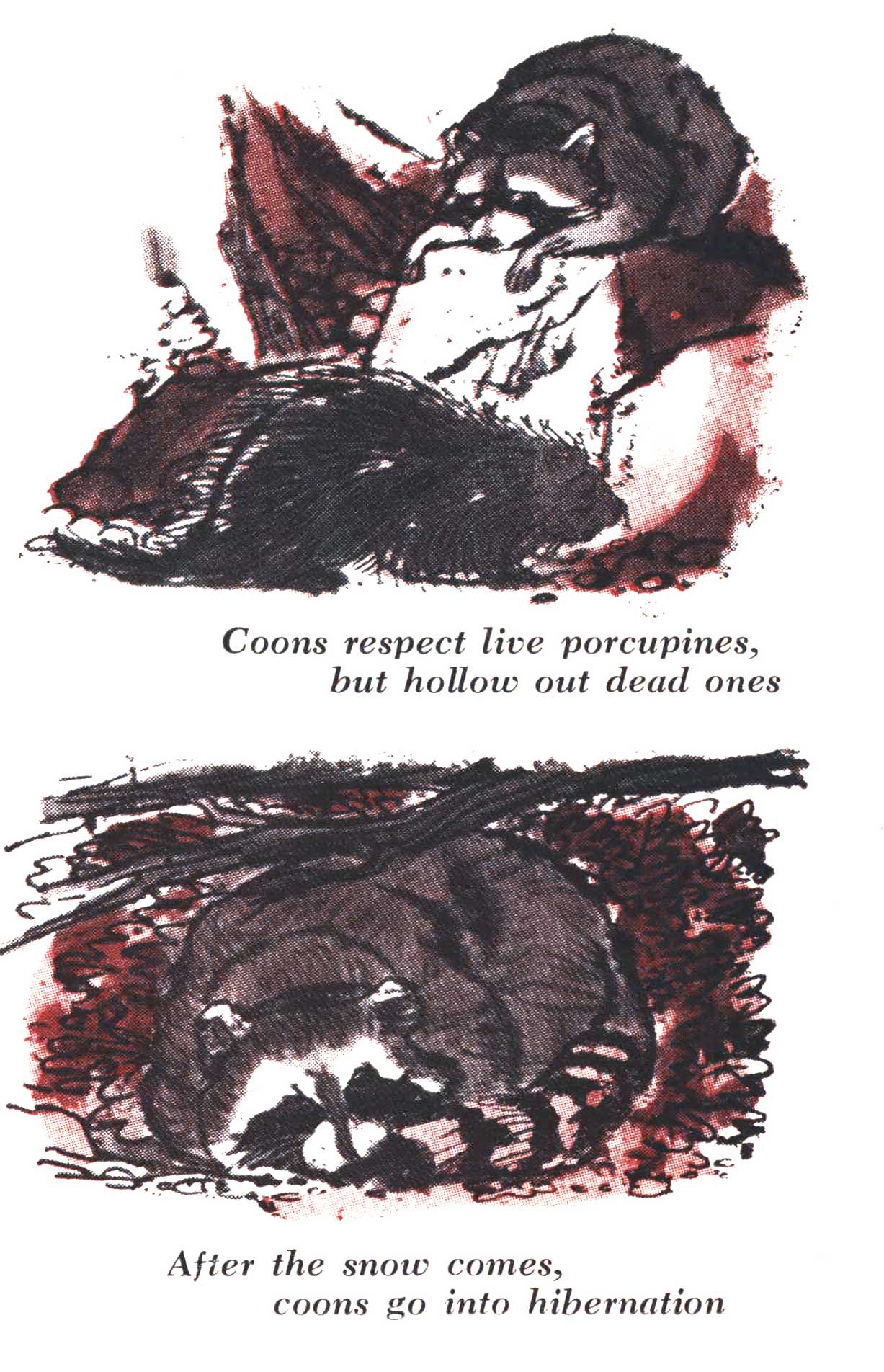
After the snow comes, coons go into hibernation. If the weather remains cold, they may not come out for a month or six weeks. They don’t pass into a torpor like a chipmunk or a groundhog, and if there’s a warm spell they become active, but not the first night like a skunk or possum. It usually takes three or four days of warm weather to get them moving.
A midwinter thaw means high water, and the coon is unable to find clams and crawfish, so it again turns to the higher country. The nuts and berries are gone, so its principal food is carrion. At this season coons range long distances searching for food.
Not only do coons range farther during these midwinter thaws, but they run better and are less inclined to tree.
It’s unusual for a coon to be caught on the ground early in the fall, but later in the season they start for home at a gallop at the first sound of a hound, and if the most direct route is across an open field, that’s the way they go. On several occasions my hounds have caught coons in an open field a quarter of a mile from the nearest woods.
One warm night about 15 years ago Stan Ferris and I hunted about a mile north of Knox with the two blueticks and the black and tan which later was drowned in the Geneva marsh. The hounds picked up a trail on the ridge above Sheriff Mong’s farm. The coon must have started for home as soon as it heard them, for they’d only gone half a mile when they turned sharply and headed toward a den tree in the bottom along the creek. The shortest route led through Paul Weaver’s pig lot, so that was the way the coon went. Between the pig lot and the woods was a 20-acre field that Paul used for a pasture. Right in the middle of it, the hounds caught up to the coon.
I could tell by the barking there was something out of the ordinary. Three experienced hounds don’t take long to kill a coon, but this sounded more like the coon was killing the dogs.
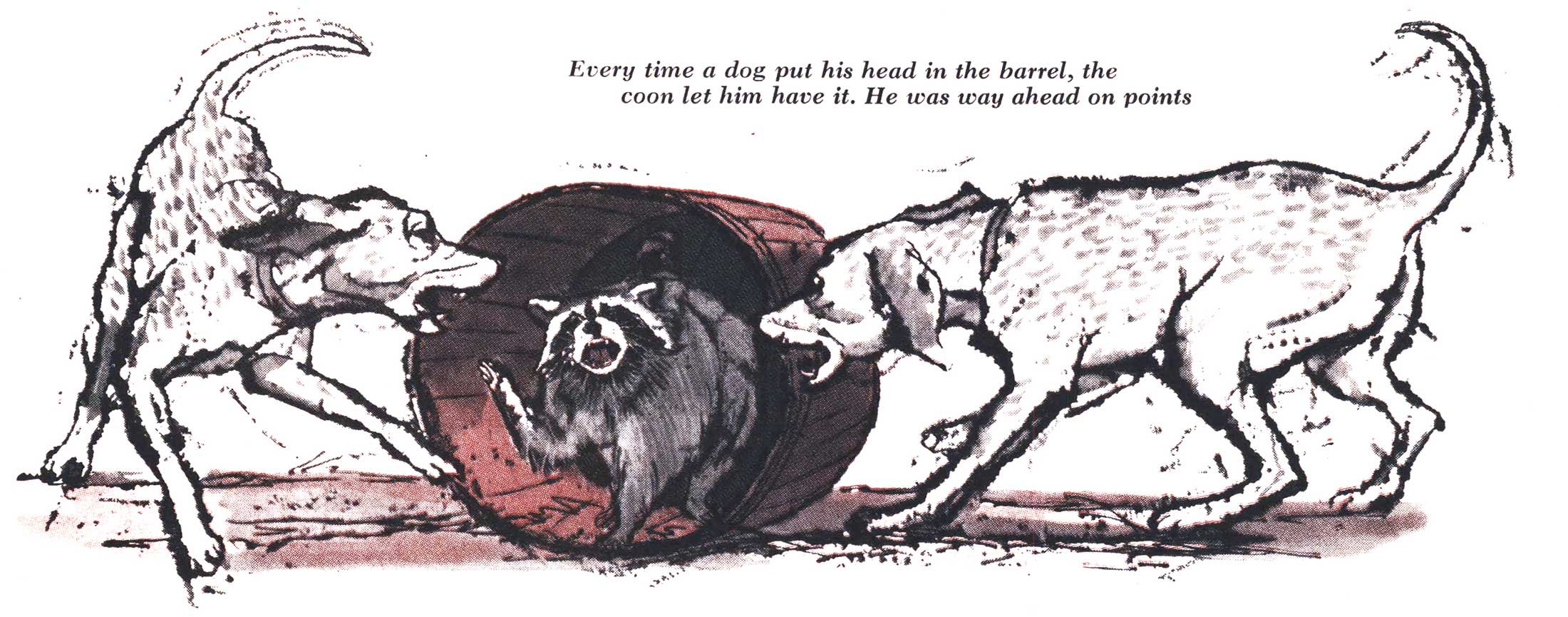
When we got there we found the hounds around a wooden barrel Paul used to water the cattle. At the approach of cold weather, Paul had tipped over the barrel so it wouldn’t freeze and burst, and the hard-pressed coon had taken refuge inside. Every time a hound stuck his head in the barrel, the coon would let him have it. He was ahead on points, for all three hounds were bleeding, and there wasn’t a scratch on him.
Stan had been wanting a coon for a pet, so we tied my coat over the end of the barrel and took the animal home. As a rule, an adult coon is impossible to tame, but this one was an exception. Within six weeks Stan was leading him around on a chain like a dog.
Most coons den in hollow trees, but around here they prefer crevices in rocks, even where hollow trees are plentiful. Another inhabitant of these rock ledges is the porcupine. Coons and porcupines seem to get along pretty well. Occasionally a coon is found with a quill in it, but for the most part, the coon gives the porky plenty of room, unless it’s dead. Coons will very neatly eat a dead porcupine out of its skin, beginning at the unprotected belly.
Most inexperienced coon dogs regard porky as natural prey, and in this neck of the woods a pair of pliers is as important on a coon hunt as a light. The sooner the quills are removed the better, for they tend to work deeper.
Forget about the tricks you’ve heard about, such as putting soda on the quills to soften them, or clipping off the ends to let the air out. One winter I caught 20 live porcupines for an animal dealer, and I had plenty of opportunity to test these methods on myself. Pulling the quills is the only remedy.
Put a piece of rope through the dog’s collar and draw him tightly against the base of a big tree three feet or more in diameter. Put another rope just in front of his hind legs and wrap him around the tree. The bend in his back won’t hurt him, and it will keep him from doing much struggling. Then blindfold him by tying a handkerchief over his eyes so he won’t bite or throw his head around when you reach for a quill. After you’ve removed those on the outside, put a piece of wood about as thick as your thumb between his jaws as far back as you can get it, and tie it in place.
By this time your dog will be gagging, howling, and frothing at the mouth, but he can’t bite or move his body. You can hold his head with one hand while you remove the quills from his tongue and gums with the other. Look carefully, for some are sure to be bitten or broken off, and a point is just as bad as a whole quill. You may even have to use a knife to get some, but it must be done.
When the operation is completed your dog most likely will be cured of hunting porcupines.
Don’t make the error of petting him and showing sympathy, or he may get the idea he did something praiseworthy.
Read Next: Wheeler’s Baptism: A Hound Dog’s First Real Raccoon Hunt
Coonskins aren’t worth much these days compared to what they were bringing in the ’20’s when every college boy had a coonskin coat. The heavily furred skins which can be sheared to imitate beaver are bringing only a couple of dollars and the others even less. However, there are a lot more coons now, and roast coon is just as good as it ever was.
Take a young animal, or a female, as the old males are too strong. Remove the skin, entrails, head, feet, and as much fat as possible. If you chill the carcass after skinning, the fat will be easier to remove. The liver will be harder than the liver of anything you ever cleaned. But the animal wasn’t sick; that’s normal for a coon. Season with salt and pepper, and roast on a rack so it won’t be swimming in its own grease. You can roast it with sweet potatoes, or with white ones. Fill it with dry stuffing, or have plain coon and gravy. Any way you take it, it’s delicious.
This story was originally published in the December 1957 issue of Outdoor Life.