
One of the things I like about snowshoe hare hunting is hot raspberry pie. Few restaurants serve it, especially in the dead of winter in a northern Michigan small-town cafe. One morning last February, my three hunting partners watched with interest, chins resting on their palms, as I sank a fork into the delicacy.
“Do you always eat raspberry pie for breakfast?” wondered Ralph Holsinger, who had invited me to join their hunting group.
“Only when I find a restaurant sensible enough to serve it.”
Another thing I like about hunting snowshoe or varying hares is trying to figure where they will appear ahead of the bawling pack of hounds. It’s a game of constant adjustment—moving up, moving over, squatting low to see through thick cover. You have to take into account the lay of the land and its habitat types and be able to sort out the hound music from what’s hot and what’s not. Sometimes the elastic circles the hares and hounds run are wide, and sometimes they are deceptively narrow.
Playing your hunches is also important because, after all, hares rarely do what they are supposed to do. That’s what Holsinger says, anyway, and he should know: He has been chasing the all-white bunnies for 50 years.
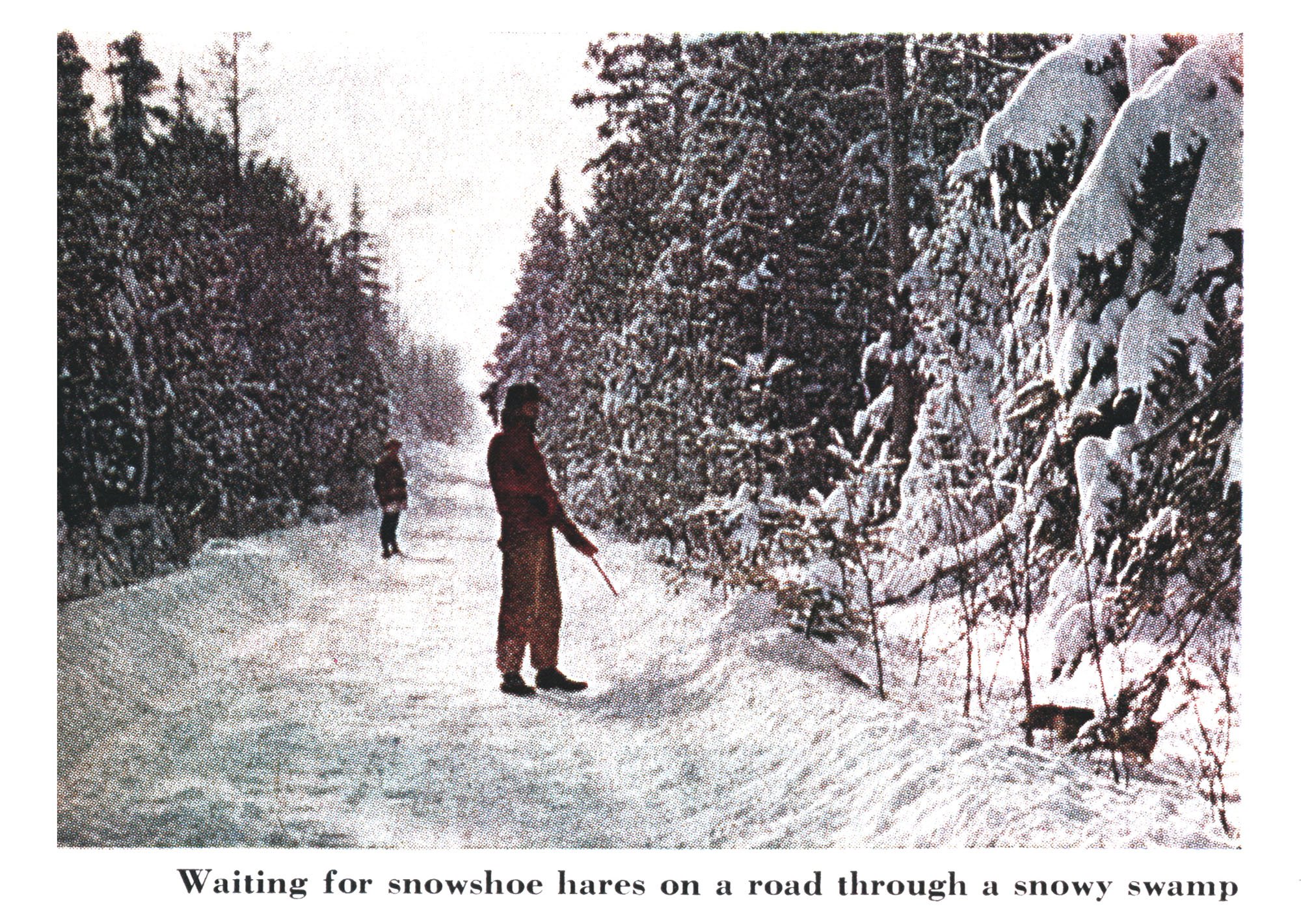
After leaving the restaurant, the four of us took stands along a fire lane through young jack-pine woods that flanked a cedar swamp. In quick succession, two separate hares gave me the slip. The first time I heard the dogs mushing through the snow toward me, I sneaked 20 yards to my left for a better shooting position. But I should have moved 40 yards because when the bounding bigfoot suddenly appeared, it was too far away for a shot. Joe Covert, a member of our hunting party, ended that romp when he shot the hare as it tried to cross the opening. Then, during the second chase, I should have stayed put; this time the elusive hare practically ran over my earlier position, but I wasn’t quick enough for a shot. It slipped by the other hunters, too, and now the pack had driven the snowshoe deep into the swamp.
We waited, 100 yards apart, and shuffled our feet against the cold. Thirty minutes passed, and now it was 10:30. Then I could hear it—the faint squeal of Squeaky, Holsinger’s lead beagle. Soon, Rambo barked in with a coarse bawl. The stretched-to-the-limit circle was tightening once again. The other dogs—Shane, Twinkie, Candy and John—began to cut loose with assorted chops, yelps and squeals that were definitely growing louder. The gutsy pack of hounds was pushing this splayfoot right down my throat. For once, I wouldn’t have to move at all.
Sinking to haunches, I swept the woods slowly from left to right and waited for the hare to materialize. You never hear snowshoe hares, at least not with snow on the ground, and certainly not with the hounds chorus ringing through the woods and in your ears. No, like true ghosts, snowshoes take shape before your eyes. Suddenly, and with a rush of adrenalin, they are there. So where was this one? The dogs were closing in too fast. Already I could see their skinny tails whipping left and right, but no rabbit.
There comes a point when the hunter of hares knows he has failed, and usually that is when he sees the dogs. They filed by at 30 yards, eagerly punching their noses in and out of the loose snow and ignoring me altogether. How did they know I was no threat to any swamp ghosts today? Snow-choked cedars muffled a shotgun blast, which told me that one of the other hunters, probably Marty Anthony, had ended this nonsense. So much for my hunches.
Seven species of hares—which actually differ from rabbits because they are born fully furred and with eyes open—are native to North America. The snowshoe, or so-called varying hare, turns all white in the winter and is the smallest. At an average of 14 to 15 inches, hares are a little longer than cottontail rabbits. At an average weight of 3 1/2 to four pounds, they are a bit heavier, too. Range of the hare includes the northern tier of states and all of Canada and Alaska. They also live in mountainous regions of the Alleghenies, California and New Mexico. Besides Alaska, 20 states have hunting seasons.
Read Next: Best Guns for Rabbit Hunting
In addition to mysterious population swings that affect both rabbits and hares every 10 years or so, snowshoe numbers rise and fall dramatically according to habitat availability. In areas of aggressive timber-cutting activities or where fire has destroyed a forest, hares thrive on the new growth for a few years. Then, when the forest begins to mature, the animals may all but disappear.
According to Ben Tullar, a wildlife biologist with the New York Department of Environmental Conservation, abandoned farms in northern New York first support red spruce, balsam fir and white cedar. These conifer species get a head start on hardwoods such as maples, beech, yellow birch, black cherry and white ash. “For example, after a period of only five to 15 years,” Tullar said, “an abandoned pasture can support a huntable hare population for another five to 15 years. But the hardwoods eventually overtake the conifers, and a hardwood/softwood mixed forest develops with little understory vegetation and, consequently, no food or shelter for hares.”
When the habitat is right, populations explode because few animals are as prolific as snowshoe hares.
Snowshoe hares are an important food source for hawks, owls, foxes and coyotes. Apparently, hunting by man has little impact on their populations, and that is why seasons in most states are long and bag limits are usually liberal. Wisconsin hunters, for example, have enjoyed no closed seasons and no bag limits since 1965. During peak years, though, they shoot only about 3 percent of the state’s hare population. In Maine, Michigan, Minnesota, Oregon and Washington, hares go underharvested most years.
Hares rarely hole up, a habit that makes them available to hunters on all but the coldest days. In bad weather, they crouch under snow-laden branches and have been known to tunnel under snow, but they don’t usually go underground, even when pushed by a hound pack. Most jumped hares don’t seem to be afraid of the dogs anyway, and I suspect that is because they know they can’t be caught. Most of them amble along, taking their time a few yards ahead of the dogs that flounder in deep snow. Put a crust on that snow, though, and hares will pick up enough speed to keep just ahead of the pack. Generally hares run a wide circle, returning to the same vicinity where the dogs started them. But not always. I’ve seen hares lope through the woods for a mile on a course as straight as a Nebraska section road. Years ago, Holsinger was hunting a linear strip of woods, between a Michigan Upper Peninsula highway and Lake Superior, when his dogs jump-started a snowshoe. When the rabbit took his dogs out of hearing, Holsinger leaped into his truck and drove two miles to where the cover petered out. Ten minutes later he shot the animal when it came bounding through. Most hares would have crossed the highway at some point; Holsinger’s hunch that this one would not paid off.
On a warm, sunny afternoon you can post an area punctuated by the Y-shaped prints of snowshoes and sometimes get shots at animals sunning themselves. Stillhunting, tracking and stalking are effective ways to hunt them, too, if you remember to move slowly and bend down to rabbit-eye level now and then. Just as quietly moving deer hunters look for the flick of a tail or some other part of a buck’s anatomy, so, too, should hare hunters watch for telltale movements or black-tipped ears on the white-on-white bunnies.
It’s easy to find out if hares are using an area by keeping an eye out for their tracks, trails, droppings and eating signs. Saplings girdled near the ground are pretty good clues that a hungry hare stopped by. If food is plentiful, snowshoes will occupy a five to 10-acre area all winter. But if food is scarce, they will migrate several miles in search of something to eat.
Sometimes hares can be pushovers but not very often. One occasion is during years when their populations are cycling high and the animals don’t exhibit the same degree of caution they do during lean population years. The other time is when a fluke of nature puts all-white hares in snowless woods, a condition that can happen in the late fall or late winter. Then, the rabbits are as easy to see as the Blaze Orange clothing on your hunting partner. Nature always helps wild things to adapt, however, because in portions of Oregon, Washington and British Columbia, where snow is generally scarce, snowshoe hares don’t turn white at all.
No matter where you find the varying hare, the most exciting way to hunt them is with hounds. Best scenting days are when temperatures are near freezing or higher and the snow packs underfoot. Worst conditions are extreme cold and powdery snow because what scent there is gets easily covered by the first dog floundering on the track.
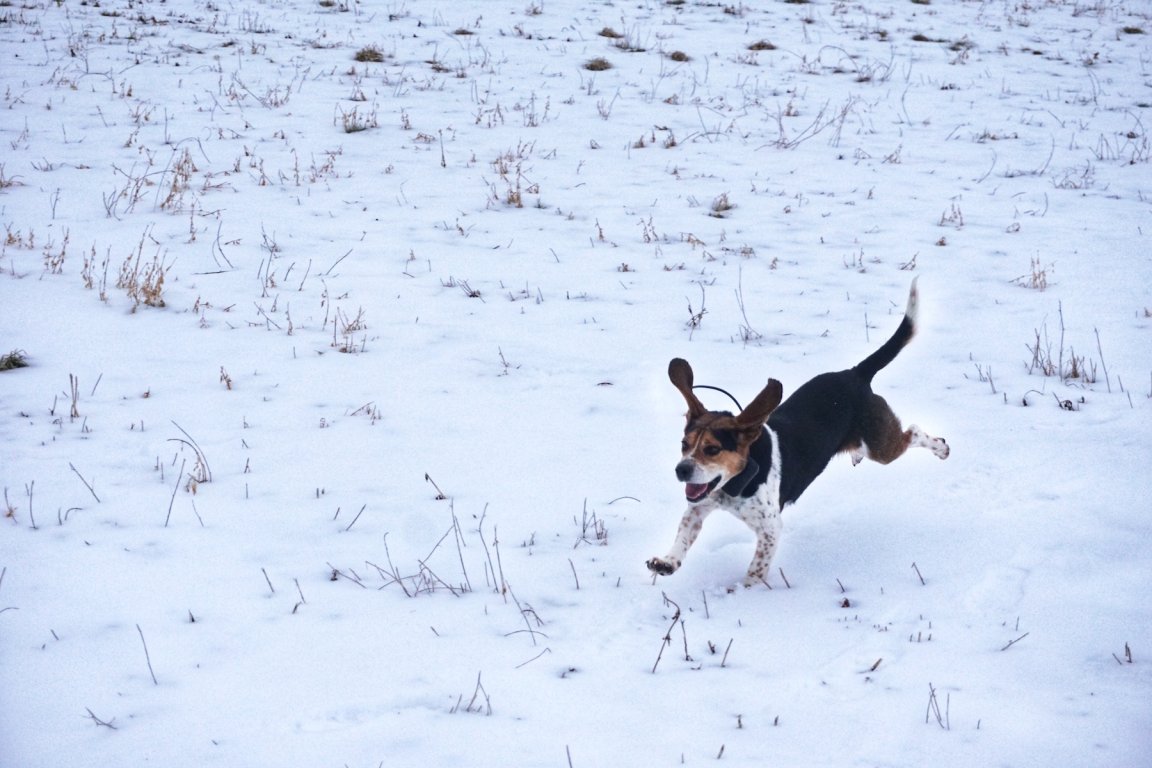
“Only the hounds seem to know if hunting will be good or not,” said Holsinger, who has owned and raised dozens of high-stamina beagles, which are most hare hunters’ dog of choice. For two years a couple of Holsinger’s friends kept careful records, noting such hunting-day conditions as temperature, humidity, wind and dog behavior. Their conclusion? Not only is every day different, but it is often unpredictable. On good-weather days the dogs sometimes had trouble getting a chase going, and then on certain days of poor conditions, they ran well.
“Just listen to those hounds,” Holsinger said as he and I hurried down a logging road next to a swamp where the dogs were puzzling out a fresh track. “We put a new dog in that pack, and the music is sweeter than ever.”
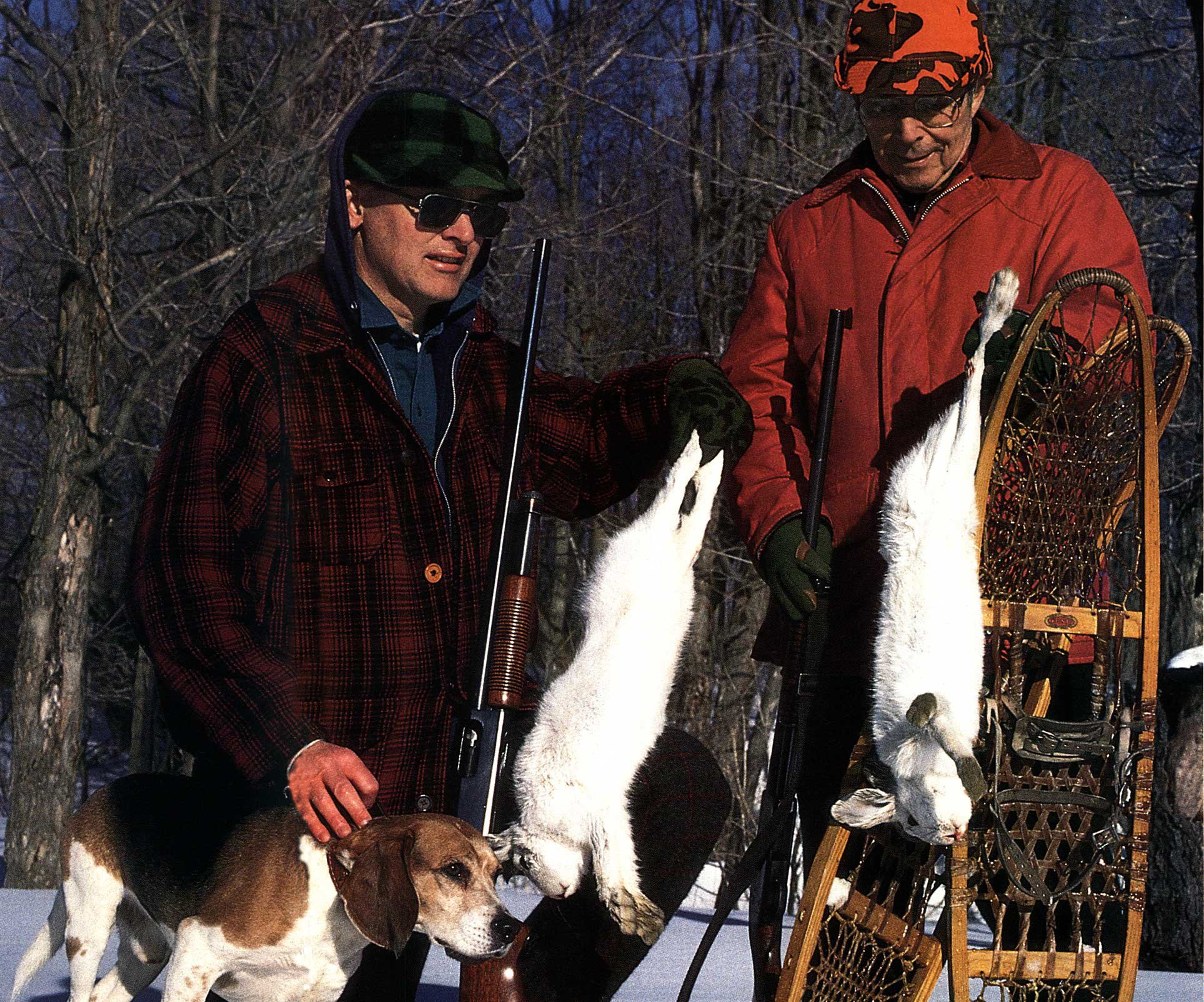
Holsinger was striding along in front of me in a place where the woods necked down. Bouncing from one side of his game bag was the white head of a hare. Sticking from the other side were the fuzzy feet of another snowshoe. “The dogs are turning this way,” he said, looking back at me. “Where do you want to set up?”
Read Next: A Christmas Hunt for the Black Hare of Halcott Mountain
“I’ll take a stand right here,” I said and waved him on. “I have a hunch the rabbit will cross at this bottleneck.”
It didn’t. Instead, the hare loped across the road in front of Holsinger, who bowled it over with a load of 12-gauge, No. 5 shot.
It just wasn’t my day for hunches, but all was not lost. I knew where to get another wedge of hot raspberry pie.
This story was originally published in the December 1990 issue of Outdoor Life.