
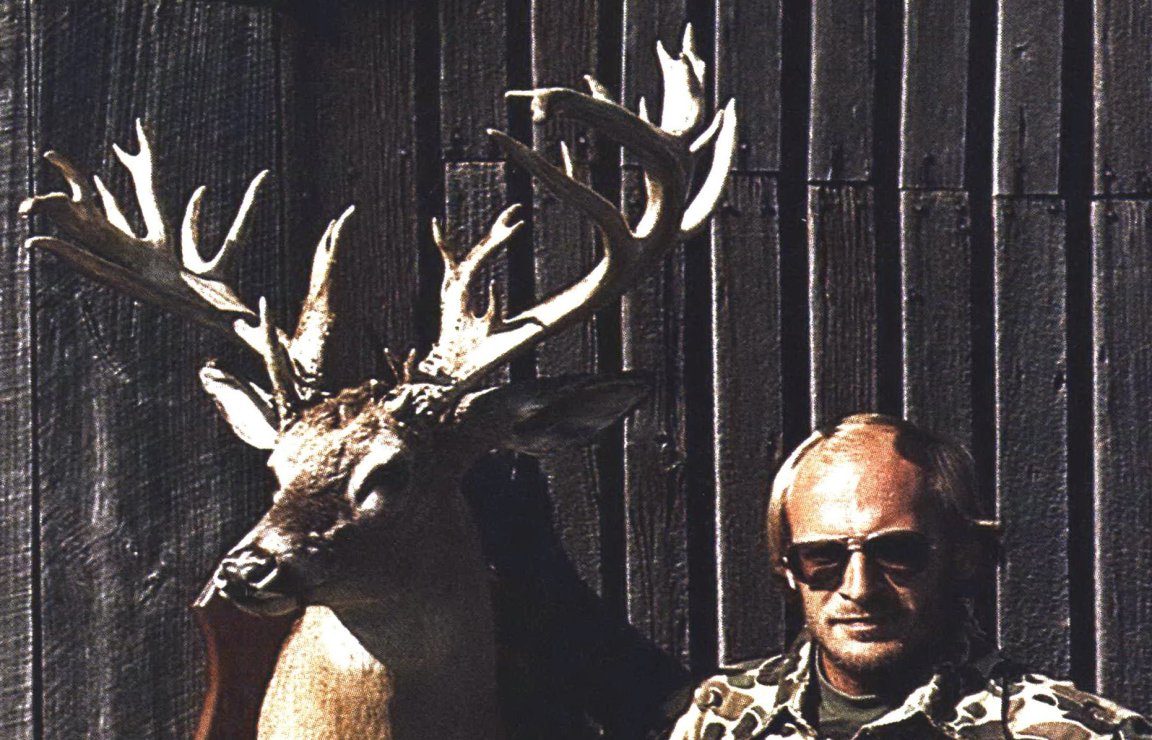
This story, “Swamped by Trophy Bucks,” appeared in the December 1980 issue of Outdoor Life. Mickey’s buck, which scored 238 2/8 according to the Boone and Crockett Club record books, remains the largest nontypical ever killed by a hunter in Michigan. It’s ranked as the No. 2 buck in the state, however, after a 246 2/8 deadhead found by Ronald A. Waldron in 2010.
I’d bet 10 to 1 there are at least 20 whitetail bucks within a 50-mile radius of my home that have racks good enough to be listed in the Pope and Young or Boone and Crockett record books. I live near Bay City, Michigan, not far from the other big cities of Flint and Saginaw and less than 100 miles from Detroit.
There are millions of people in this area, but there are also farmlands and swamps that produce some of the nation’s finest trophy whitetails. They are so smart, and so used to coping with the activities of humans, that most hunters never see them.
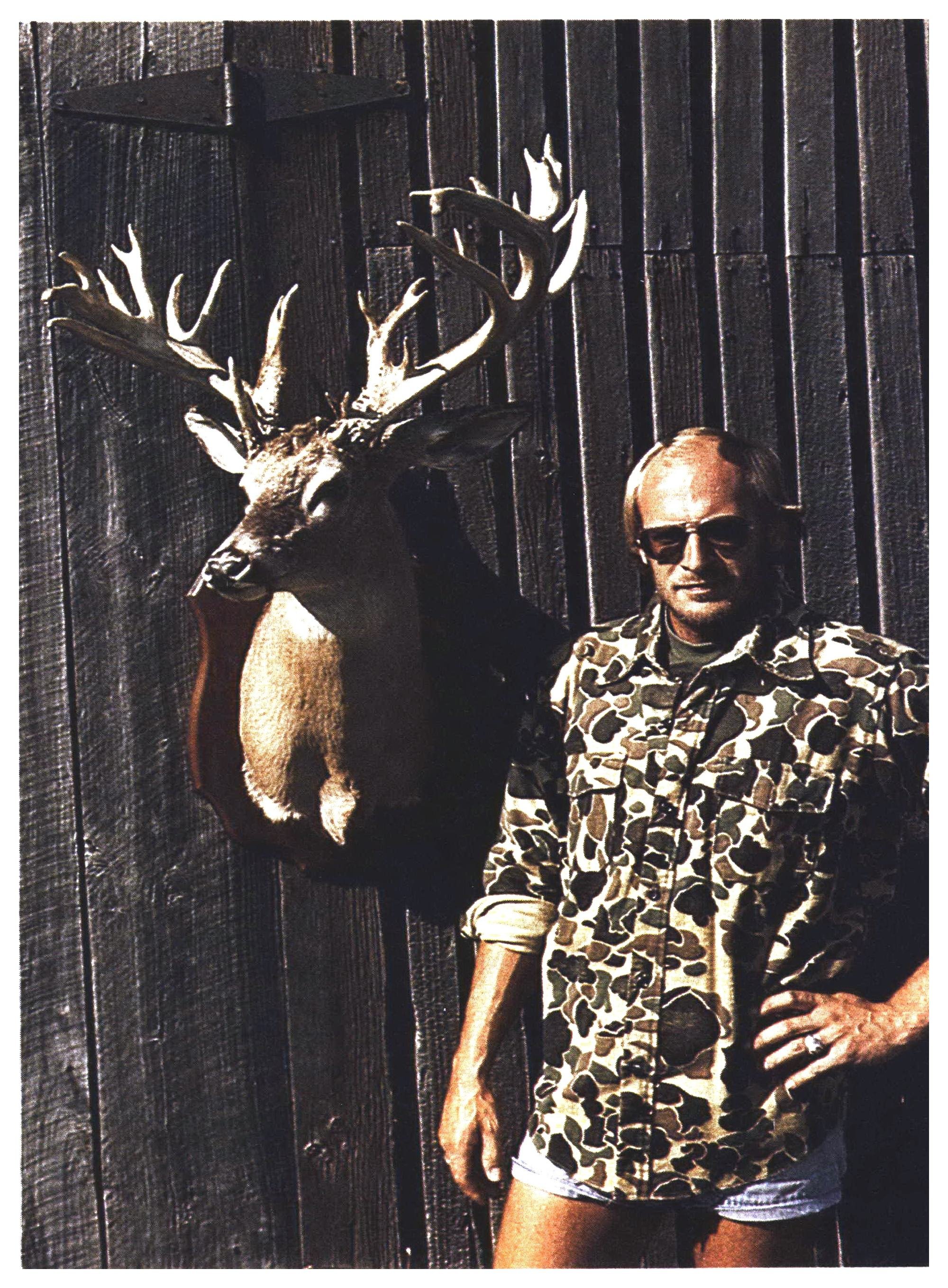
In 1976 I shot a nontypical whitetail that scored 238⅝ points. It won the first award at the Seventeenth North American Big Game Awards program in 1980. It was the best nontypical whitetail taken in North America during the previous three years, and it’s the best ever taken in Michigan.
I shot that buck about 9 miles from my home. There’s another buck as good or better than him even closer. He has an 18-point rack. He has outsmarted me for two years, but I think I’ll get him. There’s a 16-pointer in the same area. I’m confident I could take that buck with my rifle, but I’m determined to get him with a bow.
I’m 32, but I decided 10 years ago not to shoot any bucks with a rifle unless I got chances at really outstanding trophies. I have head-and-shoulder mounts of 11 of my bucks now, and a lot of them were taken with arrows.
The main reason I get big bucks is that I hunt deer full time for two to three months every fall. All that time without earning a paycheck produces some financial problems because I work as a carpenter, but my wife Kay doesn’t say anything. We lived together for 1½ years before marrying, so she knew what she was getting into.
I used to hunt everything in season years ago, but now I concentrate exclusively on Michigan deer. I’d love to be able to hunt other big game in Western states or Alaska, but I can’t afford to. Anyway, I’m obsessed with trophy whitetail bucks. And when you hunt them as much as I do, you’re bound to learn some strange things about deer behavior. Here’s an example.
In 1972 Rick Havercamp and I were bowhunting along a bank of the Saginaw River on a cold but sunny afternoon in late December. The 300-yard-wide river had recently frozen over. Rick was close to the shore, I was a few yards up the bank in some brush. Suddenly my partner said, “Get down, there’s a whole herd of deer running out there on the ice. They might come across. Get ready, here they come!”
I looked out there and saw about 40 deer. There were at least 10 bucks, and the whole herd was coming dead on. I nocked an arrow on the string of my 70-pound Jennings compound bow, then squatted down.
As the deer got close to our side of the river they began breaking through the shoreline ice. I don’t know if they saw us, but for some reason they veered to our left and crashed into a cattail marsh about 500 yards long. The going was tough for those deer. I figured if I ran along the bank at full speed I could get to the end of the marsh before the deer did, and that I could intercept them as they came out.
I was puffing hard by the time I got there, but I knew right away that I was ahead of the herd. I could hear the deer breaking ice and banging through dead cattail stalks. Then the commotion suddenly stopped. About half an hour passed without my hearing a sound. I couldn’t figure out what was going on, so I walked back to confer with Rick.
I met him half way around the marsh. He was as confused as I was.
“I’ll climb a tree and see what’s going on,” he said.
When he got up the tree and looked, he said, “Hard to believe. They’re all out there, standing still as statues. Some of ’em are through the ice, up to their chests in water. There’s a couple of really huge bucks. What’re we going to do?”
“I’ll give you 10 minutes to get back to where they ran into the cattails,” I answered. “Then I’m going back to the other end and drive those deer back your way. If that ice is thick enough to support the deer it’s thick enough to hold me.”
When I returned to the far end of the marsh I cautiously tested the ice near shore. It seemed OK, so I took off. I covered about 50 feet, then I dropped through that ice as suddenly as if I’d walked off a plank. My boots hit the mucky bottom about 3 feet down, but I was already making my move to get out of there.
I rolled up onto the ice at the edge of the hole I’d made, and the whole edge broke off. I was soaked by the time I made my next roll, and again the edge gave way. I broke through once more, and then I found ice that supported me. By the time I reached the shoreline I was covered with black muck and marsh weeds.
I had lost all concern for deer, then I suddenly heard loud noises. It dawned on me that all those deer were crashing through the marsh again, and they were coming straight toward me. I nocked an arrow and squatted low in a kneeling position on the edge of the wall of cattails, and shook my head when I realized that, almost unbelievably, I was seconds away from having a whole herd of whitetails in my lap.
The first deer out was a doe. She broke through the cattails about 10 feet to my left, stared wild-eyed at me, then bolted up the bank. Another doe came out just to my right and did the same thing. Now the crashing diminished. Somehow the rest of the deer had been alerted that those two does had run into something that wasn’t right.
Then I spotted movement above the cattails a few yards in front of me. A rack of antlers was moving slowly toward me. I couldn’t see any part of the buck except his 10-point rack, but it was obvious what was going on. That buck wasn’t about to run out of the marsh as the does had done. He was going to peer over the edge of the cattails to see what the problem was.
It seemed like that deer’s neck was stretched out 5 feet when it popped into view at a range of about 3 yards. I was already at full draw, and I drove my arrow dead center into the white spot on his throat. When I had that head mounted I told the taxidermist to mount it with the neck straight out, exactly as I’d first seen it.
That hunt taught me one of the most important buck-hunting lessons I’ve learned. When I broke through the ice and began floundering about, I was producing exactly the same sounds as the deer were making when they broke through. They assumed that I was a deer making my escape through that end of the marsh. So on they came, intending to use the same escape route.
Since a deer’s range of vision in thick cattails is only a few yards, you can actually walk or wade right up to a buck because the sounds you make won’t seem unnatural to the animal. An important part of the equation is that smart bucks in heavily hunted farm country soon learn to go where most hunters won’t go. Those places are swamps, the rougher the better. If you hunt whitetails, and you have thick cattail swamps in your area, you can bet that they hold a lot of deer.
One of the best bucks I’ve taken out of a cattail marsh was an 11-pointer I arrowed in 1979. Though it was a great rack, it wasn’t nearly as impressive as one belonging to another buck in the same herd. The inside spread of the 11-pointer’s antlers measures 19½ inches. I saw both bucks only moments apart, and I’d bet everything I own that the bigger buck’s antlers have a 23-inch inside spread.
It was windy and clear that day, but the 20° temperature made for colder than usual December hunting. Though there were traces of snow on the ground, there was none on trees or cattails. That called for brown camouflage outer wear, including a brown face mask. I usually wear camouflage face grease, but when it gets so cold that makeup would freeze, I wear masks.
When I go with a bow I’m camouflaged completely according to weather conditions. Early in the season, when the foliage and ground is green I use green camo. Later I switch to brown. If there’s lots of snow I’m dressed in white, and so is my archery tackle.
I began that hunt by walking up to a big marsh and climbing a sloping deadfall in the oak bottomlands that edged the cattails. I immediately spotted two big racks. They seemed to be floating above the stalks only 60 yards away. I’ve seen similar sights several times. Deer will stand in water for hours without moving. You won’t see most of them because the cattails completely hide their bodies. But when you get a buck that’s not alerted — when he’s not trying to conceal his antlers — his rack will be above the marsh terrain when he’s standing.
I slithered down the deadfall, then stalked along the edge of the cattails to a spot that was about even with those bucks. There I eased up another deadfall, just far enough to see one of the bucks. He was walking slowly down the marsh, but he was only about 30 yards out in the cattails. Again I began sneaking along the edge of the marsh. I wanted to get ahead of him before I began wading into the swamp.
Right then that enormous buck — the biggest one I’ve ever seen — stood up in the cattails 20 yards from me.
He was looking dead away, but he quickly turned his head and looked right at me. Though I was perfectly camouflaged, and still as a stone, he knew something wasn’t right. Our little game lasted at least 30 seconds. I don’t think he ever figured out what I was, but he whirled and bounded out of range before I could shoot.
I stalked on for 25 yards and stepped up on another of the maze of sloping deadfalls that littered the edge of this marsh. I spotted the huge buck I’d spooked. He was more than 100 yards away, standing near the other side of the cattails and looking back. The two bucks I’d originally spotted were 40 yards straight out in front of me. They didn’t seem nervous.
When I hunt these marshes I always wear hip boots or waders, depending on the water’s depth. I stepped into the cattails and began wading without making any attempt to conceal the sounds of my approach. When I figured I was about 20 yards from the closest and largest buck, I pulled my arrow to full draw in the compound bow and kept right on wading. At a range of about 17 yards I saw his shoulder through the maze of cattails. I picked out his heart area and drove my Bear Razorhead right into it. He bolted, but died on his feet.
He was looking dead away, but he quickly turned his head and looked right at me. Though I was perfectly camouflaged, and still as a stone, he knew something wasn’t right.
I sincerely feel that a bow in the hands of an expert is almost as deadly as a rifle. If I can get within 40 yards of a buck I can kill him because I can hit a grapefruit-size target every shot at that range. I can do that only because of dedicated practice. It’s extremely unusual if I don’t practice shooting arrows at least an hour every day.
I learned how to hunt on my own. My folks were divorced, but I lived with my mother on 15 acres of land near Kawkawlin where I live now. Even when I was a little kid I was out in the woods most of my free time, studying birds and animals and shooting arrows or my BB gun.
I shot my first buck, a spikehorn, when I was 14. I didn’t know much of anything about deer hunting then. I just blundered into the little buck in a pine plantation and knocked him flat with my grandfather’s .300 Savage.
Though I bowhunted deer for several years I didn’t get one until I was 18. He was a five-pointer. I’ve taken bigger bucks with arrows every year since. A few years ago, when it became legal for Michigan hunters to take a deer with a bow and another with a gun, I’ve always scored on another big buck with my .30/06 sporterized Enfield.
I used that rifle to shoot an 11-pointer in his bed in 1975. Rick Havercamp was with me that day too. He’s 36, and a carpenter. We were in an area 3 miles across, that borders the Au Sable River near Cook Dam. It’s laced with beaver ponds, tag alders, and muck.
You have to wear hip boots or waders to get in there, and even then you usually get wet because the mucky bottoms are so treacherous. Every year I have to chop out trails with a machete because there’s no way I could find my way in or out of that place in darkness. I throw the chopped off alder branches in muddy places that would be impassable without their support.
The middle of that place is so rough I’ve never seen another hunter in it. That’s why it draws deer like a magnet.
There had been a blizzard the day before that had left a foot of snow on the ground, but there were a million stars in a clear sky when Rick dropped me off near one edge of the swamp. His plan was to drive around to the opposite side and hunt in from there.
I took a stand on an island, and I sat there until a forkhorn and six does browsed to within 25 feet of me. The little buck finally saw me and panicked. He charged into brush and through some skim ice, and he took the does with him. They made such a racket I decided to go stillhunting.
Because of the recent blizzard, every deer track I found was fresh. When I came upon a set of enormous tracks I began following them. I stayed on that track for five hours, taking a few steps at a time and then stopping to inspect the area ahead. I’d squat and bend to look under branches, around clumps, and behind deadfalls.
Because the snow was deep and soft my extremely slow progress was almost soundless. Once I almost walked up to a doe. When about 20 feet separated us she jumped out of her bed and crashed into a thick stand of snow-laden cedars. She produced a miniature blizzard of sun-sparkling snow when she blitzed through those trees. As time passed I jumped several deer, including an eight-pointer. It was impossible not to surprise at least some deer; there were deer tracks all over. It was a job to keep the tracks I was following separate from the rest.
Finally, during one of my staring-ahead sessions, I saw a brown spot 40 yards to my right. I figured it was a dead cedar stump, but I turned up my 3X-to-9X Redfield scope to full power for a closer look. I still couldn’t tell if the spot was a deer or a stump, so I inched forward a couple of yards. Another look through the scope proved nothing. I just couldn’t identify any part of a deer. Then the stump suddenly became a deer and shook snow off its body like a dog shakes off water.
I had to crawl a couple of yards to my left before a massive rack suddenly popped into focus. I broke the buck’s back with a 180-grain handloaded slug. When my rifle went off that place erupted deer. They seemed to be rushing off in all directions. Rick, who was a few hundred yards away at the time, said later, “After you shot I had deer running by me for five minutes.”
A different kind of stalk produced my award-winning buck. John Miller, another hunting buddy (he’s 29 and works in construction) saw the buck just after the 1976 archery deer season opened. The buck was on a ridge eating acorns when John saw him, and he figured the buck was working toward a runway leading down into a stand of tag alders. John guessed correctly, but it was almost dark when the buck went by his stand. He missed his shot, but he sure got excited. He was waiting at my home when I returned from hunting.
“Paul, that buck is unreal,” he said. “I couldn’t get a good look at him, but he’s got a rack that’s so wide it looks preposterous. He’s got at least 12 points, maybe twice that many. The antlers are so massive I just couldn’t believe what I was looking at. I overshot him because he was closer than I thought. When my arrow hit a rock I could see sparks fly, that’s how dark it was.”
John and I were back in the area before dawn the next morning. He wanted to be on stand near the oak ridge, but I had a different idea. I figured that if the buck went into a stand of alders at night there was no way he wanted to stay in them. I assumed he would go through the alders, then cross a road and go down into a winter wheatfield that edged another stand of alders. So I went down in there and picked a stand near a runway.
I hunted that area for five straight days and never saw a deer, the worst run of bad luck I’ve ever had. Miller saw several deer every day, but no big bucks. We finally got disgusted and went to Michigan’s Upper Peninsula (U.P.) for two weeks of bowhunting.
When we got back, an ironworker friend told me that his two boys jumped the giant buck in a field of weeds while they were pheasant hunting. He said the animal’s rack was so big it wouldn’t fit through a doorway. But what really shook me was that the kids had jumped the buck in the same area where I’d been hunting him. John and I were back on our stands the next morning.
I hunted three days without seeing a deer, but I found a clump of tag alders and willows that were ripped and shredded from near the ground to eye level. It was by far the biggest buck rub I’ve ever seen. I wondered aloud how many points the buck must have to do that kind of damage.
The next morning I saw three does.
They went into a jungle of alders, so I decided to leave my stand and follow them. About an hour later I jumped that buck 40 yards ahead of me.
When the buck leaped up his antlers slammed into a maze of branches thick enough to stop his up and forward motion. He was in a half-standing position, and he was actually trying to pull those trees out of the ground. The muscles in his hindquarters were standing out like whipcords, but my attention was riveted on his massive and almost pure white antlers. I was so startled that the whole show was over before I could nock an arrow. The buck dropped low, then bolted away.
I saw him once more before I got him, and that time he almost ran over me. We came as close to a full-speed collision as you can get. If he had hit me he probably would have put me in the hospital, or worse.
It was Halloween, cloudy and very foggy. I was on a stand in some weeds edging a drainage ditch about 6 feet deep. John got bored with the miserable, wet morning before I did, so he decided to drive a cornfield toward me. A stubblefield about 100 yards wide separated my position from the standing corn. I knew John was in the corn, but I didn’t think anything unusual was happening until he suddenly yelled, “Here he comes!”
The muscles in his hindquarters were standing out like whipcords, but my attention was riveted on his massive and almost pure white antlers.
I heard the buck before I saw him. He was crashing through cornstalks and flattening them as he ran. He burst out into the stubblefield and bolted for a corner in the drainage ditch 150 yards to my left. Spray flew as he hit shallow water. Then he disappeared and everything became still. I knew there was a runway down there, and I was positive he used it to get into a thick stand of alders.
So I stood up, put my quiver on my bow, put the arrow I had nocked in the quiver, and jumped across the water in the ditch. One more step would put me on top of the ditch and on level ground. To understand what happened next you must know that the buck did not go down the runway as I assumed he would. Instead, he jumped back up on the ditch’s bank and ran straight toward me at full speed. He was not aware of my presence, and I was sure he was gone. When I took that last step out of the ditch, I popped up into his vision and route of travel at point-blank range.
The first thing I saw was the buck hunching up as he slammed on the brakes. All his legs were stiff, and he was jamming his hooves into the soft ground like spears. I could have hit him with the tip of my bow, but I was so startled, I couldn’t move. He reacted like a giant coiled spring. He seemed to bounce backward and hit the ground, bounce again as he whirled toward the ditch, then bounce across it into some willows. He was gone before I could even think about reaching for an arrow.
John had watched the whole episode from 100 yards away. He was still dumfounded when he ran up to me.
“I couldn’t believe what I was watching,” he said. “I saw him change course at the corner of the ditch, and I knew he was going to run right past you. I figured that buck was as good as dead. Then I saw you stand up and put your arrow back in your quiver. I just groaned when I realized what was happening.”
I kept hunting the buck for almost two weeks without seeing him again. By now it was time to head for the U.P. for the rifle season. Every fall, 13 of us hunt from a cabin there. It’s the highlight of the year for all of us. I couldn’t get that big white-racked buck out of my mind, but I figured I’d get him in December with my bow.
I usually stay at the cabin through November, but this time I went home for Thanksgiving, mostly because it would give me three days to try for that buck with my rifle.
John Miller and I hunted the next morning in pouring rain. We went home about noon, got out of our sopping clothes, then headed out again about 4 p.m. I was about 700 yards from my stand near the winter wheatfield when I spotted something out of place in the wheat. Visibility was poor because of the rain. My first thought was that somebody had put an old junk car out there because the thing I’d spotted resembled a car bumper. I checked it out with my scope. The car bumper immediately turned into the enormous white antlers of my giant buck. I had missed seeing his body because it was dark with the rain and blended in almost perfectly with a background of wet and dark alders.
I was in a field of weeds about 4 feet high. I immediately dropped down out of the buck’s sight. I could close the distance by 200 yards just by hunching over and running through the tall weeds to the edge of a stubblefield. The buck hadn’t moved much during the few moments it took me to reach the foot-high stubble. He appeared to be grazing without any hint of fear, so I rested a minute to control my gasping breath.
Then I flattened out in the mud and began crawling. I knew if I could make it through the 300 yards of stubble I’d be within a shooting range of about 200 yards.
Then I flattened out in the mud and began crawling. I knew if I could make it through the 300 yards of stubble I’d be within a shooting range of about 200 yards. If he detected me sooner, I’d just have to shoot when he began running.
I hadn’t crawled far when I found that the buck was going through a precise routine. He’d graze for a few seconds, then jerk his head up fast. He’d look straight ahead, then inspect things to his right for another few seconds, turn his head left and do the same thing, then conclude his check for danger by craning his neck around to the side and looking straight to his rear. After that he’d take two steps forward, lower his head and resume grazing. He did the same exact thing every time.
I had a definite advantage now. I timed my crawling periods to start when he lowered his head, and to end just as he jerked it upright. When I got to the end of the stubble I wiped my scope clean of water and pieces of weeds and seeds. Then I waited to make one last move that would give me a wide-open shot.
When his head went down again I made a complete roll from the stubble into the very short wheat and then spread out into the typical prone shooting position. My 180-grain bullet broke his back and put him down instantly.
Read Next: The Story of the Allison Buck, and the Best Opening Morning in Ohio History
The excitement of such a stalk exhausts you as much as the exertion. By the time I ran full speed to the deer I could hardly breathe. I was gulping for air. I finally managed to tape the outside spread of the rack at 26½ inches, and then I tried counting antler points. I kept losing count, but I finally counted 31. By that time, John was running onto the scene. From over 100 yards away he yelled, “Did you get him?”
“Yeah, I got him. I finally got him!”
“Does he have more than 12 points?”
“John, he’s got more than that on one side.”
When John got to me he was so happy he was laughing. I was still in a state of shock. I couldn’t think of anything appropriate to say, so I started grinning and laughing too. We stood there in the rain, staring at those fantastic antlers and laughing our tensions away.