
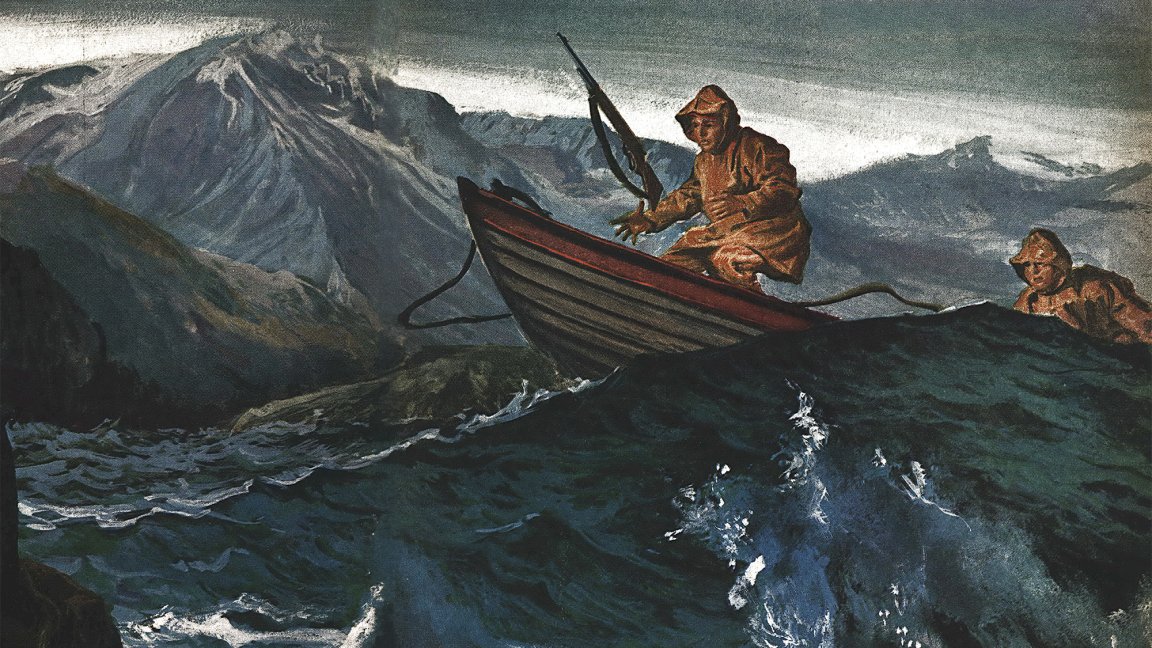
This story, “Seven-Year Itch,” appeared in the July 1961 issue of Outdoor Life.
A raw, wet wind, sweeping around Cape Alitak, was churning up choppy seas and scud the length of Deadman Bay. The bay is a sheltered indentation in the rugged coast at the southwest corner of Kodiak Island, but there was no shelter from the weather that rainy May morning.
As we approached the inlet that led into Horse Marine Canyon, we spotted three hair seals on a kelp-draped rock a few feet above the sea. Hal Waugh, my guide, turned the outboard-powered dory that way, nosing through the chop at reduced speed. I sprawled flat in the bow, ready for a prone shot.
Hunting hair seals isn’t the most exciting sport on earth, but it is a harsh test of a rifleman’s marksmanship. I was getting a kick out of it, despite the bad weather. Had I guessed what the outcome was going to be, I’d have stayed in the tent and played gin rummy instead.
The seals were almost within range now, but I couldn’t get the stance I wanted, flattened awkwardly in the bow of the dory. I raised up, half standing, half kneeling. Then a big sea caught us unawares. The boat lurched, my feet slipped on the rain-slick bottom and flew out from under me. Burdened with boots and oilskins, I dropped my rifle and grabbed for a hold that would save me from a plunge into the cold, gray water. I heard a splash, and when I regained my balance and looked around my rifle was gone.
That’s how come a fine .348 Winchester lies today in water 60 feet deep on the bottom of Deadman Bay.
I don’t suppose it mattered too much. By that time I had accomplished everything I went to Alaska for, and the rifle had done its job well. Hal and I didn’t even tell the boys back at camp what had happened. We figured things were bad enough, without letting ourselves in for that kind of razzing.
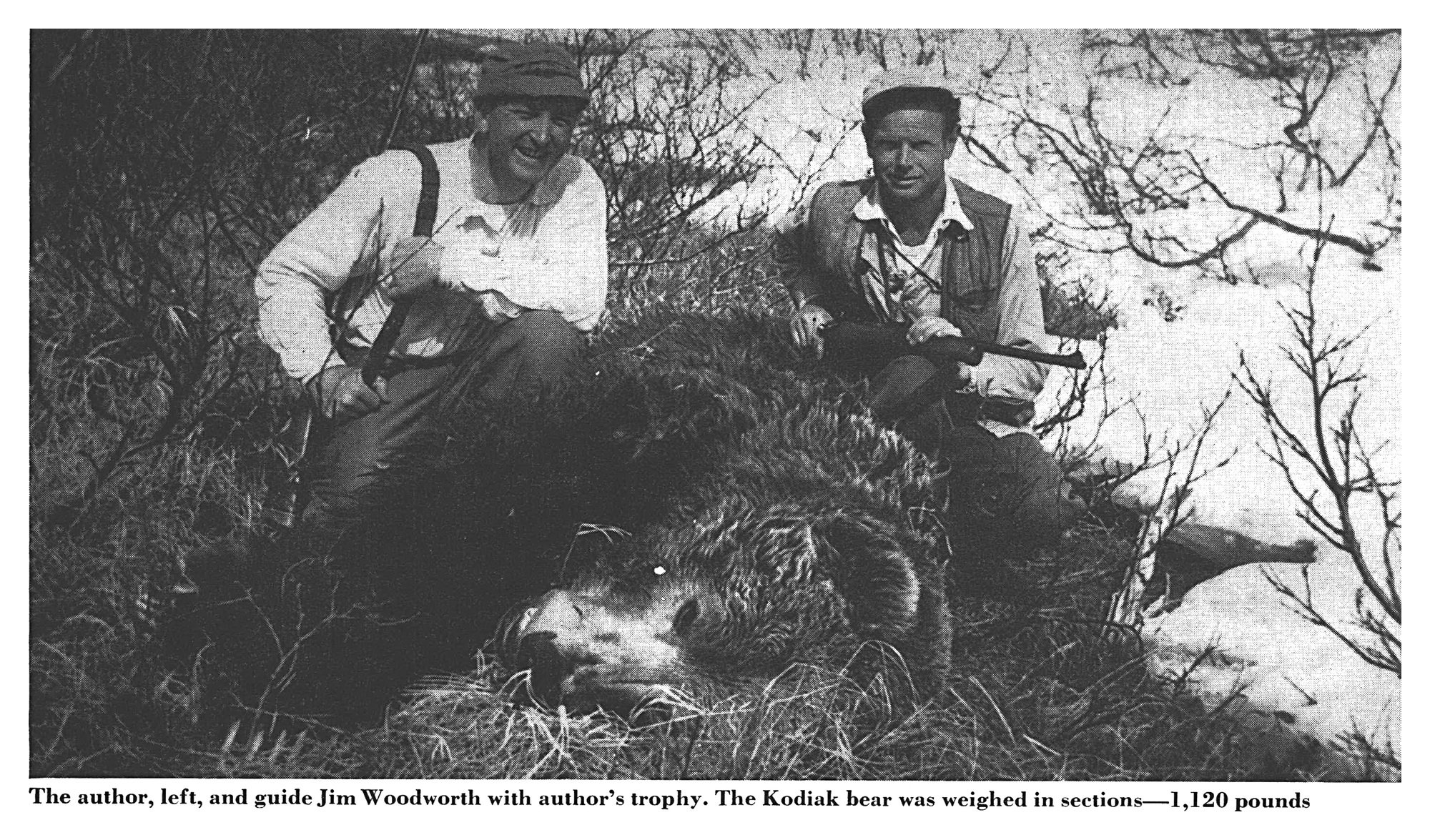
We were camped at the head of the bay, a party of nine. The hunters were George Heinold of Harrisburg, Pennsylvania, Joe Steine of Baltimore, and myself. Our guides were Hal Waugh, Earl Stevens, and Jim Woodworth, who has written several hunting stories for Outdoor Life. Jim and his bride, Marge, married a short time before, were taking a bush honeymoon. Marge, a Southern gal with some top-notch recipes at her finger tips, was cooking for the camp. Larry Keeler, a husky lad of 22, was taking care of chores. And we had an extremely interesting guest, Dr. Bob Rausch, chief zoonotic-disease control officer for Alaska, on Kodiak to study brown bears and their health problems.
For me this hunt had been months in the planning and years in the dreaming. It got its actual start one rainy night in the fall of 1950, when I sat in my home in Sioux Falls, South Dakota, where I’m an appliance wholesaler, reading Outdoor Life. An ad offering a Kodiak bear hunt caught my eye. I’ve hunted for 25 of my 35 years, pheasants, ducks, and geese, and by that time I’d also shot deer, antelope, and an elk.
As far back as I can remember, Alaska has been a magic place to me. I’ve known ever since I grew up that I’d have to hunt there someday. A man can deny those inner urges only so long. Well, I sat and read the bear-hunting ad that stormy fall night. If I’m going to do it sometime, why not now? On the spur of the moment, I wrote to the guide for details. When his reply came I knew I wasn’t quite ready for my Alaska adventure, after all. The money involved was more than I could spare. My dream would have to wait.
It waited six more years. The idea stayed with me like seven-year itch while I slowly saved up the money. In the fall of 1956 I wrote to three outfitters who had ads in Outdoor Life. I knew this might be a once-in-a-lifetime affair, and I wanted to plan carefully. I wanted a brown bear big enough for the record book, and I figured my chance of getting it would be best if I hooked up with the right guide. Above all, I didn’t want to be farmed out to some part-time guide after I reached Alaska or pressured into settling for a second-rate trophy when the chips were down.
I got fair and honest answers from all three men. They promised to guide me personally and do all they could to find me the kind of bear I wanted. None made a flat guarantee on that score, of course. They’d put me within shooting range of a brownie of respectable size, they said, but a record bear was a matter of luck, as I already knew. As to location, equipment, and services, one sounded about as good as another. I finally picked Hal Waugh because of his straight-from-the-shoulder letter and also because of what I’d heard and read about the size of bears taken by hunters he’d handled.
I first wrote Hal in October. By December I was firmly booked for a hunt the following May. That didn’t end our correspondence, however, and before spring I began to realize that answering letters from greenhorns and giving them advice on guns, equipment, and other details must be one of the major headaches in the life of an Alaska outfitter. But for me, that winter of planning and Hal’s letters were half the fun of the trip. My excitement and anticipation mounted, and by take-off day they had reached a pitch like nothing I’d ever known before.
I left home on May 6, 1957, flying to Kodiak Island by way of Seattle. At Kodiak I contacted Bob Hall, who does the local flying for Waugh. Hall grew up in North Dakota, which made us practically neighbors, and we had a fine time chewing the fat while a light plane was warming up for the hop to Deadman Bay, where Hal and his crew had camp set up.
We made the flight in dazzling sunshine, winging between snow-covered peaks. I kept looking for bears on the snowfields and along the creeks, but saw none. I did see plenty of trails, however, and by the time we set down on the wind-riffled blue water of Deadman Bay my hopes had soared sky high.
Only one thing bothered me. On Hal’s advice, I’d brought hip boots and a raincoat that came below my knees. I didn’t see how anybody could climb those mountains in such gear. And if the weather was going to be so fine, why did I need it in the first place? I got the answer to that the next morning, when clouds blotted out the peaks and misty rain socked in the whole of Kodiak Island.
Hal and Woodworth and Stevens came down to the beach to meet me. I hopped ashore from a pontoon, shook hands, and went up to the tents to meet the rest of the party. I was just in time for the evening meal, a real backwoods banquet. So far the trip was up to expectations on every count.
After supper we listened to Hal and the two guides spin bear yarns, and drew Dr. Rausch out on some facts he had turned up about brownies. Rausch has followed his work all over Alaska, living with natives and learning their languages. He’s as interesting a campfellow as I ever encountered. We turned in shortly after sundown, but that wasn’t early, for the sun didn’t set till 9 or 9:30. The spring nights on Kodiak are short. By 3:30 in the morning the sun was up again.
The weather was dirty next morning but I hadn’t come to Alaska to let weather hold me up, and Heinold and Steine felt the same way. We got into our rain gear and wished each other luck, Hal and I crossed the bay in the dory and landed on the beach of Horse Marine Canyon. Then, without any loss of time, I got my first lesson in hunting brownies in the rain.
We clumped across the beach and through a belt of dead grass taller than a man’s head. There was still plenty of cover to hide a 1,000-pound bear, and I found myself wondering what was to prevent one from bouncing out from under our feet. I’d come for a brownie but I didn’t want to encounter him on those terms, and I breathed a sigh of relief when we were through the grass. Then we went into the alders, and that was worse.
Alaska alder patches are something you have to see to believe. Snow packs the young shoots flat to the ground the first winter of their lives and they stay that way permanently, growing into horizontal trunks three or four inches thick. But as soon as they get big enough to withstand the weight of the snow the alder trunks turn up and finish their growth vertical. The result is a northern jungle. You can’t see five paces ahead. Once more I started to speculate on what would happen if we surprised a bear in his bed.
Beyond the alders, the mountain went up steep as a house roof. Hal led the way at a lively clip and I scurried along behind him, slipping and stumbling in my hip boots, pouring sweat under the raincoat. An hour from the beach we reached the spot we were headed for and sat down on the bank of a small stream. Hal went to work with his glasses, not even breathing hard. For five minutes I couldn’t do anything but wipe sweat and try to suck more air into my lungs.
Soon Hal pointed across the valley. “Put your glasses on that rockslide over there,” he instructed. “See that greenish ravine running down from the edge of the snow to the little canyon?”
I did.
“Make out the yellowish rock about halfway down?”
I nodded.
“Well, it’s not a rock. You’re looking at your first Kodiak bear.”
When I took a longer look through my 7X binoculars I could see that Hal was right. It was a bear, yellow-brown in color, curled at the foot of a boulder half as big as a house, apparently asleep.
“Good one?” I asked eagerly.
Hal shook his head. “Likely a three-year-old. Nothing to make a two-mile hike for.”
We watched the bear for half an hour. He finally lumbered to his feet, went out of sight in the canyon, traveling at a rolling walk. Even if he couldn’t qualify as a trophy and was two miles away, he made my heart thump like a trip hammer.
He was the first of nine brownies we saw that day. In spite of the weather and the alders, the climbing and sweating, I had a wonderful time. None of the bears was in the trophy class. We turned down off the mountain in time to get back to camp for supper.
Joe Steine had fared better. Jim Woodworth had taken him up on a mountain at the head of the bay and Joe had gathered in a nice brownie.
Hal and I headed for Atkinson Canyon next morning, in even worse weather. Rain squalls were driving in off the Pacific, and the wind howled across the snowfields. I blessed Hal that day for warning me to bring good rain gear.
We saw bears again, plenty of ’em, but none of a size to interest us. I was beginning to feel a little discouraged when we headed for camp in late afternoon, but my spirits lifted when we got to the tents and found that George Heinold had connected. Neither his bear nor Steine’s was as big as I was hoping for, but the fact that two members of our party had taken fair trophies in two days made me feel that my own chances had to be pretty good if I kept at it.
I kept at it, all right. In the next two days Hal and I hunted Griffith and Melton Canyon and Alpine Cove, some of the most promising spots around the bay. Jim Woodworth was free now that his hunter had filled, so he went with us on the theory that three men might do better than two. I think the real reason Jim came along was because he’d rather hunt bears than eat.
Stevens and Keeler put in the time hauling driftwood logs from the beach to camp for firewood. There’s no timber for cutting in that section of Kodiak Island, so we had to rely on what the tides carried ashore. The beach was strewn with it in many places. Jim’s wife was feeding us like kings, and all in all it was a happy camp.
We hunted four days before we saw what we were looking for. Then, as we sat on the slope of a 3,000-foot mountain trying to pick holes in the mist and fog that shrouded another mountain across the valley, Hal let out a grunt of surprise. “There’s one worth trying for,” he said.
The bear was at the edge of an alder patch high on the opposite slope, poking around in dead grass and turning over rocks, hunting lemmings or ground squirrels. When I picked him up in my own glasses he looked about the size of a horse.
“Can we get up to him?” I asked.
“Not sitting here,” Hal retorted with a grin. “Let’s go.”
We angled down off the mountain, with rain slashing at our faces, through the alders and up the opposite slope. From the air the mountains of Kodiak Island don’t look especially formidable, but to a man at the foot of one, wading creeks fed by melting snow, toiling like an ant through grass, alders, and snowfields, they look different.
Hal set the pace. My throat started to burn and I couldn’t get enough air into my lungs. The only chance I had to catch my breath was when we slowed down to pick our way across one of the tumbling, brawling streams, knee-deep in the rushing water, slipping on rocks, fighting for balance. Part of the way the slope was so steep we hung onto rocks and brush to help ourselves up.
The mountains around us lay in a jumble, with ridges running in every direction, and the wind seemed to blow up the canyons, first this way, now that. I could see it had Hal worried. “It’ll be luck if he don’t scent us,” he told Jim.
At the end of two tough hours we pulled up at the foot of a big alder thicket. The rain had slacked and the clouds had lifted. We could see all the way to the top of the mountain now, but the alders cut off our view directly ahead. Jim and Hal agreed that if the bear hadn’t moved we were about 400 yards below him. We stood and looked things over, hoping he’d give himself away, but there was no sign of him.
“We’ll get away from these alders and try to locate him,” Hal decided. “Then if the wind doesn’t trick us we can crawl up for a shot.”
We started out across a bare slope on hands and knees, heading for a little knoll that would give us cover while we glassed for the bear. But before we’d gone 20 yards we heard a loud grunt above us and a small rockslide came rolling and tumbling down. Hal and Jim bounded to their feet and ran for the knoll and I scurried along behind. They were in time to catch a glimpse of our bear, running full-throttle over a ridge beyond the alders. I didn’t even see him.
“What now?” I asked when the excitement was over.
“Back to camp,” Hal replied. “There’s no use trying to follow that fellow. He either smelled us or saw us and he won’t stop on this mountain.”
I was about as downcast a bear hunter as Kodiak Island ever saw. Judging by what Hal and Jim had seen of him, the brownie was exactly what I hoped for, and I couldn’t expect to encounter another like him. My boots had chafed my feet, and I was drenched with sweat and beginning to shiver in the cold wind. But Hal grinned cheerfully and reminded me, “That’s bear hunting. Just part of the fun.”
All I needed to fix me up was one of Marge’s hot suppers and a good night’s sleep. I rolled out at daylight next morning, rested and ready to go.
Larry voted to come with us. The four of us left camp right after breakfast. The weather was better and we rolled our rain gear and tied it on a packboard. We climbed up a steep canyon at the head of the bay, glassed for more than an hour, and moved on toward a higher ridge, finishing the climb shortly before noon. Hal liked to jump the gun on the noon meal — complained he couldn’t eat enough breakfast to see him through — so we sat down in a sheltered spot for lunch.
I hadn’t taken two bites when Larry laid his sandwich aside, brought his glasses up, and took a long look toward a mountain about three miles away. “There’s a bear over there,” he announced finally. “Take a look,” he invited Jim and Hal. “It could be a good one.”
By that time I had my own glasses up. The bear appeared to be hardly more than a brown speck moving along on the skyline, following the crest of a ridge away from us. While we watched he turned down off the ridge in the direction of two other brown specks, and we realized we were looking at three bears.
“That’ll be a sow and yearling cub,” Hal predicted. “Looks as if the old fellow wants to make up to her, but it’s the wrong time of year. Bet she sends him packing.”
He was right. They were too far away for us to see exactly what happened, but the two bigger bears ran at each other two or three times. Then the one that had come down off the ridge stood around for a couple of minutes, as if hoping the other would change her mind. When she didn’t, he ambled back the way he’d come. He went directly over the ridge and out of sight.
“That’s a big bear,” Hal told me. “You want to try for him?”
I did. The chance of a shot seemed slim, for the bear was three miles off and traveling away from us, but I wasn’t willing to pass up a chance at anything of his size.
Hal had been bothered by a headache all morning. He decided to go back to camp and let Jim and Larry and me finish the hunt without him. “I doubt you’re going to see that bear again,” he said, “but it’s worth a try.”
“Peel off your wool shirt,” Jim advised as we stood up. “You’re not gonna suffer from the cold the next couple of hours.”
That proved to be the understatement of the hunt. The ensuing hike was a retake of the previous day’s stalk, but on a bigger scale. Jim and Larry went at a fast walk. Half the time I dog-trotted to keep up. We slid and scrambled down off the mountain to the valley. Halfway across it we encountered a good-size stream, swollen with snow water. It came almost to the top of our boots, but we inched through. Beyond the stream we ran into a bad alder patch, and then we were at the foot of the mountain where we’d seen the bear, and the climb began.
Part of the time we went up on all fours. On the north slope of a big canyon, where the sun had not melted the winter ice, we slid down on the seat of our pants. Climbing out, the snow was so deep and soft we had to lie flat, dig our fingers in, and belly our way up. Jim stopped for a breather at intervals, and toward the end of the climb I was taking those breaks standing up. If I sat down it was too hard to get back on my feet.
When we broke out on top of the ridge there were the tracks of our bear printed a foot deep in the snow. I had never seen anything like them, and I felt a chill run up my spine.
Jim studied the tracks briefly. “We’ve found your bear,” he told me. “There aren’t many that make a track that size.”
We followed the trail to where it turned down the far side of the ridge. There we stopped and glassed as much of the country as we could see. The bear was nowhere in sight, and I was beginning to share Hal’s misgivings, but Jim didn’t seem worried. We stayed with the track, and a quarter of a mile farther on it came back over the ridge and led into an alder thicket on the slope we’d just climbed.
“He’s bedded down,” Jim predicted confidently. “If we work things right we’ve got it made.”
For a second I felt a flicker of doubt as to whether I was up to the rest of my end of the affair, but it was too late to back out now.
Jim sent Larry down to skirt the alders and find out for sure whether the bear was still on that side of the mountain. We knew he’d take plenty of time, for it was a ticklish chore. Jim and I moved slowly along on the side of the ridge above, in the open, where we’d be able to see the bear if he came out.
We were knee-deep in soft snow, the going was hard, and we stopped every few steps to make sure we didn’t miss anything. As we started ahead after one of those brief halts I heard a sudden thrashing in the alders 150 yards down the slope. Then a grizzled brown head about the size of a barn door popped into sight and a resentful roar seemed to lift my cap all the way off my head.
I’d had the scope of the .348 mounted by Griffin and Howe so I could use either it or the iron sights as I chose. But I’ve been a scope man ever since I started hunting big game, and now I went to the scope by reflex. The whole field was full of bear head and alder brush.
I slammed a shot, the bear head disappeared, and there was nothing left but brush. Then I went to iron sights and I could see the alders shake as the bear came smashing through, running uphill for the open ridge.
“He’s big enough! Throw lead!” Jim yelled. I shot three more times, feeding shells into the magazine as fast as I used them. I don’t remember doing that, but I must have, for when it was all over the magazine was still full.
The bear broke out of the brush 100 yards away, his rump closer to the snow than it should have been and his left hind leg dragging. I had put in a disabling shot, but it was too low and too far back to anchor him.
“Nail him!” Jim shouted, and I drove another 250-grain Silvertip at his shoulder. He went down, rolled over with all four legs in the air, and I thought the bear hunt was finished. But he kept on rolling, got his feet under him, lurched up on three legs, and went for the top of the ridge again, running like a streak. I had time for one more shot as he made the crest. He fell and went out of sight, dragging himself awkwardly down the far side.
I knew enough about brown bears to know that we might have a nasty chore on our hands, and I could tell from the way Jim acted that he was thinking the same. The bear had left a broad, bloodstained trail in the snow, falling repeatedly. It was a safe bet he wouldn’t go far, but he might still be in shape to make trouble. From where we were standing we could trace the blood trail down the slope for 350 yards. There it went out of sight in a patch of scrubby alders the size of an average yard.
We started down, moving gingerly, our rifles ready. When we reached a place where we could see the far side of the thicket, our bear hunt came to an abrupt and happy end. Our brownie lay at the edge of a small creek another 150 yards ahead. Jim worked up to him cautiously and prodded him with a stick. He was as dead as a rock.
I wanted to sing or dance or whoop. I wanted to call my wife and tell her I’d killed a bear. I wanted to buy everybody a drink. Instead, I just shook hands with Jim, trying not to show my excitement.
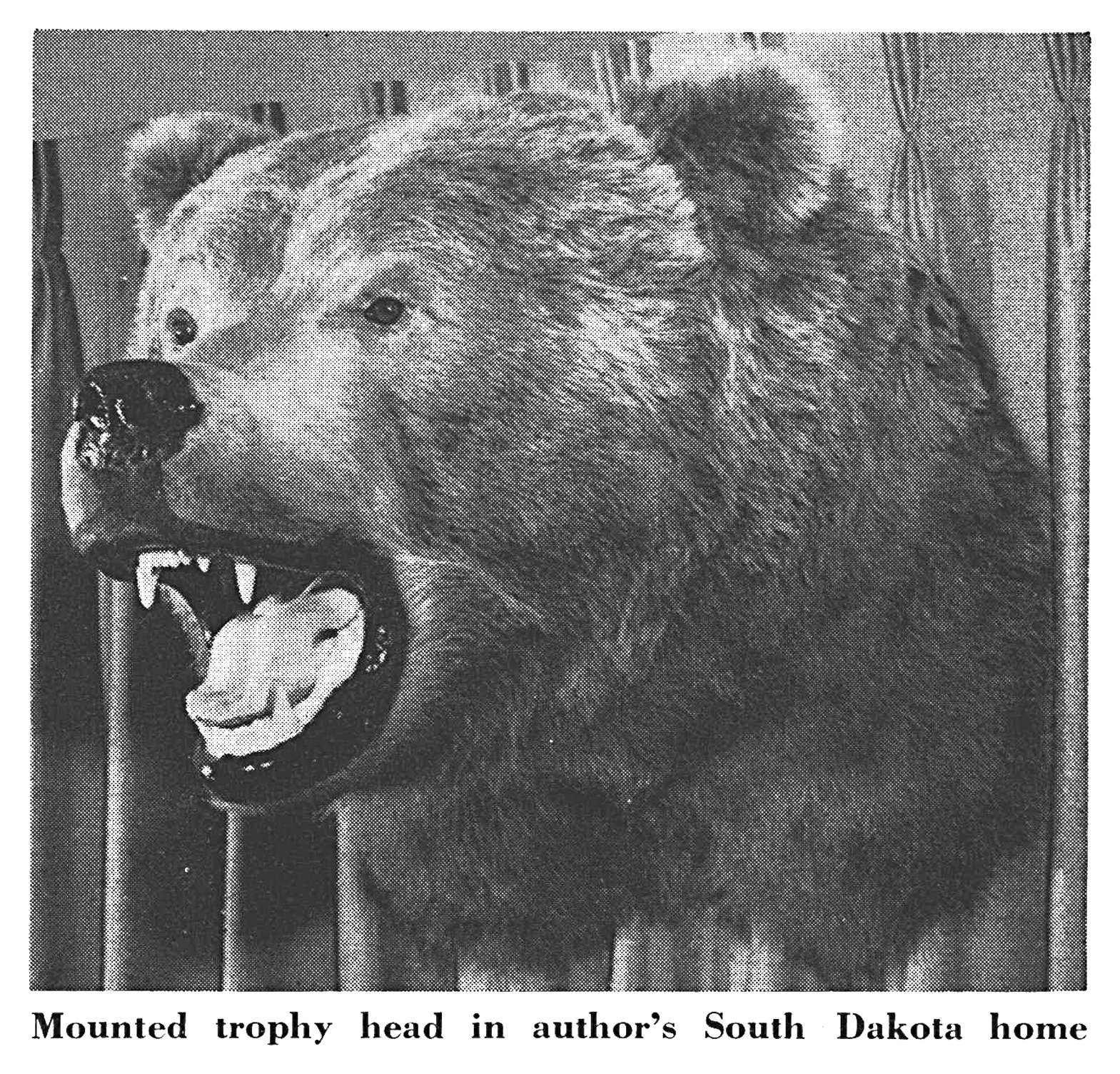
When I had a chance to size up my trophy I was happier than ever. He was huge, bigger and burlier than I’d thought, with a fine pelt. His color was rich brown tipped with golden yellow, darker on the legs and belly, shading into paler yellow and blond around the ruff and head. If I’d drawn up blueprints for the kind of bearskin rug I wanted I couldn’t have done better.
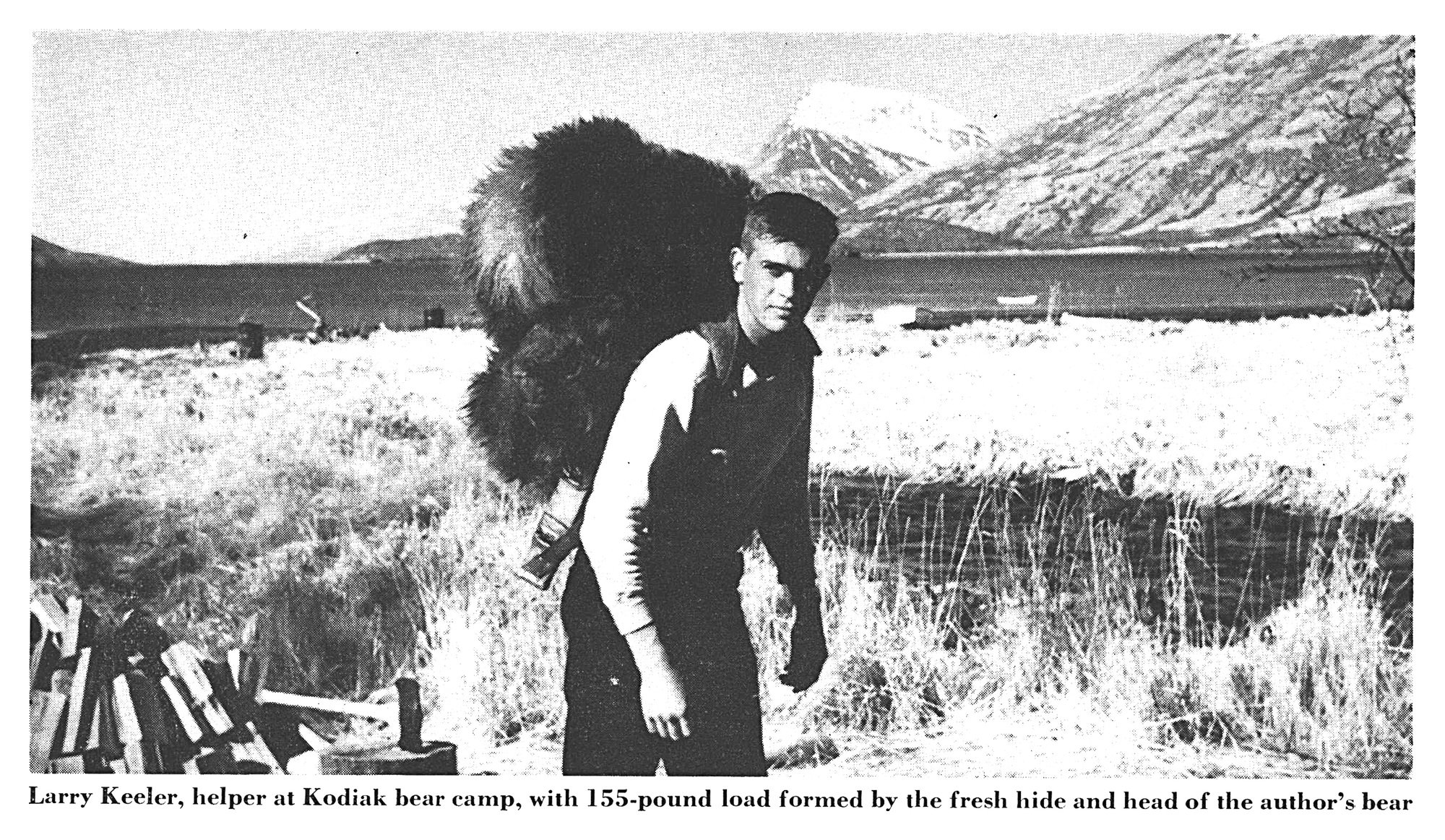
We took a few pictures and then Jim and Larry went to work on him. They took a lot of pains getting the pelt off, and it was a four-hour job. We finished at 6:30, rolled the hide and head on a packboard (we learned later they weighed 155 pounds) and Larry, young and full of ginger, offered to pack the bulky load back to camp.
But we had six miles to go, and we were barely off the mountain when darkness overtook us. The bearskin was too much of a load to pack in the dark, so we lashed it in the crotch of a big alder and tied my hat on it to keep other bears away. It was an hour after midnight when we got back to the tents, but we routed everybody out to hear the stories we wanted to tell.
I had worn my toes raw on the climb that day, so I stayed in camp the next morning. Hal, Jim, and Earl went after the pelt and Larry took Doc Rausch back to the carcass. Doc wanted to look it over as part of his research. He took along scales with a capacity of 100 pounds to weigh the sectioned carcass.
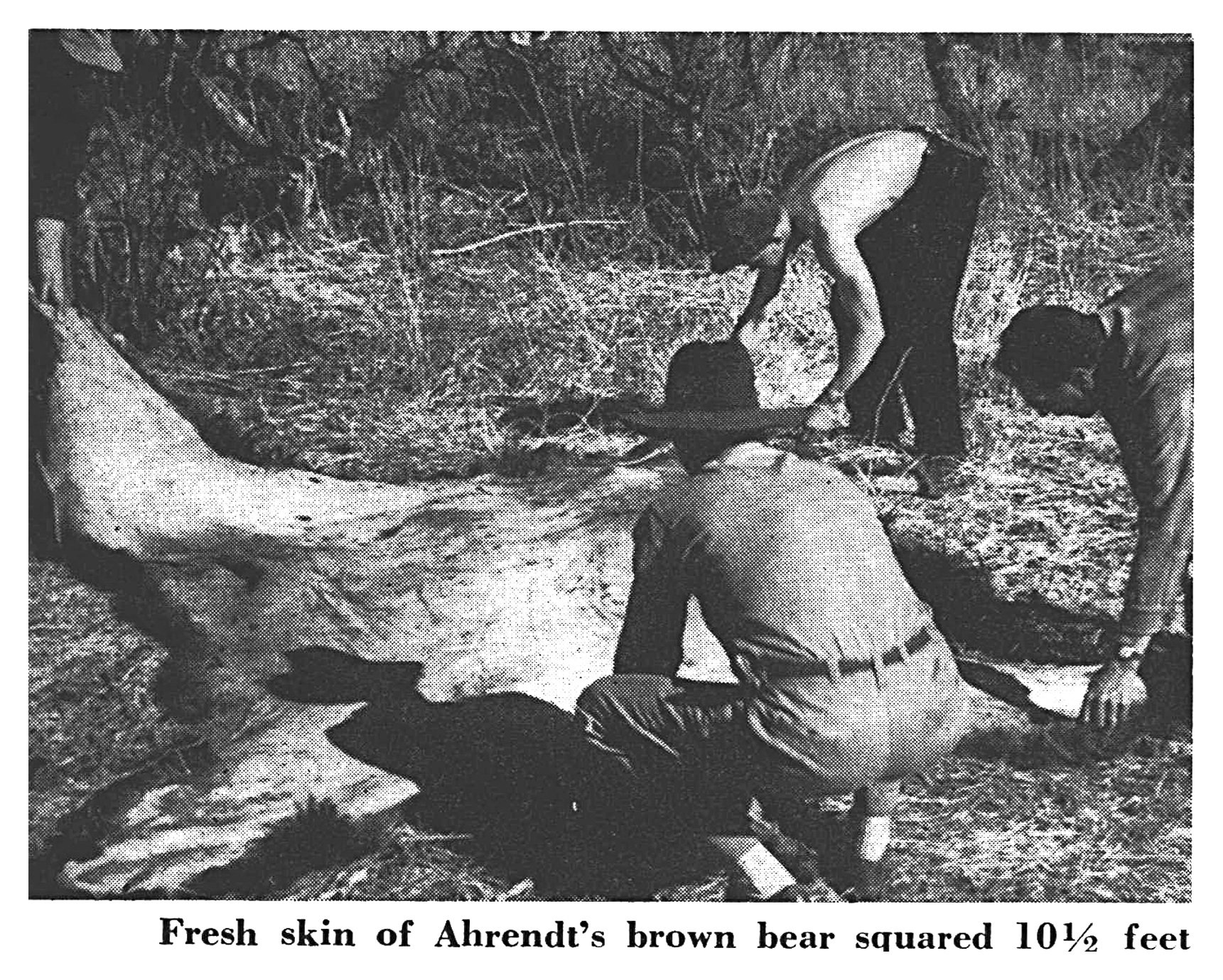
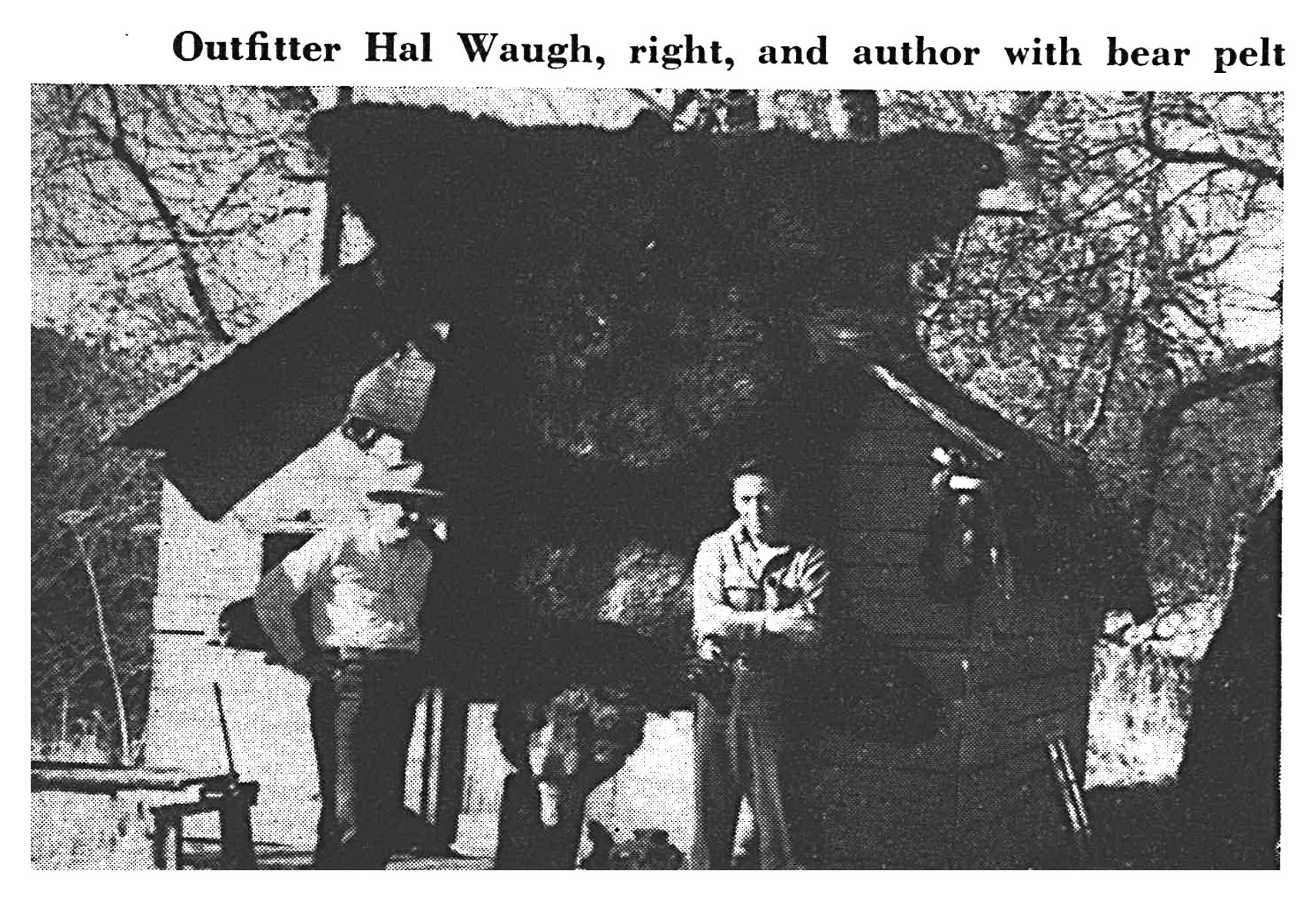
The total weight of the bear was 1,120 pounds. Rausch and the guides calculated its fall weight, fat and ready to den up, would have been around 1,450. The rear pads were 13¾ inches long, the front claws 3¾. The pelt was 8 feet 11 inches long and squared 10½ feet. After drying, the skull scored 28 11/16 in Boone and Crockett Club competition. There are a lot of brown bears ahead of it in the record book, but it is big enough to make the list.
Read Next: My Son Could Hunt Bears with Any Rifle, He Picked the M1 Garand
I said a while back that when I planned the bear hunt I thought it might be the only trip I’d ever make to Alaska, but I was wrong about that. I have another in the dreaming stage. I want to go into the Post Lake country with Hal for a Dall ram. I don’t know just when, but I can make one promise. I won’t wait seven years this time. I know better now than to let a case of itch run that long.