
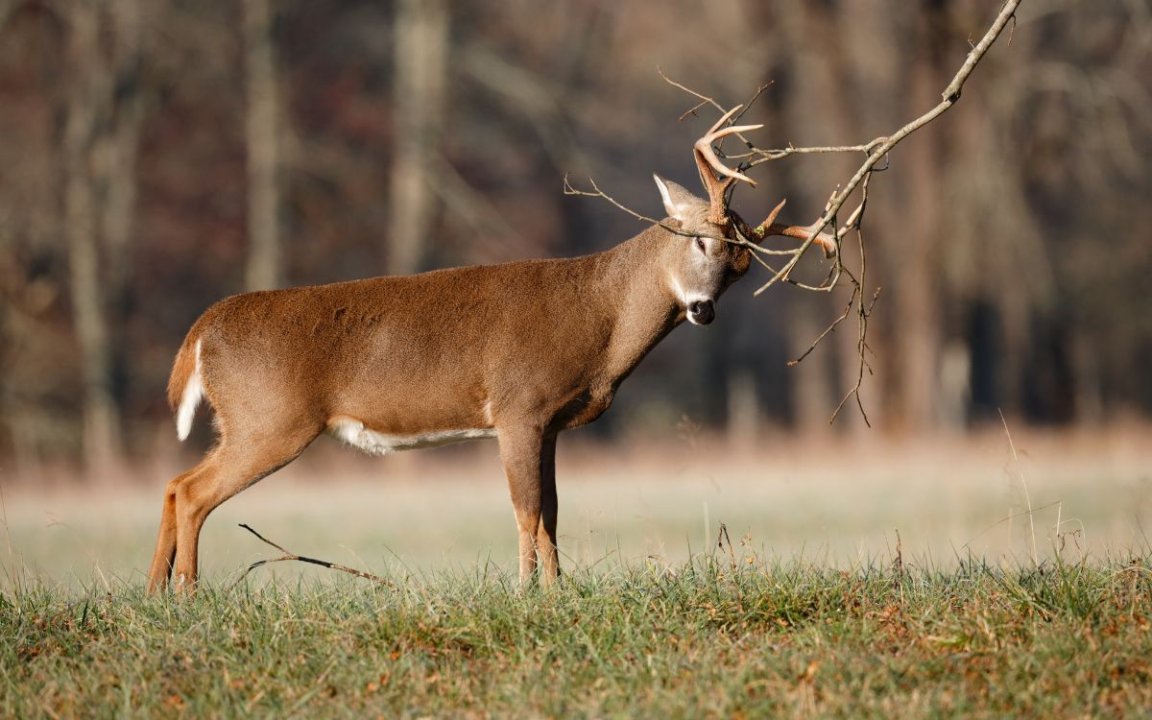
The trap was set: To get to my mock scrape, the buck had to cross an opening 25 yards from my stand. But just as my pulse started to race, he stopped. As he turned his head slightly, I got a good look at his massive rack, a heavy-looking 12 points.
Staring in the direction of the scrape, the buck put his head down, threw dirt 15 feet with his right front hoof, paused, then threw dirt 15 feet with his left. I could see the hair on his neck standing on end. Then he turned sharply and passed right beneath me.
I drew my bow, followed the deer with my sight pin, and took the shot. The buck ran 30 yards and piled up. When he hit the ground, another large buck ran up to my scrape and then back up the draw. Now I understood the scene: The buck I shot was trying to get in position for an aggressive move on the second buck, right in front of the scrape I had made the day before.
The results I have achieved using mock scrapes and licking branches have changed my hunting. That’s why I’ve been able to pare down the 40 to 50 stand locations I once had ready for a season to the 10 to 15 stands I concentrate on nowadays. I still scout heavily and spend a lot of time preparing and selecting sites—but now it’s more to help bucks select which areas they like best.
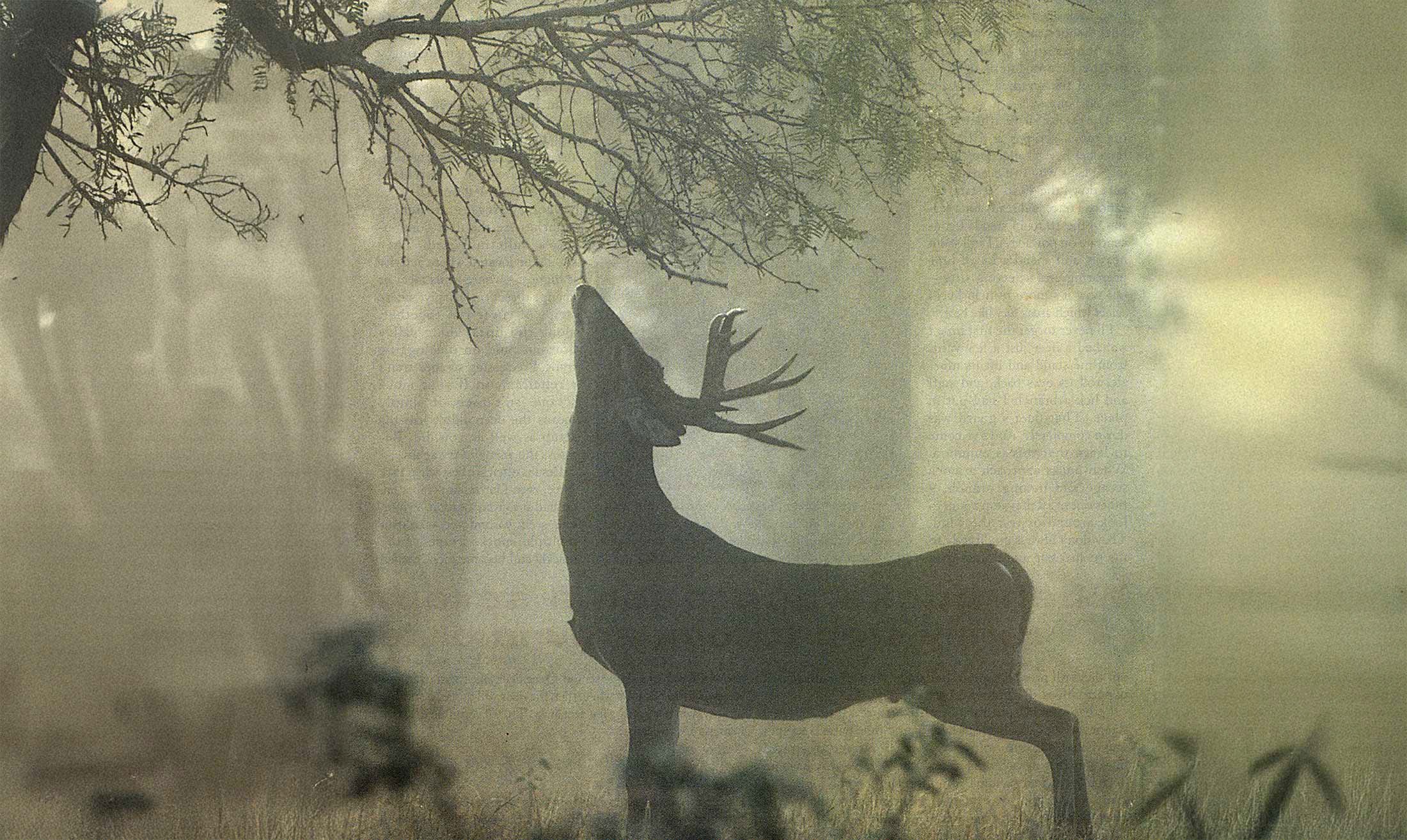
I’ll never forget the first time I watched a deer just a few yards from me stand and lift its muzzle, roll its eyes back, and sniff and lick a branch I had put in place. That deer’s guard was down completely. And I’ve come to learn that this is common. When bucks approach a mock scrape and licking branch, 9 times out of 10 they don’t stop to look around or test the wind. They don’t always go directly to the scrape, but more often than not they still present a good shot angle. And after all, a good opportunity is all a hunter can expect.
Perhaps I’m blaspheming Mother Nature a little, but real scrapes are not as reliable as false ones. Some natural scrapes are visited one time only, an outlet for some frustrated buck’s increasing breeding urge. Other scrapes may have no licking branch or may not be in the right position for a good shot setup; or they may be in an area that cannot be hunted at all for one reason or another.
But when you make your own scrape, you can make it perfectly: It can be placed to take advantage of the winds and thermals, in front of a stand site that affords you maximum cover and a fairly predictable shooting situation.
How valuable is the licking branch? It’s often the catalyst that makes your efforts and a buck’s instincts work together for a successful hunt. Bucks and does, both young and adult, use licking branches to leave their scent and check the scents of other deer. They are like calling cards, and every deer is compelled to hand them out. In the spring, when I put in a licking branch and clear the dirt below it, all I’m doing is simulating a scrape that has been there forever. When deer notice the licking branch, they’ll come in and change its status from mock to real. By the end of summer, when the rut begins, my licking branches and cleared areas are part of the local herd’s natural world.
Scrape areas and licking branches are the deer community’s bulletin board. They should be located where activity is highest—where trails meet or change direction sharply, where strips of cover run together, along rub lines, along valley bottoms, and on old logging trails. Preexisting scrapes aren’t a requirement. If your mock scrape isn’t used, it simply means the deer didn’t like the setup as well as you did. Reassess the area and try again.
Results often are best when two, three, even four mock scrapes are created at a given location. Whitetails seem to find and take over multiple mock scrapes more quickly and become more excited about them than a single scrape. Once deer take them over, one scrape will be hot for a while, then the deer will move to another scrape, even if it’s only a few feet away. They’ll continue to rotate from scrape to scrape.
Read Next: The Truth About Rope Scrapes, One of the Hottest Tactics in Whitetail Hunting
The Setup
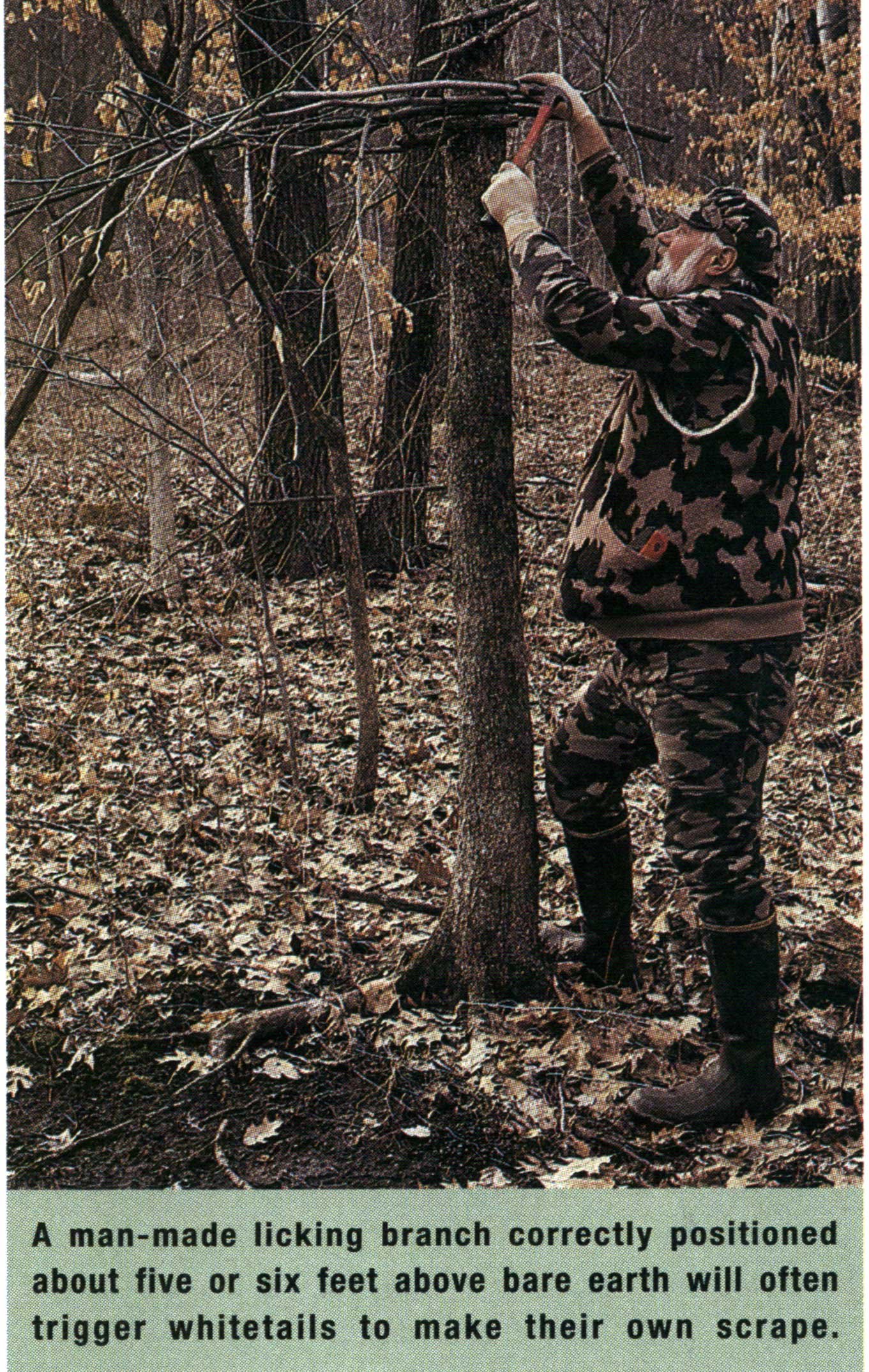
Place your stand 10 to 20 yards from the scrape, downwind, in a clump of brush or in front of a big tree trunk that will help hide you or at least break up your silhouette.
Once the stand is selected, look for a branch of the right height and size to hang over the scrape. Deer like to rub and chew on a single branch tip, so use a thin and sparse one. (Overhanging wild grape vines are the only exception I ever discovered. Deer love them.) The branch tip should be placed five or six feet above the trail, preferably pointing downward.
There are two ways to position the branch: 1) Bend a sapling so that one of its branches is placed downward, using wire to lash it in place. Try to fasten the wire near the base of an anchor tree so the wire is more or less vertical. This makes it a lot easier to bend the sapling to the proper position, and a vertical wire is less dangerous to animals moving through the woods. 2) Cut a small sapling and staple or nail it to a tree near the trail. Position the branch so the limb tip hangs over the trail at a height that just allows a deer to stretch up and lick it. Wear rubber gloves while doing all this to minimize your scent, and never touch the end of the branch.
Read Next: The Best Deer Attractants
Making Your Mock
The soil directly below the branch must also be prepared. Pick a spot with little or no grass. If you can find a totally bare spot, so much the better. Break up the soil surface with a shovel, or if necessary, your boot heel. Clear the earth and make it level. Deer don’t like to scrape on a sloped surface. About one month before the peak of the rut, when bucks start heavy scraping on their own, I begin “sweetening” the soil in the scrapes I’ve made with a squirt or two of deer urine, even though deer already will have taken over those scrapes. The refreshed scrape is a challenge issued in the dirt, and often one or more bucks already using the scrape will become distinctly less cautious and start showing up earlier or more often to make their own mark.
As far as choosing a deer urine, it hasn’t made any difference for me—or to the deer—which type I use. Older supplies have a stronger ammonia smell, but that’s basically the odor of all old urine.
If you’re male, you might want to experiment with your own urine (hey, you gotta go sometime). I did, and it worked. The mature human male has the hormone testosterone in his urine, which can be attractive to bucks during all stages of the rut, when their own sex hormones are flowing.
As the rut approaches, deer will use the licking branch even more, leaving scent on the branch from saliva and from glands on their foreheads. After using a licking branch, bucks paw the earth below, then leave a smelly signpost in the scrape by urinating on their hocks (over their tarsal glands).
The scent left behind denotes a wealth of information, warning subordinate bucks away and advertising for does. When does are ready to be bred, they will stand expectantly on or next to the scrape. They will remain there 15 to 30 minutes before wandering off if no buck shows up. Does not bred during the first rut will use the scrapes in the same manner 28 days later when they come into season again.
Final Results
During the third week of last October, deer were still coming out to alfalfa fields on the ridgetops where I hunt in the Midwest. On one cold evening that threatened snow the deer were especially active. I passed up three bucks that had checked the mock scrape my stand hung over. Then, at dusk, two does, a couple of minutes apart, moved into and past the scrape. Three minutes later, a 12-pointer walked up, nose to the ground, following the does.
I spent several tense seconds trying to decide whether, this early in the season, the buck was good enough. The buck stood in the scrape, looking toward the does in the field, lifting his head to lick the branch, rubbing his brow on the branch, then looking back again at the field.
I finally decided to shoot, and my 15-yard shot was on target. The buck ran back downhill a short way and fell. I made the right choice—he was a beauty.
In addition to scouting stand sites, taking the time to make mock scrapes and licking branches is a rewarding way to kick-start the action. And any time you can find a way to get closer to whitetail bucks, you’re on the right track—or at least the right mock scrape and licking branch.
This story was originally published in the September 1995 Issue of Outdoor Life. Bob Fratzke has taken more than three dozen trophy-class whitetail bucks with bow and arrow. He is author of Taking Trophy Whitetails.