
There are two things that my friend Harvey Wilcourt loves more than anything else. One is ice-fishing, and the other is eating peanuts. It might not sound as though that bears any relation to whitetail deer hunting, but one time it actually helped me to collect a very big buck.
Harve and I had scheduled a day of winter fishing for walleyes, and the plan was to meet at a well-known parking area near the lake and then decide upon a particular frozen-over bay that might offer the best results. As it happened, however, car trouble delayed my arrival by more than an hour, so naturally, when I finally reached our meeting place, Harve had already headed out onto the ice-shrouded lake.
At first, I shrugged my shoulders, not knowing in which direction he might have headed. Then, I happened to look down at the ground near his parked vehicle, and guess what I spotted? Right, peanut shells! Right then, a wide smile came across my face because I instantly knew that tracking Harve would be easy.
In most places, the trail was relatively thin, but occasionally I’d come to an abandoned hole in the ice where shells littered the entire area. Then, the trail would lead off into the distance to another hole, and then still another. Eventually, I spied my partner in a distant channel, and we spent the remainder of the day fishing together. Without the discarded peanut shells showing the way, I might have never located Harve and might have ended up fishing solo that day.
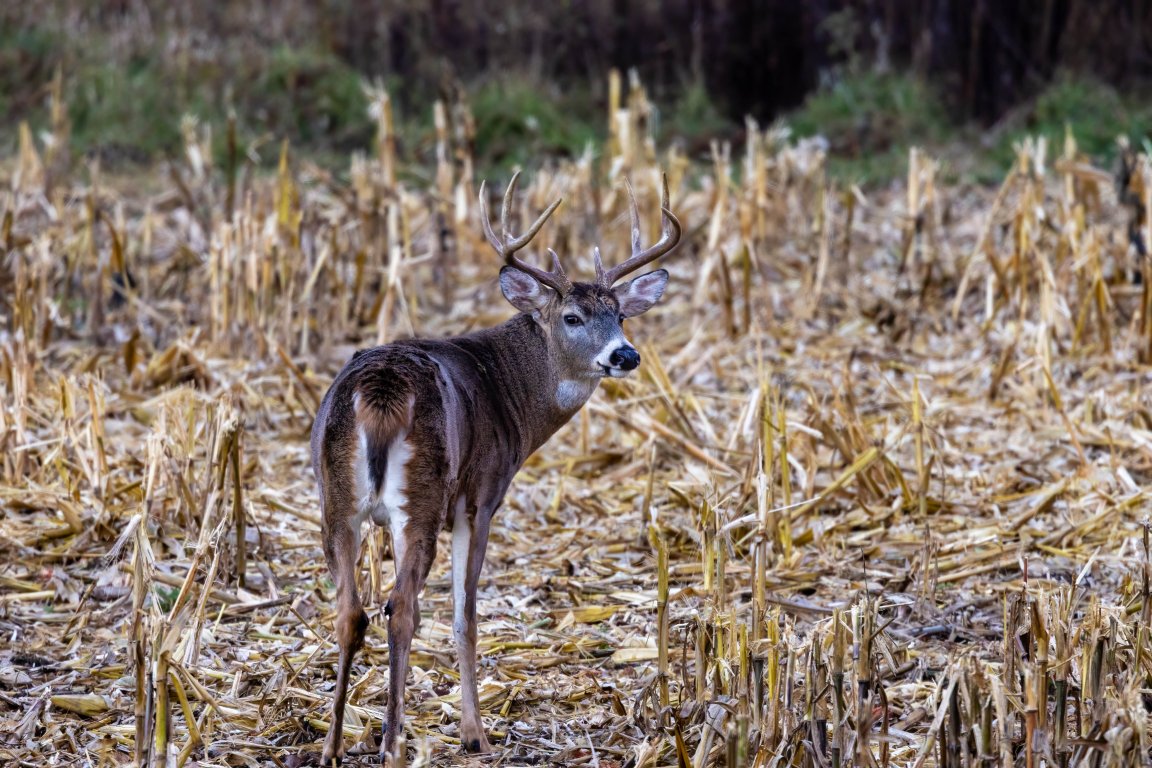
The irony is that several years later, I duplicated the same type of feat, but this time the trail eventually led me to an eight-point buck. To the best of my knowledge, whitetails don’t maintain any particular fetish for peanuts, but they do love corn. And after filling their paunches in a cornfield, it’s quite common for them to carry off a cob in their mouths and continue eating from it as they travel to a nearby bedding site. Sometimes, they’ll finish with the cob along the way and let it fall to the ground right there. Other times, they’ll carry the cob all the way back to the actual bedding location, perhaps to snack upon later.
In any event, I had been hiking along the edge of a large cornfield near my home in southern Ohio, and in coming upon a threadbare trail exiting from the corn, I had found a partially eaten cob. Recalling my amusing experience with Harvey, I decided to follow the trail, and just inside the leading edge of a nearby beech forest I discovered another cob on the ground, and then still another. All of the cobs were in various stages of deterioration, so I knew that they had been dropped at different times over a period of weeks. Large, fresh deer tracks of uniform size and large droppings provided additional clues, and eventually, more than 300 yards into the timber, I came upon a lone bed. That confirmed I was in a buck’s bailiwick, because had there been tracks of varied sizes and several beds, I could have inferred that the deer were only does.
After resting the area for two days, I snuck back into the spot and quietly fabricated a makeshift blind behind a convenient blowdown overlooking the trail. Later, when there was just enough light to make a shot, a gray shadow materialized in the distance, traveling right along the trail. My arrow caught the eight-pointer at the base of the neck, and after sprinting 50 yards, the buck collapsed in a heap.
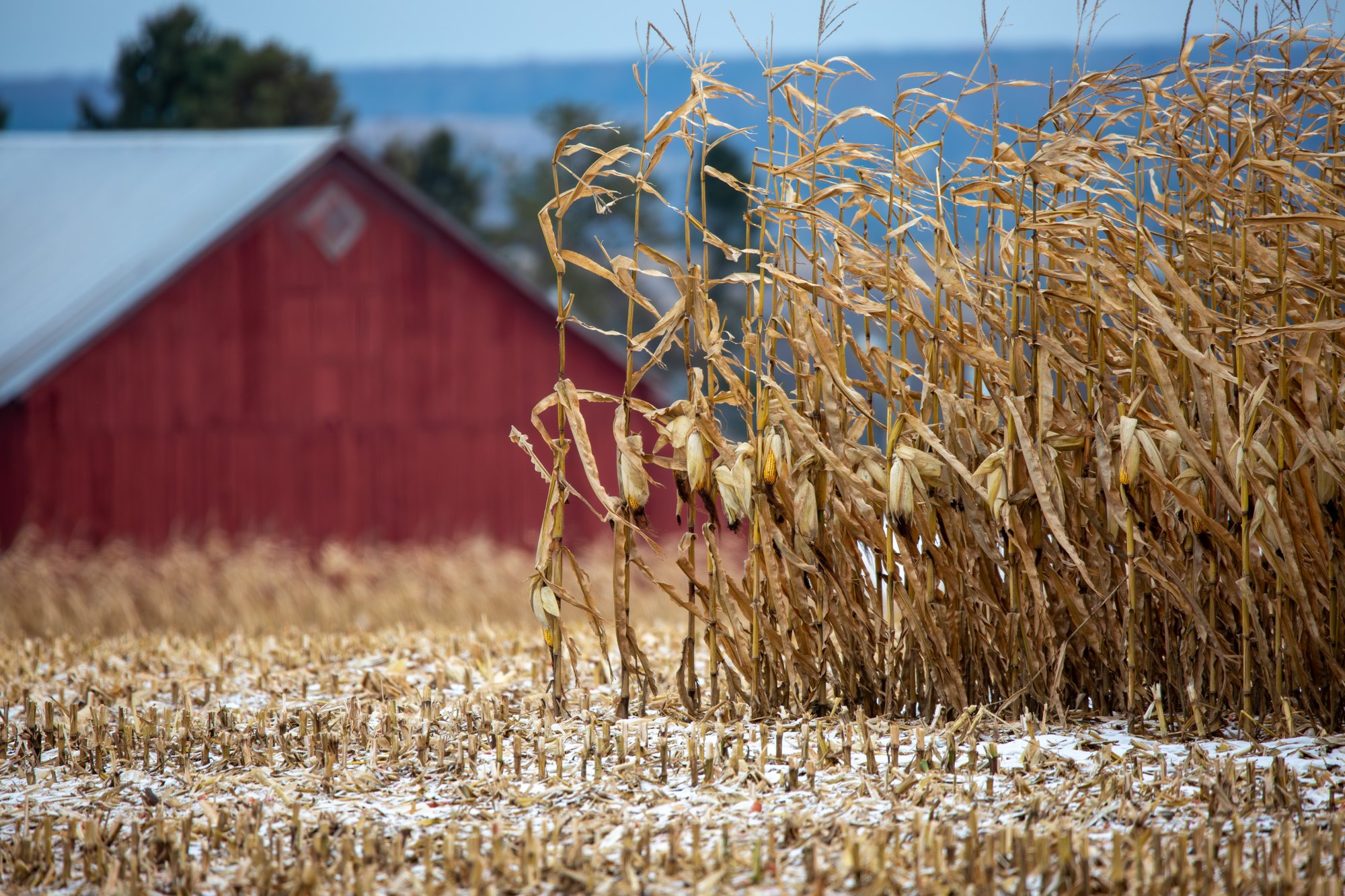
It’s no secret that bucks and corn go together like bacon and eggs, and we have plenty of all of those commodities, especially throughout the Midwestern agricultural belt. In fact, after talking recently with my local extension agent, I learned that in 1986, in the nine major farming states stretching from Ohio to Minnesota, more than 46 million acres of land were planted to corn.
Moreover, acquiring hunting permission in agricultural regions is invariably easier than it is on other privately owned lands because of the extensive damage often inflicted by wild animals. In Wisconsin alone, it was estimated that during 1986, deer destroyed more than $22 million worth of corn, and this cost each farmer an average of $490. Add to this the combined losses of alfalfa, soybeans, truck garden crops and other foods that whitetails regularly dine upon, and it should come as no surprise that though a majority of farmers certainly enjoy seeing deer on their land, they don’t take kindly to whitetail populations reaching such levels that they severely cut into the farmers’ annual incomes.
The exasperating problem that most hunters face is how to effectively hunt those often mammoth and intimidating cornfields.
The first task is to confirm that deer are indeed using the corn, and this is easily ascertained by merely hiking the perimeter of the field and looking for tracks entering and leaving the food plot. Obviously, the best time to do this is either after a rainy period, when the ground is soft, or after several days of light snowfall.
If the region has been experiencing several weeks of dry weather, however, and the terrain is like hardpan, tracks are not easily detected. It is in this case that other types of insight must be applied to the hunting situation. For example, one time I discovered a cornfield where many stalks had been knocked down and countless partially eaten ears were on the ground. Initially, I thought that I had found a mother lode of deer activity, but I was dead wrong.
As I learned later, several raccoons had been at work. The telltale giveaway — pointed out to me by a friend who is a serious naturalist — should have been the fact that the ears were only partially eaten. Raccoons rarely eat an entire ear of corn; instead, they knock down a cornstalk and bite off just the tender tip of the ear, then move on to the next stalk.
If the cornfield borders a climax forest, corn-hungry squirrels may also give the false impression that deer have been at work. But in this situation, the animals climb the stalks, nibble away at the ears, stuff their cheeks and then retreat to their dens, where the scavenged kernels are placed in storage. This leaves the ears still attached to the stalks but gives them a ragtag, moth-eaten appearance.
If deer are working the corn, however, the clues to look for in the absence of tracks are scattered cobs on the ground that have been cleaned of almost every kernel of corn. Also keep on the lookout for droppings.
Once it has been determined that deer are hitting a particular cornfield on a regular basis, the best mode of hunting must be decided upon. And contrary to what you might expect, the best method of hunting is not necessarily the tactic you might like to use most, but rather the one that most appropriately falls in line with the agricultural cropping practices in your region.
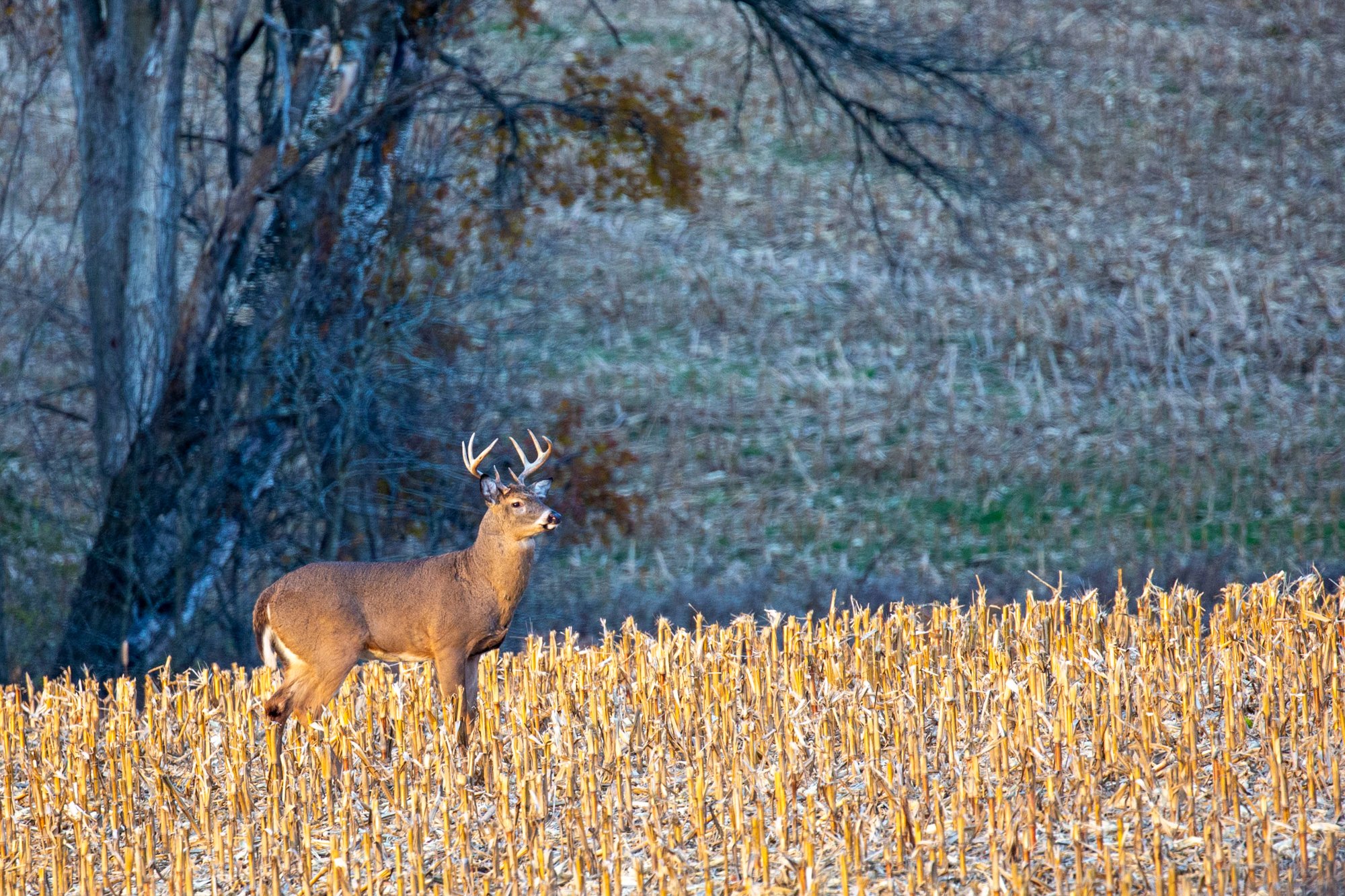
In many areas, conventional harvesting methods are engaged in sometime during October or November, when the corn is brown and cured. The picking operation leaves the cornfield in a stubble-like condition, yet there remains on the ground plenty of spillage residue to attract the interest of local deer. Under these conditions, with the previously standing cornstalks no longer present and the concealing cover therefore eliminated, midday hunting is virtually out of the question. The animals will predictably visit the corn only in the early morning hours or at dusk. If hunting pressure is intense in the region, the deer may even be strictly nocturnal in their feeding.
Conversely, in many other regions, it is becoming an increasingly popular agricultural practice to leave corn standing in the field for as long as possible. With grain-elevator storage costs escalating like never before, and future market prices always uncertain, many farmers nowadays are simply delaying their harvesting either until such time as they have a specific need for the corn for stock feed or until the price increases, which it often does in February or March. Consequently, the hunter now finds that he can effectively hunt the cornfields not only early and late in the day, but also during the midday hours.
Regardless of whether a solo hunter elects to use bowhunting equipment, a rifle, a slug-loaded shotgun, a muzzleloader or a handgun, there are four options to choose from when hunting standing corn: sneak-hunting in and around the corn; sneak-hunting in and around nearby heavy-cover regions; taking a stand designed to intercept the animals coming to the corn; or taking a stand designed to intercept the animals as they leave the corn.
Still again, the right method to use may not necessarily be the hunter’s favorite way to hunt, but it must be geared to existing conditions. The foremost determinant that I rely upon to make my decision is the presence or absence of wind — assuming there is standing corn, of course.
On a windy day, I do not want to be in a tree stand. Wind is the result of downdrafts of cold air meeting warm air. Therefore, no matter which direction the wind is coming from, it will have a tendency to force scents down toward the ground, and this will readily give away a hunter’s location. Compounding the problem is the fact that deer do not like to move on windy days because the wind disallows the effective use of their sense of hearing. Calm days, on the other hand, or those during which the wind is only slightly and gently blowing from one specific direction are ideal for quietly waiting on stand for the deer to walk by.
Just the opposite is the case when hunting in and around the cornfield itself. Now is when a hunter wants the windiest conditions possible. This is because when whitetails bed during the midday hours, they feel most secure and safe by retreating into the heaviest, thickest cover they can find. In many agricultural regions, the terrain surrounding cornfields, such as gullies and forest lands, simply does not offer hiding cover that is as thick as that in the cornfields themselves. Consequently, the whitetails will commonly bed right in the cornfields in these areas.
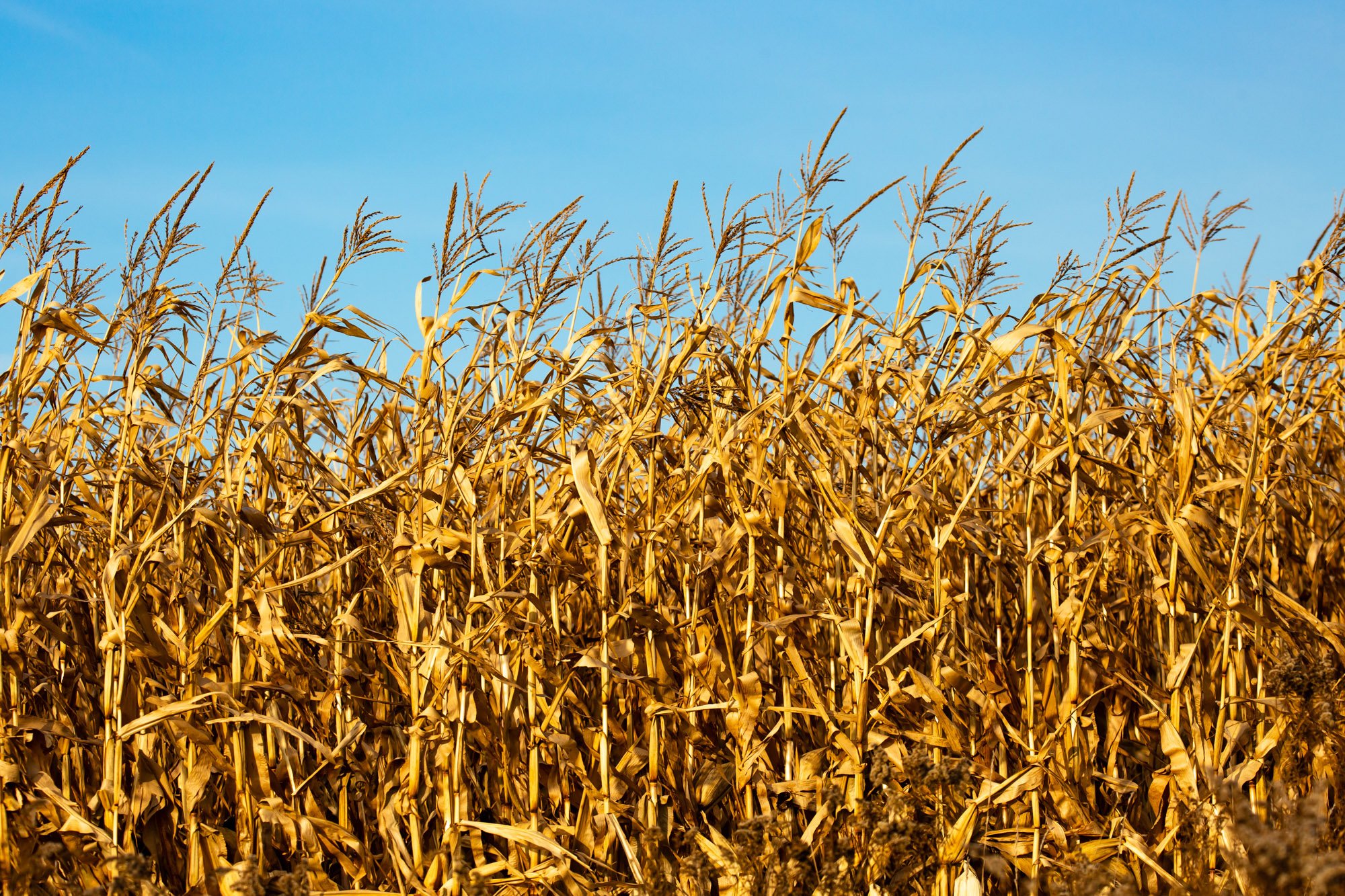
Now it becomes obvious why the very time to hunt these cornfields is during periods of high winds. It is because under blowing conditions, a cornfield is a very noisy place. The leaves are dry and brittle later in the season, and the loud rustling and crackling noises that they make in the wind cover up so much human error in prowling around that a hunter can quite easily walk right up on deer without them suspecting his presence.
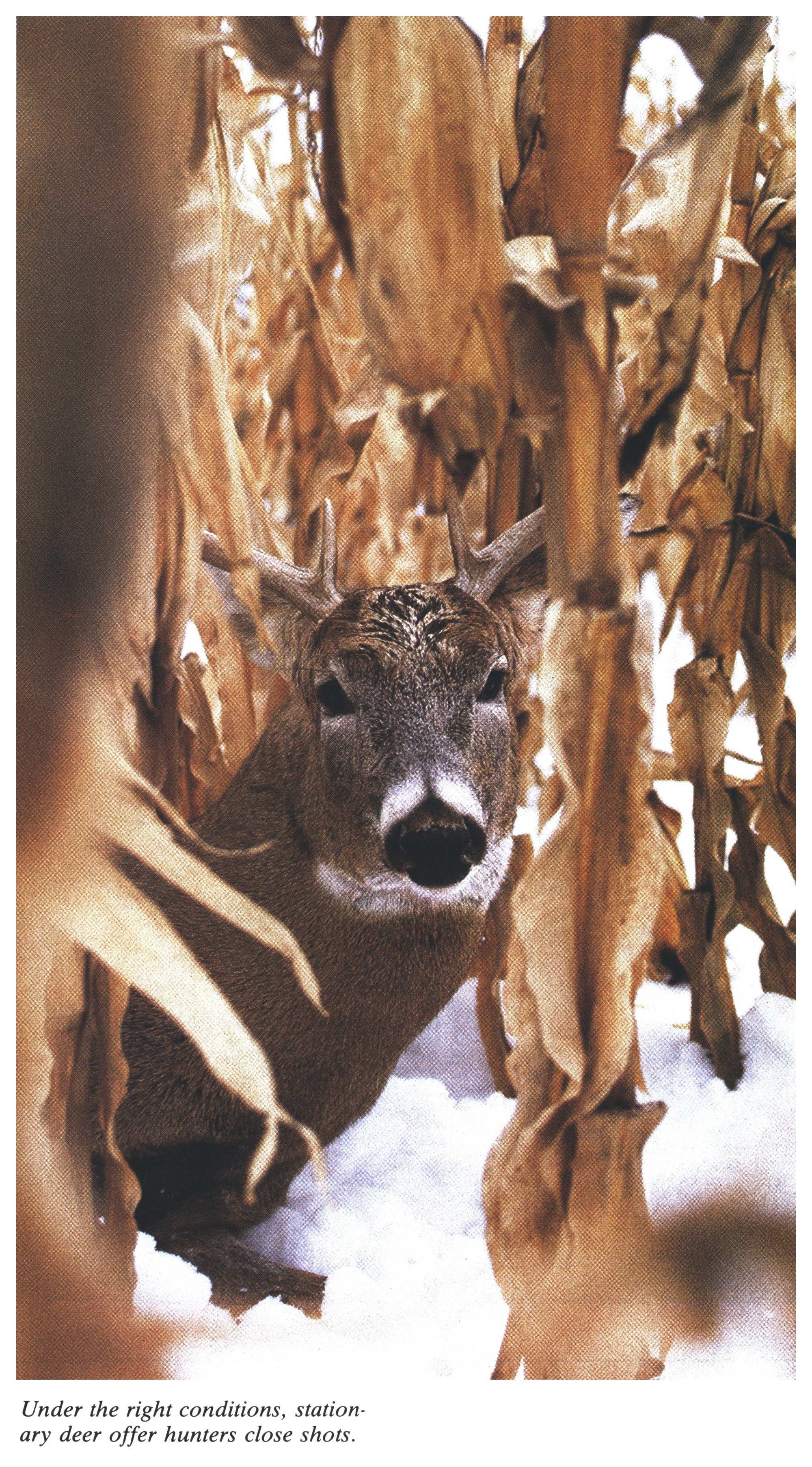
Moreover, a hunter doesn’t have to worry about his scent when hunting in a cornfield. Wind in a cornfield is a tricky thing. It hits the stalks and broad leaves and bounces every which way. As a result, deer in a cornfield may catch a hunter’s scent, but in most cases they will not be able to determine the direction from which it’s coming. As a result, they lock up, or freeze, in position because they know that if they attempt to run, they may blunder right into trouble. And if the hunter then happens to step into the right row of corn, he may have an easy shot at a stationary buck.
In going back to calm days, during which patiently waiting in a tree stand or ground blind is the preferred method of hunting either standing corn or stubble fields, there are two tricks that I use to properly locate my stand. First, it’s necessary to engage in enough scouting to know in advance where trails are located. It must be remembered, however, that it’s quite common for deer to leave a cornfield via a different trail than the one they used to enter the field, assuming, of course, that the deer are bedding somewhere other than in the corn itself. Therefore, a morning stand to intercept the deer leaving the corn will undoubtedly be in a different place than an evening stand that has been set up to ambush deer coming from their bedding areas to the corn.
Thus, what a hunter initially wants to do after locating trails is to ascertain what time of day they’re being used. The direction in which tracks are pointing is a sure clue — if the tracks are pointing toward the corn, they were probably made in the evening; if they are directed away from the corn, they probably indicate an exit trail that the animals use in the morning. Also, the hunter should be on the lookout for corncobs. Because deer obviously do not carry cobs from their bedding region back to the cornfield, but do carry cobs from the field to their bedding sites, the presence of intermittent cobs along the trail indicates in no uncertain terms that the travel route is a morning trail.
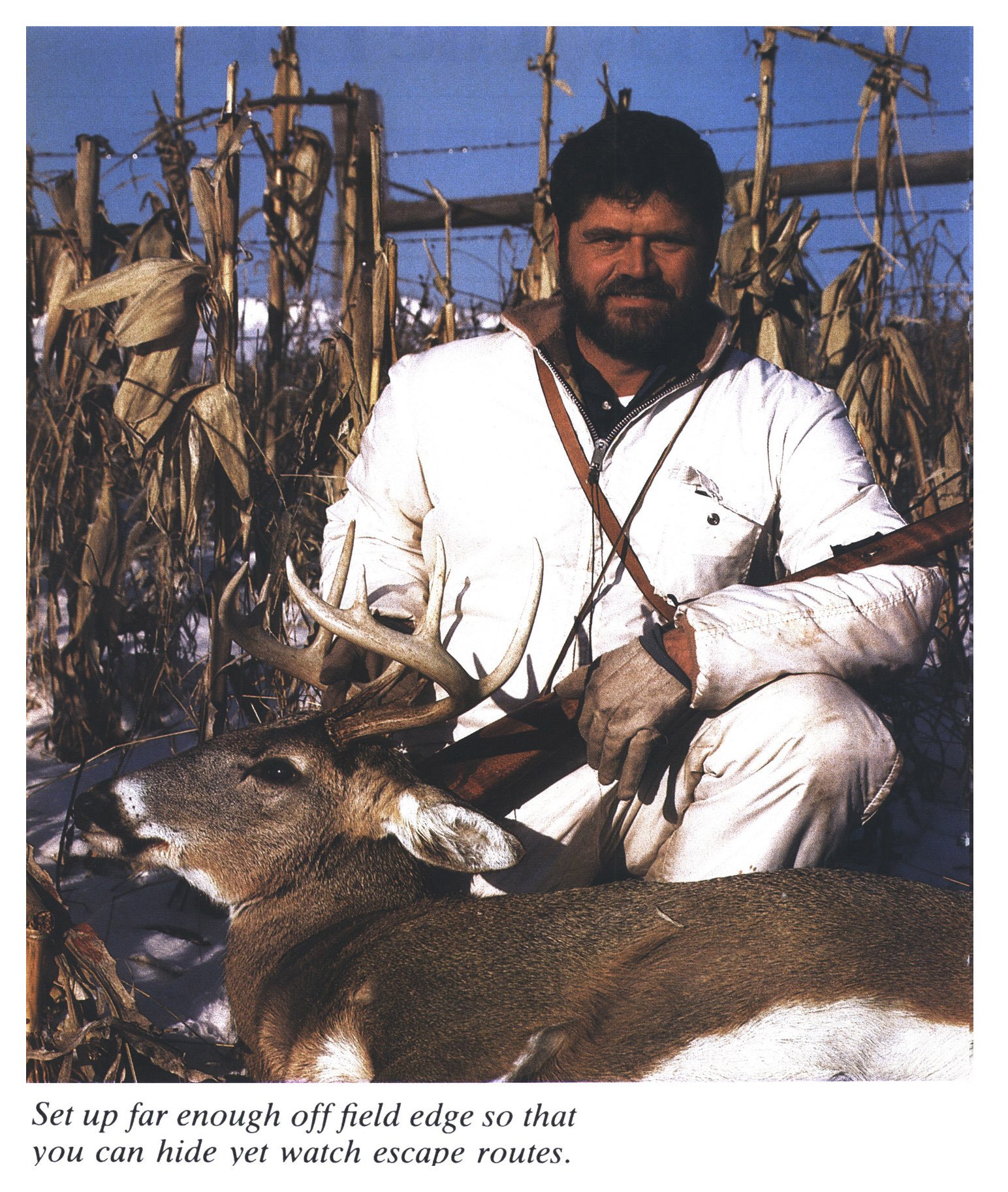
As a general rule, I do not like for either a morning stand or an evening stand to be too close to a cornfield where deer are feeding. If possible, depending upon his evaluation of the terrain, a hunter should try to situate his stands or blinds 100 to 200 yards from the cornfield so that he can overlook the exit and entrance trails that the deer are using to enter or leave the food plot.
There are several good reasons for this strategy. To begin with, the largest bucks in any given region do not like to expose themselves unnecessarily in broad daylight, especially in regions where hunting pressure is intense. They can pretty much be counted upon to leave the cornfield at the very hint of early morning’s first light. Because it may still be too dark to shoot accurately, the hunter wants to be farther back down the trail that the deer are using so that by the time they reach the stand location, it will be fully light enough to see.
Conversely, in the evening hours, the very largest bucks seldom enter a cornfield when the sky is still brightly illuminated. They like to linger back in the shaded, heavy cover of their bedding areas, sometimes not actually entering the cornfield until after full dark. Naturally, therefore, if a stand or blind is positioned close to the cornfield, by the time the deer reach the location, it will be too dark to see.
In all of this, it should be kept in mind that though the hunter doesn’t want to position his stand too close to the cornfield for either a morning or an evening watch, neither does he want his stand too close to the bedding area that the animals are using. This is simply too risky because the animals are very likely to detect the hunter as he tries to approach his stand site; and if they are spooked from the very region that they previously considered the safest place to be, they may not return for many days.
In fact, it’s worth mentioning that during the course of scouting, I always move slowly but make plenty of noise. Sometimes, I even whistle to myself as though I’m engaged in some type of routine outdoor work such as that of a surveyor or forester. Whitetails are accustomed to this type of minor disturbance, and they will simply circle around the intruder. And because the deer have the opportunity to hide or sneak away undetected, they’ll still have full confidence in the security of their chosen area, prompting them to return shortly after I’ve left.
Later, when I return to begin my hunting vigil, I stalk my stand. I actually sneak up on it just as though I were stillhunting through the woods. By doing this, the chances of any nearby deer recognizing my presence are much lower.
Pursuing whitetails when they’re actually in the corn is one of deer hunting’s most challenging and exciting endeavors. But the hunter should remember two things: If the terrain surrounding the cornfield is devoid of thick security cover, meaning that the corn itself is the very best place to hide and bed, the deer will probably cling to the corn all day and every day. This is especially the case if water is readily available in rain-filled puddles or tractor ruts. The second thing to remember — again — is that the windiest days are the best days to hunt.
Simply sneak-hunting around the perimeter of the cornfield can put venison on the meat pole, particularly during the early and late hours of the day, when the deer are feeding and have a tendency to work along “edges.” I’ve most often found this to be the case when the cornfield is bordered on one or more sides by lush hay meadows planted to some legume such as alfalfa, red or white clover or lespedeza. This is because it’s rather uncustomary for whitetails to gorge themselves on a single food type, as they are opportunists in their feeding habits and like variety in their diets. Therefore, if you know of a cornfield bordered by some other equally preferred food, you’ve hit paydirt!
In sneak-hunting around the perimeter of a cornfield, a hunter shouldn’t expose himself in the open by remaining along the outside edge. Instead, he should stay one or two rows inside the edge of the cornfield — just far enough in so that he’s concealed yet can still see along the outside edge and into the adjacent, secondary food plot. The only exception to this rule is when the cornfield butts up directly against a brushy thicket or other bordering cover. In this case, the hunter can remain along the outermost edge of the corn and move slowly along with minimal chance of detection.
If the entire outside perimeter of the cornfield has been worked and no deer have been seen, it’s now time to assume that the whitetails are deeper within the confines of the corn, where they are most probably either feeding or bedding.
If the hunter is familiar with the terrain from previous scouting missions — before the corn was planted — he should try to recall the locations in the field where there were rock piles, soupy swales, sand pockets and the like. These exist in many fields, and farmers simply plow and plant around them. Once the surrounding corn has grown high, however, such places are hidden from view, and they are the very types of locations where deer commonly like to bed. The hunter should sneak up on these places during windy conditions, and he might very well shoot an unsuspecting deer right in its bed.
If firearms are being used and several hunting partners are working together, staging drives is an excellent way to push deer through the corn to the opposite end of the field, where standers are likely to have shots. But there are a few important points to bear in mind when using this method. If the cornfield is large, it is imperative that a large number of drivers — spaced no more than eight to 10 rows apart — be employed, because otherwise the deer, reluctant to leave the security of the cover, will tirelessly circle and sneak back between the drivers. Consequently, if there are only a few hunters participating in the drive, only smaller cornfields where the animals can be moved effectively in a predetermined direction should be hunted.
Also, in the interest of safety, drives in cornfields should ideally include stand hunters placed in tree stands, or at least on some other elevated vantage points such as hillsides or knolls. This way, they will be able to look down and through the rows of corn to see both the escaping deer and their approaching partners. Likewise, when they shoot from such higher locations, the angles of their shots will be acutely downward, rather than horizontal.
Bowhunters can also enact drives in cornfields, but instead of hunting parallel with the rows in an attempt to push deer to standers in the distance, they should hunt perpendicular to the rows. In this type of situation, no hunters need be placed on stand.
Along the edge of the cornfield, the bowhunters should be spaced about 100 yards apart. The team leader at one end of this drive line should then use his arm to signal the first hunter on the far end to enter the field. As this hunter enters the first row, he should look right and left, then move on to the second row, and so on. After about 30 seconds, the drive master should then motion the next hunter to enter the cornfield in the same manner. What results is that instead of a straight and even drive line moving through the field, there is a diagonal shift across the field. Therefore, if a hunter enters a row and sees a deer he wants to shoot at, he can do so to either his right or left with complete confidence in safety, knowing that his partners to either side are far ahead of or behind him. If he does not wish to shoot, the deer will usually run parallel to the rows and eventually offer a shot to one of the next hunters in the line.
Finally, one of the shrewdest ways I know to evaluate potential cornfield hunting situations, especially in unfamiliar regions, is to go to a local airport and hire a small plane to fly over the terrain. Most pilots charge an average of $30 per hour, and if two hunters split the expense, the cost per person is not prohibitive. But most important, in one hour of flying about 500 feet above the ground, a hunter can learn more about an area than he can in two weeks of driving back roads and scouting on foot. A topographic map should be brought along, and the location and configuration of every cornfield in the region should be marked. Adjacent terrain and cover should be carefully examined, and it then should be easy to determine with a high level of accuracy how deer are living, moving and feeding in each specific region.
Read Next: Old-School Whitetail Wisdom for Deer Hunting When the Weather Finally Turns Cold
Believe me, if there are cornfields in the region you plan to hunt, you can be sure that bucks are in the corn — if not continuously, then at least intermittently. In either case, you should make the effort to be on hand, too, and when you leave, the chances are excellent that you’ll be dragging your deer behind you.
This story, “Deer By The Ear,” appeared in the November 1988 issue of Outdoor Life.