
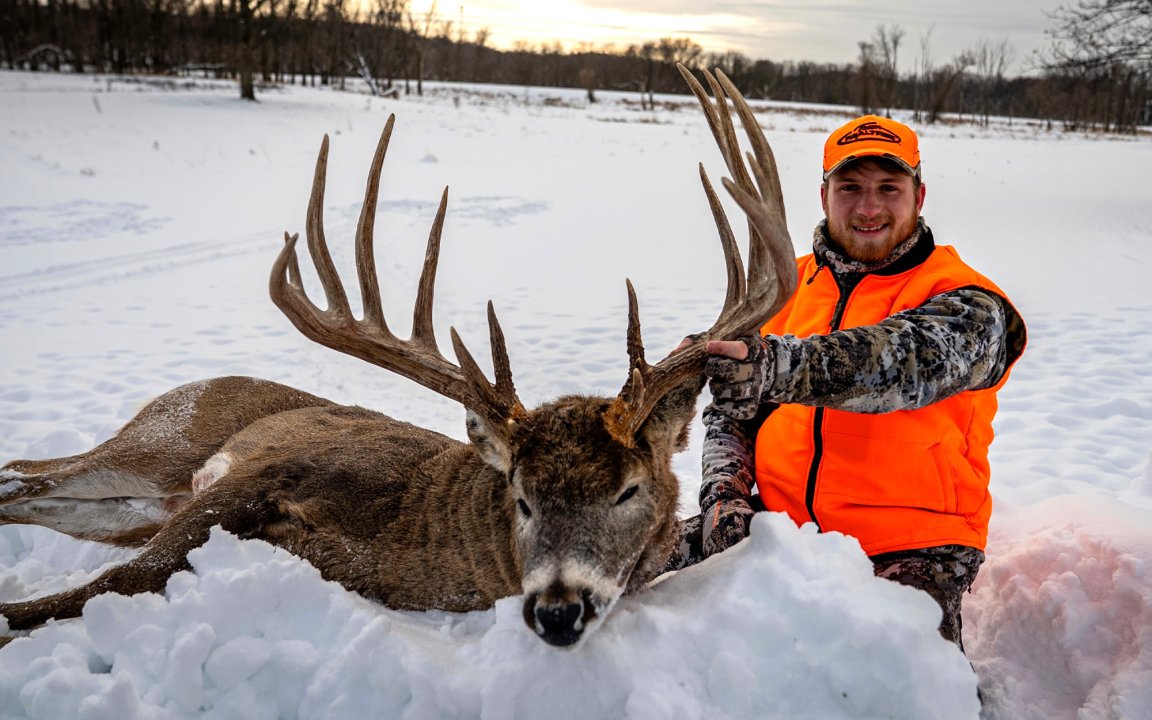
Wisconsin’s Dane County is classic Midwest whitetail habitat. Rolling hills, small farms, hardwoods, and lots of deer – big ones. It’s also where the sprawling college town of Madison is located, and the Wisconsin Department of Natural Resources includes much of the county in the state’s special “Metro” gun season, which runs 10 days longer than the general November gun season.
This gives local deer hunters some extra time in the woods, which is just what Steven Loomans needed this year. He knew a huge buck was in his area from the sheds he’d been finding, and he’d gotten a close look at the deer earlier this season.
“I’m a dedicated bowhunter and tried hard to arrow that buck,” Loomans tells Outdoor Life. “I even had him come by my stand at 25 yards while bowhunting. But he was running, so I didn’t try a shot.”

Loomans kept hunting the deer with his bow through a cold and snowy early December, even though he could have used a gun. Finally, on Dec. 10 — the last day of the Metro deer season — he decided to switch to a rifle.
That morning, he was in a ladder stand with a .30-06 Browning rifle that he borrowed from his grandfather. He was set up near a well-used deer trail on the 200-acre farm.
“I got into my stand after sunrise, later than I wanted to that morning,” says Loomans, a 22-year-old real estate agent who lives in Madison. “I was just getting settled into the stand and noticed a bush moving about 50 yards away. I put the rifle scope on the bush and saw antlers.”
Loomans knew it was the huge buck he was after, but the deer was bedded on the ground near the bush.
“I don’t know how he didn’t spot me, but he was facing into the wind and looking away,” Loomans continues. “The wind was blowing from him to me, and the bush was pretty thick, so he never knew I was there.”
Read Next: I Shot a Big Wisconsin Buck Just Seconds Before a Young Hunter Tagged Her First Deer
Because the deer was bedded down, its vitals weren’t easily visible to Loomans.
“He was all balled up, and I wanted him standing so I could see his side and shoulder,” Loomans says. “I made a howl like a wolf, thinking that’d make him stand. He didn’t move. Then I made a deer call. Nothing. Finally, I screamed ‘hey deer’, and he picked his head up.”
Loomans settled his rifle scope’s crosshairs on the buck’s neck near its spine and fired. The deer collapsed and never moved.
“I was freaking out and called my dad to celebrate the news. He showed up pretty soon at my stand.”

The hunters field dressed the buck and used a drag sled to pull the estimated over 200-pound whitetail to a pickup truck. Then they took the huge buck home to show family, friends, and Loomans’ grandfather, Eugene.
Loomans says the rack green scores at 191 7/8 inches as a typical 12 pointer, or 206 6/8 as a non-typical 18 pointer. If that typical score holds after the 60-day drying period, it will be in the top 10, and could be Wisconsin’s new No. 5 typical in the Boone and Crockett book.
“I am so blessed to hunt and have family and friends who understand my passion,” Loomans says. “The deer’s score doesn’t matter as much as what God has given me with memories like this, the people I love, and moments I’ll be thankful for forever.”