
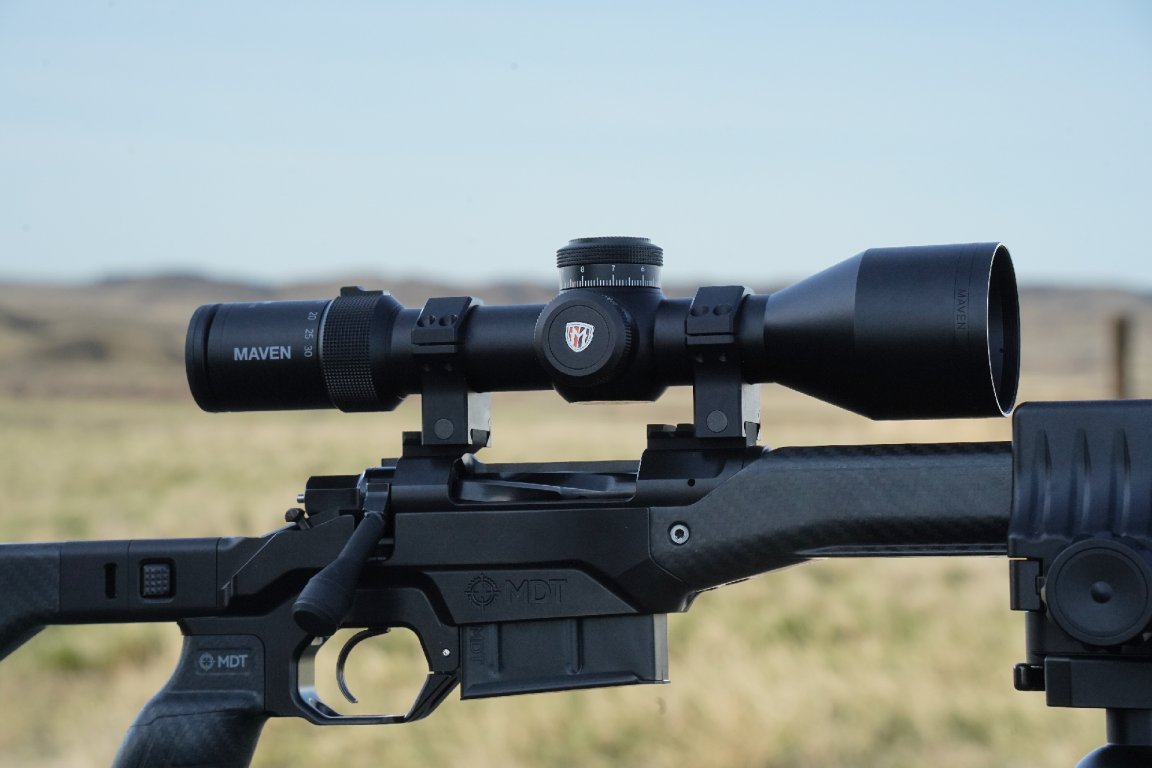
Does a rifle scope’s appearance affect its performance? You might ask the same of a rifle itself. Does an ugly rifle still shoot straight?
In both cases, the answer is yes. And no. We’ve all had clunker guns that somehow were one-hole shooters. But a rifle’s handsome proportions are not only pleasing to the eye, they help fit it to a shooter, making a gun’s accuracy repeatable.
These same perspectives apply to a rifle scope’s build. Tight, tactile turrets are pleasing to look at and to turn, but their finely geared movement is a pretty good proxy for precise reticle adjustments. A scope’s proportionate and svelte controls, to include the power-changing dial, diopter adjustment, and illumination and parallax controls, not only contribute to its precision but enable fast, confident, repeatable operation in the field.
To ground these abstractions in glass and metal, Maven’s new RS4.2 first focal plane scope not only looks good, but its tight build and purposeful proportions makes it a reliable precision optic that can win rimfire competitions and ring steel as far as you can shoot. Along the way, it might be the best-looking scope on the firing line. Dimensionally, it’s a tidy package. Measuring just 12.8 inches, the RS4.2 packs a lot of performance into a 34mm build that nicely fits short-action chassis rifles and just about any long-range hunting rig.
The RS4.2 is the second generation of Maven’s premier first focal plane target scope. The original RS4, from 2020, introduced the Wyoming company’s gem-bright glass and mannerly controls to precision shooters. Founded in 2013 in Lander, Maven has developed a cult following for its curated line of optics, responsive customer service, and its direct-to-consumer sales strategy that cuts out traditional retailers’ mark-ups.
The latest iteration of its flagship precision scope, the RS4.2 was released earlier this year and is built around the same premium Japanese glass and a first focal plane etched reticle in a choice of four designs, two in MOA and two in MIL configurations.
The RS4.2 costs $2,050, in line with many premium precision scopes, but offers more performance for the price, thanks to the direct-to-consumer model. So, what do you get for that price, and how does its handsome styling contribute to its precision talents?
MAVEN’S GLASS
Let’s start with the glass inside the RS4.2. It’s Maven’s premier class of Japanese-made glass, with edge-to-edge sharpness, color-correcting coatings, and high light transmission that delivers a vibrant image and excellent brightness. One of the most significant evolutions in precision shooting over the past decade has been serious shooters’ demand for premium glass, the idea being that you can’t hit a target you can’t clearly see.
These days, top-tier competitive shooters invest as much in their scope’s glass as in its repeatable controls. The RS4.2’s configuration, 5-to-30-power behind a 56mm objective lens, is the right combination of useful magnification and light-delivering optics to keep targets in the image plane and clearly focused. The left-side parallax control focuses targets as close as 15 yards and all the way out to infinity, making the RS4.2 a smart precision rimfire scope and capable of any medium- to long-range centerfire work.
THREE-REV TURRET

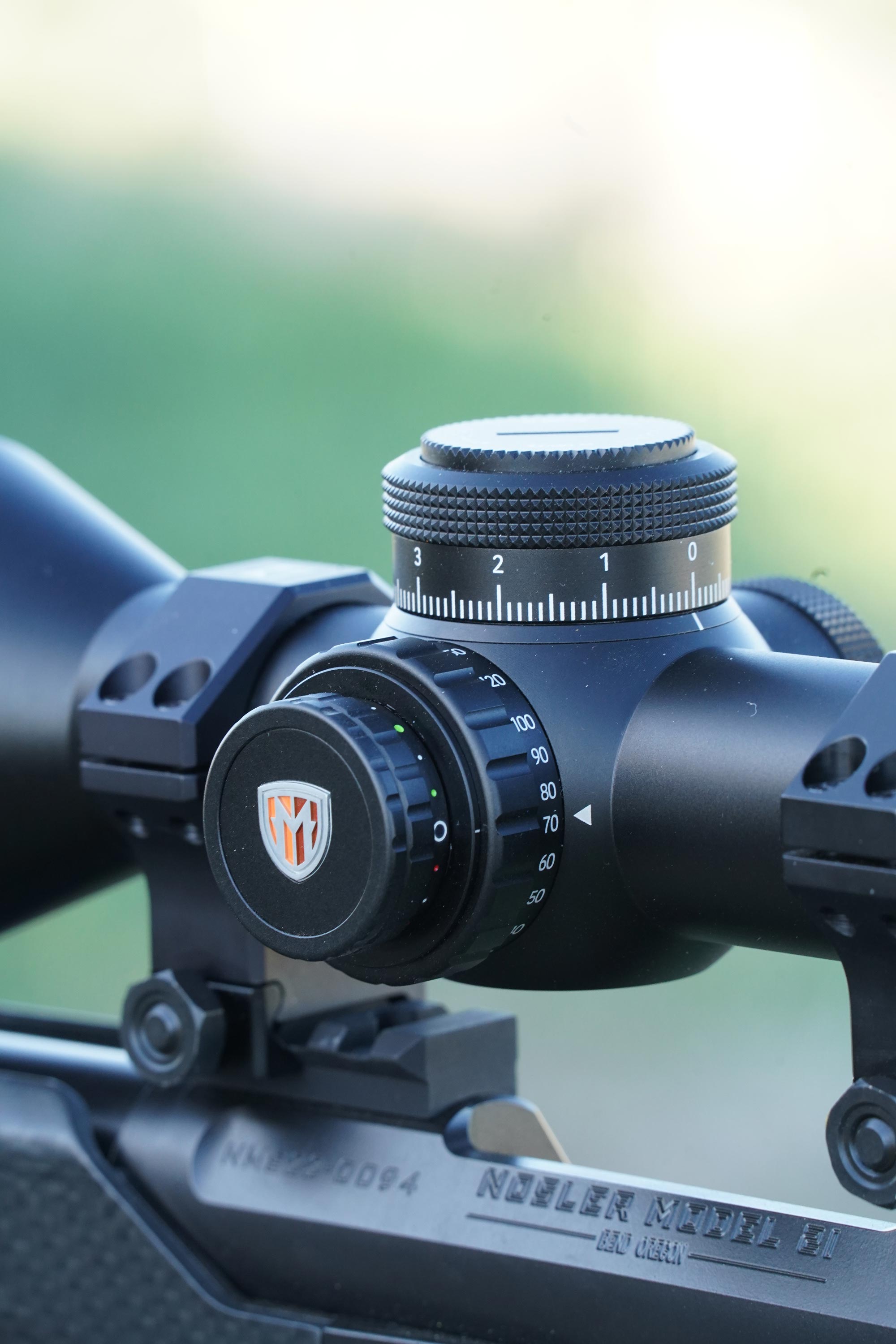
The RS4.2 brings two important attributes that separate it from the original RS4, and from many of its peers. The first, and most significant, feature is the locking three-revolution elevation turret. With 10 MIL (25 MOA) of adjustment per revolution, the three-turn dial gives shooters a total of 35.5 MILs (120 MOA) in elevation adjustment that locks with a stiff downward push.
The original RS4 has two turns of elevation turret adjustment, plenty for most shooters, but adding a third more dialing real estate elevates the RS4.2 to an elite group of precision scopes with at least 35 MILs of both turret travel and internal adjustment.
Just beneath the Maven’s crisp and substantial (a meaty 1-5/8-inches in diameter) elevation turret, smart and simple revolution indexing keeps track of turns, so shooters always know where they are in their rotation. The turret’s indexing is similarly clean, clear, and simple.
Possibly the most remarkable attribute of the Maven RS4.2 is found beneath the elevation turret. It’s a mechanical zero stop that mates up to the metallic innards of the turret, creating a solid return to zero that’s achieved without the shims or plastic collars that other brands use. The zero’s stop is positive and consistent, with no mushy back wall that leaves shooters wondering if they’re truly zeroed or 0.1 MIL off.
Even more useful, the zero stop is accessible via a toolless turret design that allows shooters to remove the elevation cap without special tools, adjust the zero stop to the preferred spot, and then lock up the works quickly and surely. No tiny set screws to lose or special-purpose wrenches to misplace. It’s a fast, strong, and elegant design.
The scope’s texturing on its moving parts, from the turret controls to the power-changing dial, is grippy and positive, the handsome diamond-cut knurling matches the restrained professionalism that defines the overall appearance of the RS4.2. The scope is available in either black-on-black or a striking glossy black with sharp graphite accents on its dials and objective-lens ring.
COMPETITION- AND HUNT-READY RETICLES
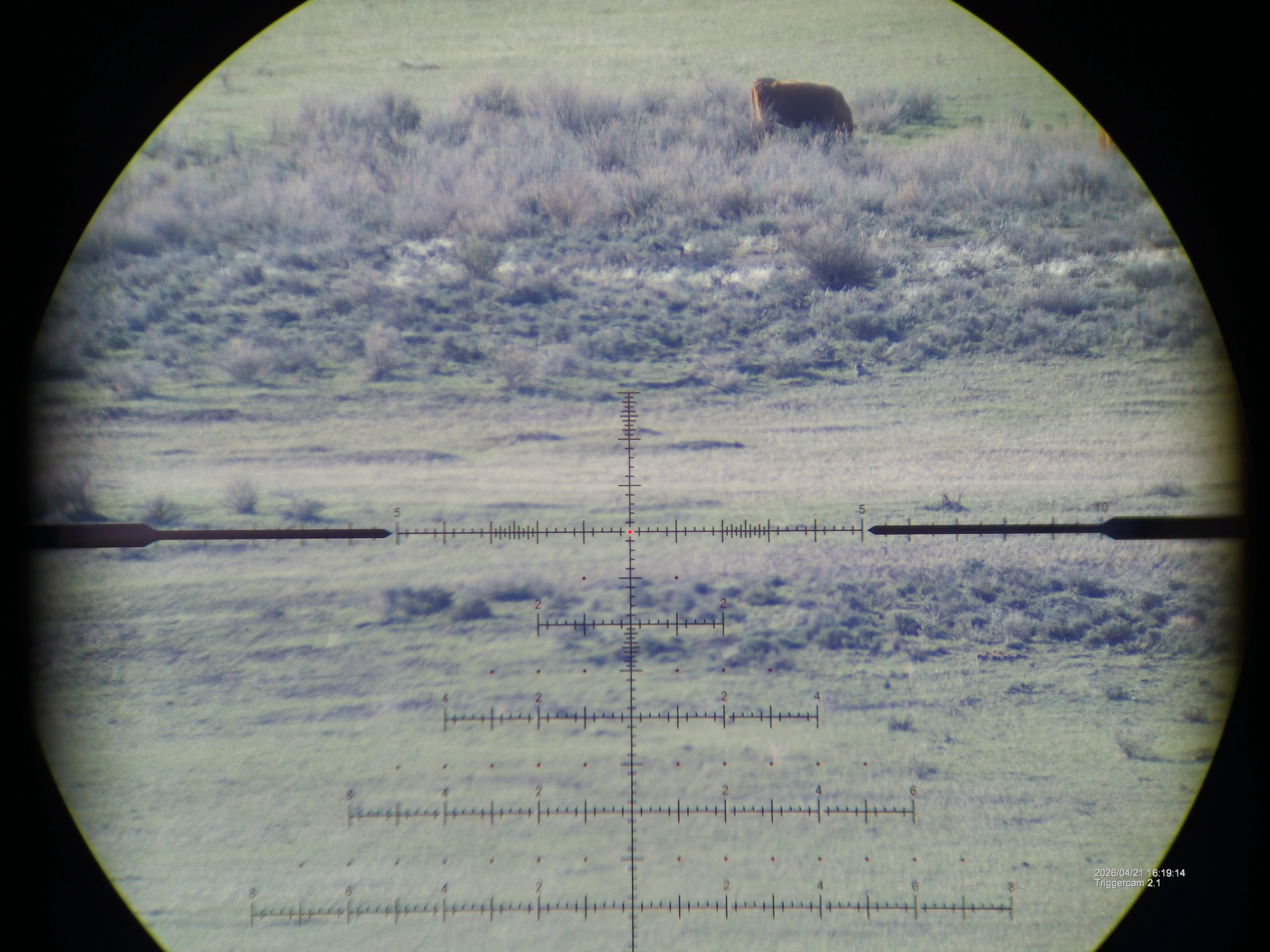
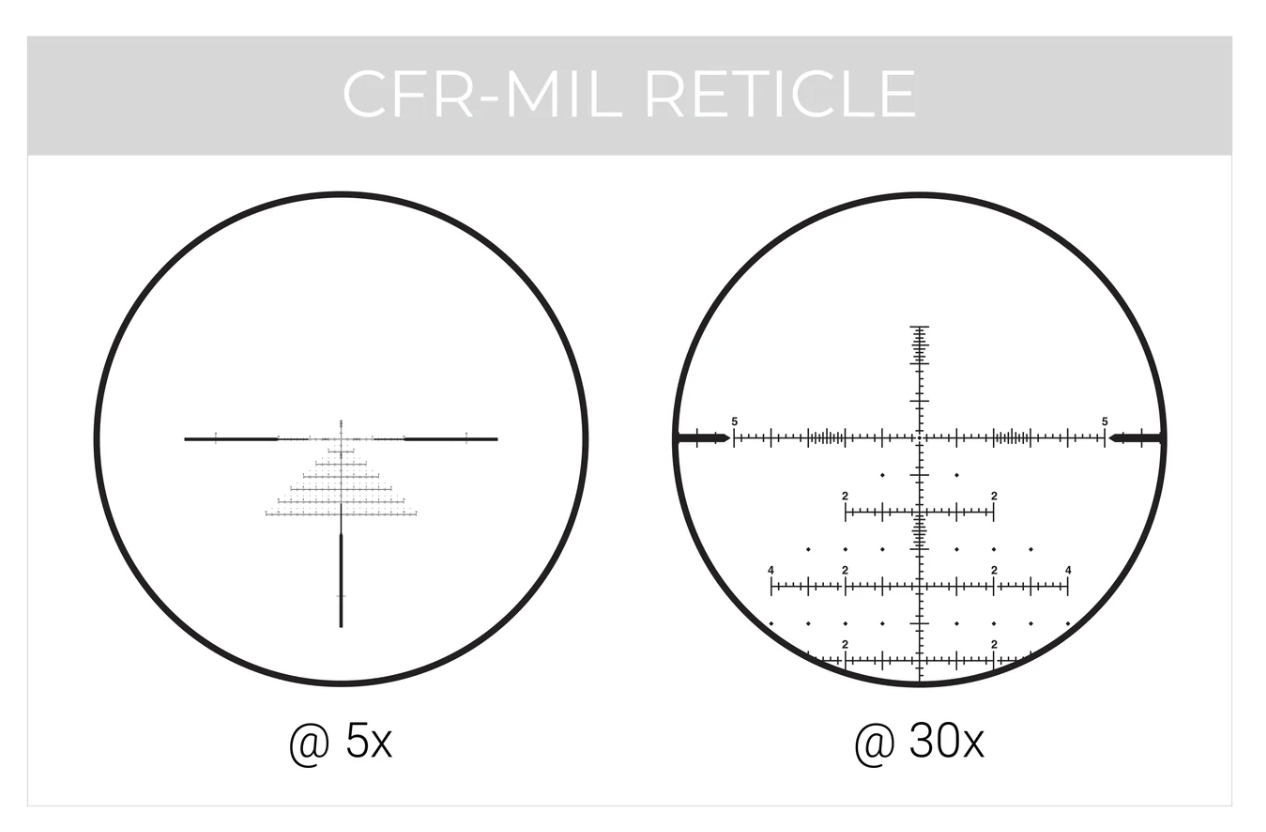
My test sample is in Maven’s brand-new CFR-MIL first focal plane reticle. Designed by competitive shooter Collin Fossen, the Collin Fossen Reticle features a tree-style arrangement of 0.2 MIL elevation and windage steps around a 0.05 MIL floating center dot that is optimized for both slow-fire dialing and rapid hold-over shooting.
The reticle has five MILs of windage holds on either side of the center aiming point and floating diamonds in the image plane that conform to 1 MIL wind and elevation holds. Once you understand the reticle’s math, those diamonds make holding intuitive, though as you’ll read below, not always fast.
For MOA shooters, the RS4.2 comes with the option of Maven’s two well-regarded MOA-based reticles, the MOA-2 and the SHR-W designs. The MOA-2 has a whopping 60 MOA of elevation references around a 0.1 MOA floating center dot, with hashes at each 1 MOA step and more pronounced windage and elevation references at every 5 MOA increment. My gripe with this reticle is that it has only 10 MOA of fine windage marks on either side of the center aiming point; I’d like twice that. It does, however, have coarser hashes at 15 and 20 MOA of wind.
Maven’s SHR (Simplified Holdover Reticle) series of reticles, in both MOA and MIL designs, is intended for long-range hunters. Taking the SHR-W first, the simplified hash-style MOA design has 5, 10, and 20 MOA elevation holds and 10 MOA of wind holds on either side of its floating dot center aiming point. If I were selecting a reticle for hunting, I’d be hard-pressed to pick between the SHR-W (in MOA increments) or Maven’s new SHR-MIL reticle (in MIL increments).
The SHR-MIL is built around that same floating center dot, but its 10 MILs of elevation holds delineated in 0.5 MIL steps make it a fast and intuitive reticle. It doesn’t have a lot of windage holds, but experienced shooters will learn to use the length of the 5 and 10 MIL long hashes for quick hold-off references in full-value 5 and 10mph winds.
The reticles all benefit from the RS4.2’s tight and focused center-dot illumination. With four intensities of both red and green illumination, shooters can adjust the reticle visibility to the conditions and to their personal optical prescriptions.
THE RS4.2 AT THE RANGE
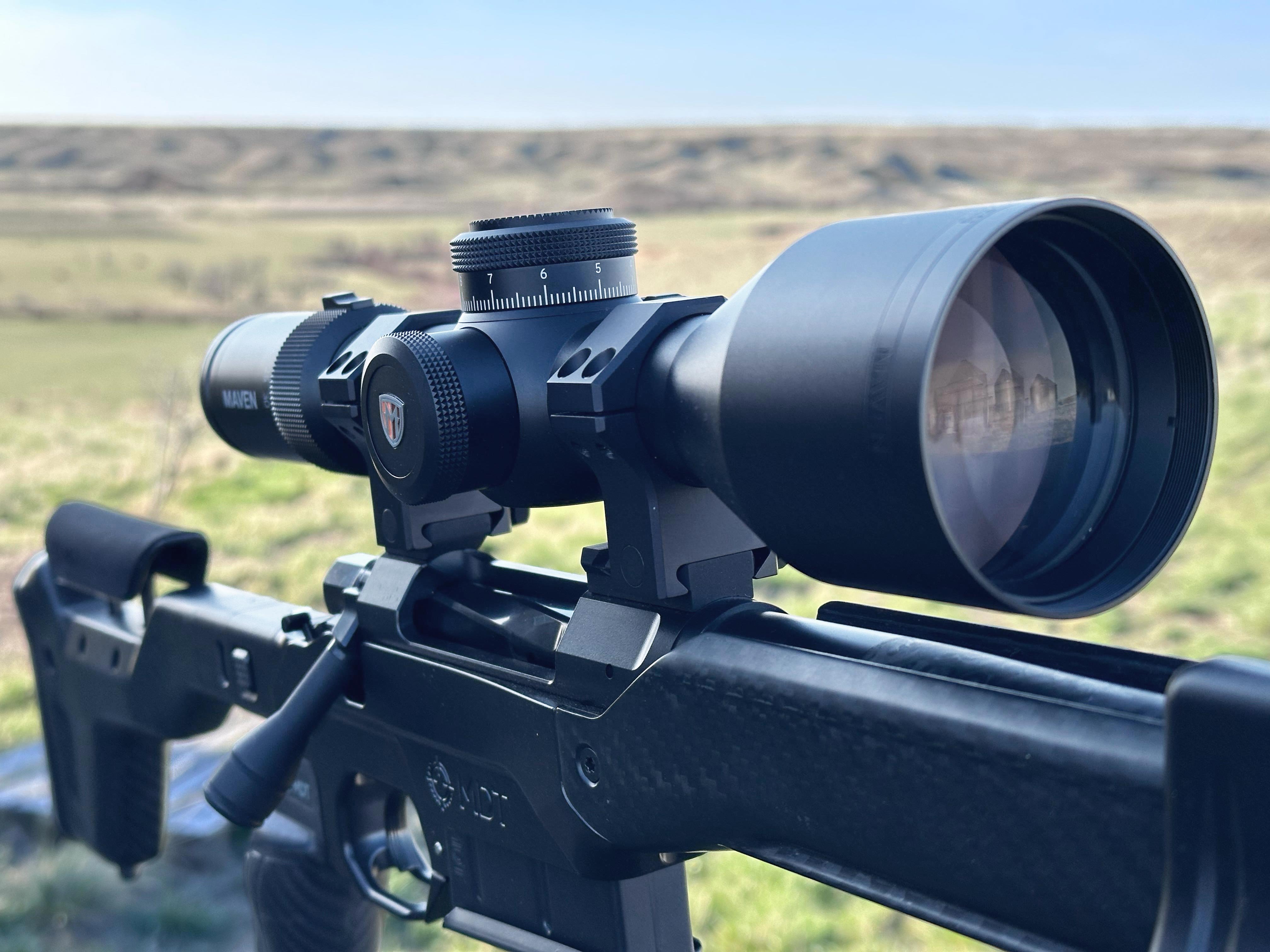
Given the short stature of the Maven, I worried a bit about mounting dimensions, but the scope fits nicely on the rails of both my Horizon Vandal X and Springfield Model 2020 precision rimfire with medium-high rings and plenty of mounting geometry along its 34mm tube.
I don’t think the reticle is really useful until about 9x, when the references become readable and I have all the windage available, to include 20 MIL hashes on the horizontal stadia. But any real precision work starts at about 14x, where the reticle is “squared,” with 10 MILs of elevation and 10 MILs of windage on either side of the vertical stadia.
With a 100-yard zero atop my 22 Creedmoor — in windy conditions on the eastern Montana plains, I generally default to the 80-grain ELD-X from Hornady — I’m dialing 1.9 MIL in elevation at 500 yards. I ran a course of steel out to 900 yards (5.12 MIL) and worked on both dialing and holding for the aiming solution.
Generally speaking, this is a dialer’s scope. The holds are clear but I found myself slowing way down to confirm the wind, especially in the odd-numbered MIL values for elevation. The floating windage diamonds are certainly better than nothing, but they’re not fast. For example, at 650 yards, I’m holding 3 MILs in elevation, but with a 5mph full-value wind, I’m holding 0.57 MIL wind, which is sort of no-man’s land in the scope.
Dialing both elevation and wind is my preference with this scope. The pull-to-turn elevation dial is crisp and tactile, though I had to condition myself to use just my fingertips to push the turret back in place after adjusting it. The toolless cap is so proud — it sticks out about 1/8 inch above the locking ring — that you can’t just slap down the ring. Instead you have to grip it to lock it back in place. That’s by no means a flaw, but it does take some practice to make sure the ring is seated.
At full 30x, the reticle shows about 6 MILs of holds, which is adequate for tight precision work. My favorite working magnification, for its balance of reticle visibility and field of view, is about 17x, where I have 8 MILS of elevation and about the same windage, and the reticle references are sharp but I retain abundant situational awareness. The lower magnification allows me to keep my eye in the scope under recoil to witness hits.
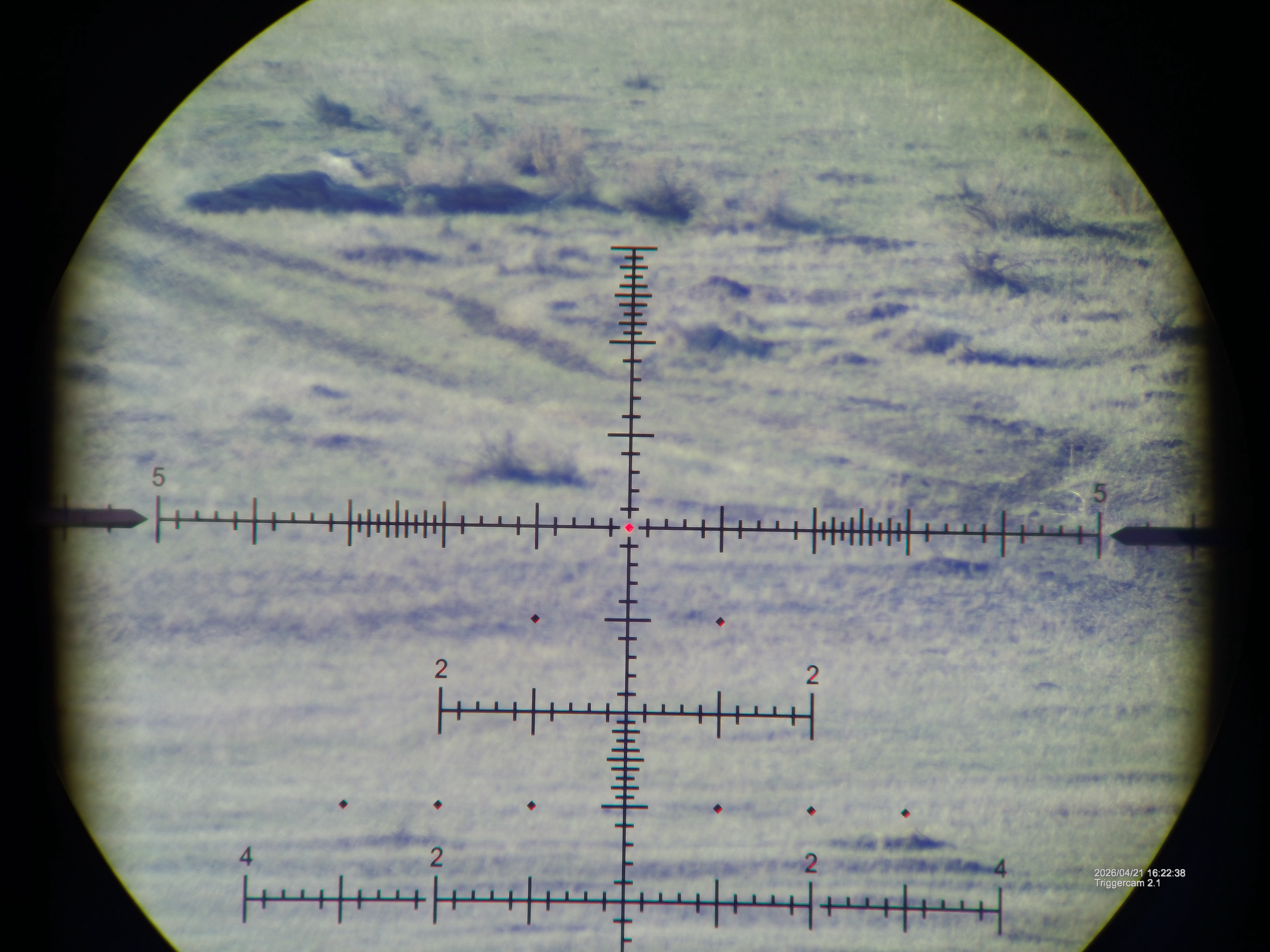
A note about the illumination. I’m vastly more fond of the red than the green, but in both cases, the 0.05 MIL center dot is sharply illuminated, with virtually no bleeding. But what’s remarkable about this illumination is that all the cardinal references on the etched-glass reticle are illuminated at a lower intensity. In practical terms, that means the eye is drawn to the full-bright aiming point, but all the numeric references and dots are illuminated with what appears to be half-intensity. The remainder of the reticle, the hashes and main stadia, are illuminated at about quarter-intensity.
The result is a really useful aiming aid, whether in bright daylight or in low-light conditions, when the intensity is nicely muted. The illumination module features an auto-off control that switches the illumination off when it’s not in use to save battery life.
PRICE AND WARRANTY
The world of precision optics is so confused by the cascading variables of magnification, reticle style, internal adjustment, glass quality, and warranty that it’s increasingly hard to compare scopes from different manufacturers, even when they share magnification and objective-lens configurations.
But Maven’s RS4.2 packs so many features into its compact build, and offers it at such an appealing price that it compares favorably with its nearest competitors, Nightforce’s venerable ATACR, Vortex’s Razor HD Gen III, and the Mark 5HD from Leupold, all of which cost significantly more, and in some cases are twice the price of the Maven. The feature that may elevate it even further is Maven’s unconditional lifetime warranty. If something fails in the optic, send it back to Lander and Maven will handle it from there.
Maven’s aesthetics aren’t as easy to quantify or define, but the RS4.2’s tight proportions and clean lines dress up any rifle it’s mated with. Will the scope’s appearance make you shoot better? That’s debatable, but if function follows form, this is one of the sharpest-shooting precision scopes in the field.