
This story, “Hurricane Hunt,” appeared in the March 1954 issue of Outdoor Life.
As a newsman here in south Georgia, I’m sure I get to see many more hurricane warnings than the average citizen. I’m equally sure sighting one of these warnings on a teletype machine means more to me than to the average newsman. Each time I see one my mind races southward across the wire-grass flats and pine slopes of Georgia, across the cypress swamps and cabbage-palm hammocks of north Florida to a day when I punched a cash register instead of a typewriter.
I needn’t mention the year. If you’re an adult and read newspapers or listen to the radio, you’ll remember the incident before you read much farther. It was autumn, and I had just opened a sporting-goods store in east-central Florida. Considering my brief tenure, I had made a great many new friends in the St. Johns valley, if one can think of so slight a depression as a valley. One of these new friends was Hutch Newsom, a huge, lithe, tough, pleasant fellow of about 40 who knew the coast like the porch of his home. And I was to meet him this day, a September 17, the eve of my birthday. Many years have passed since birthdays meant much to me, as birthdays, but that date has leaped out at me every year since.
In the grayness that should have been sunrise that morning, dark clouds sagged baggily over the very treetops, bulging as if ready to split under their liquid weight.
Normally I wouldn’t have seen this dreary vista. I’d have been asleep. But this morning an air of foreboding awakened me, and my little fishing barometer was already descending past the 29 mark. Aircraft known as hurricane hunters had for three days kept constant watch over what had become a monstrous cyclone, centered near the Bahamas somewhere east of my home in West Palm Beach. It was moving northwest, toward Jacksonville.
The storm worried me for two reasons: Hutch had offered to take me on a marsh-hen hunt this day, along with Ed Howe, a fat little Palm Beach insurance salesman. Second, a sizable crack somewhere above the main show window of my store was expected to admit a lot of water if it rained while the wind was easterly.
By noon the sky seemed lighter, but a fresh wind kept patches of dust swirling in the street. Sharp gusts under the rear door of the store scattered papers on my desk. I tested the ventilator windows for security, and spent a futile hour looking for the crack over the show window.
Hutch called at noon. “Everything ready?” he asked.
“Sure,” I said, noticing through the window that people had begun to gather in little groups up the street, out of the wind, or to walk hurriedly about their business. “What about the weather?”
“Well,” Hutch said, “looks sort of raw. But this wind will roll the water in like nobody’s business, and you’ve got to have high tides to get marsh hens. Makes ’em flush easy.”
During the time I’d been in Florida I’d never hunted marsh hens. I was anxious to try it. Still, I knew Hutch was venturesome. He was the kind of smiling, stubborn-chinned fellow who didn’t look as if he were afraid of anything — and wasn’t. Then I said, “That little bet I made about my average on these slow birds is hereby withdrawn, in this wind, but I’m willing to tackle ’em, if you say.”
“Storm warnings are out up to Cape Hatteras,” Hutch answered, “but looks like we’re going to miss most of it here.” His deep bass voice was reassuring, and I said I’d expect him at 3 o’clock. It would take us nearly an hour to get across the causeway to Palm Beach and up the strand to the fish camp where we’d get a boat. Hutch had said we’d pole along and scare birds from the grass tops.
I didn’t go home for lunch. I told my wife I was rushed at the store, because I didn’t want her to talk me out of going. Actually, none of the clerks were busy. The only places doing any business were the coffee shops, and building-supply houses where customers were buying nails and sheeting to batten down against the blow. I ate a tasteless sandwich and kept going out to look at the clouds which still seemed lazy but which somehow passed quickly.
I called Ed, and he said he’d be ready, if unwilling. All the time I kept remembering pictures of the Miami hurricane of the 1920’s, of the huge ship blown ashore in Biscayne Bay park and stone houses reduced to the rubble you can still find in the lush weedery of Miami’s suburbs.
Ed called back. Wasn’t the hunt called off?
I told him no, that we still planned to leave at 3 o’clock. When he demurred, I suggested he tell his missus he was going out to see a prospect, and promised to buy a $2 loss policy on one of my guns. Ed chuckled and said he was game, but his voice, already a little thin, seemed a little thinner. In addition to the storm, he was concerned about his wife who was overdue with their first offspring. Ed was the youngest of us, with a pink, round, Peter Rabbit face, and was surely no outdoorsman. But he’d said such a hunt would give him something fresh to talk about with prospective clients.
Just before 3 o’clock I called my wife again and told her I was going over to Palm Beach and wouldn’t be back until after dark. That was indeed true, but I should have told her I was going hunting.
And why not? The storm wasn’t coming anywhere near, and I’d been out hunting at all hours for years. Yet I had a little feeling of guilt. I dismissed it when Hutch pulled his Model A Ford up to the curb.
I threw in my waders, gun, two boxes of No. 6 shot, and climbed in. I almost asked Hutch to wait while I went back into the store to get a couple of life preservers; but then I decided I was getting all worked up over nothing.
At Palm Beach, Ed waddled out to the car with a raincoat, sou’wester hat, boots, moccasins, a huge hunting knife, a field coat, and about the worst stovepipe of a shotgun I’d ever seen. Hutch noticed me gawking at the gun, but he winked approvingly. “Ed’s got the right thing for a salt marsh,” Hutch said. “Spray and mist just eat up a good gun in no time flat. Took a fellow once who insisted on carrying a pretty automatic. Three weeks later we went on a deer hunt and he couldn’t pull back the bolt. So we went back home an’ I took it apart an’ shook out enough salt crystals to churn up a jug of ice cream that same afternoon.”
Hutch wasn’t kidding about the salt. I thought of my nearly perfect Parker and was glad I had decided not to wipe off the heavy grease which had preserved it all summer.
As we drove up the strand north of the famous Florida resort, Ed worriedly kept looking up and down the sound. His chubby forehead was creased, and a sort of hunted look darkened his eyes.
“What’s the matter, Ed?” I kidded, hoping to cheer him. “Got some poor insurance risks for the storm?”
“No,” he said almost in a whisper. “It’s just Lucy.”
Lucy is Ed’s wife. After a moment I said, “The hunt isn’t that important. If you’re worried about her and the baby, for heaven’s sake let’s go back. You don’t have to be a nitwit just because Hutch and I are.”
Ed slowly shook his head. “Maybe it is important,” he said. “Nobody ever knows just what is. If talking about hunting marsh hens helps me sell insurance, it may be more important for me to be here than back at Palm Beach. I couldn’t stop the hurricane, even for Lucy.” His jaws were set as solidly as a tent rope in the rain.
I saw Hutch glance down at Ed, over the match he was chewing, and in Hutch’s eyes was a new, surprised respect for the little man wedged between us.
The water in the sound looked different. Waves were larger than I had ever seen them and they seemed to carry farther. The crests reached from shore to shore in a steady, driving rhythm. They looked slow, but when they hit the steep inshore beach they pounded heavily, lashing high into the air, whipping over the lower part of the road. But Hutch drove on, humming a juke-box tune.
A mile short of the fish camp, the road hit a low spot where seas had once washed out the fill. It had never been properly rebuilt. Sea water was flowing across it. Hutch stopped the car, put on his waders, and carefully tested the depth. He seemed satisfied.
I wouldn’t have tried it, but Hutch chugged right on through. The bottom felt shaky, and we stopped on the far side to see if a wheel on the chronically ailing vehicle might be loose. As we got out of the car there was a peculiar gurgling noise, and we saw the roadbed at the spot we had crossed dissolve in a sandy froth.
“Nothing to worry about,” Hutch shrugged. “I think we can get through after the hunt, when the wind dies.”
There was no other road. I looked at Ed, found him looking at me, hard.
At the fish camp all the boats were pulled out and staked down with their bottoms up. Kinley, the man who ran the camp, was boarding up windows and was surprised to see us.
“Bang-bang!” Hutch said, pointing his forefinger and clicking his big thumb. Hutch had known Kinley for years. “We want some meat.”
“You mean you’re going out in this?” Kinley asked. But he was already starting down to the landing where he took the lines off a 14-foot plywood skiff. I figured that was a pretty good endorsement of Hutch as a boatman.
When we put the skiff in the water, here on the lee side of the strand, it lay as if in some farmyard pool. The water was unusually clear, and very low. Darting minnows scooted away. But I saw Ed was looking across the sound where even in the grayness we could see a mass of angry whitecaps.
“Hens all gone across by now,” Kinley stated. “Nothin’ doing on this side with low water. You got a good kicker, ain’t you?”
Hutch took the little five-horsepower outboard from where he kept it clamped to the scarred door of the car. Kinley grunted. “Good lookin’ little kicker,” he said, but he seemed to emphasize the adjective little, as he looked from the motor to the whitecaps.
Straight across from the camp, a peninsula jutted out so that it was only about half a mile distant, but on each side of the shore the mud beaches swept away westward from the peninsula’s weathered, sandy point. “Hadn’t we better just go straight across to the peninsula, and work the shores from there?” I asked. “Then we could get ashore if the motor failed.”
Hutch laughed. “Could. But wouldn’t find no hens until we got to where the wind’s piled the water up in the marshes, way over yonder.” Watching Ed, he added, “We’ll try it your way, though.” Ed’s face seemed a trifle blue, and the wind wasn’t that cold.
Our trip across to the point wasn’t bad. We pulled up into a creeklet and tied the boat to a mangrove bush. Spreading out across the finger of land, we began to wade through the scant marsh, hoping to kick up enough birds to persuade Hutch not to take the boat farther downwind. High tide ordinarily would have covered all but the grass tips here, but the wind had blown the tide up along the west shore.
Suddenly something flushed in front of me — a gray-brown bird whose speed increased rapidly. Hutch downed the bird as it angled toward him, retrieved the thing, and motioned for us to come look.
“The book says this one’s a clapper rail,” he explained. “There are at least three kinds of marsh hens: sora, the little bird they shoot in Georgia and Ca’lina; the Virginia that they shoot farther up the coast, and this one, the biggest of the lot.” The bird was as large as a grown crow. Its flesh felt soft.
We started on, and suddenly a sharp gust of wind blew my cap off. I reached for it, and before I could get it on my head, it began to rain, tiny, stinging drops almost as fine as mist, blowing nearly parallel with the ground.
It became impossible to keep one’s eyes open, traveling in the direction we had taken, and we reversed our course. On the way back toward the boat I bagged two birds and Ed missed an easy one. The rain grew heavy, drops becoming as large as buckshot.
Then, magically, the sun came out. Bright, hot on our necks where rain still trickled down. The rain stopped entirely, and the wind slackened.
We got back to the boat and were unloading our guns and thinking we had been fortunate to kill three birds under the adverse conditions, when the skies began closing in again with a blackness that suddenly turned the whitecapped water to ink and old lace.
Ed said abruptly: “I don’t like it.” He squinted as he looked back the half mile toward Kinley’s camp, and when I followed his gaze I saw, creeping out from the shore, a massive series of ripples on the water that began to break upon themselves and throw spray into the air, hiding what looked like a figure waving wildly on the beach by the camp.
Hutch cast off. The boat drifted rapidly southwestward while he prepared to start the motor.
Ed called to him and pointed. When Hutch looked, the calm left his face. All at once it seemed leaner, and his morning whiskers stood out clearly. He pulled the starter rope and the motor roared dependably.
“She’s gonna be rough when she first hits,” he said, shouting now because the wind was a new force that flattened Ed’s sou’wester against his forehead and, once, made a toot like a horn in my gun barrels. Hutch headed straight into the wind and opened the motor wide. It had a high-pitched, soothing whine.
The heavy sea had not yet reached us, and the little motor drove the boat steadily forward toward the landing. Nobody said “Guess the squall changed course.” It was unnecessary. We all knew that, somehow, this was the first blow of the hurricane, the biggest in years, a capricious hurricane that had deserted its path to wreak unbelievable havoc on the Palm Beach area.
Our bow went up on the first wave with a lurch that threw Ed halfway out of his seat. He got busy and bailed. Several smaller waves passed, and we could see one ahead bigger than the first. Right then we felt a terrific jolt, probably a log floated off by the wind, and the quick scream of an outboard motor that has sheared a pin. Before Hutch chopped the throttle the boat was broaching into the wind.
Ed grabbed an oar, but it was as if he were paddling with a toothpick. The boat was already broadside, and I heard myself yell: “Get another pin!”
Hutch didn’t even look up from his flailing oar. “No wrench, no pins,” he shouted. All of a sudden he dropped the oar and grabbed the gunwale. He was cartwheeling out as he shouted hoarsely, “Overboard!”
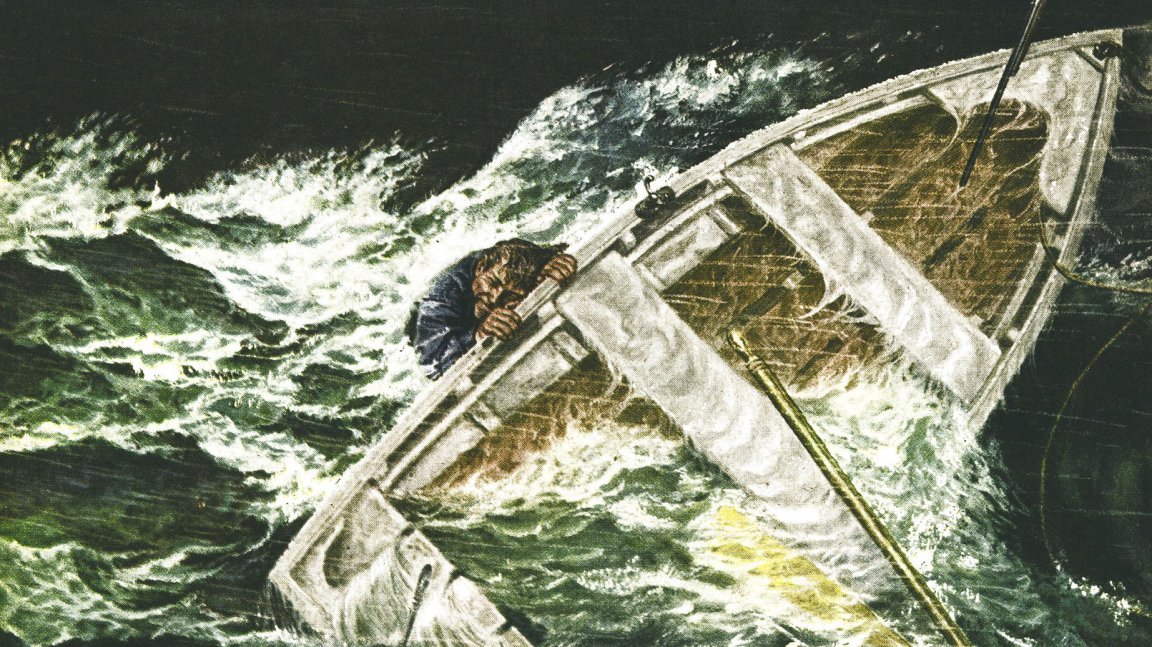
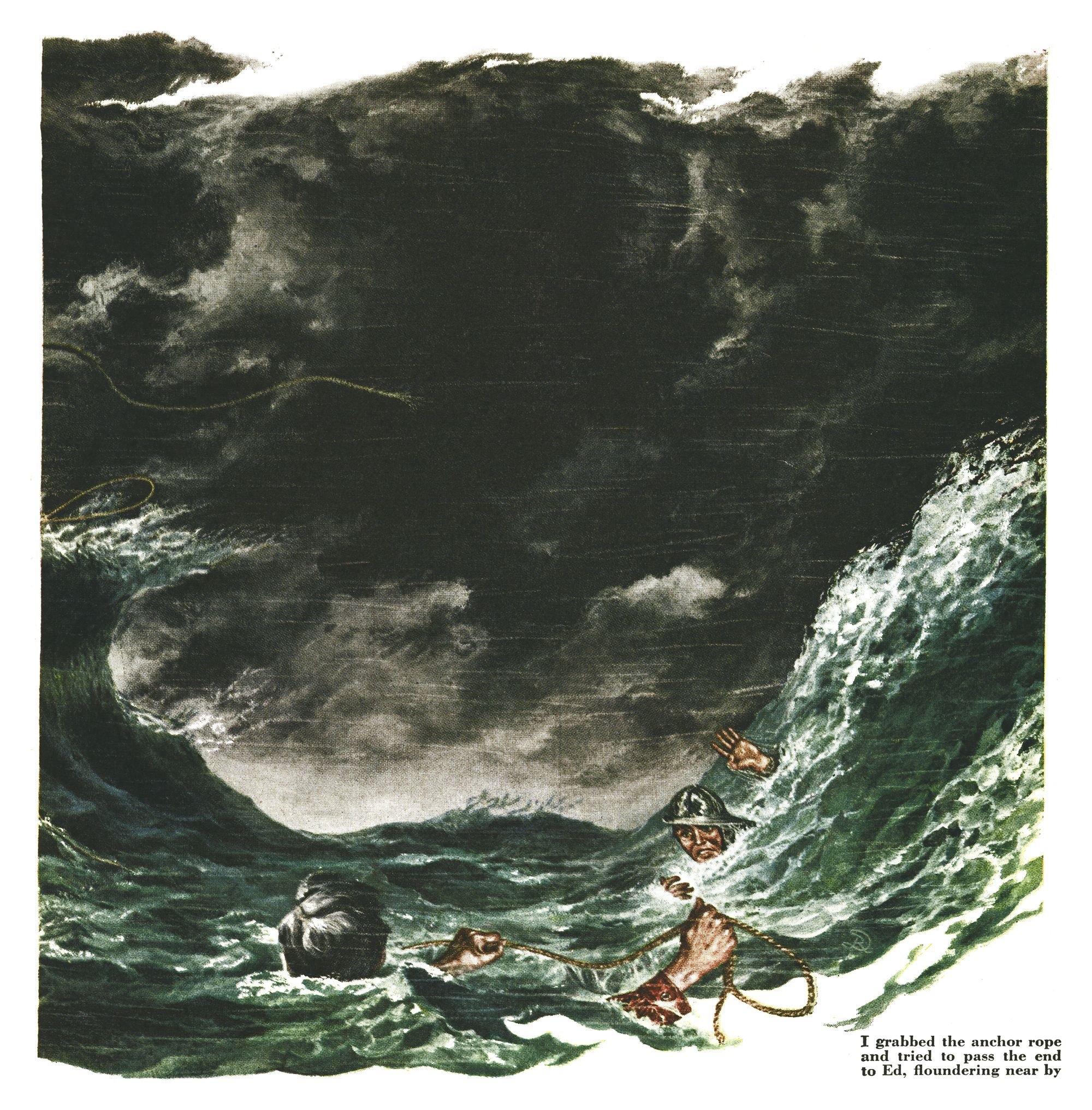
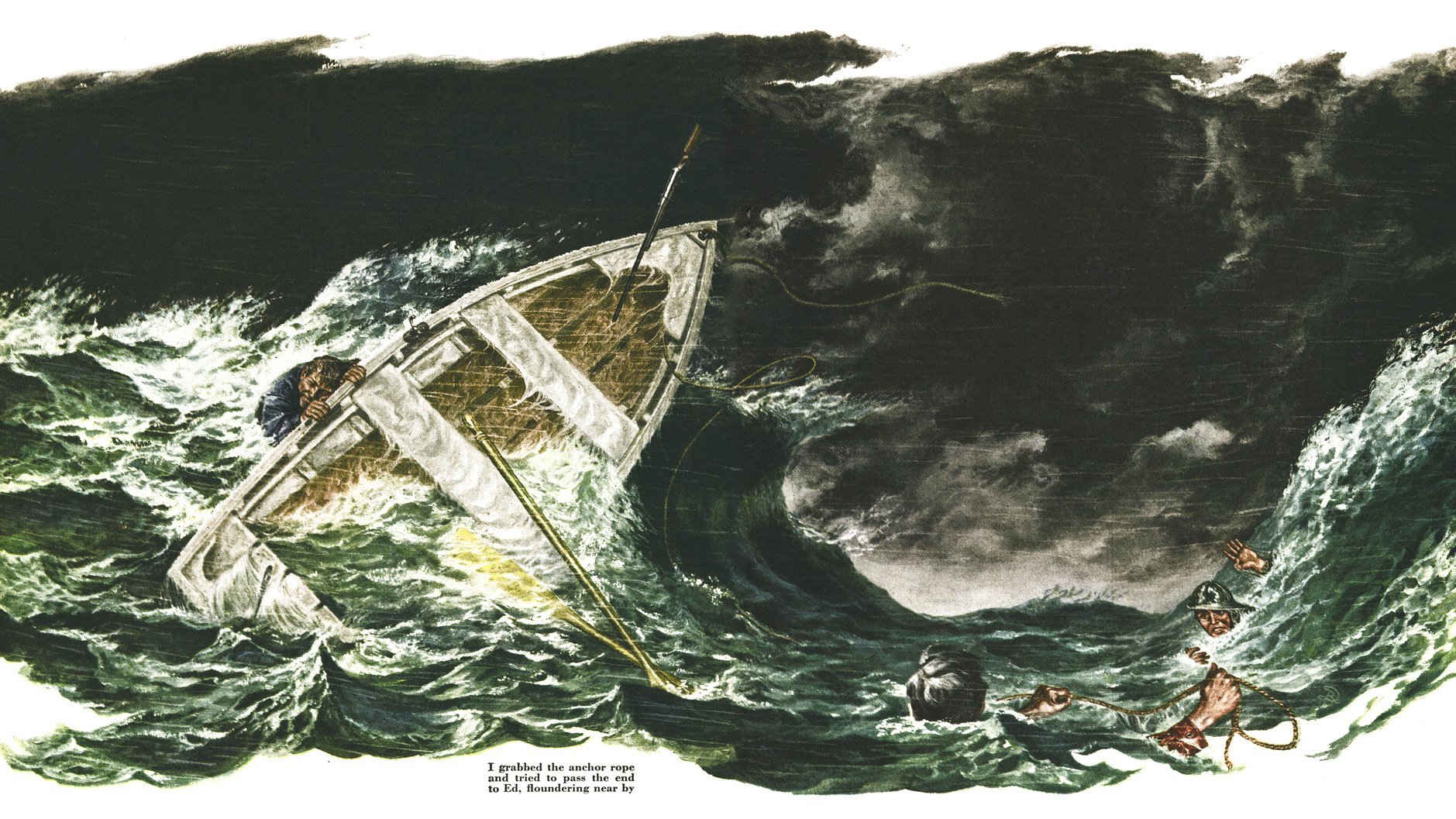
I didn’t have to turn to know he was looking into the big wave. I grabbed the anchor rope and rolled out headfirst.
The wave hit just as I shook water from my eyes. I saw Ed, clawing at the buckles of his raincoat, pitched out of the boat as it went up on its beam. The top of the wave slid under the boat, carrying Ed with it.
When the wave had passed I saw Ed swimming awkwardly, the chin strap of his sou’wester cutting into his throat, and I knew he was still trying to get rid of his coat. Hutch saw him too and yelled, but his words were lost in the wind.
The boat lurched and I stretched out my body toward Ed. I felt my foot bump him, and then he caught it and pulled himself within reach of the boat. I took a turn of the anchor line around my right hand and passed the loose end to him. It was slick and hard as a greased cable.
The boat was right side up again now, two thirds full of water. Hutch was working his way along the gunwale toward us when Ed began trying to climb into the boat. Hutch caught at him, pulling him back, and Ed was fighting him. “No good!” Hutch was shouting. “And get your clothes off — it’s going to get worse!”
It did, almost before Ed got rid of his coat. The rain came again, blinding, choking, cold. Half of it seemed to be wind-whipped sea water, but I think that was because the boat’s pitching kept me under the salt water half the time. Hutch got the motor unfastened and let it go before the stern sank.
The rain came again, blinding, choking, cold. Half of it seemed to be wind-whipped sea water, but I think that was because the boat’s pitching kept me under the salt water half the time.
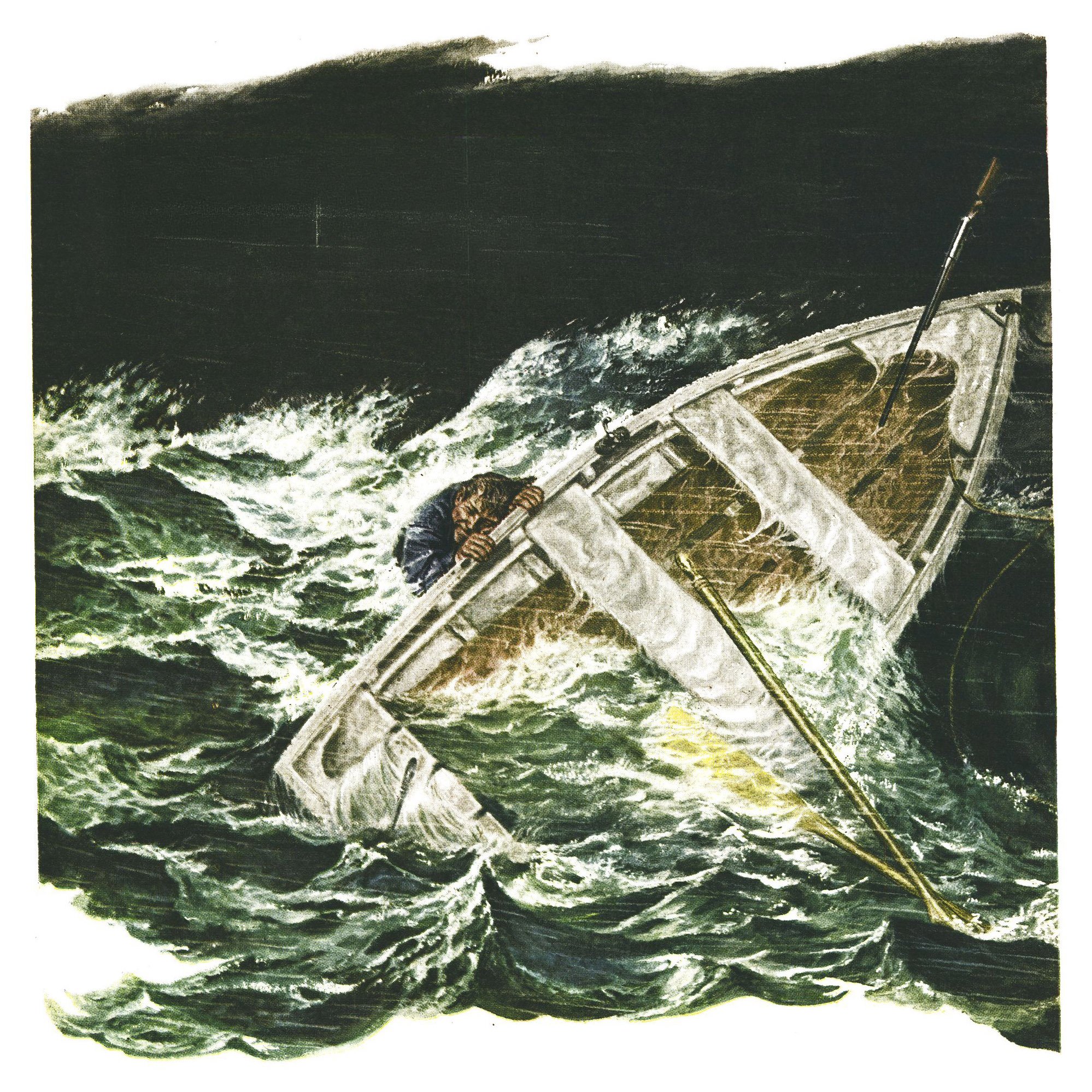
The boat didn’t sink though it got full of water and once turned completely over, but it pitched so it was impossible to hold on. We finally managed to get close together on the same side in the manner of an outrigger, constantly working to keep the boat upright, clutching each other and the rope. Once, with my head under water, I thought whimsically of my treasured Parker shotgun and Ed’s old relic, and admitted mirthlessly that now one was no better than the other.
The rain increased, became a vertical river blotting out vision and sound until it seemed impossible to tell where the rain ended and the sea began.
Time passed. I couldn’t guess how much. Finally I didn’t even care, didn’t care about anything except holding on so I could get my head above water part of the time. I sensed Ed and Hutch were still with me but I couldn’t be sure, and I wondered about my wife and Lucy’s baby.
I discovered I was seasick and must have been for some time. Horribly sick. Even through violent air maneuvers and a good many years at sea I had never known anything like this. Gasping for breath, I inhaled sea water and became sicker, if possible. But I held on, because I couldn’t turn loose. I thought once, in a fleeting logical moment, that if I survived this my hands would show rope burns for weeks. Sometimes the rope would slacken, as if Ed had been torn loose; then it would tighten viciously with his weight, and seasick as I was I couldn’t help thinking how bad it must be to be having a baby in a hurricane.
Once, or maybe it was twice, a bright sun shot through that awful rain. I was aware of its brilliance; I couldn’t actually see it. Up, down, skidding sideways half underwater. Then over again, and over, and over again.
My legs? Something was beating on them and I wondered, with a moment of groggy horror, if they were numb and a shark or barracuda was at work.
Something was beating on my legs and I wondered, with a moment of groggy horror, if they were numb and a shark or barracuda was at work.
Then there was pain. I kicked, mostly to see if they were still there, and felt something solid. I kicked again, and this time it tore the calf of my right leg. I extended a foot, and felt it dragging over something brittle and rough. It dragged for several seconds before reason came to me — oyster shells.
We were dragging over oyster shells, and the way we’d been drifting those could only be on the mainland shore, a wild, uninhabited salt desert that ran for miles along the sandy muck.
Then there were no more oysters. We were swept on again. My spirit died. And then — more oysters, higher this time, cruel, pleasant things cutting at my hips, banging my thighs. But at the speed we were drifting they would cut me to pieces! I made myself turn loose the anchor rope.
That was no better. Beaten about alone in that water, the shells would have killed me. But the boat overtook me, pounded at me as if asking me not to leave it. I mustered enough sense to crawl up on the gunwale. My weight pulled that side of the boat under water, but I lay half-drowned and thankful for the meager protection. I wriggled toward the stern and pulled a limp Ed partly into the boat too, even before I realized the boat was hung on the oyster bank. Ed had knotted the rope about his wrist. I found Hutch’s legs under me, and then his face. The rain seemed a shade lighter, but it didn’t matter, and I remember wondering if it was only Hutch’s body I was holding.
Read Next: Frozen Terror, One of the Greatest Survival Stories of All Time
We pounded on the shells. I knew, presently, that the bottom of the boat was nearly gone, and tried to protect my knees by lying over a thwart. The beating brought Hutch to life, too, for I suddenly found him helping me, trying to protect Ed. Then we were loose and drifting again, drifting into mangrove trees, pounding against their springy limbs.
The boat wedged fast. Hutch and I dragged Ed into the swamp until we bumped into a threshing palm tree. The three of us huddled in the torrential darkness with our backs to the palm, not even thinking of our cuts.
Then the body chemicals that had kept us fighting to live played out. We fell into nightmarish, exhausted dozing. We could feel trees crashing down about us, the sharp report of their cracking trunks piercing even the wind.
When I was fully conscious again I went through the torture of standing erect. Rain still fell, but now it was only a drizzle. The wind no longer shrieked. It was a fresh breeze under a gray dawn sky.
The palm was still there, cracked in its roots, leaning at a crazy angle, its top awry. Everywhere were splintered and fallen trees. The brush was flattened and rivulets of water ran back toward the sound, which was now miraculously some 100 yards away down a sloping bank.
We fell into nightmarish, exhausted dozing. We could feel trees crashing down about us, the sharp report of their cracking trunks piercing even the wind.
Hutch sat with his back against the palm, eyes puffed and closed. I touched his shoulder. He opened swollen eyelids, and after a moment a faint smile tried to crack his chalky face. He nudged Ed, and Ed woke up painfully. He looked at Hutch and at me but no one spoke. Then Hutch said, “Hell, we’ll be late for breakfast.”
Ed tried to answer but failed. Then he tried to grin but that failed too.
My knees would barely support me. They were flimsy, yet so stiff they felt as if they belonged to someone else. My right pants leg was gone and among the smaller cuts an ugly gash puckered at me from the calf. Hutch seemed unhurt beyond a twisted knee, but Ed, stripped naked, was a mass of small cuts and bright greening bruises that made an awful background for ridges of clotted blood. He said suddenly: “I’ve got to get to Lucy.”
“We’re on the west shore,” Hutch answered indirectly. “Better start headin’ west; there’s a railroad runs a mile or so in.”
We staggered behind Hutch for an hour until we found a set of rusty rails and Hutch said, “We’ll go south. That’s toward home, anyway.”
Two agonized hours later we came to Kenny, a little station 10 miles north of West Palm Beach. The agent put us into his car, and when I woke up I was home, and my house was unharmed.
The phone lines were down so my wife drove Ed home. She was back before I got to sleep, reporting Ed — rapidly recovering — was all mouth and a new papa. Most of the houses away from the water were safe. The hurricane had headed for the interior and Palm Beach was already clearing its debris.
It was more than two weeks before I heard from Hutch Newsom again. He came into the store and bought a package of shear pins and a grappling hook, and we discussed my water-ruined show window. “One thing I was right about, anyway,” Hutch said sheepishly.
“What’s that?” I asked, suspiciously. My leg still hurt.
Read Next: How I Almost Drowned During a Coast Guard Rescue in a Freak Storm
“I said we’d get that car back across the wash when the wind died. Well, I got it back — today. I’ve got it layin’ all over the back yard. Want to go marsh-hen huntin’ tomorrow, when I get it put back together?”
“No thanks,” I said. “I’d rather stay home and have a baby.”