
It was a bad season for grizzlies. Maybe the warm, wet summer had something to do with it, but for whatever reason, the bears were uncharacteristically aggressive. I’d been coming to these Alaskan mountains for five to eight weeks each season for nearly a decade to hunt, fish and live in the wilderness. I had seen hundreds of grizzlies, but with few exceptions, they always had been timid or curious, seldom dangerous. I usually carried a bear tag, partly because if I was forced to kill one, I wanted to keep the hide (in my home state of Alaska, a bear killed in self-defense becomes the property of the state if you haven’t got a bear tag or if it isn’t taken in season). I also wanted a seven-foot bear. Grizzlies in the northern interior and Arctic survive largely on vegetation and don’t get as big as the salmon-fed coastal bears. A seven-footer was as good as you could expect to see.
The first part of my annual expeditions was reserved for sheep hunting with Cheri Flory, a friend who has taken several trophy-quality caribou and moose. After the tiny Cessna 185 had clattered to a white-knuckled stop on an almost too short, rocky river bar, we floated downriver for two days. From there we backpacked several more days up an unnamed river, swollen and angry from recent rains, into ram country.
When we arrived at my campsite, on a bench above the river, a large, dark grizzly was grazing placidly on blueberries exactly where I have pitched my tent for the last several years. We shouted and I fired the 7mm-08 into the air. As the shot echoed between sheer, limestone walls, the bear ran straight up a steep, scree slope and over a ridge 2,000 feet above. No surprise. That’s how they usually behaved.
In the next few days, we spotted several more bears near camp, and even though they all behaved as expected—they moved away once they sensed us—I was vaguely uneasy. That unease was almost a foreboding, and it lasted until the end of the expedition.

Early one morning, Cheri and I started from camp to find a band of rams I’d seen from a distance the day before. A quarter-mile downwind of the tent, she spotted a bear laying on his belly on a talus slope just above her. The bear lay with his chin on folded paws, apparently just waiting for us to go by (grizzlies have better eyesight than most people give them credit for, and this one could clearly identify us 300 yards away). I wasn’t particularly worried, and there was no reason to think this bear would be any different from the rest we’d seen. I hollered, cursing the bear and his relatives. It had no effect. I shouted again, and this time fired a shot over his head. He sat up and cocked his head at us, but didn’t show the slightest inclination to run. We shouted ourselves hoarse, and I fired several more shots, but it didn’t faze the bear. In fact, he seemed almost amused by it.
Possibly he’d had the same treatment in earlier years, and because he hadn’t suffered, was no longer afraid. Probably, too, the smell of our camp was just too intriguing to ignore. No matter how careful you might be, in a bear’s incredibly keen nose, there will always be the smell of food around even the cleanest camps.
We had to protect our gear and food, so we turned back to camp. A ruined camp would have been a serious matter—we had 300 miles of wilderness backpacking and river travel to civilization, and the journey would take us six weeks. The loss of camp would be just as serious, perhaps, as a mauling. After all, we had antibiotics, pain pills and stitching gear in case of a mauling, but no spare tent or sleeping bags.
The moment we turned for camp, the bear padded after us. I was startled by the maneuver. For some reason it was the last thing I expected, so I opened the bolt to be sure that I had a full magazine and one up the throat. As I jammed the bolt shut, I reflected grimly that though the 7mm-08 was a good sheep gun, it was hardly the stuff for a charging grizzly.
As the distance closed, the bear slowed, then stopped and began browsing on soapberry bushes. I was pretty sure that it was a ruse. He didn’t want a confrontation just yet and was testing us to see just what he had to deal with. We walked slowly toward camp, taking pains not to hurry, which might cause the bear to chase us. I watched over my shoulder and prodded Cheri along (she was more fascinated than worried by the bear’s antics, and at the most irritating times she insisted on pausing and watching). The bear stripped the soapberry branches, leaves and all, as if that was all he was interested in, but watched us out of the corner of his eye and edged closer as he fed. He was still testing us, still trying to find out just how far he could go.
A moment after we walked into camp, the grizzly trotted over the crest of the bench, following our trail like a bloodhound with his nose to the ground. He stopped, looked at us and the tent, then swaggered slowly forward in an exaggerated, side-to-side gait. I hoped it was all bluff, but grabbed an aluminum pot and pan and while banging away, went to meet the bear. If there was going to be trouble, I didn’t want it in camp, where Cheri could get hurt or the tent destroyed. He stopped. I could see the surprise in his expression, and he let me come. At 30 yards the sweat began to trickle down my forehead, despite a cool breeze, and my skin suddenly felt too tight. I thumbed off the safety as my heart pounded in my ears, and advanced again. Finally, to my immense relief, the bear gave, hesitantly at first, then turned and walked slowly off the bench, glaring back over his shoulder almost as if to say, “I’m not quite through. Yet.”
We watched the bear browse on soapberry bushes for hours. Several times I fired the 7mm-08 at rocks only feet from his nose in hopes of driving him off, but all he did was stare stupidly at the rock powder hanging in the air. He didn’t even flinch. He obviously wasn’t impressed, and he slowly began moving toward camp again.
Eventually, he edged to within 40 yards of the tent, and twice made short, bluff charges, probably hoping we’d abandon camp and leave him to his explorations. He made clear our choice, though: Either move camp or he’d force a showdown. I didn’t want to shoot him—bear season wouldn’t open for several weeks and there’d be a great deal of red tape with the fish and game department if I did. Besides that, I’d strangely developed an affection for the wayward bear. After all, we were the intruders, and it was his country.
We had tried every diplomatic means to diffuse a confrontation, and nothing worked, so we began breaking camp. Cheri was stuffing the tent into my backpack when, without warning, he charged. The bear came at a gallop, growling fiercely but still not as intensely as a full charge might be. But I knew if he pressed home there’d be no telling what might happen. I couldn’t take the chance, so I aimed low near his feet, hoping to change his mind. If that didn’t work, I’d have time enough for one more quick shot.
He rolled over at the muzzle blast, bawling and swatting at the air as I worked the bolt. He regained his feet and then stumbled off the bench toward the creek. He sat down 100 yards away and licked his paw and glared at us on the slope just above.
We quickly stuffed our few final items into the packs and started up-canyon. I brought up the rear and kept a close watch behind. We hadn’t gone a quarter of a mile when the bear was nosing around our just vacated campsite. He didn’t limp in the least—apparently, I’d stung his paw with ricocheted debris.
Two hours later, I glanced down the canyon, and the bear was following our trail a half-mile below, again with nose to the ground exactly like a bloodhound. I’m used to being the hunter, so it was more than a little unsettling to suddenly find myself being hunted by something so much larger and more powerful. Only if the 7mm-08 was used properly (it was seeming smaller and smaller all the time), could it equalize things. For a moment, I felt a bit like David, and the bear was Goliath—finesse vs. brute strength. Eventually, he closed the distance to about 200 yards and kept it there. Then, finally, as we crossed a high shale ridge and dropped into the next drainage, he quit following. I breathed a huge sigh of relief when I was relatively sure that he’d quit dogging us, but it was several nights before I slept soundly again, and even then I kept one ear open and a loaded rifle beside me.
The sheep hunt was successful. We saw a half-dozen more grizzlies and all behaved themselves, and two weeks later we trekked back down to the river where we had left our cache stored in steel drums. We had 250 miles of wilderness river to float as we hunted for moose and caribou on our way to our bush-village destination. In time, we collected a good moose and a huge caribou, spotted several more passive grizzlies, and on the lower part of the river toward the end of the expedition, came into flat country where spawned-out salmon littered beaches and gravel bars. Bear tracks were everywhere, and in two days we spotted six grizzlies as we floated. Each night I unloaded and heaved the 14-foot raft up onto the bank next to the tent and tied aluminum pans to a line so I’d hear if a bear came into camp (if anything happened to the inflatable raft, we’d be in dire trouble).
One evening, we pulled up at a likely looking campsite. I climbed the bluff to check it out, without a gun, as I usually do, and forced my way through a screen of willows into the shadowy spruce timber to look for a place to pitch the tent. I walked around for a moment, then heard a commotion behind me.
I was sure that it was just a surprised moose crashing off, but when I turned I was face to face with a large grizzly charging down on me through the dusk and thick trees. Spruce branches were flying like straw, and the ivory of his teeth were almost glowing in the gloom. Any bear chasing you is apt to seem huge, but this one was honestly a big bear.
I was unarmed and as helpless as I’ve ever felt. My chest tightened as I waited for the impact and the teeth tearing into me. I was as sure as I’ve ever been of anything that I was going to be mauled, as sure as a falling rock climber is sure he’ll hit the rocks below. I was so positive of a mauling that I’d accepted it and was already thinking beyond to Cheri waiting in the raft. She was an experienced wilderness hand (this was her third trip), and I felt sure that she could get out the four days or so left downriver to the native village. But what of the grizzly? Would Cheri get away?
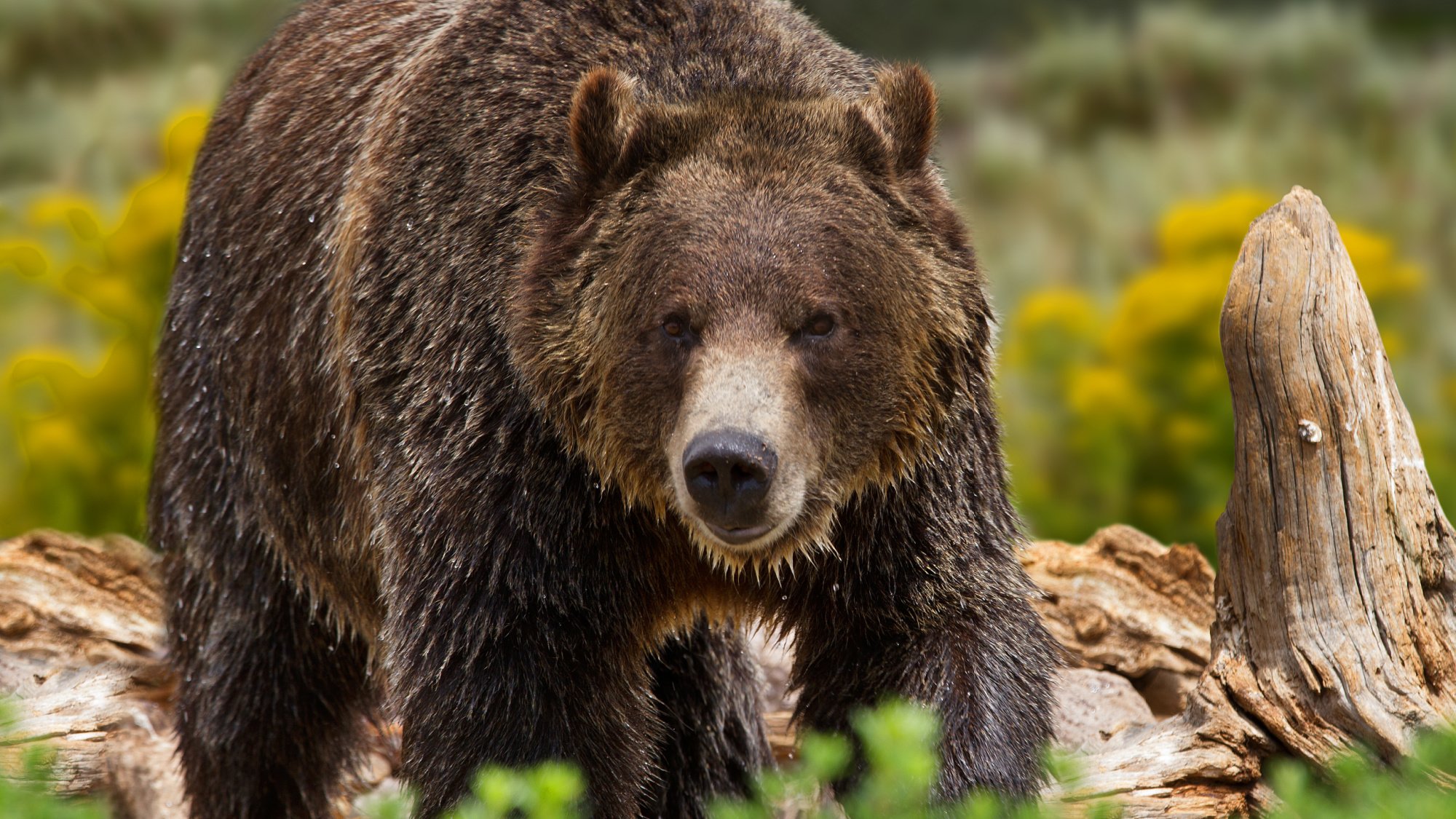
“Cheri, get the gun!” I said in a loud voice that wasn’t quite shouting and that sounded like someone else, hoping she’d be able to protect herself when the bear was through with me. Immediately she shouted something back and the bear veered at 15 feet, almost disappearing momentarily behind a deadfall, thoroughly confused by the second voice from a different place. It gave me a chance, and I rushed through the willows and leaped off the bluff onto the raft, at the same time hissing, “Row!” This time I kept my voice low, feeling that if I said it any louder it would bring the grizzly down on us. Cheri leaned urgently into the oars, and a moment later we were out into the current. I was elated, flying on an adrenaline high and almost giddy with the sudden release of tension and unexpected reprieve. I was still alive, still in one piece, and incredibly surprised about it. A moment later, the bear was on the bank looking for us, and I was trying to free the rifle from the duffel. Bear season had opened by then, and I could have cheerfully shot this one because he’d frightened me badly enough to sprinkle my beard with a handful of my first gray hairs (at least I blame it on that, because they showed up several weeks later). But before I could free the gun, he was gone.
We floated downriver until well after dark, trying to get as far away from the bear as possible before pitching the tent. Neither of us slept much that night, and I awoke frequently, quickly breathing and sweating from visions of bristling, bloody-jawed grizzlies standing over me.
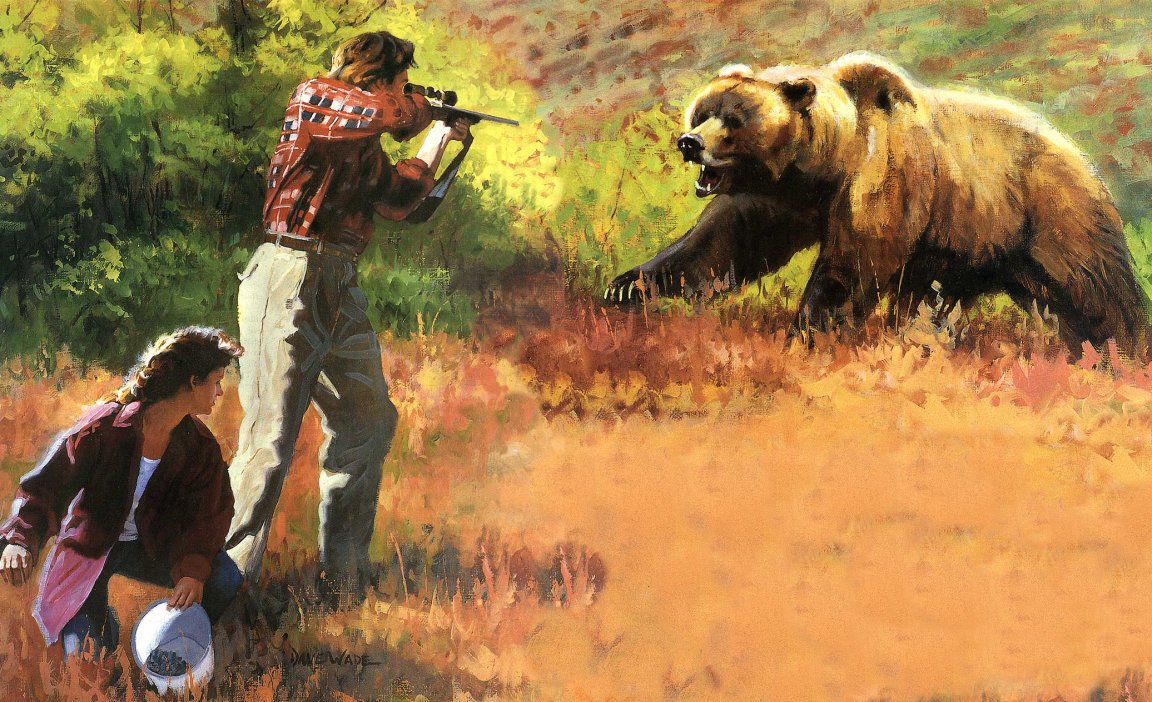
Late the next afternoon, we tied off the raft in an eddy and climbed a low hill to pick some blueberries for dessert that night. This time I took the rifle and kept a careful watch as Cheri picked. We talked, and I felt sure any bear in the area would hear us and would have plenty of time to move off. We worked slowly over the hill, and suddenly, just below, was another bear.
“Oh God, not again!” I thought, feeling the blood thicken behind my eyes. This bear was very blond, and he saw me at the same time I saw him. He stood abruptly on his hind legs—seeming to tower over us like those Hollywood bears in old “B” westerns—nose raised into the wind and head rocking quickly from side to side as he tried urgently to scent us. I worked the bolt and brought the rifle up. Cheri heard the hard, metal sound of the bolt and froze, knowing what it was without seeing it. There was that same brassy taste in my mouth, and I knew before the bear started that he’d charge. We were just too close; given the adult male grizzly’s disposition and ego, he had no choice. He dropped quickly to all fours with an explosive snorting-grunt and charged, the glossy blond fur on his shoulders and neck filling the riflescope as he rushed silently, intently, bounding across the spongy tundra and closing the distance faster than I would have believed. At the shot, he seemed to hang there and stare a moment, almost in surprise, before sagging into the blood-colored dwarf birch. Then it was silent, nothing moved or made a sound; I had the feel of a mouthful of flannel as I tried to wet my lips.
Only after I lowered the rifle and breathed again did Cheri stand up from where she’d been picking berries on hands and knees. Later, I realized it had taken a great deal of self-possession to freeze that way with a grizzly charging you and with your survival in someone else’s hands. The big grizzly lay motionless less than 20 feet away; the bullet had shattered the vertebrae just behind the skull. He squared just seven feet, a very large bear for the country, and his hide was spectacular. But I killed him because I had to, even though I now very much appreciate the trophy.
He smelled wine-sweet, the odor of the fermented blueberries around us, as I stood next to him letting the tension uncoil. Cheri and I were both strangely subdued that afternoon, standing on the blazing crimson, gold and green tundra.
Why the grizzlies had been short-tempered that season is anyone’s guess. I’m fairly certain that I could wander up there for the rest of my life without another serious bear encounter, let alone three charges within a few weeks. But despite that, I’ll now carry a gun whenever I’m in grizzly country, something I never did before unless I was actually hunting. And without trying too hard, I can see again the big, dark grizzly charging down on me in the dusky gloom of the forest as I stand unarmed and as helpless as I’ve ever been. As I relive it, my palms become clammy and my scalp prickles as I wait for the impact and the teeth.
That season, I learned that I wasn’t the most important, the most powerful, maybe not even the most deadly creature in that wilderness. I also learned humility.
I didn’t shake that foreboding, gloomy feel of doom until days after the chartered plane landed at my cabin on the Yukon River, when I was sleeping in sheets again, behind a heavy log wall.