
This story, “We Climbed a Wild River,” appeared in the June 1962 issue of Outdoor Life.
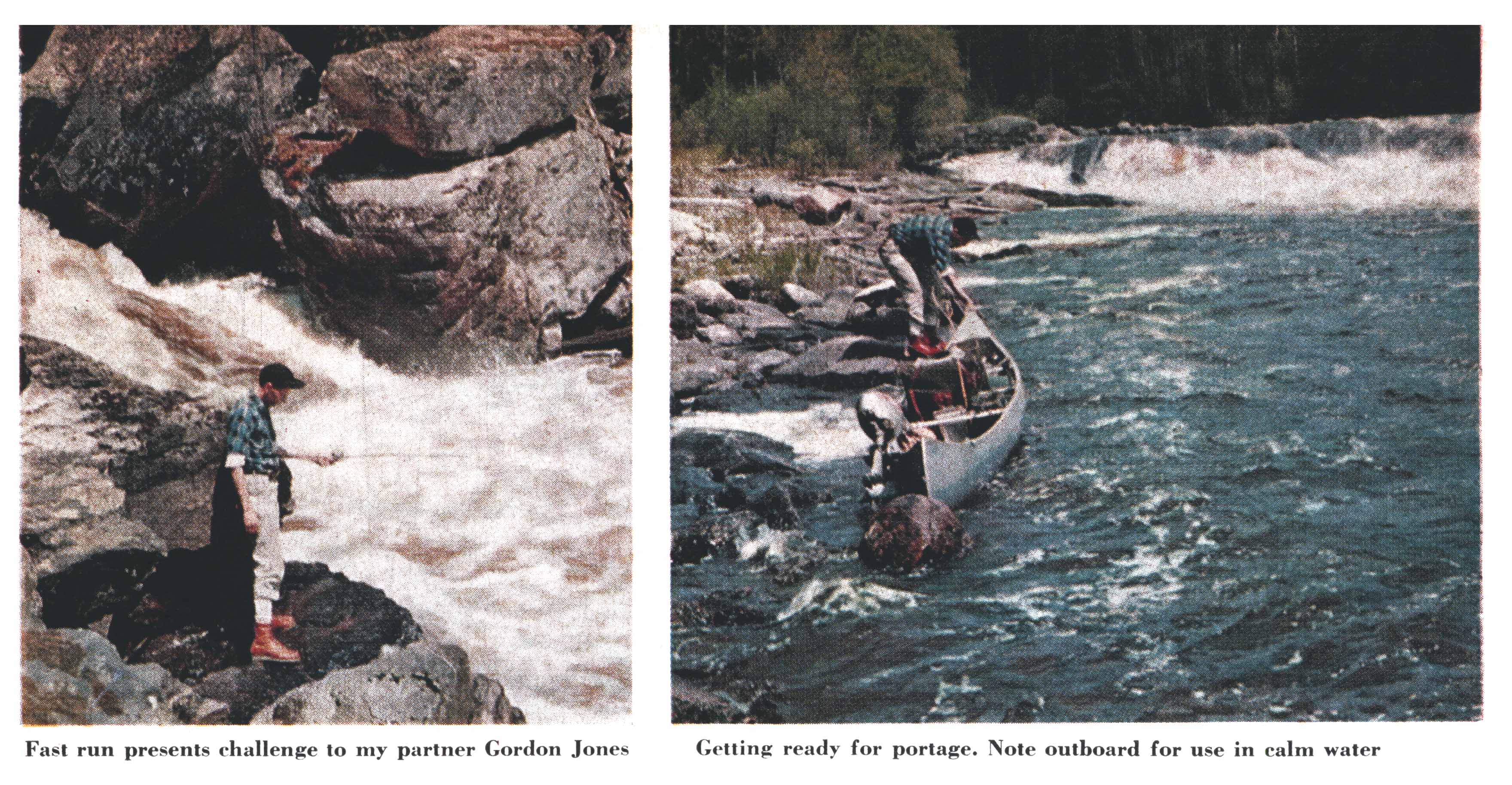
The turtle river boils into the north end of Robinson Lake, in the roadless Ontario bush 50 miles northeast of Fort Frances, as if it couldn’t get there fast enough. First it makes a 30-foot plunge over a mist-hung waterfall, then it crashes and foams for 150 yards down a rocky channel, bouncing over ledges and broken by huge boulders. Our tent was pitched 100 yards below the falls, but it was wet with spray by the time we got the ropes tightened.
Where the current spilled and slackened in the lake’s deeper water looked like a good place to fish, so Gordon Jones and I stepped out on a couple of rocks and started casting. We had a supply of salted minnows, and Gord flipped one into deep water and let it sink. I tied on a spin-size, red-and-white wobbler and reached a little farther offshore.
Gord got action a split second ahead of me. A three-pound walleye latched onto his minnow the instant he started to turn the reel handle. One almost as big grabbed my spoon on about the third wobble. We slid them out on the rocks and strung them, with supper in mind. Gordon took another on his next try, but I had to make two passes for my second.
The water was swarming with walleyes, and I don’t suppose any had ever seen a lure. In the next two hours we landed so many we lost count. We kept seven for our evening meal, and eased the hooks out of the rest and let them go. We had caught between 25 and 30 when they finally slacked off. We did a few camp 2chores, and about an hour before supper Gord suggested more fishing, this time in the fast water at the foot of the rapids. There we found northern pike, scads of ’em, running from three to 10 pounds, and the action was even faster than it had been in the lake. For an hour neither of us put a spoon in the water without getting a strike. We fought and released 20 good northerns before we quit for supper.
The country around the Turtle, as it snakes south from Bending Lake, about halfway between Kenora and Port Arthur, is as wild and inviting as any I know. There’s not a mile of road between Wabigoon Lake to the north and the United States border to the south, and the river twists and froths through wilderness all the way. Big lakes are strung along it and beside it like giant beads on a cord, and wherever you look there are lakes and streams, rapids and falls, muskeg pools and beaver ponds — almost as much water as land. Swamps and bogs alternate with hills and ridges of bare rock, and the whole empty land swims off to the horizon in a patchwork — the dark green of spruce, the lighter green of aspen and birch, the blue of water, and the brown of muskeg.
It’s country you know a man couldn’t walk out of in a whole summer without a canoe to help him, and it’s fascinating the way any remote place is bound to be. Then, on top of everything else, there’s the fishing.
I’m a pilot for Trans-Canada Airlines. 29 years old. living in St. James, a suburb of Winnipeg, Manitoba. I was born at Sioux Lookout, Ontario, my dad was a bush pilot, and I was brought up with Indian ways. I started fishing when I was five. At 12 I had a canoe of my own, and the year after that I made my first wilderness canoe trip, with dad, in northern Quebec. Hardly a year has gone by since that I haven’t spent from days to weeks on a white-water river somewhere in the wilds of Canada.
I had flown over Turtle River country more times than I can remember, glassed the lakes, streams, falls, and rapids with binoculars, and studied the maps. Each time I looked down on it I itched harder to get into it, sample the fishing, and find out what the river and its portages were like.
During the winter of 1959-60 I flew with a friend, Capt. Charles Robinson, a retired T.C.A. pilot who owns a fly-in fishing camp on Bending Lake. He explained that the only feasible water route into that area was up the Turtle from Rainy Lake. Starting at Fort Frances, it would be about 130 miles to his place, he said, with nobody knew how many portages. He also told me that as far as he could learn from Indian guides, the last white men to make the trip had done it about 30 years before when logging operations were in full swing on the upper Turtle. “There’s a lot of river where nobody’s wet a line since,” Charlie said.
That settled it. I knew I couldn’t wait much longer. In the spring of 1961, I picked my fishing partner, Gordon Jones, to go along, mainly because we had done enough fishing and canoeing together (including a 150-mile canoe trip in the summer of 1960) to know that we hit it off well and would make the right kind of team for this venture. Gord originally hails from Regina, Saskatchewan, was a T.C.A. pilot for a time, and now works for Trans Air Ltd. in Winnipeg. He likes the bush as much as I do.
We made our plans well ahead. We’d go up the Turtle its entire length from Rainy to Bending, then down the Kawashegamuk to Wabigoon Lake, exploring the lakes along the way and fishing. We’d start at Fort Frances and take out at the town of Wabigoon on the Trans-Canada Highway 100 miles east of Kenora. It would be a trip of more than 200 miles, and all of it through roadless bush country.
Related: How We Fished Our Way Along the Canadian Railway
It’s one thing to run a white-water river downstream, but it’s something else to travel the same river upstream, bucking the current every foot of the way and carrying uphill around falls and rapids.
We’d be climbing the Turtle, and much of the climb would be steep. It would be a tough trip, but we’d be seeing new and unknown country and fishing virgin water we knew we could count on for action. No matter how hard we worked or what minor hardships we encountered, we felt sure of enough adventure to make it worthwhile.
We allowed 16 days for the trip, and we decided to go during the first half of June before the blackfly hatch reached its peak, a good reason if you know the Ontario bush. We left Winnipeg on the afternoon of May 31 with Barney Stephanson, a fellow T.C.A. pilot, and his wife. They would drive my car back. We stayed that night in Fort Frances and completed last-minute preparations next morning.
Our canoe was a 17-foot aluminum one with a side bracket, and we were taking along an 11-year-old, 2½-horsepower outboard for use on big lakes and in slow-currented stretches of the river. In fast or shallow water, or where we encountered
we’d paddle. We figured 12 gallons of gas would be enough and planned to carry it with us. But when we talked to Vern Jones, a good friend and owner of the Rainy Lake Airways at Fort Frances, he insisted on flying in half our gas supply to lighten our load. We’d pick it up on a small sand beach at the south end of Eltrut Lake. We got away from Fort Frances shortly before noon on June 1, with thunderstorms rumbling all around us, planning to travel 45 miles to the first falls of the Turtle before dark. But Jong before the afternoon was over we were lost two or three times among the countless islands, points, bays, and channels of Rainy. From the water they all looked alike, and our map didn’t seem to help much. When a downpour overtook us, we gave up trying to reach the mouth of the Turtle that day and took shelter in a deserted, tumble-down logging cabin.
We had company in the night — a bear that prowled around the cabin for more than an hour. It was still raining at daybreak, so we stayed in our sacks until it stopped about 9 o’clock. Then we rolled out, ate breakfast, loaded the canoe. and headed up the lake.
There was no danger we’d miss the way now for we were in Redgut Bay, a big arm of Rainy, and our map showed the Turtle coming in at the head of it. Two hours took us to the falls and our first portage. We walked up the trail to look it over, and above the falls we found living evidence of how the river came by its name. We caught a snapping turtle that weighed 14 pounds and saw smaller turtles along the shore.
The portage was 250 yards. Our outfit weighed 375 pounds, and we had to make three trips, first carrying the canoe, paddles, and fishing rods, then our 70-pound food pack, Gordon’s personal pack, tackle boxes, spare clothing, cameras, pots and pans, ax and sleeping bags, and finally coming back for the tent-a 9 x 9 umbrella model that weighed 40 pounds — rifle, motor, and gas cans. We’d follow that same procedure for the entire trip.
We finished the portage and went on, only to find a second waterfall a short distance upstream. We unloaded and carried again, but when we came to rapids a little farther on we pulled the loaded canoe up, using 75 feet of light rope we’d brought along and fending the canoe from shore with long poles. Less than a mile above those rapids, we came to a log boom chained across the river and holding back a raft of pulpwood that covered the water solidly for a quarter of a mile upstream. Destined for paper mills at Fort Frances, this was a barrier we hadn’t reckoned with.
Because there was no trail along shore, it seemed easier to fight our way through than to portage around, so we hauled the canoe over the boom and tackled the raft. One man leaned over the bow to move the logs aside while the other paddled from the
stern to force the canoe ahead.
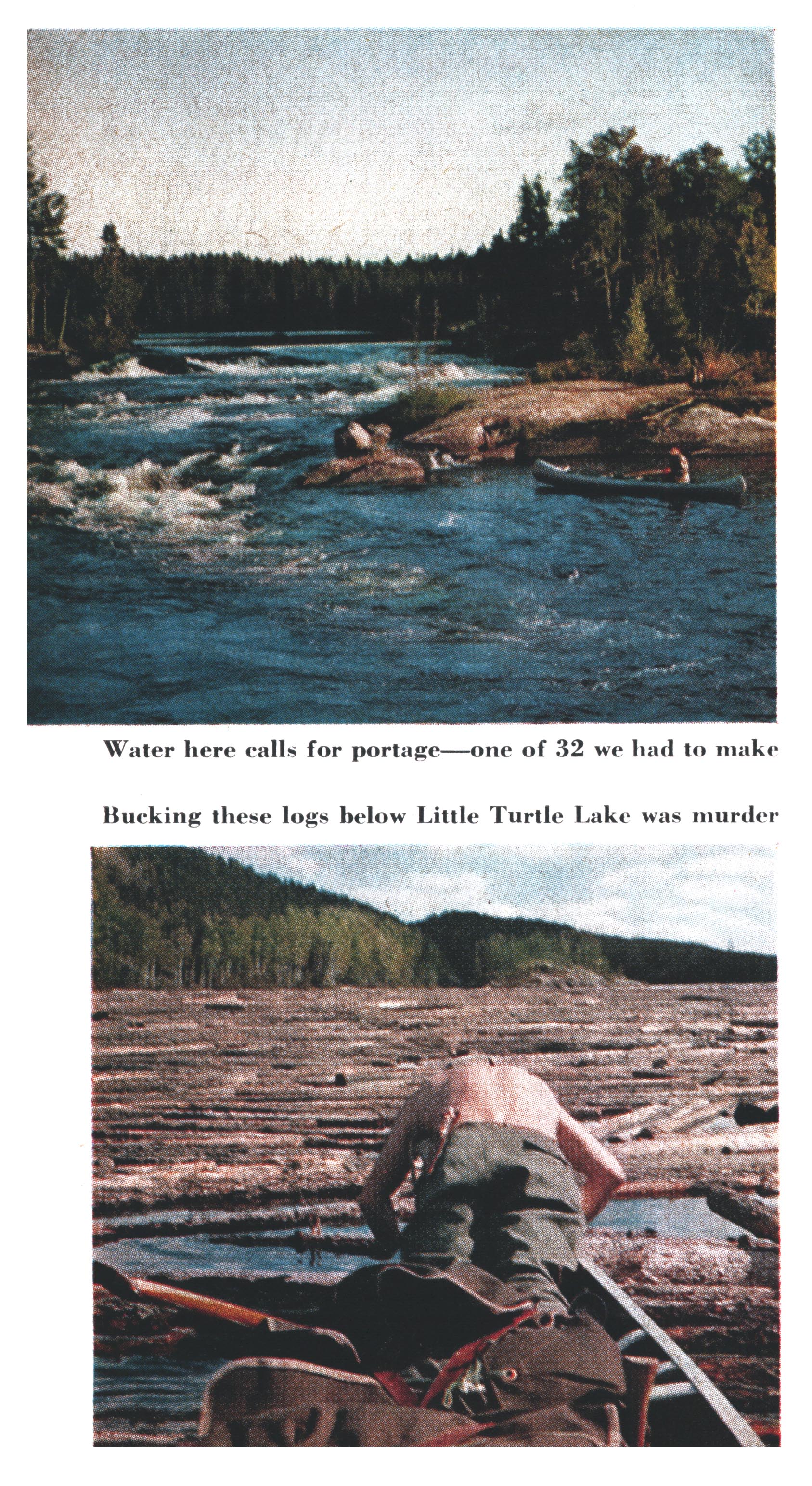
Pressure of the current had jammed the logs in a tight mass. They were eight feet long and eight to 12 inches through, and it was pure murder on the arms for the man in front. We had to work in short shifts, changing places every 10 minutes, and a couple of times we were about ready to admit defeat. But going back was as bad as keeping on, so we rested and went at it again. It took three hours of back-breaking work to make our way through, and when we broke into the open river we were as tired as we’d ever been. But the water here was slow and deep, so we started the kicker. The sky had been overcast all day, but about the time the river widened into Little Turtle Lake the sun broke through.
We went ashore on a strip of sand beach, got the tent up and our supper fire going. Then I picked up my rod and started casting around the shore of a small bay to get something for the pan. The fishing wasn’t spectacular, but in half an hour I caught enough walleyes for a good meal plus five or six pike that I put back.
Related: The Best Walleye Lures: Proven Baits That Catch Keepers and Trophy Walters
A few blackflies paid us a call while we were eating a reminder of things to come — but not enough to be bother — some. At dusk, a million frogs started peeping in a marsh behind our tent, an owl hooted back in the timber, and just before we turned in a wolf barked 100 yards from camp. The night was cold enough so that we slept in our long underwear and two pairs of socks.
We crossed Little Turtle next morning, and a short distance above the lake we came to the first of a series of rapids. We portaged 250 yards around the first and 300 around the second, which included two very steep hills. When the third turned out to be 500 yards long and uphill all the way, we elected to try lining up. We broke out our rope, I stripped off everything but my shirt, Gord took the line, and I waded into the river. There’d been ice in the lakes four weeks before and the bite of it was still in the water. It was a cold job, but better than the back-breaking toil of the portage. Above that rapids we had clear sailing. We ran six or seven miles by outboard to another series of rapids just downstream from Robinson Lake.
Deciding to postpone the carry until morning, we made camp below the rapids and went fishing. We found a pool where the water swirled in a deep eddy, baited up with salted minnows, and had all the walleyes we needed in 10 minutes. They were good fish, running to four pounds. I switched to a wobbling spoon, tried a run of fast water, and landed a six-pound northern on my second cast. Then we quit and went about our evening chores. We agreed we’d put in next day at that same spot.
It proved a fine idea. Three-pound walleyes and northerns up to 10 crowded every pool. The pike struck any lure we offered. In place after place each cast meant a strike, and they were the hardest fighters of their breed I had ever encountered.
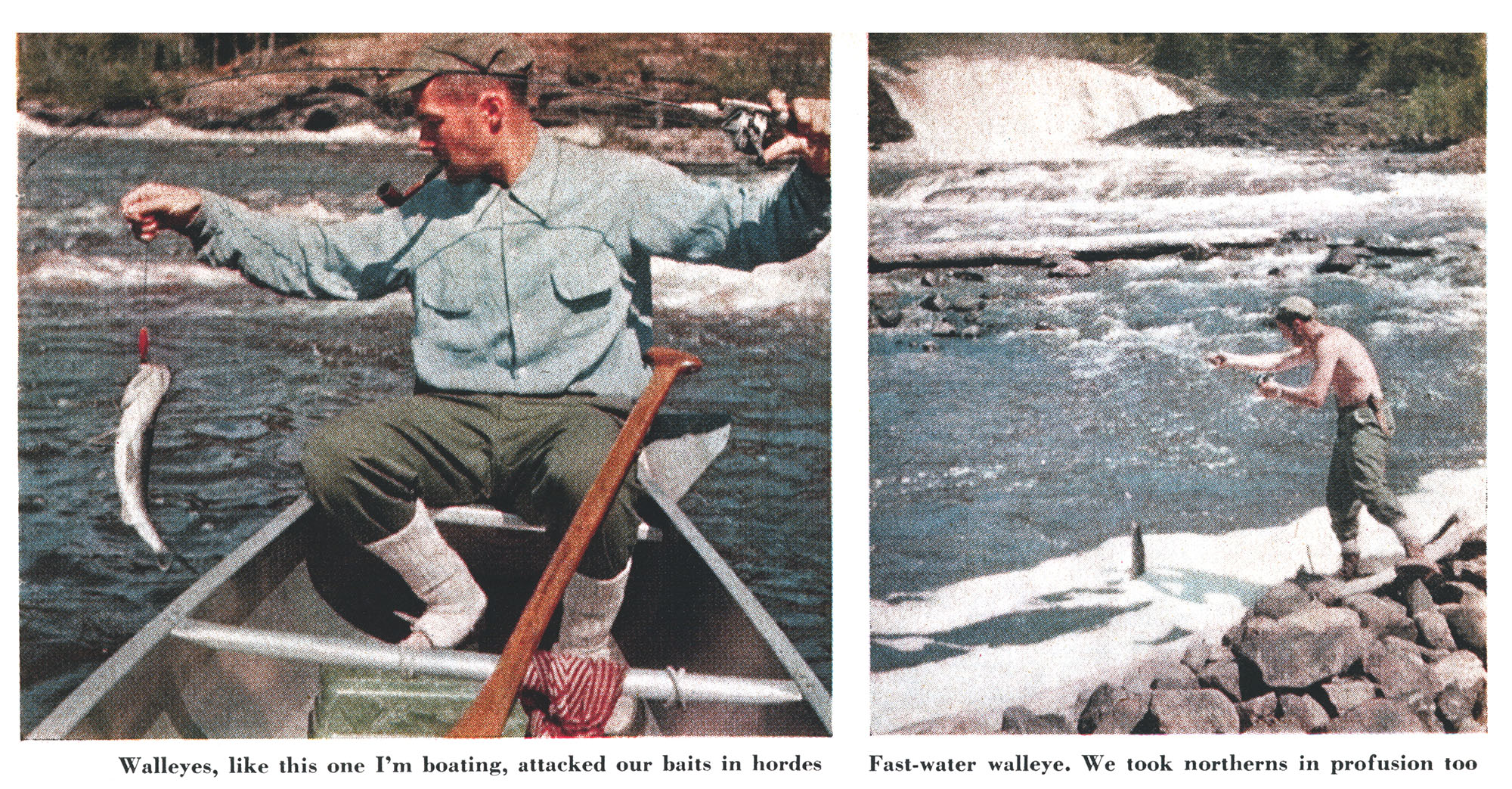
The walleyes were a bit more choosy, showing a marked preference for salted minnows and small spinners, but also liking a small silver spoon with red dots. We hooked and played them by the dozens. The one we wanted most of all, however, we didn’t catch. It was huge, the biggest walleye I had ever seen, lying motionless in a pocket where a rock split fast water. We guessed its weight at about 12 pounds, and we teased it with every lure we had. It wouldn’t take any of them.
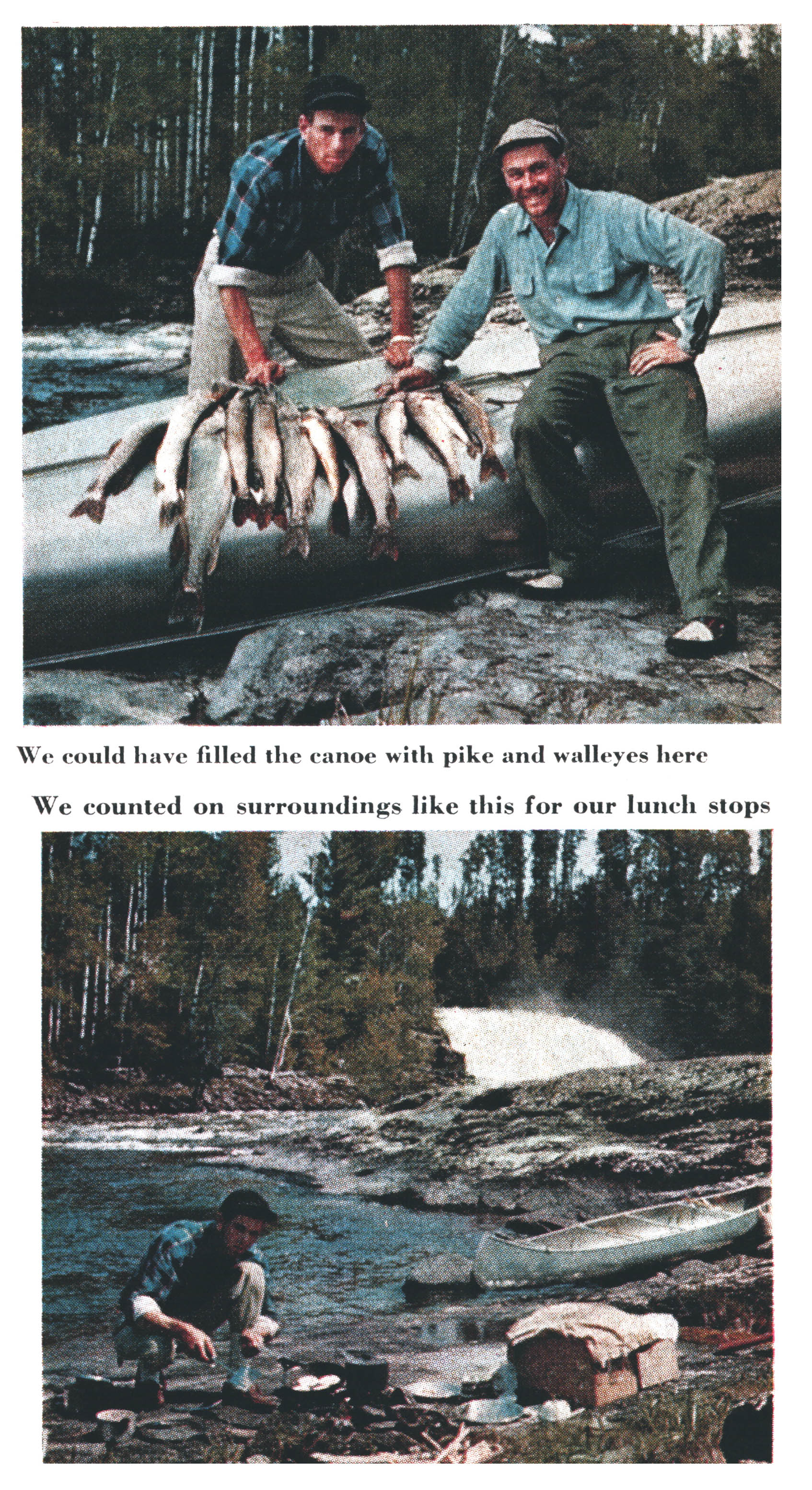
We hated to leave that spot, but our time was limited. We broke camp next morning, portaged into Robinson Lake, crossed to the upper end, and found another fishing hole just as good — the one I described at the start of this story. Again we stayed over a day, reveling in tile kind of fishing every angler dreams about but that only those who get back into roadless wilderness are likely to find. Our supply of minnows was gone now, but the walleyes he1e made no issue of it. They seemed to like artificials fully as well, and we could have filled the canoe with fish had we wanted to. Again we left reluctantly.
The portage around the falls and rapids above Robinson Lake was the toughest yet, up a ridge so steep that the canoe slid back of its own weight when we put it down to rest. But once across we had a short and easy run into Eltrut Laite where we picked up the gas Vern Jones had flown in.
We came now to a long stretch where the river looped for miles through marsh and muskeg. Wild rice was abundant, and we saw ducks by the thousands. This was choice moose range too, and in two hours between Eltrut and Jones lakes we counted 11 moose and five deer. One cow moo:ie with twin calves was feeding along a shallow creek and we paddled within 75 feet without attracting her attention. When we unlimbered our cameras, however, she spotted us, and the hair on her back bristled up the wrong way. She gave her big ungainly head an angry shake and started for us. We put 50 yards of river behind us in nothing flat.
Above Jones Lake, the river narrowed and sliced down through a long chute, running slick and fast. The current was too strong for paddles, but there was no white water and we decided our motor could drive us up. It proved a bad decision.
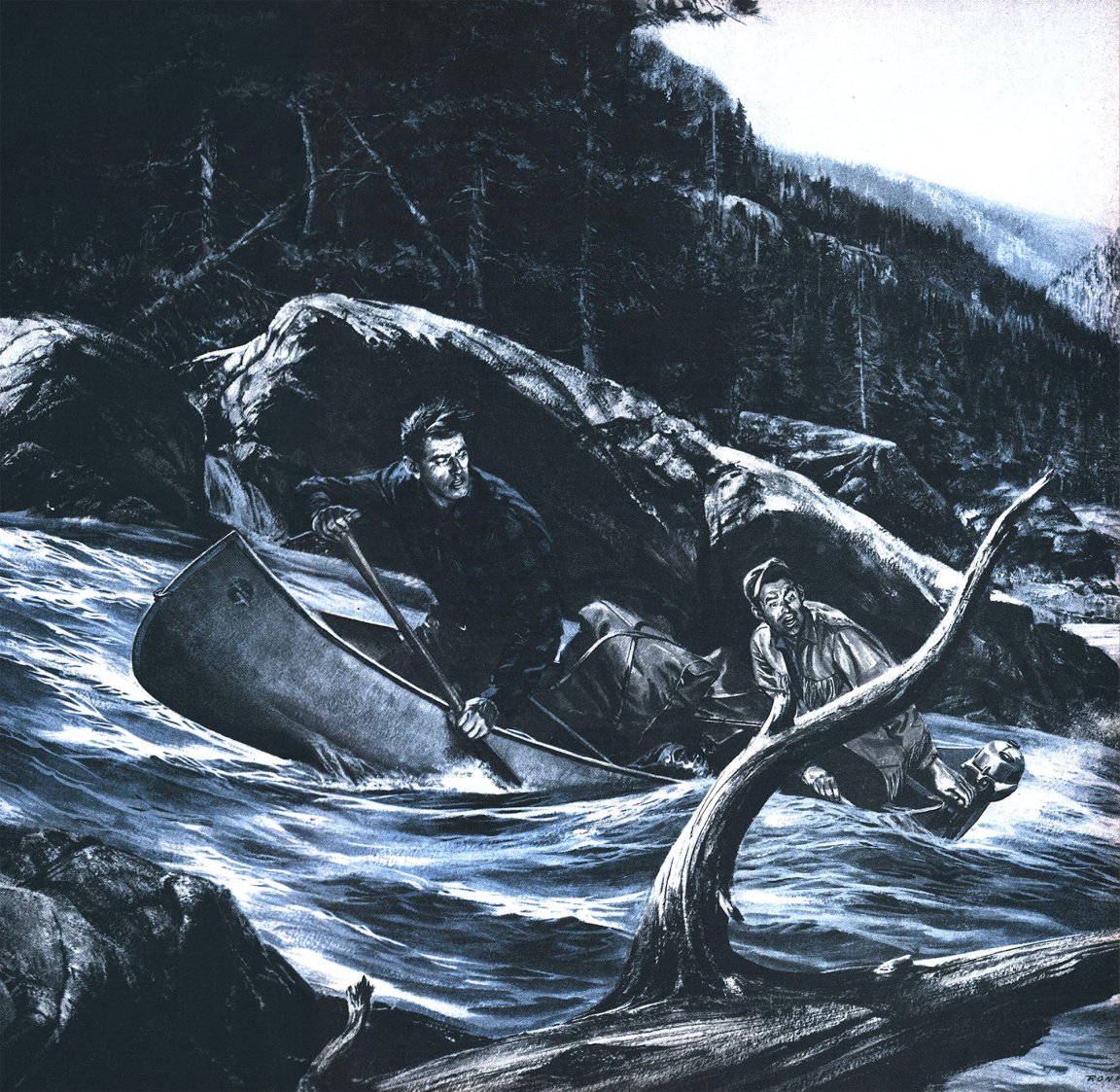
We slammed into the chute at full throttle and made it all the way to the top, but at the very lip the canoe lost headway, hung motionless for a second, then swung broadside and went careering back down with green water pouring — over the sides. Luckily we didn’t take enough aboard to swamp us, and when we shot out onto the pool below, sluggish but still floating right side up, we paddled meekly ashore, emptied the canoe, and did what we should have done in the first place — lined up.
We made seven portages that day, three of them real toughies, and when we stopped to camp there was no longer any doubt in our minds as to the difference between running a river upstream and down.
We were getting close to Pekagoning Lake now. The Turtle was a savage, brawling thing in this stretch, with rapids, falls, and gorges one after another ( I have flown over it in February and seen it running black and unfrozen through the white wilderness, too wild for the cold to fetter), and we found no evidence that other canoe parties had ever passed this way. The nights were chilly, with a touch of frost on the grass in the morning, and Gord and I sat in front of a cheerful fire that evening and speculated on how long it had been since a campfire had last winked in the dark at that spot.
Whatever marks the lumbering operations had left in this region had long since disappeared. There were no trails at the portages, so we made our own, hacking through brush as mosquitoes and increasing numbers of blackflies added to our troubles. But the wilderness scenery was as fine as any we had ever seen, and the fishing stayed almost too good to believe. Our muscles were hardening, and we were putting away whopping meals of fried walleyes, pancakes (20 apiece for breakfast the morning we reached Pekagoning), beans, and other good bush food, and we were enjoying every minute.
On June 11 we reached Charlie Robinson’s camp on Bending Lake and ate at a table for the first time in 10 days. That night Billy Harrison, Robinson’s chief guide, told us of a hotspot for big northerns in Smirch Lake, back the way we had come. We dropped down the Turtle next morning and made a half-mile carry into Smirch, but before we could get to the place Billy had pointed out on the map, a strong north wind started kicking up seas too high for our canoe. We found ourselves marooned in a little cove no more than 100 yards across, so we decided to try fishing where we were.
We didn’t take any lunker pike, but the walleyes and northerns in that small cove gave us all the action anybody could ask for. We let red-and-white wobblers down on bottom, and before we had cranked in 10 feet we both had our hands full. My fish was a three-pound walleye, Gord’s a northern weighing twice as much. They kept it up, and when we finally tired we had caught 20 walleyes, none under 2½ pounds, and 10 pike between five and seven. The northerns proved even better scrappers than those we had taken below Robinson Lake too, fighting at the top with almost as much vim as smallmouth bass. They jumped time after time, knifing up out of craters of water, unkinking in the air like steel springs as they tried to throw the
hooks.
We were wind-bound until almost sundown, and when it died we decided to save ourselves the long portage back to the Turtle by taking an alternate route Harrison had told us about, down the outlet of Smirch Lake to the lower end of Bending. We encountered rapids almost as soon as we left the lake, lined down the first reach, ran four more, and found ourselves confronting a final rough stretch where the stream tumbled into Bending. It didn’t look too bad, but in water of that kind looks can be misleading. We debated portaging or lining, but it was late and we were in a hurry, and we both thought we could let the canoe down safely. Gord took the rope and I trimmed a long pole for guiding the craft around rocks.
We should have carried. Almost down, the canoe jammed, swung sideways, and swamped. I jumped in, boots, clothes, and all, in the hope of saving the motor and gear, but the river was running like a millrace and everything happened so fast there was little I could do. The canoe couldn’t sink, but it filled in seconds.
We got off easier than we expected.
Our paddles, tackle boxes, and gas can floated free, and we recovered them without difficulty. Our cameras were in waterproof plastic bags and suffered no damage. We got the canoe ashore, dumped it, and when we finished picking up found we had lost only a few items of food. The kicker was drowned, forcing us to paddle the rest of the way. We got to Robinson’s place long after dark, but he had a lantern on the dock for us and hot coffee on the stove. Next day we took the outboard apart and dried it, and when we headed up Bending Lake on the last lap of the trip everything was in top shape.
We had come now to the end of our climb up the Turtle. The first portage would take us to the headwaters of the Kawashegamuk, and 1t would be downhill the rest of the way to Wabigoon. But we quickly discovered that that didn’t mean easy going.
The country flattened out, and just beyond Bending we came to portages of a new kind, through swamps and muskeg flooded by beaver dams. They were by far the worst we had run into. We battled our way across bogs and small streams all that day, seeing moose and flushing ducks by the hundreds. When we made camp on Kawashegamuk just before sundown we estimated we’d walked 12 miles, carrying heavy loads half of that distance. It had been our hardest day since we fought our way through the log raft.
We made 35 miles on June 15, down Kawashegamuk Lake in the face of a strong wind and then following the twisting river through bog and muskeg. Save for one short portage, the shores were almost all swampy. We did not find a place to land until we reached Dinorwic Lake.
We camped that night at the site of an abandoned Indian homestead on the narrows between Dinorwic and Wabigoon, expecting to finish the trip in an hour or so next morning. But the wind came up at daybreak and we had to feel our way along shore, keeping in the lee of points and islands. At 5:30 p.m., June 16, we made our last camp in a sheltered bay across from the town of Wabigoon where my friend Bill Rutledge was to meet us next morning. We had come 200 miles from Fort Frances — uphill the first 130 — made 32 portages, and finished right on schedule.
Read Next: A Freak Storm Flipped Our Canoe, and My Buddy Didn’t Make It. Here’s Where We Went Wrong
We knew at last what the Turtle River was like from Bending to Redgut Bay, and we also knew where to go back for some of the greatest northern pike and walleye fishing we will ever find.
The first thing we did after we got the tent up was shave, but we went about it reluctantly. We’d lived for 16 days in a lonely world of river and rock, rapids and portages, pools and muskeg. We had had a big chunk of far-off, unspoiled bush to ourselves, and we hated to leave it.