
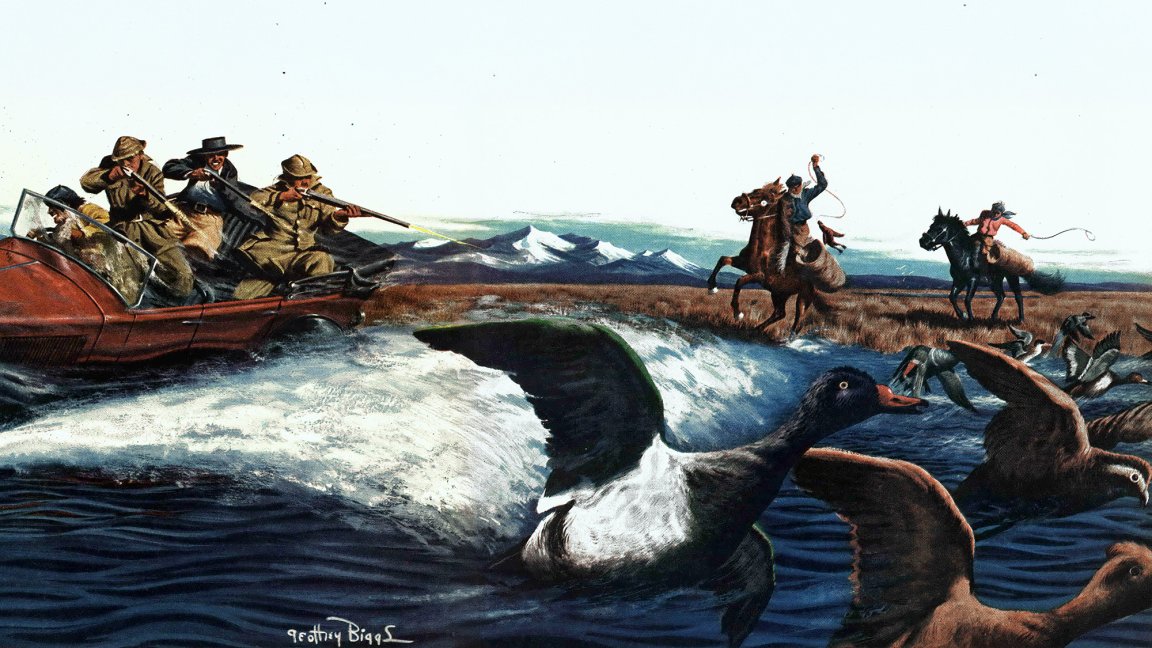
This story, “The Argentine Way,” appeared in the November 1953 issue of Outdoor Life. The author is known for his book, A Northwoods Rendezvous.
Mat Strother and I crawled on our bellies through the thin, parched grass of the Argentine pampas with the sun fairly frying our backs through our heavy shooting jackets. Ahead loomed a limitless expanse of flat grazing land, broken only by a near-by open pothole, glittering in the midday sun. But if our eyes stung with sweat, our mouths also watered in anticipation, for in that pothole, in plain view, hundreds of ducks were diving for their dinners. Mat sucked in his breath as he lifted his head for a wary look.
“Glory be,” he whispered. “It looks like all the ducks in the world have ganged up here.”
“Get down!” I snapped. “Or all the ducks in the world will take off for parts unknown.”
Silently, Mat and I continued to gaze at the marvel. Never in our years of hunting together all over North America had we seen ducks in such vast numbers or curious variety. We could pick out a few teal in the bunch, but most of the others were strangers, birds with curiously shaped bills and unusual markings. But regardless of their beaks or plumage, they were sure-enough wild ducks. They stood up on their hind ends to stretch and flap their wings, preened their breasts, and wiggled their tail feathers, chattering cheerfully to one another just like their Yankee cousins. This, to a pair of game-starved shooters, promised good gunning and still better eating. We pulled down our heads and crawled nearer.
We worked forward until we could see the gold coloration in some of their eyes. Even if they flushed wild we’d still get a couple of shots. We slipped off our safeties and sat on our heels. The ducks ignored us. We scrambled to our feet, guns ready — and those dumb Argentine ducks still went on about their affairs. Mat slipped his gun under his arm and clapped his hands. They didn’t stir. We yelled and whistled, waving our guns to make them fly. No action. Mat wiped the sweat from his eyebrows and shook his head.
“Beats anything I ever saw,” he grunted. “Argentine ducks must be deaf and dumb.”
“Let’s rush ’em,” I proposed, and we lumbered forward, yelling and waving our arms. The ducks didn’t even look up.
“Let’s give ’em a broadside.”
At the water’s edge, with a shoal of ducks almost underfoot, Mat raised his 12 and let go a single barrel right over their heads. The ducks eyed him curiously and went back to their dapping. Mat wiped his brow with his hat and pawed his sweaty hair. “Well, I’ll be —” he snorted.
Then a familiar voice broke in behind us. “My Yankee friends,” it was saying in an Oxford accent tinged with a trace of Spanish, “as I have warned you, it is not possible to shoot the Argentine ducks in the North American way, no more than you can shoot the North American ducks in the Argentine way.”
We turned to face Guillermo Leloir, whose family owned the estancia, or ranch, where Mat and I had been invited to shoot. Beside him, a broad smile on his round face, stood Jorge Luro, Señor Leloir’s friend and the pilot who had just flown us in from Buenos Aires. Both men wore I-told-you-so smiles. This was back in the prewar days, and they had been helping me in my negotiations with the Argentine government concerning a flock of scout-bombers. Señor Leloir had given me some sage counsel. Now he gave me some more.
“We Latins,” he said, “admire the initiative and enterprise of you North Americans, but as for your duck hunting—” He shrugged his expressive shoulders and walked away.
I glared at Mat as though it were all his fault. An old schoolmate, he was connected with the American Embassy at B.A. Dropping in on him one morning, I’d caught him sitting behind his desk with his duck gun in one hand and a trip string in the other, practicing his swing on a miniature duck as it soared across the room. Of course, that set-up could lead but to one thing, the present duck shoot and the accompanying warning from Señor Leloir.
“No one shoots the ducks in Argentina,” he had assured us. “So the pampas near one of our estancias fairly swarms with them. There you find many little lakes and ponds, each with vast numbers of birds on it. But, my friends,” he concluded, “these you cannot shoot in the North American way.”
Of course we two experienced wildfowlers had ignored the warning. That’s why we were standing there in the hot sun, complete with hip boots, heavy canvas coats, pants, and the other paraphernalia of the northern gunner. And our friends had the laugh on us.
Guillermo Leloir was a dapper young Argentine, dark and distinguished in the native gaucho costume he affected on his estancia. His smartly tailored, single-breasted jacket buttoned down the front, and his full-cut trousers were tucked into the tops of short leather boots, not with the careless abandon of a North American cowboy but with the smart dash of a boulevardier. A flat-topped, stiff-brimmed black gaucho hat sat jauntily on his head, secured by a loose thong tied under his chin. In this distinctive costume our young friend looked to be exactly what he was, an Argentine aristocrat.
Jorge Luro was a big, round-faced fellow in a loose business suit and a beret. One of Argentina’s pioneer sportsman-pilots, he had been the first to fly over the treacherous Andes Mountains. He had also raced automobiles in such classics as the Milan Grand Prix. Now, as he measured us in our strange regalia, he too smiled and shrugged his eloquent shoulders. Luro spoke no English, but he didn’t need to with shoulders like those.
Señor Leloir, waving toward the grove of Lombardy poplars bordering the formal gardens at the ranch house, suggested we return there for lunch. “After the lunch,” he said, “we will take our siesta, in the Argentine way, and then we will hunt the ducks also in the Argentine way.”
Lunch was an adventure in itself. We four sat around a long, carved, antique table in a room adorned with hunting trophies and Indian curios. Course after course was served us. When, after a while, half a broiled chicken was placed before me, I naturally supposed the main course had arrived. However, this turned out to be just another appetizer, topping off the asado for which Argentina is famous. For this they spread-eagle a dressed sheep on a long spit driven slantwise into the ground and barbecue it before a hot fire.
Even after that it was a long time before we finally came to the main dish — thick fillets of Argentine beef. During dinner Señor Leloir entertained us with vivid tales of the Argentine pampas, a subject as romantic to him as our West is to us.
“Our gaucho,” he remarked, pushing back his chair, “is like your cowboy — a wild, romantic fellow. You see, I’ve seen a great many of your movies. But unlike your cowboy, who appears to be a devil-may-care sort, our gaucho has long been a melancholy wanderer, often a fugitive from the military press gang or the sheriff. So he took to the wide-open spaces.
“A gaucho despises firearms,” he said. “His inside and his bolas are to him both weapons and implements of chase.” Stepping to the wall behind him, he lifted off an old bolas. It consisted of three round stones, each covered with woven rawhide shrunk tight, and each suspended separately from the common center by a short length of braided rawhide. Holding the bolas by its center, our host swung the balls in an arc overhead.
“In pursuit of an ostrich, for example,” he continued, “the gaucho rides at full speed behind the fleeing bird, twirling the bolas before he throws. The bolas, if well aimed, sails through the air and wraps around the legs of the bird, bringing it to earth. And it makes a wicked instrument with which to club a man to death.”
“What,” Mat inquired, “does the gaucho live on?”
“Meat and maté,” Leloir replied. “Meat such as you have just eaten, prepared in the form of the asado, and yerba maté such as you may now sample.”
A waiter had brought in a silver tray and set it in front of Señor Leloir. On it a silver teapot steamed over a spirit lamp, and a polished gourd, open at the top and decorated with heavy silver mountings, sat upright in a stand formed of silver leaves opening upward.
“Maté,” Señor Leloir instructed, pointing to the gourd. A long silver tube, something like a soda straw with strainer holes in its lower end, stood upright in the gourd. That was a bombilla, Leloir explained. Then he spooned what looked like tea leaves into the gourd. “Yerba,” he explained. “A bitter evergreen tea. Sometimes it is sold in your country as Paraguay tea.”
Our host slowly filled the gourd with steaming water from the silver kettle and let the brew steep awhile. Then he took a sip of the liquid through the bombilla and passed it to me. Sure enough, it tasted just like the Paraguay tea mother used to push on us kids with the sulphur and molasses.
Leloir stepped to a glass-fronted cabinet at the end of the room. He drew out an English shotgun and passed it around to be admired.
“Relatively few Argentines are bird shooters,” he remarked. “My father, who was educated in France, passed the sport on to me. I enjoyed the Scottish shooting while I studied at Oxford, and I’ve shot quail in Carolina, grouse and woodcock in New England and New Brunswick….”
Mat’s eyes began to sparkle. “What, no ducks?” he demanded.
Leloir grinned. “In Argentina, no,” he replied. “In America, yes. I hunted at Currituck in North Carolina, in Illinois, and especially for the mallard at Stuttgart, Arkansas.”
“Why not here in Argentina?” Mat insisted.
“In Argentina,” Leloir replied, “I prefer other sports. For example the perdiz, our South American quail, affords good shooting, though he is a runner and does not lie well like your bobwhite. But I am really more of a fisherman. Fishing for the dorada on the river Paraná is something which only your tarpon fishing can approach.”
Leloir rose and moved toward the door. “Let us now take our siesta,” he said. “After that we will have our duck shoot.”
We were aroused from our nap by the roar of an engine exhaust under our window. It was Luro in an ancient 12-cylinder touring car with a right-hand drive. The top had been removed. Luro raced the motor with its cut-out open, and the roar brought Señor Leloir from his room with two beautiful Purdey guns in his arms. Mat and I wasted no time getting downstairs.
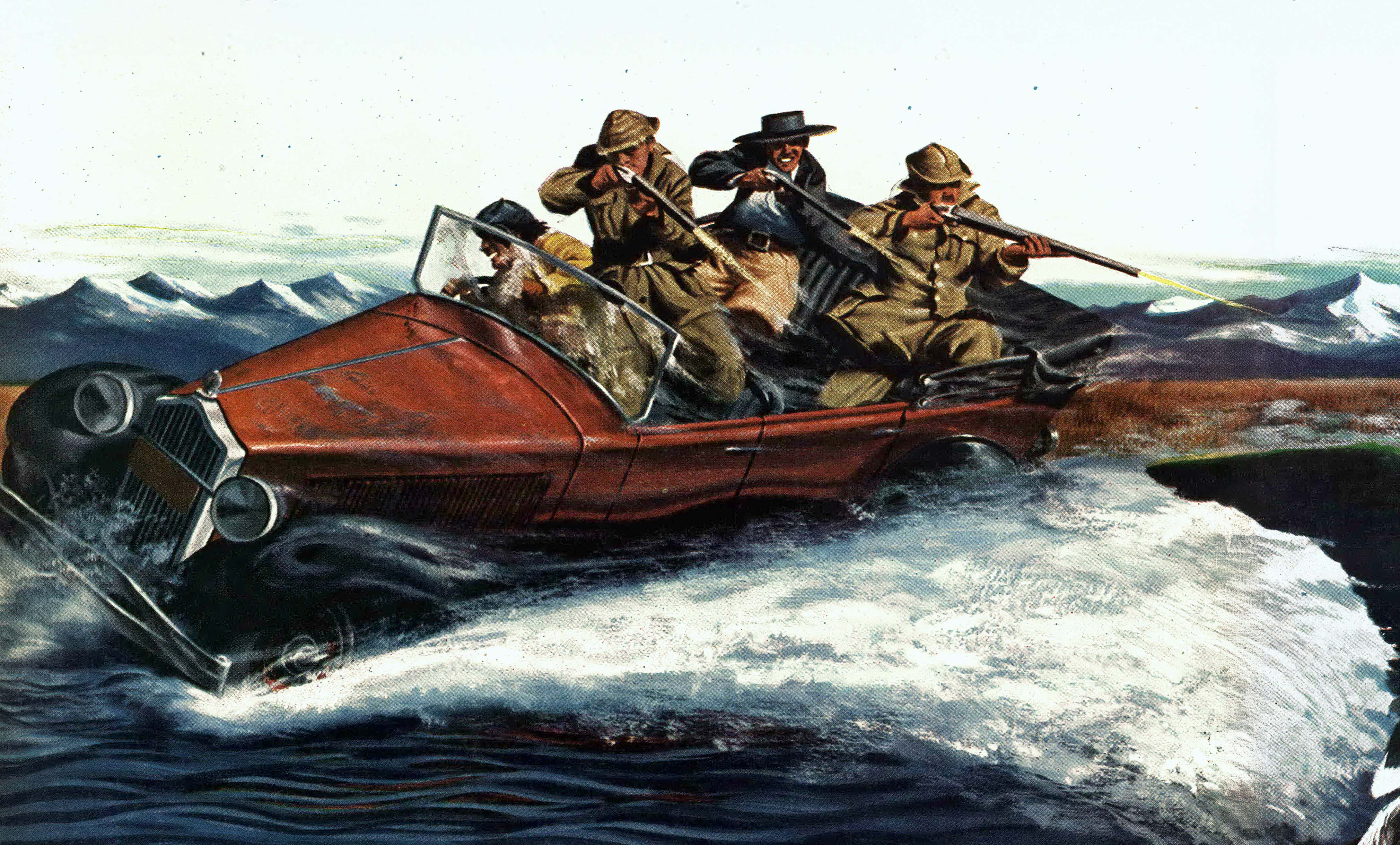
Mat sat in the front seat with Luro; I shared the rear one with Leloir. At my feet lay an open case of American shotgun shells. Then Luro raced the motor, Leloir barked a command, and we careened down the dirt road and through a gate. Swinging on two wheels, we roared out onto the open pampas, headed straight for the very pothole where Mat and I had met our Waterloo.
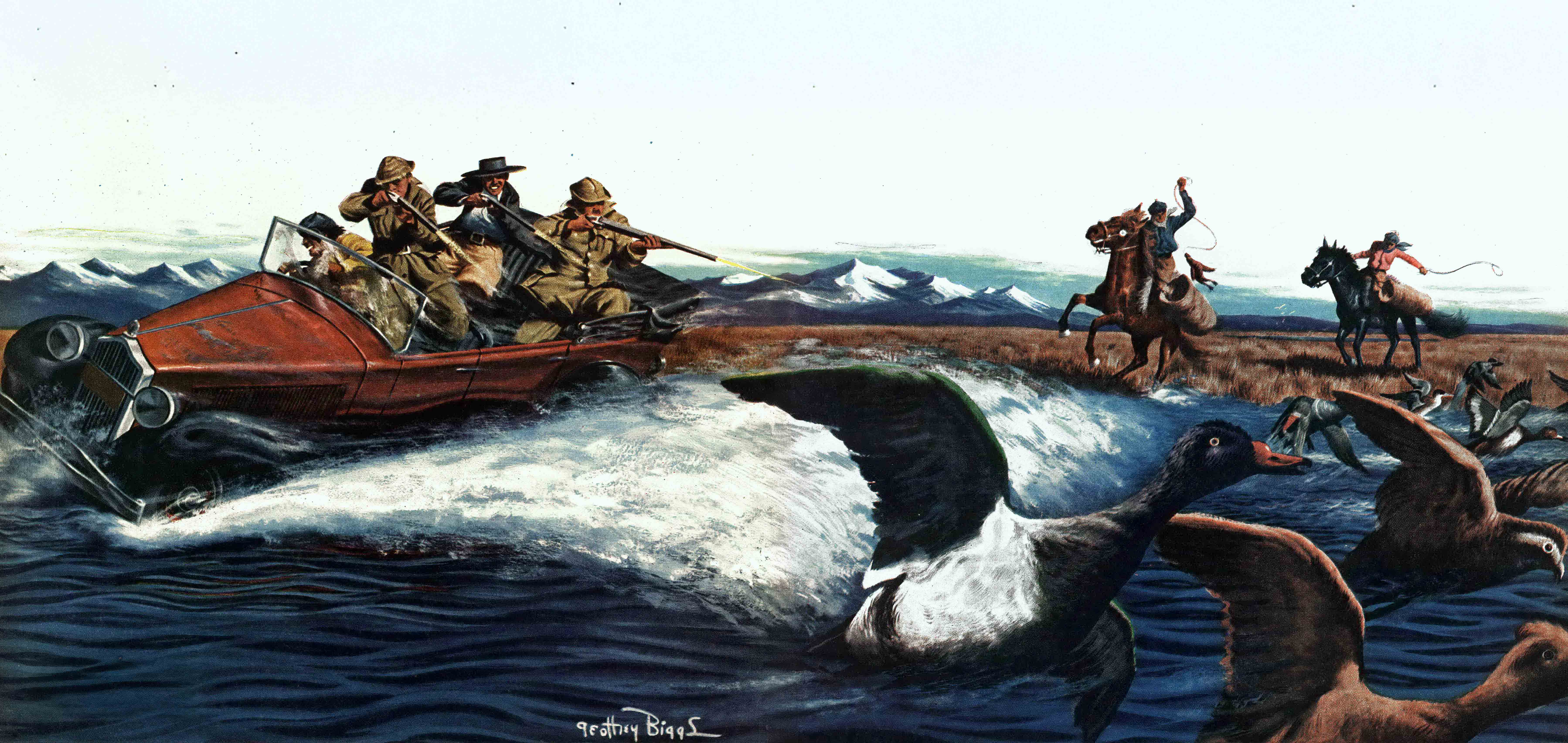
Driving like a wild Indian, Luro bore down on the big flock at the water’s edge. And he didn’t stop! The car leaped into the shallows and veered to the right, splashing a sheet of spray over the surprised wildfowl. Luro raced the motor with a terrifying roar. A shoal of squawking, protesting birds sprang into the air. Instantly we three gunners staggered to our feet, struggling to keep our balance in the pitching car, and blasted with both barrels. Out of the tail of my eye I could see birds splashing into the water. A few quail, scared up from the grass, mingled with the fluttering ducks.
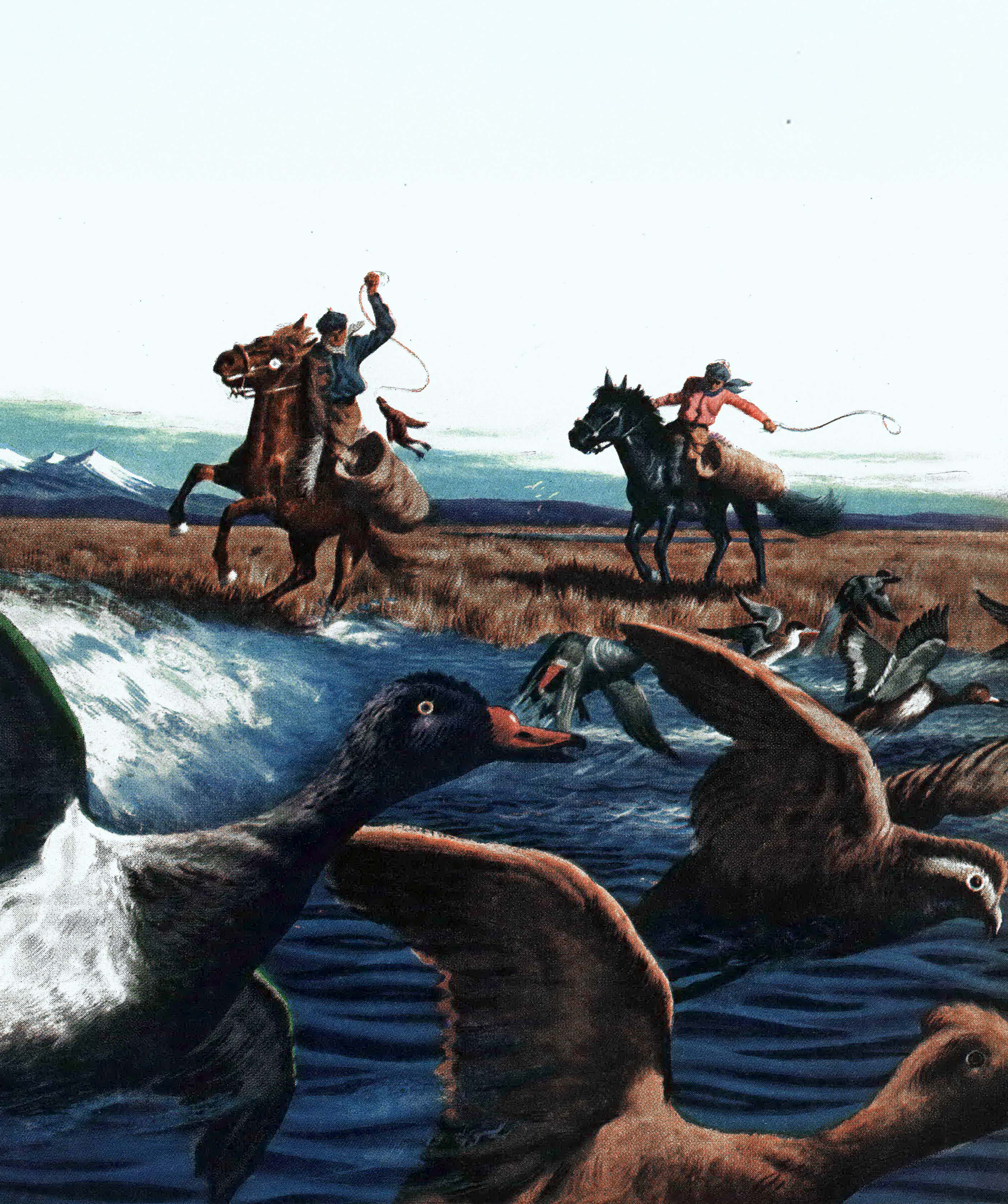
But our driver paused not for the fallen. Instead he tore off across the pampas, headed for another pothole. As the jolting car spilled me onto the rear seat, a corral gate opened and two gauchos rode hell-for-leather toward us. Splashing into the water at full speed, they yanked back on their reins, bringing their horses up with forelegs pawing the air. The gauchos, leaning from their saddles, snatched up the dead birds on long looped wires. Then they galloped after us in full cry. Mat’s eyes bulged.
“Good night,” he yelled. “Galloping gaucho gillies!”
Meanwhile the old car, hitting only the high spots, bounced across the pampas toward the next pothole. This time our pilot started his turn a little too late, throwing a deluge of water into the car. Wiping my eyes so I could see for a shot, I caught a glimpse of Mat standing straddle-legged on the front seat, firing with grim determination while rivulets ran down from his hat. Leloir swayed beside me, grinning, as Mat, the old war horse, let out a whoop that brought wild yelps from all four of us. Firing and yelling, we splashed more ducks into that lagoon, where the hard-riding gauchos swept them into their bags.
This was no easy shooting. In the lurching car it was hard enough to keep your feet, let alone swing and shoot. No sooner would we abandon one pothole than we’d be off across country for the next one, still yelling like Comanches. And judging by my own snapshooting, I began to have a sneaking suspicion Leloir was accounting for more than his share of birds.
On one run between potholes we flushed an enormous hare, far bigger than our Western jackrabbits and as swift as chain lightning. Our driver, watching the fast-jumping rabbit out of the corner of one eye, held the car behind him while we blasted with all we had. Then after we’d closed the range a bit, Leloir, who had not been shooting at the rabbit, sent him rolling head over heels with one shot. Leaving him to the mercy of our galloping gillies, we sped on to the next pond.
A short distance beyond this one, while we were trying to regain our balance in the car, Luro slammed the brakes on so hard I thought Mat would do a swan dive over the hood. Our pilot had sighted a perdiz speeding along a cowpath. As the car ground to a squealing stop, we leaped out and took off after the running bird. But he managed to keep just ahead of us, refusing to fly. Putting on a burst of speed that brought him into the air, I stubbed my toe on a hummock and sprawled flat on my face. Leloir dropped the bird with stylish grace.
Getting underway once more, we sought out bigger, better potholes, cruising the circumference of a wide semicircle with the tall poplars of the estancia as its center. This permitted the hard-pressed gauchos to cut cross-country and keep pace with us. Thus we sped from pothole to pothole, firing as fast as we could load, taking anything and everything that came our way, on the ground or in the air. After a while we lost sight of our gauchos.
By the time we completed a half-circle around the estancia, I was ready to call it a day, though Mat would probably have kept it up until dark. My shoulder ached from the recoil of one of Mat’s guns, which was too short for me, and the second finger of my trigger hand had a lump on it as big as a robin’s egg, where the trigger guard had bashed me. I was dripping sweat and my boots were half full of water.
Back at the estancia we spread our mixed bag on the lawn; and it was well mixed. Leloir sorted out the ducks and named some for us. Aside from the teal, which he said had probably migrated all the way from North America, these were purely local types. For instance, there were ducks with red bills and green feathers along the leading edges of their wings. Others were brown all over with dark bills. Among the quail, the perdiz chica was somewhat larger than our bobwhite and certainly a lot leggier. One variety of quail wore a topknot. The perdiz colorado, as large as a small hen turkey, was a mottled reddish-brown. Altogether we had collected over 50 birds, firing about 100 shells apiece.
Mat and I were both enthusiastic, and of course that made our host happy.
“What is your honest opinion of this hunting?” Leloir asked me.
“Well,” I hedged, “I miss some things. For instance, I like to break out of a warm bed before dawn and hustle into the warmest gear I can find. I like to feel my way down to the marsh where the punt lies on the shore, and to hear the crackle of skim ice as I pole her down the creek to the blind. Then too, it’s nice to sit there behind fresh-cut cedars, shivering with excitement, fondling your old 12 as you listen to the whistle of wild wings.
“Better still, I like to watch the birds dipping and tipping up among the decoys while the dawn breaks, and to listen to their chatter as they feed among the shallows. Then, just before sunrise, I like to stand up in the blind and watch them spring out of the water, quacking and protesting. Then they straighten out and you drop a nice double. Best of all, I like to watch my old springer as he jumps into the icy water to retrieve the duck. And when, finally, he lays the birds down at my feet and looks up for a word of approval, I quit shivering and glow all over, happy just to be out there.”
I stopped for breath. Leloir was translating it for Jorge Luro. When he finished, both of them smiled.
“And besides,” I went on, all warmed now, “between the retrieving of a good springer and a hard-riding gaucho, I go for the dog every time.”
Read Next: Here’s What Firing 1,000 Rounds a Day in Argentina Will Teach You About Wingshooting
Señor Leloir slapped his leg and laughed. “That’s it!” he cried. “Just what I was telling you. That’s the North American way. There’s nothing I like better myself — when I’m up north.”
I grinned. “And if I can’t get the home-grown product,” I said, “I’ll take the Argentine way anytime!”