
We may earn revenue from the products available on this page and participate in affiliate programs. Learn More ›
Most of us judge a laser rangefinder by its obvious attributes. When we peer through the lens and press the ranging button, does it deliver an accurate and consistent distance to the target. Done and done. But when it comes to sorting out the best rangefinders for hunting, we need to dig a bit deeper.
A few curious members of our community navigate the mode commands, and learn that their range-u-lator can also measure incline, temperature, elevation, and altitude and apply a prodigious amount of ballistic calculation to make us more lethal hunters.
Ours is a test of these multidimensional monoculars, those that carry ballistic software, ranging reticles, and even navigation capability. Because not every hunter and shooter needs or wants that capability, we include a few point-and-shoot units fully worth your attention. This year’s field was among the most exciting we’ve seen with both high value and the latest technology. Here are our picks for best rangefinders for hunting from our 2026 optics test.
- Editor’s Choice: Garmin L60i
- Great Buy: Vortex Triumph HD 850
- Bushnell R5 Broadhead 2
- Sig Sauer Kilo8K-ABS Gen II
- Leupold RX-5000 TBR/W
- Bushnell R5 2000 AB
- Leica Rangemaster CRF Max
Editor’s Choice: Garmin L60i
Pros
- Integrates Garmin’s mapping with rangefinding
- Onboard Applied Ballistics Elite solver
- Compatible with Garmin Explore app
- Best glass and coatings in the category
- Precise 0.5-MRAD laser beam divergence
- Powered by twin AAA batteries
Cons
- At nearly $2,500, pricey
- One-year warranty well below category norms
Key Features
- Augmented reality display overlay
- Contains Garmin’s extensive mapping library
- Measures distance between points
- Waypoint dropping well beyond laser range
- Tripod mountable
Garmin’s entry into the laser rangefinding market has had such a seismic effect on the category that once you use the L60i, LRF monoculars that simply measure distance and spit out a ballistic solution are so two-dimensional. By adding an augmented reality display that leverages Garmin’s extensive digital mapping services, the rangefinder becomes a first-rate wayfinder.
It’s impossible to overstate the ambition of this device. Garmin has managed to pack so much mapping horsepower in this handheld unit that it is being used by search-and-rescue agencies to locate wayward folks, by explorers who want to see what’s on the other side of a blind ridge, and by hunters who want step-by-step navigation to the spot they sighted that cross-canyon buck, even if they approach from the opposite direction.
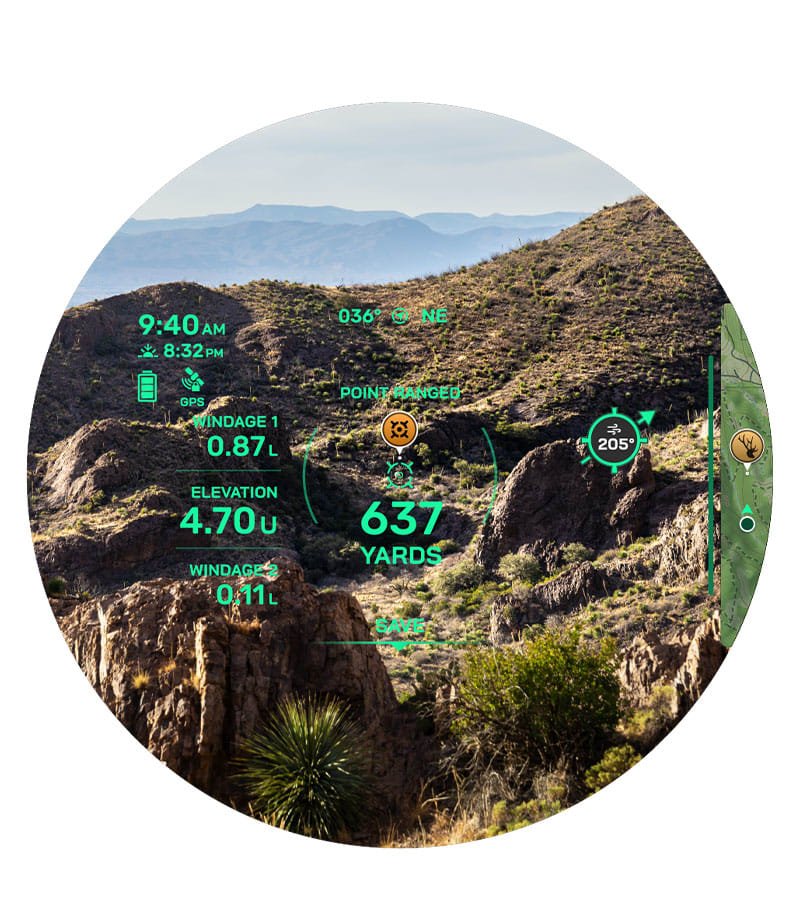
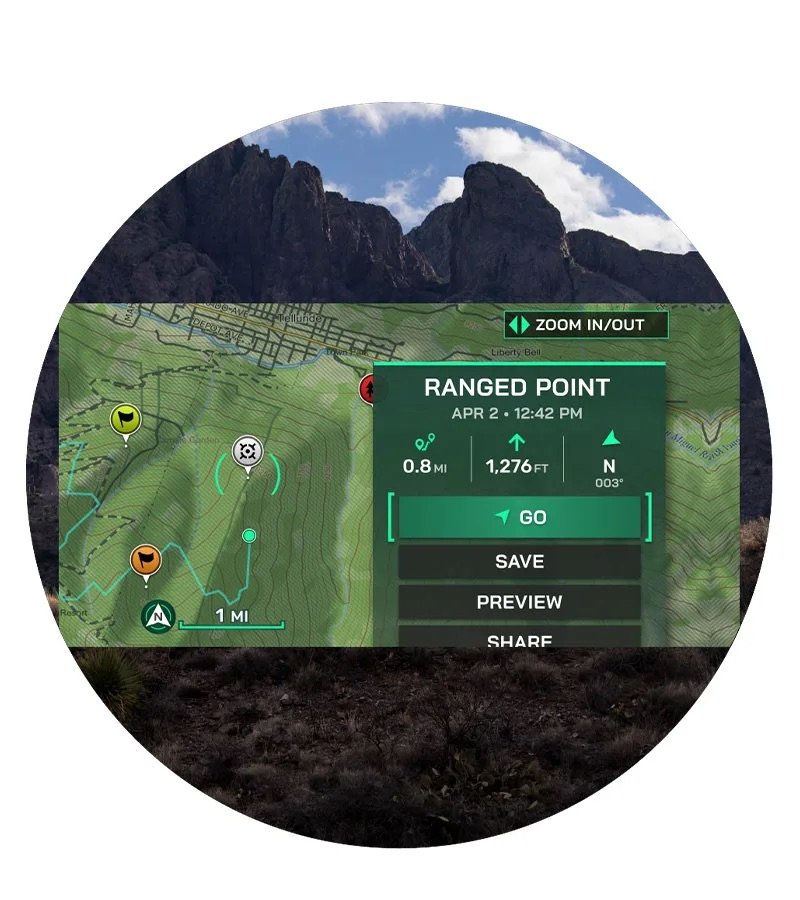
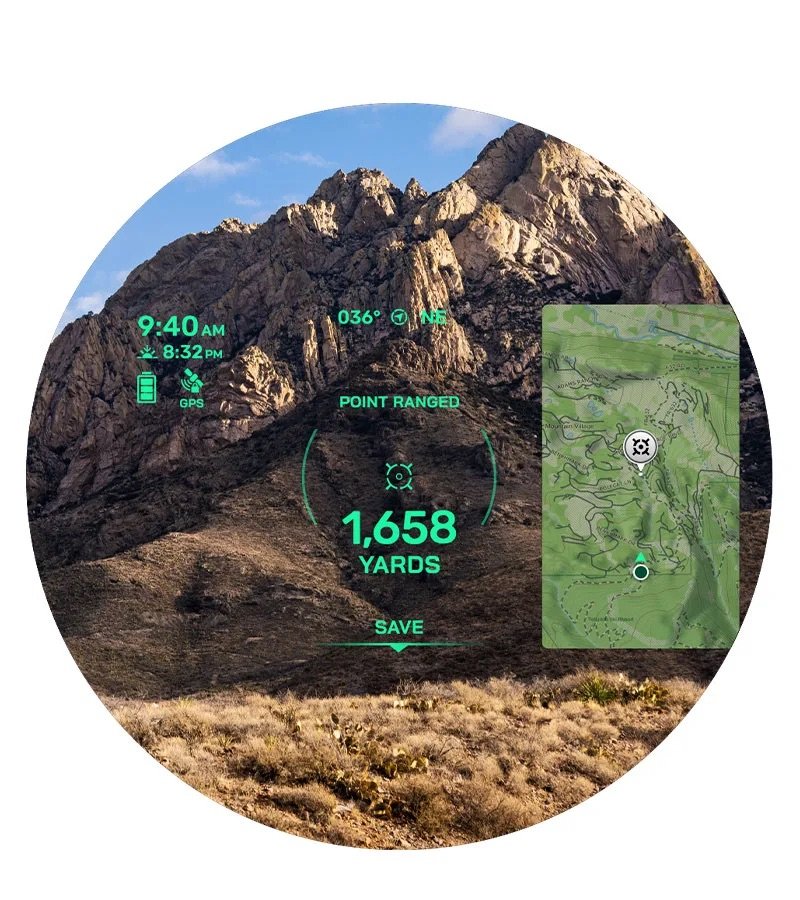
The L60i communicates its mapping capabilities via a see-through overlay inside the display that seems at times like it’s an alternative-reality headset. You can see the real world of terrain through the glass of the optical system, but the display drops over the seen landscape a digital veil of landmarks, distances, navigation arrows, and waypoints. Operationally, this means you can find waypoints from any direction. Practically, it means the Garmin’s distance isn’t limited by its laser beam but by its optical gaze. If you can see a landmark, even 20 miles away, you can drop a waypoint on it using Garmin’s onboard map.
But the unit is also a first-rate laser rangefinder. Garmin rates its ranging capabilities in two very different conditions: full sunlight and optimal conditions. Those of us who have used laser rangefinders in full daylight know that the laser bounces off all sorts of reflective objects, limiting its precision. To get the best distance readings, you want to laze objects under cloudy skies or just after the sun has set. Garmin claims the L60i can range reflective targets out to 7,500 yards in optimum conditions, or to 5,500 yards in full sunlight. We got nearly those readings in our testing.
The Garmin also has a first-rate ballistics solver onboard, thanks to its long relationship with and now ownership of Applied Ballistics. It leverages the integrated AB Elite software or AB Quantum software via the Garmin app to provide not only ballistic groupings but the specific performance of custom loads out of your particular rifle. It links to Kestrel wind meters. It includes an archery mode and an extended-range ballistics mode for ranging out to nearly 8,000 yards. But it also links to the universe of Garmin devices, from dozens of smart watches to the company’s myriad GPS devices.
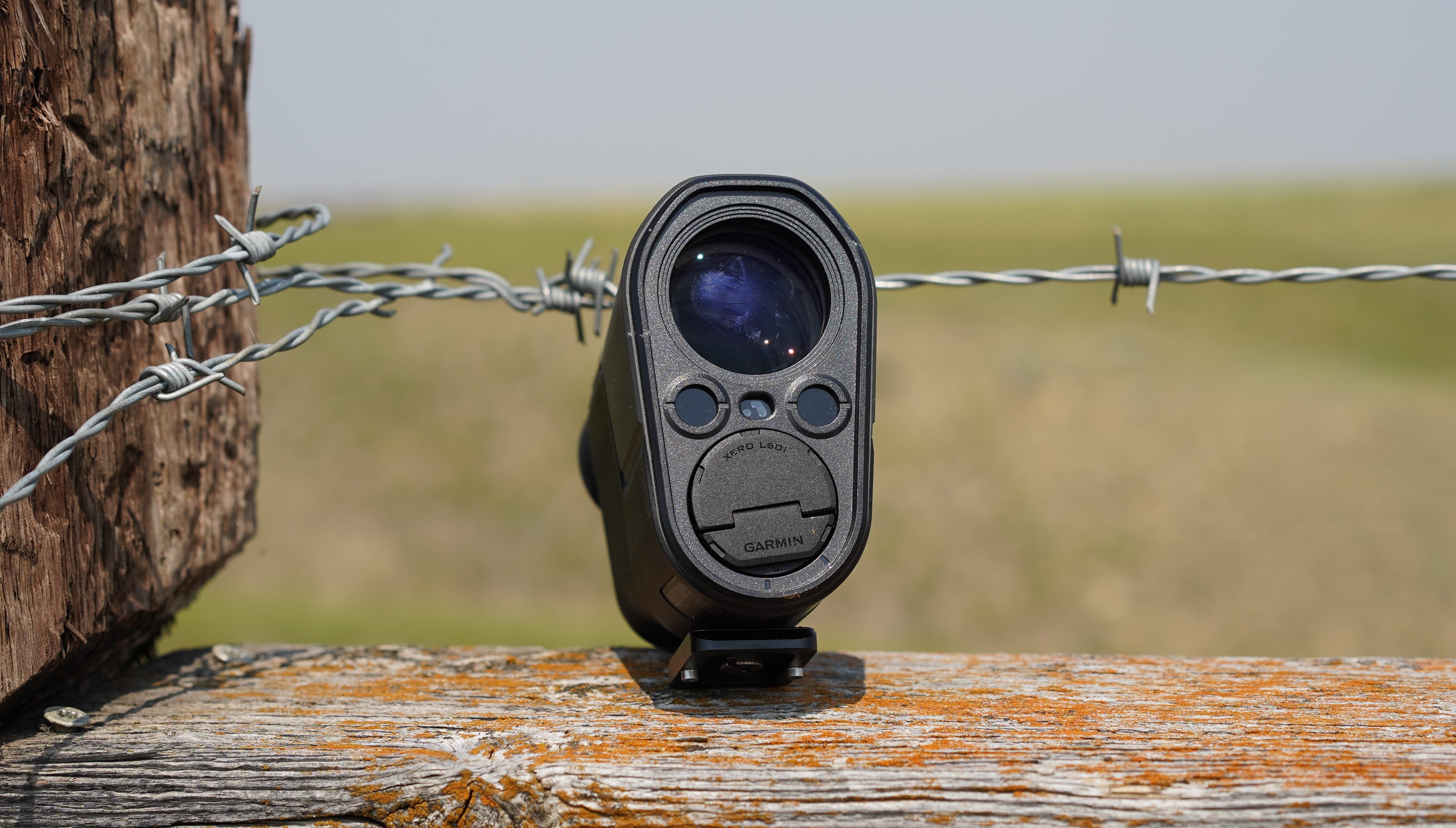
The unit is among the largest and heaviest (13.6 ounces with twin AAA batteries on board) LRF monoculars we’ve tested, but that heft settles nicely in hand. To get the best out of the unit’s extended range, mount it to a tripod via the threaded adapter on the underside of the monocular. But hand-holding the unit is the best way to enjoy its mapping features, because the heads-up overlay moves seamlessly with the landscape as you pan. The Garmin is at its best with both the rangefinding and mapping features employed. Laze a distant target, acquire the ballistic solution to make a shot (or not), then drop a waypoint on the target location. Now, employ the unit’s graphic overlay to not only “see” the waypoint on a topo map, but actually navigate to it, even if you approach from a different direction. Highlighted prompts give you step-by-step directions to the waypoint. The effect is surreal, as though you are watching yourself from the perspective of an eagle. Or a satellite.
This out-of-body experience is not only useful for the pedestrian tasks of hitting targets and retrieving game, but also for exploring your world both in your boots and from far above. By harnessing the best attributes of Garmin’s mapping library, applying an excellent ballistics package to the task, and then connecting both through devices, apps, and digital ecosystems, Garmin has elevated the LRF monocular to something that approaches the first do-everything handheld device on the market.
Outdoor Life’s testers approached the Garmin L60i with a dose of skepticism. Could an LRF monocular really drop waypoints 20 miles or more away? Could its heads-up display really be visible enough to be useful? And wasn’t that $2,500 price tag simply too precious? By the end of our test, every question had been resolved to our satisfaction, excepting the cliff-hanger: Whatever in the world will Garmin dream up next?
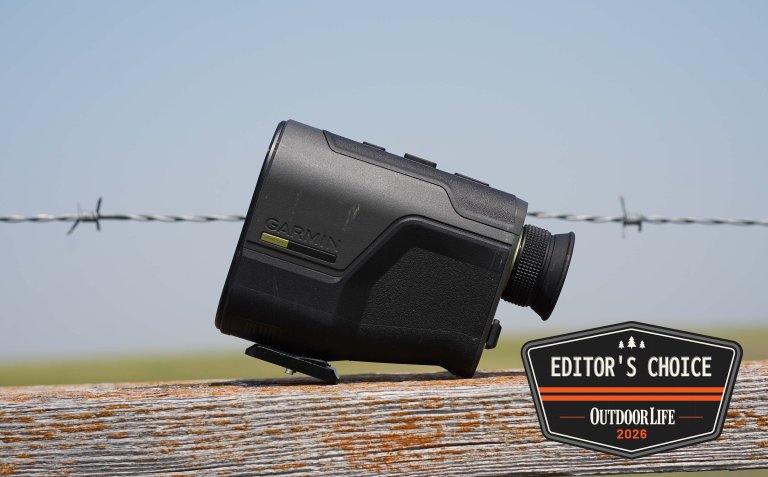
For its astonishing capabilities, its ability to perform as a ballistics-solving LRF at a high level, and the audacious ambition of the device, the Garmin L60i is the consensus winner of Editor’s Choice as the standout LRF monocular of the year.
Garmin L60i 7×32 Specs
| Stated Maximum Range (optimum conditions) | 7,500 yards reflective, 4,000 trees, 3,000 game |
| Stated Maximum Range (full sun) | 5,500 yards reflective, 2,000 trees, 1,500 game |
| Tested Range | 4,300 yards reflective, 2,812 trees, 1,800 game |
| Minimum Range | 5 yards |
| Ranging Modes | Scan, general, archery, Applied Ballistics |
| Target Modes | First, best, last, extended range |
| Ballistics Solver | Onboard Applied Ballistics Elite, AB Quantum through Garmin app |
| Reticle Options | 5 |
| Display Type | Full-color, high-resolution Digital Light Processing |
| Wind Feature | Connects to compatible anemometers |
| Mapping Feature | TopoActive mapping, Garmin Connect |
| App Connectivity | Garmin Connect |
| Weight | 13.6 ounces |
| Warranty | 1 year |
Great Buy: Vortex Triumph HD 850
Pros
- Ridiculously low real-world price of under $100
- Decent range and speed
- At 4.6 ounces, very light and compact
- Elevation mode suits treestand hunters
Cons
- Washed-out display
- Slow scan mode
Key Features
- Line-of-sight, angle-compensating, and scan features
- Normal, first, and last target modes
- Ships with soft carrying case
- Fully transferable lifetime warranty
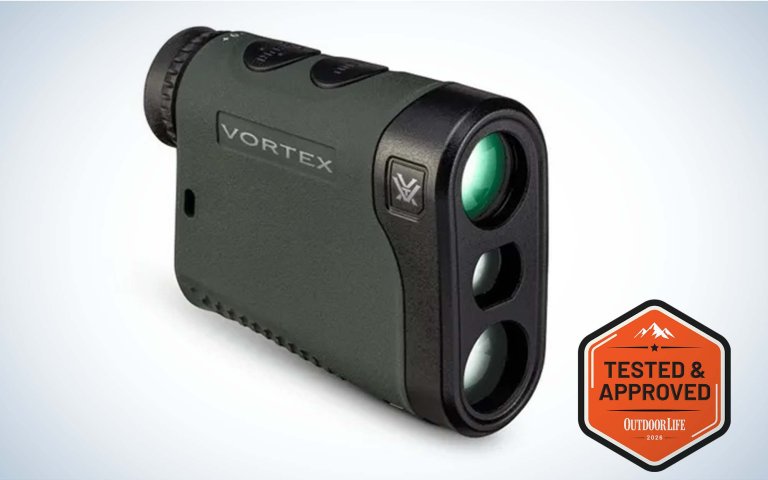
An 850-yard rangefinder for under $100? That’s not only about 12 cents per yard, it’s a crazy value for a starter monocular or for hunters and shooters who don’t often shoot over a quarter mile.
The Triumph HD 850 continues Vortex’s product line that provides good performance and amazing value, with full warranty coverage. The Triumph line announced itself with the very good 10×42 binocular that has a real-world street price of about $100. Like the binocular, the HD 850 will get the job done, assuming the job is mid-distance ranging, without a lot of extraneous features or particularly good optics.
Vortex claims a range of 850 yards on reflective targets and 350 yards on game. We actually got pretty close, ranging metallic targets out to 680 yards and deer at 325 yards. The LRF has the typical modes: normal, first, and last target modes and line-of-sight and angle-adjusted ranging mode, along with a fairly sluggish scan mode.
The unit has a liquid crystal display that appears washed out against some backgrounds. The ranging engine is noticeably slower than the top LRFs in our test, but it’s just fine for most purposes. Note that the Triumph HD 850 doesn’t have a ballistic solver or location pinning or any of the features you might see in a unit that links to a phone app. But its angle-compensating mode and minimum ranging distance of 6 yards makes it a good choice for bowhunters. It’s also a good unit for shotgun hunters, straight-wall carbiners, and other hunters and shooters who shoot large-caliber bullets that drop quickly, and where knowing the specific yardage inside 300 yards is the difference between a clean miss and a killing shot.
The optics are pretty tough, and the plastic unit feels a little flimsy, but its 4.6-ounce weight and compact build make it a good choice for go-light hunters or a treestand hunter who doesn’t want, or need, a heavy ballistic-calculating rangefinder.
For all its remarkable value packed in a no-nonsense build and its ability to perform the basics we require of a laser rangefinding monocular, the Vortex Triumph HD 850 wins our Great Buy award as the great bargain of the year in laser rangefinders.
Vortex Triumph HD 850 5×21 Specs
| Stated Maximum Range | 850 yards reflective, 500 trees, 350 game |
| Minimum Range | 6 yards |
| Tested Range | 680 yards reflective, 510 trees, 325 game |
| Ranging Modes | Scan, line-of-sight, and angle-adjusted |
| Target Modes | Normal, first, last |
| Stated Accuracy | 0.5 yards at 100 yards |
| Ballistics Solver | None |
| Reticle Options | 1 |
| Display Type | Segmented black LCD |
| Wind Feature | None |
| Mapping Feature | None |
| App Connectivity | None |
| Weight | 4.6 ounces |
| Warranty | Fully transferable lifetime |
Bushnell R5 Broadhead 2
Pros
- Auto-adjust ActiveSync display
- Extremely grippy handling
- Multiple reticles
- Fast ranging for mid-range LRF
- Lifetime warranty
Cons
- No ballistic solving capability
- Plastic housing is loud
Key Features
- Silent push-button operation
- ActiveSync display changes from red to black
- Includes best-in-class VaultLite pouch
- Bushnell’s proprietary optical coatings
- Arc mode for rifles and bows
- Tripod mount
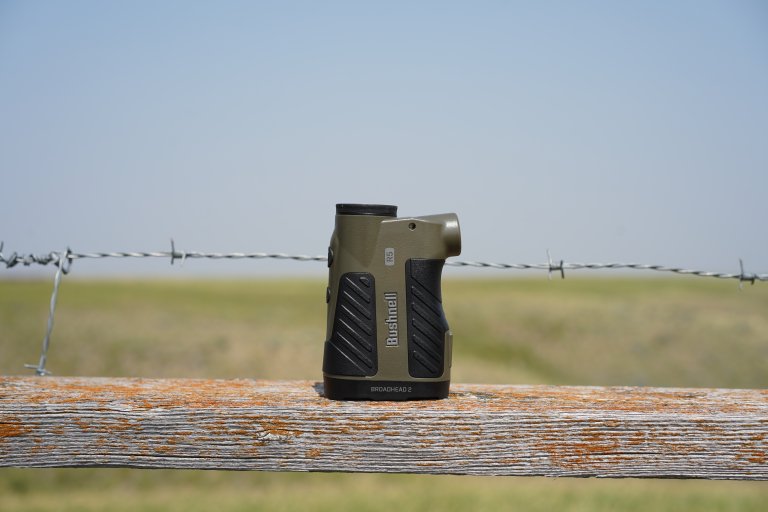
Bushnell has added some tasty updates to this workhorse LRF. The Broadhead 2 has Bushnell’s very good proprietary weatherproofing coatings that boost contrast and should make the unit more usable in drippy weather. Speaking of grubby conditions, the LRF’s Brush/Fog mode, which prioritizes farther targets, has a powerful update in this generation of the Broadhead. It’s a logic that discourages the laser from picking up reflections off water droplets, and Bushnell’s works quite well.
The second-generation Broadhead retains Bushnell’s ActiveSync display that sounds on the surface like a gimmick but is a very useful feature. Sensitive to light intensity, it runs black LCD in daylight conditions but automatically turns to a red illumination in twilight. It’s a clutch attribute that allows the display to pop against any background or light condition.
We really like the overbuilt VaultLite rangefinder pouch, which has useful hardware for belts, and we like the pistol grip of the unit. The protruding outline of the rearward battery compartment serves as a “hook” that grabs the hand, whether gloved or not, and helps stabilize the very light (6-ounce) monocular.
And we like the tripod mount on the belly of the unit. That’s a nice touch for those using the Broadhead at its most-distant ranges when precision is important.
The Broadhead 2 didn’t especially wow us with its optics, ranging horsepower, or menu navigation. All are fine, and just what you should expect from laser rangefinders at this price and ranging engine.
It may take users a bit of time to get used to Bushnell’s nomenclature. “Regular” mode is line-of-sight mode. “Bow” mode is the angle-compensating mode, which Bushnell calls its “ARC” feature. “Fog” mode is called “last target” by some manufacturers and Bushnell’s “Bullseye” mode is what most LRF users know as “first target” mode.
The Bushnell R5 Broadhead 2 is a great choice for bowhunters and rifle hunters and shooters who need to reach out to uncomfortable distances. The lack of a ballistic solver holds it back from being used by shooters who require more of an LRF than just range. But it’s a solid rangefinder in the middle of a very competitive pack.
Bushnell R5 Broadhead 2 6×25 Specs
| Stated Maximum Range | 2,000 yards reflective, 800 trees, 500 game |
| Minimum Range | 5 yards |
| Tested Range | 1,660 yards reflective, 695 trees, 475 game |
| Ranging Modes | Scan, line-of-sight, and angle-adjusted |
| Target Modes | Normal, bullseye, brush/fog |
| Stated Accuracy | 0.3 yards at 150 yards |
| Ballistics Solver | None |
| Reticle Options | 5 |
| Display Type | ActiveSync red and black |
| Wind Feature | None |
| Mapping Feature | None |
| App Connectivity | None |
| Weight | 6 ounces |
| Warranty | Fully transferable lifetime |
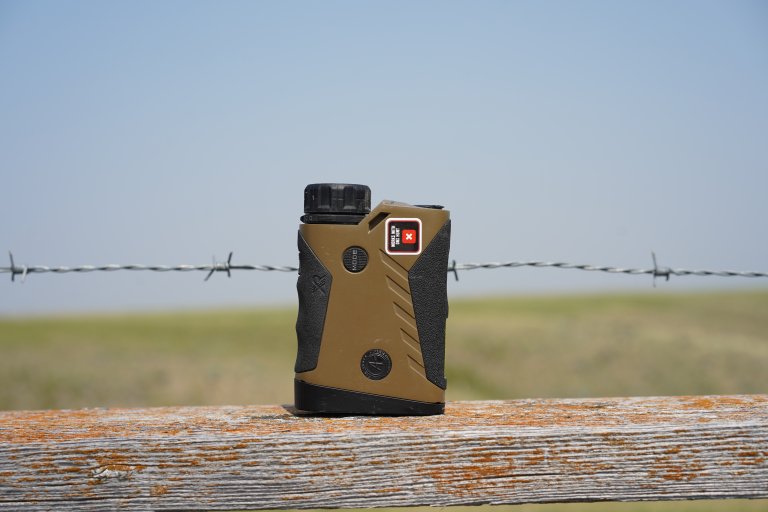
Sig Sauer Kilo8K-ABS Gen II
Pros
- Impressive 8,000-yard range
- Onboard Applied Ballistics Elite solver
- Connects to BDX-enabled Sig devices
- Assembled to MIL-SPEC by Sig’s Special Weapons Group
Cons
- At $1,500, fairly pricey
- Lacks tripod adapter
Key Features
- AB Elite’s entire bullet library onboard
- Improved optics and display
- Includes XR (extended range) mode
- Drops waypoints on variety of mapping apps
- Includes Sig’s new archery mode
The Gen II version of Sig’s excellent Kilo8K-ABS rangefinding monocular is more powerful, brighter, and connects to a larger galaxy of mapping and ballistics apps. In other words, it’s almost a brand-new laser rangefinder.
Its engine even got an upgrade. The Kilo8K-ABS Gen II runs on Sig’s new LightWave DSP, which returns four readings a second in scan mode, even out to a mile. Its return is snappy, precise, and confident, and new coatings and optics make the active-matrix display pop. The display is worth a few sentences. Some manufacturers are so busy crowding information in their display that the result is a confusing thicket of distance, ballistics solutions, angle, temperature, and mode. Sig has done a nice job of simplifying the display to just the elements needed to make a quick shot: the range, and the come-up and wind holds. In the field, it’s fast and simple.
The lazing power of the unit is simply stunning. In extended-range mode and strapped to a tripod, I was able to range grassy hillsides at 6,200 yards without much trouble. I worked on getting the claimed 8,000 yards out of the unit, but couldn’t quite get there. The impressive part to me isn’t the distance, it’s the speed of the DSP engine.
The onboard Applied Ballistics Elite software is similarly impressive. You can tack up the data by connecting to the AB Quantum app, but you don’t need to. The entire ballistics library is in the palm of your hand, almost quivering in the 7.5-ounce monocular that’s begging to be put to work. That the unit also connects to Sig’s BDX devices, including BDX-enabled riflescopes, gives this monocular even more utility.
There are a lot of choices on the market for ballistics-solving LRF monoculars. At first glance, the price of the 8K-ABS Gen II (just under $1,500) seems excessive, but when you consider its ability to quickly and precisely range, then deliver an equally fast and verified aiming solution out to 4.5 miles … I don’t know that I’d call the Sig a bargain, but it’s a very good deal for hunters and shooters who intend to take it to its impressive limits.
Sig Sauer Kilo8K-ABS Gen II 7×25 Specs
| Stated Maximum Range | 8,000 yards reflective, 2,500 trees, 2,000 game |
| Minimum Range | 6 yards |
| Tested Range | 8,060 yards reflective, 2,300 trees, 1,850 game |
| Ranging Modes | Extended range, archery, angle-modified range |
| Ballistics Solver | Applied Ballistics Elite |
| Reticle Options | Circle, milling grid |
| Display Type | Active-matrix red OLED |
| Wind Feature | Connects to several wind meters |
| Mapping Feature | Drops pins on several mapping apps |
| App Connectivity | Sig’s BDX app, AB Quantum app |
| Weight | 7.5 ounces |
| Warranty | Sig Sauer Infinite Guarantee (lifetime) |
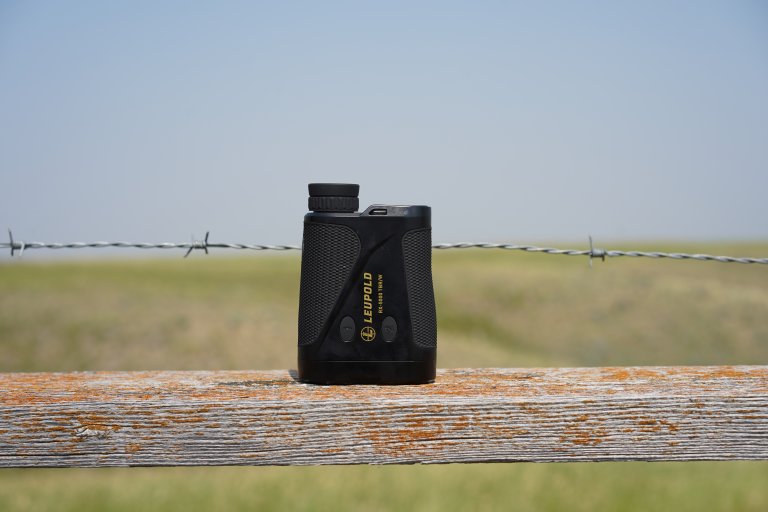
Leupold RX-5000 TBR/W
Pros
- Three-month onX Hunt subscription with purchase
- Uses Hornady’s 4DOF ballistic solver
- Bow mode powered by Precision Cut Archery solver
- Remotely drops pins on digital mapping apps
Cons
- Requires included “saddle” to mount to tripod
- At about $800, fairly pricey
Key Features
- Long-range mode extends range to 5,000 yards
- Connects to Leupold’s excellent
- Control app
- Drops pins on variety of mapping platforms
- TBR/W mode leverages 25 ballistic groups
We’ve seen Leupold’s RX-5000 before. Two years ago, we gushed about its ability to remotely drop onX pins just by lazing a distant spot and then pinning the location to the digital map on your phone. It’s a useful feature, but Leupold’s competitors have made it standard on so many LRF monoculars and binoculars that it’s no longer novel.
But a lot has changed with this little handheld marvel since then. Its ballistics solvers are now powered by Hornady’s excellent 4DOF software, its bow mode borrows from Precision Cut Archery software, and its mapping feature is not limited to onX Hunt. You can drop pins on maps from Deercast, HuntStand, and both Apple and Google maps. Those updates are enough to include it in this roundup of new LRF monoculars because, while the form factor and operation are pretty much the same, the guts of the RX-5000 are new and galaxies more powerful and useful than the original.
That form factor is worth mentioning. While many sub-$400 LRF monoculars feel flimsy, the Leupold has a tight, metallic heft that settles nicely in hand. We wish the unit had a tripod adapter built in, but the tripod “saddle” that Leupold ships is a good addition, and it’s necessary to get the most out of the RX-5000’s long-range chops. With the unit stabilized on a tripod, we were able to get ranges very nearly to 5,000 yards, and when you add Hornady’s 4DOF ballistic solver to that extended distance, it’s both imaginable and possible to hit targets at that extreme distance.
The optics in the Leupold are excellent. The 8-power magnification combined with the relatively large 30mm objective make this a pretty good glassing unit. But the value proposition, of course, is the ballistics paired with the fast and precise ranging engine. Given the huge amount of ballistic computations, the powerful laser, the excellent Leupold Control app, and generally clear and intuitive navigation, you could make the case that the 799RX-5000issotalentedthatitcouldundercuttheequallyimpressivebutpricey(3,900) BX-6 Range HD, Leupold’s new LRF binocular.
Leupold RX-5000 8×30 Specs
| Stated Maximum Range | 5,000 yards reflective, 3,100 trees, 2,000 game |
| Minimum Range | 6 yards |
| Tested Range | 4,660 yards reflective, 3,025 trees, 1,800 game |
| Ranging Modes | Long-range, line-of-sight, bow, TBR |
| Ballistics Solver | Hornady 4DOF, Precision Cut Archery |
| Reticle Options | 3 |
| Display Type | Red OLED |
| Wind Feature | Leupold Wind |
| Mapping Feature | Pins location to several mapping apps |
| App Connectivity | Leupold Control |
| Weight | 9.7 ounces |
| Warranty | Lifetime on optics, 5 years on electronics |
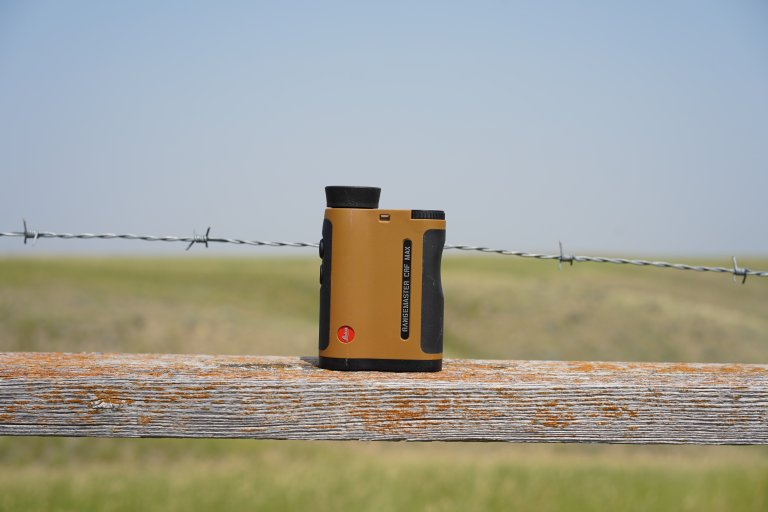
Leica Rangemaster CRF Max
Pros
- Leica’s fullest featured monocular
- Very bright display
- Handsome flat dark earth colorway
- Onboard Applied Ballistics Elite solver
- Includes ProTrack tracking feature
- Sub-$1,500 price is about right
Cons
- Non-intuitive navigation
- Housing is slick
Key Features
- Includes shot-probability analysis tool
- Customizable micro-LED display
- Excellent optics
- Configurable holdover units
- Connects to Leica Ballistics app
With this do-everything long-range LRF monocular, Leica has regained its standing at the head of the rangefinding line. The Rangemaster CRF Max not only compares favorably to peers from Sig and Leupold, but its build and optics borrow from its extensive history in the category.
But it’s the electronic guts of the Rangemaster CRF Max, introduced in 2025 but hitting retailers’ shelves now, that elevate the device. Leica has stuffed the monocular with a best-in-class ballistics solver (Applied Ballistics Elite), an interesting should-I-or-shouldn’t-I shot-probability calculator that gives you the odds of making extra-long shots, a location feature to drop waypoints on digital maps, and a tracking tool that guides shooters from the place they took the shot to the location of the target.
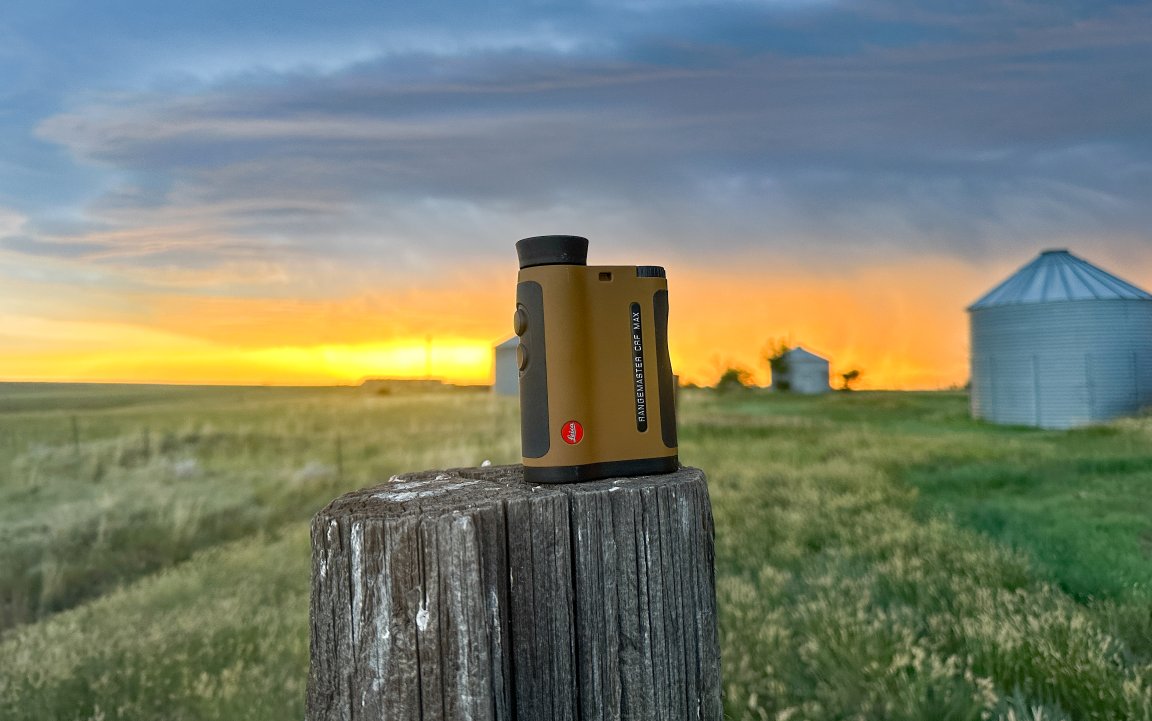
For just under $1,500, that’s a lot of performance packed in a tight, elegant build. The flat dark earth colorway is a giveaway to its talents. Leica has started to use device color to define its place in the brand pantheon. The base Rangemaster CRF is onyx black, the mid-level Rangemaster CRF Pro is forest green, and the top-of-the-line Rangemaster CRF Max has this handsome FDE exterior.
The unit has all the ranging features you’d expect, including three target modes, the ability to input wind direction and intensity or connect to an external anemometer, and the ability to use either onboard ballistics or import custom ballistic data from Leica’s excellent mobile app.
The 3,700-yard maximum range for the device may not compete with Sig’s 8,000-yard model or Leupold’s 5,000-yard monocular, but it’s plenty powerful for nearly any long-range hunting or shooting situation. We managed to get very nearly that distance when ranging hillsides and reflective signs.
The laser return is fast, the display is clear and bright and customizable, so you can include only the data you need to make quick, confident shots. And the glass and coatings are superior, as you’d expect from an optics company with the performance expectations of Leica.
Leica Rangemaster CRF Max 7×24 Specs
| Stated Maximum Range | 3,700 yards reflective |
| Minimum Range | 10 yards |
| Tested Range | 3,588 yards reflective, 1,600 trees, 915 game |
| Ranging Modes | Normal, near, and last target |
| Ballistics Solver | Applied Ballistics Elite |
| Reticle Options | Circle, square, cross |
| Display Type | Red Active-Matrix micro-LED |
| Wind Feature | Onboard wind velocity and direction |
| Mapping Feature | Connects to BaseMap |
| App Connectivity | Leica Ballistics app |
| Weight | 7 ounces |
| Warranty | 10 years on optics, 3 years on electronics |
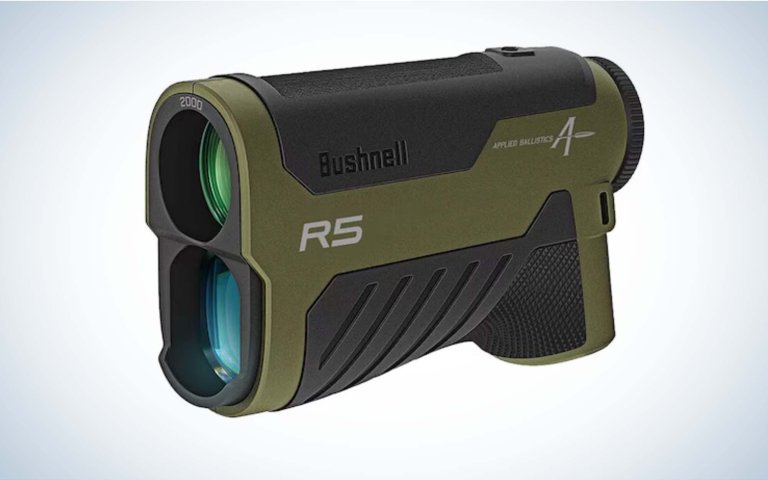
Bushnell R5 2000 AB
Pros
- Includes Applied Ballistics solver to 800 yards
- Pairs via Bluetooth to Bushnell Ballistics app
- Bow and rifle modes
- Ships with useful soft case
Cons
- Ballistics solutions limited to 800 yards
- No tripod adapter
Key Features
- Very good ballistics solver
- Interfaces with decent mobile app
- Target, Brush, and Regular target modes
- Regular, archery, and Applied Ballistics ranging modes
- Displays hold in MOA or MIL
If Bushnell’s Broadhead 2 is purpose-built for bowhunters, the 2000 AB version is similarly configured for rifle hunters. To have baked-in Applied Ballistics’ solver in a $250 rangefinder is pretty extraordinary.
The value proposition of this new R5 rangefinder is pretty appealing. Once you build a ballistic profile for your rifle load in the Bushnell Ballistics mobile app, then connect via Bluetooth, the rangefinder will give you a distance-informed hold in MOA or MIL. Note that the Ultralite version of Applied Ballistics is valid only out to 800 yards, but that’s plenty enough horsepower for most hunters and long-range shooters.
The pros and cons that we discussed in the Broadhead 2 all apply to the 2000 AB, with the exception of the display. While the archery R5 contains Bushnell’s excellent ActiveSync display, the rifle version has only a black LCD. We also note that the 2000 AB is powered by a single CR2 lithium battery. We’d like to see a CR123-sized powerplant for extended use given the amount of data the little unit has to crunch.
The R5 2000 AB retails for $250, but you can expect to see that price come down as the unit wins more fans and as more customers learn about the crazy amount of performance in such a simple and affordable rangefinding monocular.
Bushnell R5 2000 AB Specs
| Stated Maximum Range | 2,000 yards reflective, 800 trees, 650 game |
| Minimum Range | 10 yards |
| Tested Range | 1,700 yards reflective, 660 trees, 510 game |
| Ranging Modes | Scan, line-of-sight, and angle-adjusted |
| Target Modes | Target, brush, regular |
| Ballistics Solver | Applied Ballistics Ultralite |
| Reticle Options | 6 |
| Display Type | Segmented black LCD |
| Wind Feature | None |
| Mapping Feature | None |
| App Connectivity | Bushnell Ballistics |
| Weight | 6.4 ounces |
| Warranty | Fully transferable lifetime |
How We Tested the Best Rangefinders for Hunting
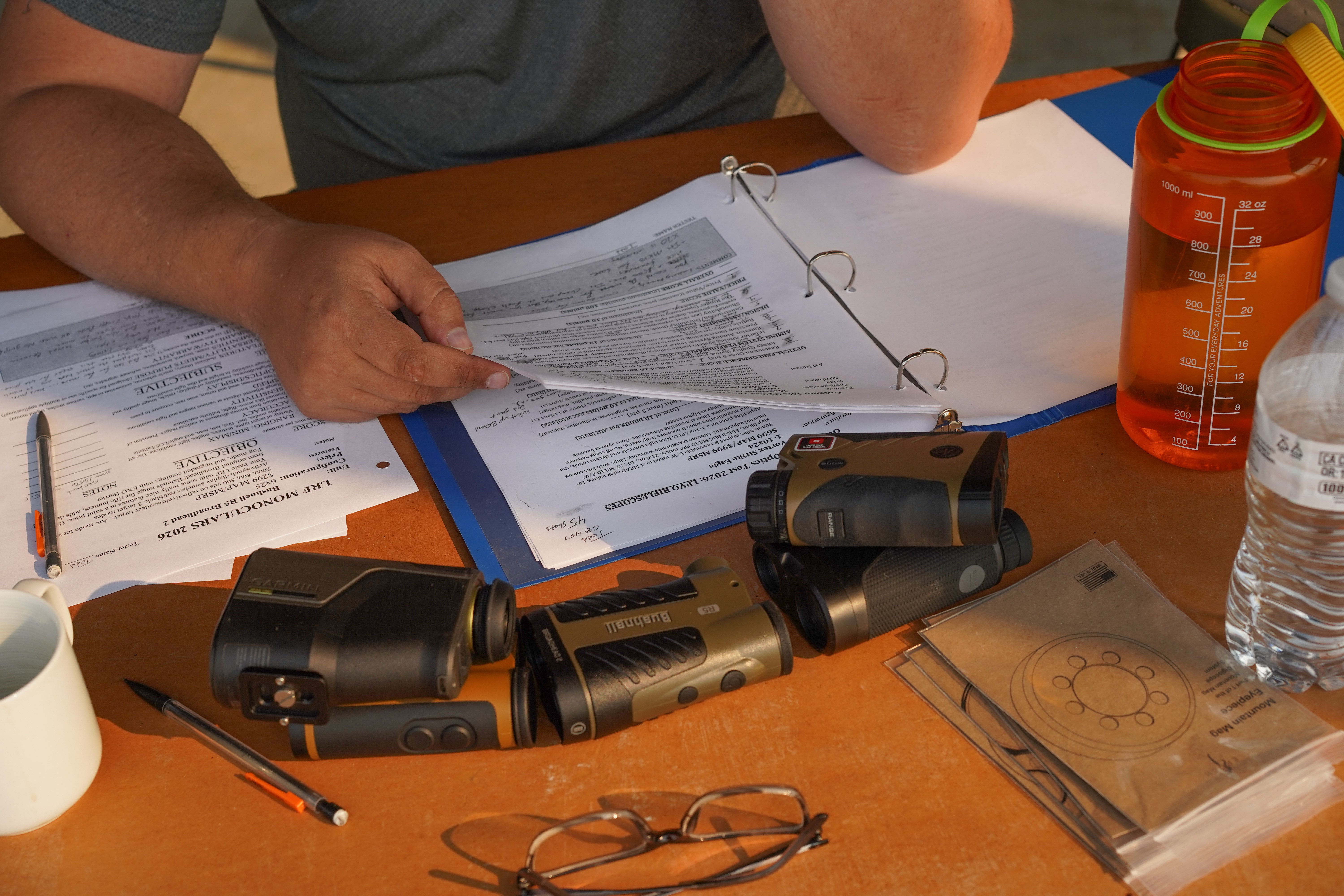
Manufacturers’ ranging claims are as spurious as a camouflage company’s promise to elude. Most take their best distances, not their average, and discount target size and orientation. They don’t always report what we found, some inconsistent ranging on a wide variety of surfaces, from gravel to grass to 3D archery targets to trees. We test the maximum and minimum range, and use every targeting mode and menu option. We’ve provided the max and minimum ranges we were able to achieve on non-reflective targets to give you an idea of real-world capabilities.
We mount monoculars on tripods to get rock-solid ranging, and we take the units in the field, deploying them both methodically and rapidly at targets of various sizes and distances. And then we pair them to a slave rifle and a ballistic app and judge their ability to improve our shooting accuracy.
We break our 10-point scoring into four general categories: ranging performance, display and optics, features, and value. The average of these categories is the basis of our grades, detailed below.

Ranging performance includes both the maximum and minimum distances the unit is capable of ranging, but also ranging precision and ability to repeatedly range objects of various sizes and textures. The performance score also considers various targeting modes. Display and optics assesses how well the unit “sees” targets, how useful and adjustable the display is to each users’ eyesight and different light conditions, and reticle utility. The feature grade assesses whether the unit connects to a mobile app, or contains a ballistic library, or has on-board sensors. Lastly, our value grade is a measure of whether the unit is worth its price, and considers its peer group, warranty, and amenities like a lanyard or carrying case.
The laser rangefinder that gets the highest overall score wins our Editor’s Choice award for the best in the category; the optic with the highest price/value score wins our Great Buy recognition. We also assigned other awards for specific noteworthy attributes.
How We Grade Optics
Our 10-point evaluation adds up to a total numeric score, but we translate those to grades for each submission. The ranging Performance grade combines the scores from ranging, accuracy, sensitivity, and processor speed. Our Display/Optics grade aggregates both display and optics scores. The Features grade considers amenities, connectivity, and versatility. And then the Price/Value grade is our assessment of whether a rangefinder is worth the money, which also considers durability.
To earn an “Excellent” grade, the average of that category must be 9 or higher, which is extremely hard to achieve. “Very Good” is an average score of 7 to 9. A “Good” grade is 5 to 7. Our “Fair” grade is 3 to 5, and “Poor” is anything under 3. This scoring system gives us a great comparative tool for the best rangefinders for hunting.
How to Choose a Laser Rangefinder for Hunting

As you can deduce from the wide variety of capabilities in submission to this year’s LRF test, you can spend over $1,000 for a gee-whiz rangefinder, or you can spend $200 for a basic unit that will range your target even if it doesn’t make you breakfast.
It’s up to you to determine what you want out of a rangefinding monocular. Do you want a hand-held ballistic calculator that will give you precise ranging out to 2 miles for your pet load? Or are you satisfied with a basic unit that provides line-of-sight and angle-adjusted ranging and little else?
Of course, there are plenty of units that reside between those two poles, but the biggest differentiator for LRFs in this year’s test are those that borrow from a mobile app to provide very specific customized aiming solutions, and those that don’t allow for many inputs and instead spit out ranges for a few basic hunting and shooting scenarios.
The price between those two capabilities is immense, with Bluetooth-connected units selling for close to $1,000 and bare-bones LRFs retailing for under $300.
Beyond those basics, if you are mainly a bowhunter who wants archery-specific ranging data, look for those units that have arrow-flight dynamics baked into their software. Similarly, suppose you’re an ultra-long-distance target shooter. In that case, you’re going to want a unit with precise, situation-informed ranging results based around the specific bullet dynamics you’ve measured and plugged into the ranging software.
Check out the display of a rangefinder you’re interested in in a wide variety of light conditions. Some units have blazingly bright OLED displays while others have black LCD displays that can get lost against a cluttered background or low-light situations.
Lastly, consider the warranty. Unlike the lifetime, fully transferable warranty that has become an industry standard for non-electronic optics like binoculars and rifle scopes, most companies offer a limited warranty for electronics like rangefinders. But there’s such a wide range of protection on the market that it pays to take a close look at the details.
FAQ
There are a lot of great rangefinders for hunting. To find the best one for you, you need to consider how, where, and what you hunt.
Bushnell rangefinders are popular, especially because they are affordable. But there are also other options that are better in some ways.
Yes, a rangefinder is an incredibly valuable tool for hunting.
That depends. Cheap rangefinders can work great if you only need to range shorter distances under 200 yards or so, and you won’t be subjecting them to bad weather or too much moisture. For some hunters, they will get the job done.
Final Thoughts on the Best Rangefinders for Hunting
Most of us use only a single laser rangefinder button—the ranging button—and as long as we get fast, reliable range dope, we’re happy. That’s actually how we started our assessment, simply by punching the range button and recording the results.
But the cool thing about the best rangefinders for hunting is that they are so adaptive. The most sophisticated have on-board or off-board ballistics solvers that can guide a bullet well beyond reasonable ranges. The best units have environmental sensors and sensitive angle and directional intelligence that can inform a shot whether you’re connected to your phone, or not. And the expectation of a LRF these days is that it must have both line-of-sight and angle-adjusted ranging along with ballistically informed ranging.
If you don’t need the full-on connected unit, make sure the unconnected unit performs the basics well, with an intensity adjusted display, an ergonomic body, and enough features to enable ranging a buck deer standing behind a screen of branches. The only downside to this crop of capable rangefinders is that they’re removing our last excuse for missing that must-hit shot.