
We may earn revenue from the products available on this page and participate in affiliate programs. Learn More ›
How many spotting scopes do you own? One for carrying in the field, another for the truck or back deck? Or maybe a cheaper knock-about model and another one that’s so expensive that you don’t want to ding it up?
Could you add another to your collection? That’s the hope of the optics industry, which this year has a model for just about every hunter and outdoors person. We’re seeing more subcompact models that nicely bridge the gap between binoculars and full-size spotters. We have a couple of flagship models from high-end brands. And we have a number of spotters that are priced attractively to either be your first spotting scope or your next in a growing collection. We’re seeing spotters explicitly intended for the large and growing birding market.
And we’re seeing the image-stabilized revolution that roared on the scene a couple years ago broaden to new brands and products. We even have our first totally digital spotting scope in this year’s collection, and it’s better than you might expect.
In all, we had nearly a dozen new spotting scopes in this year’s review. Read on. There’s something for everyone.
- Editor’s Choice: Swarovski ST Balance 14-35×50
- Great Buy: Vortex Crossfire HD 20-60×80
- Zeiss Conquest Apia 20-50×65
- Innovation Award: Kite STABI ONE 10×20
- Swarovski AT Endura 21-65×75
- GoBirding Vision Master Smart AI Spotting Scope 30-120×45
- GPO Passion 20-60×85
- Hawke Frontier ED X 15-35×56
- Kite SP 56 12-36×56 WA
- GPO Passion 16-48×65 APO
- Kite APC 60 ED 17-35×60
Best Spotting Scopes of 2026, Reviews & Recommendations
Editor’s Choice: Swarovski ST Balance 14-35×50
Pros
- Stabilization enables use without tripod
- Useful magnification range
- Excellent European glass
- One-hand operation
- Also available in an angled eyepiece version
Cons
- At $3,849, a pricey optic
Key Features
- Straight non-removable eyepiece
- Center-barrel focus control
- 88 percent light transmission
- 12-hour run time on internal battery
- At 10.6 inches, compact and packable
- FOV: 210-117 feet at 1,000 yards
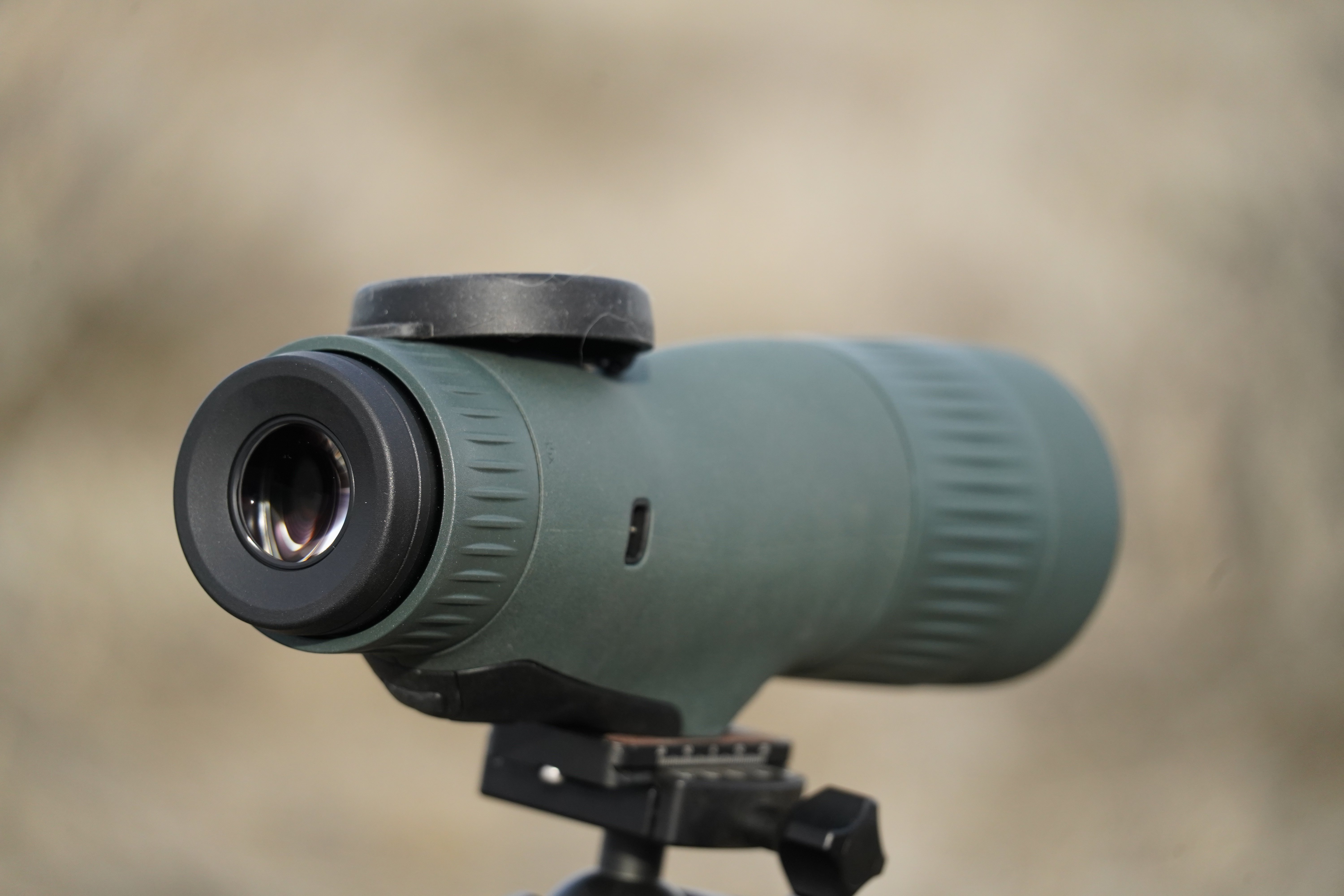
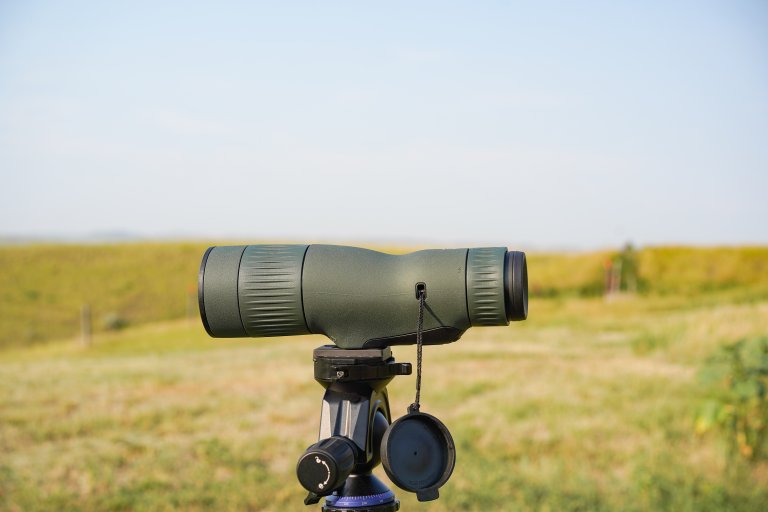
Swarovski tinkered with its first stabilized optic for years before unveiling the ST Balance early this year. It was well worth the wait. The ST Balance (there’s an angled 18-45x65mm version, called the AT Balance) seamlessly blends a vibration-taming electronic stabilizer with Swarovski’s world-beating glass and coatings to create a smooth, almost cinematic image.
The ST Balance is so well tuned that it’s extremely easy to use with a single hand. It’s compact enough to slip into a backpack, and its controls are smooth and precise. In short, it’s a helluva scope even without its battery-operated stabilization module.
But the gimbal elevates the Swarovski into a rarified category of optics with a price to match. The 14-35×50 ST Balance is priced at $3,849. The angled AT Balance costs $3,999. If that seems stratospheric for a 50mm optic, you’re right. But the Swarovski’s performance is so remarkable and its handling and styling are so on-point that it was the consensus pick for Editor’s Choice as the top spotting scope of the year.
The value proposition of the Swaro is that it’s just as capable as a hand-held optic as it is as a tripod-mounted spotter. The stabilization module tames shake and vibration so completely that we managed to evaluate the horn length of a running pronghorn out the window of a moving vehicle — without the aid of a window mount. Try that with any other optic. Even the very good stabilized spotting scopes from Sig Sauer and Kite have a hard time taming the multi-axis vibrations that a moving, bouncing vehicle dishes out. But the Swaro easily managed this task at lower magnifications. We had to stop the pickup and reduce the shakes in order to dial up the magnification and get a better view of the pronghorn buck. But the fact that we could accomplish this without a tripod makes the ST Balance the best field optic we tested this year.
The heart of the stabilization unit is a floating lens that’s governed by a vibration-sensing motor wired to onboard accelerometers. The system measures the direction and intensity of movement and then sends up to 1,000 corrections per second to the lens to counter the shakes, whether they’re the minute shudders delivered by a crosswind or the big, image-degrading movements of a pitching and rolling boat.
The stabilization module is powered by a proprietary rechargeable battery that has a 12-hour run time. We’d like to see the ST Balance use standard AA batteries, like those in most of Sig’s stabilized spotters, but the battery stows nicely in the belly of the Swarovski and can be charged on-board via a USB-C cable in those cases where you need to charge while on the go.
The Swarovski is so nicely proportioned and balanced that users can operate the unit with a single hand. With the body resting in the palm, it’s an easy reach of the fingertip to the mid-barrel focus wheel which turns with silky precision. The scope is elegant in its proportions and even with the battery out of the unit, the glass is among the best in the business. Both the AT and ST Balance scopes are built around Swarovski’s high-end SWAROVISION glass, which includes field-flattener lenses and fluorite glass to minimize color fringing. Swarovski pegs light transmission at about 88 percent.
If you’re choosing between the AT (angled) or ST (straight) Balance, consider the wider magnification range of the angled model. I prefer the straight version, largely because target acquisition is so much faster and more intuitive, especially when deployed without a tripod. But both models feature elegant form factors and premium glass that’s improved by a best-in-class stabilization module. Either Swarovski scope belongs in the pack of any serious backcountry hunter.
For its unbeatable combination of excellent glass, ease of handling, and vibration-free viewing, the ST Balance easily won the 2026 Editor’s Choice for the year’s top spotting scope.
Read Next: Swarovski ST Balance Review
| Swarovski ST Balance 14-35×50 Specs | |
|---|---|
| Magnification: | 14-35-power |
| Objective Lens: | 50mm |
| Eyepiece: | Nonremovable straight |
| Focus Control: | Center barrel |
| Construction: | Polymer |
| Exit Pupil Diameter: | 3.6mm to 1.4mm |
| Twilight Factor: | 26.4-41.8 |
| Field of View: | 210-117 feet at 1,000 yards |
| Close Focus: | 11.2 feet |
| Weight: | 45.9 ounces |
| Length: | 10.6 inches |
Great Buy: Vortex Crossfire HD 20-60×80
Pros
- At around $300, extremely affordable for full-size spotter
- Decent controls
- Also available in straight-body model
Cons
- Grainy and dark image above 50x
Key Features
- Direct tripod mount with Arca-Swiss foot
- Non-removable eyepiece
- Center-barrel focus
- Ships with neoprene jacket
- FOV: 105-53 feet at 1,000 yards
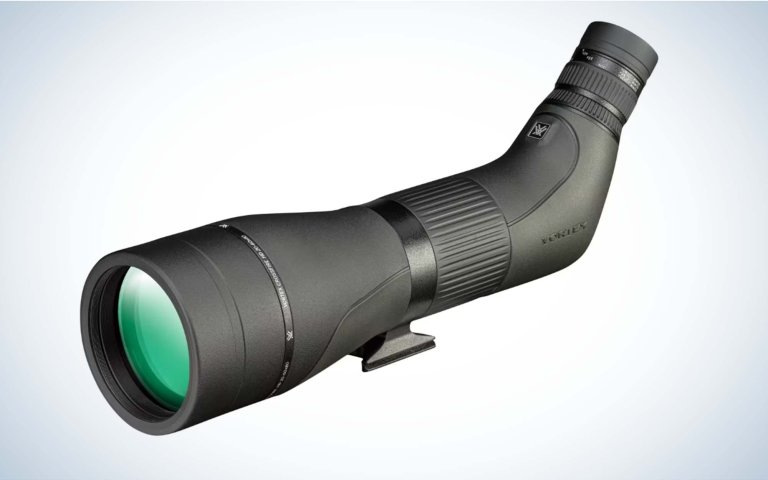
The most remarkable thing about this full-size spotter is its price. Savvy shoppers will find the Crossfire HD for around $300. On a per-ounce basis, that might be the most affordable 80mm scope on the market.
The spotter isn’t great. Its glass is murky and it seems a measure too light, which made us worry about long-term durability. Testers noted that the image darkened noticeably at magnifications higher than about 45x, and north of 50x the image turned grainy. But there’s still a wide magnification range, from 20x to nearly 50x, in which the Vortex will do everything you ask of it. It’s a great back-deck scope for spotting birds, butterflies, and wildlife both wild and domestic. It’s a handy range scope for checking bullet holes and group size. And its weight, 53 ounces, makes it a decent pack scope.
The controls are tight and precise. We love the built-in Arca-Swiss compatible foot that mates directly to most tripods. And the barrel rotation is snappy and strong, enabling users to share the eyepiece with a hunting buddy or rotate the scope for use on a pickup window mount.
Because it’s a Vortex, the warranty is the best in the business. That makes the Crossfire HD a good investment for a beginning hunter, or a good choice as a second spotter, whether you’re a hunter, birder, or wildlife watcher. The crazy amount of value packed into this 80mm scope let us overlook some of its optical disappointments and made the Crossfire HD the consensus pick for this year’s Great Buy spotting scope.
| Vortex Crossfire HD 20-60×80 Specs | |
|---|---|
| Magnification: | 20-60-power |
| Objective Lens: | 80mm |
| Eyepiece: | Fixed angled |
| Focus Control: | Center barrel |
| Construction: | Undisclosed |
| Exit Pupil Diameter: | 4mm to 1.3mm |
| Twilight Factor: | 40-69.3 |
| Field of View: | 105-53 feet at 1,000 yards |
| Close Focus: | 26 feet |
| Weight: | 53 ounces |
| Length: | 15.6 inches |
Zeiss Conquest Apia 20-50×65
Pros
- Precise controls
- Excellent glass
- Accepts excellent smartphone adapter
- Versatile size and weight
Cons
- At 47.6 ounces, relatively heavy
Key Features
- Field-flattener lenses
- Highly textured controls
- Magnification throw lever
- Removable eyepiece
- Premium Zeiss LotuTec lens coatings
- FOV: 144-81 feet at 1,000 yards
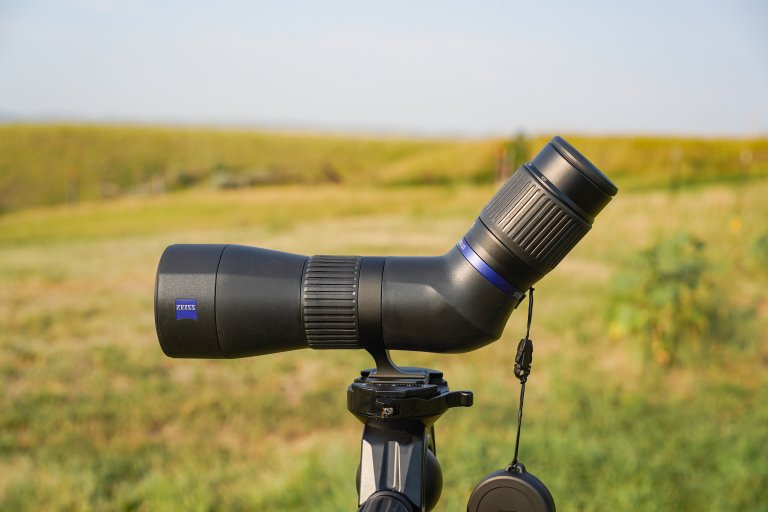
This is not only a first-rate spotting scope, but the Conquest Apia is something of a statement. It’s the first premium Zeiss optic that’s neither designed nor manufactured in Germany. It follows the highly regarded Japanese-made Conquest line of rifle scopes and binoculars that premiered a few years back, but those optics were largely engineered in Europe. The Apia, manufactured in China, is focused squarely on the North American market, with excellent handling, a durable magnesium alloy chassis, and very good glass that’s improved with Zeiss’s proprietary T* and LotuTec optical coatings.
The result is an excellent middle-tier spotter that sits comfortably between super-premium European optics and price-point Asian scopes. Priced under $1,500, the Conquest Apia is still a reach for many hunters, birders, and outdoors folks, but we gave it high price/value scores based on handling and overall performance that’s nearly on par with scopes costing twice as much.
Specifically, we like the tight and durable build of the Apia and its confident handling thanks to its oversized controls. The removable lens fits flush to the body thanks to a simple but tight bayonet mount. The center-barrel focus wheel turns with tack-sharp precision, though it’s a bit tight for our liking. We love the overall balance of the Zeiss. It’s slightly forward-heavy, which makes it settle nicely in hand (or stabilized on a pack or fence post) for low-mag use off a tripod. But at higher magnifications, the Apia’s prodigious optical horsepower is on display when mounted to a tripod, an operation that’s enabled by the scope’s integrated Arca-Swiss foot.
The 20-50-power magnification range is just right for both panning large landscapes and resolving details of a distant object. The 11.7-inch length is extremely packable, though the nearly 3-pound weight is fairly significant for a 65mm scope.
For optics snobs — to include myself — who equate Chinese glass with sub-par performance, the Apia may change your mind. Zeiss claims 87 percent light transmission, which is pretty good for the spotting scope category. The image is bright and vibrant up to about 42x, which it starts getting grainy. But we detected no edge distortion, flaring, or color fringing, evidence of good glass and excellent coatings. It takes a very discerning eye to detect differences between this glass and the best European glass and coatings.
Zeiss has also designed an excellent digiscoping adapter that connects any mobile phone to the Apia’s eyepiece. The adapter costs another $200, with the magnetic eyepiece receiver, but it’s worth the price for the ability to convert the spotting scope into a first-rate telephoto camera lens.
If the Conquest Apia is the first of a line of Asian-sourced Zeiss optics, it bodes well for the combination of quality, price, and performance that we expect to see in other Zeiss optics categories that are designed for American, rather than European, hunters and birders.
| Zeiss Conquest Apia 20-50×65 Specs | |
|---|---|
| Magnification: | 20-50-power |
| Objective Lens: | 65mm |
| Eyepiece: | Removable angled |
| Focus Control: | Center barrel |
| Construction: | Magnesium alloy |
| Exit Pupil Diameter: | 3.25mm to 1.3mm |
| Twilight Factor: | 36.1-57 |
| Field of View: | 144-81 feet at 1,000 yards |
| Close Focus: | 11.5 feet |
| Weight: | 47.6 ounces |
| Length: | 11.7 inches |
Innovation Award: Kite STABI ONE 10×20
Pros
- Pocket-sized spotter
- Electronically stabilized operation
- Runs on single AAA battery
- At under $450, priced right for ample performance
Cons
- Hard to focus
- Intended for use with aftermarket phone adapter
Key Features
- At just 4.6 ounces, goes everywhere
- Impressive 12-hour run time
- Excellent field of view
- Stabilization stills images even without tripod
- Powerful when paired with a phone’s camera
This little marvel is on our short list for most compelling outdoor product of the year. It’s tiny, but the unit’s good optics and excellent stabilization unit turn your cell phone into a very useful spotting scope and long-range camera.
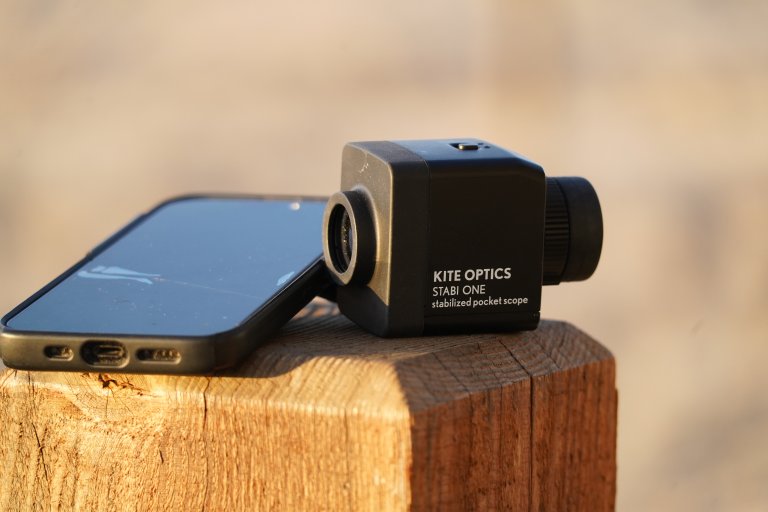
There’s deceptively little to see in this “pocket scope.” About the size of a USB charging cube, the little Kite measures less than two inches on a side. One side has a simple 20mm objective lens. The other side has an eyepiece with an undersized focus control. In between those two lenses is where the magic happens. The STABI One contains a vibration-taming stabilization unit and accelerometers that measure and neutralize shake. The result, when the unit is powered on, is a pleasingly calm and vibration-free image.
The STABI One works fine as a stand-alone micro spotter. But its value proposition is revealed when connected to a mobile phone camera via any number of adapters (our favorite is the Epoch Outdoors Mountain Mag). Using your camera’s on-board magnification, that 10-power Kite becomes a 20x, 30x, and even a 90x digital video camera. The stabilization effect combined with the phone’s magnification makes this a powerful and extremely portable alternative to a full-size spotting scope for capturing images and all-around viewing. And, at under $450, it’s an affordable alternative to a dedicated DSLR camera and telephoto lens.
The image delivered by the Kite isn’t on par with a high-end spotting scope, but it’s certainly good enough for most purposes. The stabilization unit is powered by a single AAA battery with an impressive 12-hour run time. I’ve been using a pre-production version of the STABI One since last winter, and it’s changed the way I hunt and hike. I find myself leaving behind my heavy optics and relying on this pocket sized wizard.
The Kite has some maddening design elements. The tiny focus tab on the eyepiece is hard to turn when connected to a phone adapter, and the puny square is hard to hold, whether the stabilization motor is firing or not. And I constantly worry about the durability of the little flimsy-feeling unit.
But the STABI One is among the smartest and most disruptive optics we’ve ever tested. It’s smart, fun, and extremely useful, whether you’re a go-light hunter, a traveler, or just a curious person who wants a better view of your world.
| Kite STABI ONE 10×20 Specs | |
|---|---|
| Magnification: | 10-power |
| Objective Lens: | 20mm |
| Eyepiece: | Fixed straight |
| Focus Control: | Eyepiece |
| Construction: | Die-cast magnesium |
| Exit Pupil Diameter: | 2mm |
| Twilight Factor: | 14.1 |
| Field of View: | 270 feet at 1,000 yards |
| Close Focus: | 6.7 feet |
| Weight: | 4.6 ounces |
| Length: | 1.65 inches |
Swarovski AT Endura 21-65×75
Pros
- Perfectly sized between 65 and 80mm spotters
- At under $3,000, appealing price for premium spotter
- Arca-compatible tripod foot
- Infinitely adjustable eyecup
Cons
- Barrel rotation lacks detents
Key Features
- Non-removable angled eyepiece
- Mid-barrel focus control
- Premium glass and coatings
- 90 percent light transmission
- FOV: 99-54 feet at 1,000 yards
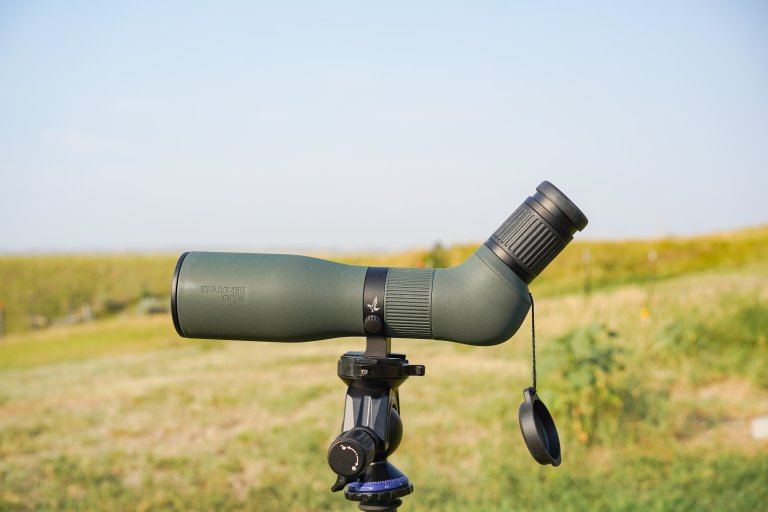
It says everything about Swarovski’s super-premium optics that the Austrian company presents the new AT Endura, which costs $2,899, as a “mid-priced” spotting scope. But when you consider the other spotters in Swarovski’s catalog — from the $5,000 BTX system to the $4,300 STX system to the $3,000 ATC 56mm super-compact scope — the AT Endura seems downright affordable. It’s also about $1,100 less expensive than Swaro’s older ATS 80.
The new AT Endura bridges all sorts of gaps beyond prices. Its configuration — 21-65×75 — is nicely sized between compact and full-size spotters. Its 3.3-pound build makes it an extremely packable scope. Its “high definition glass” also bridges the gap between super-premium scopes built around Swarovski’s “SWAROVISION” glass and price-point spotters that use cheaper glass prescriptions that tend to deliver dull and lifeless images at the higher end of spotting scope magnification ranges.
But the AT Endura also brings a different build to the market. Most of Swarovski’s spotters are designed to be modular, that is, customers can buy a body and then match it with any number of eyepieces. But the AT Endura’s eyepiece is non-removable. The design saves on production costs, but it also makes the one-piece aluminum-chassis scope more durable by keeping out dust and moisture that inevitably gets into the works when you trade out eyepieces.
Okay, but how does the Swaro perform in the field? Brilliantly. The HD glass delivers bright images and we didn’t detect edge distortion or color fringing. The image gets dim north of about 55x, but that’s still more useful magnification than many 80 and 85mm scopes with forgettable glass deliver. Testers noted the sweet spot for most daylight observation was about 45x.
We love the oversized magnification wheel on the eyepiece, and the center-barrel focus wheel is positioned for precise fingertip operation. And we like the integrated Arca-Swiss-compatible foot that makes tripod mounting quick and sure.
But we registered a couple of misses. The barrel-rotation band doesn’t have detents at 90-, 180-, and 270-degree points, like most angled spotters have. It’s no deal-breaker, but it’s nice to have those positive spots when you’re rotating the barrel. And the AT Endura lacks a retractable sunshade. Again, not a big deal, but when you’re paying nearly $3,000 for an optic, it’s a nice feature to include.
Those are fairly minor quibbles. The scope won our low-light test and was in the top three spotters for optical resolution. The 75mm objective is smart. It’s small enough in diameter that the scope doesn’t require an objective-lens swell, but it’s large enough to make this a magnificent low-light performer. The lines of the AT Endura are straight, smart, and easy to fit in the side pocket of a pack.
Will the Endura line eclipse Swarovski’s flagship spotters in the U.S. market? Probably not. Sophisticated users are willing to pay a lot for super-premium glass. But the AT Endura makes the case that Swarovski can deliver pretty-premium glass in an extremely field-friendly package, which should make every serious hunter and birder consider this durable and “affordable” Swarovski.
| Swarovski AT Endura 21-65×75 Specs | |
|---|---|
| Magnification: | 21-65-power |
| Objective Lens: | 75mm |
| Eyepiece: | Fixed angled |
| Focus Control: | Center barrel |
| Construction: | Aluminum |
| Exit Pupil Diameter: | 3.5-1.2mm |
| Twilight Factor: | 39.7-69.8 |
| Field of View: | 99-54 feet at 1,000 yards |
| Close Focus: | 13.5 feet |
| Weight: | 53.3 ounces |
| Length: | 15.1 inches |
GoBirding Vision Master Smart AI Spotting Scope 30-120×45
Pros
- Fully digital spotting scope
- Integrated Arca-Swiss tripod mount
- On-board image stabilization
- Powerful zoom feature
- Captures photos and videos
Cons
- Requires connection to mobile app
- AI-powered bird ID is tedious
Key Features
- Livestreaming feature enables image sharing
- 6-hour run time on internal battery
- Can be used as hand-held spotter
- At 2 pounds, very lightweight
- Auto focus and manual focus
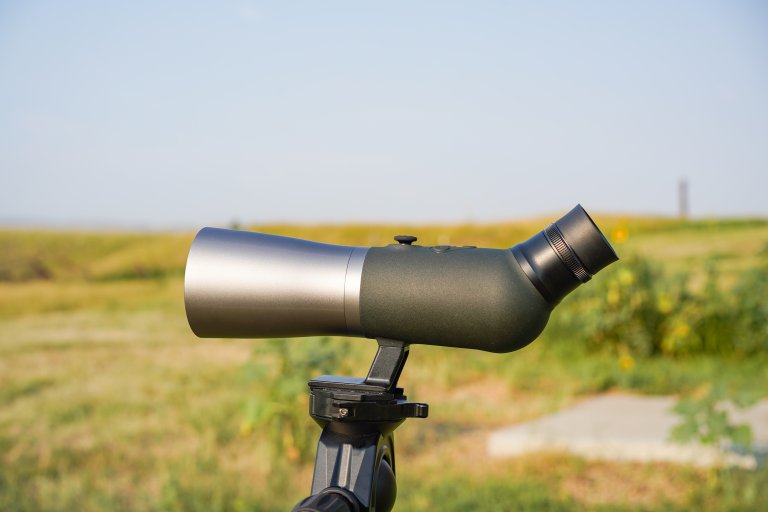
This is one of the most disruptive “optics” in our optics test. A fully digital spotting scope that connects to your phone, the GoBirding device also connects to the internet, where it leverages artificial intelligence to help you identify the birds it sees.
If that’s not mind-blowing enough, the Vision Master scope has on-board stabilization so you can use it with or without a tripod, and it has a crazy amount of digital magnification, up to 120-power. All that digital horsepower is less expensive than you might imagine. The GoBirding Vision Master Smart AI Spotting Scope retails for under $800.
This is a lot more than a gizmo. The digital image delivered by the unit is fairly robust, with good detail and resolution. The fact that you can save images and videos to your phone to share with buddies or for your own use makes this a handy device for a guide or for tech-savvy birders. The phone connection allows users to live stream the feed from the scope, which can enhance the vibe around viewing in certain circumstances.
Operationally, this device keeps its secrets. There’s not much to see or fiddle with besides a little joystick on the top that both zooms and focuses the image. One push button captures video and other photos. Then there’s the AI button that guides users through the optimal way to focus and frame birds for positive identification. If the on-board library of 1,500 images doesn’t produce a match, users can access the internet through the GoBirding mobile app and search a library of an additional 10,000 images of birds.
It’s a cool feature, but one we didn’t fully explore as we were more interested in the capabilities of this digital spotter in hunting and shooting scenarios. In that latter capacity, the Vision Master did a very good job of recording hits on steel targets out to 800 yards. In the former capacity, we used the device both on and off a tripod to glass river-bottom whitetails and to classify bucks. We were a little disappointed in the resolution, and a number of testers noted that the image saved to our phone seemed to be sharper than the one viewed through the scope’s eyepiece.
That’s an important conclusion, because while the Vision Master is an adequate stand-alone spotter, its capabilities are magnified when used in conjunction with the mobile app. Not only are captured images and videos vibrant and colorful, but they’re sharp and large enough media files that they enlarge without losing resolution.
The name of this scope hints at its intended audience: birders who are keen to enlarge their life lists of observed birds. The bird-recognition software is cool, but it takes a good deal of effort to frame a target bird, snap a well-composed photo, and then activate the ID capabilities of the digital app. The number and sequence of steps made me wonder if an aged birder, one who is not a digital native, might struggle with the operation.
The tasks of a hunter are easier to accomplish with this device. Use it to capture very good video and photos and to share them via your phone. Use the stabilized scope off a tripod to glass large landscapes, then mount it on a tripod to zoom in for detailed images.
We were unable to compare the low-light talents of the Vision Master with conventional optics, because the display of the digital scope burned our retinas and ruined our night vision. But we tried to focus on a 300-yard resolution target with the live stream on our phones, and we noticed a funny phenomenon: We could “see” the target late into the night, even later than we could with conventional spotting scopes. But we couldn’t see the details at all. They were grainy and pixelated. We’ve seen this with other digital “optics” – they thrive in full light but struggle in the twilight conditions when game animals are most active.
Fully digital devices are on the way, and if they don’t totally replace conventional “analog” optics, they will undoubtedly take market share as these devices get sharper, more sophisticated, and probably more affordable. The GoBirding scope is a very good freshman effort that’s priced right for its impressive performance. We’re eager to see and use the next generations of this smart, capable, and integrated observation device.
| GoBirding Vision Master Smart AI Spotting Scope 30-120×45 Specs | |
|---|---|
| Magnification: | 30-120-power |
| Objective Lens: | 45mm |
| Eyepiece: | Fixed angled |
| Focus Control: | Auto and toggle manual control |
| Construction: | Not provided |
| Exit Pupil Diameter: | 5mm |
| Twilight Factor: | N/A |
| Field of View: | 353-130 feet at 1,000 yards |
| Close Focus: | 13 feet |
| Weight: | 31.9 ounces with batteries |
| Length: | 11.7 inches with eyepiece |
GPO Passion 20-60×85
Pros
- Durable magnesium body
- Built around apochromatic lenses
- Integral Arca-Swiss tripod mounting foot
- Fully transferable lifetime warranty
Cons
- Slight play in eyepiece connection
Key Features
- Removable angled eyepiece
- Mid-barrel focus control
- Ships with neoprene jacket
- Useful sunshade
- FOV: 108-60 feet at 1,000 yards
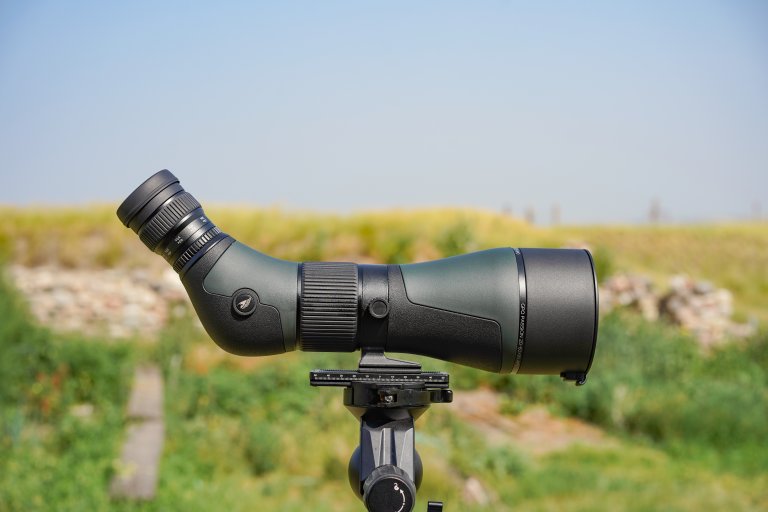
GPO has two new versions of its Passion spotter, this 20-60×85, and a handy 16-48×65 compact model. Because the two scopes are nearly identical in components and performance, we’re going to nearly duplicate our assessments. I say “nearly” because testers concluded that the 65mm model is the better iteration due to its smaller frame and wider versatility.
Both the 85 and 65mm Passion scopes share an old-school threaded connection between the removable eyepiece and the body. In fact, they can share eyepieces, which is a handy attribute. Buy both bodies and swap a single eyepiece. But that threaded connection can be problematic if grit or grease gets in the works or if the locking collet works loose. We’d rather see bayonet mounts similar to the way camera lenses connect to camera bodies, or non-removable eyepieces to ensure the interior remains free of dust and debris.
The eyepiece design doesn’t degrade the performance of the GPO Passion. Both scopes are relatively sharp with controls that turn with smooth authority. We didn’t love the glass in the scopes — even with the premium apochromat lenses (that’s the APO in the Passion’s name). We detected significant edge distortion in the 85mm version. Both resolution and low-light performance settled in the middle of our field, which is about right for the mid-market price of the GPO spotters. The 65mm Passion retails for about $650; the 85mm version retails for right at $1,000.
We love the Arca-Swiss compatible foot that’s attached to the barrel rotation band, allowing for direct mounting to most tripod heads. And we like the oversized center-barrel focus. The GPO spotters ship with a very serviceable neoprene jacket.
As mentioned, testers preferred the 65mm version for its ability to work in tight quarters. But the 85mm Passion, tipping the scales at just under 4 pounds, is a good choice for a base-camp spotter, and it would be at home on just about any cabin deck or backyard window. The magnesium body is built to hold up for years, and the Goldilocks performance – not too cheap, not too expensive – makes it a smart option for buyers looking for a full-size spotter that won’t break the bank.
| GPO Passion 20-60×85 APO Specs | |
|---|---|
| Magnification: | 20-60-power |
| Objective Lens: | 85mm |
| Eyepiece: | Removable angled |
| Focus Control: | Center barrel |
| Construction: | Die-cast magnesium |
| Exit Pupil Diameter: | 4.25mm to 1.4mm |
| Twilight Factor: | 41.2-71.4 |
| Field of View: | 108-60 feet at 1,000 yards |
| Close Focus: | 16 feet |
| Weight: | 63 ounces with eyepiece |
| Length: | 16.9 inches with eyepiece |
Hawke Frontier ED X 15-35×56
Pros
- Built around high-end lanthanum glass
- Square foot works well on flat surfaces
- Wide field of view
- Compatible with Hawke smartphone adapter
Cons
- At over $700, pricey for a compact spotter
Key Features
- Angled, non-removable eyepiece
- Center-barrel focus
- 3-position eyecup
- Ships with tripod plate
- FOV: 210-110 feet at 1,000 yards
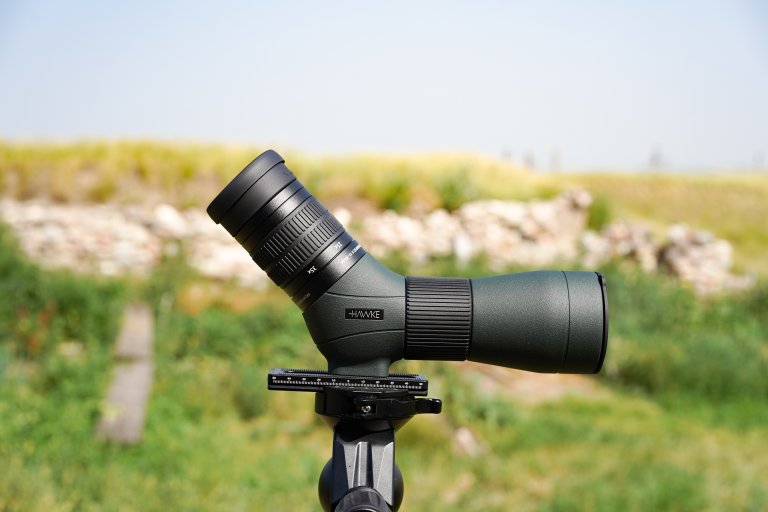
With this very good and tight Frontier ED X, Hawke has entered the premium subcompact spotting scope category, joining similar 56mm builds from Vortex, Maven, and Swarovski. Hawke’s own Nature-Trek 13-39×56 hit the market a couple years ago.
But the Frontier X brings very good glass, tight controls, and a fast, intuitive form factor to the game. We thought the $749 price was a bit steep, but it’s not far out of line considering the quality of the components and the overall performance. This is a great shooting-range spotter, but it’s also at home in the console of pickups, where it can be wedged against a window or corner post for in-the-moment spotting.
The square heel of the Hawke allows it to sit upright on flat surfaces, but the spotter ships with an Arca-Swiss-compatible mount for quick mating to just about any tripod head.
The image delivered by the 15-35×56 Hawke is bright and crisp, with edge detail and decent color fidelity thanks to its lanthanum glass with a high refractive index that bends light aggressively and enables the short stature (10.4-inch) of the scope. The ocular lens is big and immersive. It’s a natural optic to throw into a pack and nicely bridges the gap between a binocular and a full-size spotter.
We had no quibbles with the well-behaved little scope, and that’s a rare statement, indeed, in our highly critical reviews.
| Hawke Frontier ED X 15-35×56 Specs | |
|---|---|
| Magnification: | 15-35-power |
| Objective Lens: | 56mm |
| Eyepiece: | Removable angled |
| Focus Control: | Two-speed fingertip |
| Construction: | Die-cast magnesium |
| Exit Pupil Diameter: | 3.7mm to 1.6mm |
| Twilight Factor: | 29-44.3 |
| Field of View: | 210 to 110 feet at 1,000 yards |
| Close Focus: | 12.5 feet |
| Weight: | 35.4 ounces |
| Length: | 10.4 inches |
Kite SP 56 12-36×56 WA
Scott Einsmann
Pros
- At under $400, appealing price
- At 9.8 inches long, very compact
- Threaded for tripod plate
- Square “boot” suitable for tabletop use
Cons
- Barrel doesn’t rotate
- Fairly narrow field of view
Key Features
- Center-barrel focus
- Angled, non-removable eyepiece
- 3-position eyecup
- FOV: 162-87 feet at 1,000 yards
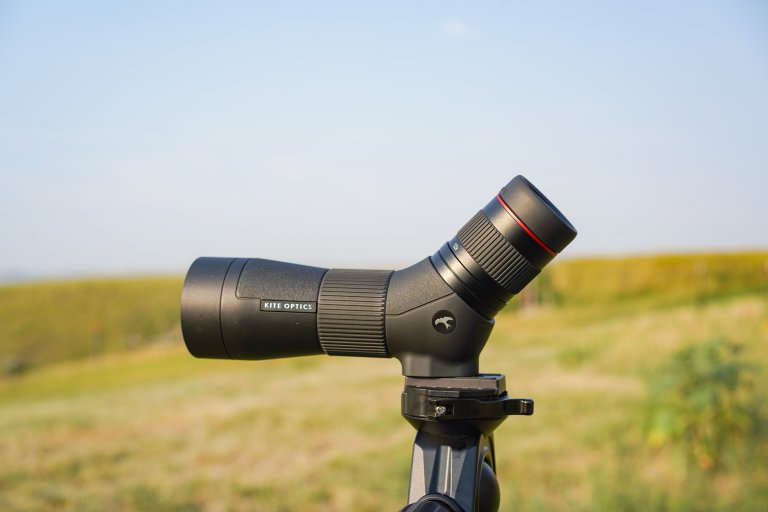
One of several ultra-compact spotters in this year’s test. Along with the Hawke Frontier ED X (15-35×56) and Swarovski ST Balance (14-35×50), the Kite’s small frame is intended to go anywhere, and its light weight (24.7 ounces) makes it a killer backcountry spotter. At $399, it’s by far the least expensive of these micro spotters (though any consideration of the category should include the Vortex Crossfire HD 12-36×50, which retails for $200) and is adequate for most mid-range observation work.
The Kite loses both its brilliance and its resolution at the highest end of its magnification range. Testers noted significant image darkness above 28x. And the Kite’s field of view is pretty stingy, nearly 24 percent less than the equivalent Hawke.
But for a price-point optic that neatly fills the void between 10×42 binoculars and full-size spotters, the Kite SP 56 is a versatile workhorse. It’s a clutch range spotter, easy to deploy with or without a tripod on your shooting bench. It’s a great back porch bird spotter. It should be in every pickup’s duty box, with a window mount already in place, as a quick-deploy optic to spot and classify roadside game.
The Kite’s controls are tight and positive. The glass is decent if not life-changing. And the form factor, which promotes hand-held glassing or attachment to a tripod, is smart and useful.
| Kite SP 56 12-36×56 Specs | |
|---|---|
| Magnification: | 12-36-power |
| Objective Lens: | 56mm |
| Eyepiece: | Non-removable angled |
| Focus Control: | Center-barrel |
| Construction: | Polymer |
| Exit Pupil Diameter: | 4.7mm to 1.6mm |
| Twilight Factor: | 25.9-44.9 |
| Field of View: | 162-87 feet at 1,000 yards |
| Close Focus: | 11 feet |
| Weight: | 24.7 ounces with eyepiece |
| Length: | 9.8 inches with eyepiece |
GPO Passion 16-48×65 APO
Pros
- Durable magnesium body
- Built around apochromatic lenses
- Integral Arca-Swiss tripod mounting foot
- Fully transferable lifetime warranty
Cons
- At over $800, pricey for a mid-sized spotter
Key Features
- Removable angled eyepiece
- Mid-barrel focus control
- Ships with neoprene jacket
- Useful sunshade
- FOV: 138-74 feet at 1,000 yards
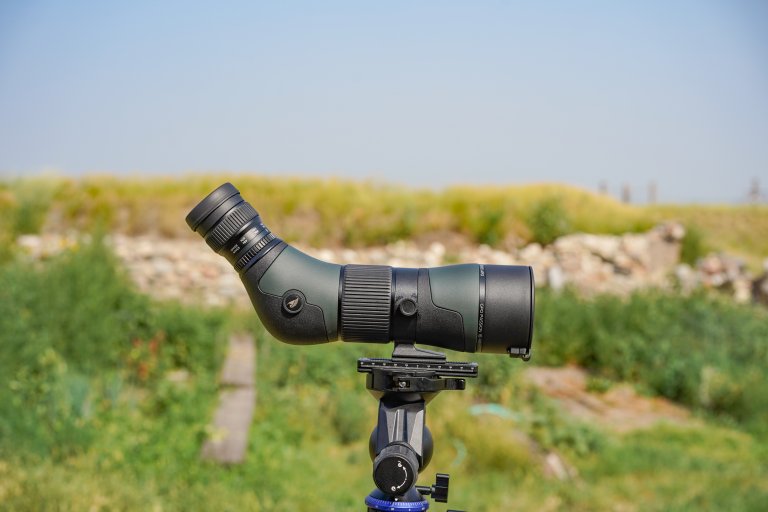
See our take on the 20-60x85mm version of the GPO Passion spotting scope for our overarching review of both the 85 and 65mm models. Our same concerns with the threaded eyepiece and middling glass extend to this compact version.
But it’s worth extolling the virtues of this small-frame spotter, because its portability and ability to work in tight quarters makes it a more useful field scope than its big, 4-pound 85mm sibling. This 2.9-pounder has a certain heft, but instead of making it ponderously heavy, the durable magnesium chassis gives it a settled balance that stills vibration whether in hand or on a tripod.
Like the 85mm, the smaller GPO has an integral Arca-Swiss-compatible foot, a tight mid-barrel focus, and very good eyepiece action. It ships with a premium neoprene jacket, is covered by GPO’s excellent warranty, and, at about $800, is a fairly good price for a hard-working field scope.
| GPO Passion 16-48×65 APO Specs | |
|---|---|
| Magnification: | 16-48-power |
| Objective Lens: | 65mm |
| Eyepiece: | Removable angled |
| Focus Control: | Center barrel |
| Construction: | Magnesium |
| Exit Pupil Diameter: | 4.1mm to 1.4mm |
| Twilight Factor: | 32.2-55.9 |
| Field of View: | 138-74 feet at 1,000 yards |
| Close Focus: | 18 feet |
| Weight: | 46 ounces |
| Length: | 13.7 inches |
Kite APC 60 ED 17-35×60
Pros
- Pioneering stabilized spotting scope
- Interchangeable eyepiece
- Useful without tripod
- Image-stabilizing gimbal and software
Cons
- Blocky design not especially ergonomic
Key Features
- Straight body and eyepiece
- Objective bell focus control
- Tripod mount on belly of spotter
- Eyepiece interchangeable with 80mm body
- Ships with carbon monopod
- Limited lifetime warranty
- FOV: 180-123 feet at 1,000 yards
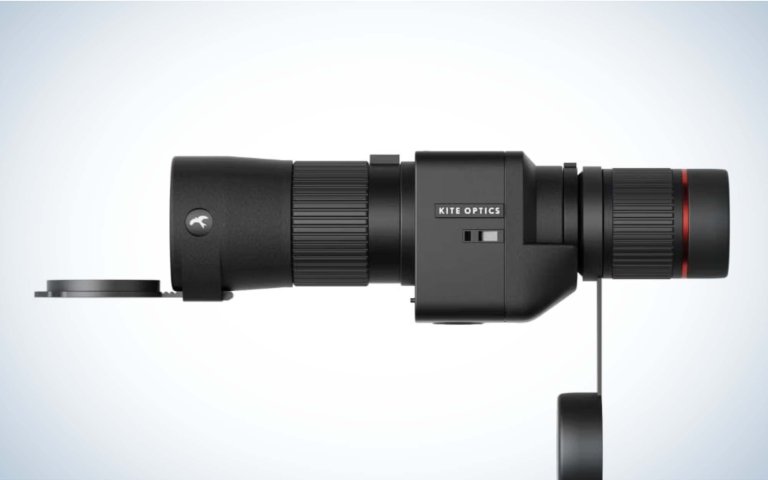
This is the product that launched the stabilized-optic revolution. By sticking a couple accelerometers and a motion-canceling gimbal inside a spotting scope, Kite produced a mid-power optic that can be used with or without a tripod.
The APC 60 ED is so similar in size, form factor, and price to the Sig Sauer OSCAR6 HDX PRO that most readers and aspiring owners will compare the two. So we put these two leading stabilized spotters to a sort of head-to-head test (“sort of” because we didn’t have both scopes in hand at the same time). We tested the Sig in last year’s Outdoor Life optics test. As a twist, we added Swarovski’s AT Balance stabilized scope to this arbitrary comparison.
Short story: The Sig and Kite are so similar that any variations are minor and matters of taste, not performance. For instance, both the Sig and the Kite share the same blocky torso that houses the shake-neutralizing electronics. The Sig’s power-changing and focus control texturing might get our nod as the most grippy and aesthetically pleasing. But the Kite gets our nod for run time (36 hours) of its internal rechargeable battery.
In terms of optical resolution and brightness, both the Kite and Sig scopes produce nearly identical images. We gave an edge to the Swarovski in our assessment of the lowest power without stabilization that we could hand-hold the scope. When the stabilization gizmo is activated, the Swaro also gets the edge as the more useful scope across the magnification range. Interestingly, all three scopes were nearly identical at 22-power, which is the middle of their power range.
Both the Kite and Sig feature interchangeable eyepieces, meaning you can buy the body of either and then change the magnification with a higher-power or lower-power eyepiece. We’re waiting for both brands to bring an eyepiece with integrated reticle to the stabilized-spotter game. Maybe next year.
We give a slight edge to the Sig for its use of common AA batteries, versus the internal rechargeable batteries in the Kite, and we like the flat dark earth colorway of the Sig. Bottom line: the leaders of the stabilized-scope revolution may be dueling with nearly identical products and performance, but the ultimate winners are consumers who can leave their tripods at home and still enjoy shake-free, vibrant images through either the Sig or the Kite.
| Kite APC 60 ED 17-35×60 Specs | |
|---|---|
| Magnification: | 17-35-power |
| Objective Lens: | 58mm |
| Eyepiece: | Removable straight |
| Focus Control: | Objective bell |
| Construction: | Thermoplastic |
| Exit Pupil Diameter: | 3.5mm to 1.7mm |
| Twilight Factor: | 31-45 |
| Field of View: | 180-123 feet at 1,000 yards |
| Close Focus: | 14 feet |
| Weight: | 47.6 ounces |
| Length: | 11.3 inches |
How We Tested the Best Spotting Scopes
Optical Resolution
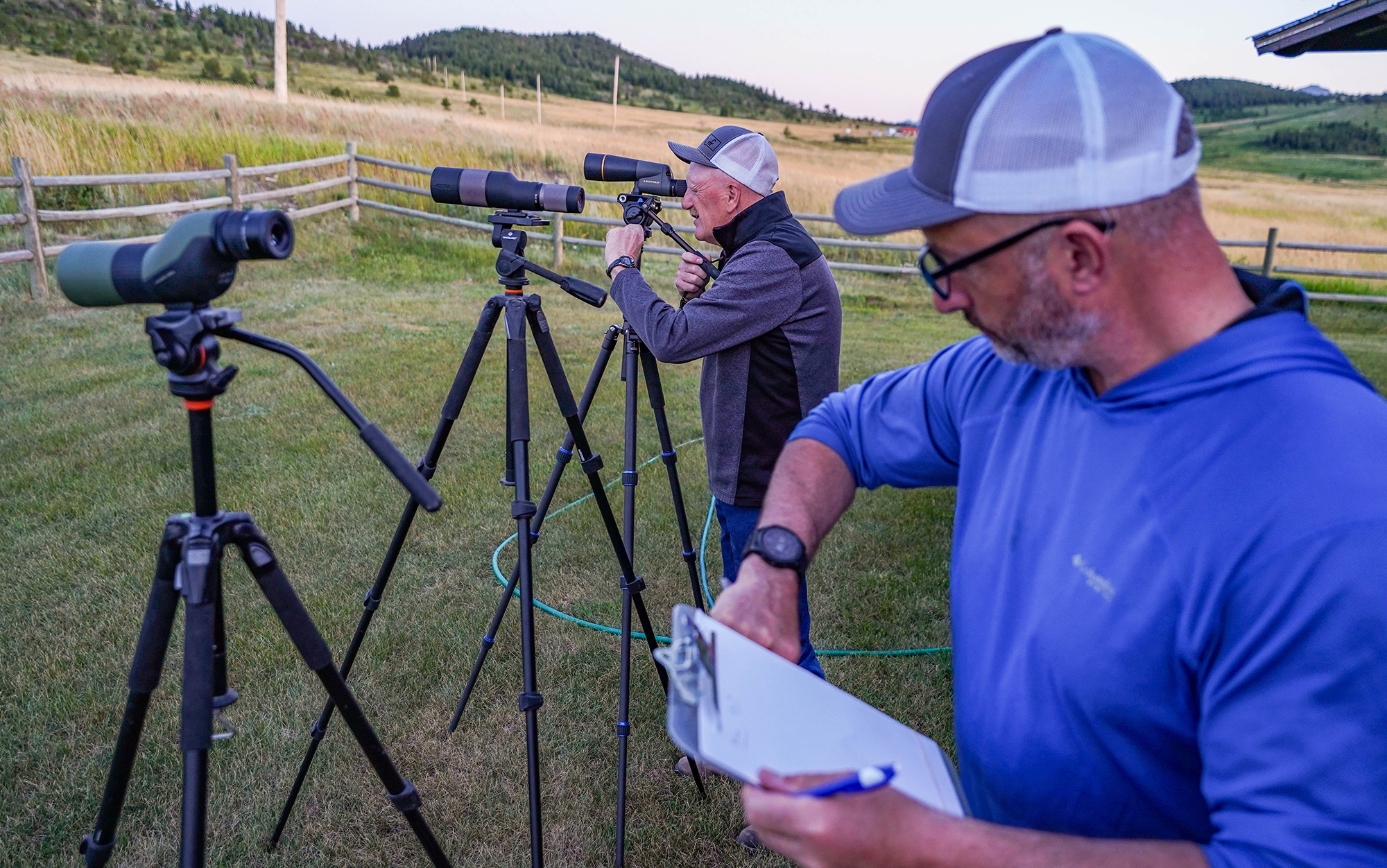
We put all submissions, whether full-size or super-compact, through the same criteria. First, we measure optical resolution, using the diminishing black-and-white lines of a 1951 Air Force Resolution Target to score the optical performance of each submission.
Low-Light Performance

We also measure the low-light performance of each submission by mounting them to tripods and focusing them at 200 yards at a black-and-white resolution target at twilight, all in order to measure the brightness of the glass.
The scope that can “see” the longest into the gathering darkness gets top marks. The scope that loses its night-vision earliest gets the lowest score. Scopes in the middle receive scores somewhere between those two poles.
How We Score and Grade Optics
We break our 10-point scoring into four general categories: optical performance, mechanical performance, design, and value. The average of these categories is the basis of our grades, detailed below.
Optical performance includes the resolution and low-light tests plus the more subjective assessments of image quality and brightness. Mechanical performance assesses the durability of the submission along with its controls: focus and zoom, eyecups and barrel rotation. Design considers the exterior finish, interior blacking, tripod mount, and its innovation and versatility along with its comfort. We ask testers to evaluate this critical question: how long could you glass with this spotter?
And then our price/value score rates how much optic—along with warranty and amenities such as carrying case, additional eyepieces, or field cover—you’re getting for your money. The spotter that gets the highest overall score wins our Editor’s Choice award for the best in the category; the optic with the highest price/value score wins our Great Buy recognition.
Grading
Our 10-point evaluation adds up to a total numeric score, but we translate those to grades for each submission. Our Optical Performance grade combines the scores from resolution, low-light, image, and brightness. Our Mechanical Performance grade aggregates the mechanics and durability score. The Design grade considers Construction, Innovation, Versatility, and Comfort. And then the Price/Value grade is our value grade.
To earn an “Excellent” grade, the average of that category must be 9 or higher, which is extremely hard to achieve. “Very Good” is an average score of 7 to 9. A “Good” grade is 5 to 7. Our “Fair” grade is 3 to 5, and “Poor” is anything under 3.
How to Choose the Best Spotting Scope for You
Since even good budget spotters average over $1,000 and premium optics can cost up to $4,000, spotting scopes are among the most price-prohibitive pieces of outdoors gear. That means you want to be sure you’re buying the best scope for your use.
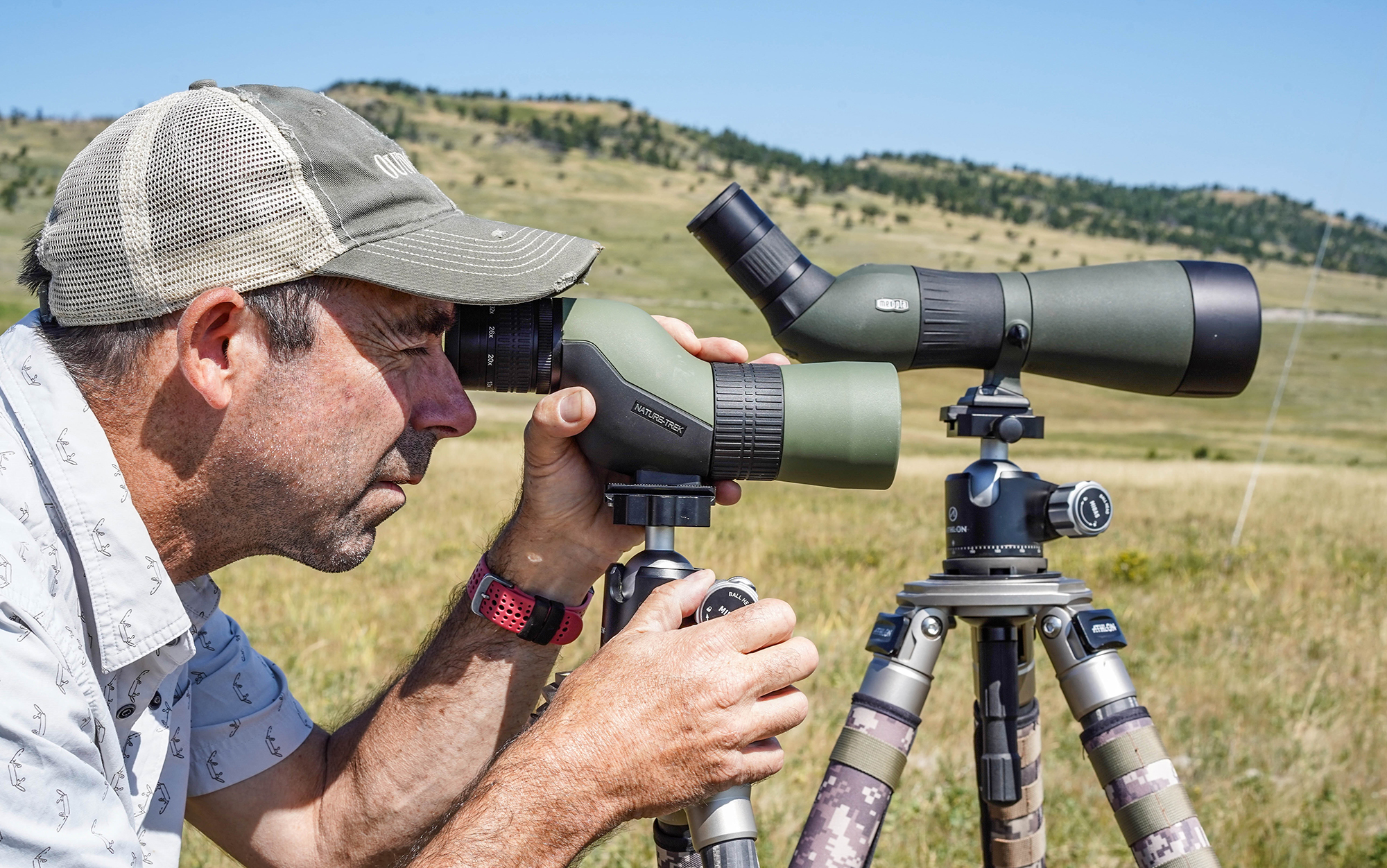
Full-size units start at 80mm objective lenses and can go up to 90 and even 95mm. That’s a lot of glass. Make sure you’re going to get the most out of it by investing in a stout tripod that will stabilize the scope. Second, really consider whether you need a full-size unit, or whether a 65mm or even a compact 56mm spotter is more your speed. For most of us who carry spotting scopes for miles over rough country, the smaller versions are preferable over the super-sized ones.
Next, consider whether you want an angled or a straight-body scope. I prefer angled scopes because of their versatility. I can easily deploy one on a steep hill, and by rotating the barrel, I can share the scope with a buddy sitting beside me without ever moving the scope.
Other considerations: center-barrel focus or fingertip focus close to the eyepiece. Also magnification range. Most full-size scopes have 20- to about 60-power magnification zoom ranges that cover most practical glassing purposes, but if you need more magnification, you’ll probably pay for it.
Look for spotters that have fully transferable lifetime warranties, good customer service, and solid reputations. After all, you’re going to be laying out a lot of cash for this spotter, and you want to make sure the company stands behind their product.
Final Thoughts on the Best Spotting Scopes
This was the first year we tested the best spotting scopes that have been on the market for a few years against new-for-’23 products, and we were both surprised and delighted to see the oldies pull their weight. That’s an indication that optics built with premium components and durable construction retain their value, and for buyers it means that you might find some very good deals on scopes that are being discontinued.
Testers were also interested in seeing how many spotters are relative clones of one another. We had three or four submissions that likely originated in the same factory, with only coatings and armor—and sometimes, a different grade of glass—differentiating them.