

We may earn revenue from the products available on this page and participate in affiliate programs. Learn More ›
“I couldn’t have missed; the crosshairs were right on.” How often have you heard this pitiful phrase, or, lamenting a missed deer, uttered it yourself?
It may come as a shock, but the reason why some shots mysteriously miss their targets can be explained by the fact that the shooter does indeed clearly recall seeing the crosshairs when he pulled the trigger. The memory of having seen the crosshair, or reticle, may very well have resulted from the shooter having had to look for the reticle in the scope’s field of view and then deliberately overlay it on the target. That means that the shooter’s primary attention had been focused on the reticle rather than the target.
Any time your concentration is not on the target, a miss is in the making.
Does this mean that the reticle in some scopes — perhaps the one you use — can be wrong for the kind of hunting and shooting that it is used for? Exactly. Of all the factors that have to work together when you aim your scope-sighted rifle, shotgun or handgun, one of the most important — the reticle in your scope — is one of the least understood. Also, for reasons that I can only guess at, discussions and even supposedly learned writings about telescopic sights seldom do more than pay lip service to reticles.
Before I sat down to write this column, I thumbed through the half-dozen good books on shooting that have been written during the past half-century and found that although the authors describe different reticles, usually with tidy illustrations, no really helpful suggestions or worthwhile conclusions are offered.
The standard advice being, “Here they are boys; use the one that tickles your fancy.”
I was even more distressed when, upon rereading the chapters on telescopic sights in a couple of books that I’d written, I discovered that although I had outdone myself in describing the mechanics and technical aspects of scopes and reticles, I had largely failed to take the subject off the pages and put it in a real shooting situation. I hadn’t explained why one type of reticle can offer a solid advantage over another.
Scope makers themselves have likewise been of little help, mainly catering to popular trends in reticles and promoting the optical qualities of their products while at the same time tending to ignore the simple fact that first and foremost a telescopic sight is a sight — an aiming device — and that we aim with the reticle, not the lenses. The optical qualities and magnification of the scope, whatever they may be, merely support the sight’s only purpose: aiming.
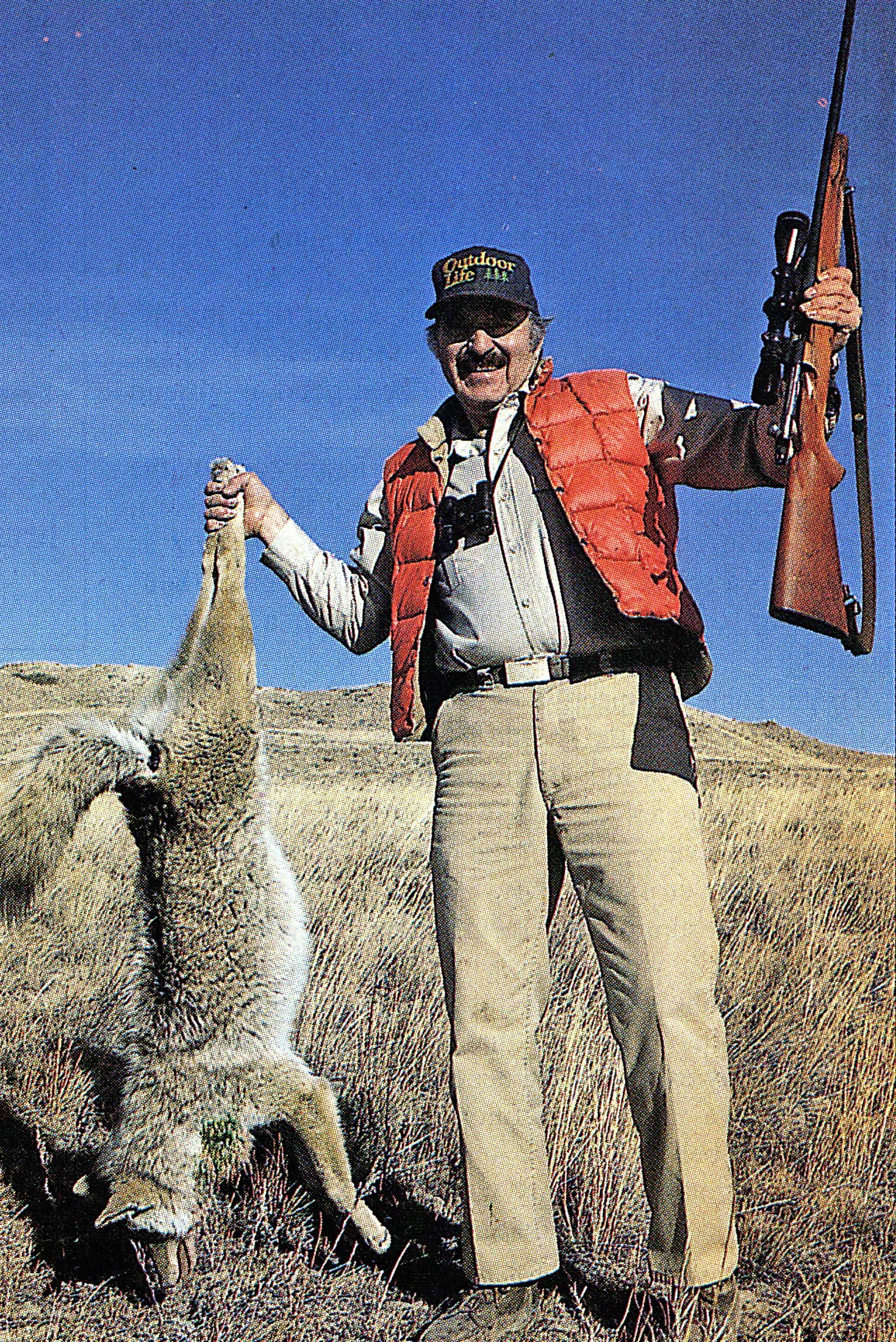
This sounds like a critical assessment, and it is intended to be, because when it comes to reticles, shooters aren’t being led astray so much as they are not being led at all. We get away with this because virtually any reticle, even a bad one, permits pretty good aiming, and as long as the scope can be sighted in and the bullets hit near where we aim on the practice range, we figure that we’re doing OK. What more can be asked?
But shooters and hunters are constantly asking for more, and I have a notion that once they become more acquainted with the relative advantages of different types of reticles, there will be as much campfire debate over crosshairs and dots and posts as there is over the .270 versus the .30-06.
I get a good bit of mail from readers asking for advice when they are planning on buying a new hunting rig. A typical letter reads something like:
“I’m thinking about buying a bolt-action rifle in .280 Remington caliber, and I want to mount a 3X-to-9X variable scope on it. Will this scope be a good all-around choice?”
Very seldom, however, is there an inquiry about the best choice in reticles for different kinds of hunting, even though reticle choice, in many instances, is at least as important as a scope’s magnification, field of view, brightness or any of the other criteria by which a scope is selected.
To get some perspective on the importance of a scope’s reticle, always keep in mind the simple fact that you aim with the reticle. So let’s consider how a reticle affects how you aim.
Read Next: The Best Rifle Scopes for Hunting of 2026, Tested and Reviewed
Quite a few years ago, when I first began doing a lot of varmint shooting, I was very much of the opinion that the best reticle was an extremely fine crosshair. My reasoning was that fine crosshairs allowed greater aiming accuracy because very small targets such as thumbtacks, or a woodchuck’s eye, could be divided into precise quadrants. For the most part, this was only wishful thinking because the precise bullet placement that I sought to achieve by such hairsplitting greatly exceeded the accuracy of my rifles and ammunition. Of course, I was also overly optimistic about my marksmanship. To make what I believed to be a good thing even better, I took the crosshairs out of some of my target scopes and replaced them with the thinnest filaments I could find. Youth and innocence require no apology.
More serious, however, was what these slender reticles might have been doing to both my shooting and aiming habits. To aim the fine crosshairs, it was necessary to divide my concentration between the reticle and the target, which, in any shooting situation, is the crooked road to a bad shot. Ideally, the reticle should be of a size and shape that insinuates itself on the target — the image you see in the scope — and transmits the point of aim to your brain without you having to look for it or think about it. That’s why when a reticle is right for the job, you will make a good shot without a clear recollection of having noticed the reticle at all. In other words, the right reticle lets you concentrate on where you want to hit. An apt comparison is a well-fitted shotgun that lets you give your full attention to the flight of the target without having to think about aligning the barrel.
Obviously, what is needed in the way of a reticle is one that is so distinct that it is instantly seen without looking for it and one that remains a distinct element of the sight picture even when you concentrate fully on the target. It would seem then that the ideal reticle would be a broad, very black crosshair, but this is somewhat of an oversimplification because different shapes, as well as sizes, of reticles may be best for different types of shooting.
In recent times, some scope makers have been making a big thing out of the brightness, or “light-gathering” qualities, of their scopes — the idea being that the oversize tubes and objective lenses transmit more light to the shooter’s eye and thereby permit better viewing and aiming during periods of low light, such as at dawn or dusk. This is fine as far as it goes, but without matching the reticle to the hunting conditions, there is little point in having an extra-bright scope.
A while back a scope importer sent me a new model to test that was claimed to be wonderful for shooting in low light. It had a 30mm tube (nearly 3/16 of an inch bigger than a standard one-inch scope tube) and a skillet-size objective (front) lens that transmitted a wonderfully bright field of view. Sadly, though, the scope would have been virtually worthless for hunting in low-light conditions because its standard crosshairs got lost in the evening shadows.
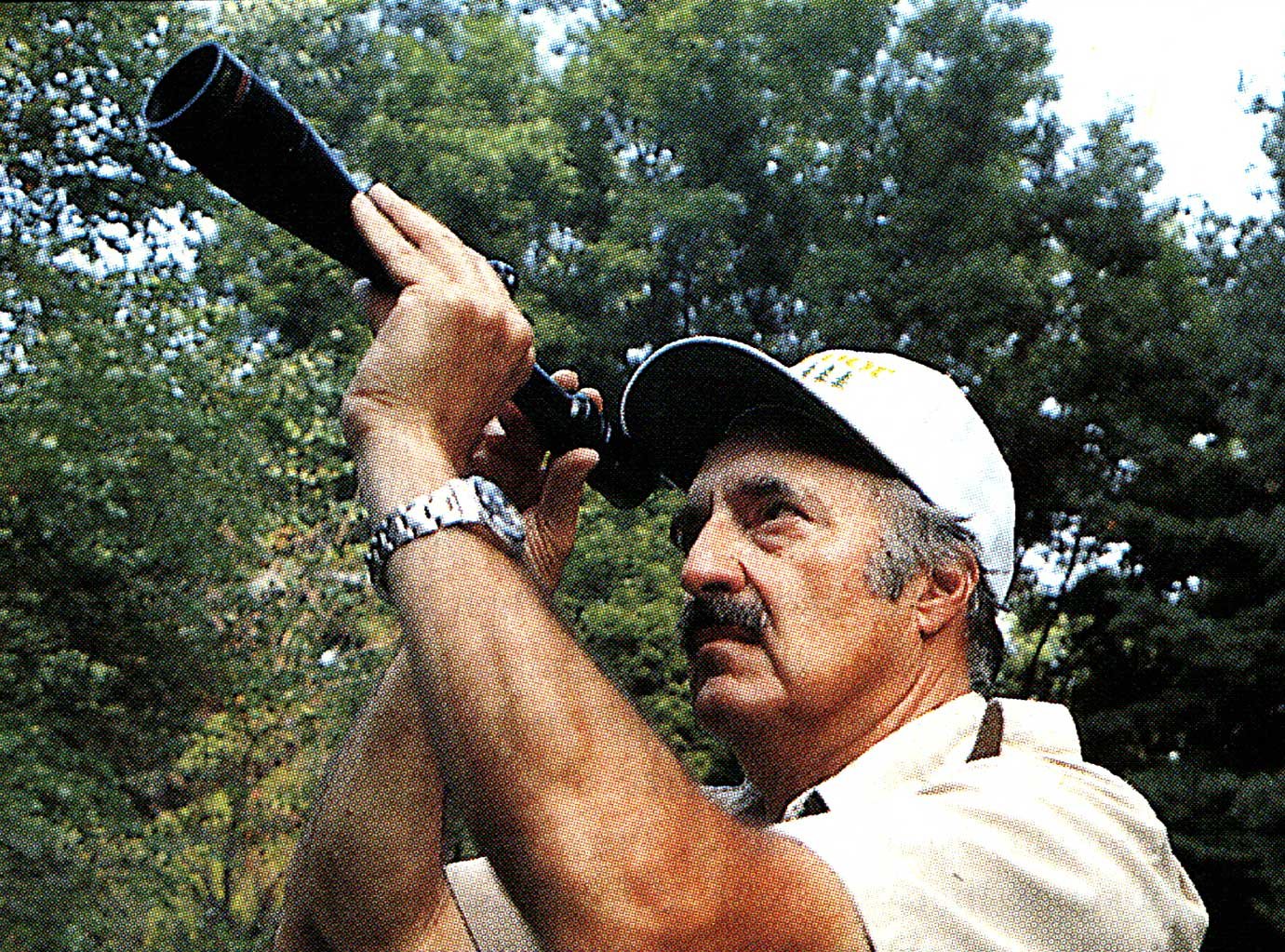
During the many excruciating hours that I’ve spent in a leopard blind, I’ve found over and over that when I’ve had to call it quits on account of darkness, it was not because of being unable to see the target zone, but rather because the reticle in my scope had faded into the gloom. This is why the size and shape of the reticle is more important than the brightness, or so-called “light-gathering” qualities, of a scope that will be used for shooting in dim light.
European hunters, who often shoot in darkness that would astonish their North American counterparts, have long been wise to the absolute necessity of a bold reticle for hunting in poor light. This is why German and Austrian scope makers have traditionally offered not only a wider variety of reticles than American scope makers, but also reticles of much bolder dimensions.
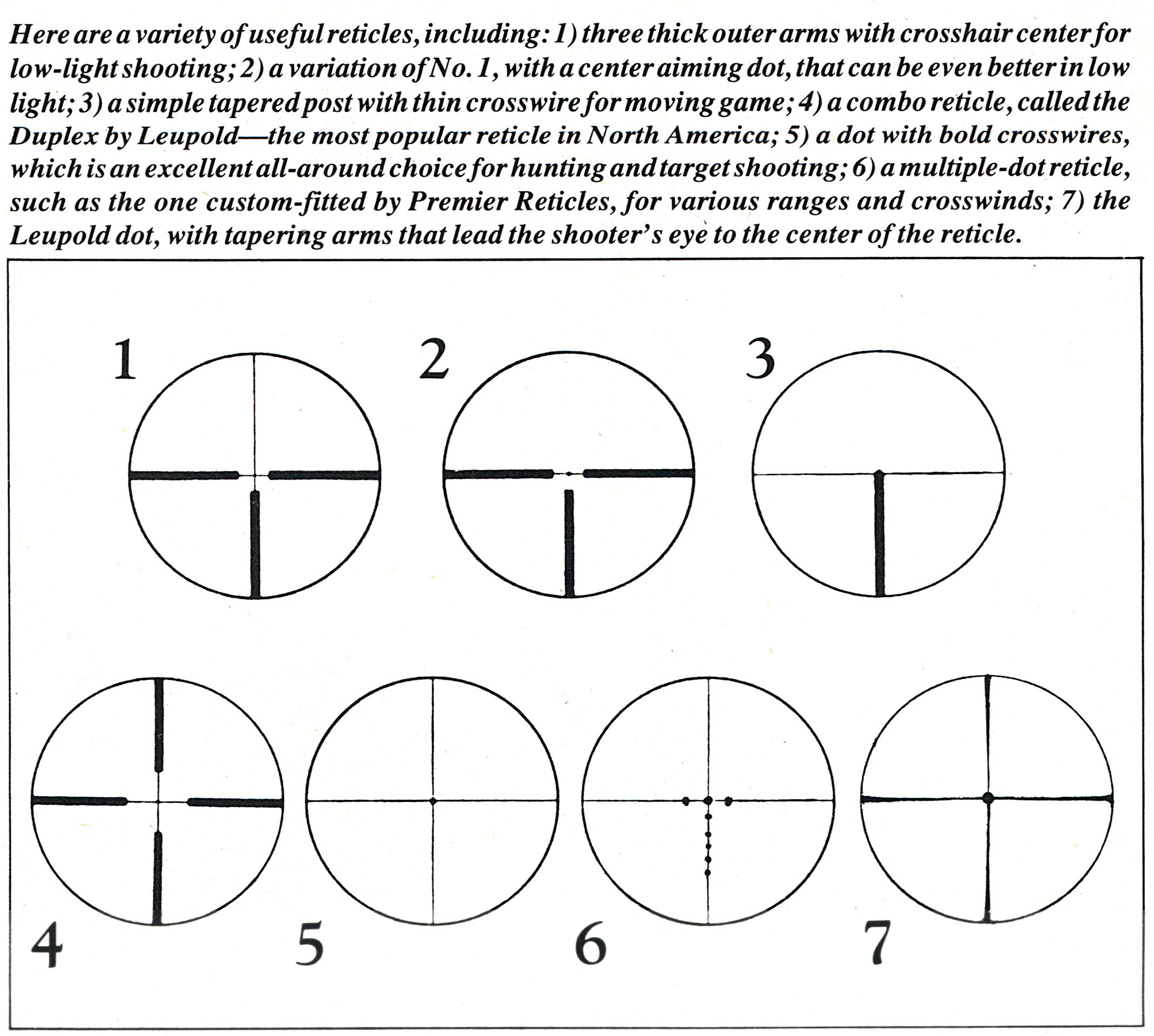
To give you an idea of the difference, the crosswires of a typical 4X American scope will subtend about one-half to three-quarters of a minute of angle at 100 yards. In layman’s terms, this means that the crosswires appear that wide at 100 yards, twice that wide at 200 yards, with progressive enlargements as the range increases. If the reticle is the popular dual-dimension crosshair, such as Leupold’s Duplex pattern, the thicker outer arms of the reticle will subtend about two minutes of angle, more or less.
By comparison, the center wires on a European scope will subtend a full minute of angle, with the thicker arms appearing to be as wide as six to eight inches at 100 yards! Not only that, but the thick arms may reach much closer to the center. These arms reach in so close in some models that even if the thinner center part of the reticle is lost in darkness, the thicker arms can still be used to reasonably aim a shot.
North American hunters, followed by American scope makers, have never cottoned to these bold, extra-thick reticles because they blot out a sizable portion of the field of view, as well as seem to make aiming somewhat imprecise. In truth, though, the broad outer arms of the European reticles don’t block out anything important, and the thick center crosswires, though not the best choice if you want to shoot quarter-inch groups, make it possible to aim a rifle in dim light that would render more delicate reticles useless. My favorite of the European-style reticles has only three heavy arms, with the top arm being omitted. This leaves the top half of the field of view unobstructed, but there is still plenty of reticle definition for aiming in poor light.
I’m not saying that a European-made scope is the only salvation for hunters who take to their deer stands during the darkest minutes of legal shooting hours. There are plenty of scopes made here and in Japan that can be had with low-light reticles. Leupold’s 6×42 scope, for example, comes with a choice of either standard or heavy reticles, with the heavy style having center crosshairs nearly an inch thick (as they appear at 100 yards) and more than 2 1/2 inches wide at the outer arms. Some scope catalogs include tables of reticle subtensions, which I don’t think are often read by consumers but can provide valuable information if you take the time to look at them.
Though the reticles I’ve been discussing may work best in conditions of poor light, there are other hunting and shooting situations where other types of reticles will work better. For example, if you hunt deer in timbered or brushy terrain, where the shooting distance is usually close with the quarry frequently moving or on the run, a heavy European-style crosswire reticle becomes a less than perfect choice. The reason is that when you shoot at a moving target, you want two things: maximum reticle definition and an unobstructed view of the target, especially on the horizontal plain where the target is moving. This latter criterion explains why a reticle with thick horizontal cross arms is a poor choice: As you swing ahead of the running target, the horizontal arms may hide or largely obscure what you are shooting at.
The old-fashioned flat-topped standing-post reticle, with or without visible crosswire, is hard to beat for hunting in brush or timber and for shots at moving game. The bold profile of the post can be easily seen against a brushy background, and the open field of view to either side of the post allows you a clear view of the target even when you are leading a running shot. Troy Lawton, a shooting friend who won the 50-meter running-target event at the U.S. International Shooting Championships a few months ago, tells me that he uses a post reticle for the difficult running-boar events in international competition. Presumably he does this for the reasons that I’ve just described, because what works best in the hunting field frequently works best on the target range as well.
Simple post reticles are not as common in American brands of scopes as they once were. The reason for this, I think, is that modern-day rifle and scope buyers have become overly obsessed with accuracy, and they fear that a post reticle won’t allow the precise aiming that is necessary to shoot bragging-worthy groups at the local club’s range. This is a fundamental but common mistake, because you don’t hunt big game on the practice range. When selecting a hunting reticle, try to imagine how it will look on a miserable, dark, rainy day in heavy brush. In such conditions, a big post can be mighty comforting. That’s why a big post is my first choice in a scope for a shotgun with rifled slugs, because the terrain, hunting conditions and distances at which rifled shotgun slugs are typically used are those where a post reticle is at its best. What with today’s improved slugs and slug-shooting guns, along with hunting regulations requiring their use in some states or regions, I wouldn’t be surprised if the post reticle was to make a comeback. Scope makers take note.
I’ve saved the dot reticle for last because more and more I’ve come to regard a dot as the best all-around reticle for most forms of rifle shooting — especially for any sort of shooting, such as target shooting, plinking and varmint hunting, where careful aiming is required and your eye is kept busy aiming many shots for extended periods. This represents quite a change of opinion, because there was time, long past, when I was of the notion that a dot, no matter how small, covered up too much of the target and thus restricted the accuracy of my aim. But as I mentioned earlier, those were innocent times. Also, a dot reticle nearly caused me a disaster on an Alaska bear hunt several years ago. This I’ll describe presently.
For decades past, the dot reticle has often been referred to as a Lee dot, named after T.K. “Tackhole” Lee, who installed dot reticles in scopes of all types. Lee was famous for his “floating” dot, which was suspended on a filament of spider web so fine as to be all but invisible, making the dot truly appear to float in space. Of course, such dots were a fascinating technical achievement, but in a more practical sense, they left a lot to be desired, as I learned on a cold, drizzly day on the Alaska Peninsula when I tried to draw a bead — or rather a dot — on a bear.
My scope was one of the old 2.5X Lyman Alaskans set in a low Griffin & Howe mount, the way it was done back in the 1950s, and altogether it made for a fine weatherproof rig for hunting bears along the blustery Alaska coast. I’d spotted a nice bear from a hill above and worked my way down to within a range of about 80 yards, remaining hidden in the brush while the brownie scavenged among sea-eroded boulders along the shore. When I raised the .375 Holland & Holland to fire, what I saw was not one dot, but dozens of dots of all sizes, caused by specks of rain on the scope’s eyepiece. By the time I sorted out the dot I wanted to aim with, the bear had disappeared behind a rock and then reappeared several yards down the beach. So I had to make a dash to catch up for another shot, at which point I again played pick the right dot, and the bear once more disappeared. After I had played this guessing game a few more times, the bear stopped long enough for me to get the right dot on target.
Right then I swore off dots, but only for a while. Nowadays I use dot reticles in most of the scopes that I use regularly, especially those that I use for target and varmint shooting, but they aren’t floating dots. Instead, I want the dot suspended on visible wires that instantly lead my eye to the dot. Not only that, but I’ve come to prefer what many shooters would consider oversize dots. The lone exception is the one-eighth of a minute dot in the 36X scope that I use for benchrest shooting. But even such a small dot causes less eye fatigue than crosshairs when a shooter is aiming at a target for long minutes at a time. The same is true with reticles for varmint shooting, only here I prefer a larger dot that can be easily seen against the varied backgrounds typical of varmint-infested pastures.
Where a dot is at its most helpful is in situations where the hunter or target shooter does not have a solid rest and must shoot offhand or from a relatively unsupported position. With the constant twitching of the sights typical of offhand shooting, especially when you’re out of breath or excited about a shot at a trophy deer, ordinary crosshairs can be especially difficult to see as they jiggle and skitter across the target. Trying to keep up with the crosshairs causes you to concentrate on the reticle rather than the target, and as described at the beginning of this column, a miss is in the making.
With a nice plump dot suspended on clearly seen wires, you don’t have to look for or even think about the reticle, and your full attention is focused on where you want the bullet to hit. Also, as you’ll discover, a big dot seems to jiggle less than a crosshair, thus reducing any tendency to jerk the trigger. This is why the dot reticle is an overwhelming favorite with silhouette shooters who fire only from the difficult offhand position. The preferred dot size for silhouette shooting is about a half-minute, which looks big and fat through the high-magnification scopes (16X or more) usually used in competition.

Shooters who use fine crosshairs in the belief that these reticles are an aid to precise aiming (as I thought as a youngster) are only kidding themselves. Savvy shooters, especially experienced target shooters, know that an undersize reticle causes eye fatigue and leads to reduced target concentration. That’s why the top shooters who pump shot after shot into a tiny bull’s-eye use surprisingly large dots or thick crosshairs.
For hunting, the size of the dot should be matched to the magnification of the scope, with lower-power scopes having progressively larger dots. A 4X scope, for example, should have a dot in the 2 1/2 to three-minute range, and a two-minute dot is about perfect for a 6X scope. With modern variable-power scopes, the size of the dot will diminish progressively as the magnification is increased. The dot reticle in Leupold’s 2X-to-7X variable scope, for example, subtends 4.3 minutes of angle at the lower setting and 1.61 minutes at full power, which is ideal.
Whatever reticle you use, be sure that it is perfectly focused for your shooting eye. All too often a scope doesn’t do all it can for a shooter simply because the shooter isn’t seeing the reticle as clearly as he should. Scopes are usually delivered with the eyepiece lens focused for normal vision. But don’t count on the lens being focused, especially when using secondhand scopes. You can easily bring your scope’s reticle into clear focus for your eye by screwing the eyepiece out until the reticle looks fuzzy. Then, while looking through the scope at a neutral background, such as the sky, screw the eyepiece forward (to the right) until the reticle is sharp. While focusing the eyepiece, it is a good idea to look away from the eyepiece every few seconds so that your eye doesn’t accommodate itself to the scope (false focus). Also, if you use prescription glasses when shooting or hunting, be sure to wear them when focusing the eyepiece. Likewise, if you don’t wear your corrective lenses when hunting, focus the scope without them. And if you wear bifocals, be sure to focus the scope while looking through the long-distance part of your glasses.
Remember, the reticle is what you aim with, and the better you see it, the better you’ll shoot.
This story was originally published in the November 1990 issue of Outdoor Life.