
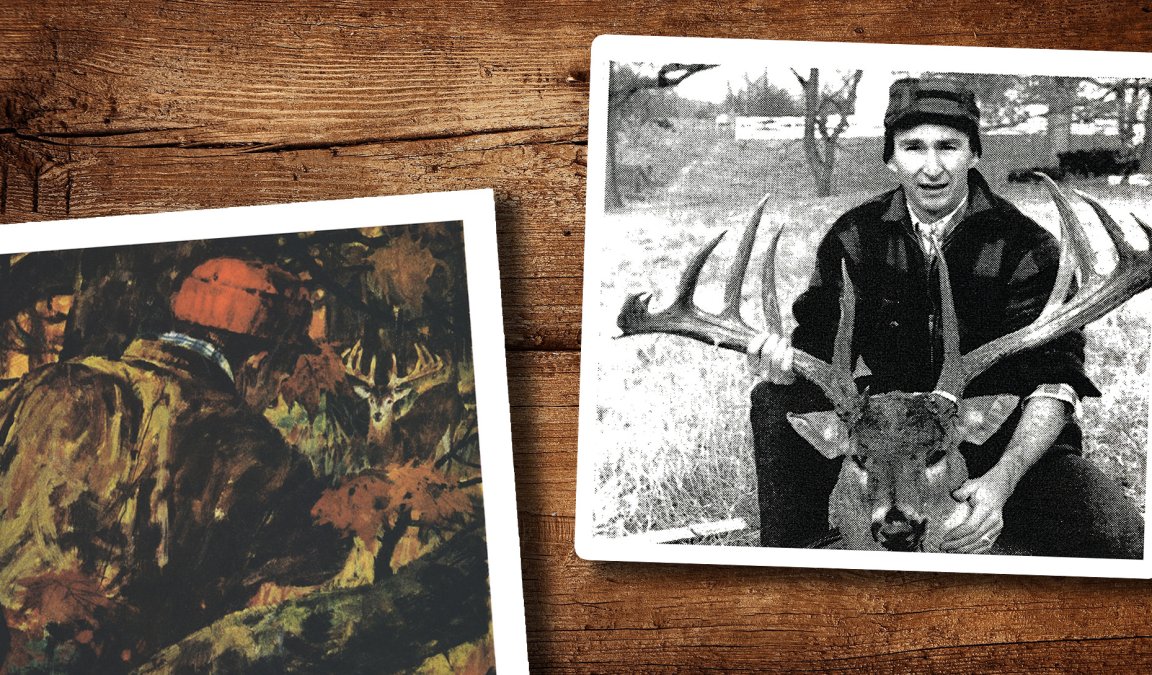
This story, “I Shot Big Red,” appeared in the January 1967 issue of Outdoor Life. Shelton’s buck is now the 20th biggest typical whitetail ever taken in Kentucky, according to the Boone and Crockett Club. At the time, however, it was the biggest ever taken in Kentucky. It also had a wider inside and outside spread than any deer on the books, including the then-world-record deer.
At 2 o’clock in the afternoon on November 28, 1964, I was ready to give up the dream of a lifetime. The rain, which had been steady since before dawn, suddenly stopped, and the woods of northern Todd County, Kentucky, were still. I was 20 feet up in a huge sycamore, watching a deer runway that meandered through thick brush. I’d been half-wet most of the day, and I felt another case of chills coming on.
I might as well quit, I thought. I’m not going to see Big Red, and I probably won’t see any other deer.
My thoughts seemed logical, but another line of reasoning wouldn’t be denied. This was Todd County’s first deer season in modern times, and the season was for this day only. So far as Big Red was concerned, I had good reason to believe he was the best trophy whitetail buck in North America. Besides, I’m mighty stubborn when it comes to deer hunting. I decided to stay in that tree till dark.
In front of me, to the north and 30 yards away, a tiny creek flowed through a heavily wooded east-west valley. The runway crossed the creek and continued into dense thickets. I couldn’t see the thickets’ far edge, but I knew the growth thinned against a hillside that topped out alongside a stubble cornfield 200 yards away. The cornfield was 40 yards wide and bordered a little-used gravel road. Across the road was 40 acres of tangled cedars, the thickest cover in the area. I figured any deer leaving those cedars would use the runway I was watching.
Around 2:30 a twig snapped behind me, to the south. Then I heard branches rubbing together and sounds resembling a squirrel digging in the ground. I knew I was listening to a deer.
The sounds were a few yards off the runway. In another minute they became more distinguishable, and I knew the animal was working toward me. I had two choices: remain motionless in hopes the deer would move past me, or try to inch my way around so I’d face south.
Though the leaves were off the trees, I figured I had an excellent chance of moving without being seen. I was standing on a huge branch, but I was tight against the trunk. Deer don’t normally look up, so I also had that advantage. In addition, I figured the deer was feeding and not alerted to immediate danger. I moved as cautiously as possible.
It took a few minutes to make my move. Now I was facing south. Surprisingly, I could still hear the same sounds, but I couldn’t see any movement.
The sounds kept coming closer. Then, as if by magic, there he was. I saw antlers and legs at the same instant, about 30 yards away. The buck was pawing at acorns. I couldn’t get a clear view of his antlers, and I didn’t dare risk a shot through that thick brush. There wasn’t much I could do except wait.
After what seemed like hours, he suddenly tossed his head up. He seemed to be looking straight at me. His rack was massive, but I knew instantly it didn’t belong to Big Red. I was sure the buck had caught a glimpse of me or winded me.
I better take him, I thought. Time is running out.
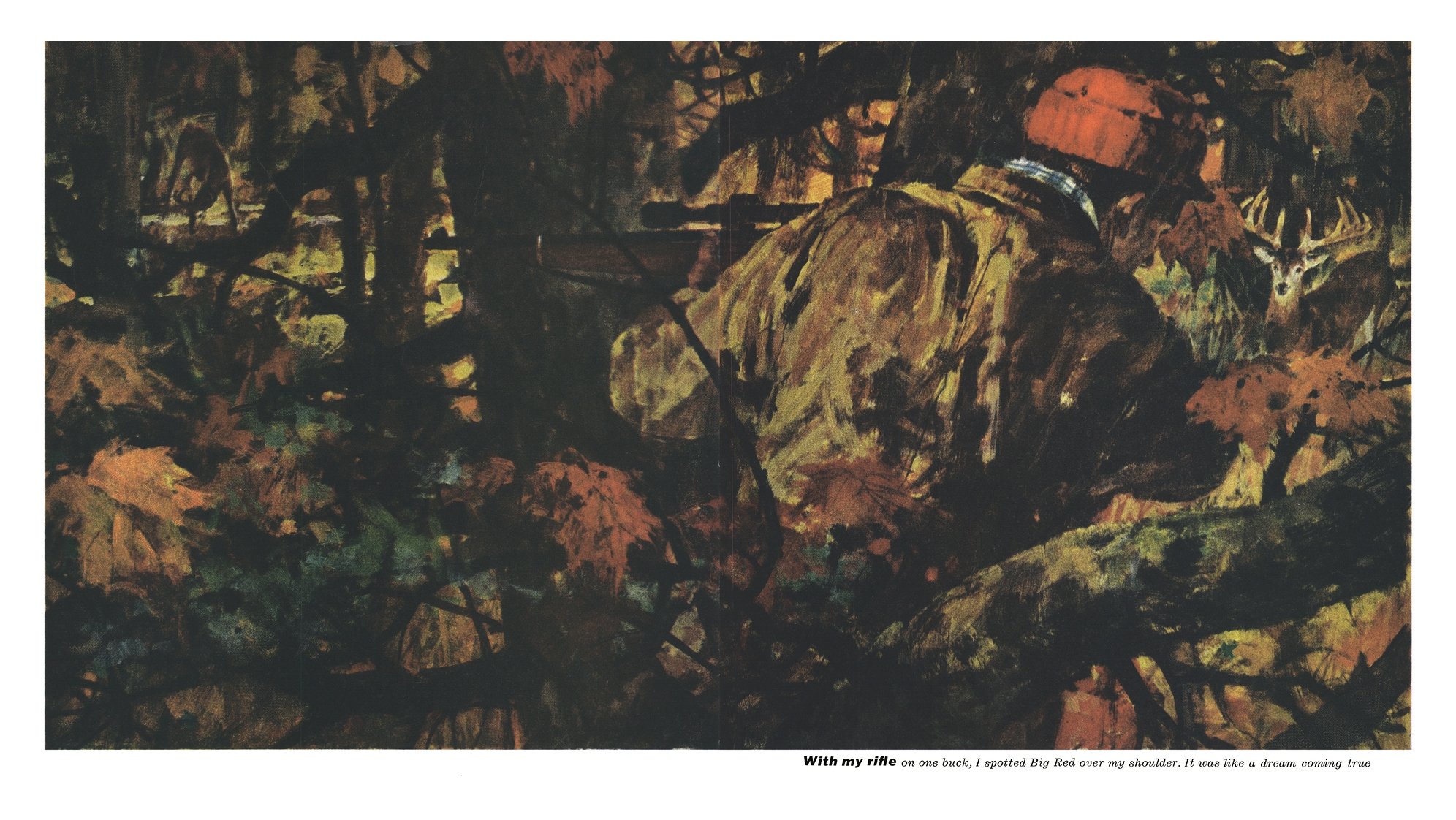
My .44 Magnum Ruger carbine was braced against the trunk. I started lining the crosswires of my Weaver scope on his chest. Then, through my variable-power scope, I made an amazing discovery. That buck wasn’t looking up at me at all; he was staring on the level along the runway toward the north.
Now the eight-pointer relaxed and dropped his head to feed again. I heard the same sounds that had startled him. To the north, behind me now, I heard another deer. I glanced over my shoulder and got the second biggest shock of my life. Big Red, in all his glory, was walking toward my tree stand. The monstrous buck was in clear view, 50 yards away and moving down the runway. There was no question about his identity.
I had seen him two years ago when we had come face to face under the most dramatic conditions. We had startled each other that time. Now I had all the cards. Or did I? I was in no position to shoot. If that buck was alerted to the slightest suspicion, he’d bound into the thickets and disappear.
This dream situation had been in the making for a long time. I guess it really started when I was nine years old, the day I shot my first squirrel. After stalking the gray for hours, I knocked it off a stump with my brother Rudy’s .22. I decided then and there I wanted to become the world’s best hunter. That boyhood ambition has never dimmed, though it’s been realistically tempered by maturity. At that time my family lived in the town of Mayfield, in southwestern Kentucky. There was plenty of small game and birds, but no deer.
By the time I got a chance to go deer hunting, I discovered I wasn’t much of a hunter after all.
By the time I was in high school, I was addicted to duck hunting. The area around Mayfield is laced with creeks, rivers, and potholes. It was a duck paradise. I taught myself how to call by sneaking up on flocks of waterfowl and listening to their various calls. I’d go hunting before and after school every day during the season. I practically lived outdoors. But by the time I got a chance to go deer hunting, I discovered I wasn’t much of a hunter after all.
I’m 26 now and live in Bowling Green, where I work as a real estate salesman and auctioneer. My wife and I have a daughter, four, and a son, two.
Kentucky’s first modern deer season opened in 1956, when I was still a teenager. I didn’t get a chance to hunt deer until 1959, but nobody ever dreamed about deer hunting more than I did.
Looking back, I realize I started my first season as quite a stupid deer hunter. I had no experience, and I’d never seen a deer in my life. The 1959 season lasted three days, and I hunted every one of them from dawn to dark. After it was all over, my record was unblemished: I still hadn’t seen a deer. I’m not sure I even saw a fresh track.
My failure made me more angry than disgusted. I bought books on deer hunting. I went to the library. I subscribed to Outdoor Life. I studied every word I could find on deer.
Three months before the 1960 season opened, I started scouting my hunting territory on weekends. With six weeks to go, I stepped up my scouting trips to every couple of days. I found runways and beds, examined browse conditions, and located the “use” areas of three herds of whitetails. It all paid off. I killed a fat doe from a tree stand just after dawn on the opening day of the season.
I missed the 1961 season because of a session with Uncle Sam, but I didn’t lose contact with shooting. My ability with a rifle was good enough to win me an instructor’s rating, and I had charge of an army rifle range for 10 months.
In 1962 and 1963, I collected my second and third whitetails. I shot both of them while sneaking silently into bedding areas I’d discovered on scouting trips. My 1962 deer bolted from thick brush 80 yards away, and I dropped him with a single bullet. My third deer, a six-pointer, heard me pussyfooting along, but I saw him before he spotted me. He went down in his tracks.
After I killed my first deer, I studied taxidermy and began mounting deer heads for my friends. I mounted the head of my big six-pointer, but every time I looked at it I dreamed of the day when those six points would be dwarfed by a much larger rack. My dream had plenty of substance because by this time I’d seen Big Red.
We met in October, 1962, while I was living in the town of Elkton, Todd County. I’d heard that the county might be opened to deer hunting, so I started scouting likely areas. I’d done some business with H. Sweeney, a local farmer, and he’d told me he frequently saw deer crossing his fields.
On one of my scouting trips, I found a heavily traveled runway through a hilly area of oak, poplar, hickory, and cedar. The runway was pocked with fresh tracks, and I followed it down through the hills and across a valley to where it led into a rye field. Where the field met the woods, a huge oak tree offered a perfect stand. I decided to climb the tree and see what moved along the runway toward evening.
About 5 p.m. I heard some deer coming through the woods. It was a warm, quiet day, and the trees were still in full foliage, so I heard them for a long time before I saw them. Shortly, three deer walked below me and went out into the rye field to feed. I watched them for half an hour. Then I heard another deer. He moved steadily to the last bit of cover, then stopped.
I made out the partial outline of a huge deer. The whitetail stood motionless for a full five minutes; then he stepped into the field and joined the other animals. He had an eight-point rack and was the biggest deer I’d ever seen.
Across the pond, 20 yards away on top of the opposite bank, stood the most magnificent whitetail buck in all the world.
Then I heard dogs barking. They were chasing something, and the sounds kept coming closer. A six-point buck suddenly burst out of the woods, ran under my tree, and joined the other deer. As if on signal, they all bolted out of sight.
I never did see the dogs or any more deer, though I stayed in the tree till dusk. I’d traveled farther than I thought, and it was dark before I got halfway back to my car. I decided to bypass the woods and stay in the fields. It was this decision that set up the chance meeting with Big Red.
I was crossing a fescue field when I approached a man-made stock pond. Banks, about 10 feet high, had been bulldozed around the pond to collect and hold water. I could have walked around the embankment, but I decided to walk along the top of it. A full moon had just cleared the horizon, and the landscape was bathed with an eerie beauty. I went up to the top of the bank and got the shock of my life. Across the pond, 20 yards away on top of the opposite bank, stood the most magnificent whitetail buck in all the world.
The huge animal was silhouetted against the moon in fantastic beauty. I guess we saw each other in the same instant, and we both froze, each sizing up the other.
I remember my breath going out in a gasp. My first thought was that I was looking at somebody’s tame elk. Then I knew the animal had to be a deer. His size didn’t awe me so much as did the tremendous spread of his antlers.
We must have stared at each other for seconds. Then the monster buck snorted, whirled, and bolted down the bank and across the field. About 75 yards away, he leaped a five-foot fence. Then he stopped and looked back. I took a few steps toward him, and he trotted into some woods.
I was talking to myself when I got back to the farmer’s yard where I’d parked my car. I went up to the house and knocked on the door. He didn’t seem very impressed when I exclaimed, “I’ve just seen the biggest buck in Kentucky!”
“That’s Big Red,” he said. “I’ve seen him a few times. You can’t mistake him. He’s a lot bigger than an ordinary deer. His face is sort of reddish. That’s why we call him Big Red. The local farmers know about him, and you’re going to have plenty of company if you figure on hunting that buck.”
As it turned out, Todd County wasn’t open for deer hunting in 1962 or 1963. Kentucky controls its whitetail population by allowing hunting only in counties where the herds have built up to the carrying capacity of available deer range. In 1956 (the first year that deer hunting had been allowed since 1911) only 27 of the state’s 120 counties were open to shooting. In that season 6,000 hunters killed 1,300 whitetails. By comparison, 14,000 hunters bagged 4,100 deer in 1965. The 1966 population was estimated at well over 50,000 deer, and hunting was allowed in 74 counties.
All of this had its beginning in 1950 when the state began its stocking program with deer bought from Pennsylvania. Original stockings were made in Mammoth Cave National Park and Federal Wildlife refuges. With a ban on hunting, these herds multiplied so rapidly that certain areas became overrun with deer. Live-trapping crews thinned out the overpopulated sections and stocked the deer in other areas that had heavy browse conditions. As these herds build to huntable populations, additional counties are opened to hunting.
In the summer of 1964, the Kentucky Department of Fish and Wildlife Resources announced that Todd County would have its first deer season, a one-day hunt on November 28. I told my brother Rudy about Big Red, and we planned to hunt him together. We didn’t get much sleep the night before the season opened, and we left for our hunting area at 3 a.m.
A few changes had taken place during the two years since I’d met Big Red. The monster buck had moved from the Sweeney farm to adjoining woodlands owned by farmer Ross Laster. The deer’s travel routes had also changed, but I knew all about this because I knew Ross well and hadn’t relaxed my scouting trips. I hadn’t seen the buck a second time, but I’d found his tracks many times, and some of the local farmers had seen him just a month earlier.
Dawn was breaking when Rudy and I drove down a gravel road toward Ross’s farm. A mile from our destination, a four-point buck jumped across the road ahead of us, ran to the far edge of a small stubble cornfield and stopped.
“Get your rifle and nail him,” Rudy said as he braked the car.
“No, you take him,” I answered. Neither of us made a move, and the buck walked slowly out of sight. While we wouldn’t admit it, both Rudy and I weren’t the least bit interested in shooting that buck.
We drove to the farmhouse, and Ross had news.
“That bunch of deer are traveling new runways,” he said. “The best one is about a mile down the road by a cornfield where. . . .”
“That’s where we just saw a buck,” I interrupted. “There’s a bunch of cedars across the road.”
“That’s the place,” Ross said. “I’d forget your other plans and pick a couple of stands along that runway.”
That’s exactly what we did. Half an hour later, I found the big sycamore I mentioned in the beginning. Rudy decided to follow the runway toward some heavily wooded ridges half a mile away.
The air rasped into my throat with such suddenness that I momentarily feared he’d heard me. But he gave no sign of caution. He raised his head, walked through the shallow creek, and came directly toward my tree.
About 8 o’clock, it started raining hard. By 8:30 I was so wet I went back to the car, changed clothes, and put on a yellow rainsuit. I was almost back to the sycamore when I heard shots from Rudy’s area. I walked up on a ridge and found Rudy all excited.
“I shot at a buck with a brushpile rack,” he said. “I was curled up under a tree trying to stay dry when I heard a deer coming down the runway behind me. I turned around and we spotted each other at the same time. The buck bolted, and I cut loose with three shots. I lost his tracks right here. He sure was a big one!”
Rudy was a mighty disappointed deer hunter. He’s 35 and one of the best outdoorsmen I know. He’s been a hunting nut all his life, and he taught me how to hunt and fish when I was a boy. He lives in Mayfield where he works as a heavy-equipment operator. He’s married and has two teenage sons.
Rudy went back to his stand, and I stillhunted till noon. We met at the car for lunch, stillhunted another hour, then returned to our stands. It wasn’t long after that when I glanced over my shoulder and saw Big Red.
I don’t remember any trace of buck fever, but I do recall coldly analyzing the situation. I studied every bit of cover between myself and the deer. About 40 yards from my tree stand, a clump of cedars edged the runway. Big Red would have to pass behind that clump. When he did, I’d turn around.
My change in position came off like clockwork. When the animal appeared again he was unsuspicious, and I was in perfect shooting position with my scope lined up on his chest. I decided against squeezing the trigger. I wanted him to come as close as possible.
At the creek 30 yards away, the trophy buck stopped for a drink. The suspense was terrible. I used this moment of his relaxed alertness to suck in a deep breath. The air rasped into my throat with such suddenness that I momentarily feared he’d heard me. But he gave no sign of caution. He raised his head, walked through the shallow creek, and came directly toward my tree.
Suddenly he stopped, turned his head toward his backtrack, tilted his nose, and tested the air. Then he swung his massive antlers forward and walked behind a couple of cedars where he stopped dead still. I had a feeling he was getting nervous.
He might bolt at any second, I thought. As soon as he steps from behind those cedars, I’m going to shoot.
The range was now 25 yards, and there was no question about his increased caution. His face peeked from behind the cedars. Then that unbelievable rack. Again he stood motionless. Suddenly he broke into a fast trot.
It was now or never.
The crosswires settled at the base of his neck, and my rifle roared.
Big Red staggered sideways, regained control of his feet, and lunged straight ahead. I aimed my second shot for his shoulder, and the 240-grain bullet spun him around. He dived into thickets alongside the runway and was gone. I heard him crash through brush; then all was silent. I knew he had fallen.
I went down that tree as fast as I could. I got within 30 yards of him, and then he staggered away. I snapped two shots through the thickets, but the bullets never got to him. I heard him fall again about 60 yards to my right. I got within 40 feet of him before he tried getting up. He couldn’t make it. Another bullet finished him instantly.
I started field-dressing the buck immediately. It wasn’t easy. His bulk was so great I couldn’t move him. I tied his legs to saplings to spread-eagle his hindquarters. Throughout the job, I whistled for Rudy every few minutes. It’s a whistle note we’ve used for woods communication since we were kids. I was nearly done with the chore when Rudy found me. He stayed with the buck while I went to Ross Laster’s farm for help.
Four of the Laster brothers and I got a tractor to within 300 yards of Big Red. Then we had to chop down saplings, clear brush, and cut a fence to get the tractor within 100 yards of the buck. After that it was pure bull work — dragging, hauling, and lifting Big Red till we finally had him balanced on the tractor.
A few hours later, he weighed 260 pounds on a coal scale. I was surprised because I’d figured he would scale over 300 pounds. I guess the massive antlers fooled me. I was familiar with the Boone and Crockett Club method of scoring trophy deer, and I was certain my buck would score near the top of the record list.
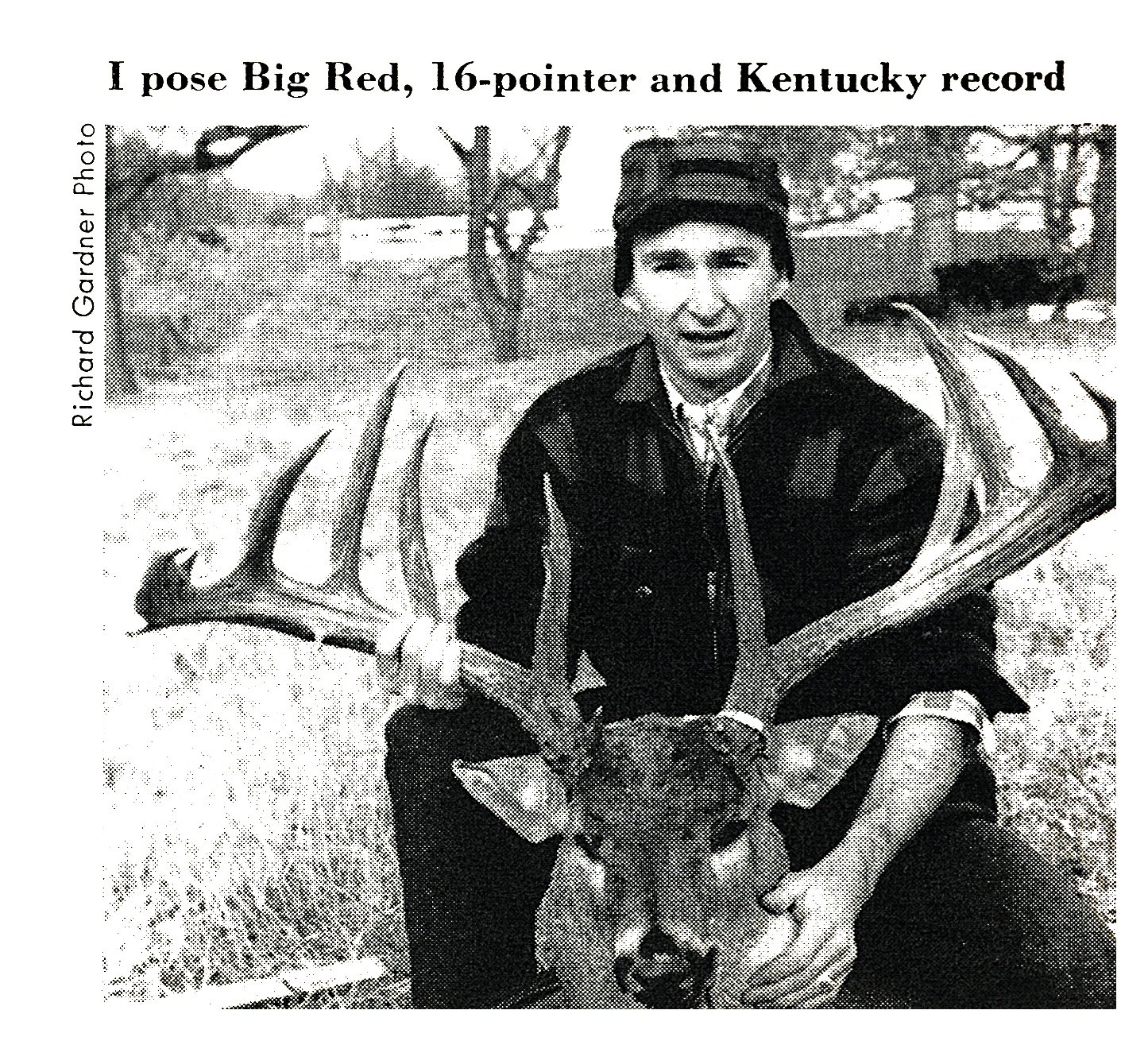
Two months later, the antlers scored 185 4/8 points. My trophy won third place for typical whitetails in the Boone and Crockett Club two-year competition period ending December 31, 1965. Though I didn’t kill a new world record, I did score some impressive ratings. Big Red is the best trophy whitetail ever killed in Kentucky.
The inside spread of his rack measures 30 2/8 inches, more than 10 inches wider than the current world record. While checking the last listing of all-time Boone and Crockett records, I discovered that this inside measurement is the greatest among all typical whitetail deer recorded there. Though I realize that total score is all that counts, I doubt whether anyone will ever kill a whitetail buck with a wider antler spread than Big Red’s.
There’s one thing I can guarantee — nobody will ever know a greater hunting thrill than I experienced when I looked over my shoulder in that sycamore and saw the dream of a lifetime coming true.