
When I was a skinny, big-footed kid in grammar school, I had the unbelievably good luck of being yanked out of school for several days to go on a deer-hunting vacation with my family. Nowadays, thanks to the game commission’s deer stocking and management programs, deer are plentiful in the mountains of east Tennessee, but in the 1940s they were nonexistent. That meant that going on a real deer hunt involved traveling hundreds of miles and visiting places as far removed from our farm as was the back side of the moon. It was, to my mind, an elegant adventure, sort of like going to Europe or taking an ocean cruise. Nothing could be finer. My chums were green with envy.
Our hosts were old family friends who had struck it rich and bought an historic plantation in Virginia, complete with antebellum mansion and miles of sweet-scented hardwood forest.
On the day we arrived, dressed in our Sunday best, in a gleaming pickup truck, our host had shot a nice buck and it hung in the smokehouse. I remember inspecting the animal in elaborate detail; feeling the texture of its hair, looking at its teeth and bones and, most of all, marveling at the wonder of its gracefully curved antlers.
Horns, as they grew on cows and bulls, were familiar to me. But antlers were something entirely different — harder, more graceful and certainly more dangerous looking. I nearly lost my senses when told they were shed and regrown every year. For a while I simply didn’t believe it and only gradually allowed myself to be convinced.
And deer could jump, too, higher than a cow or even a horse. My imagination reeled with stories of these wonderful animals.
“Come on,” I said, “nothing can jump a high-wire fence.” So my host took me to a crossing place and showed where the deer-tracked path led up to a fence then continued on the other side. “Wow, they really can do it. Wait till I tell Mom.”
Next day, after breakfast of deer loin, rich gravy and biscuits, I stood in front of the gun rack, itching to get my hands on a genuine deer rifle and go hunting for these wonderful animals. Already, visions of great stags were dancing through my head.
My dad took the first rifle, a Model 99 Savage in .250 caliber, and my brother selected a shortened .30/40 Krag. Why, I wondered, had he passed over a truly beautiful Model 141 Remington pump-action rifle in .30 Remington in favor of the Krag? Anyway, I liked the pump and was glad I had a chance to use it. But when I was clear of the barn lot and stopped to load the rifle, his motives became clear. Nearly all of the cartridges had a sharp indentation on the primer, meaning they had previously misfired and were now useless. Of the lot, only three had virgin primers, and these I fed into the rifle with the optimism of youth.
Less than an hour later, I “jumped” a deer literally in his bed. He came up so close to me that for a moment I was so startled I almost turned and ran. He was not the stag of my dreams but he did have antlers, perhaps six points, and he could be mine! At first the buck ran away so fast that it looked as though I wouldn’t have time for a shot, but then he did something that still has me wondering. After running dead away for about 100 yards, he spun around and headed right at me. Clearly, he would pass by within a few feet, and even at full tilt I’d have a fairly easy shot.
Closer he came and the rifle was at my shoulder, my teeth clinched against the fearful recoil, eye squinted over the sights.
“There he is, pull the trigger!”
Click.
“Hurry, he’s getting away. Try another shot!”
Then the buck whirled again and headed back at me again! He was passing by close enough to hit with a hoe handle.
Click. And he was gone.
Tears streamed down my cheeks. Tears of disappointment, tears of frustration and tears of anger. I’d had a better than fair chance and lost it because of grown-ups who’d palmed off a bunch of useless cartridges on me. On the way back to the house, I tried the last cartridge but like its brethren, it only clicked in dismal failure.
It started with a deer rifle that wouldn’t fire and a .22 that missed crows, and I’m still at it, studying, asking questions and, bit by bit, unraveling the puzzles.
As it turned out, I was the only hunter who’d had a “shot” that day, meaning that on the following morning the gun rack was again emptied of all workable deer rifles. All that was left was a little Mossberg Model 151 Rimfire Autoloader complete with a 4X scope (don’t ask how I remember these details, how could I possibly forget?) and several boxes of Super-X ammo.
The day before, I’d passed a newly disked and seeded field of winter wheat that was covered with crows. Surely they would be there again. “If I can’t shoot a deer, at least I’ll shoot some crows,” I told myself as I lifted the .22 from the rack and pocketed a box of ammo.
The crows were there, within easy range, but my first shot kicked up dust far to the left and lower than where I’d aimed. When the crows settled back I missed again the same way. Clearly the rifle didn’t hit where the scope aimed. Why? The rest of the day, and the days following, were spent unraveling the mysteries of sight adjustment and bullet trajectory. A whole new world of excitement lay before me. So many things to learn about guns and only a lifetime to study them.
It started with a deer rifle that wouldn’t fire and a .22 that missed crows, and I’m still at it, studying, asking questions and, bit by bit, unraveling the puzzles.
A small boy can do worse than go deer hunting, even with a rifle that won’t work.
Muy Grande
Every time I look at the 12-point whitetail mounted on my trophy room wall, I wonder if I’d do it over again if I had the chance.
It was December ’77 and I was after big whitetails on the Guajolota (translates to female turkey) Ranch in deep south Texas. When I say big whitetails, I don’t mean just big, but big-big, Texas-big, the kind of big that makes vaqueros (cowboys) whisper “muy grande” in wide-eyed wonder. The Guajolota is a working cow ranch but, like most big spreads in south Texas, it swarms with quail and so many big-antlered whitetails that owner Jim McAllen got the idea that he could make more money “farming” deer than beef.
So true to his stock-breeding tradition (McAllen, Texas, is named after Jim’s pioneer family), he set out to make his herd of deer bigger and better by using the same selective breeding techniques proven in the development of superior beef herds. In Texas, just about everyone who hunts deer either owns land, leases hunting rights or hunts on a “pay per day” ranch. (That “per day” arrangement is not the same sort of operation as the exotic game ranches, which also flourish in Texas.) Accordingly, McAllen figured that if he could breed a “super” race of elk-headed whitetails, hunters would just naturally pay more to hunt on the Guajolota.
The first step in his program was to kill off the “culls” — bucks with skimpy antlers and a tendency to pass on this trait — and save the giant bucks for a while for breeding. The program had been in effect only a few years when I hunted the Guajolota, but signs of its success were abundant on my first morning of hunting.
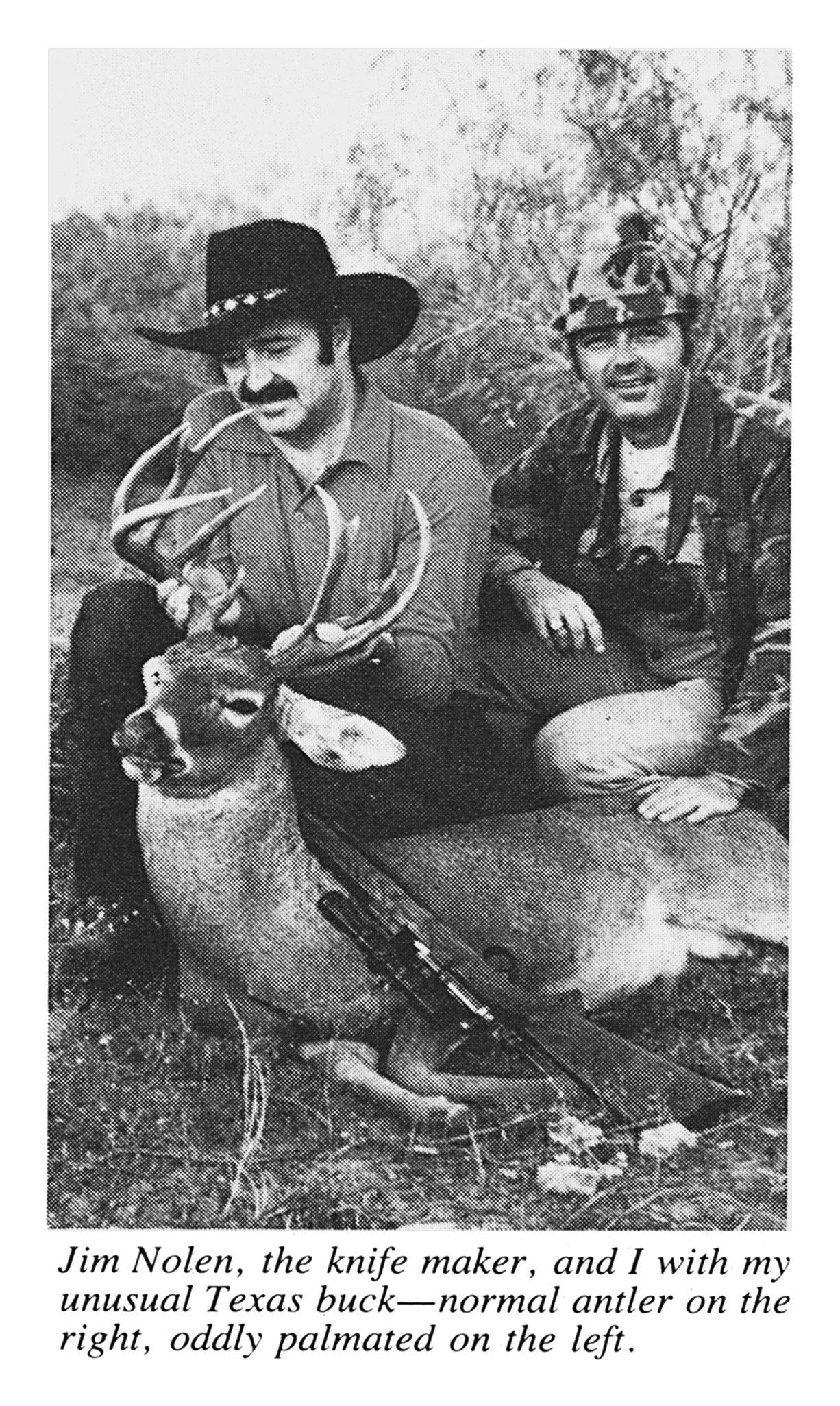
Accompanied by my pal Jim Nolen, maker of the well-known Nolen knives and guided by Ed Dutch, who at that time was the ranch’s game biologist but has since become a top wildlife photographer, we hid under a mesquite tree where we could look out over a 60-yard flat of open grassland.
With a bit of imagination, you might call the south Texas terrain “brush country,” but it’s not the kind of brush hunting one gets in, say, Pennsylvania or Missouri. Just about everything that grows wild in that part of the Texas empire either sticks, scratches bites or poisons, so stalking deer through the cactus and catclaw isn’t all that much fun. That’s why hunting is usually done from a quick stand or from a high seat that lets you look over the thorny chaparral. Fortunately, there is a high buck-to-doe ratio that makes the bucks especially aggressive and eager to challenge other bucks for available does.
The sound of these bucks doing battle is a distinctive clicking and rubbing of antlers that can be heard a pretty fair ways and has the effect of calling other bucks to join the fray. If you ever happen to come upon a couple of bucks fighting it out over some does, you’ll probably spot one or two more waiting their turn, and while the fighting is going on, a smarter-than-average Romeo may be trying to make off with the harem.
Many years ago, some deer hunters had the clever idea of banging a couple of deer antlers together to imitate the sounds of a fight and thereby call bucks to the gun. It worked like a charm and “rattling” up bucks has become an accepted form of the hunting arts.
I’ve tried rattling bucks from Maine to California but the only places I’ve had much success were in areas of dense deer population where there were plenty of aggressive bucks. South Texas is the home of rattling, with both the terrain and temperament of the bucks ideally suited for the technique. The trick, though, in addition to knowing how to rattle the antlers together, is finding a stand that gives you a fairly good view of at least an acre or so of relatively open space.
Some bucks apparently lose all reason at the sound of a fight and dash right in where at any other season they would fear to tread. Some rattlers report having snorting bucks right in their laps after only a moment or two of clicking the antlers. Wiser bucks will come in more cautiously, perhaps circling the stand, wanting to get sight or wind of the combatants. Thus, if you position yourself on the edge of a clearing, you get to see the deer before he gets too close. This also gives the deer a bit of breathing room so he won’t have to get too close and overly spooky. You’ll see deer heads poking out of the bush around the clearing, ears forward, and too curious — or determined — to bound away. More often than not, there’s time for a well-aimed shot, but be sure to keep your rifle close to your shoulder and ready to fire. If they see you move, they’re gone in a flash. Man, deer or fowl, there’s something about poaching on another’s territory that makes any male more than a little spooky.
Greed had slithered to the surface of my consciousness. Greed, unbelievable, unforgiveable greed.
I settled back against the forked trunk of the mesquite tree with my rifle resting on my knees. It was a trim little .250/3000 bolt gun stocked by Don Allen and built on a Mauser action that had been shortened a full inch by ace metalsmith Ron Lampert. Nolen, who was to take first turn playing the antlers, was just to my right and Dutch, who wanted some pictures, was a few yards behind, manning a telephoto lens.
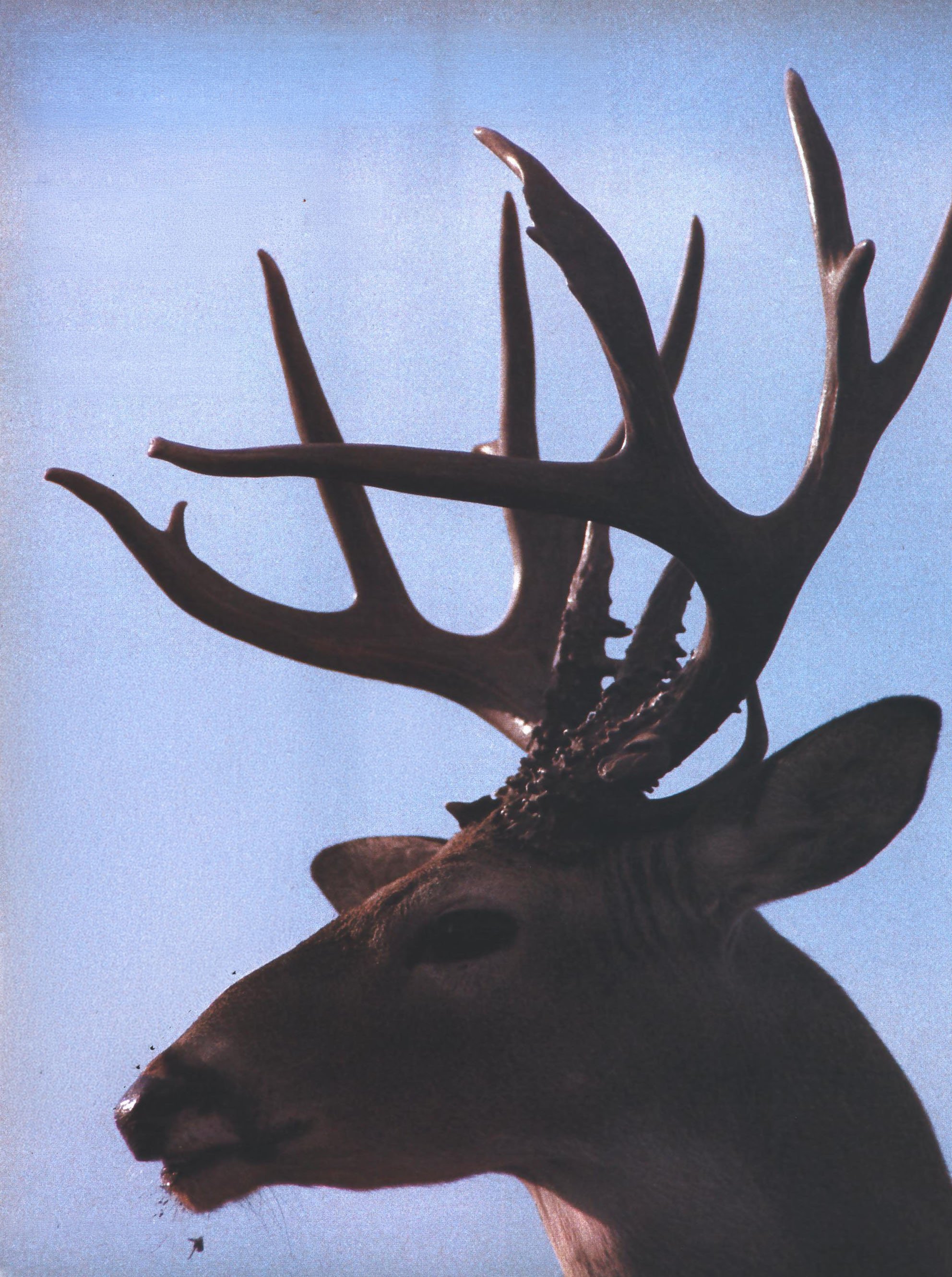
Results were almost immediate. Nolen had banged the antlers no more than twice, twisting and rubbing them together to make the characteristic scrape-click-scrape sound of fighting deer when there, right in front of me, snorting and stomping his feet, was the biggest whitetail buck I’d ever seen on the hoof. He was huge, with perfectly symmetrical antlers. The main beams seemed to grow straight out in a horizontal line before hooking in at the tips. His points stood straight up like rods in an iron gate and the whole picture was a deer-hunter’s fantasy. The buck of a lifetime, too big to be true, perfect. It had to be a lie, a tale told in a deer camp, vividly remembered.
But he was there, stomping, snorting, beautiful. All I had to do was put the crosshairs on his chest and touch the trigger and my whitetail-hunting days would be over, for never would I see a bigger buck. For long moments, I held the crosshairs on his chest, poised to shoot, listening for the click of Dutch’s camera, Click-click-click it went. Now I had a record of the moment, a deer hunter at the gates of paradise. Every nerve in me howled “pull the trigger, pull the trigger,” but I didn’t.
Greed had slithered to the surface of my consciousness. Greed, unbelievable, unforgiveable greed. “Look old boy,” it said to me, “this is only the first deer. Think about the really big ones that are waiting back there in the thicket. We’ve got lots of time to wait for the absolute world beater.”
Incredibly, I lowered my rifle, worked the bolt and emptied the chamber. Then, settling the crosshairs back on the buck’s chest, I tickled the trigger.
“Click,” it went, and the buck was gone.
“Just wanted to know what it felt like to pull the trigger on a giant buck,” I explained to an absolutely astonished Jim Nolen.
“Why didn’t you shoot?” Dutch asked.
“Waiting for something bigger,” I allowed.
“That’s as big as they get,” was his answer, and I knew greed had done me in.
That morning we rattled in a couple more trophy-size bucks, but nothing nearly so grand as the first, so I couldn’t bring myself to raise the rifle. That afternoon, after a lunch of chili and frijoles served on a tortilla, cowboy-style, followed by a siesta, we tried again — but the antlers were cold and nothing answered the challenge.
That evening a few of McAllen’s vaqueros stopped by the bunkhouse for cerveza and conversation. “It is true,” they asked, “you had El Macho Grande in your sights and did not shoot? Why?”
I really couldn’t answer, but one thing for sure, if I ever saw him again I would shoot.
Next day the antlers were still cold, so by midafternoon we changed tactics and climbed into a tower where we could watch for deer crossing a narrow sendero (a rough, clear-cut roadway). The view from the tower allowed us to look down into the endless thicket, but no deer were moving. By early evening I had counted dozens of javelina, the small wild pigs of the Southwest, and had seen more quail than I thought existed, but no deer other than an occasional doe.
The sun hung low over the deep Texas thicket and a soft haze had wrapped itself around the evening air when the buck stepped into the sendero. The distance was just a bit more than 200 yards, but even with my 7X binoculars, the antlers were hard to judge because the sun was behind the deer, reflecting through the haze so that the deer seemed to be the center of a psychedelic burst of rainbow color. It was not a vision of earth, but a dream in pastel colors with quail calls for background music.
The buck moved slowly, a step at a time, nibbling shoots of greenery. But his antlers remained a mystery. We could see that they were big and exceptionally high, but the way they reflected shafts of gilded light made rational judgment impossible.
“I can’t see his antlers clearly,” Nolen whispered, “but I can see points everywhere.”
The buck was nearly across the sendero now and in a moment he would be gone, perhaps forever. I’d already let the trophy of a lifetime slip through my fingers. Did I dare risk losing a second chance? My trigger finger tightened and the little rifle spoke gently to the soft evening.
The buck was a freak, wearing incredible antlers that had grown to typical, though huge, shape on the right side but with an oddly palmated branch on the left. Is it the trophy of a lifetime, a one-of-a-kind specimen never to be duplicated? Or just a freak with outsize antler growth? I wonder. I wonder every time I look at it on the wall.
The Meat Buck
In addition to liberal season and bag limits, Alabama has some of the biggest-antlered and heaviest-bodied whitetails I’ve ever looked at. One Alabama trophy deer I saw a few years back got me so excited that I spent several consecutive seasons there trying to bring home the granddaddy.
And I saw lots of bucks, some eight and 10-pointers with such seductive racks that I was often tempted to touch the trigger. Patience prevailed, though, and as days turned to weeks I became more or less accustomed to the sight of the Alabama sun setting over a hardwood thicket in which, from a tree stand, I might be glassing from two to six big-antlered bucks at one time. But as I said, I wanted only the he-coon of the hardwoods and nothing else would do.
How was it, then, that I eventually shot a little eight-pointer?
Hoping to relieve the tedium of my daily wait-and-watch routine, I got myself invited to a party hunt, and on the appointed morning found myself in the midst of an incredible spectacle. The setting was a beautiful Southern mansion complete with curving driveway and vast, oak-bordered lawns. What made the scene so bizarre was the unbelievable variety of humanity strolling or squatting about the neatly clipped grounds. Tweed shooting jackets and English riding boots mixed with faded overalls and run-down clodhoppers while the elegant accents of aristocratic Southern speech were punctuated with the staccato “patoos” of well-aimed tobacco juice. There had been a violent thunderstorm during the night, and judging by the smells of wet wool and soaked leather, many of the attendees had passed the night in the rain.
A metal tub about the size of a horse watering trough was being set up on a stone foundation, eventually to be filled with gallons of cooking oil, and nearby a wild-eyed chap was tugging at a heavy chain leash in a futile attempt to separate two snarling dogs. “Get back,” he yelled when I approached to help, “these dogs are killers.”
“Then why don’t you leave them alone?” I asked.
“I’m trying to keep them from killing each other until Big Bob wakes up.”
“Who is Big Bob?” I had to ask.
“That’s him over yonder,” he responded, waving his free hand in the direction of an inert form stretched out in the tangled remains of what appeared to have once been a rose garden.
I meant to take a closer look, but at that moment a silence fell over the assembly as a spry black man of uncertain vintage, his hair a fluffy white, came down the brick-paved path leading from the big house.
“Mista William is a commin’,” he chanted. “Mista William is commin’, here he come now.”
Sure enough, there was the great one himself, Mister William, owner of thousands of acres of prime farmland and hardwoods, home to the biggest whitetails to be found anywhere. Obviously, Mister William had reached that unique station in society where elegant or even proper attire was no longer required as an emblem of station or success. Accordingly, he was outfitted in soiled chino work pants and shirt, the tail of the latter flapping loosely about his backside, muddied work shoes with, as I remember, only one sock and crowned off with an ancient straw hat that was liberally ventilated with odd-size holes. Yet there was no denying his regal presence. As he puffed unsteadily along the brick pavement, pausing occasionally to scratch, spit or realign his direction, there was a chorus of salutations and more than a few caps were doffed.
“Mornin’ Mista William.” “Fine day Bill.” “Good to see you Mista Bill.”
Each greeting was received with a wave and every face was recognized by name.
“Glad to see you, Jack.” “Nice of you to come over, Pete. How’s Mary and the kids?” “Hi Ralph.”
When at last he faced me, his eyes narrowed, searching for a name.
“Nice to meet you sir. I’m Jim Carmichel and I appreciated the invitation to your deer hunt.”
“Glad to have you, glad to have you,” he gestured grandly. “This hunt ain’t much, just something me and the boys like to do every year about this time.
“Hey there you, Jake, tell Big Bob I said to put Mr. Carmichel here on the road where the deer cross.”
With that he ambled back up the walk, mounted the porch steps and turned to face the breathless assembly. “Boys, the hunt’s on.”
The next few moments were lost in a bedlam of shouts, cheers, running feet and spinning truck tires. Seated in the back of a pickup (I almost made the fatal mistake of climbing into a truck full of savage curs) that fishtailed out of the driveway in a shower of mud and gravel, I caught a glimpse of Mister William as he turned and re-entered the great house, aided by his white-topped butler. Apparently he was not attending his own hunt.
Positioned as I was, on a muddied logging road, I could hear the baying pack of Catahoula curs as they topped a ridge nearly a mile away. As the baying grew louder, it was apparent they were coming my way and would cross the road in front of me. Mister William had indeed given me the best stand on the hunt and in just a few moments I would have a shot.
I was using a borrowed shotgun loaded with No. 000 buckshot and the deer would be crossing from right to left, a dead-easy setup. When the deer broke from cover and bounded across the road, I swung the bead some two feet ahead of his chest and was tightening on the trigger when I realized that it wasn’t much of a buck. An eight-pointer, perhaps, but it was a bucket-head without much width, height, or thickness of beam. The buck certainly wasn’t the world-beater I wanted. With another bound, the young buck disappeared into more timber.
By then the road was covered by a blanket of howling and snarling beasts with their owner, Big Bob, not far behind.
This was the first time I had had a close-up look at Big Bob and he was, to be sure, an awesome apparition. Clad only in bib overalls and a white T-shirt, despite the chill of the day, Big Bob stood a good six or eight inches over six feet and was as wide as a church door. His hair, probably waist length, was knotted behind his head in the style of a samurai warrior, and when he spoke I could see that every tooth in his head was covered in gold. His bout with the rose garden had criss-crossed his arms and face with bloody lacerations, and at his side swung a hunting knife that looked as long as a Saracen scimitar.
As he strode toward me — eyes wild, face blood-caked and mouth flashing of gold — the sword banged against his knee. It was the only weapon he carried. Considering his size, the obvious strength of his hands and arms and the fierceness of his countenance, the knife was more of an affectation than a necessity.
“Where’s the deer?” he asked. “I didn’t hear you shoot.”
“I didn’t shoot.”
“How come? His tracks is right there in front of you.”
“He wasn’t a good trophy,” I answered.
At this, his eyes narrowed, “Mister, we ain’t huntin’ trophies, we’re huntin’ meat. We got a lot of people to feed tonight and if you don’t shoot somethin’ these dogs get meaner than they already are.” Big Bob made his point very convincingly.
“The next time something comes by, I’ll be sure to shoot,” I promised.
And that’s exactly what I did. A couple of hours later, the howling pack came by again in violent pursuit of a distinctly undistinguished little eight-pointer.
That evening, my buck and two others that had been killed during the hunt were sliced into bite-size chunks, rolled in batter and deep-fried in the gas-fired horse trough I’d noted earlier.
In time, huge platters were stacked with the delicious-smelling venison tidbits but, for some reason, no one took so much as a single bite. This struck me as curious because no one had eaten since breakfast and I assumed that everyone was as famished as I was. Not wanting to violate local custom, I decided it best not to serve myself until someone else had done so.
The reason for the holdup was soon apparent, however, when Mister William’s butler appeared and announced the immediate arrival of his benefactor. “Here come Mista William, ever’body git ready, here he come now.”
Mister William’s appearance was greatly improved; not only was he better turned out than several hours previous, but his gait was markedly steadier.
Without a word to the hushed onlookers, he marched straight to the deep-fry trough and extracted a crispy brown morsel of batter-dipped venison. For a moment he chewed thoughtfully, eyes cast heavenward. Then, with a sly smile, he made his pronouncement, “Boys, this meat is fit to eat.”
Later, food and drink in hand, I was buttonholed by Big Bob, his countenance no less ominous than earlier and his face still blood-caked from his personal war of the roses.
“If you had shot that other deer,” he allowed, “we would have had some extra meat for my dogs. Now I have to feed ’em dry dog food, which makes their bowels tight and they get meaner than ever.”
“Here,” I answered, handing him my half-emptied plate, “they can have mine.”
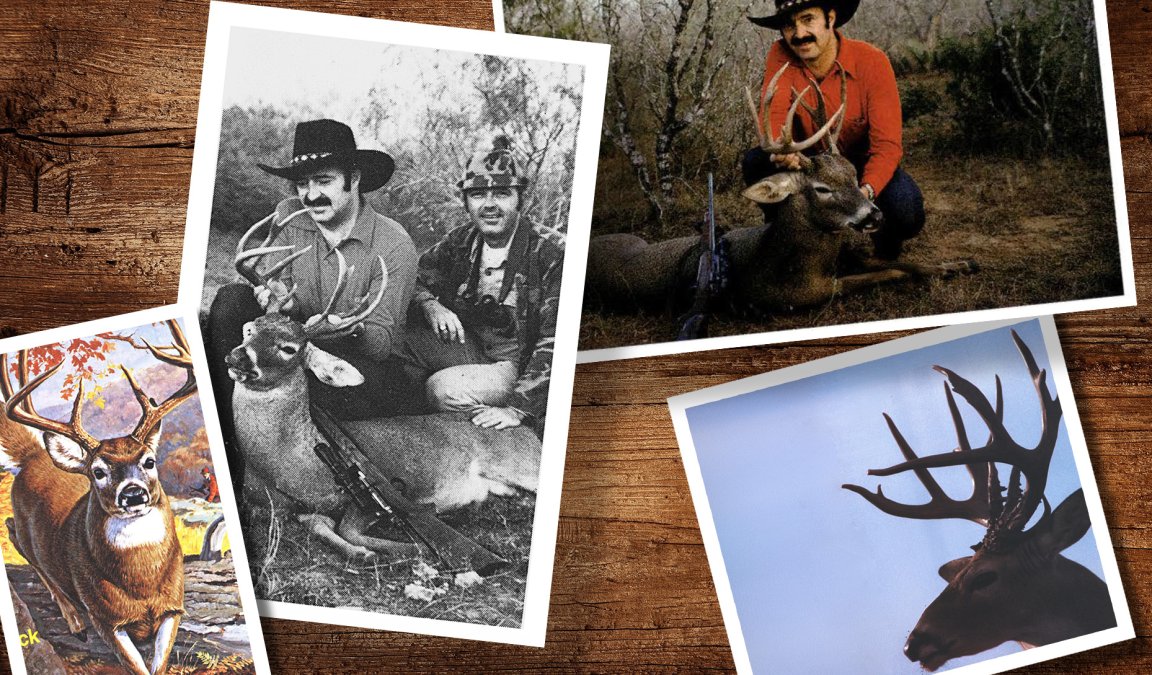
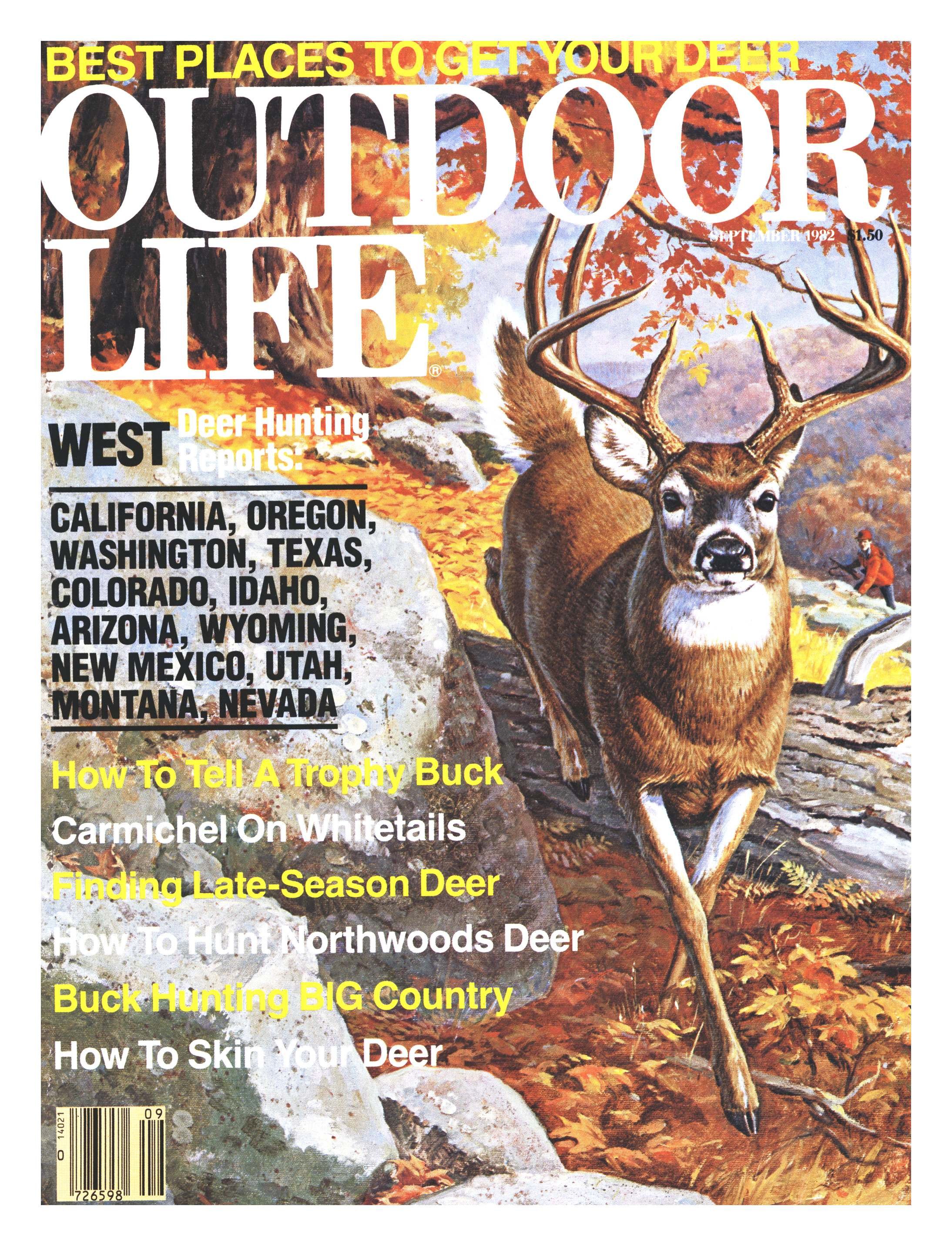
This story, “Whitetails I Have Known,” appeared in the September 1982 issue of Outdoor Life.