
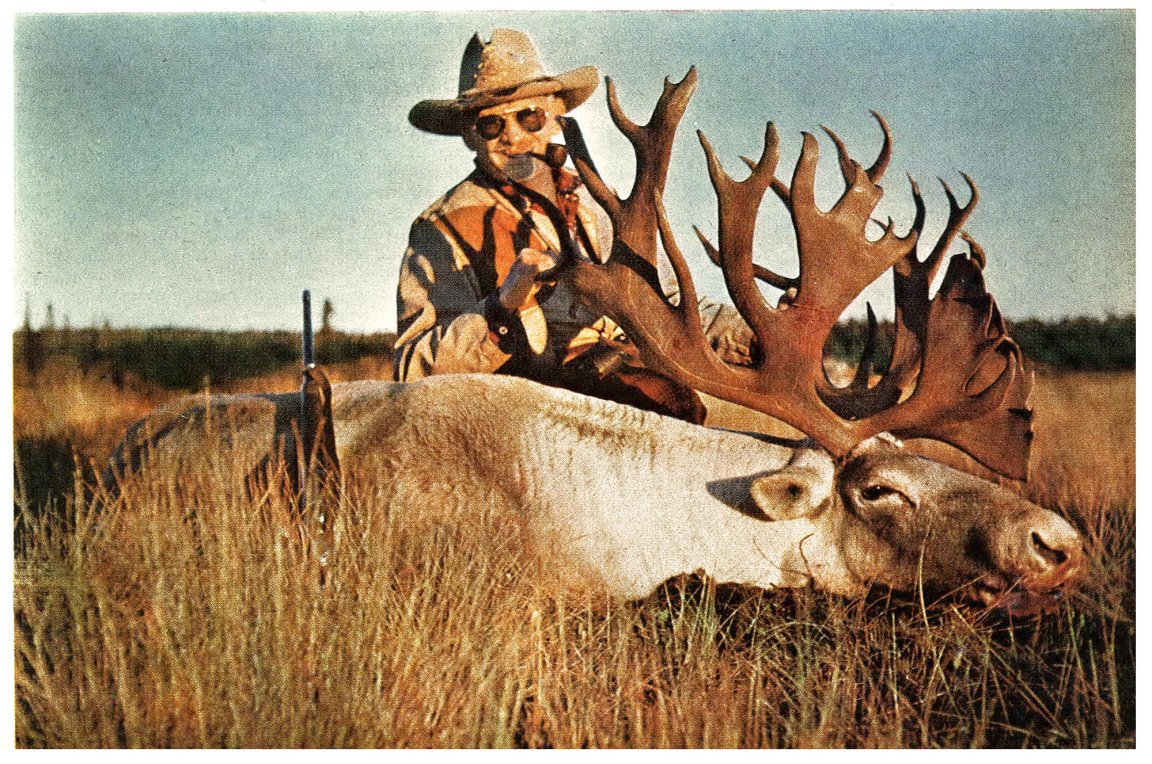
This story, “A Dream Trophy,” appeared in the March 1961 issue of Outdoor Life. Fitz’z caribou is currently ranked 57th all time for woodland caribou in the Boone and Crockett Club record books.
In the cabin on Deer Lake that served as a base for Ray Wellon’s bush airplanes, we unfolded my big map of Newfoundland. I had outlined four small areas on it in pencil. Fairly well separated, they were deep in the southern interior, and I pointed to a remote patch that scaled out to roughly 15 miles wide.
“That’s where we want to go,” I told Gene Manion, who would fly the little plane. “If it doesn’t pan out in a couple of days we’ll try one of the others.”
“I figure we’ll get there in about two hours,” Gene said.
The plane was loaded with our simple camp gear, and its pontoons left the water a few minutes later to carry us eastward in the bright sunshine of an early October day. In only a few minutes we were crossing the narrow expanse of Grand Lake, and soon we were speeding over the Rainy Lake country where Wellon has a hunting camp.
“From all accounts, they’ve seen a caribou with a real big rack around there,” Gene remarked to me. Only the evening before, I’d been told about this giant bull by a hunter who saw it after filling his license with a handsome, 30-point trophy that wasn’t quite big enough for the official records. A somewhat bigger specimen than his was just what I wanted. But, on assignment from OUTDOOR LIFE, I was following a very special plan, and I wasn’t going to try my luck in the Rainy Lake region if I could help it.
We flew onward over countless brooks, puddles, ponds, and larger lakes. In contrast with the mountain scenery we had left in the lower Humber River valley, there were only occasional, isolated hills. The farther we went, the more open and barren the country became. Somewhere beyond Red Indian Lake we noted a few small, scattered groups of little white dots. These were the first Newfoundland caribou I had seen, and the total came to around 25 before we crossed that locality and entered a broad strip that seemed completely empty.
“The area you marked is just ahead,” Gene said at last.
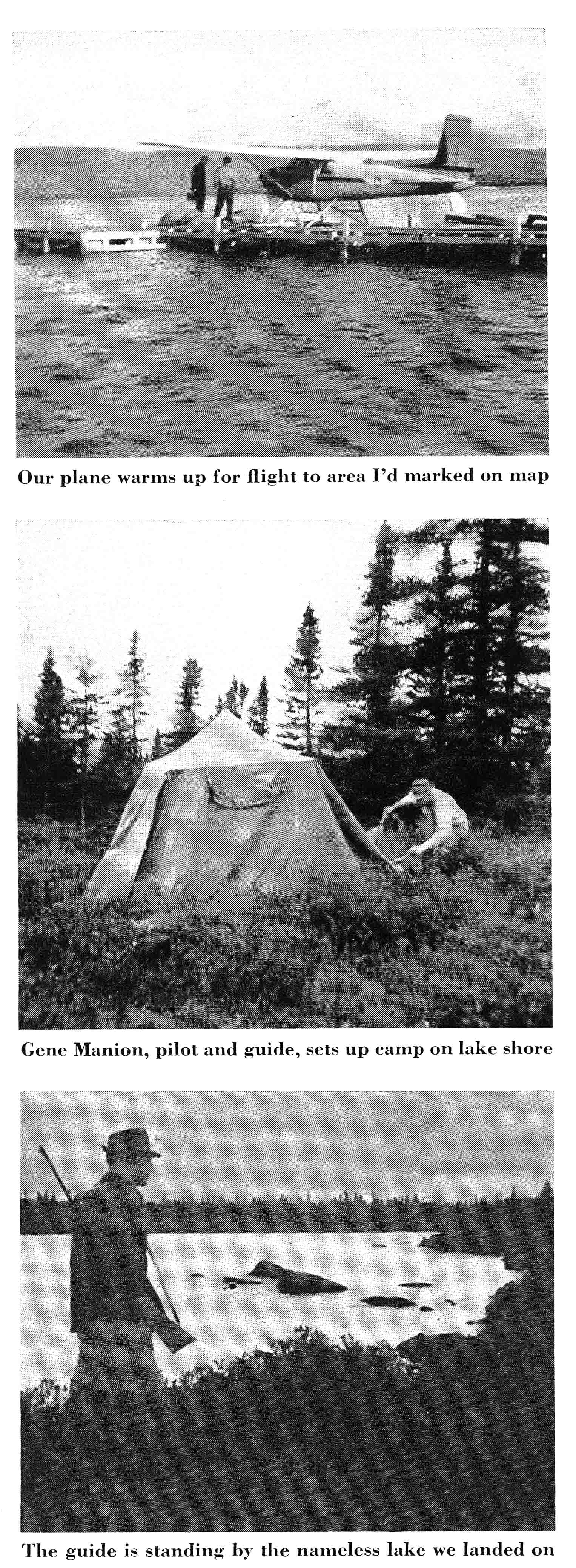
I soon realized that the choice of landing places would be limited. Very few of the nameless ponds were big enough to let us take off from them safely, but Gene brought us down on a larger one — scarcely 500 yards long — and dodged rocks in taxiing to its northern edge. There he tied the plane in the shelter of the bank.
“Here’s a place we can pitch the tent,” he said as I scrambled ashore. He had found a level spot not far from the water’s edge. But we could make camp later. I was anxious to hunt while the weather was good, having learned how quickly it can change. Soon we started out through an open and fairly wide corridor, covered with yellow marsh grass, that stretched away to the west between stands of spruce.
Once or twice we had to detour some soft spots, but none of the footing could match the really treacherous muskeg in parts of northern British Columbia and in various ranges of the Barren Ground caribou. Stretches of tundra covered with hummocks of typical caribou moss were less common here; they often gave way to grassy bogs and to firmer ground carpeted with a kind of short buckbrush. Most of the forested sections, which had seemed to be trifling when we flew over them, now proved to be considerably bigger.
Perhaps a mile from the plane, the edge of the timber on our right curved back sharply, and when we passed that point we saw a bull caribou lying in some buck-brush about 150 yards away. His antlers were so tall they startled me. Gene and I froze in our tracks. The gentle north wind blew directly toward where we stood, and I was glad the bull hadn’t spotted us as I raised my binoculars for a careful look at him. With more features to consider than on any other antlered animal, caribou heads aren’t easy to judge in a hurry.
We stopped. They stopped. We went on, speeding up and angling somewhat away from the wind to discourage their notion of circling in front to get our scent.
This one showed four or five top points on each side — not big, but acceptable for a woodland specimen. His slender main beams were straighter than most, and therefore were shorter than their height suggested. They would tape a bit more than 40 inches. His double brow palms were rather small, and he had about 30 antler points, all told. His most remarkable features were his extremely long second, or bez, points. They curved far out to their high-carried end palms, which weren’t much wider than my hand. That length would count heavily in an official trophy score.
“The head looks light,” Gene commented, summing up a major weakness.
“I wish he’d face this way and show me his spread,” I said.
Seemingly eager to oblige, the bull stood up. So did a cow that had been bedded near him in the low brush. The bull was the biggest-bodied woodland specimen I’ve ever looked over. The hair on his gleaming, snow-white neck was so long and thick that it hung in an enormous dewlap. His fine spread of antlers almost equalled their length, and after some quick calculations I decided that he could make the lower brackets of the record class. But the spindly conformation of his rack bothered me. and I knew that he wouldn’t do for my collection.
“He’d make the record book,” I told Gene, “but I’m going to pass him up.”
Turning from temptation with the thought that our hunt had hardly begun, we continued walking. And those curious caribou came right along, narrowing the distance between us. We stopped. They stopped. We went on, speeding up and angling somewhat away from the wind to discourage their notion of circling in front to get our scent. That, I knew, would start them racing off into country where they might spook a finer trophy. But they kept abreast, and soon we were barely 60 yards apart.
“Go back where you came from, you old fathead,” I said to the bull.
While I doubt he understood me, he proved again that he aimed to please by ceasing to follow when we moved off. Before long he was heading toward where we had found him, taking with him the one bride he had so far collected.
The rest of the day turned up no other notable heads, but enough ordinary caribou to keep things interesting. We were careful to avoid giving any of them our scent. One young bull and a couple of cows waited until we were within 50 yards. Then they walked on ahead of us exactly like driven cattle.
When we finally went back to organize our little camp, I had sized Gene up as a smart outdoorsman who knew his hunting as well as his airplanes, and he had surely proved himself to be an excellent companion. My greatest satisfaction, however, was in the behavior of the caribou we’d found. This reinforced my confidence in the plan I had carefully worked out. That plan, which has possibilities in other regions, was designed to answer a challenge that differed drastically from any other I had ever tried to meet.
In 1959, when I’d finally collected all 25 legal, big-game animals in North America, it seemed reasonable to limit my future hunting on this continent to the nine classes in which I had never bagged an officially listed, record-class specimen. In two classes particularly — woodland caribou and Columbian blacktail deer — the best examples I’d shot were nothing to be proud of. But when I thought of trying for a really outstanding woodland caribou last fall, the prospects seemed downright discouraging.
Newfoundland is the traditional hunting ground which has produced the finest heads in the past. Four from there were recorded in 1951. None of these was equalled by any of the five that turned up since, however, and neither the number nor the quality of those taken after 1955 warranted a class in later Boone and Crockett Club competitions. Newfoundland it had to be, though. Besides, no other Canadian province has had an open woodland caribou season in many years.
How good a chance did Newfoundland offer? I had never been there. Although I’d had considerable experience with other caribou races, my only encounters with the woodland species had been in northern Quebec and in Saskatchewan, where I’d run across them while hunting other game. I also knew that quite a number of keen trophy hunters had gone to Newfoundland in recent seasons and failed to find a decent head. At the same time, many men who weren’t so choosy had successful hunts. Since the population of ordinary caribou seemed sufficient, there had to be at least a few big ones. And with Canada’s long tradition of catering to visiting sportsmen, there had to be some good guides too. I began to wonder why trophy racks were so rarely brought out.
A little investigation clarified the picture. Several hunters reported that, while the outfitting in most cases had been excellent, the kind of footing in the caribou bogs made it hard to cover much ground. The outfitters had a different story. They felt that too many sportsmen were either unwilling or unable to walk far enough to find trophy heads and preferred to hang around camp.
Both viewpoints made sense, but I knew that among the unlucky trophy hunters were some serious and thoroughly able-bodied veterans. If the record-class trophies were so seldom close enough to camp for them to reach, what were my chances of doing better? Here was a challenge I’d have to lick with my head instead of my legs, and before long I came up with a theory.
There was every reason to believe that the best hunting camps had been located — some of them many years ago — in the centers of excellent game regions. Knowing that many of their clients liked to be pampered, the prominent, long-established outfitters made their camps uncommonly comfortable. After that, it was only natural for them to take their dudes to the same places year after year. When a region which must be covered on foot from a central base is pounded to that extent, the heads to be found there can hardly be other than ordinary ones.
At that point I was ready to apply the theory I’ve used for 30 years. This is that fine trophies can be taken if the hunter goes to the right place at the right time with the right guide, and then keeps hunting hard and passing up the smaller specimens until the real prize shows up. Naturally, plenty of advance research is often needed to satisfy the first three requirements, and either the hunter or his guide must know how to judge heads.
The ideal place for heads that hadn’t been picked over would be a rutting area for caribou that had not been hunted in recent years. Suggestions from guides or from other sportsmen would be of no help; I didn’t want to go where they had been. But if I went to Newfoundland a few days before my hunting began, I might find somebody who could give me solid information.
Experience with other kinds of caribou provided me with most of the answers about when to hunt. The rutting time for all of them starts in early October. In Newfoundland — where the 1960 open season would run from September 12 to October 29 — a man after venison along with his trophy head should hunt during the first week or 10 clays. Later he’d run into a peculiar situation. Many trophy specimens of elk, moose, or deer furnish good meat at the height of the rut — even though this is hardly the time to expect it at its best — but a rutting bull caribou simply isn’t fit to eat.
On the other hand, early season is a bad bet for getting top-flight heads. The older bulls are then spending too many daylight hours in the dense evergreen forests where they are hard to find. There’s not much chance of inspecting many racks before the animals come out into the open barrens, usually in the first week in October. From that time on there may be other problems. Some of the many small points on caribou antlers are often broken as soon as the rutting battles get under way, and plenty of trophy heads are practically ruined.
Also, the heavy frosts that must come before the rut really gets going may be followed, all too quickly, by enough of a general freeze-up to make it hard to get out of the country. Not much ice is needed to prevent a pontoon-equipped plane from taking off.
Finding the right guide in Newfoundland didn’t seem too important. Although the law sensibly requires a nonresident sportsman to be accompanied by a licensed guide, I was planning my 55th hunting trip for big game and felt qualified to size up a caribou rack and stalk the animal without any help. I wasn’t worried about getting lost, either. What I really needed was a competent bush pilot to fly me to a place I’d select for myself. I also wanted him to stay with me until my hunting was over so I could change my territory and pull out promptly if the freeze-up threatened.
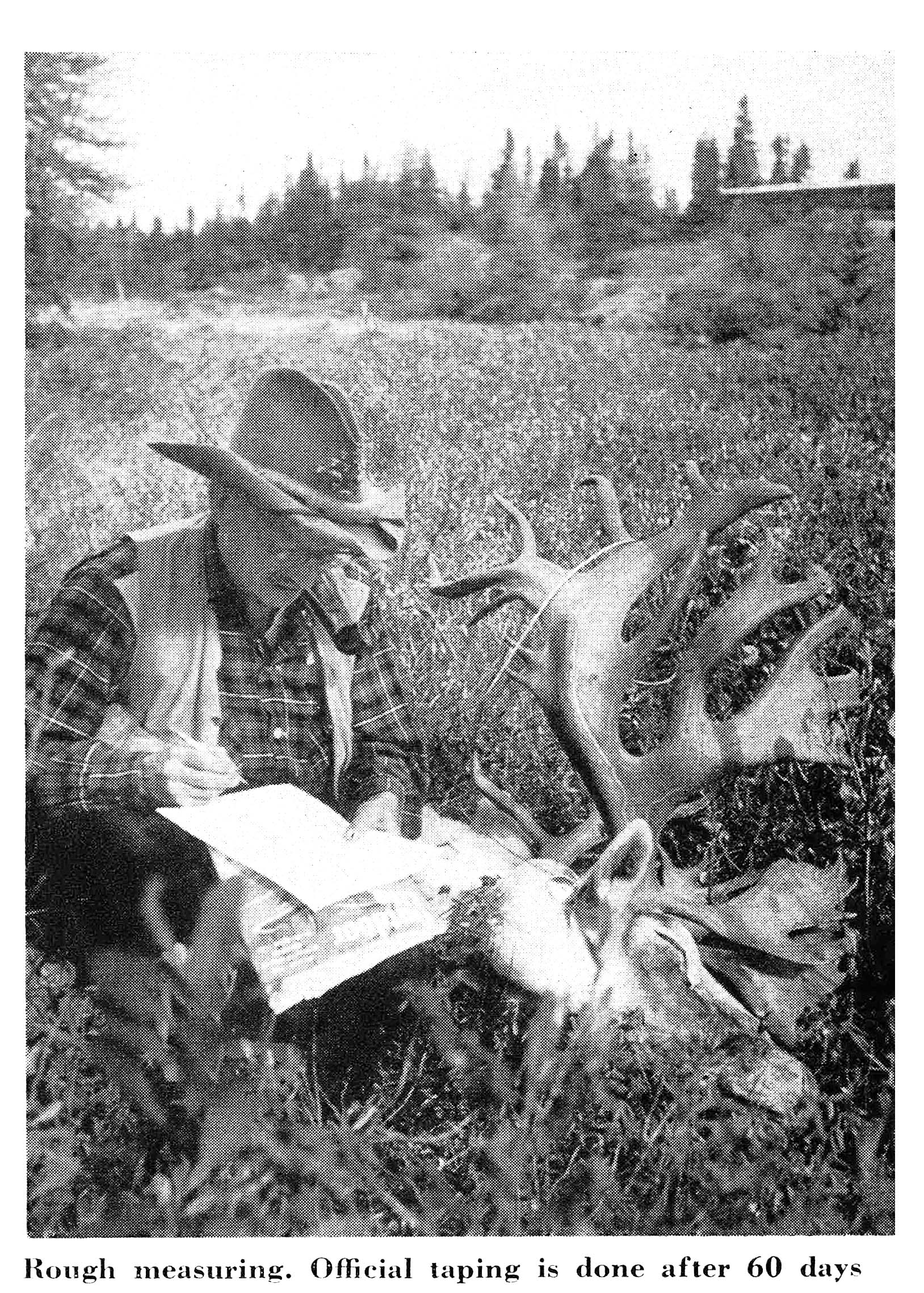
This approach was tempting, and on September 28 I began to organize things in St. John’s, the provincial capital.
Crossing the whole island from west to east to get there had already given me some idea of the country. As I didn’t know where I’d end up, Trans Canada Air Lines solved the travel problem. My return ticket would let me stop off at the airport nearest my hunting grounds — when I decided where they would be.
From the air, the Newfoundland landscape seems to belong much farther north than it actually is. Here is caribou country that was world famous before I was born. Remembering my own first canoe trip in the north, I could imagine how hard it had been for old-time sportsmen to get around in it, or even to get there at all. The speed and comfort of the Viscount plane made me realize how fast the world has changed.
Through the Canadian Government Travel Bureau in New York, I’d learned of a bush plane contact. The Newfoundland Tourist Development Office in St. John’s had furnished the original information, so I made my first stop there. They told me that Wellon’s Flying Service, outside the city of Corner Brook on the west side of the island, had the kind of planes I wanted. I was informed that Ray Wellon also was an outfitter and could get me a guide. Next, in the Department of Mines and Resources, I met Stuart Peters, the Deputy Minister, and A. T. Bergerud, the game biologist. Both of these young scientists are well informed, and they brought me up to
date on the caribou situation.
“A mysterious malady has been killing off newborn calves for the last several years,” Peters said. “This season we are issuing only 200 caribou licenses. We’re now encouraging the moose hunters.”
With 45,000 moose in flourishing shape, Newfoundland has turned into a moose country. The bag limit is now three to a hunter in one zone.
After I’d learned that not more than 5,000 caribou were left in all Newfoundland — with only about 800 mature bulls — I wondered whether I was justified in hunting them at all. But I soon realized that the present game management program is in good hands, and that taking out less than 200 — old trophy bulls would have no effect on the species. My first three days in St. John’s were mainly spent in considering areas which had no hunters but might have some good caribou. The three zones open for hunting them took in roughly a third of the island’s 43,000 square miles. Assuming that only 100 of the 800 known mature bulls carried heads good enough to suit me, each of them would have an average of about 140 square miles to get lost in — one good reason why so few were taken. There were, however, areas that had none.
After gathering suggestions from all sources I could think of, I got a big map of the whole island and a series of inch-to-the-mile government maps covering the sections that seemed most promising. When I’d studied these in relation to what I’d learned about caribou habitat in other areas, I made my final choice and caught a plane to Stephenville on October 1.
A 60-mile taxi ride took me to Corner Brook. From there, I promptly moved into the night club Ray Wellon runs, along with his other activities, six miles out of town on the Humber River. It was closer to his Deer Lake airplane base, and the accommodations were very comfortable. Like everyone else I met on this trip, Ray did all he could for me. It developed that Gene Manion, one of his pilots, was also a qualified guide, so I was all set. There was only one trouble. My plan called for hunting after a hard frost signaled the start of the rut. The weather, however, was much too warm. And having got this far, I was determined to carry out my campaign as perfectly as possible.
The break finally came on October 5 — and that brings us back to the Deer Lake cabin and my first day’s hunting. Early on the morning of our second day, as Gene and I were getting ready for breakfast, I saw a small-headed bull caribou on the sparsely timbered ridge behind camp. One cow kept him company. A light breeze came from the north, toward the lake as on the day before, so they couldn’t get our wind. Not much more than 100 yards away, these unexpected visitors watched us until we were almost ready to leave. “Now the caribou have started hunting us,” Gene said. “Maybe it’s a lucky sign.”
We headed again to the west, and finally a big, solitary bull showed himself in the early afternoon. His lack of female attendants was soon explained. From the trophy standpoint, his right antler was excellent, but the heavy main beam of his left one had been broken off just above the bez branch. It must have taken a terrific smash to do that. This old fellow proved that some of the serious fighting had begun.
He seemed little concerned by us, although we were in a bog with no cover. I wondered if I could stalk close enough to get a really good picture of him. Then the fun began, because this sort of thing calls for the type of telephoto equipment which is too bulky to pack when you are hunting in earnest with a rifle. I wanted to get within 30 yards. The bull wouldn’t let me, but he stayed close enough to keep me trying. As our slow and patient game went on, he led the way into some country we might not have otherwise explored.
And there, in a shallow open basin, I spotted a bewildering number of caribou in a single herd. We settled down to do a thorough job with our binoculars.
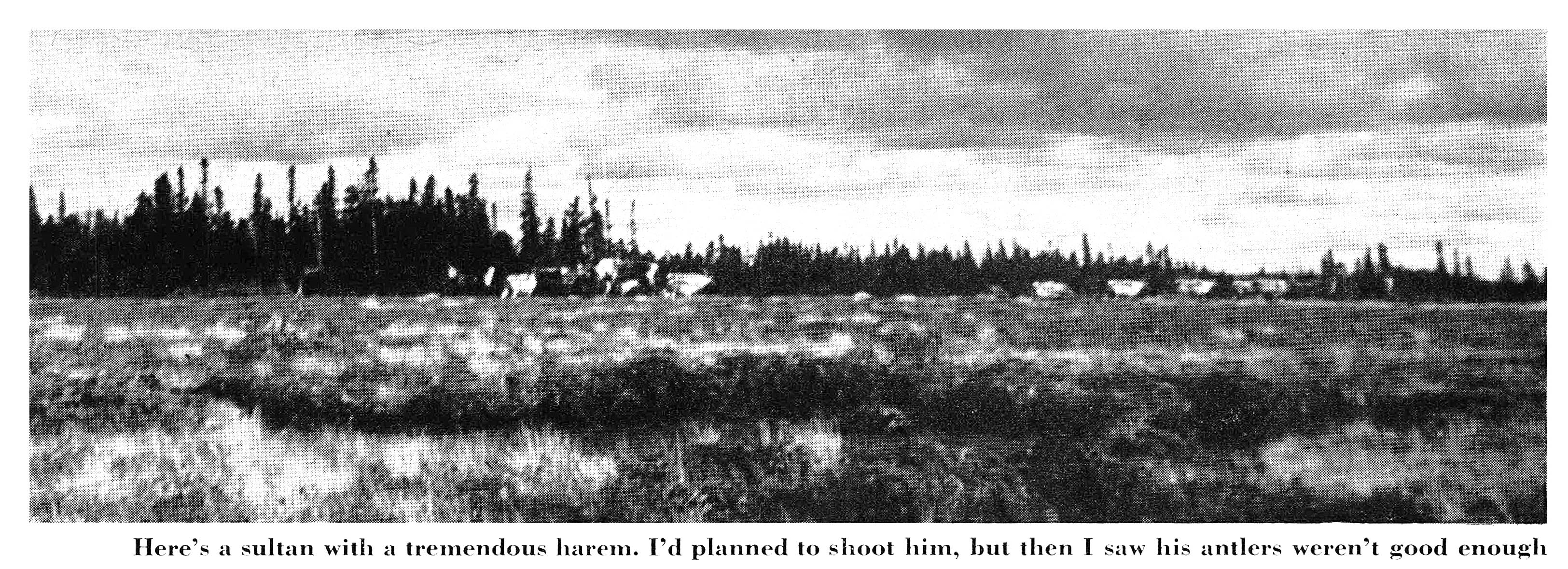
The animals were 600 or 700 yards away, and we counted 18 after doing our best to search out all the less conspicuous ones. I checked them over several times before I was satisfied there was only a single bull. Bearing in mind that woodland caribou have short, compact antlers — the minimum record-class score for them is 295 points, compared with 350 for the mountain and Barren Ground groups — I saw that he had a heavy and huge-framed rack with fine brow palms and broad bez palmations. His main beams swept away back before curving forward, and I felt sure they were close to 45 inches long. He also had at least a 40-inch spread. The number, length, and palmation of points near the beam ends would have to be studied at closer range, for they meant a Jot in the trophy ranking. It is in this top development, often so spectacular on heads of the other classes, that most woodland specimens fall down. If his tops turned out to be even moderately good, this bull would surely satisfy me.
The puzzling part was the size of this sultan’s harem. Woodland caribou at that time of year are normally split up into small rutting companies in which individual bulls have rarely gathered as many as a dozen cows. All at once I thought of an answer.
“Gene,” I said, “I’ll bet this so-and-so broke the antler off our playmate and stole all his gal friends.”
“Could be,” he agreed. “He looks big enough to do it. How do you plan to stalk him?”
The question didn’t have an easy answer. Caribou may be simply uneducated. More likely, however, these gorgeous beasts are probably just plain stupid. While deer, elk, and moose have learned to thrive close to civilization, caribou are often said to avoid all contact with man by migrating away from him. I wonder. Most of them, I think, have migrated to the great beyond after having been too curious about natives with rifles.
In any case, most caribou believe nothing but their noses. Unless you’ve alarmed them, you can nearly always walk up for a 200-yard shot with no careful stalking whatever when the wind is in your favor. But you cannot count on this invariably. So I don’t like to take chances with an outstanding trophy, and with nothing in the muskeg to conceal us I didn’t want to go directly toward this bull. Here, as we faced the herd, the wind blew straight across from right to left. The terrain just beyond the caribou showed a series of bare little ridges. These would offer some cover if we approached from the far side. We could get there unseen if we moved to our left and traveled in the timber which almost encircled the whole open space.
First, we had to get rid of the bull with the broken antler. That was managed when I led the way into the woods and stopped. After crossing in front of us, he came back to where he caught our scent and then promptly romped off into the forest. Things went smoothly from that point on. The herd was out of sight. In less than an hour we were almost opposite our starting place and ready to move into the open across those grassy ridges toward where the caribou had been. As they were on their feet and feeding
When we saw them last, I thought they had probably moved just a little.
When I crossed the hollow, those downwind cows got to their feet and started to go. Hastening up the little slope, I knew I had to concentrate on placing my first bullet exactly, for there might be no second shot if the bull ducked behind the ridge.
A few minutes later, easing up one ridge with Gene a couple of steps behind me, I looked over its top and spotted a cow lying down on the farther slope of the little dip between us. The wind, of course, was now coming from our left. This harem inmate was to the right of a line from us to where I thought the sultan himself might be. If I kept going ahead, she would surely scent me. To make things worse, I saw another cow in the draw below her.
What to do? When we were in the timber, apparently, the herd had drifted over to lie down among the ridges. The bull might now be quite close. If we backed away from the two cows to pass them on the downwind side, we would sacrifice the concealment the rolling terrain had given us. And if we alarmed them before the bull was in sight, the same ridges could easily cover his escape.
“I’m going a short way to the left, then straight on in,” I told Gene. “Those cows are bound to smell us, but I’m gambling on finding the bull before they mess things up.”
This route took us to a bit higher ground. We looked over the nearer ridge to the one beyond it, and there we saw the tops of a pair of antlers. In a moment they slowly disappeared behind the crest. The tops were the only features of the bull’s head I hadn’t checked earlier, but on this occasion there’d been time to count four passably good points near the end of each beam. Added to the excellence of his other qualities, they were enough.
From the nearer ridge, the range would be about 200 yards, with never a doubt that a splendid head was mine for the taking. I went ahead for the kill.
When I crossed the hollow, those downwind cows got to their feet and started to go. Hastening up the little slope, I knew I had to concentrate on placing my first bullet exactly, for there might be no second shot if the bull ducked behind the ridge. Fortunately, I wouldn’t have to worry about his head any longer, for I knew all about that.
There he was! As he neared the top and turned almost broadside, I could even see his knees. I sat down. The scope-sight picket of my old Griffin & Howe .30/06 steadied on his shoulder, and when Gene came up to where he also saw that caribou, I was starting a careful trigger squeeze.
In that instant, Gene said, “Wait!” May I never forget the lesson of the next few seconds. I had been a complete jackass, and only Gene’s timely word had saved me from filling my license with a nice, better-than-average bull I didn’t want. Looking at the whole animal. Gene had known instantly that it wasn’t the sultan we had seen before. This one, with the tops I’d checked, carried a different head in all other respects. I hadn’t even glanced at it. My attention had been focused on the animal’s shoulder. Stupid as it may seem, the possibility of a second bull in this part of the basin had never occurred to me. So I felt deeply grateful.
We pushed ahead, then, and promptly learned that the cows we’d scared belonged to the bull I’d almost shot. The big sultan and his large harem were still upwind. They had trotted off when we spooked the others, but they soon doubled back and stopped within easy rifle range to look at us. No longer trigger happy, I saw that while this bull’s massive rack would measure just about what I’d thought, he carried only a single top point on each antler. He wouldn’t do.
After we’d roamed around a little more, it was time to head for camp. As we trudged across the muskegs and worked through some strips of tangled forest, I felt let down. Thinking again of how few record-class, Newfoundland trophies the recent seasons had produced, I may have been beginning to wonder about the huge bull I’d passed up the day before.
We were within half a mile of the tent, marching through some open marshland with Gene a step or two ahead of me, when he stopped. He’d spotted a bull caribou and four or five cows near the edge of the timber to our
left.
“Not as wide a spread as some of the others,” he noted. “How does he look to you?”
The low sun was behind us as I raised the binoculars, then quickly lowered them.
“This hunt is over,” I said.
I had seen a pair of fantastic bez palms and a rack with a whole forest of points. Its other features were too good to need study. As the bull wasn’t more than 175 yards away, there was no reason to go closer. He was facing me squarely. Wanting no blood stains on his beautiful white neck, I waited just long enough for him to turn a trifle and then squeezed off a 180-grain Silvertip. Although this sharply angled body shot would have been quickly fatal, it didn’t knock him over. An instant later, when he turned a bit more, I finished him with another shot.
My excitement grew with every step toward the downed animal. I’d wanted a trophy that typified the classic woodland characteristics, and here was a dream head in that respect. When we had counted 42 antler points, it hardly disturbed me to note that he’d broken off a couple of other ones.
Read Next: I Arrowed the World-Record Caribou by Pretending to Be a Tree
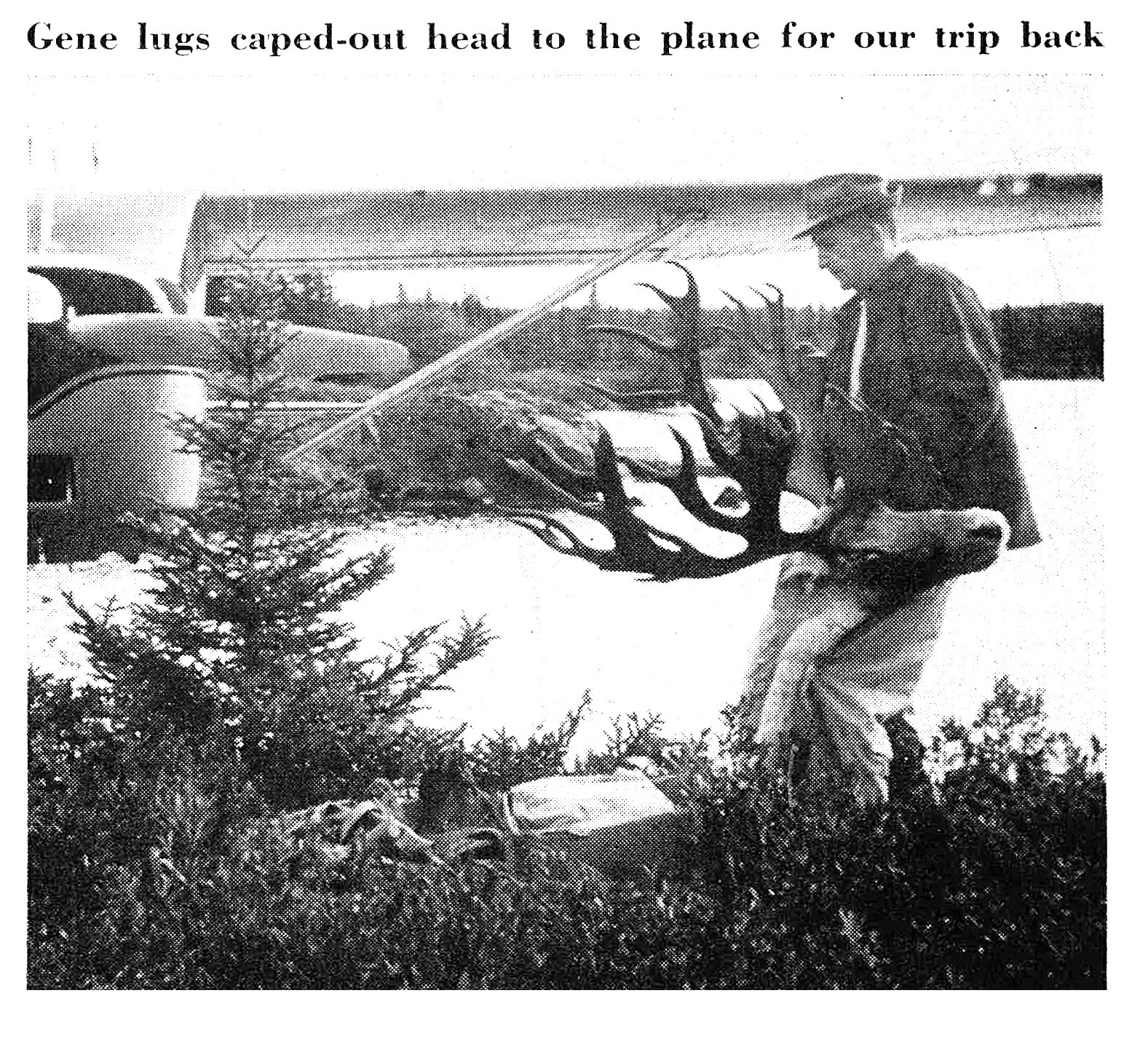
The more I examined him, the more delighted I felt. He would mark the 17th different North American species represented by a record-class head in my collection. Much later, in New York, I learned that he’d cinch eighth place in the present record list, and it was clear that this was the finest Newfoundland trophy since 1951. With Gene’s help, I’d come up with a proper caribou instead of a boo-boo.