
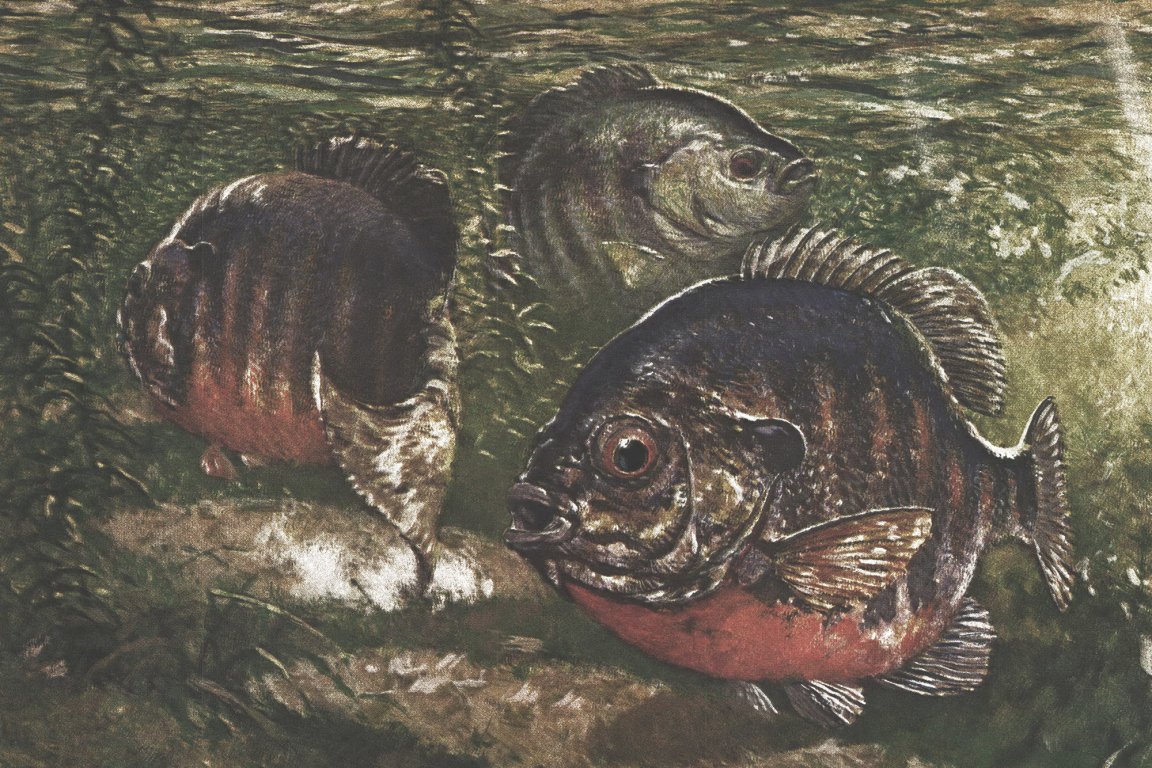
This story, “Catch the Biggest Bluegills,” appeared in the July 1976 issue of Outdoor Life.
No freshwater fish offers more pure joy to fishermen than the bluegill. It is superbly abundant over a vast range, catchable by numerous fishing methods, a diminutive demon on the hook, an utter delight in the skillet.
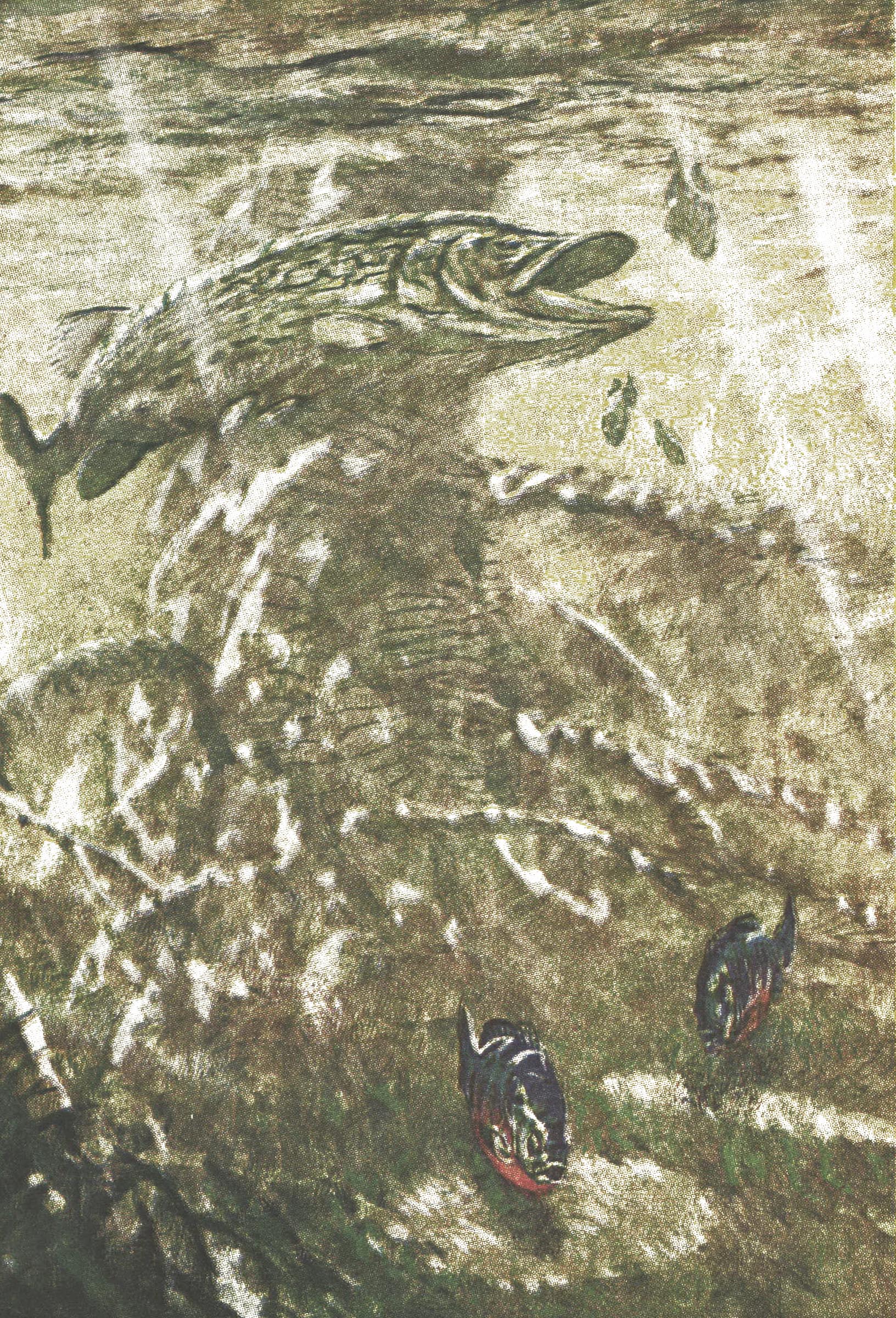
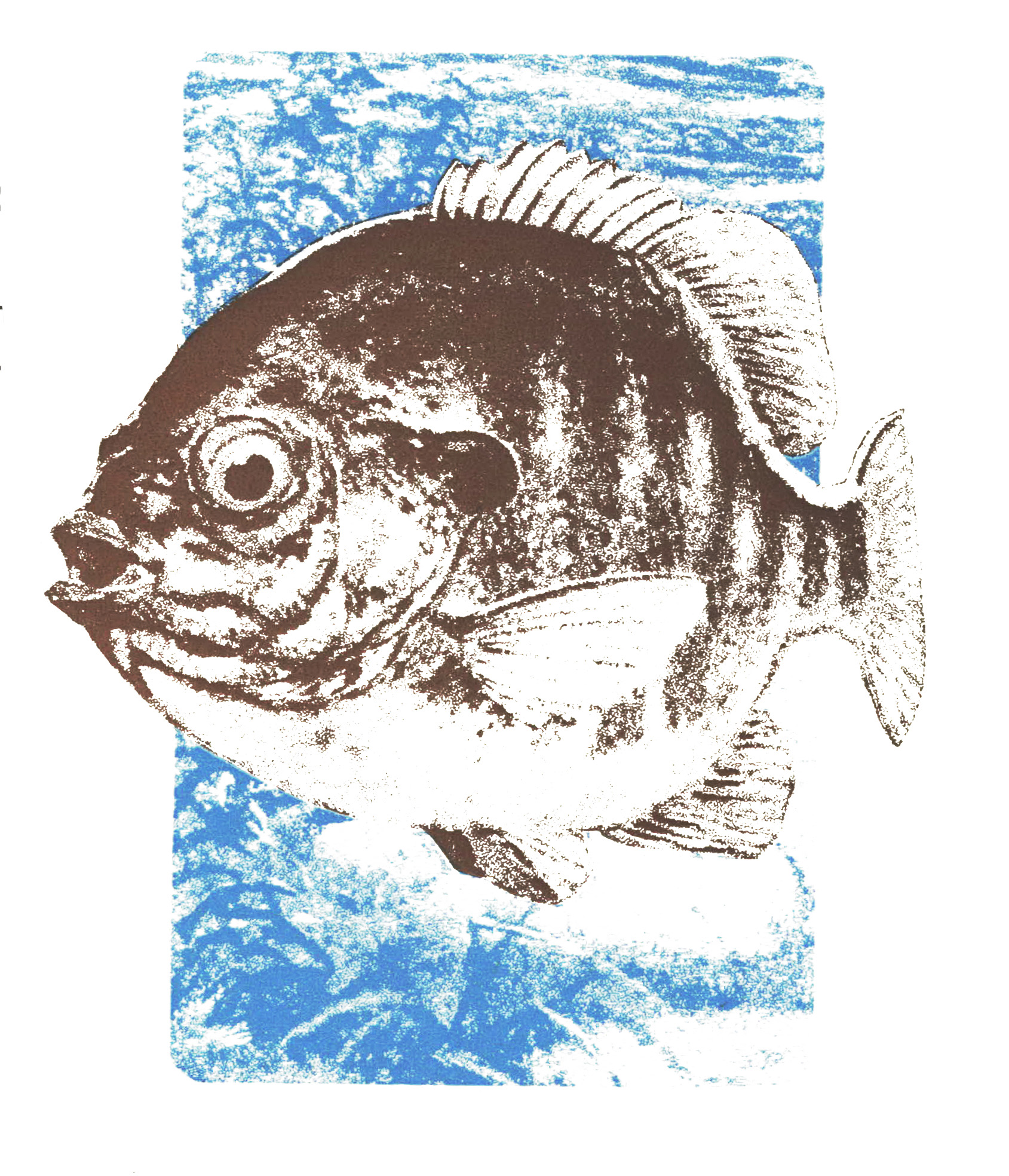
Those thoughts were in my mind as I tried to corral the 15th in a series of saucer-size specimens that had been bowing my two-ounce spinning rod almost as fast as I could present a bait. This one, a gaudy male of proportions that most bluegill enthusiasts classify as “bulls,” finally weakened but still valiantly circled at the surface. It made a handsome picture, outfitted in its spring spawning colors, daubed with brilliant orange across throat and breast, with striking blues on head and gills nicely complemented by greens and olives rearward.
As I slipped it into the livewell with the others, I guessed they’d all weigh at least three-fourths of a pound, some over a pound. I was thinking that most fishermen tend to take the bluegill for granted as an eagerly willing customer that requires little fishing finesse or specialized know-how. It’s true that moderate-size bluegills usually can be caught anytime. But it is far more sport to catch the large old specimens, and that’s not always easy.
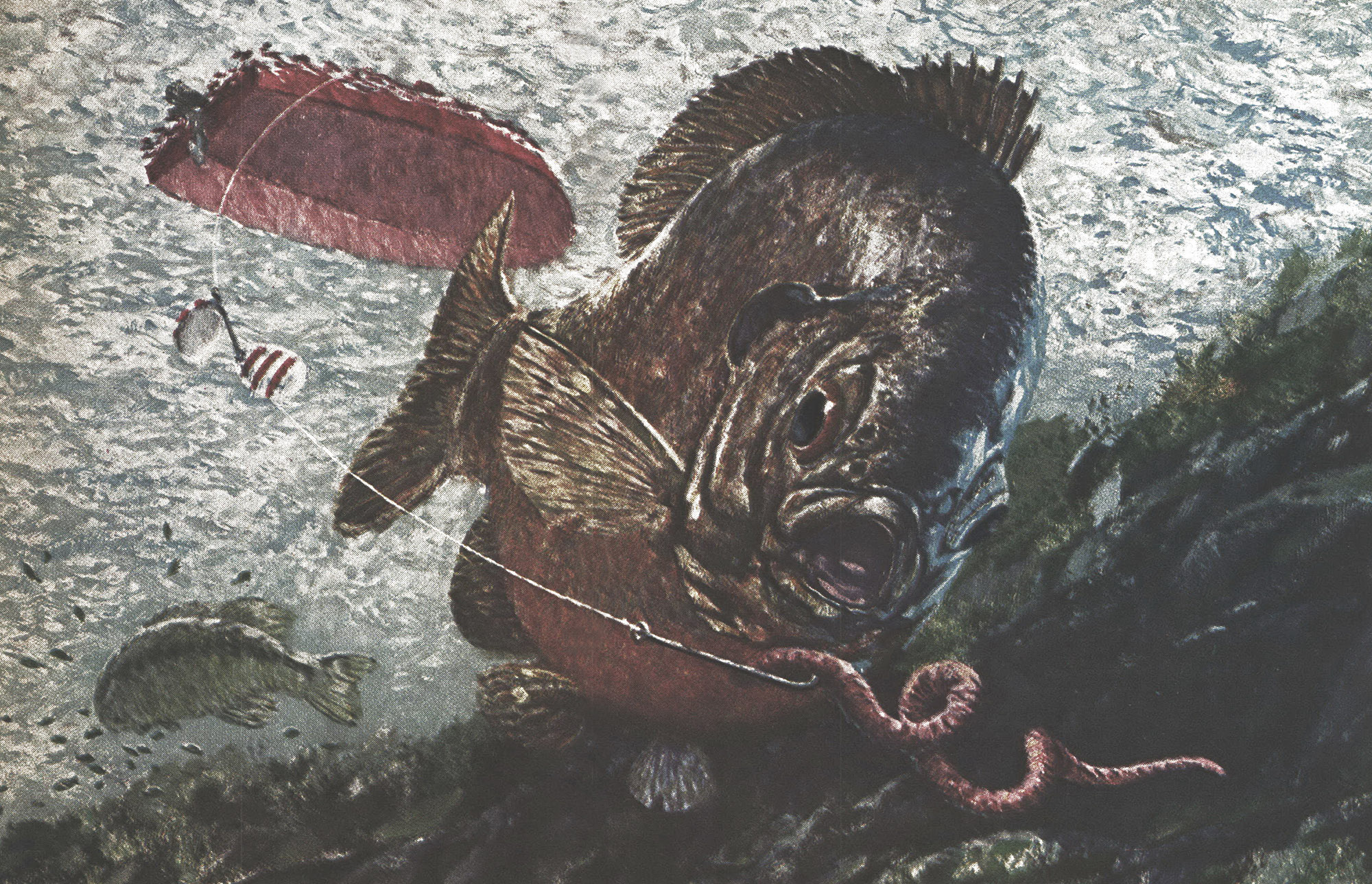
If you hope to catch big bluegills consistently, you need to know what kind of waters are most likely to contain many good-size fish and where they will be in those waters. You must also realize that just any old tackle won’t take them as efficiently as light, fine-line outfits will. Learn how to find and fool the bulls, and the middle-size specimens really can be taken for granted.
Bluegills prefer lakes and ponds. A few are found in slow streams. Bluegills do poorly in crystal clear, infertile waters, either lakes or streams.
Best bets are fertile lakes That’s why some large impoundments across the lowland South produce excellent crops of large fish, and why in several states the state-record bluegills, and many of unusual size, come out of well-fertilized farm ponds.
Thousands of lakes throughout the country contain bluegills. With so many to choose from, it will pay any bluegill enthusiast to look for those that produce the most consistent crops of large fish. Such lakes are in the North
as well as the South. It’s generally assumed that, because of the long growing season, Southern states offer the largest fish. Swift growth does help, but often optimum habitat and year-round warm weather induce several spawning periods. Such congenial living conditions commonly burden a lake with thousands of stunted fish.
In small lakes — 50 to several hundred acres — look and fish along shore to check what size bluegills seem abundant. If you see swarms of tiny fish and catch many that are three inches and others one step larger, you’re probably on an overstocked lake. The several age classes indicate high survival, not enough predator fish, and swarms of so-so bluegills.
A classic big-bluegill lake is one I fished many times some years ago in northern Michigan. It covered possibly 400 acres. The water and bottom were fertile, and there were ample weedbeds and suitable spawning areas near shore. But I could ease along in shallows and see very few small bluegills. Even in shallow shoreside waters small bluegills were caught only in modest numbers. Out away from shore in deeper water, or during spawning closer in, I could take a limit (then 15) of bluegills that would consistently weigh a pound each. This lake had a natural balance — it also contained bass — that kept spawn survival to a level that allowed almost all fish ample living room, and growth to phenomenal size.
Bluegills are partial to weedbeds (but not weed-choked waters) and fairly soft bottoms, of sand, clay, or muck as opposed to rock or heavy gravel. Such waters, of course, are usually fertile. A good example is huge Toledo Bend Reservoir on the Texas-Louisiana border. This is a drowned-forest lake with thousands of stumps and tree trunks in various stages of decay showing above water. Much of the bottom ranges from packed sandy loam to moderately soft mud.
Toledo Bend is one of the finest bluegill Jakes I have ever fished. Compare it with another well-known Texas impoundment-clear, deep Amistad Lake on the Rio Grande River. Not only is rocky-shored Amistad cooler, but it is not nearly as fertile as Toledo Bend. Now and then some fair bluegill catches come out of Amistad, but it produces nothing like Toledo Bend.
Almost without fail, you’ll take very few really large bluegills in a lake in which you catch scads of three or four-inch fish regardless of where you fish in it. Some lakes are good producers of fish that are obviously adult, even old, but though ump are seldom over five to six inches Jong; you can bet such fish are the best those Jakes have to offer. Such lakes are not bad. But by searching you can find better.
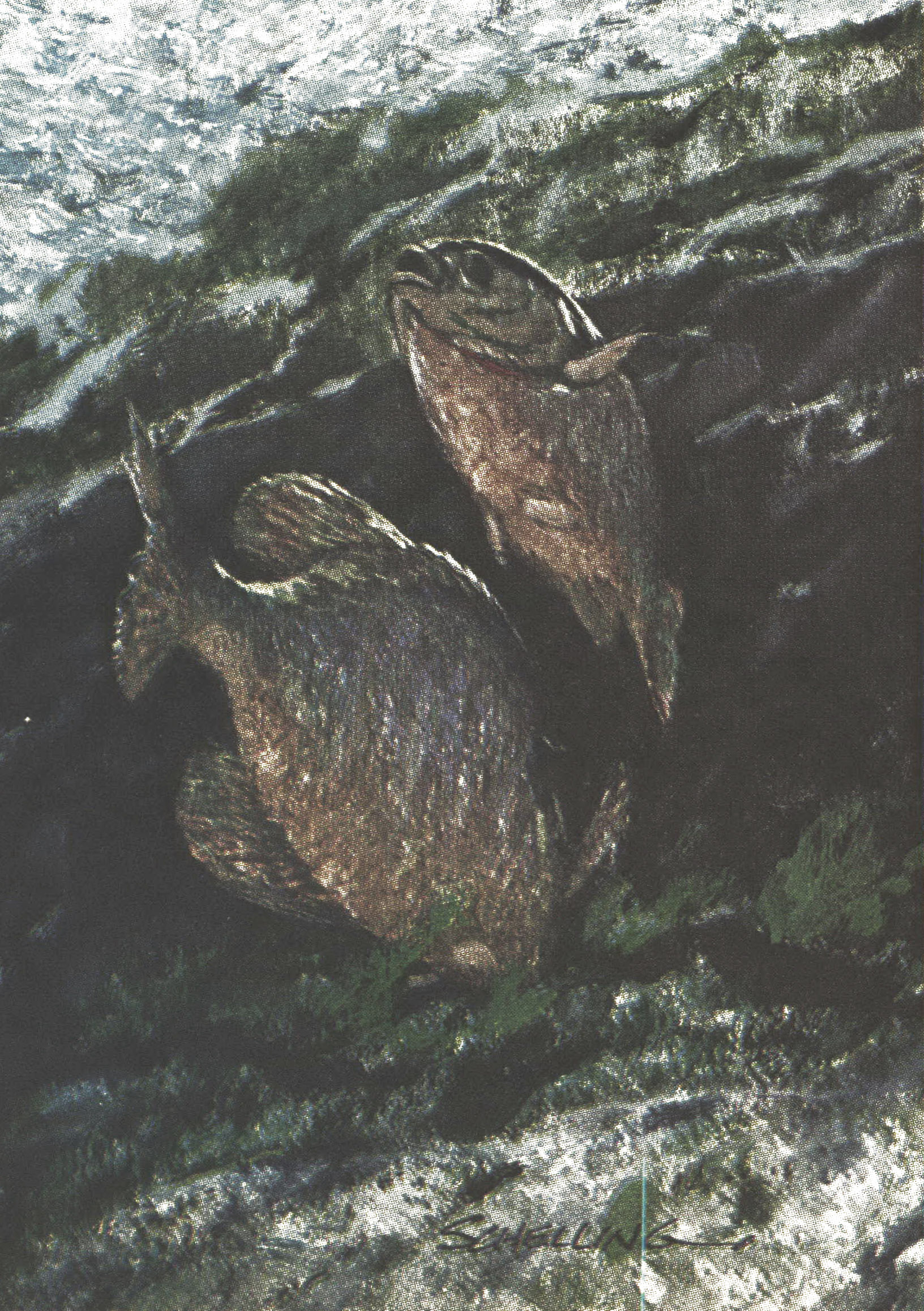
You can tell old bluegills, incidentally, because they lose any hint of vertical stripes. They are often quite dark overall or show pinkish to purplish body hues. They also have exceptionally long, broad ear-flaps. Lakes that produce plenty of outsize specimens will continue to produce them year after year for as long as the lake habitat does not change drastically. Many fishermen fail to catch the big fellows consistently, even on a topnotch lake, because they don’t realize that the old adults seldom hang out in quantity where the small and medium-size ones are at home. Large bluegills will be in deeper water. This applies to any time of year, spawning season as well as summer.
During spawning look alongshore for beds in shallows. They’re easy to spot in six inches to two feet of water. Each is a fanned-out area 12 to 18 inches in diameter. A bed looks paler than the rest of the bottom because it has been cleaned of silt. When you find an area with lots of beds in shallows, you’ll note that usually the fish are of small to modest size. Now move offshore gradually, looking for depths of six to 10 feet. If a suitable bottom is available — hard sand or clay or fine gravel, with a few partly submerged bushes and old snags or stumps — that’s where the big fellows will be bedding — IF any are in the lake.
Last season Hap Noble, an avid bluegill fisherman from Longview, Texas, and I searched a cove on Toledo Bend that offered suitable bottom for beds. Near shore we found scores of small bluegills. We then drifted out from shore, using a depth-sounder, letting a couple of baited hooks drag gently along bottom. When the flasher registered 10 feet we each had a hit. We anchored instantly. We caught 20 big males within casting distance, in 10 to 12 feet of water. Many bluegill fishermen don’t realize the big fish spawn that deep.
They spend the spawning season — best fast-action time of the year — catching medium-size fish close to shore.
There are exceptions. You must learn to judge a lake by what is available to the fish. A Wisconsin lake I used to fish was muck-bottomed and heavily grown to weeds. Bluegills cannot fan beds in muck, because the beds will fill with silt. There was only one shoreline area offering hard-packed sand covered by a thin layer of silt. The water was shallow, but this was the only suitable spawning bottom in the entire lake. All the fish, big and little, were forced to utilize the place.
Also, though the big fellows are usually in deep water, deep is relative. One of the greatest bluegill lakes I ever fished years ago was Panasoffkee in Florida. It is large and rather shallow. Florida and other Southern states have many waters where 15, 10, even eight feet is deep.
In such lakes the fish can utilize practically all of the lake for foraging and, given proper bottom soil, much of it for spawning. Conversely, in a steep-sided, very deep lake such as bass-famous Table Rock in Missouri, nowhere near as much lake bottom is available to fish such as bluegills. Much of it is barren and too deep. Many shallow lakes are stunning producers of huge crops of big bluegills. Even on these, the bigger fish are invariably in the deepest parts out away from shore.
When I first fished Panasoffkee, I worked the shoreline weedbeds. I caught lots of fish, and some seemed pretty big to me. Then one day a fishing-camp owner took me out, saying he’d show me what big really meant. He went clear out into the lake. There we drifted, baited with outsize gobs of worms, crawling the bait along bottom in eight to 10 feet of water. We caught bluegills I couldn’t believe — thick, heavy, old “bull brim” so deep-bodied and fat they were almost round.
In that fine Michigan lake I mentioned earlier, the deepest areas were 20 to 25 feet. Most of these areas had wisps of scattered weeds. The soil was soft. There we always racked up limits of big ones. They were invariably full of bottom material taken in while the fish grubbed for nymphs and worms.
In summer on northern lakes I’ve hauled up lots of old adult bluegills from 30 feet of water. How deep they’ll be depends on the lake, the types of bottom available, and water temperature. Food intake is highest at 70° to 75°. However, the old adults may bite well at lower temperatures.
The deepest I’ve ever caught bluegills — and I’m sure it was a very unusual situation — was in a Northern lake in midsummer at exactly 65 feet. The lake was mostly shallow and warm. We found what apparently was an old channel or steep valley running across one section. That’s where we found the fish, all big ones.
In many of the popular impoundments nowadays the old creekbeds at 25 or 30 feet draw summer bluegills, as do old roadbeds. The fish even use old road sites as spawning grounds because of the hard bottom.
Water temperature is what triggers and controls spawning. Bluegill fans eagerly look forward to this fastest-action time of year. Water must reach 67° to launch the breeding season. The fish will spawn at higher temperature, but a cold snap at the beginning that sends water temperature down to 60° will turn off activity and scatter the fish.
Several years ago I was producing a bluegill fly fishing film in northern Louisiana. We began in late April. Things went just fine the first day, but then a cold front moved in. Fish left spawning sites en masse, scattering widely into Depp water. Not until it warmed up again did we get back to successful work.
Time of spawning differs north to south. When I lived in the North we always figured that in a normal spring, mid-June was peak time. Hap Noble told me that at Toledo Bend mid-May is the time. In southern Florida I used to figure mid-April onward. The depth and size of individual lakes may make a temperature difference, so you have to check your favorites to be certain when spawning begins.
The beginning of spawning should be emphasized. The males come onto spawning grounds first, to fan out beds. At this time they are at their physical best, beautiful and fat. By fishing during this period you catch mostly unspawned males. Then you begin to catch both males and females, all still unspawned. Females are easy to identify because they do not wear bright spawning colors. Soon the eggs will be deposited in the beds, the females will leave, and the males will stay to guard the nests. You can catch them easily over the beds at this time, hut they will be spawned out, weak, and poorer eating.
During spawning it makes little difference what time of day you fish, particularly when you’re fishing the deep bedding areas in six to 12 feet of water. In shallow water the fish may spook easily, and dusk and dawn are the peak action periods. In fact, as a general rule you’ll get the over — all best results — deep or shal!ow, spawning season or not — during the first two hours of light in the morning and the last three in the afternoon. But don’t let this rule stop you from fishing deep any time of day. I’ve taken scads of big bluegill down at 20-plus feet spanning the middle of the day, especially on overcast days.
After the spawning period small fish may remain near shore. Big ones will scatter into deeper water. Doth males and females are thin then, and they feed heavily to regain weight. A month after spawning they begin to gang up again, and if you can find the concentrations you’ll again catch strong, physically prime fish. Look for groups of them in the following or comparable locations: along the slopes and shelves of points, around and at the foot of small underwater hills or humps that don’t quite break surface out in a lake, along the deep edges of weedbeds, and over sparsely weedy mud flats that may harbor an abundance of nymphs.
Most saucer-size bluegills will feed far more below the surface than on the surface, and much of the time they’re right down on or very near bottom. In lakes that are relatively free of obstructions one of the most productive ways of locating fish is to drift, row, or scull slowly probing the bottom as you go.
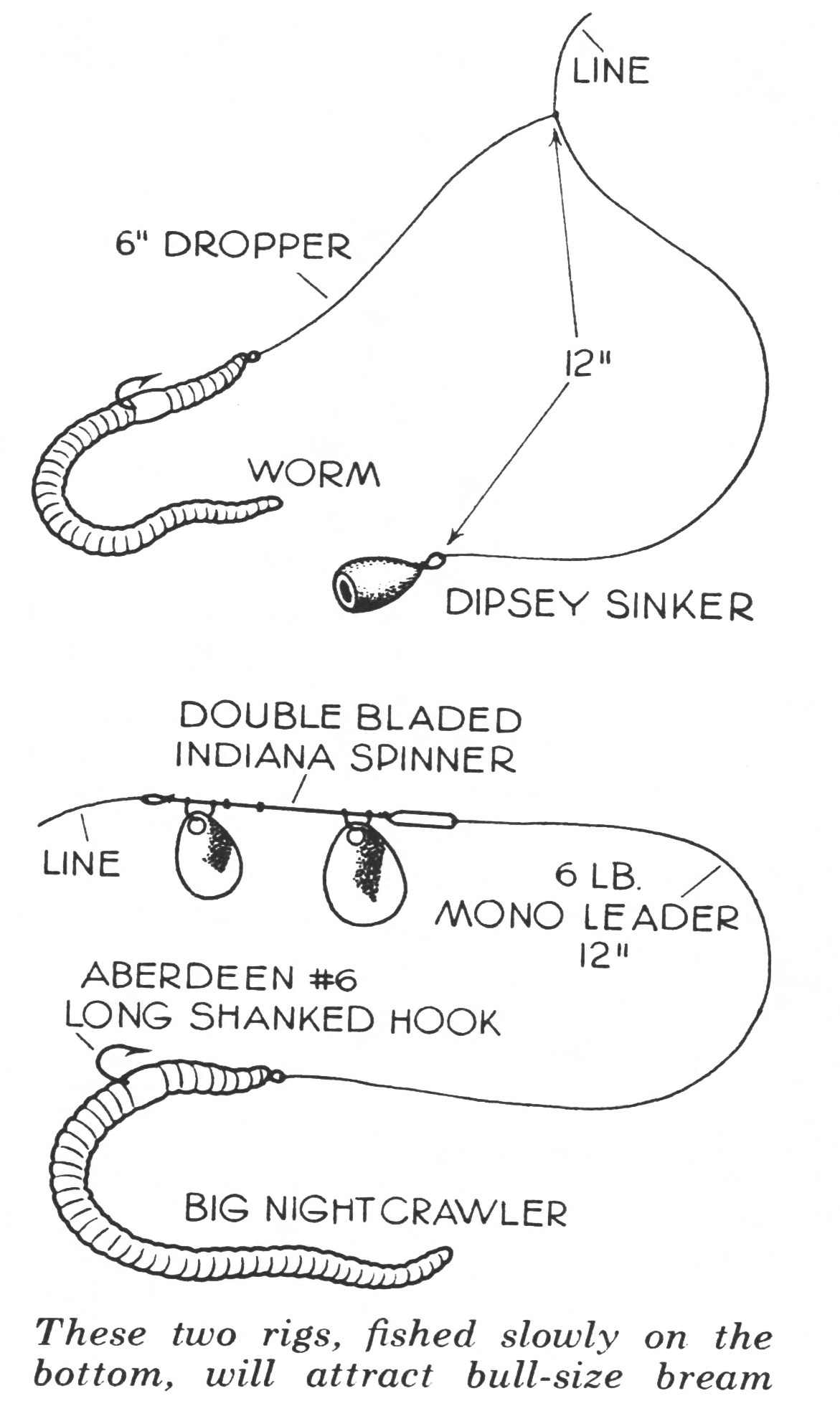
Some years ago the late Carl Allen, for many years a conservation officer in northern Michigan, taught me an unusual and astonishingly effective method for locating and catching big bluegills. Here is the terminal-tackle rig: an Aberdeen No. 6 long-shanked, thin-wire hook that injures bait little, will bend and can be reshaped if hung up, and is easy to remove from a small-mouthed fish: a foot of monofilament leader no heavier than six-pound test; a nickel-finish, double-bladed Indiana spinner in size 5 or 6, tied between line and leader. No sinker. The hook was baited with a big nightcrawler strung shank-length on the hook. This may sound like a preposterous, oversize concoction, but it is pure murder.
We’d drift, or row, pitching out the big spinner-and-crawler rig and paying out maybe 30 feet of line. The double blades, turning slowly, are very buoyant. We’d try to move barely fast enough to keep from dragging bottom. The instant there came a nip, we’d let back a foot of slack, then strike. Only bull-size bluegills went for the crawler after being attracted by the turning blades. It was amazing how we gathered them in. We’d circle and try where we got the first hits. If we got more, we’d keep circling. Sometimes, however, we’d anchor and then change rigs. We’d make up a dropper rig: small dipsey sinker at end of line, hook attached to a six-inch dropper a foot up the line. Again, we’d bait with a big crawler, which is quite a switch from the small worms usually recommended for bluegills. We’d cast this rig and barely creep the sinker along bottom, which made the bait trail slightly above bottom. It is deadly.
Later on I switched from crawlers to a small porkrind about 1½ to two inches long. It is very effective. Later still I learned to use the small pork-rind, usually white, in effect as a wet fly. I simply put it on a bare Aberdeen hook, gold or blued finish, and cast and retrieved slowly, deep or shallow, wherever fish were. I consider this one of the all-time best bluegill lures I’ve ever used.
All sorts of baits catch bluegills readily. Worms are standard. Last spring on Toledo Bend we used crickets exclusively. They’re usually avail-able in bait shops and are eagerly gobbled by big bluegills. Some specialists hook a cricket under the collar on the back. I don’t. Too fragile. I simply thread them on from the rear, bringing the hook out the thorax. With fine spinning tackle I use the smallest split-shot sinker that will carry the cast. I let the bait sink to the bottom and, keeping my line barely snug, move it an inch or two occasionally to attract attention. If bot-tom weeds are a problem, a bobber can be used. Leeches, mayfly nymphs, mealworms (an ice-fishing favorite now available preserved for summer fishermen), grasshoppers, and catalpa worms all make excellent offerings.
In my estimation, however, crickets and worms are about the best because they are so readily available everywhere and the fish like them. A few big-bluegill experts favor very small minnows. Indeed, these do catch some big fish. I seldom use them be-cause the diet of a bluegill, many studies have shown. is better than 50 percent insect material, and most of the remainder is small crustaceans and various worms. Incidentally, never use a snap or snap-swivel to attach the hook. The less conglomerate your bait rig, the less skittish the big bluegills will be.
Many artificial lures attract bluegills. Small jigs, fished vertically in deep water over the gunwale, often work well. A small spinner ahead of a bait or a fly also is good at times. Spinfishermen can use productively a casting bubble and a sponge-rubber cricket or other bug with rubber legs. These bugs, let down with a small sinker and jigged near bottom, also get a lot of action at times. All told, however, for the largest fish it is hard to beat bait-with one excep-tion, and that is flyfishing.
Remember that bait or lure, if it is to be moved, must be fished very slowly for top results. Big bluegills aren’t chasers. Also, watch the water temperature. If it is in the mid or low 60’s, fish even slower than you would at 70° to 75°.
The beauty of fly tackle is that, especially for fishing at the surface or at modest depth, it allows you to retrieve at the perfect speed. In addition, scores of varied types of bugs and flies can be used successfully.
When I first started flyfishing for bluegills many years ago, I had already long been a trout fisherman. I began by using regulation trout flies such as bivisibles and Adams dry flies in size 10 or 12. I used trout-style nymphs for subsurface fishing, letting them settle and twitching them a bit. Few fishermen know it, but some of these nymphs are more productive than the popular sponge-rubber bugs with legs. The fish take trout flies in a quick gulp, whereas they often pull a leg of a rubber bug in a false hit. Small cork or plastic-bodied popping bugs a re marvelous bluegill catchers when the fish are spawning shallow or are feeding up top in low light. Simply cast, let the bug rest, twitch or pop it, move it an inch or two and repeat. Often hits from the biggest fish come during the pauses.
Read Next: This Traditional Bait Still Slays Summertime Bluegills
One time in Florida a salty old native watched me fish a popping bug early one morning and said, “Son, you’re not fishing over much beds here. You let me show you. I kin smell beddin’ brim.”
It’s a fact that some old-timers in the South believe that a large bedding area during spawning gives off a musky odor that they can smell. Maybe so. Anyway, he had my interest, so I took him into the boat. He steered me toward a big cove that might have possibilities. Then he tapped my shoulder.
“Would you mind washin’ some with lake water — yer hair and under yer arms?”
I was annoyed. I’d had a shower before I came out, and I told him so. Apologetically, he said, “Son, I warn’t callin’ you dirty. It’s just that good-smellin’ stuff you got on — it bothers my nose for brim smellin’.” I laughed and complied. And believe it or not, he led me to a large bedding area full of fish.
A hoax? Maybe. And maybe you won’t want to go quite that far in ferreting out the big ones. But the basics offered here have kept my rods bent over hundreds of good bluegills season after season, and I’m sure that if you follow them you’ll draw a lot of envy from the fishermen with smaller ones on their stringers.