
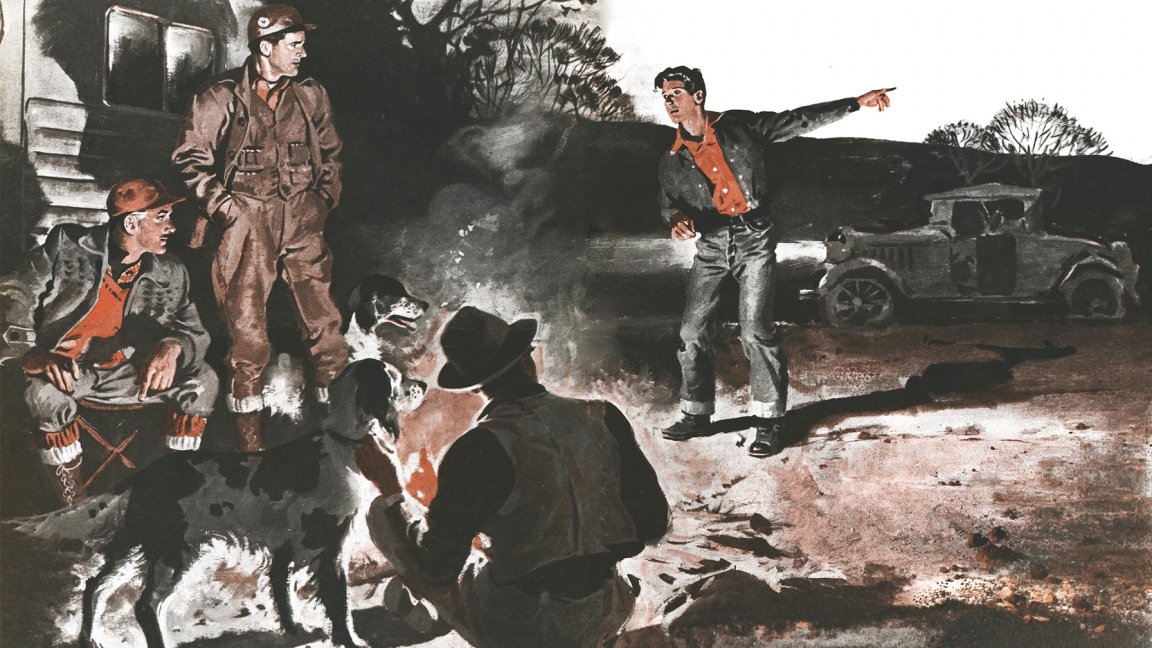
This story, “Axel Takes a Walk,” appeared in the March 1954 issue of Outdoor Life.
What Reino Lahti and Swede Lanham and I were hoping for was a change in weather. We needed a day or two of wind and rain. We were camped in Lahti’s house trailer on the Gunflint Trail, the road that runs from Grand Marais to Saganaga Lake, at the northeast tip of Minnesota just below the Canadian border, and the weather was much too fine to suit our plans.
It was the first week in October. There was a blue haze on the hills, and along the shore of Lake Superior the birches and aspens were a rolling plain of gold, and here and there a maple made a lipstick-scarlet splash. The big patches of fern were brown and crisp from frost, and when we walked in the woods in the morning we smelled the damp, bitter fragrance of withering leaves.
In other words it was grouse time, and that’s why we were there. But the foliage, pretty as it was, had us stymied. Only a few leaves had fallen and the cover was so thick we couldn’t see a bird 20 feet away. The dogs stood one and put him up on the far side of an alder clump, but we never got a glimpse of him. We just heard the thunder of wings, and as it died away in the thickets the dogs came back and asked with sad, reproachful eyes why someone hadn’t shot.
On the way up we’d spent a couple of days farther south and found enough birds to prove that Bum and Lady, Swede’s setters, were razor-sharp. But the leaves hadn’t even turned color, and it was like shooting in a green cave.
“Let’s try the country along the north shore,” Reino suggested. “Fall comes a week or two earlier up there.”
So we high-tailed it to the Gunflint, but found it just as hard to see a rocketing partridge through red and yellow foliage as it had been through green. And we knew it wouldn’t get any better until the leaves were off the trees.
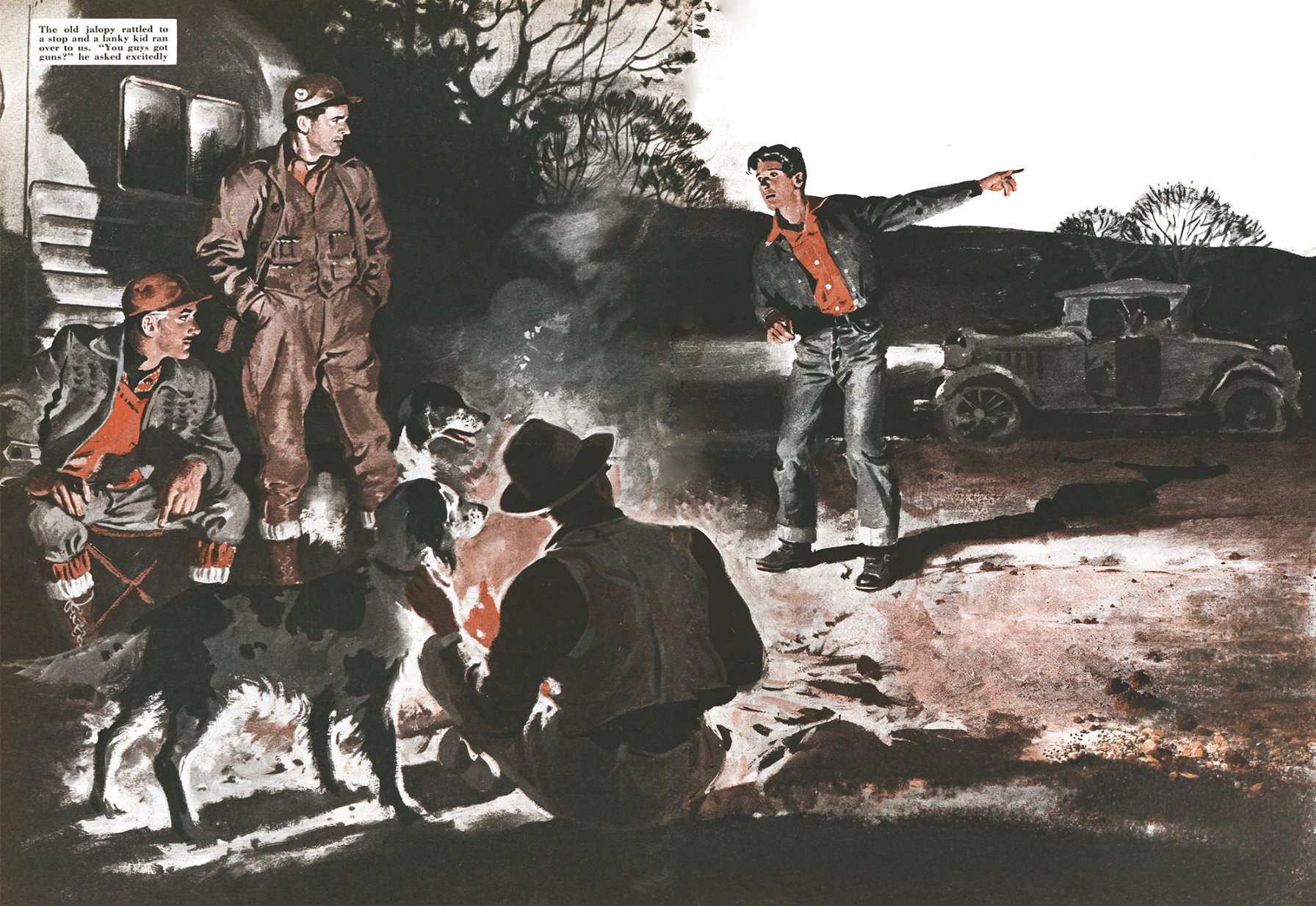
The days were warm but it turned cool after the sun went down. So after supper on the second night we lighted a fire and sat around smoking and yarning. All was quiet and still, but on toward 8 o’clock we heard a car coming up the road. It turned out to be an old jalopy which rattled to a stop in front of us, and a tall, lanky kid with hair the color of wheat straw climbed out. I guessed him to be about 16. He was short of breath, and it was plain he was pretty worked up about something.
“Hey,” he said, “you guys got any guns with you?”
Swede admitted maybe we had a couple, and wanted to know why.
“Fellow in a pick-up hit a bear a couple miles up the road,” the kid explained. “Knocked him colder than yesterday’s boiled potatoes, but he came to and dragged himself into the woods. Must have broke his back or something. We oughta finish him but we need a gun and a flashlight. You want to do the job?”
We chewed on that a little. Our artillery consisted of three shotguns, and the heaviest shot in camp was 7½. That didn’t seem quite the right equipment for putting a wounded bear out of his misery. And having to do the job in pitch darkness didn’t make it any more enticing.
“What kind of a place is it?” Reino asked.
“A cedar swamp, and kinda thick,” the kid said. “But the bear didn’t crawl in far. We heared him whining and thrashing around.”
“Suppose our bird shot would do it if we poked the gun right in his ear?” Swede asked me.
“If any ear poking gets done, you can do it,” I told him. Once I stopped a creased bear at 50 feet after he’d made up his mind to get me, and that’s closer than I ever aim to get to one again until I’m positive he’s totally and permanently disabled.
Lahti cast the deciding vote. “Well, somebody’s got to kill the poor devil,” he pointed out. “Guess we’d better get going.”
We got our guns and flashlights, climbed into the kid’s clunker, and bounced up the road to where the pickup was parked. The driver was in the cab. The car had a crumpled fender, one headlight was jammed in, and there was black hair all around the broken frame. From the looks of things the bear had been clobbered plenty.
There was no commotion within hearing, though. The swamp was still as a grave, and just about as black.
“Maybe he’s dead,” Swede said hopefully.
But the kid wouldn’t have it that way. “He’s just crawled in so far we can’t hear him,” he said excitedly, “or maybe he’s playing possum. I’ve read they’ll do that when they’re hurt.”
The kid hadn’t been exaggerating when he said the place was thick. It was like a fish net, and our lights couldn’t reach more than 15 or 20 feet through the brush. But we were there to do a job, and we couldn’t very well back out. So we found the track where the bear dragged himself off, and plunged in.
We formed kind of a tight knot like a flying wedge, and played our lights in all directions. Our guns were halfway to our shoulders, and we each had a finger on the safety. I could feel gremlins playing ticktack up and down my spine.
The driver stayed back on the road, no more than a skip and jump from his pick-up. Not so the kid. He tagged along with us, as eager as a terrier at a rat hole, though he had neither a light nor a gun.
We followed the track for 100 yards through leaves and moss and over fallen logs. The deeper we got in the swamp the thicker it became. The track began to fade. It went over an old log, under a windfall — and disappeared. We circled the low tree and probed the near-by growth with our lights. No trail. Swede suggested that maybe the bear had recovered enough at this point to get on all fours and walk. We finally concluded that perhaps he’d broken a shoulder and, if so, would probably travel a long way. At any rate, since there was no track to follow we figured we were off the hook. We felt let down, but nobody was really sorry as we headed for the road.
The boy drove us back to camp, and on the way he told us he was Axel Olson and that he lived on a farm a few miles down the road toward Grand Marais. When we got back to the trailer we made a pot of coffee, built up the fire, and sat around talking about bear hunting. Swede told a couple hair-raising yarns, and the kid hung on every word. He had a slow grin that split his face wide open, and it was evident he was having a good time. But the conversation finally swung around to a tamer subject.
“Many partridges around here this fall?” Reino asked the boy.
“They’re thicker than whisky-jacks,” he declared, “but it’s been a dry summer and you won’t find ’em on high ground. Mostly down in the cedars where there’s water.”
I noticed he kept looking at the setters tied up at the end of the trailer. “I suppose they’re real good bird dogs,” he said finally, and Swede nodded. “We don’t use dogs much up here,” Axel went on. “Most of the time we hunt the roads. The pats sit up in trees. Don’t need a dog that way.”
That ruffled Lahti. “Yeah,” he blurted shortly. “We saw three road hunters on the way up here. They were back on an old swamp road in a jeep, one driving slow and the others poking guns out on either side. That’s a hell of a way to hunt grouse.”
“They oughtn’t to do that,” Axel agreed gravely. “Birds ain’t afraid of a car. They just set and let you shoot ’em. Man oughta walk.”
We grinned at that, but the kid was dead serious. His eyes went over Lady and Bum once more. “I never hunted with a bird dog,” he said.
Swede took the hint. “Like to hunt with us in the morning?”
“Gee, that would be great,” Axel exclaimed with a big smile. “I’ll be here right after daylight.”
He got up quickly, climbed into his old crate, and drove off, almost as if afraid we’d pull back the invitation.
“I like that kid,” Swede said as the car’s tail-light disappeared.
“You should,” I jibed. “He’s a countryman of yours.”
“More spunk than a cornered muskrat,” he chuckled. “Stuck right with us, down there in the swamp.”
“Yeah,” Reino agreed, “but him and his road hunting!”
“That’s just the way he’s been brought up,” Swede insisted. “We’ll wean him off that tomorrow.”
“At least he’s got a point about these north-country pats being tree perchers,” I pointed out. “Half the time they let you walk up and look ’em in the eye. You have to boot them out to shoot them.”
“That’s just the way they’ve been brought up,” Swede retorted. “Bum and Lady will teach them better manners in the morning.”
But nobody taught anybody anything the next morning, except maybe Lahti gave Lanham a few pointers on gin rummy. A northwest gale blew in after midnight, with rain so cold it was close to snow, and for 24 hours we holed up in the trailer. In the afternoon Axel came by to make sure we were still there and that the invite was still good. Next night we heard geese going over, headed southwest, and we figured the storm would last maybe three or four days. But at dawn the sky cleared, and the wind died down.
What that blow had done to the foliage was the answer to our prayers. The red and yellow leaves were gone like frost in the sun, and the underbrush was broomstick-bare.
We expected Axel to show up with a rusty old single, or maybe even a double with twist barrels, but when he rattled into camp just at daylight he handed us a surprise. He was carrying a sweet little 16 double, brand new, that must have set him back plenty.
“Took me three summers to save up the money,” he told us as we admired the gun.
We swung down an old logging road that runs into an alder bog, and it took Bum and Lady just about a minute to make a find. Bum romped through dead grass and ferns, with just his head and back showing, and suddenly whipped around and stiffened out as showy as a Greek statue. Lady was out of sight behind some alders, but when I walked around them I saw her rigid as an iron dog on the same bird.
I started to walk in, but the bird didn’t wait. He didn’t roar up the way he was supposed to, either. He just fluttered off the ground like a woodcock, and before I could slip my safety he was perched 20 feet up in a jackpine, twisting his head this way and that and calling “quit-quit-quit.” A fool hen couldn’t have behaved more stupidly.
The kid backed off a few steps and got ready to whang away, but Swede stopped him. “Hold it, Axel,” he called quietly. “That’s not the way we do it, not with dogs. Unless you kill a bird on the wing it don’t count.”
The boy moved in toward the tree, and the partridge suddenly got the idea. He tipped out quietly on the far side and was beyond sight in the brush before any of us could get onto him.
“Looks like that one didn’t count anyway,” Axel said dryly.
The next birds we found were in a tree to start with. There were three. We watched them for a spell, then Lahti stepped ahead, bounced them, and dropped two on the get-away. It was a pretty double. The kid, standing next to me, said, “Gee, that’s shootin’.”
Reino’s double touched off some of the best grouse hunting I’ve had in a dozen years. The kid wasn’t pulling our legs when he said the pats were thicker than whisky-jacks, and the storm made things exactly right for us.
We went on through the swamp to a low ridge. At the edge of the cedars two birds ran out 50 yards ahead of us. The dogs went off to the right, working in thick stuff, and the pats stopped beside a stump to size things up. One was in plain sight. I could have smacked him like a bottle on a post, and I knew Axel was itching. But he didn’t even take the gun out of the crook of his arm.
The bird bobbed his head a few times and looked up at the branches of a birch. It was easy to see what he had in mind, but neither he nor his pal got a chance to carry it out. Suddenly Lady came slashing through the cedars and shin-tangle and pinned both of them down so close and hard they didn’t dare flush.
They held the way grouse should. Swede walked in and was within 10 paces before they broke and streaked off through the brush. Neither the kid nor I had a chance, but Swede and Reino each slammed a shot. We heard two low, muffled thuds as the birds hit the ground. “Dead bird, Lady,” said Swede. “Fetch.”
Those two setters of Swede’s are force-broken to retrieve, and it’s worth the price of any trip to see them find and bring. Swede likes to “blind” one by holding its head between his knees, facing backward. Then he’ll pitch an empty billfold far out in thick cover, and give the order to fetch. The dog circles out at random, quartering on short tacks. When it gets close Swede checks it by command. The setter locates the billfold with its nose, and comes back as proud as a winner on Derby day.
This time Lady came back with one partridge before you could count to 30, but she didn’t get a chance to pick up the second. Bum came barging up out of the swamp and took care of that.
“Pretty,” Axel said to Swede. “I’ve read about dogs doing that, but I never saw it done.”
Bum nailed another bird before we’d gone 200 yards along the ridge, but it wouldn’t stay put. We heard it thunder up, saw it sail into a clump of evergreens. But suddenly it changed its mind and flipped out on the other side, too far away for shooting. Bum moved on, but before he’d gone a dozen yards another pat was smoking in his nose. That one held.
On a damp day like this was, with the scent strong, Bum doesn’t fool around. He slams into a stand, head high, tail straight, and holds so rigid he trembles. If the bird played fair, and nobody came along to upset things, I think he’d stay like that all day.
He spiked this bird in an alder clump, and the setting was just what artists like — black brush, dead ferns, evergreen background, the setter a living statue. We stood for three or four seconds admiring him, then Swede pushed the kid out in front. “This one’s yours, Axel,” he called softly. “Walk him up.”
The kid moved slowly, his gun half up. He almost reached the dog when the pat jumped, stirring a swirl of leaves and lifting through the underbrush with the heart-stopping thunder that’s the undoing of many young grouse hunters — to say nothing of some older ones. It was the first bird the kid had ever put up that way, the first shot he’d ever had over a dog, and for all we knew the first time he ever tried to kill a rising grouse. He was in a tight spot, but he was cool and steady.
The cover was thick, and the pat bored through it in zigs and zags like a midget jet on a mission. The kid just waited. Then, 20 yards away, the bird reached an open lane and leveled off. The right barrel of the 16 smashed out one sharp syllable. The pat fell out of sight, but we saw brown feathers eddy down behind him.
“Fetch, Bum,” Swede called proudly.
The setter broke his trance and lunged ahead, but midway of his first jump he stuck his nose into bird smell again and pulled around as if he’d forgotten something. That bird didn’t stand on ceremony. It lighted out full throttle and turned Reino’s way. Reino tried and missed, then connected with his second shot. When I looked back I saw Bum had moved into the middle of a patch of fern and was ramrod-stiff on still another bird.
Swede walked in, and the pat pulled the oldest trick in the book. He flew straight for my head, so low and fast I had to duck. No one could shoot until the bird was past me, and by then he was all mine. The cedars were 30 feet off and he climbed to dive into them, but I found him over the barrel within a couple of wing strokes of cover, and he never made it.
Lady was in the act by that time, and I left him to her. Reino picked up his own bird, and when I looked around for Bum I saw him trotting out of the brush with the grouse the kid had knocked down. He delivered it to Swede and Swede handed it over to Axel. The kid grinned his slow grin, and if he’d inherited all the iron mines on the Mesabi Range he couldn’t have been any happier.
It didn’t stay quite that lively the rest of the morning, but we found plenty of birds and the lulls were just long enough to keep the action spread out. Now and then a bird took to the trees, but the dogs were hot and fast and most of the pats, nailed at close range, sat tight.
We finally went back to camp for a sandwich, loafed a couple of hours, and then went out for some afternoon shooting. The wind had come up, the ground was dryer, and the birds were wilder.
The last shot of the day fell to the kid, and he did all right with it. We were circling a beaver pond when Bum and Lady came loping down off a birch-grown hillside and made a stand in tall grass near the edge of the water. The pat jumped almost before we saw what was happening. Swede was beyond range on the hill, and Reino and I held back to give Axel his chance. He didn’t need much of a handicap. The new 16 blurted out, and Lady came trotting up with the bird limp in her mouth.
We invited Axel to stay for supper, but he had chores to do. “I’ll come back after awhile, though,” he said. “I’d like to talk with you.”
He showed up while we were washing dishes. But a little later we sat by the fire, and the boy got Lady’s head across his knees and picked devil’s-pitchforks out of her ears.
“Guess I won’t ever care much about road hunting again,” he said. Then he turned to Swede, and asked, “If Lady has pups sometime, would you save me one?” But before Swede could answer, the kid’s chin dropped. “Likely that would cost too much, though. What would one of her pups be worth?”
“Oh, about five bucks, including express charges,” Swede told him in an offhand tone.
That slow grin split the kid’s face again, and this time it went all the way back of his ears. “Save me one just like him,” he said, jerking a thumb at Bum.
Read Next: The Duck Dog Who Wouldn’t Abandon a Retrieve, Even If It Killed Him
We checked after we got home, and figured it’s going to cost Swede at least $10 to get that dog up to Axel, to say nothing of the offers he has of $75 and up for one of Lady’s male pups. But come next spring, if she does her part, the deal will be closed.