
This story, “The Buck and The Great Gray Owl,” appeared in the November 1972 issue of Outdoor Life.
For at least a mile, I had trudged along a U.S. Forest Service trail to avoid hunting through the dense evergreen woods on both sides. There the trees sagged under heavy burdens of snow, and to brush against just one branch was to release a load of it down the back of my neck.
But following the trail wasn’t always easy. In places the blaze marks were obliterated by snow that a high wind had plastered against the tree trunks, and here and there drifts were piled waist-high. Slogging through such deep wet snow can take the joy out of deer hunting, so I decided to head back for the warmth and comfort of the ranch. I elected to take a shortcut rather than to retrace my steps, and that decision proved to be a mistake.
My shortcut led down and around a slope, then crossed an old burned area, now grown up in a thicket, where the new snow covered a nightmare of crisscrossed deadfalls. Before I reached the far side of the burn, I tripped many times and was wet from chest to toes. I swore out loud the last time I fell, and in that instant three does suddenly sprung from their beds in the snow and fled downhill.
The does did not bounce away in the characteristic stiff-legged manner of mule deer. Instead they hesitated and floundered, now and then up to their bellies in the snow. I threw the rifle to my shoulder and could easily have shot all three, so slow was their progress. But the purpose of my trip was to bag one good buck, and I had a few more days to hunt.
Back in camp, I found George Smith and John Moxley propping wet boots close to a cast-iron stove to dry while a pot of coffee brewed on top.
“Did you see any game?” I asked.
“Not even a new track,” George answered.
“We may have started this hunt too late,” John added.
I almost had to agree with John — the three does were the only deer I had seen since arriving at George Smith’s Canyon Creek Ranch. For years George has been guiding hunters from this ranch, located in the Pioneer Mountains of the Beaverhead National Forest, about 17 miles of steep winding road from Melrose, Montana. When John and I couldn’t make our annual Western hunt in time for the October opening of the big-game season, George suggested that we hold off until the season’s last week, which would be the last week in November.
“By that time,” he had written, “the big bucks should be down low and we can have a real trophy hunt. Besides, all my guests will have gone home for Thanksgiving, so Bob and I can join you.”
Bob is my youngest son, and he was working for the Smith family during the season as a guide and wrangler.
The plan sounded perfect to John and me. John is from Ohio, and I had recently moved from Ohio to Wyoming.
On a crisp bright day in November — perfect weather for big-game hunting — I met John at the airport in Butte, Montana. We picked up some supplies and then drove the 60 miles to Canyon Creek Ranch. We arrived well after dusk under a still-clear sky.
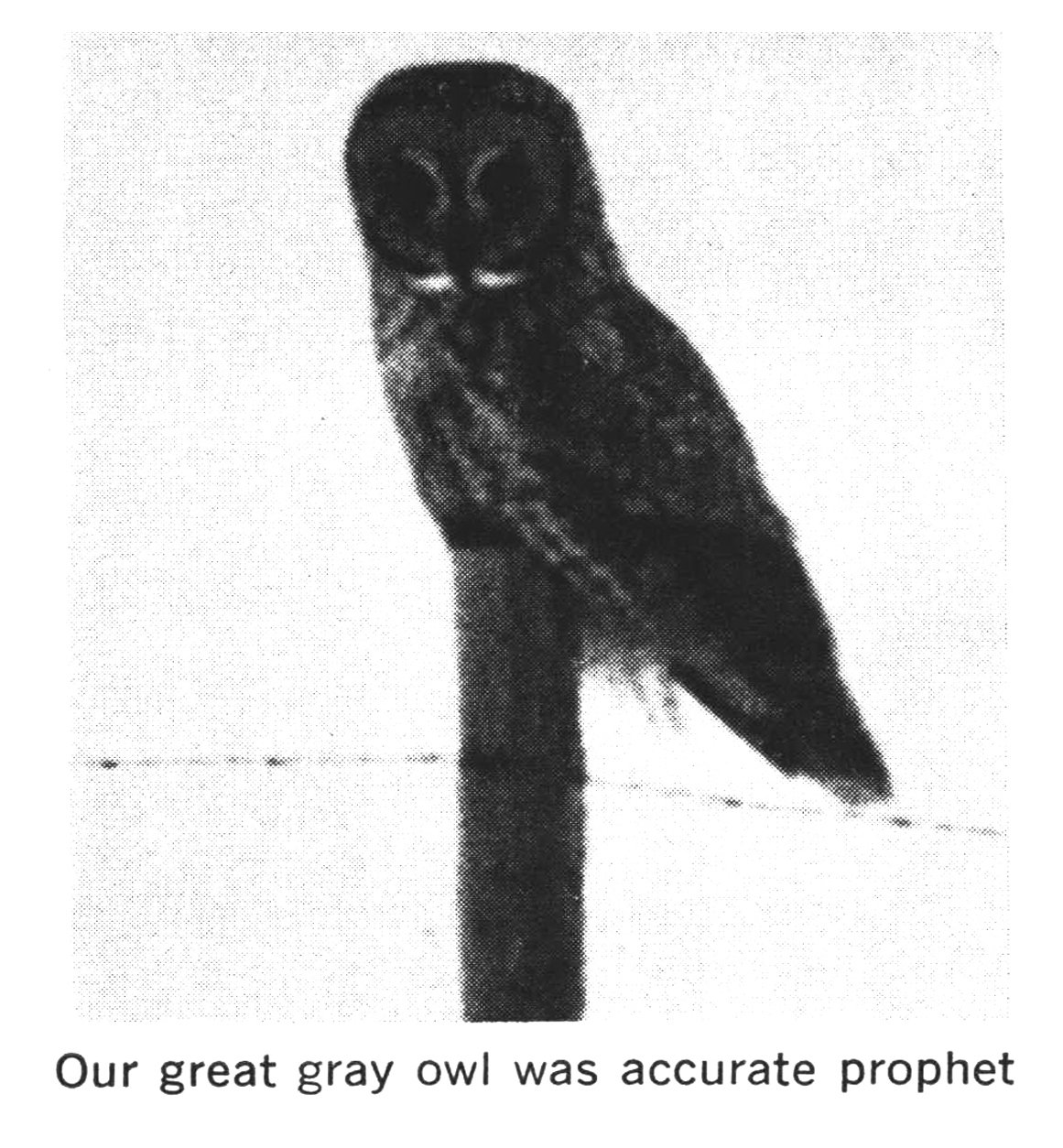
I’d never felt more optimistic about starting a hunt. But two things did bother me. First, we did not see any deer in the headlights of our vehicle on the drive to the ranch. Second, after our arrival George mentioned seeing a great gray owl around the ranch buildings. In that region the great gray is a rare visitor, and according to George it arrives only ahead of a storm.
“The last gray owl I saw,” George recalled, “came just before the worst winter storm in my memory hit this place.”
Late that night, snow began to fall and a violent wind came up. The snow didn’t stop until more than a foot of white covered the high country — about 7,000 feet at the Canyon Creek Ranch — and the temperature plunged to zero. We did very little hunting, and it was unsuccessful.
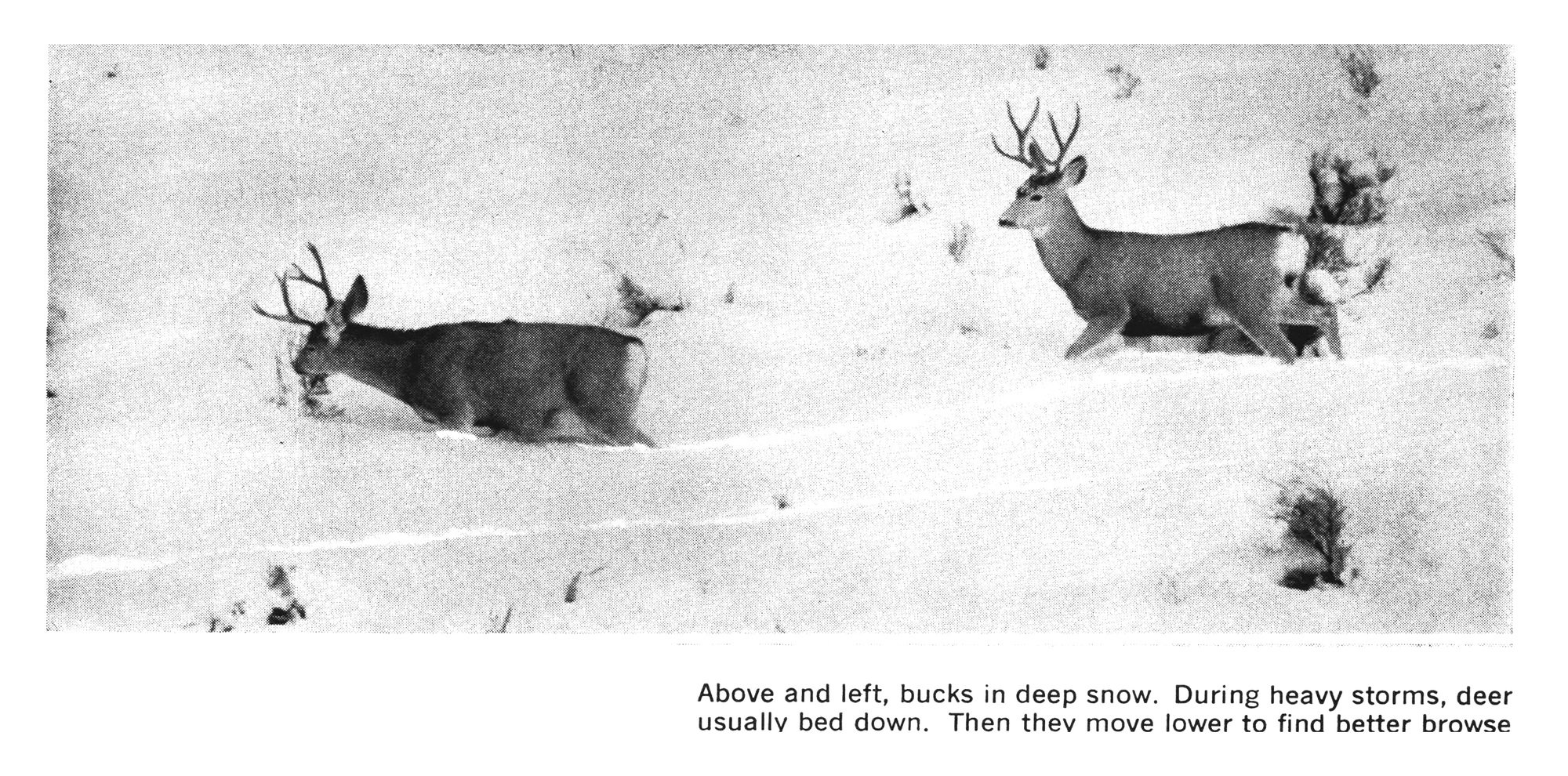
“The deer have either bedded down until the blast passes,” George explained, “or moved down to where the snow isn’t so deep. We’ll have to wait and see.”
At first the waiting wasn’t too bad. I hadn’t seen Bob or George for a year, and we had plenty of stories to swap in the snug ranch atmosphere. Besides, there was a Thanksgiving banquet to cook and eat. But eventually I got restless and wanted to start hunting in spite of the conditions. The result was that we left a good many bootprints in the deep snow without covering much distance or seeing any deer or even any game sign.
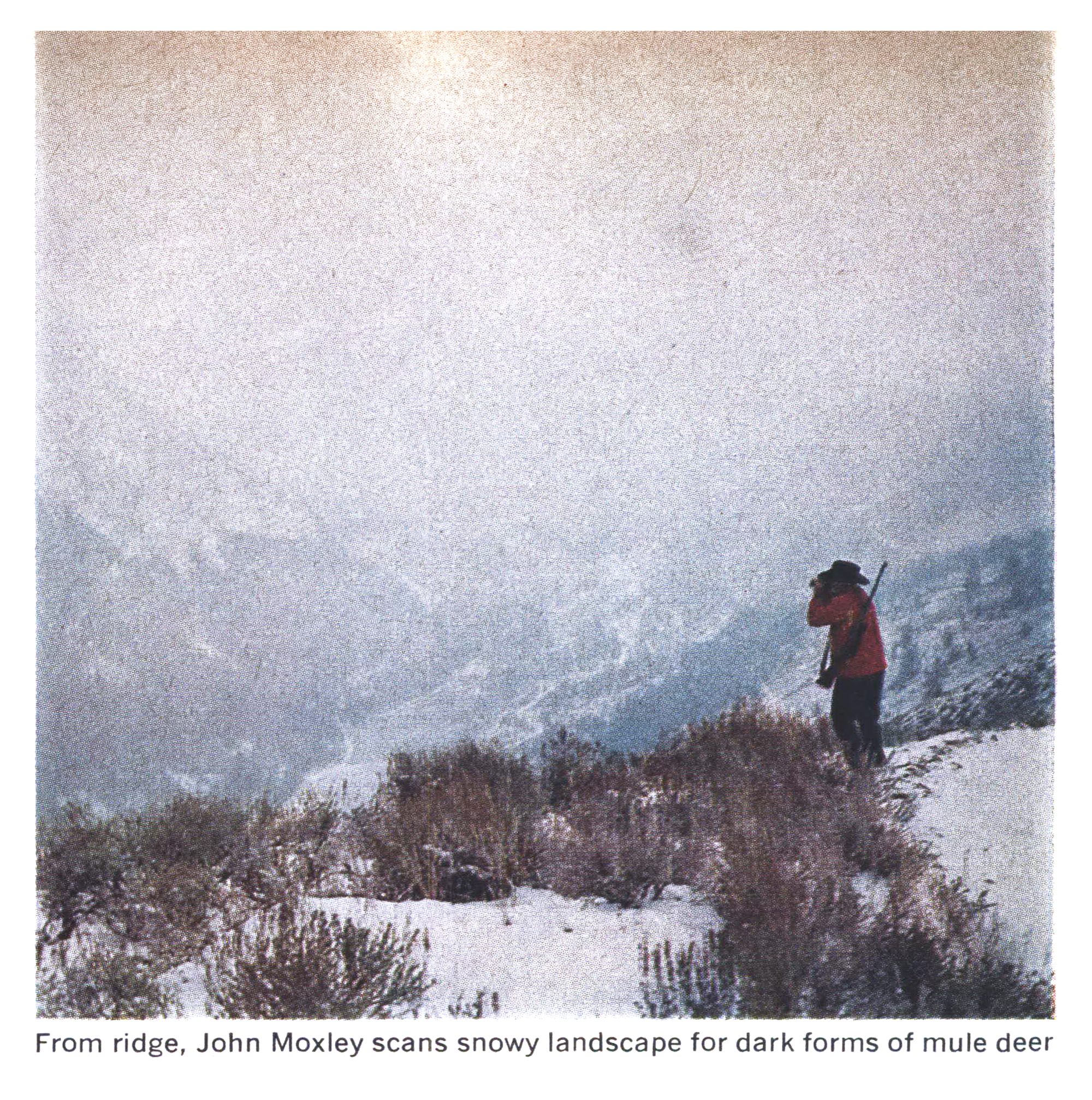
The morning after I saw the does, I started out early. The wind had stopped blowing, but visibility was still poor. Gray clouds hung in the canyons and close to the wooded slopes so that long-range scanning with binoculars was seldom possible. One very effective tactic for hunting in good snow cover in mountainous country is to carefully glass all slopes, particularly south slopes, for game that stands out sharply against the white. The clouds ruled out that tactic.
But the day didn’t pass without excitement. I had crossed a steep draw and, on reaching level ground on the far side, had paused to catch my breath. A moment later I heard animals crashing toward me through an evergreen thicket up ahead. My heart began to pound. I flipped off the safety on my Model 700 Remington 7 mm. Magnum and held the rifle ready. A cow moose followed by a calf stomped into the open and crossed my path without even a sidelong glance in my direction. It was quite a surprise to see them so far from more-typical moose habitat.
Bob had good news back at the ranch that night. He had scouted in another direction and found many tracks.
“They seem to be paralleling Canyon Creek, heading down toward the old ghost camp,” Bob said. “If the snow’s thinner, we might find them there tomorrow.”
The next morning was bitterly cold. We gathered in the ranch kitchen and huddled around the cook stove while George carved thick strips of bacon from a slab and mixed up a large bowl of sourdough pancake batter. It is a standard practical joke around Canyon Creek to conceal a round sheet of cardboard inside some unsuspecting diner’s pancake and then watch him try to cut it with a fork. George pulled the trick on John, and we had a good laugh before beginning a cold day.
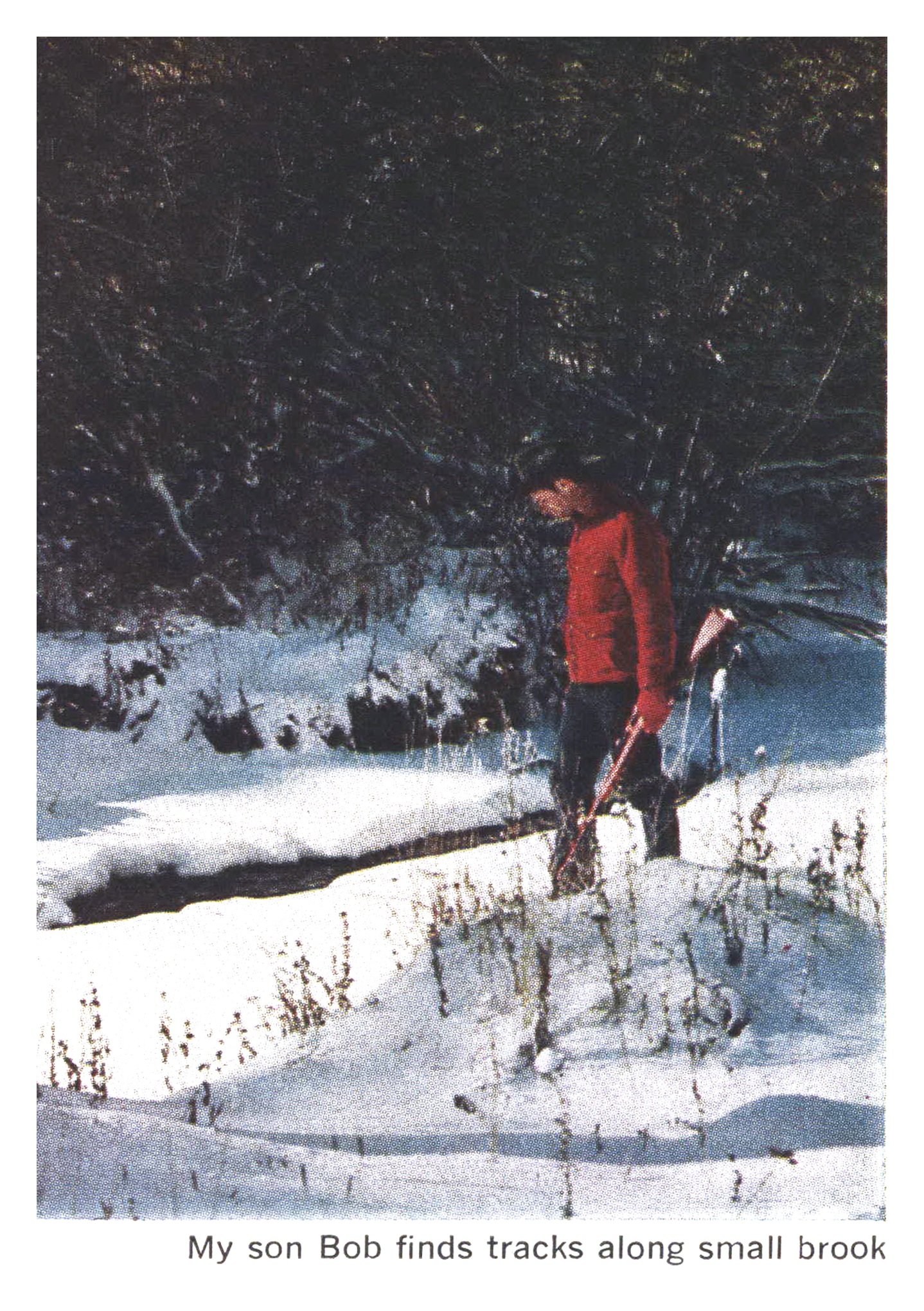
It was possible to drive our four-wheel-drive rig partway to where Bob had found sign the day before. We parked our vehicle beside a small tributary of Canyon Creek, now almost completely frozen, and followed it on foot to an open meadow bordered by a wooded slope. There we found Bob’s tracks as well as deer tracks that had been made since his reconnaissance. It was soon evident that a herd of deer had fed along the meadow’s edges; in windswept places they had pawed circular areas free of snow to get at the vegetation underneath. But apparently the deer hadn’t lingered long, and their tracks disappeared in many different directions.
“Our best bet,” George said, “is to go separate ways and see what we find.”
Because George knew the country best, he took a more complicated route, which led through heavy cover, wound around a mountainside, and nearly dead-ended at a steep rocky cliff. He figured that game might be bedded on top or near the face of the cliff.
John and I proceeded together until the meandering tracks appeared to divide into two small herds. Then we separated, planning to meet late in the day on an unimproved road far below.
One set of the tracks I followed was very large, and I concentrated on it. I walked parallel to the buck’s path on the downwind side while watching far ahead for a glimpse of the animal. That technique had worked well for me on other hunts, and it might work again.
I was so intent on following the buck that I almost stumbled over a bedded doe. She went flying in a cloud of snow down the slope. Then, before my hands were steady again, a shot cracked in the distance. The shot spooked a second deer about 150 yards to my right. I saw the animal for only an instant and couldn’t tell whether it was my buck. But when I hurried back to the buck’s trail, I found the spot where he had suddenly shifted into high gear.
For the rest of the day I stillhunted slowly but got no action. I was optimistic, however, for at last we were in deer country.
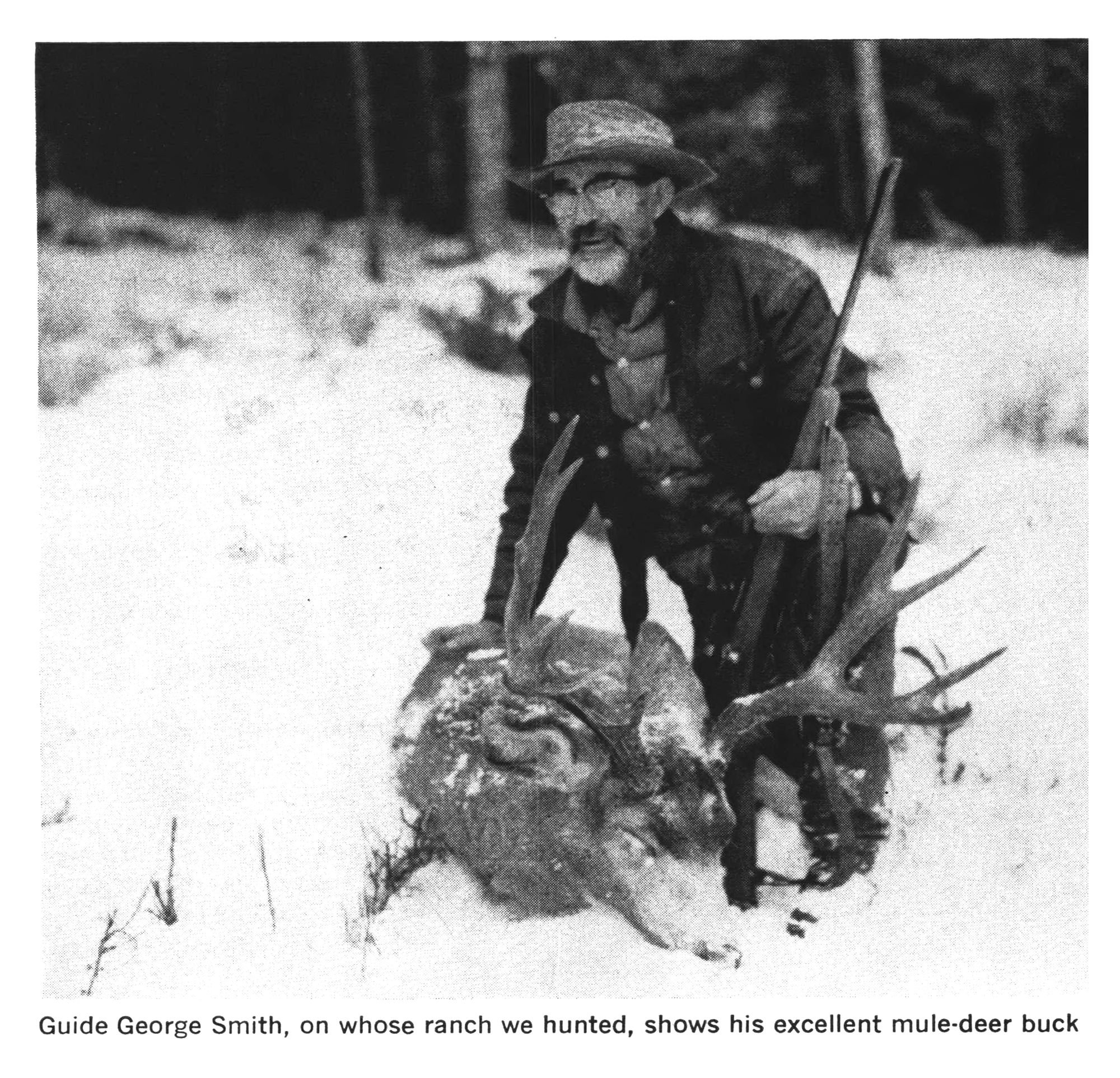
The shot I’d heard was George’s. He had broken the ice. About a mile from where he’d left John and me, he’d noticed that the tracks of the largest deer became more meandering — often an indication that a deer is seeking a good place to bed. George slowed his own pace accordingly, stopping often to scan thoroughly every bit of mountain terrain in front of him. This is the simplest and oldest of all mule-deer-hunting strategies, and once again it paid off.
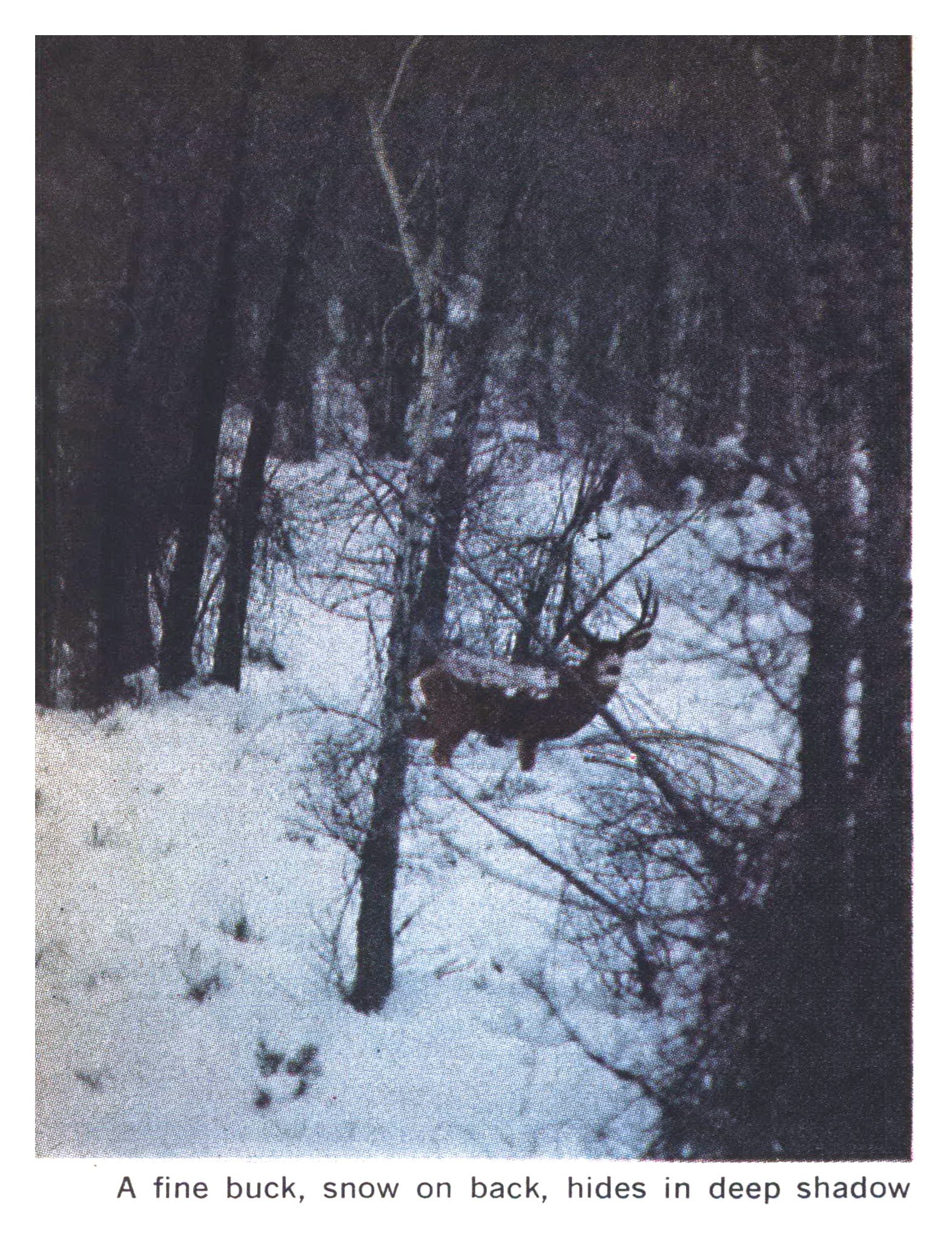
Just before George reached a small draw, he stopped. Soon he saw a shape that put him on alert. On the slope slightly above him was the outline of a buck’s rack, somewhat obscured by a screen of brush. In the next moment the deer was on its feet and running. But it was slowed by snow, and it hadn’t gone more than 20 feet when George drilled a shot through the lungs. He found the animal dead 50 yards from where it had been hit.
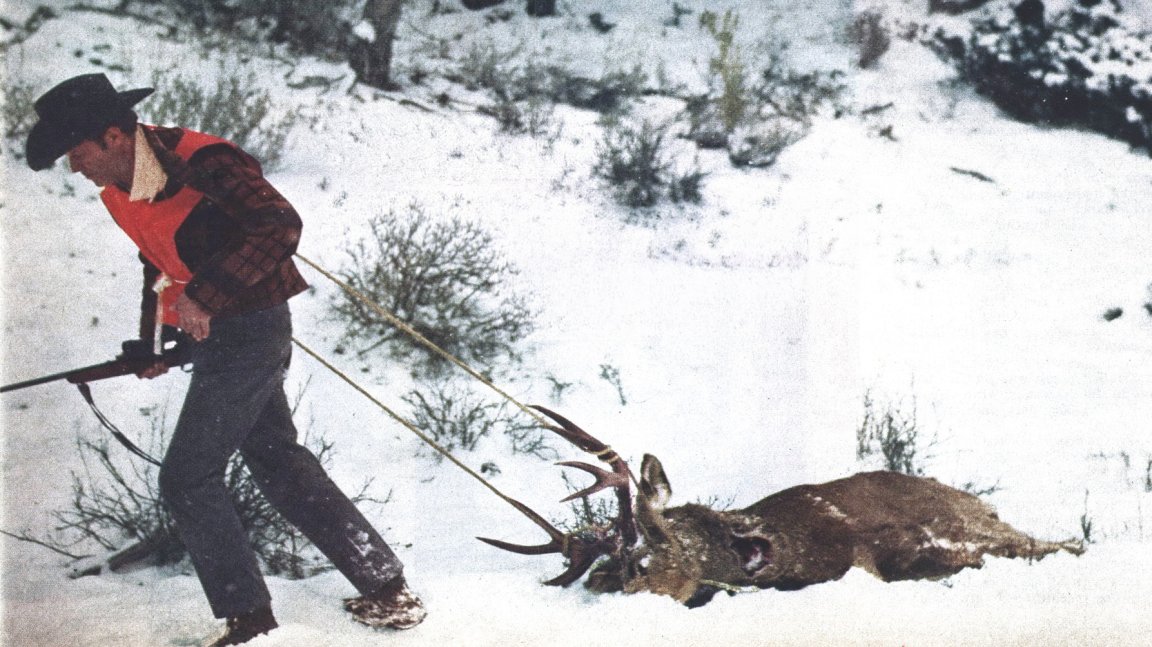
The buck was an old, heavy five-pointer (Western count) with unusually heavy beams. It was a trophy that even an old-timer in the Montana Rockies could brag about. The buck, even when field-dressed, was a terrible weight to drag to the nearest pickup point. Without the slippery snow and all-downhill going, we would have needed a packhorse or two for the job.
But the day produced more than a trophy mule deer for George. It also revealed that deer were moving from the high country into lower ranges where food was more available. The farther we had hunted that day, the more fresh tracks we had encountered. John reported jumping 12 deer from a sheltered meadow that, from the amount of tracks and digging in the snow, resembled a livestock pasture. None of the deer had the kind of rack that John was looking for, but his gloom early in the trip had been replaced by enthusiasm.
“Tomorrow,” he predicted to me, “both of us will score.”
The next morning was overcast, and flurries of snow drifted to the ground as we huddled again around the kitchen stove. After breakfast George drove us to a spot close to where John had seen deer the day before. We had driven along that same trail several times before. Only two days before, John noted, the only track on the new snow had been made by a wandering coyote. Now deer tracks were everywhere.
George left John and me where the road forked. He would pick us up late in the afternoon at a point about two miles farther on.
Few thrills can match walking through woodlands that you know contain game. You are tense and excited, and it’s difficult to slow down and hunt carefully enough.
John and I had scarcely separated when I saw deer running over an open ridge ahead and above me. I didn’t spot any antlers, but no matter. All the animals were out of range and gone before I would have had a shot.
“Slow down,” I said to myself half-aloud. But my pulse was racing.
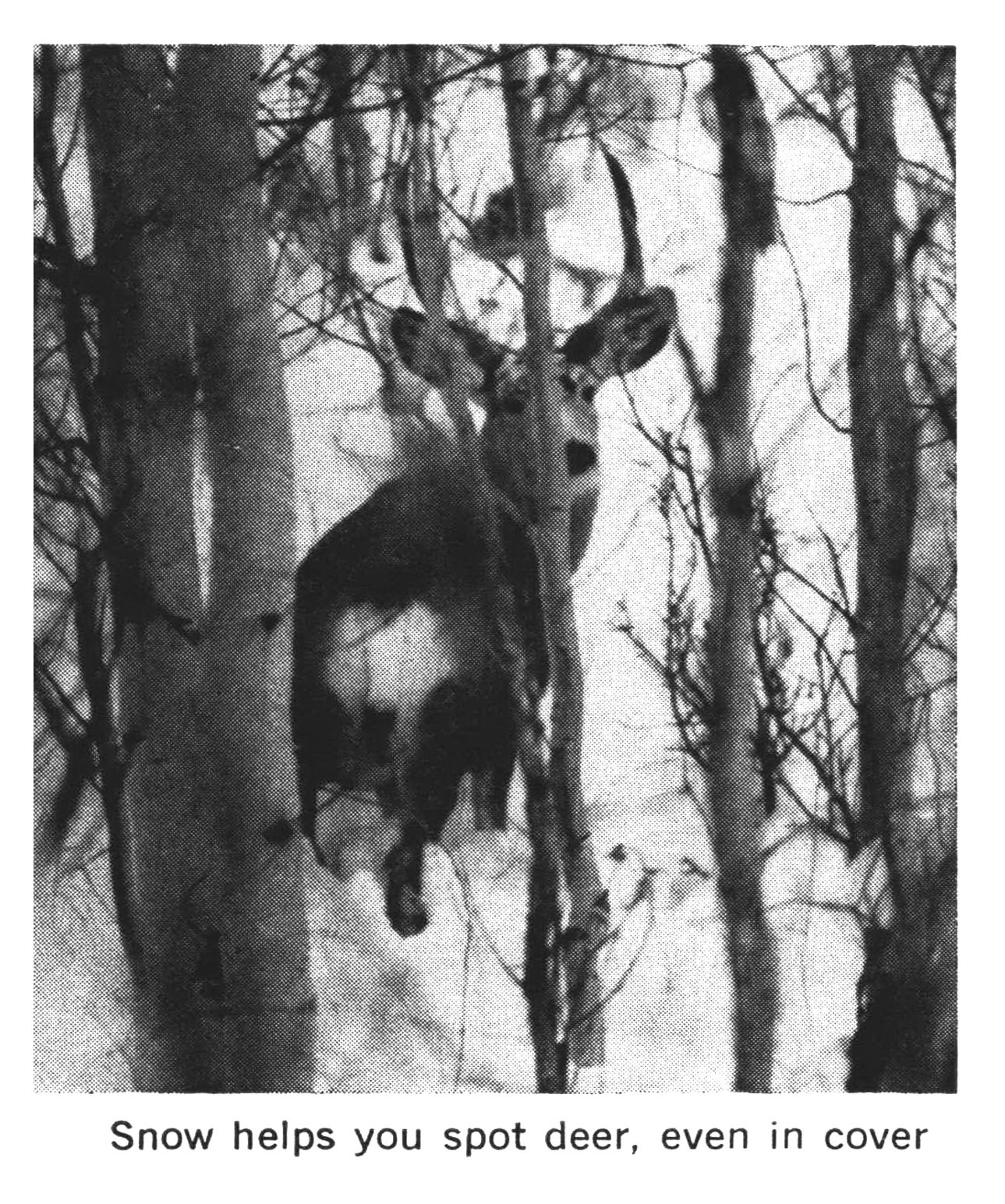
That day I saw as many muleys as I’ve ever seen on a day’s hunt afoot. We had found a winter deer yard, and collecting venison would have been incredibly easy. But I kept hoping for the big buck. Actually I did see two together, but they were traveling and already 400 to 500 yards away.
At dusk when I came out again on the road, weary to the bone, I still hadn’t fired a shot. The headlights of George’s vehicle were a welcome sight in the gloom. Even better was the big buck lashed on top. John had scored, and back at the ranch he told about it.
Early in the morning, after his eagerness had spooked a very good buck, John decided to hunt more from the seat of his pants and less by hiking all over the landscape. When he found a good sheltered place, he sat down on a deadfall. Though the mountain slope opposite him seemed empty of game, he studied it through his glasses. Soon he focused on a spike buck, bedded and almost hidden behind a juniper bush. John shifted his gaze slightly upward, and there he saw the kind of buck he wanted.
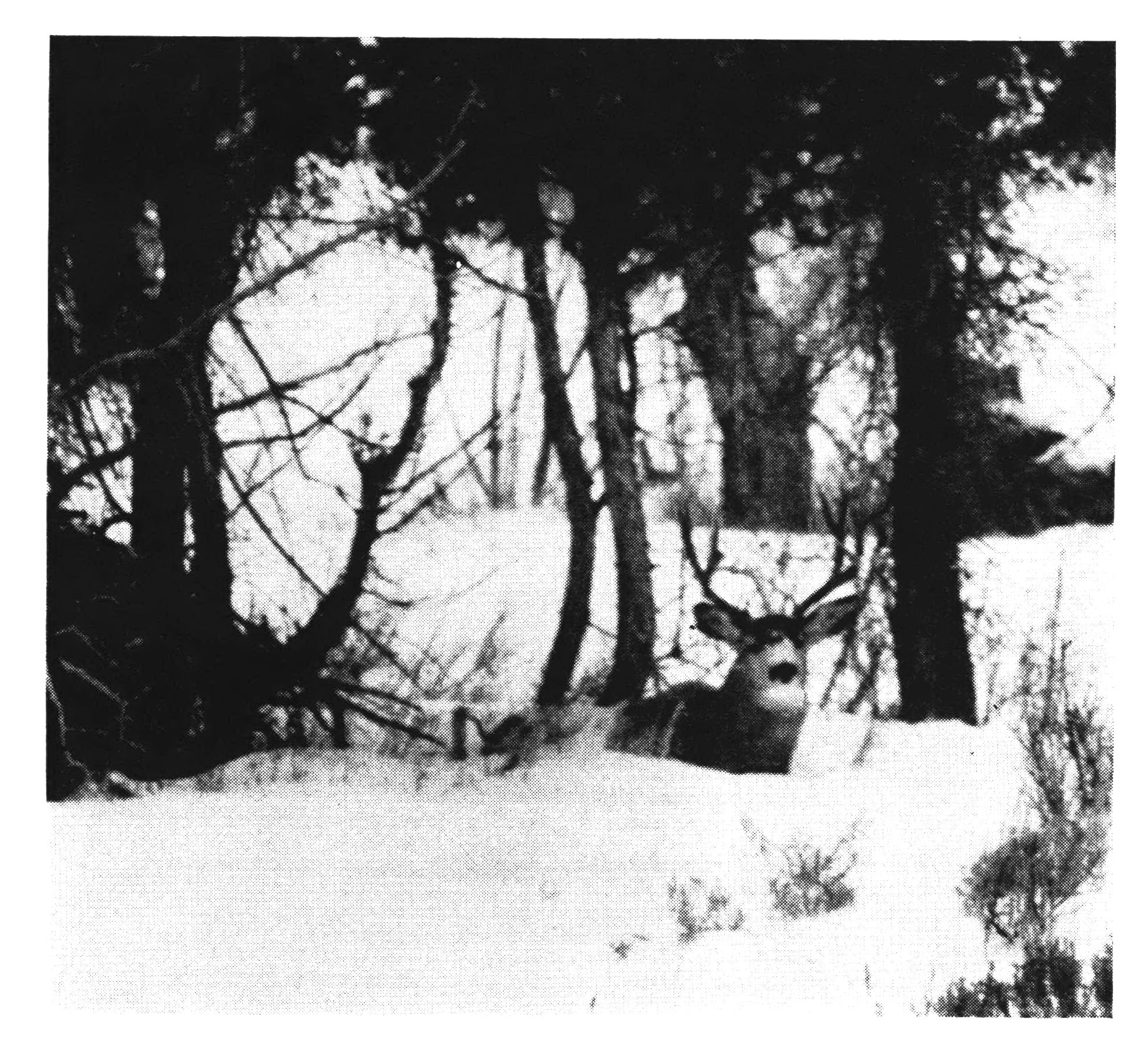
The four-pointer was bedded in a cluster of trees and was in deep shadow. But his antlers, outlined against the snow, gave him away. John figured that the range was more than 500 yards — much too far to risk a shot — but that by making good use of the cover on his side of the mountain he could cut the distance in half. He made the stalk successfully, and one shot from his Model 700 Remington .30/06 anchored the buck.
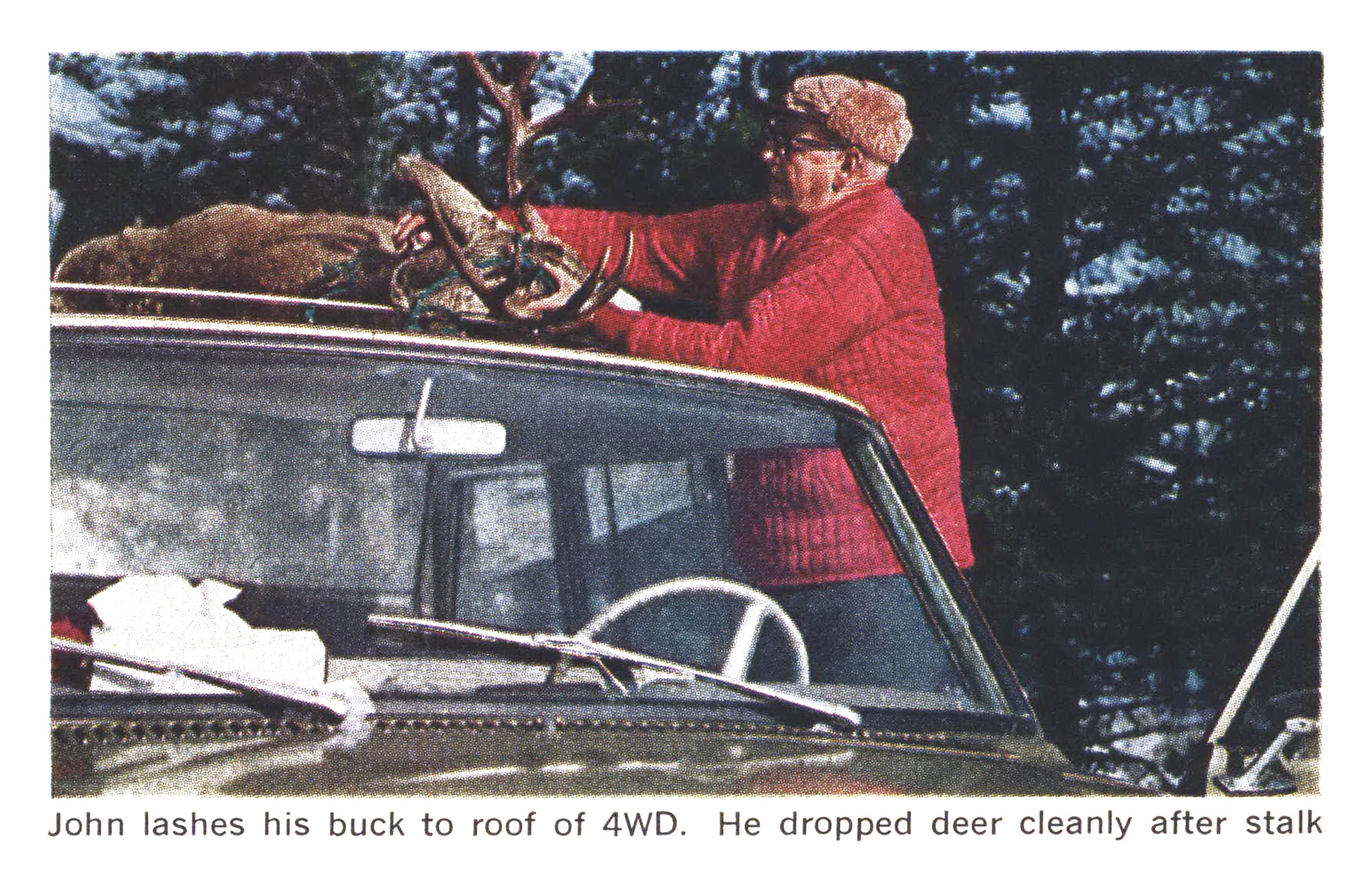
That left one day — the last day of the open season — for me to score.
Perhaps because of the intense cold in the bunkhouse the next morning, the alarm clock didn’t work and George had to awaken me.
“Look out the window,” he called, “and over toward Canyon Creek.”
There, in the crown of a dead spruce splintered long ago by lightning, sat the great gray owl. Probably another storm was on its way. As a result I wolfed my breakfast and, though I should have known better, got hooked on one of George’s cardboard pancakes.
George drove me close to the deer yard we had found, and from there I started out on foot. It was not a pleasant morning to be afield. Scattered snow flurries were being driven by a wild bitter wind, which was quickly obliterating deer tracks and which made cautious hunting — stopping often to scan the slopes — very difficult. I had to keep moving to keep warm. By mid-morning I had found very few fresh tracks and had seen no deer. I figured that all or at least most of the deer had already moved to even lower elevations ahead of the new storm. My chances looked very poor.
At noon I found some deadfalls on the edge of a dense spruce thicket that furnished a fairly good windbreak, and I sat down to munch a sandwich and a candy bar. The place also gave me a good view, between snow squalls, of distant, partly timbered mountainsides. Through binoculars I examined the wooded slopes, concentrating on those farthest away. As I glassed, I caught a slight movement much closer. Refocusing the glasses, I saw a forkhorn traveling slowly down the hill below me. He was less than 200 yards away, and though the crosswind wasn’t the best for shooting, it would not give me away.
I decided I would have to take the forkhorn or get nothing at all. Slowly I raised my rifle and found a rest for it on the deadfall. The shot would have been easy, but as I was about to squeeze off, a second forkhorn strolled out into the open. Then, right behind him, came a third buck.
At first I could see only the body of the third buck in my scope. But that was enough to tell me he was big. As I watched, the buck changed direction and was hidden from view again. Should I take a chance and play the waiting game, or shoot one of the forkhorns, still in sight?
The big buck resolved my indecision when he appeared again. This time I could see his splendid rack. My 7 mm. was sighted-in for 200 yards, so I held the crosshairs on the point of the shoulder, adjusted for windage, and squeezed. The deer lurched forward, out of view; I didn’t know whether I’d connected.
I hurried down the steep slope and waded through a deep drift in a gully. I found the buck lying dead against a tree trunk. He was a fine four-pointer and as heavy a mule deer as I’ve ever bagged.
That evening the great gray owl proved to be an accurate prophet. Another storm pounded the Rockies and plastered the high country with another layer of snow. But back at the ranch, I barely noticed it.
“The idea of the late hunt,” John said, “was sure a great one.”
“Amen,” George added.
A Montana nonresident big-game license costs $151. A deer-only license, which entitles the holder to one deer in a specified district, is $35, plus $1 for a conservation license. This year the general season on deer in Montana runs from October 22 to November 26. But prospective hunters should write the Montana Fish and Game Department, Helena, Montana 59601, for a copy of the detailed hunting regulations.
Read Next: I Promised to Take My Boys Rabbit Hunting Every Day of Christmas Break
The tag end of the season can be a good time for any big-game hunt. Almost everywhere in the West, the odds for connecting with a trophy head may be improved then, simply because the animals are not so high and are easier to find. Of course, there are unseasonably warm years when animals are not driven downward by deep snow until after the season ends. Remember too that late-season hunting can be very rugged — and occasionally impossible. It’s wise to know bad-weather and snow-survival techniques. But these are the chances a sportsman must take. And for my money, the rewards are worth the gamble.