
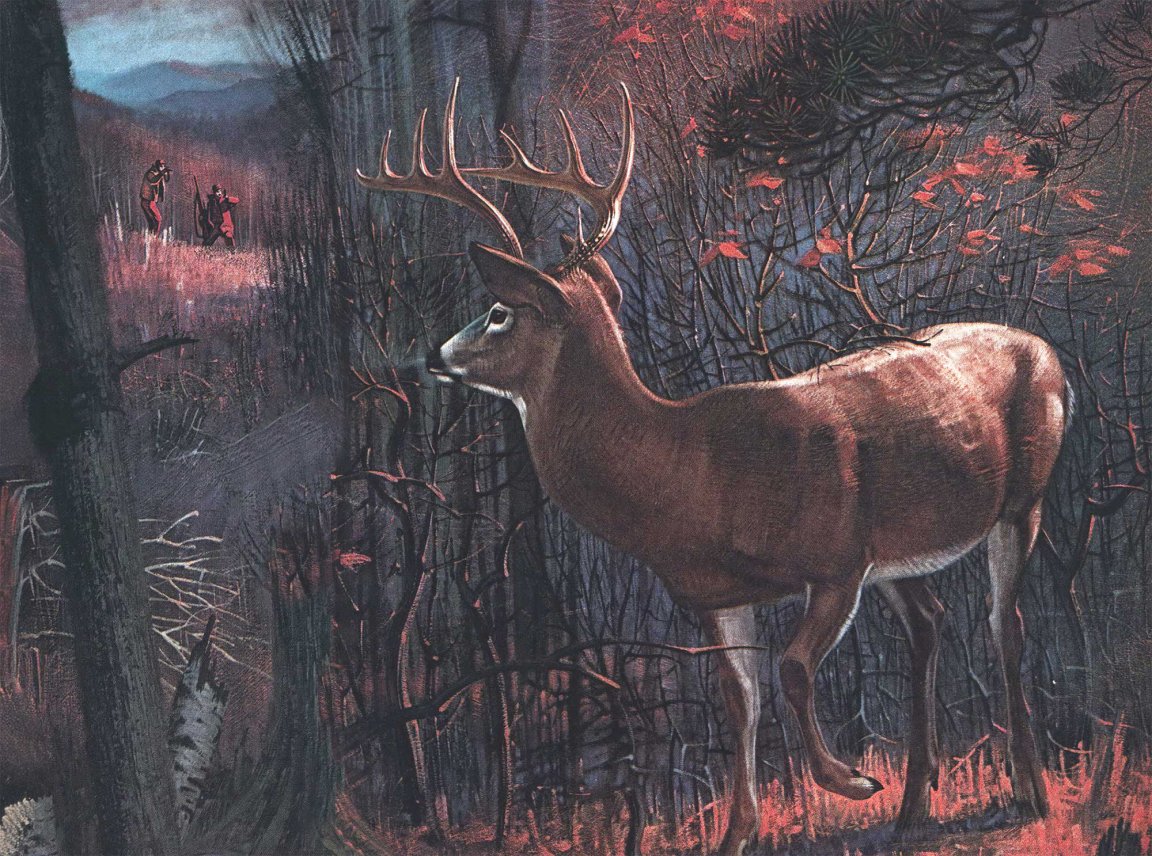
“Ho!” said Hugh, and he beat me to it by a split second. I had already puckered my lips to whistle. Hugh Fosburgh, who knows as much about whitetail deer as any man I know, had marked the little patch of sunlit runway as the place to stop the deer. The buck performed as though he had been trained in an obedience school. He stopped, keeping his nose to the trail for a long moment before he lifted his grizzled head and turned it slowly in our direction.
A moment before, he had been a shadowy shape moving through the brush; now he was a picturebook buck. Slanting rays of cold November sunlight picked out every point on his big rack and colored them a rich antique ivory.
I had first seen the buck 47 minutes before, and in those minutes the big deer had acted out a whole literature of whitetail lore.
When Hugh stopped the buck, I was standing near a hardwood log in a little staging area used by pulp cutters, and my thought was: It can’t be. It can’t be! I was not accustomed to that kind of hunter’s luck, and if the truth is to be told, I didn’t deserve it.
For a moment I thought I would kneel to shoot, but a little clump of beech brush wiped out that notion. I had raised the rifle with a kind of brainless calm, put the tapered post on his lung area, and squeezed the trigger. That trigger had always broken as cleanly as a glass swizzle stick, but now it resisted. I didn’t realize how excited I had become until I found myself jerking crazily on the trigger. A curtain of dark woods dropped into the sight picture, and the post was wavering and drifting. The safety was on!
In extenuation I must confess that in the previous 47 minutes I must have pressed the trigger-guard safety of the Remington 760 off and on at least seven times, and when I finally got a clear shot, I must have pressed it wrong.
“Well, you had cause to be nervous,” Hugh said later. “I know all about that kind of thing. Remember, I missed one at 50 yards, standing, just two days before you arrived.”
Hugh had told me that story at breakfast the day I got to camp. I had met him in a Manhattan restaurant the previous August. When he discovered that I was a fellow hunter, he said, “You must come up and hunt a few days at the camp.” I needed no urging, and after a nine-mile ride over a rutty dirt-and-gravel track from Minerva, New York, through deep forest, we emerged in a large clearing. I discovered I was visiting the 5,500-acre North Woods Club.
Hugh gave me a handsome printed map of that marvelous wilderness in the Adirondacks, and a legend told me that Winslow Homer, the American artist, had been a charter member and that all of his famous Adirondack paintings had been done there. There on the map were Mink Pond, Beaver Mountain, and the Outlet. Three Homer masterpieces—The Smudge Fire, The Young Huntsman, and The Blue Boat—loomed up in my mind’s eye.
The first day, we drove Hugh’s four-wheel-drive to where he had missed his buck. Two does and two fawns came out into full view, and a buck ran into the swamp behind a little rise of ground. I saw his antlers at the top of each bound, but that was all.
On the third day I hunted alone in the morning and had a fine experience with a big doe that walked daintily to within 12 yards of me as I sat on a fallen log above a marsh.
That afternoon Hugh said he would drive me over woods roads to give me a better look at the country. Then he would put me on stand to hunt until dark. We drove around to look at the views that Winslow Homer had painted, looked at two cubby-pen fisher sets (a trap arrangement involving a baited shelter arranged near a watercourse), visited the highest beaver dam I had ever seen, and drove a woods road onto a steep shoulder of Beaver Mountain. We got out and walked down toward some scraggly second-growth bottoms.
“I think we’ll just sit here for a while,” Hugh said. “That little flat is a good deer crossing.”
The sun had broken through the heavy overcast, and we were grateful for its quick warmth. We chatted in low tones. The dry humor sprinkled through Hugh’s low-voiced comments was diverting, but I did hear the sharp snap of a dry branch. It was the kind of noise a heavy animal makes.
“There’s a deer,” Hugh said perfunctorily, as if seeing a deer was a routine matter. I saw the deer at the same time, and it was no routine deer. I couldn’t see antlers, but even in the brush at about 140 yards, the animal’s body was burly and male. In two quick steps the deer vanished. It was exactly 2:45; I looked at my watch and recorded the time and many other things in my journal that night.
While the deer was out of sight, I swung my legs around the butt of the log so I could face in the right direction. I did it slowly, and I remember thinking: Hey, my right leg hasn’t started to tremble yet. My right knee always knocks all by itself whenever I see or hear game, especially deer.
The buck was puttering around like a cranky old bachelor doing chores. First one piece of brush moved, then another swayed. A whole mass of brush moved violently in a jerky but rhythmic fashion. I sweated out four to five minutes of this. I must have started to rise, for Hugh whispered, “Take it easy; he’ll show himself.”
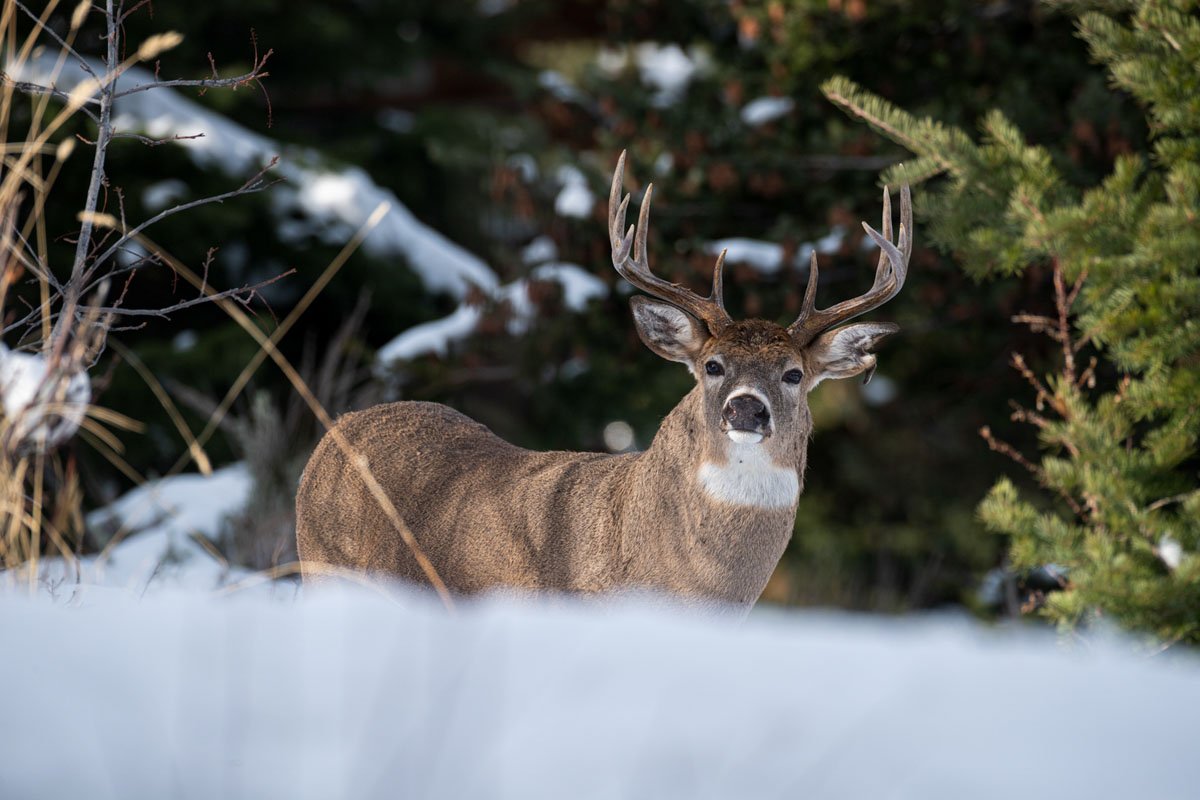
He did, but only for a second. I saw two legs, then two more from the knees down as he passed a low opening in the cover.
I strained my eyes to pick him out through the half-light that filtered down through the scattering of big and small pines, beech brush, and hazel bushes. He seemed to be moving to our left.
I pushed off the pumpgun’s safety and held on a narrow opening, but the buck turned before he reached it and angled toward us. He was still 100 yards away, but I was alarmed because Hugh and I were just high enough above the flat so that the rim would soon blot out the deer.
Time went by, and then Hugh jabbed a finger at a spot much farther to the left.
“It’s a buck—and a good one,” he said. Then I saw the head. The animal raised it just once and quickly lowered it, but the glimpse of the huge antlers was enough. My right knee began to perform.
All this while I was raising and lowering the rifle to squint through the 22X Weaver scope, but it was useless. Then the deer walked right out into the open and stood quite still. When I swung the rifle to cover him, I saw that “he” had no antlers—it was a big doe! The buck was still hidden. This quite unnerved me, and my second symptom of buck fever hit. My arms seemed suddenly drained of all strength and took on that sickly spaghettilike feeling. I managed to whisper, “My God, another one!” Just then the buck walked through the same narrow opening and was gone. Miraculously, he seemed to walk through the opening again, going in the same direction. I was flabbergasted but it was a second doe.
Our problem was complicated by a factor of three. There were three deer in the brushy tangle, and while I was trying to find the needle in the haystack, I must have had every view of a deer that a man can see in the woods—a patch of brown, a glimmer of white, a dark-gray fleeting shadow, a leg, a flicking ear, a backline moving with measured stride and then hurrying across an opening in the thick second growth. Here a motion, there a contour. It went on and on while the three deer went through their annual rutting ritual. The does were playing hard to get, but the buck was persistent, and I hoped against hope that one of the does would submit and that the buck would rise above the brush as he mounted her.
And it did happen. In a rising lunge, the buck’s body heaved above the cover as he mounted a doe. Head, antlers, bulging neck, and shoulders were all in sight. I could have fired had I not hesitated for a moment to appreciate the startling sight. As I rose, the doe evidently slid and skittered out from under the eager buck because he dropped from sight. I could hear the deer, but I could no longer see them. They were cracking twigs and rustling dry bushes. The swaying bushes showed that the buck was now chasing one or both does.
Once or twice Hugh pointed, but finally, even from his slightly different angle, he could see only the swaying bushes. The wind was blowing directly across our front, and I knew our scent would soon alarm the deer because they were angling to our left and coming much closer. Soon the animals would be under the bank that dropped off below us and directly downwind as well. Then there was silence—nothing. I felt the breeze on my right cheek.
Hugh rose slowly and motioned me forward to the edge of the dropoff. By pointing to himself and gesturing, he indicated that he would circle around to our left to see if he could move the deer back past me. I was doubtful; if he moved that way, I thought he would give them his wind. But I slipped toward the dropoff.
Hugh noiselessly edged to our left, and then one and another of the deer blew. The ragged exhale of breath of the second snort ended in an angry, screeching whistle. The deer were close under the dropoff, and they went out in wild confusion. One doe bounded off in the open to my right. Then I saw the flag of another deer going away. Buck or doe, I could not tell.
Hugh came back chagrined because he had spooked them.
“Did you see him?” he asked. I shook my head. “I thought not,” he whispered. “I think the buck ran off to our left. I think he’s still in there.”
Figuring nothing ventured, nothing gained, I gave the long, rasping gutteral Brrkkkk sound that rutting bucks sometimes make. Instantly the does blew almost in unison far up the little valley.
“They didn’t like what they heard,” Hugh said ruefully.
I waited two or three minutes and then made the Brrrrrkkkk sound again, hoping our lovesick quarry would think he had a rival nearby and challenge him. Hugh took a dim view of my calling.
“Let’s smoke another cigaret and then go back to the Jeep,” he told me. “Then I’ll drive you out on that woods road and put you on stand for the evening.”
It was 3:30 when we settled down again, chatting in low tones and listening to the slow yank, yank of a nuthatch. Far up the narrow part of the little valley where the two does had gone, I heard the long, drawn-out churr and bark of a short-tempered red squirrel. I glanced in that direction and caught a motion in the brush. It materialized into a deer walking precisely through the little glade where we had first seen the buck. It was another doe.
“There’s another,” Hugh said and pointed. Sauntering behind the first one was a second doe, and just behind her I saw a third deer—a six-point buck. He took a little hop or two, caught up with the doe, and, with his nose nudging her tail, followed her.
“The woods are full of deer,” I murmured.
Hugh said, “Get up on the road if you want that six-pointer.” He was saying it when a yearling buck came along behind the first buck. I had risen and was starting toward the woods road when the hatrack buck that had shaken me earlier stepped into the clearing behind the yearling. His head was down, but he was in full view, walking rapidly in the wake of the four deer ahead of him.
As he went out of the scope’s circle behind the cover, I swung ahead and held on another sunlit clearing. I was getting set to whistle to stop him when he came into view, but Hugh whispered, “I’ll stop him when he gets into the clearing.”
“Ho!” said Hugh, just as the buck came into full view at what I later determined was 140 yards. At the sound the buck stopped dead, and raised and turned his head toward us. I saw the ivory tips of his broad antlers, but he seemed a long way off. Curiously, I was suddenly calm. The post covered his lung area, and I began the squeeze—with the crazy results already described.
When I discovered that the safety was on, I lost my wits. My arms seemed weak again, and my right knee bounced wildly. The post wandered all over the deer after I finally pushed the safety off. When the rifle roared, I knew the hold was too far back.
The rifle went up in recoil, but then I saw the buck swinging away from me. I pumped another .30/06 cartridge into the 760, but the buck was gone.
“You hit him,” Hugh said matter-of-factly. I was amazed.
“If I did, I don’t know where. The post was all over him.” I felt a mounting disgust with myself. It had been 14 years and seven big-game animals since I had failed to kill with one hit.
“You hit him hard,” Hugh told me. “I saw him flinch. Didn’t you see how heavily he moved?”
Hugh was right. The deer had not gone off in big, high bounds. “Maybe—maybe,” I ventured.
“Oh, I’m sure of it,” Hugh remarked with an easy grin.
“We ought to wait a while and let him stiffen up,” I said. “He may be hit too far back—if he is hit. That was pretty poor shooting.”
“We’ll smoke another cigaret, and then see,” Hugh replied.
After 10 or 15 minutes Hugh said, “I’ll spot you from here. Go down and see what happened.” I thought it a bit early and decided to go only as far as the spot where the buck had stood when I’d fired.
When I got there I found nothing. I walked a bit farther in spite of myself and then went another five yards. I found a tuft of hair.
But it was pure white hair. My heart sank. “A belly shot, low down,” I said to myself.
I moved alongside the scuffed leaves, and then I saw a 10-inch patch of blood. But it didn’t look like lung blood. Too dark.
With a heavy heart I went back to where the deer had stood and waved Hugh toward me. When he walked up, I pointed out the hair, and Hugh picked it up.
“He’s hit too low, but there’s blood ahead,” I told him.
Hugh followed me to the first patch of blood, reached down in the little hollow where the blood was already coagulating, and picked up a piece of tissue.
“This is a piece of lung,” he said. And it did look like it and feel like it, but I was dubious.
“Let’s work ahead slowly,” Hugh suggested. We did, and found a few red drops here and there. One of us stood at the last drop until the other located the next. We were being very quiet. Twice we found puddles of blood. At one, we could see that the buck had lain down or had fallen down. I also noticed that the wounded buck had stirred up the leaves in a continuous disturbed line by dragging his feet.
We had come perhaps 150 yards on the blood trail when we heard a rustling and thrashing in front of us and to the left. Then it stopped. We listened but heard nothing more until a nuthatch suddenly gave its wild alarm cries.
We stopped beside a big boulder a few feet from a fallen yellow birch. In getting over it the buck had left a smudge of blood. We stood still and listened again.
“Let’s be patient,” Hugh said. “He didn’t get up, I’m sure, and with the vitality deer have during the rut, I’d just as soon he didn’t get on his feet again.”
I was more than agreeable. Frankly, I thought we had followed too far and too soon.
We sat in silence on the boulder for 10 more minutes and then worked ahead a few yards. Peering intently into the dark woods, I finally spotted him through my scope or thought I did.
Read Next: Forget Trail Cameras and Feeders. Try Hunting Wilderness Whitetails the Old Way
“He’s right there,” Hugh said with certainty. And the deer never moved. He was dead, probably from loss of blood.
The buck was a fine, big, swollen-necked nine-pointer, and Hugh held out a big hand for a congratulatory shake. The buck had been hit high in the ham, and the exit wound was in the flank on the other side. The paunch was broken. Certainly the tissue Hugh and I had taken for lung was not. But the buck was ours, and I realized again how important it is to follow up whenever you fire at game.
During the dressing out and the drag, I kept thinking of Winslow Homer’s painting, The Young Huntsman. I could see the youthful hunter and a big buck’s head partly rolled up in the deerskin. It was a strange feeling to live again a scene that had been painted many years before.
This story was originally published in the November 1976 issue of Outdoor Life. Angus Cameron, the author, was 68 years old at the time of publication. He was an editor for Alfred A. Knopf, the prestigious New York City book publisher.