
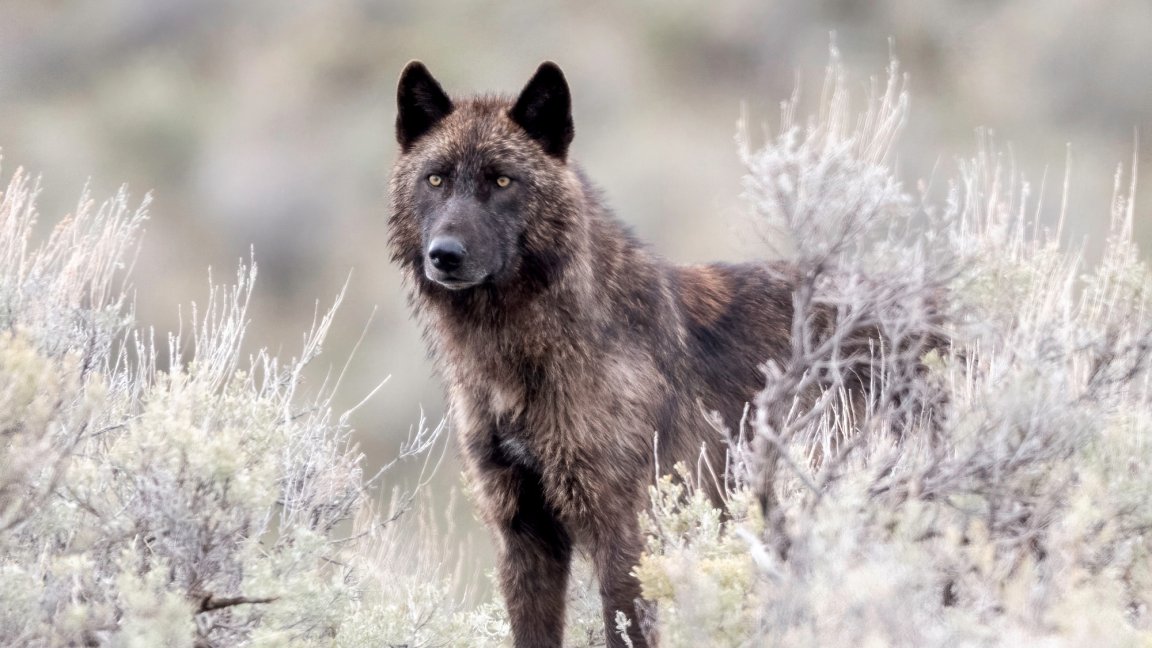
Opportunities to hunt wolves in Wyoming will likely diminish in 2026 due to a downturn in the state’s gray wolf population that’s being driven by a disease outbreak, according to WyoFile. Although a decision has not been finalized, Wyoming wildlife managers are planning to lower hunting quotas in the northwest corner of the state where wolves are managed as trophy game animals. This zone is known as the Wolf Trophy Game Management Area, and it’s where gray wolf populations just hit a 20-year low, according to the state’s 2025 Wolf Report.
In a recent draft proposal for the 2026 wolf hunting season, the Wyoming Game and Fish Department suggested an overall harvest cap of 22 wolves for the WTGMA, which covers around 15 percent of the state. That equates to a 50 percent reduction from the cap of 44 wolves set in 2025, and it would be the lowest harvest cap since 2012, when the Northern Rockies population of gray wolves was delisted and their management returned to the states.
These harvest caps, which WGFD also refers to as “mortality limits,” are similar to the harvest quotas established by wildlife managers for wolves and mountain lions in other western states. They are different from the actual number of licenses made available to hunters. WGFD typically issues thousands of wolf hunting tags in the WTGMA annually, with hunting success rates in the area falling around 3 percent most years. (The 2025 report shows that hunters in the WTGMA harvested 31 wolves last year — well under the harvest cap of 44 wolves.)
This also means that any changes to 2026 harvest caps will only affect hunting in the WTMGA, and not the remaining 85 percent of Wyoming, where wolves are classified as predators and can be hunted year-round with no limits and few regulations.
WGFD wolf biologist Ken Mills says the proposed regulation change is open to public comment until June 10. There will also be a series of public meetings in the coming weeks, and the Wyoming Game and Fish Commission is expected to make a final decision sometime in July.
Wyoming’s Wolf Decline
According to the 2025 Wolf Monitoring and Management Report, which included a population census, Wyoming’s statewide gray wolf population was at least 253 gray wolves and 14 breeding pairs at the end of last year. This is a marked decline from the 330 wolves and 24 breeding pairs counted in 2024, and wildlife biologists say the primary driver is an outbreak of canine distemper.
The contagious disease was detected last year in 64 percent of the gray wolves found in northwest Wyoming, which borders Yellowstone National Park and is where the WTGMA is located. By the end of 2025, wildlife biologists counted the area’s overall wolf population at 132, with 10 breeding pairs.
“It was the lowest number of wolves in 20 years,” Mills told WyoFile earlier this month.
As part of the delisting agreement with the U.S. Fish and Wildlife Service, which allowed WGFD to establish hunting seasons for gray wolves, state wildlife managers are to maintain a bare minimum of 10 breeding pairs statewide, as well as a minimum population of 100 wolves within the WTGMA.
Mills told WyoFile that the state has seen distemper outbreaks in the past, most recently in 2018, but that last year was the first time they saw “a population-level effect” as a result of the disease, which disproportionately affects wolf pups. Of the 87 new pups born in Wyoming last spring, fewer than 34 survived until the end of the year — a survival rate of around 37 percent.
Still, Wyoming’s overall wolf population remains well above the minimum recovery numbers established by federal wildlife managers in 2012. The 2025 Wolf Report notes that last year marked “the 24th consecutive year Wyoming has exceeded the numerical, distributional, and temporary recovery criteria” set by the USFWS.
Corrections: An earlier version of this article noted that 56 of the 87 pups born in Wyoming last spring survived until the end of the year. The actual survival number was between 31 and 34 pups. The previous version also incorrectly referred to population “estimates.” The wolf numbers and breeding pairs included in WGFD’s Wolf Report are based on a direct census, not a population estimate. This article was updated on Thursday, May 21, to include these corrections, as well as additional information from WGFD wolf biologist Ken Mills.