
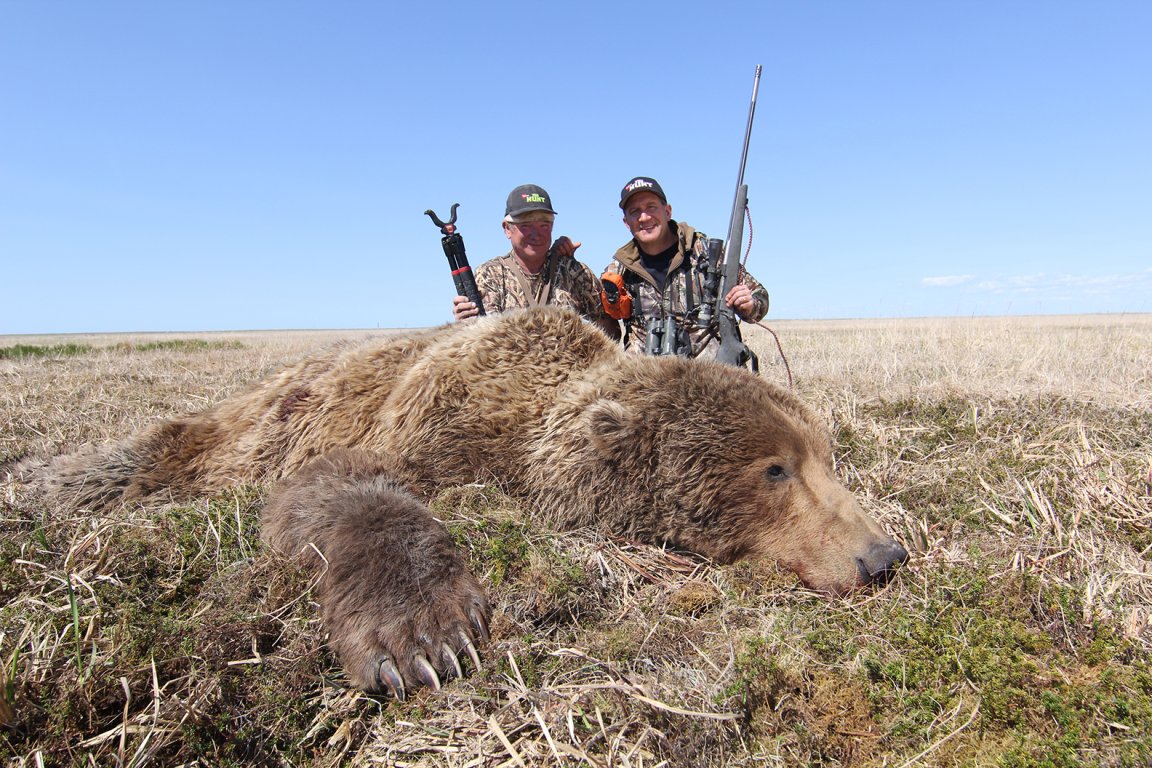
Like many hunters, I had childhood aspirations of one day pursuing big game around the world. I started a wish list early in life, and at the top was a male lion from Africa. In the number two spot was a 10-foot brown bear. After a couple of decades of hunting, I had taken the lion and I’d shot brown bears, but none that squared 10 feet. In May of 2014, that changed when I did a hunt along the Alaskan coast.
“You unpack, I’ll head up to the crows nest and start glassing,” directed Alaskan brown bear guide, Bruce Hallingstad, owner of Becharof Outfitters. I was barely nose deep into the first bag when Hallingstad hollered.
“Bear! Bear! Big bear!” Hallingstad shouted from the viewing platform. I could tell by the escalating tone of his usually calm voice it was a big bear. I was familiar with this cabin, and Hallingstad. I hunted there with him in the fall of 2009 and took a brown bear. Hallingstad is a personal friend. We’ve enjoyed a number of moose hunts and countless days fishing together in this part of Alaska.
The elevated viewing post in the two-story, dilapidated cabin served as our base camp for the next 10 days and offered the best vantage point for miles. Following a boat ride across Alaska’s Egegik Lagoon, south of King Salmon, we’d been in camp a total of seven minutes when the bear was spotted.
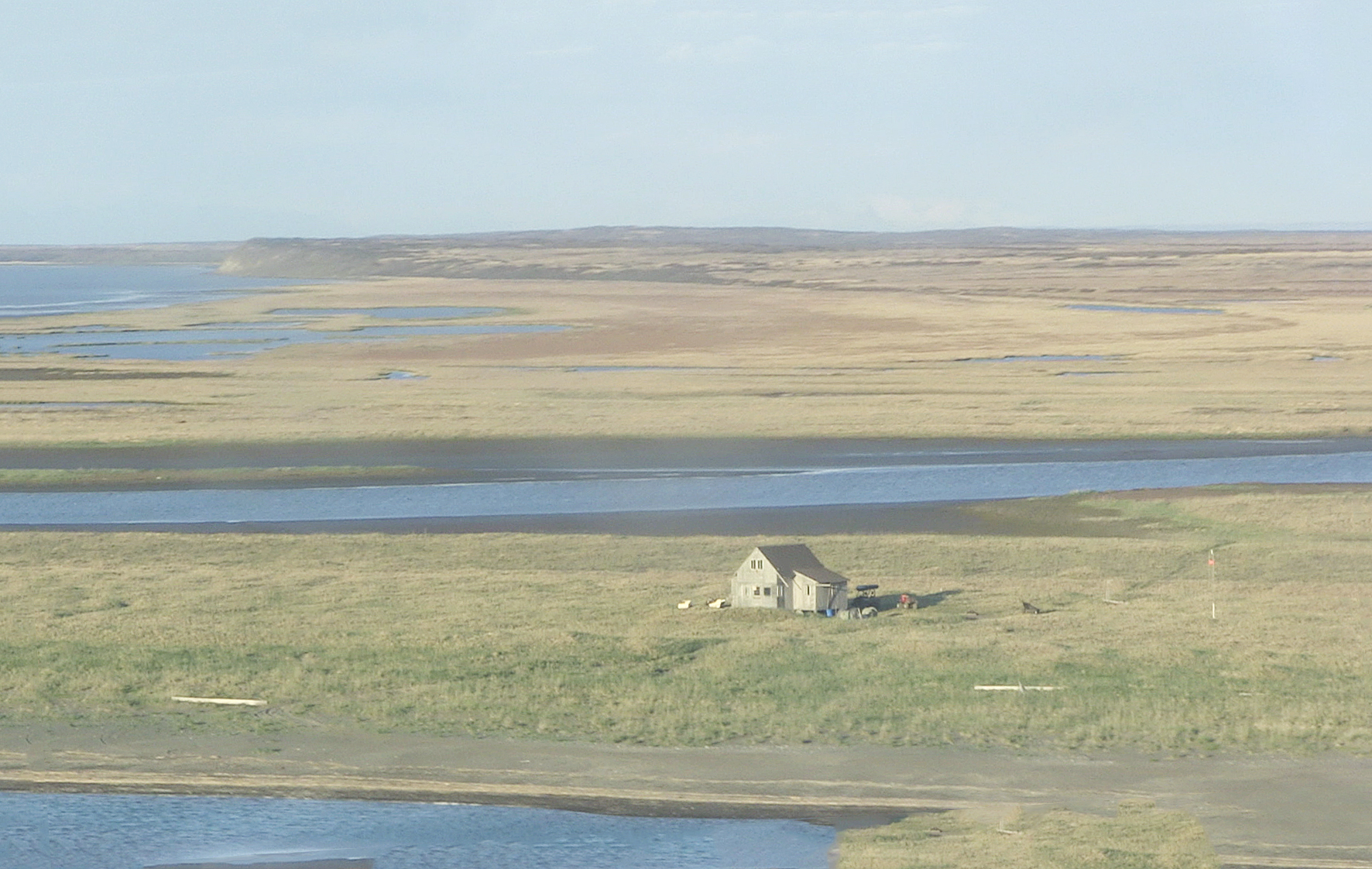
I rushed up the narrow stairway and peeked out the window that led to the crow’s nest that Hallingstad built specifically for spotting bears more than 20 years prior. I could see the bear with my naked eye from well over a mile away. Looking at the bruin through binoculars — even at that distance — it was easy to see he was a giant.
“That bear will go over 10-feet!” Hallingstad exclaimed, looking through his spotting scope. “Get your gear together, I’ll keep watching the bear. We need to make a move on this one.”
It was 10:00 a.m. I quickly layered up and slipped into breathable waders. Then I switched places with Hallingstad.
Gazing at the bear through a spotting scope for the first time was an image I’ll never forget. The massive, blocky head stood out most. Its hindquarters were massive, gyrating independently from the front half of its body with every step. The front legs were thick, from the shoulders all the way to the feet. It was a massive beast, roaming the tundra as it had done for decades.
In short order Hallingstad was ready and we were both sitting in the crow’s nest, closely watching the bear. “It’s getting dark about midnight, so we have plenty of time,” Hallingstad said, never lifting his eye from the spotter. I like hunting bears in the spring season in Alaska due to the long daylight hours. When I lived in Alaska’s high Arctic in the 1990s, spring bear hunting saw 24 hours of daylight. I loved it. I got used to running on little sleep — four hours sufficed.
For more than 30 minutes we watched the bear, anticipating where it might go. It was in no hurry, grazing on grass, slowly moving toward us. “I’ve seen a lot of bears travel this line over the years and I can just about promise you it’s going to that bench behind those willows,” Hallingstad pointed. “Let’s go.”
Two hours later Hallingstad and I were in position. But just as we prepared to slip our two man inflatable raft into a 60-foot wide creek and paddle across, the wind changed. “Let’s get out of here, now!” Hallingstad ordered. Though the bear was still over a mile away, it was the right call.
“I’ve seen this bear several times over the past few seasons and I guarantee you, if it smells us we’ll never see it again,” Hallingstad whispered. “It’s one of the smartest bears I’ve ever seen.”
A 10-foot bear is the Holy Grail of the brown bear world. One could hunt an entire lifetime and never see a bear that big, let alone kill one. I was aware of this high benchmark and during the years I lived in Alaska, I learned a lot about coastal brown bears. I learned where the biggest ones lived and how elusive they can be.
Though I’d lived in Alaska for nine years, I wasn’t a resident at the time of this hunt. (Non-residents are required to have a guide when hunting brown bear in Alaska.) Hallingstad has been guiding hunters for nearly 30 years and is renowned for taking big bears. At one time he had the number 5 and number 11 brown bears in the Boone & Crockett Records book. He has many 10-foot bears to his credit, and those all came from the area we were now hunting. Bears in this part of the upper Peninsula have exceptional genetics, abundant food sources, and they grow to their full potential.
Everything about old bears intrigues me. The bigger and older they get, the wiser they become, and the harder they are to outsmart. Combine that with the wide open spaces we were hunting, and getting within shooting range can be a daunting task.
Rather than wait on the tundra for the wind to change, we returned to the crow’s nest. Hallingstad didn’t want to risk the bear smelling us in the swirling winds. For the next several hours we alternated between spotting scopes and binoculars. We never took our eyes off where we’d last seen the bear.
“It’s bedded down and when it gets up, it’ll either start working along that ridge or pop out where we had to end our stalk,” Hallingstad said.
It was nearly 9:00 p.m. when Hallingstad started making dinner. We never took our eyes off the spot where the bear laid down. “I know what you’re thinking,” snarked Hallingstad. “But that bear is still there. It hasn’t moved. But it will.”
While Hallingstad cooked, I glassed. Tediously studying the same ground we’d been watching all day, I was jolted from a daze when the massive bear materialized in the spotting scope. Its slow gait and enormous size left no doubt that it was our bear, and it’d popped out on the end of the ridge just as Hallingstad predicted. Heatwaves rising from the yellow, grassy tundra contorted the bear’s profile. It seemed to float across the tundra. In a matter of seconds, the bear’s pace quickened.
Grabbing our gear, we wasted no time. Dinner could wait. Walking along a gravel beach on the ocean side of a rise in the tundra that paralleled the sea for miles, we kept out of sight and quickly covered ground. Hiking across a grassy flat, we reached the edge of a narrow stream cutting through the tundra. I ranged the bear at just over 700 yards. It was slowly walking in our direction. Crossing the creek in a tiny two-man raft we’d been pulling behind us, we closed to within 600 yards. The tide was out which allowed us to more efficiently navigate the soggy ground. Two hours of daylight remained.
An inch of dense, pasty, black mud covered the rocky creek bank we’d just reached. This made for slippery, challenging walking and it slowed our pace. Fortunately, we were out of sight from the bear. More importantly, the wind held perfect. We finally hit firm ground and picked up our pace. Crawling up to the edge of another creek bank, I parted the tall, yellow grass. The bear was just over 400 yards away. It had stopped. For the first time it felt like we had a chance.
Then the bear suddenly turned 90 degrees and kept walking. “If it goes out there we’ll never catch it,” Hallingstad urged, grabbing his pack and walking toward a big, muddy tidal flat. The chase was on, but I felt my dream slipping away. It’s nearly impossible to catch up with a walking bear. They cover ground incredibly fast. Such walking seems effortless for bears, but this is one of the hardest habitats a hunter will set foot in. I’ve hunted all over the world and rank Alaska’s wet tundra to be the toughest of all terrains to travel.
Read Next: I Fought Off a Brown Bear with My Fishing Rod, and Other Close Calls While Living in Remote Alaska
We eventually found firm footing along the edge of a creek. Soon we were 600 yards from the bear, then 500, then 400.
I was shooting a .338-378 Weatherby Magnum topped with a Trijicon 3×9 AccuPoint scope. The bullet was a 225-grain Barnes Triple Shock. I felt comfortable shooting out to 400 yards, but on a bear of this stature I hoped to cut that distance.
Then the bear laid down, broadside. That was the break we needed. We crawled to inside 300 yards. All the bear had to do was stand to clear of the tall grass in which it laid. Then I could shoot.
For 15 minutes Hallingstad and I sat, motionless. I was solid in the tripod shooting sticks and could hear my heart beating in my throat. My knuckles were white from gripping the gun too firmly. I worked to regain my composure. Finally, the bear rolled on its side, pivoted on its hind quarters, lethargically gained its footing, and started walking directly away. It never cleared the tall grass. There was no shot.
When the bear sauntered into a creek bottom, dipping out of sight, we ran as fast as we could to close some distance. I set up the shooting sticks on the edge of a deep cut bank right as the massive bear sauntered into view. Quartering away, it was the perfect shot angle but the grass was too thick to thread a bullet through. The bear was only 295 yards away, the closest we’d been.
“As soon as it turns, I’ll shoot,” I whispered to Hallingstad. Tracking each lumbering step of the giant bear through the scope, its stride finally slowed. At 325 yards the mammoth beast sat on its hind end, facing straight away. It had no idea we were near.
When the rifle roared, the bear dropped. I fired two more insurance shots, though they weren’t needed. Brown bears are massive and unfathomably strong. I didn’t want to leave anything to chance. Not now.
More than 12 hours after spotting the bear, our hunt was over. Approaching the beast was one of the most surreal moments in my lifetime of big game hunting. Words can’t convey how I felt. It was the first time I’d ever walked up to an animal and thought, “If I never pull the trigger again, so be it.”
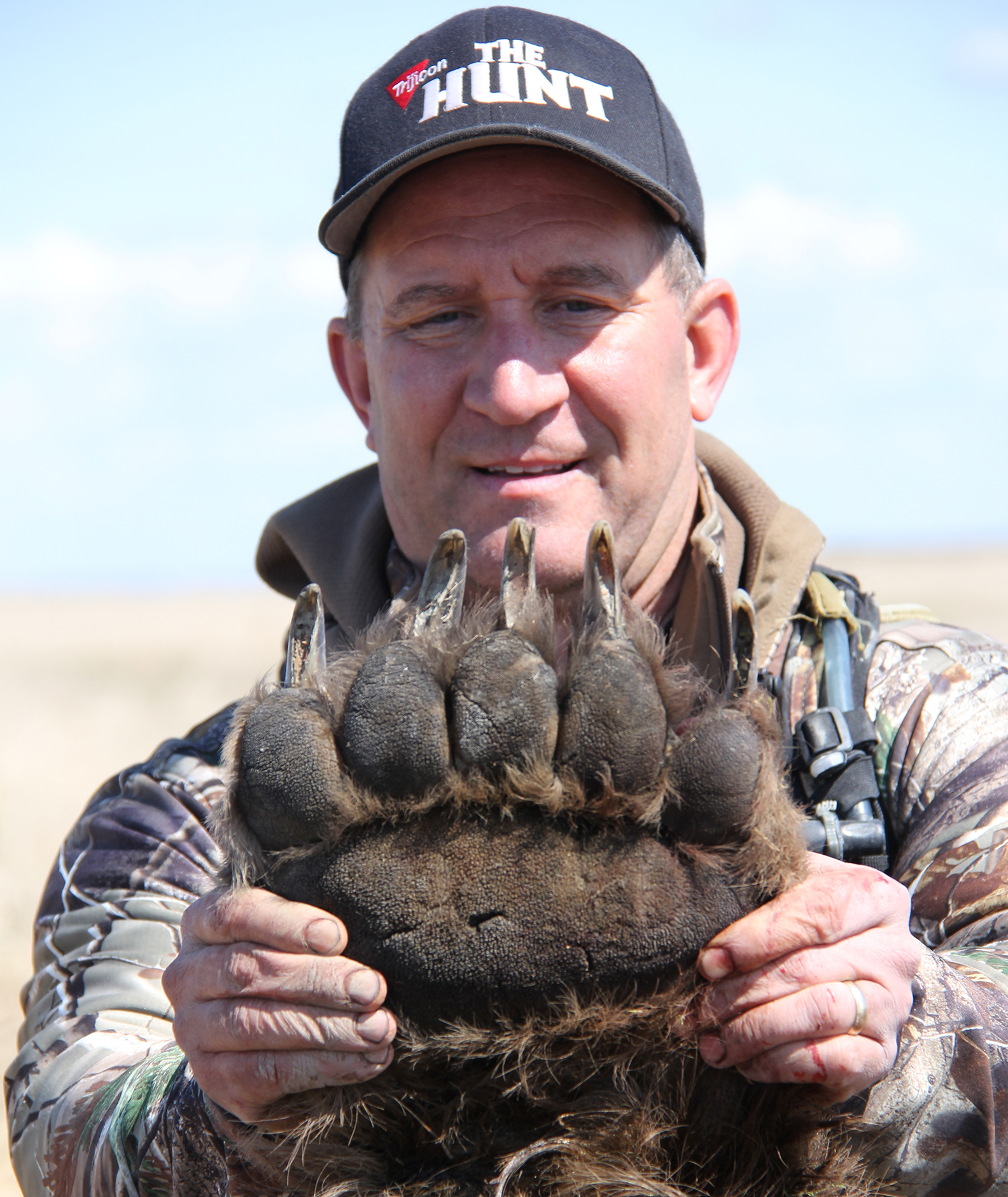
When Hallingstad reached down and lifted the bear’s upper lip to inspect the teeth, we gasped. The incisors were worn flush to the gum line. Every canine was busted. Each molar was cracked and abscessed. The claws were worn down to short, thick daggers. The old bear’s skin hung loose, covering what was less than 1,000 pounds of flesh. In its prime, this boar would have tipped the scales to 1,500 pounds.
“I’m finally touching this beast,” Hallingstad said, running his battle scarred fingers through the long, golden hair atop its shoulders. He shared some encounters he’d had with this bear over the past two years. Twice he had a world-renowned bowhunter inside 20 yards but the man was shaking so violently he couldn’t draw his bow on the bear. Once Hallingstad had a rifle hunter within 150 yards of the bear. He pressured Hallingstad into promising the bear was over 10 feet, as he said had to get one bigger than the one his friend shot two days prior.
“If that bear’s not over 10 feet you’re not getting a tip,” the man told Hallingstad.
So, Hallingstad stood up and walked directly at the bear, and of course it ran off.
“Sorry, it didn’t hold still for me to measure it,” Hallingstad barked at the hunter as he kept walking by. The man was undeserving of such an animal, Hallingstad said. He had them leaving camp the following morning. Seven months later, I shot the bear.
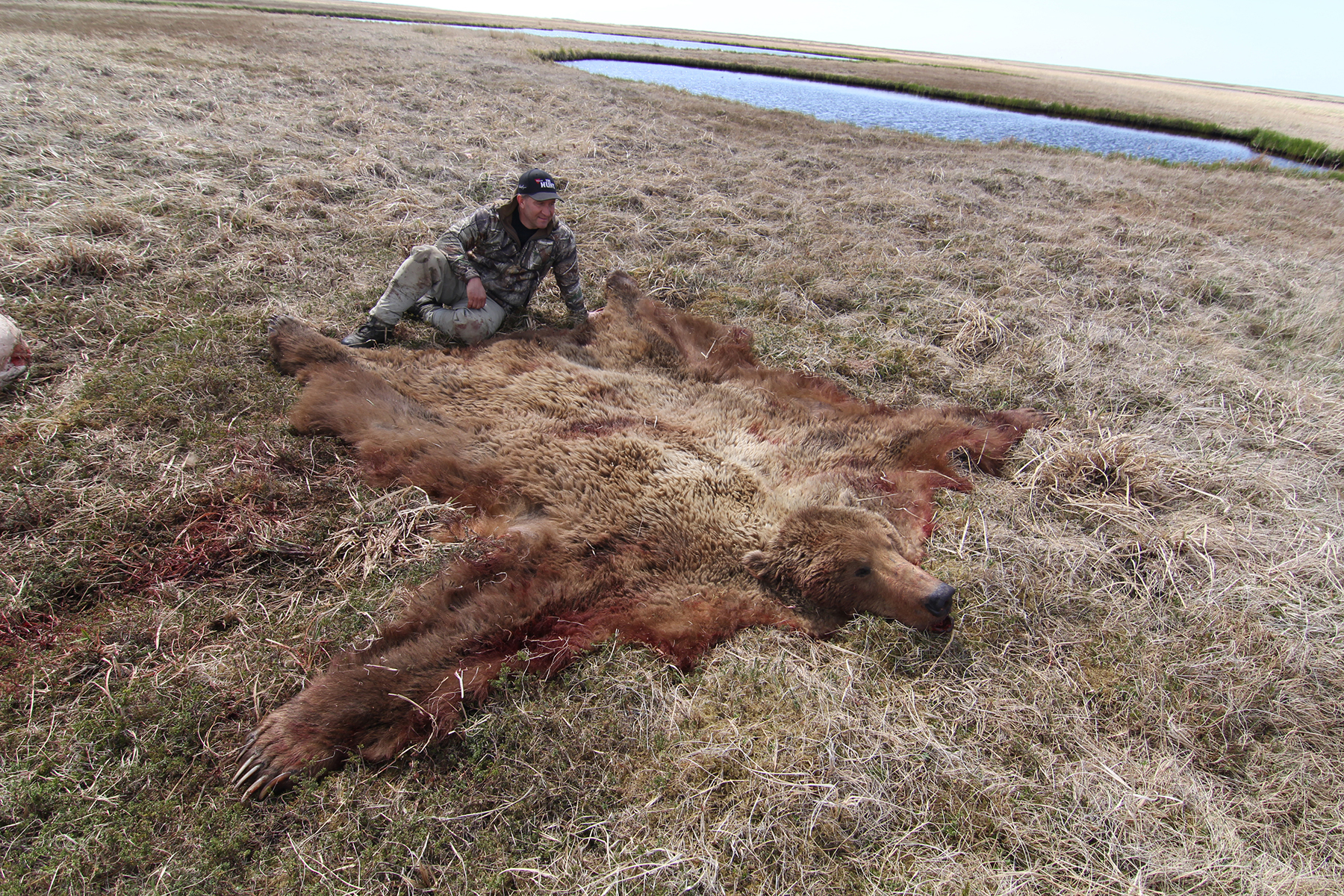
The hide of this magnificent bear squared a mind-boggling 10’9”. Once dried, the skull measured an incredible 29 5/16”, making it the third largest bear Hallingstad had ever guided for. The old boar was aged at 23 years, the second oldest ever recorded on Alaska’s Upper Peninsula at the time.
I’ve been fortunate to experience many spectacular hunts in my life. This was the best, ever. And not only because of the once-in-a-lifetime stature of the bear, but the fact I enjoyed the journey with a special man who’s devoted his life to pursuing big bears. The fact that it all happened in one of my favorite places in all of Alaska only added to an experience I’ll never forget.
Editor’s Note: For signed copies of Scott Haugen’s best selling book, Hunting The Alaskan High Arctic, visit scotthaugen.com. Follow his adventures on Instagram and Facebook.