
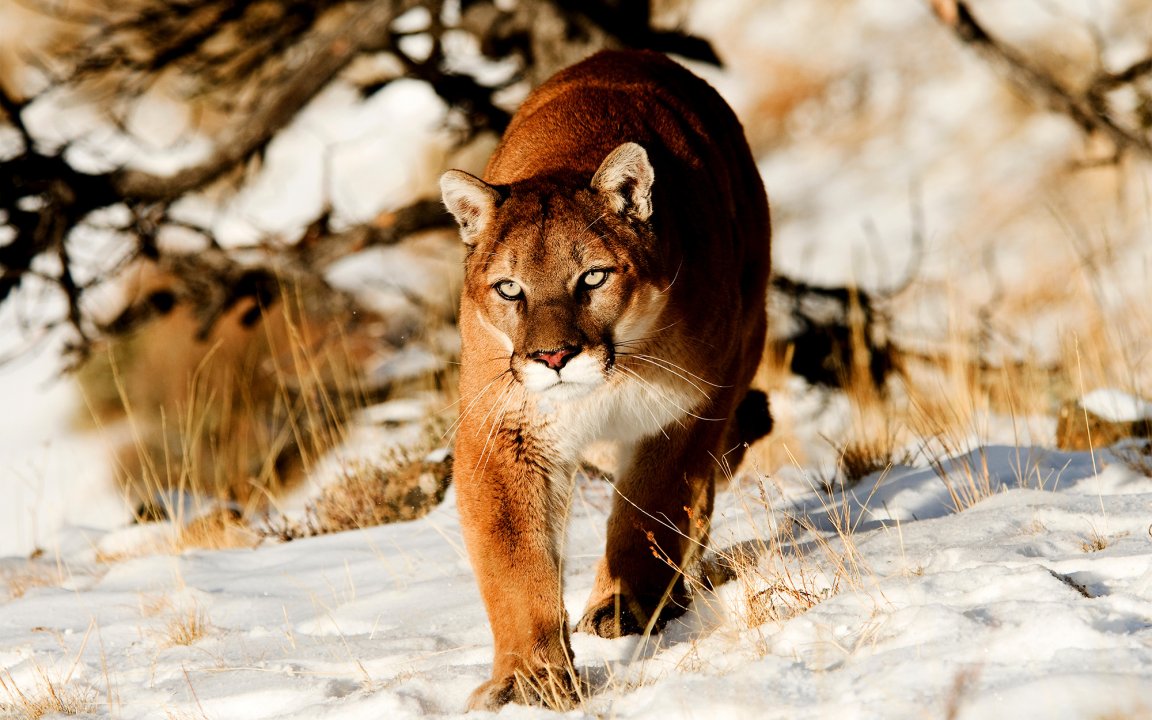
Update: Colorado officials have confirmed that the hiker found dead on a trail in Larimer County on New Year’s Day was killed in a mountain lion attack. Necropsies performed by Colorado Parks and Wildlife indicated that both of the lions euthanized after the suspected attack were subadults from the same family group, according to an updated news release issued by CPW Monday afternoon. Officials noted that the 12-month-old male and the 12-month-old female were both in good body condition, and that human DNA was found on all four paws of the male lion.
The Larimer County Coroner’s Office also released autopsy results Monday, according to the Denver Gazette, and it identified the deceased victim as Kristen Marie Kovatch, 46, of Fort Collins. The autopsy results showed the official cause-of-death as asphyxia due to external neck compression, which is consistent with a mountain lion attack.
Jan. 5, 5:19 p.m. EST: A suspected fatal mountain lion attack that left one hiker dead in northern Colorado on New Year’s Day has raised plenty of unanswered questions, according to Colorado Parks and Wildlife. If confirmed, the attack would be the first time a cougar has killed a human in the state since 1999.
CPW says it is still investigating the incident, which took place on the Crosier Mountain Trail near Glen Haven in Larimer County. The agency explained in a news release that it received a report from some other hikers on the trail around 12:15 p.m. on Thursday. The hikers had seen a mountain lion near an adult woman who was lying on the ground. They scared the lion away by throwing rocks at it and attended to the woman, but did not find a pulse.
“All signs point to [the victim] just being on a hike on Crosier Mountain Trail,” CPW public information officer Kara Van Hoose tells Outdoor Life.
Van Hoose confirmed that wildlife officials responded to the incident that same afternoon and saw three mountain lions in the area. With the help of houndsmen and their dogs, they tracked and killed two lions but were unable to find a third. (It is CPW’s policy to euthanize wildlife believed to be involved in attacks on humans.) That search effort has concluded, she says, and the trail was reopened to the public Sunday, according to the U.S. Forest Service.
Van Hoose says necropsies are being done on the two euthanized lions, and that those results should help with some of the unanswered questions. She has said in other recent interviews that the victim’s wounds “were consistent with a mountain lion attack.”
Read Next: Coloradans Vote Down a Big Cat Hunting Ban in a Massive Win for Hunters and Conservationists
Authorities will also know more based on a full autopsy of the victim, which was scheduled for Monday, according to the Larimer County Coroner’s Office. The office said in an email that this information “will be released in the next couple of days” after the victim’s next-of-kin is notified.
As authorities await those results, however, local reports of other recent cougar encounters have added to the surrounding scrutiny.
Larimer County a Hot Spot for Mountain Lions
A 32-year-old Glen Haven local told the Associated Press Friday that he encountered an aggressive mountain lion while running on the Crosier Mountain Trail on Nov. 11. After photographing and then throwing his phone at the approaching cougar, Gary Messina said he finally drove the cat away by hitting it over the head with a stick.
“I had to fight it off because it was basically trying to maul me,” Messina said. “I was scared for my life and I wasn’t able to escape. I tried backing up and it would try to lunge at me.”
Van Hoose says CPW received Messina’s report about the aggressive mountain lion on Nov. 12. They investigated that same day, and after not finding any mountain lions, they put up temporary signs on the trail warning the public of mountain lion activity.
“There is also permanent signage that is there year-round warning of mountain lions and how to handle conflicts,” she says. “I know a lot is being made of these signs, and whether they were up or not. But yes, there were signs in the area.”
Van Hoose says there was another, similar incident on Nov. 30, when two hikers were confronted by mountain lions on the same trail.
“They noticed one lion in front of them, and then found a lion behind them,” Van Hoose says, referring to the report the agency received from the two hikers on Dec. 1. “They successfully hazed the lions by yelling and throwing rocks.”
Neither incident can be considered an “attack,” she says, as no physical contact was made. But there have been several verified cougar attacks on dogs in recent months, either in Glen Haven or neighboring Estes Park, which is the eastern gateway to Rocky Mountain National Park.
On Oct. 28, a man was walking his dog off leash on McGraw Ranch Road in Estes Park when a lion attacked and killed it. The following day, a woman had her dog taken by a mountain lion while walking it off leash on West Creek Road in Glen Haven. And more recently, on Dec. 23, a man living off County Road 43 in Glen Haven found a mountain lion attacking his dog in his yard. The man shot and killed the mountain lion, which Van Hoose says was an adult male.
Van Hoose says that based on the preliminary necropsy results, the adult male killed in Glen Haven in December “is not a parent” to the two lions that were euthanized after the suspected attack on New Year’s Day. She says that based on reports from past years, it’s not uncommon for CPW to receive this many cougar-related calls during the winter months — especially in a place like Larimer County.
Read Next: Shed Hunter Killed in California Mountain Lion Attack Died Protecting His Brother
“We have a very high density of lions living in Larimer and Boulder Counties,” Van Hoose says. “It’s really good mountain lion habitat, and when you have lions that are able to find continuous food sources, they’re going to stick around … So, it’s not that uncommon to have all these calls in the same area.”
CPW officials say the last fatal mountain lion attack to occur in Colorado took place in 1999. The victim, a 3-year-old boy, disappeared while hiking with his family on a USFS trail in Larimer County. Although there is still some debate around how the boy died, it was officially described as a probable mountain lion attack, according to the Coloradoan. Another fatal cougar attack occurred in 1997 in Colorado and involved a 10-year-old boy. The child was hiking with his family on the west side of Rocky Mountain National Park in Grand County.