
This story, “One-Man Bear War,” appeared in the February 1954 issue of Outdoor Life.
Ab Carter, Texas frontiersman, heard a piercing squeal of pain coming from the edge of the little clearing around his log cabin. He grabbed his muzzle-loader and ran toward it.
What he saw wasn’t nice to look at. A big hog was fleeing toward him, most of the hide peeled off its back, and a bear was charging after it to finish the job.
The hog raced past Carter and the bear stopped momentarily at sight of the man. Then charged him.
This was something new to Ab Carter, a man who had hunted bears since he was a boy. Black bears are not ordinarily aggressive, dangerous animals where man is concerned. By and large they turn and run from men.
But this one didn’t believe in that procedure. He wasn’t going to let a mere man interrupt a meal he had worked so hard to get.
The steady-eyed frontiersman waited. When you have only one shot in your gun, you must make it count. At almost point-blank range Carter fired. The big ball broke the bear’s neck and it dropped in its tracks.
Carter stood for a long time, leaning on his muzzle-loader, thinking about bears and about people. He thought of John Reisinger, who lived not far to the east. Reisinger was a cripple as the result of just such a fracas as this. A bear had attacked one of his hogs and was gorging on pork without even going through the routine of killing the hog. Reisinger had no gun, but he rushed the bear anyway — bears always ran from human beings.
That bear didn’t. It charged him. Reisinger shinnied up a sweet-gum sapling so small the bear couldn’t climb it. That was fine as far as it went. But it didn’t go quite far enough. Close to the sapling was a big, dead sycamore stump. As if planning with human intelligence, the bear climbed that and reached toward the sapling, banging and shaking it and swiping at Reisinger’s legs.
Reisinger had to do something, so he began kicking the bear about the head. Suddenly the beast grabbed his foot and clamped down, splintering bones like dry toast. In doing so, the animal lost its grip and slid down the stump. Back up it climbed, the killer urge burning as fiercely as ever.
Reisinger kicked feebly with the other foot when the bear began banging the sapling again; kicking seemed the only thing to do. It wasn’t a good idea — the bear caught that foot too and crushed it. Again the animal lost its grip on the stump and slid down — and again it came climbing back, determined to finish the job.
What Reisinger did then was one of those “impossible” frontier deeds. Hanging onto the sapling with one hand and his knees, as his crushed feet dangled uselessly, Reisinger got out his hunting knife, leaned far over, and stabbed at the bear.
It was an amazingly lucky thrust. He hit the sticking spot, that place in the neck where a hunter sticks a deer to bleed it. The bear slid down the stump and wobbled unsteadily away, blood spurting from its neck. When it was gone, Reisinger eased down the sapling and crawled home. He lived, but he was a cripple for life.
People talked about that incident a lot, and most said the same thing — that that particular bear was crazy. Bears didn’t do things like that, people said. But as Ab Carter stood looking at the bear that had done something like that, he began thinking.
These bears were turning killers in a big way, because man had furnished them something to kill — hogs, or piney-woods rooters, as they were called.
At first the bears killed a weanling pig now and then. Soon they were killing shoats, then grown hogs. They became such efficient killers they were driving the hogs out of the woods, holding them close to the cabins. Then the bears began raiding the yards.
And now . . . Leaning on his rifle that day, Ab Carter made a resolution. He would kill the bears out of his part of the country — get rid of them entirely. Thus began a one-man bear war, one of the strangest in the history of man’s relationships with any species of wildlife.
That was way back in 1883, and the setting was even stranger than the events, for Ab Carter lived in that weird, mysterious, swampy forest known as the Big Thicket. It’s located in east Texas, not far from the Louisiana border. The Big Thicket, not the mountains of west Texas, is the last frontier of the Lone Star state. Many thousands of scattered acres of this great jungle have never been trod by man. So forbidding is it that officers of the law seldom make any effort to dig into it after a criminal who has sought refuge there. They don’t have to — they know the criminal will eventually come out voluntarily. A bank robber recently did just that.
The men of the Thicket are tough. They don’t have the colorful clothes and gear of the west-Texas cowhand but these quiet descendants of the men who took Texas away from the Indians and Mexicans are killers and sons of killers. Hunting and trapping have been their way of life for more than 100 years.
Ab Carter was as tough as any of the pioneers. He had to be to endure what he went through after he swore to kill off the bears. Carter knew what he faced. It would be man-killing work. These bears wouldn’t tree except on rare occasions; they’d just take off, digging deeper and deeper into the jungles and swamps, ripping through haw and dwarf palmetto and canebrakes and sloughs, stopping now and then to whale hell out of a dog or two, then running when the man scent came. And Carter realized the truth of something men of the woods have pointed out for years — a bear that learns to kill unnatural prey may also turn to attacking man.
In the fall of 1884 the tough little frontiersman took to the woods in earnest. He had a pack of well-trained dogs headed by Watch and Range, two strike dogs. They were redbone-Airedale crosses, good on the trail and good at fighting.
Carter had to wait until fall because of the insufferable heat of the Thicket in summer. But since the bears didn’t hibernate in winter, there was a full season ahead. With the first cool weather, Carter began nailing up bear hides one by one.
He accepted the possibility he might have to fight for his life someday. A man pushing his way through jungle growth or canebrakes to within 30 or even 20 feet of a bear and firing his only bullet at it must live with one idea in mind — someday the shot won’t do the work. Then the time for the knife would be at hand. And the knife Carter carried was long and razor-sharp.
It was quite a while before he had to use it. The first season he wore himself and his dogs down to skin, bone, and muscle, killing bears, and his one shot never failed him.
But finally, the second season, it happened. Just before dawn one cold January day Carter found himself in the same position that John Reisinger had been in — fighting for his life. And, during the early part of the fight, Carter couldn’t even use his knife.
The dogs had followed the trail of an old she-bear for hours, finally bringing her to bay for the last time in a thick canebrake. Carter pushed his way through the cane until he could see the big form of the bear clearly outlined in the moonlight, not more than 30 feet away.
He raised his gun, aimed carefully to be sure he wouldn’t hit a dog, and fired. The bear sagged to the ground and the dogs rushed in to rip and tear the thick hide.
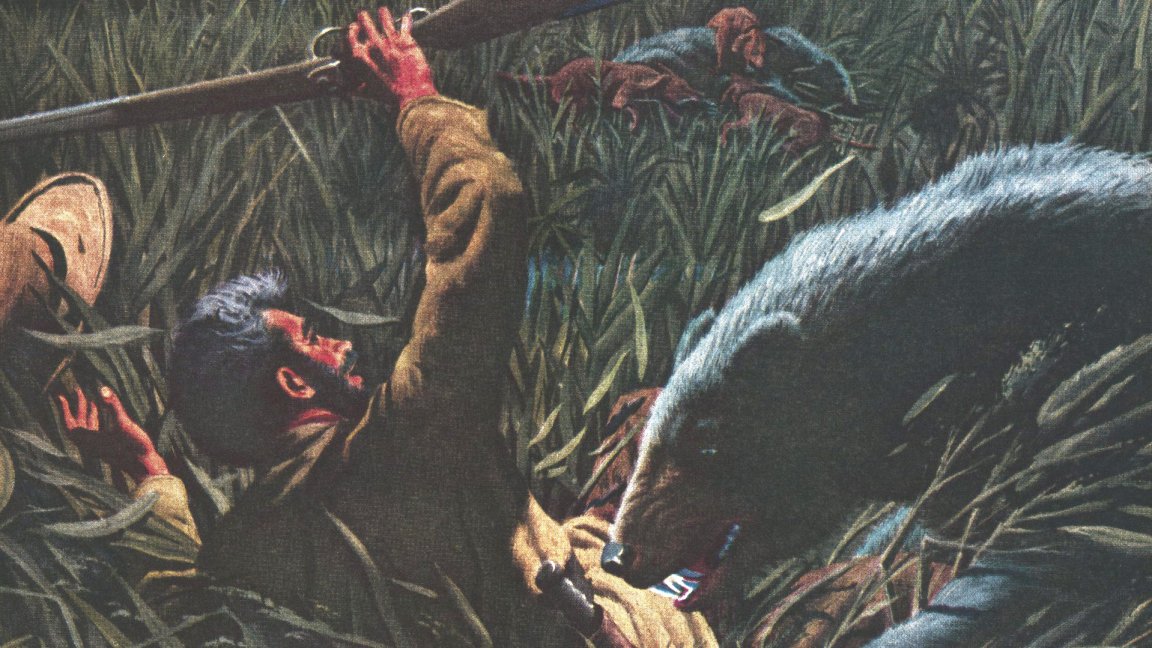
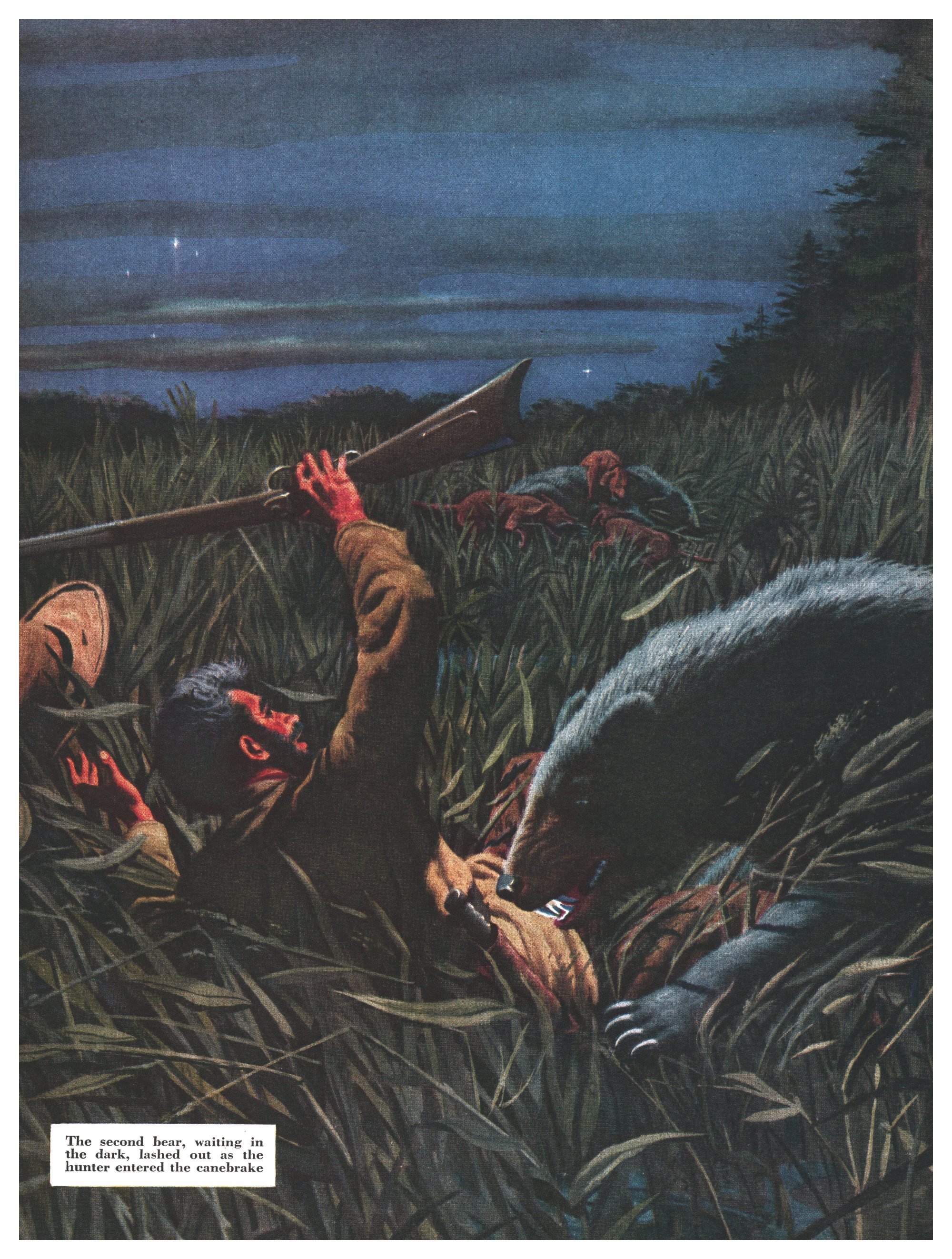
Carter took a step toward the bear. Then he was knocked almost unconscious by a big, black object that crashed violently out of the canebrake at him. It was another bear, a male.
Almost in the face of gunfire, and with a pack of hounds only 30 feet away, that bear had charged.
As Carter fell the bear snapped at him. The big teeth closed on his trousers and a piece of his hip. The trousers ripped apart, and the skin tore out. Then the bear began to maul the man.
Carter fell face downward and the cane pushed his felt hat back onto his neck. He fell in heavy cane, so heavy it more or less cushioned him, protecting him in a way.
As the frontier hunter fell he did two things — shouted the names of his faithful strike dogs, Watch and Range, and grabbed for his knife.
There’s no way of knowing how many hunters have been saved by their dogs from dangerous animals. But Carter’s dogs were savagely ripping at the dying female. Would they come to his call?
The bear that knocked him down began mauling him instead of trying to bite. And the cane saved Carter momentarily. The bear was slamming cane down on him, and it partly cushioned the blows. Carter, protecting his throat with his left arm, was trying to work his right arm around so he could use his knife. He did manage a couple of feeble thrusts, but they didn’t even get through the bear’s tough hide.
The bear grabbed him then, and Carter decided to turn quickly and start stabbing. He knew the enraged creature was getting ready to bite him.
At that instant Watch and Range, working like a team, grabbed the bear, all their Airedale fighting fury aroused by the cry of help from their master. The bruin released Carter and turned to fight this new enemy. It moved forward a bit and swung furiously with its big paws, but when more dogs closed in it started backing up — squarely into Carter.
Reaching out quickly, Carter literally hugged the beast, and as his right arm wrapped around the big body, he plunged the long, keen blade into the chest, reaching for the bear’s heart. With a gurgling cry the bear lunged forward again, scattering the dogs as it crashed into the cane across the little opening.
The dogs followed, but the chase was short. The bear turned to fight them, made a few feeble passes, then sagged down. The knife blade had penetrated its heart.
Carter wasn’t hurt badly. But he sat down and had a long talk with his dogs, telling them just how much he appreciated what they had done.
Carter hunted on. Night after night, day after day, he and his hounds were out. Sometimes his brother Tom went along. Mostly Carter hunted alone. How many bears did he kill? During the two seasons when the feud was at its peak, from the fall of 1884 to the spring of 1886, Carter, with the occasional help of his brother, killed 182 bears. That included cubs, and there were plenty of cubs in that fine breeding area.
Related: I Killed the Last Grizzly in Colorado by Stabbing It with an Arrow
Carter broke the back of the bear population in his part of the Big Thicket, an area of 400 square miles, in those two seasons. After that he never killed more than 17 in a season, and in 1900 he put away his gun and quit hunting them. The job was done. The woods were safe for the piney-woods rooters.
It would make good reading to say that Carter killed the last bear in his part of the Thicket. But he didn’t. Judge Hightower (a man who endeared himself forever to Texans when he adjourned court in the midst of a trial to go get a bear spotted by a juror) killed the last one in 1912.
It wasn’t long before hunters finished the job of killing the bears in other parts of the Thicket. Just as the grizzly had to go if cattle were to survive in the West, so the black bear had to go if the piney-woods hogs were to roam at will, as they now do.
There are no bears left in the Big Thicket. The job Ab Carter started in the fall of 1884 has been finished.