
This story, “I Watched a Forest Die,” appeared in the June 1962 issue of Outdoor Life. This editor’s note accompanied the original story: Eric Collier, long-time OUTDOOR LIFE writer and author of Three Against the Wilderness, knows intimately the area of British Columbia’s 1961 Nech fire. In his book, he told of his family’s fight to survive in this same area, and years ago he shot his first bull moose near the site of Diederick’s fire lookout. Collier spotted the outbreak of the fire from 14 miles away, and visited Diederick during its advance. A two-part story resulted. This is the first part.
When I left the lookout at 0530 hours Saturday, August 12, last year to make my customary early morning check on the forests through my Hudson binoculars, the 7 x 50 glasses gave no clue that today was going to be much unlike yesterday, or the day before, or for that matter the same date a month ago.
Though the air I breathed was heavily tainted with smoke, my lungs made little complaint. They’d been inhaling much of the same brand of fumid air at the same hour each morning since mid-May, When I picked up the mike of my FM radio, called Alec Whitecross, British Columbia Forest Service dispatcher at Alexis Creek, 20 miles southwest of me as the crow flies, and reported a thin column of smoke seeping out of the timber on a bearing of south-64° west of my perch on Mt. Alex Graham.
The fire, I told Whitecross after carefully plotting its position on my grid map, was approximately 65
air miles from my lookout, burning in the vicinity of Chilko Lake, a 50-mile-long body of glacial-fed water hemmed in by snow-covered, unexplored mountain peaks to south, east, and west, and to the north by the boundless fir, jackpine, and spruce forests of the Chilcotin plateau.
“Not much merchantable timber in that bit of no man’s Iand,” Whitecross came back dryly after digesting the report. “Scrub pine and runted spruce mostly.” Which was Alec’s own way of letting me know the B. C. Forest Service would probably let this fire rip without trying to suppress it in any way.
“How about game?” I asked, for to my way of thinking there’s considerably more to a forest than just its merchantable timber.
“I was back there a couple of years ago,” Whitecross said. “Herds of moose and deer summer there, and it’s also good bear country, both black and grizzly.”
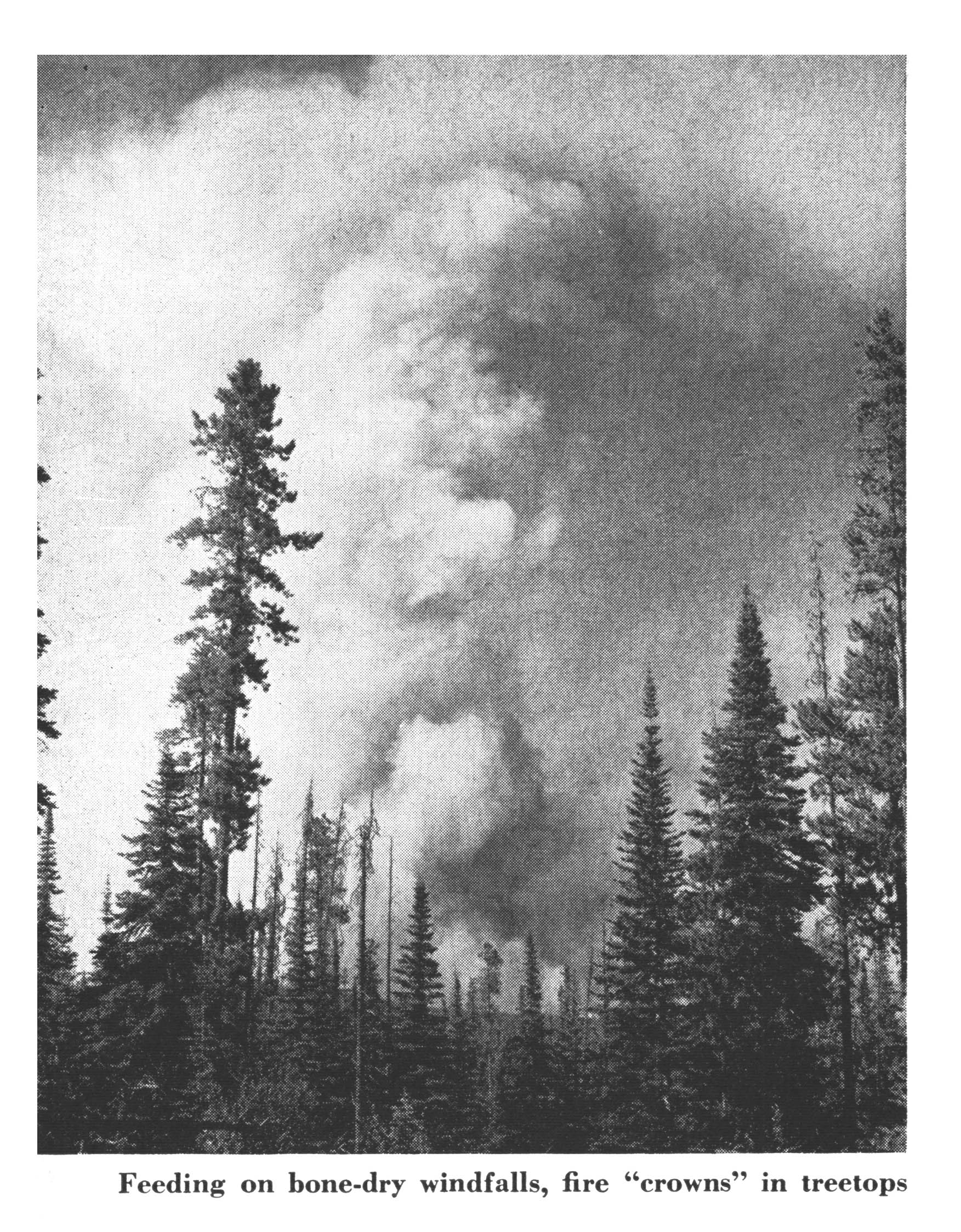
Even as I listened to his voice, the column of smoke turned from a light, dirty gray to a dense, pitchy texture which denotes a timber fire that has leaped from the underbrush and crowned in the treetops.
Watching the smoke boil up into the overhead, I intoned into the mike, “Too bad about the game.”
“Too darned bad,” Whitecross agreed. Like myself, Whitecross was only a part-time employe of B. C. Department of Lands and Forests, working for the government from May until October as dispatcher at Alexis Creek, a tiny settlement straddling the main road in the central Chilcotin section of the province. Alexis Creek felt itself to be of quite some importance in the affairs of the nation, because not only was it the site of district forestry headquarters, as well as Department of Public Works, but also boasted a resident magistrate and a detachment of Royal Canadian Mounted Police. Each fall, when fire season was over, Whitecross outfitted and guided big-game hunters, and thus had slightly more than average knowledge of the harm occasioned any wildlife when fire invades its home.
That conversation between the forestry lookout on Mt. Alex Graham and the ranger station at Alexis Creek had taken place at 1105 hours, May 17. Now, three months later, the Chilko Lake fire had already cremated some 60,000 acres of timber and was still burning out of control. Rain and nothing but rain could douse those flames: not a mere thundershower, but a continuous 72-hour downpour. But not a drop of rain had fallen on the wind-scuffed dirt and jagged-rock outcrop atop Mt. Alex Graham since late April, nor elsewhere in the Chilcotin. The land was parched, and the forests so tinder dry that the conifers were shedding their needles. According to old-time trappers and ranchers, this summer of 1961 was the hottest and driest in living memory.
The smoke had descended overnight, confining my early morning visibility to a scant two miles. In two or three hours, with the sun clear of the treetops and maybe a breath of wind ruffling the air, the smoke would likely lift, and a few square yards of flaming brush several miles distant would be something I could tell Whitecross about. That’s what Department of Lands and Forests was paying me for: to squat in my glass-walled, 14 x 14-foot eagle’s perch on the tip of Mt. Alex Graham (named after one of the earlier settlers in the district) 5,740 feet above sea level, about 20 air miles from another human, and spend my every minute of complete and partial daylight watching the horizons and all that lies between me and them for that initial wisp of smoke which denotes the birth of a forest fire.
Where fire is concerned, I’m the trouble-shooter of the wilderness. My job is to spot the smoke within seconds of its showing above the trees. Then I sight through the lens of my fire finder, take a bearing on the fire, and plot its location and distance away from me on my map. That done, I pick up the mike and pass the information on to Whitecross. From here on out, Mel Monteith, district forest ranger in charge of the ranger station at Alexis Creek, has this newborn bundle of trouble square in his lap. He can either conscript men and equipment and attempt to bulldoze a road through umpteen miles of trackless forest in an effort to reach the fire and push guards around it, or he can throw up his hands and let the fire rip.
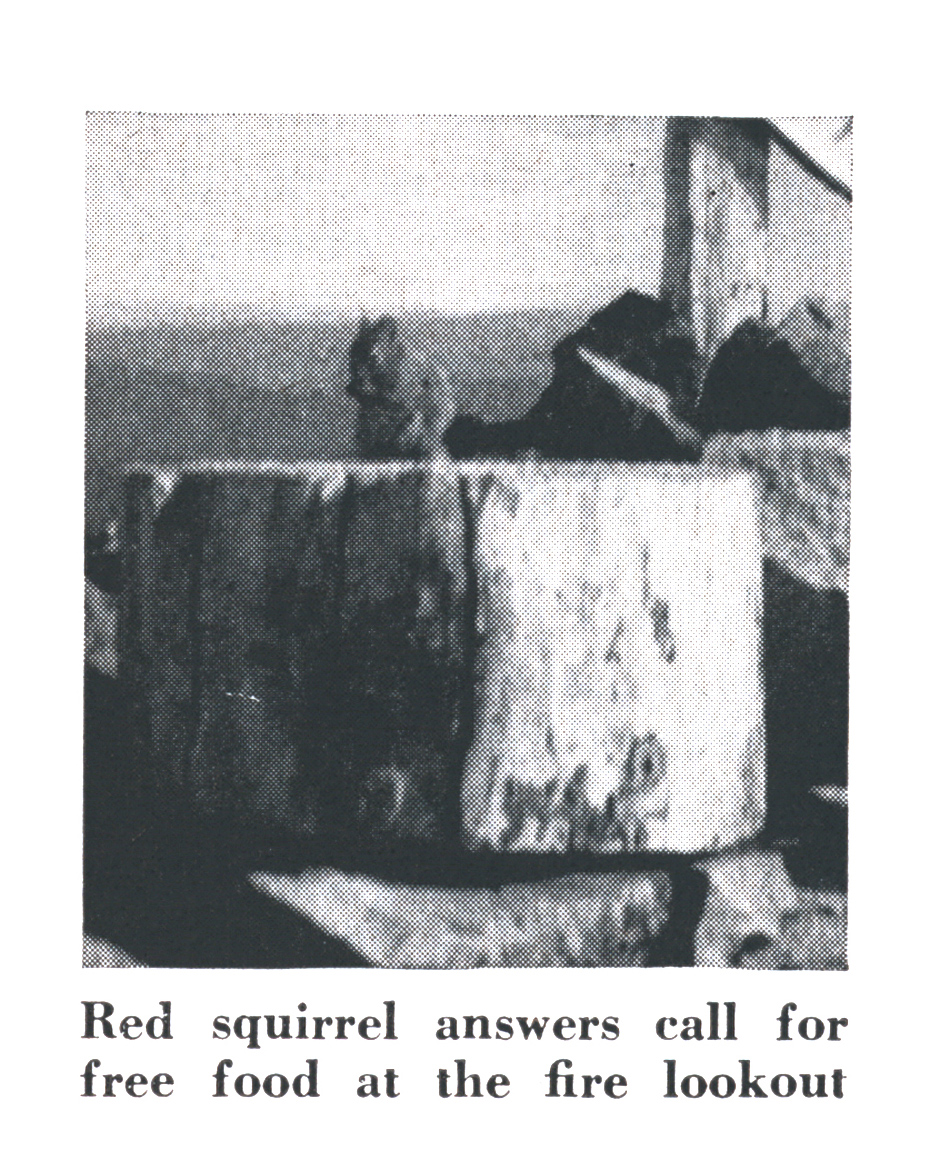
Before going back inside to see about breakfast, I let out a shrill whistle that promptly brought eight chipmunks to the scene, beelining for the three blocks of wood outside the lookout door. Then four whisky jacks parachuted from the nearest pine trees, two of them perching on my left shoulder, the other two on my head. And a second or two later, a pack of red squirrels, tails arched, scampered across the few yards of open ground between the lookout and the forest. Maybe the squirrels knew they had no business being in such an exposed spot, vulnerable to hawk or owl.
Or maybe they didn’t let that bother them so long as I was at hand to see that no such pest harmed them. Anyway, they came in answer to the summons.
I brushed the whisky jacks away and went inside and cut two slices of bread into small cubes. Then, stepping out again, I scattered the cubes on the blocks of wood, and stood back and watched as chipmunk, whisky jack, and red squirrel squabbled over who got the lion’s share of the breakfast. The chipmunks, little fellows though they were, never went away hungry.
After feeding the guests, I went back in and cooked and ate my own breakfast. Then I switched the radio on and jotted down the morning weather report: “High, 95; low, 72; wind, west, 15 m.p.h. with gusts up to 25; precipitation, nil. Outlook for Sunday, no change.”
In other words, it was going to be another scorching day, when a flaming match tossed carelessly into the underbrush would likely spark a flare-up before hitting ground, and the butt end of a cigarette flipped out of some car window would ignite the dust it lit in. Even the concave bottom of a beer or soft-drink bottle tossed away years ago becomes a potential fire threat when the thermometer reads 110 above in the sun, and the chap giving out with the morning weather report says, “Wind west, 15, with gusts to 25.”
Any first-grader knows that if you hold a magnifying glass under a hot summer’s sun, the glass will focus the sun’s rays into a hotspot that quickly burns a hole through tissue paper. Far too few grownups seem aware that when weather conditions get right, and the earth is thirsty for moisture 10 feet down from the grass roots, and the underbrush so dehydrated that a foraging mink pattering through it sounds like a mountain lion trailing a deer, an inch or two of glass from a broken bottle can touch off a forest fire that will likely burn from now until snow flies. Such a fire will cremate maybe half a million acres of spruce, pine, and fir before its final spark winks out and before an old cow moose or doe deer ventures cautiously back through the ashes, perhaps in search of a calf or fawn that was at her heels when the fire first crowned in the treetops, but was nowhere in sight when she herself reached cooler pasture.
The morning was half gone before the smoke lifted enough for me to take a reading through my binoculars on any sizable portion of the 1,500 square miles of heavily timbered mountains. hillocks, and valleys that the B. C. Forest Service expects the lookout man on Mt. Alex Graham to watch. As the weather man had predicted, a stiff breeze was now coming in from the west, pushing the smoke eastward across the trench of the Fraser River and into the Horsefly country 70 miles farther east. Since there were already several forest fires rampaging in that neighborhood, this seemed like carrying coals to Newcastle or snow to the North Pole. But the smoke wasn’t to blame; it went where the wind bade it.
I could now get a somewhat murky reading on how things were going in the Chezacut country, a sizable chunk of splendid game territory about 50 miles west of me. A real pot-boiler was belching its smoke into the sky over in that locality. I’d first reported the outbreak to Whitecross three weeks ago, but since there was very little merchantable timber in that area that any fire could hurt, Ranger Monteith didn’t consider that its stand of lodgepole pine and runted spruce trees and its several thousand acres of buck-brush meadow, muskeg, and similar big-game pasture worth the money it would cost to save them from the conflagration. Not when 439 similar fires were burning elsewhere in the province and when 3,725 men, 237 bulldozers, and 51 aircraft were already on the government payroll battling the flames of the fires preying on timber classified as merchantable.
From the Chezacut country, my glasses traveled slowly southward across the horizon, barely pausing as the pluming smoke from the Chilko Lake fire came into focus. Any fire becomes an impersonal thing to the lookout man when it is 60-odd miles away and has been burning out of control for two or three months.
Slightly east the glasses swung now, making a half-minute halt on a 15-mile front of fire razing the forests slightly northwest of Mt. Verdan, a flat-topped, rocky promontory 50 air miles due south of Mt. Alex Graham. That inferno too was burning out of control. But it was in an area so remote that even if it did contain any merchantable timber, probably no logging outfit could get back in there to cut it in the next several years. Only the odd big-game outfitter and his American or other nonresident hunter were likely to have business in that piece of country. In which case the outfitter could shovel out his own fire guard around the cabin he’d thrown up to house his tents, saddles, hobbles, and similar paraphernalia; or he could let the cabin and stuff it contained go up in smoke, since after the fire there’d be nothing, not even a snowshoe rabbit or fool hen, left there for anyone to hunt.
The glasses were moving eastward from Mt. Verdan toward the Fraser River when they suddenly made an abrupt change in course. I quickly adjusted their focus, then held them steady on a timbered hogback south-west of the lookout. It required but 30 seconds for me to decide this was no spiral of dust I saw billowing above the treetops. I went inside, lay the binoculars on the table, moved over to the radio and said into the mike, “Alexis Creek, Alexis Creek. Mt. Alex Graham calling. Are you reading me, Alexis Creek?”
And after a second or two came Whitecross’ voice: “Alex Graham, Alexis Creek. Am reading you clearly. Over.”
I looked at the clock, then went on: “At 1135 hours, leaning at an angle of 40°, color dark, density thick, above coniferous timber, moving west to east, smoke!”
“Have you a grid reference on this one yet?” asked Whitecross, meaning had I plotted the location of the fire on my map.
“This one is so close,” I answered, “there’s hardly need for any grid reference. That smoke isn’t a yard farther than four miles from me.” But in order to conform with routine procedure, I placed my grid over the map, studied it a moment, then sang into the mike, “Grid reference is 93-B, 3-E, A-6, 13-16.”
Following a brief silence, I heard Whitecross suck in his breath and ex-pel it in a muffled, “Well I’ll be darned!” Then I heard him chuckle. “Ho-ho! This one’s a bit personal isn’t it, Rod?”
“If the wind switches around to north, it becomes too darned personal,” I agreed sourly. “In this heat and fanned by a south wind. it could be clean to the top of this mountain by nightfall.”
“What’s wrong with cremation anyway?” quipped Whitecross.
“Nothing at all if you die of old age first,” I shot back. At 48 years old, I figured I still had some years coming to me.
Then, getting back to business, Whitecross acknowledged, “Roger, roger. Will notify Ranger Monteith and see what he can do for you. Stand by for further instructions.” And with that he went off the air.
This, I knew, was one fire the forestry service would have to fight, and not merely because it presented a serious threat to the lookout station in which I was living. About 12 miles due south of the outbreak was the main Chilcotin road, running east and west. At this time of year. it bore a heavy traffic load — tourists heading to or from a score or more of trout lakes and streams in the upper Chilcotin and heavy trucks hauling loads of freshly cut lumber from the sawmills in the Chilcotin Valley to the planer mills at Williams Lake, a small town in the Cariboo district of B. C. east of the Fraser River. And on either side of the road. paralleling it westward for 40 miles, were the fenced hayfields of cattle ranchers. where hundreds of tons of cured hay lay ready for stacking. North of the road for a depth of four miles was a virgin belt of Douglas fir timber which, if very little had so far been cut for lumber, had certainly been cruised by forestry officials and might at any moment be thrown open to stumpage bids by any sawmill operators interested in its cutting.
Wind west. 15 m.p.h. with gusts up to 25! But if the wind changed, as sometimes wind will do, and blew 15 m.p.h. from the north, the flames within a very short time could be into that belt of fir timber and advancing toward the road. District Ranger Monteith would never allow that to happen if he could possibly gather men and machines to fight the fire, as — by act of Parliament itself — he was fully authorized to do. In British Columbia, any able-bodied man can be pressed into fire-fighting service, if he “won’t go willingly, and any piece of machinery from bulldozer down to power saw can be conscripted, no matter who owns it.
Half an hour after my reporting the fire, Whitecross’ voice cut in on my thoughts: “Mt. Alex Graham, Mt. Alex Graham. Alexis Creek calling. Am I coming in O.K.? How on that Rod?”
“Clear as cowbells down in the pasture,” I affirmed.
“Monteith has rounded up a 10-man suppression crew that is leaving right now in a couple of forestry jeeps,” Whitecross informed me. “They’re equipped with a portable radio with call name Suppression Crew Portable, and barring unforseen troubles you should be hearing from them at scene of fire within 60 minutes give or take. How’s the situation up there now?”
“Fire is spreading rapidly,” I told him. “Wind’s picked up a bit now, west 20 about. Fire now covers roughly 50 acres, continues to move west to east, has reached mature lodgepole pine, and is crowning in the treetops. Quite some show of fireworks from up here, that it is.” I broke off for a few seconds, had another thought, then went back on the air with, “Has this baby been officially christened yet?” Fires that must be fought are named in an alphabetical order.
“The infant now has a name,” chuckled Whitecross. “Will proceed to spell it out for you.” And in phonetic alphabet, he slowly spelled. “N for November, E as in echo, C for Charlie, and H for hotel. For the official records then, this one is labeled the Nech fire.” And as an afterthought he added, “Although I’ve an idea we will hear nastier names than that before we’re through with it.”
“You will if it reaches the top of this mountain,” I grumbled.
With an ear tuned to the radio in readiness to make contact with the suppression crew when it arrived, I stared thoughtfully at the grid map, wondering what had touched off this one. Usually, lightning is the only natural agency to spark a major forest fire. When a thunderstorm passes over an area accompanied by rapid lightning strikes, the fire spotter in a lookout station estimates that it could be three or more days before he first observes the small, intermittent puffs of smoke which tell of a strike that has ignited good fuel. But there’d been no such intermittent smoke puffs from the timber in which Nech fire now shot smoke hundreds of feet into the overhead, since there had been no thunderstorms in the area so far all year.
Related: I Was Just Struck by Lightning While Catfishing. Here’s What It Felt Like
The fire then, as I saw the matter, had been started by human agency, just as perhaps 90 percent of all forest fires owe their origin to human negligence and carelessness. The flaming match or smoldering butt end of a cigarette tossed casually away, the campfire vacated while a few live coals still burn unobserved, or even the ubiquitous bottle left behind at the picnic site — it is human folly like this that is responsible for so many forest fires which annually lay waste so much of North America’s forested area.
“Mt. Alex Graham, Suppression Crew Portable calling.” At 1430 hours my radio broke silence to announce the arrival of this 10-man crew at the fire. So I answered, “Suppression Crew Portable. Mt. Alex Graham. Where are you now, Suppression Crew?”
“We left our vehicles on your road and proceeded to fire on foot. Will you please relay to Alexis Creek that bulldozers — repeat, bulldozers — will be needed to bring this one under control.” And in slightly less official jargon, the foreman of the suppression crew went off the air with, “This baby is hotter than the guts of a volcano, Rod.”
I relayed the message to Whitecross, then stepped outside and fixed my glasses on the fire. I could see flames leaping from treetop to treetop like a ship’s pennants unfurling at the yard-arms. Something forcibly reminded me of my guests which came out of the woods at my whistle to get their daily hand-outs of grub. “God Almighty!” I murmured. “What chance has a squirrel, rabbit, or anything else got trapped in a furnace like that!”
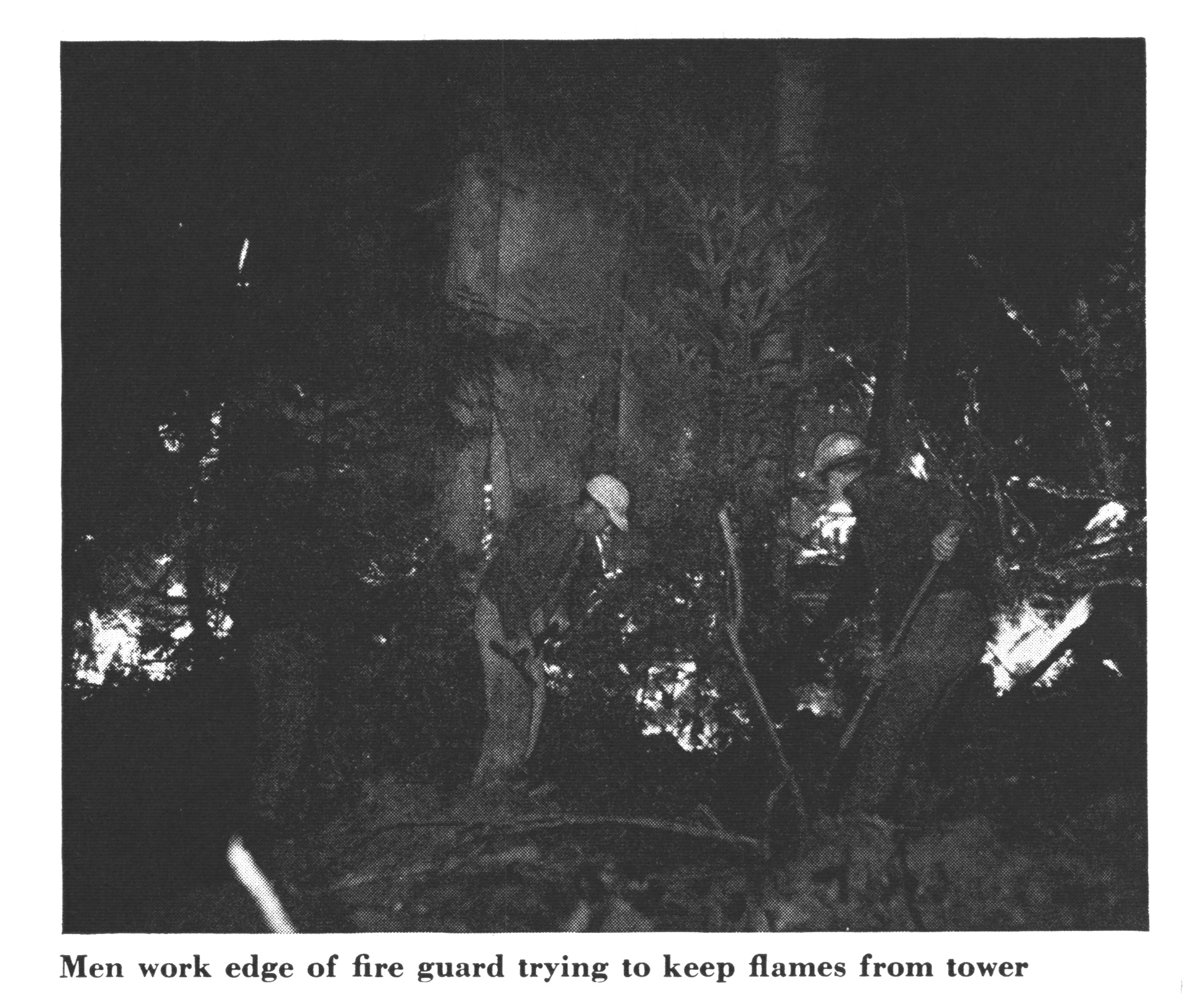
The fire, I judged, had now spread across 200 acres. From the density of its smoke and vivid lick of its flame, I guessed that besides the actual green timber it was consuming, it was now burning in bone-dry windfalls. When stoked by fuel of this kind, the heat generated by a forest fire becomes unbearable to anyone 50 yards from the actual flames. Yet right this minute, the 10 men hastily sent from Alexis Creek were there, close to those flames, battling the heat and the smoke with their shovels and axes in hopes of hacking out fire guards and bringing the blaze under some sort of control. Without more men and machinery, that hope was forlorn indeed.
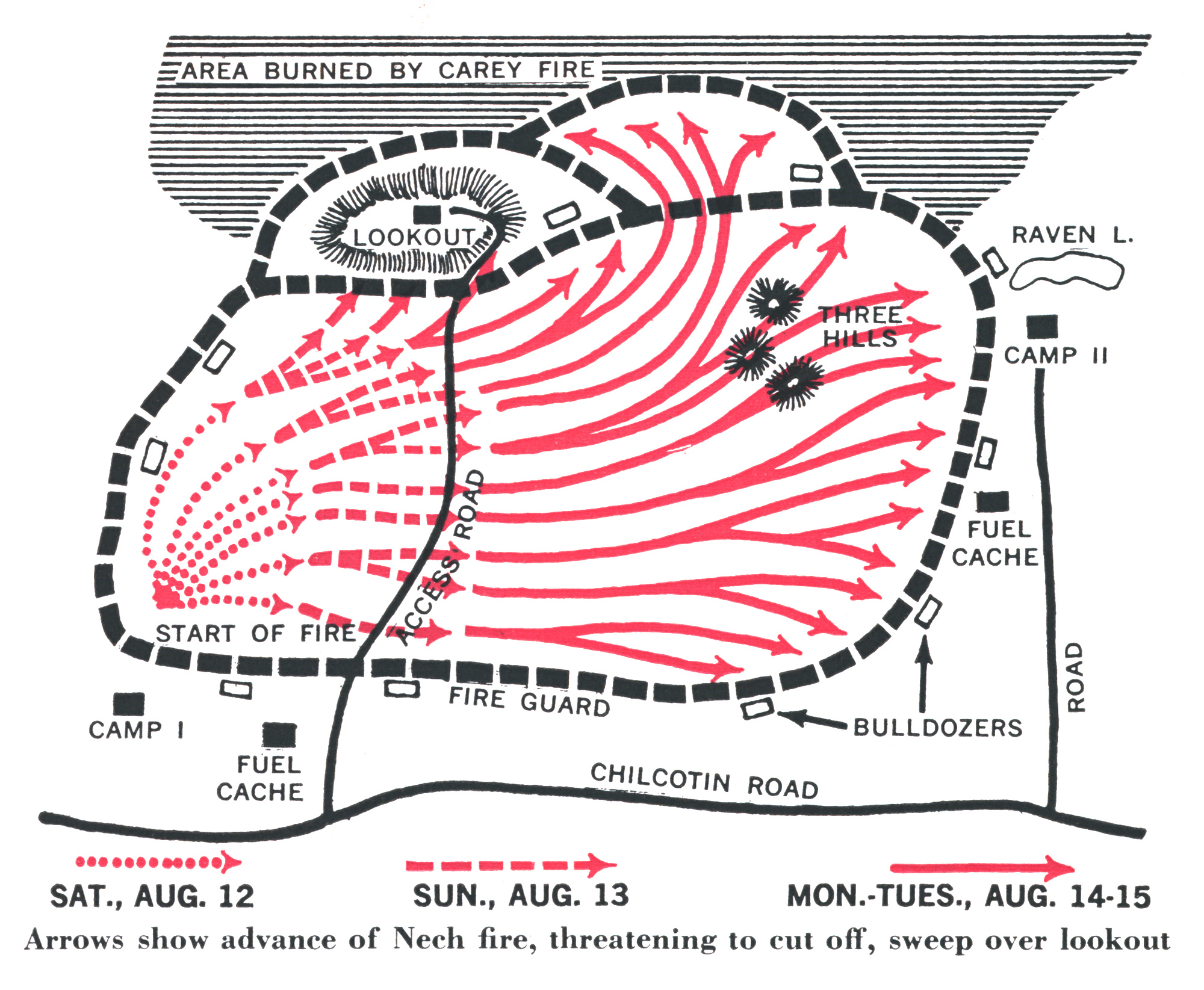
The afternoon wore on, punctuated by reports from the suppression crew. Sometimes the information was optimistic, as it was at 1715 hours when their portable announced cheerfully, “If fire doesn’t cross our present guards, hope to have its south side partially under control by nightfall.”
Related: We’re Having Our Worst Wildfire Year in a Decade, and It’s Probably Going to Get Worse
But 30 minutes later, optimism gave way to pessimism. “Fire is crowning again and heat becoming unbearable. It has jumped our south guard at 11 different places as well as running hopelessly out of control into the east.” And finally at 2125 hours, a tired voice had to admit defeat. “Shovels and axes are as useless as toothpicks on this one, Rod. Unless Alexis Creek can get bull-dozers and another crew of men in here by morning, by this time tomorrow night we’ll have a 2,000-acre fire on our hands.”
“Have already informed Whitecross about bulldozer,” I said, “and present prospects indicate that one or two can be obtained from a sawmill near Alexis Creek.”
“Praise the Lord and bring on the bulldozers,” returned the voice. And before going off the air it asked, “Any-thing else on your mind before you hit the hay?”
“Yes,” I replied after a moment of thought. “Say, just how far from my access road is the fire at the moment?”
A suppressed chuckle came from my radio followed by, “At closest spot, fire is approximately two miles west of your road and 2 1/2 miles south of you. How on that, lookout?”
“Go to bed,” I growled, putting down the mike.
The forestry lookout station on Mt. Alex Graham is north of the main Chilcotin road, with about 18 miles of narrow vehicle track connecting the two. From the point of leaving the highway, almost to within a few yards of the lookout itself, this access road stretches through heavily timbered forest. It’s scattered Douglas fir for the first four miles, dense lodgepole pine the remaining 14. This 18-mile forestry track is the only artery over which the lookout man on Mt. Alex Graham can be supplied with the necessities of life. Every ounce of food I ate, every cup of water I drank, every gallon of fuel oil I used in my cookstove had to be hauled in over that road.
That same road afforded me my only route of escape from the station if my own survival dictated my abandoning it, unless one of three things happened:
1. I was evacuated by helicopter. 2. A saddle horse was supplied me. 3. I walked out. The thought had never entered my head that any pilot could put a ‘copter down on the small portion of the snout of Alex Graham that isn’t heavily timbered. And the nearest saddle horse was no doubt cropping bunch grass in some pasture 20 miles or so to the south of me. So if I had to make a quick get-away from the lookout, and if my exit by vehicle and road was cut, I’d have to travel on my own two legs.
I certainly didn’t relish the prospect of hiking southward down that road if the timber on either side was aflame. Neither did I look forward to striking out on foot through the woods in any direction with a fire of that intensity rampant in the area. So, with such thoughts pricking my mind, I lay down on my camp cot, riffled through the pages of an outdoor magazine, and began reading a how-to piece titled “Three Ways to Barbecue Deer Ribs on the Campfire.”
I was just crawling from my sleeping bag at 0500 Sunday morning, August 13, when loud, distorted words suddenly flooded the lookout. I pulled on my pants, grabbed my mike, and sang into it, “Mt. Alex Graham lookout acknowledging. Will you please turn your volume down so I can identify you?”
“Sorry, Alex Graham.” It was Whitecross’ voice. “Didn’t realize I was coming through so loud. How are we for tone now?”
“Much better. Over to you, Alex.”
“We have only been able to get you one bulldozer so far, and it will be on its way as soon as we can grab a truck heavy enough to haul it. Have also managed to pick up 30 more men who should be up there by noon. Assistant Forest Ranger Glenn Skelhorne will be in charge of operations, and you can contact him in his forestry jeep with the call name, Car 26.”
“Where did you manage to pull in that many men?” I asked.
“Where d’you think?” Whitecross replied. “The R.C.M.P. (Royal Canadian Mounted Police) pulled most of them out of the beer parlors in Williams Lake last night. Some of them will be suffering acute hangovers when they reach you, but an hour or two on the fire guards will sober them up. How’s your visibility up there now?”
“Visibility at present,” I answered “is about 900 yards. Beyond that, I’m completely smoked in. Will contact you when it lifts and advise then how the fire looks from up here.”
At 0815 I tried to contact the support supression crew already at the fire. “Suppression Crew Portable, Mt. Alex Graham. Are you awake yet down there?”
“Alex Graham, Suppression Crew Portable answering. What do you mean, are we awake? Damned little sleep any of us got last night.”
After passing along the news of the one bulldozer coming to their assistance, also the additional men, I inquired about the lookout road.
“It’s still open to traffic,” I was told in return. “But at one point and on a front of almost three miles, the fire has approached within 500 yards of it. On its west side, that is.”
“Hmm,” I muttered, and went off the air.
The smoke had now lifted sufficiently for me to advise Whitecross on present state of the fire. “It now covers about 1,600 acres,” I reported. “is moving west to east and slightly north on a front of five miles. My windage up here at present is southwest 20 with occasional gusts reaching 30. Suppression crew reports fire is within 500 yards of my road. If wind holds to present course and fire reaches and jumps the road, no traffic will be able to get through to the lookout until road is opened again.”
And under my breath I muttered, “Nor leave it either,” after signing off with “Clear and by,” meaning I was leaving my receiver on in case anybody wanted to call me.
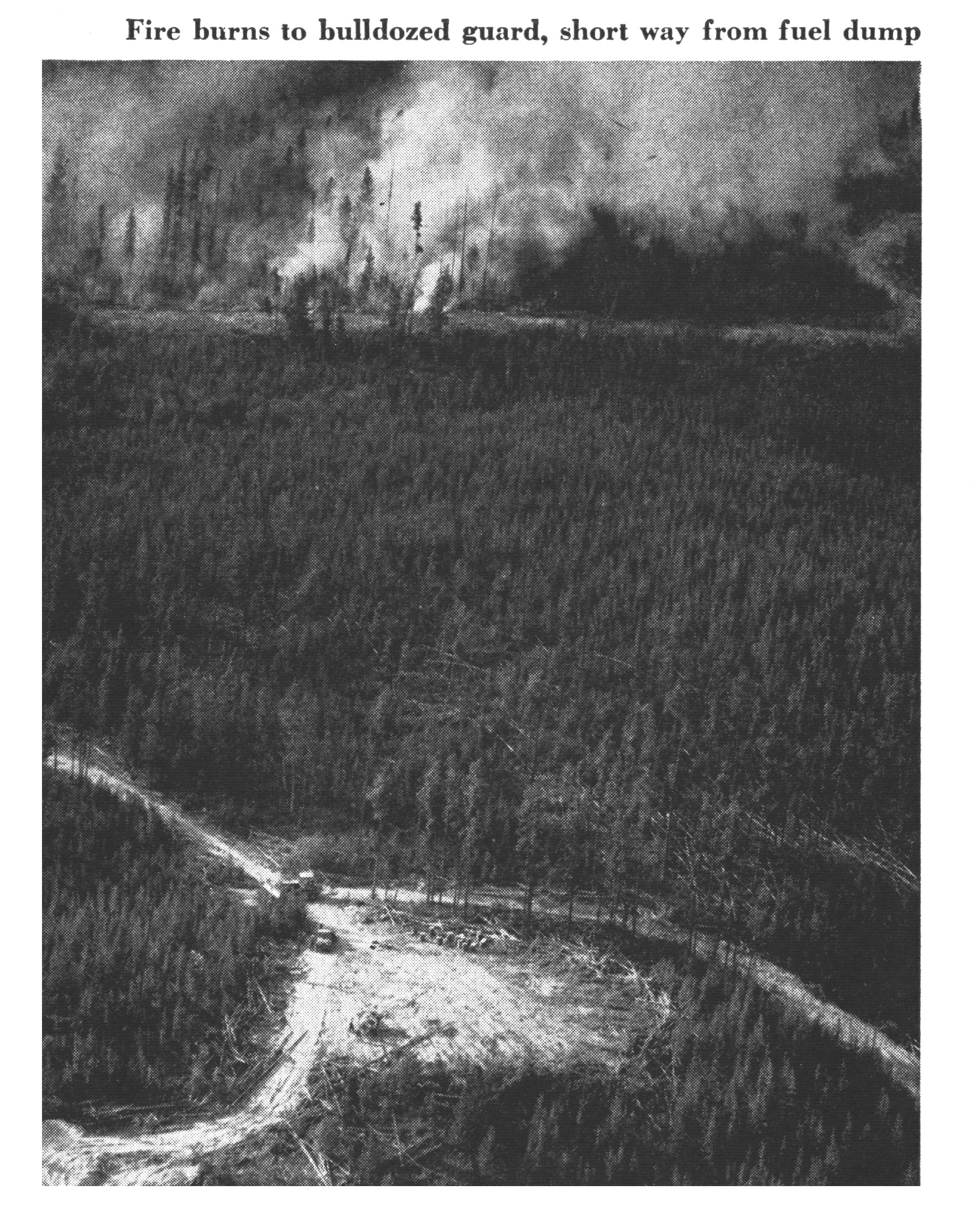
At 1600 hours, Assistant Ranger Skelhorne contacted me over his portable radio to let me know that he was now at the fire, together with the 30 men picked up in Williams Lake. A few minutes later, the single bulldozers arrived and immediately began ‘dozing a major fire guard around the southern edge of the fire. trying to hold it back from the main Chilcotin road.
An hour later I heard a vehicle growling in low gear up the last steep grade to the lookout. It was a four-wheel-drive forestry jeep, its driver and sole occupant, Glenn Skelhorne.
Skelhorne is a dark, lean, and sinewy fellow, about five feet nine, tipping the scales at 165 pounds, and in his late 20’s. His face and hands were blackened with ash, his eyes watery and bloodshot from the smoke.
“Thought I’d run up here and check on you while the road is still open,” he greeted me. “How are you fixed for water and other supplies?”
“I’ve water to do me another four days if I ration it,” I said. “But food and stove fuel should last considerably longer. How’s prospects for keeping the road open anyway?”
Related: A Rattlesnake Bite on a Fishing Trip Cost Me a Leg, and Nearly My Life
“Without more machinery, they’re not very good,” Skelhorne replied soberly. “I now have a crew of men on the road with shovels and axes, but in this heat and wind and at the rate the fire is moving, it’s doubtful that it can be kept open much longer.” His eyes wandered to the fire raging below, then came back to me.
“That’s mostly what I’m up here about, Rod,” he said. “You must use your own judgment on how much longer it’s safe for you to remain on the job here. Once the fire jumps the access road, you’re completely isolated until we can open it up again. Lord knows when that will be. The thought did occur to me that we should evacuate you and the equipment now, while we can do so with a vehicle. But. . . ” He broke off and stared absently at the fire finder.
I knew what he was thinking. Neither the FM radio set on the forestry jeep nor the portable at the suppression-crew camp could safely be relied upon to make contact with Alexis Creek. Sometimes they could get through, but at others they couldn’t. But they could always contact me at the lookout and use me to relay their messages to Whitecross. The lookout was a vital communication nerve center. But if I now abandoned it that nerve would be severed.
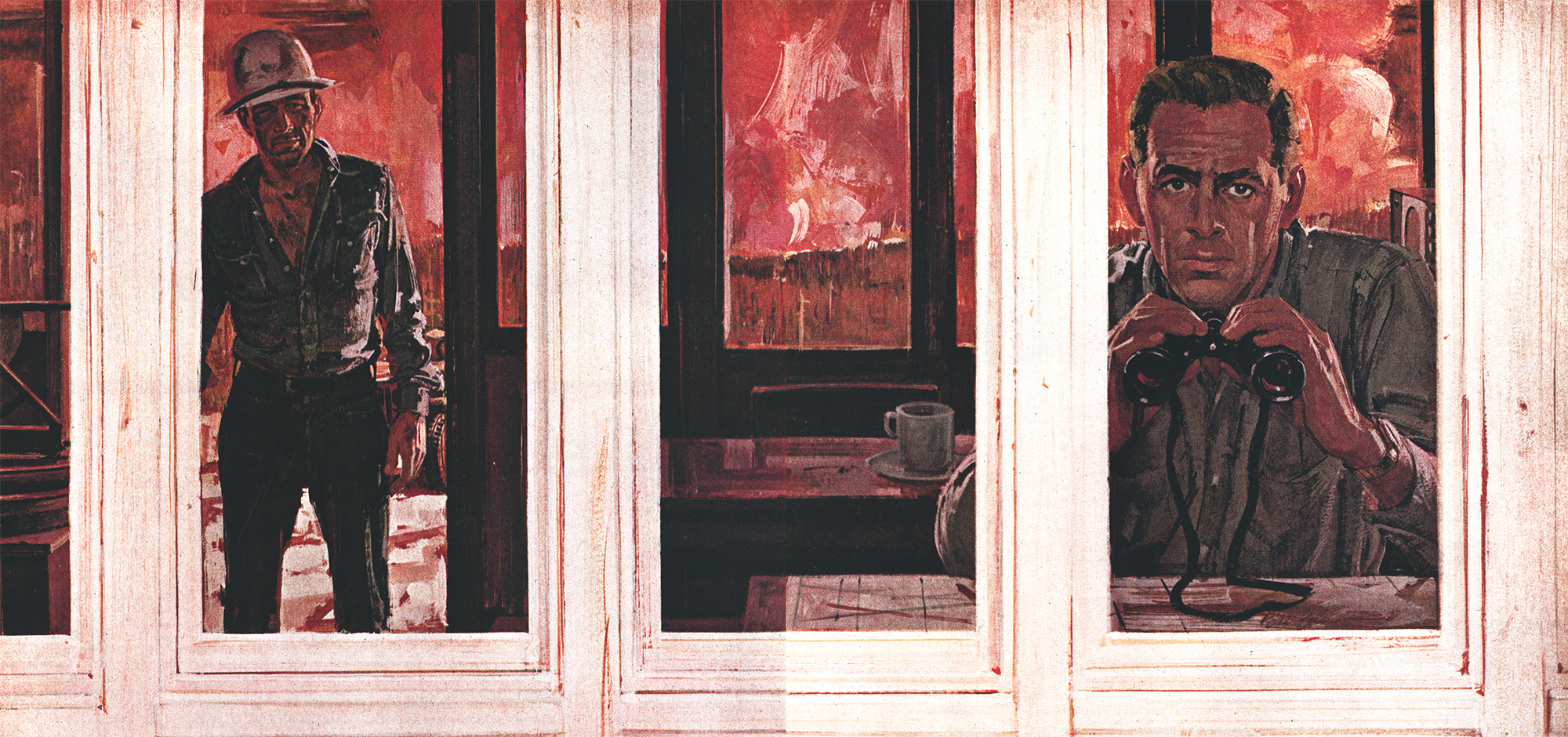
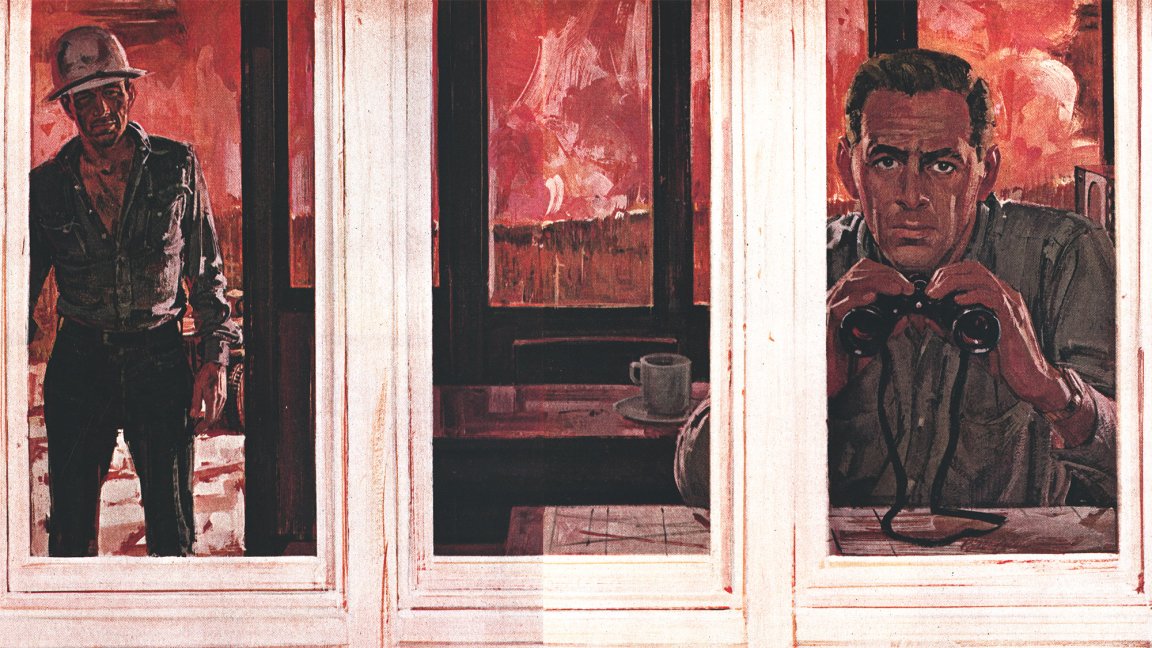
“I’ve no intention of leaving,” I told Skelhorne, a promise that was to be only partly fulfilled. Illustration by Bill Johnson / OL
“I’m staying, Glenn,” I said. “I was up here when this mess started, and I’m staying to help you boys battle and beat it. Know something? This is my third consecutive fire season here on top of this mountain. Despite its isolation and loneliness, this lookout has become a sort of second home to me.
“Furthermore,” I went on, with a slow sweep of the arm, “I’ve become sort of fond of that mass of timber down there, even though it’s mostly no-account jackpine. There’s life moving through that timber, though we can’t see it. Sometimes late in the evening or early in the morning I watch a doe deer with a couple of fawns still nursing at her udder step up within a dozen yards of this building and stand watching it, maybe wondering what in tarnation it’s all about. And every once in a while an old cow moose and her calf come hoofing up the road: they’ve become so accustomed to seeing me here that they just stand and wiggle their ears when I go outside to bid them hullo. If you just step down over the hill to where I dump my garbage, you’ll not find much refuse except the empty cans. A black bear that littered three cubs this year shows up at the garbage pile every other day or so to clean up the leftovers. Right now God alone knows how many tens of thousands of trees will die in this fire be-fore its final ash is cold. as He only knows how much wildlife will be cremated along with the trees.
Related: We Canoed 200 Miles into the Bush for the Best Walleye and Pike Fishing of Our Lives
“But of one thing I’m certain.” I told Skclhorne. “Hopeless though it may look at the moment, you forestry boys will finally get the fire under control and whipped. And I have no intention of leaving this lookout until it is whipped.”
I had no way of knowing this was a promise that was to be only partly fulfilled.