
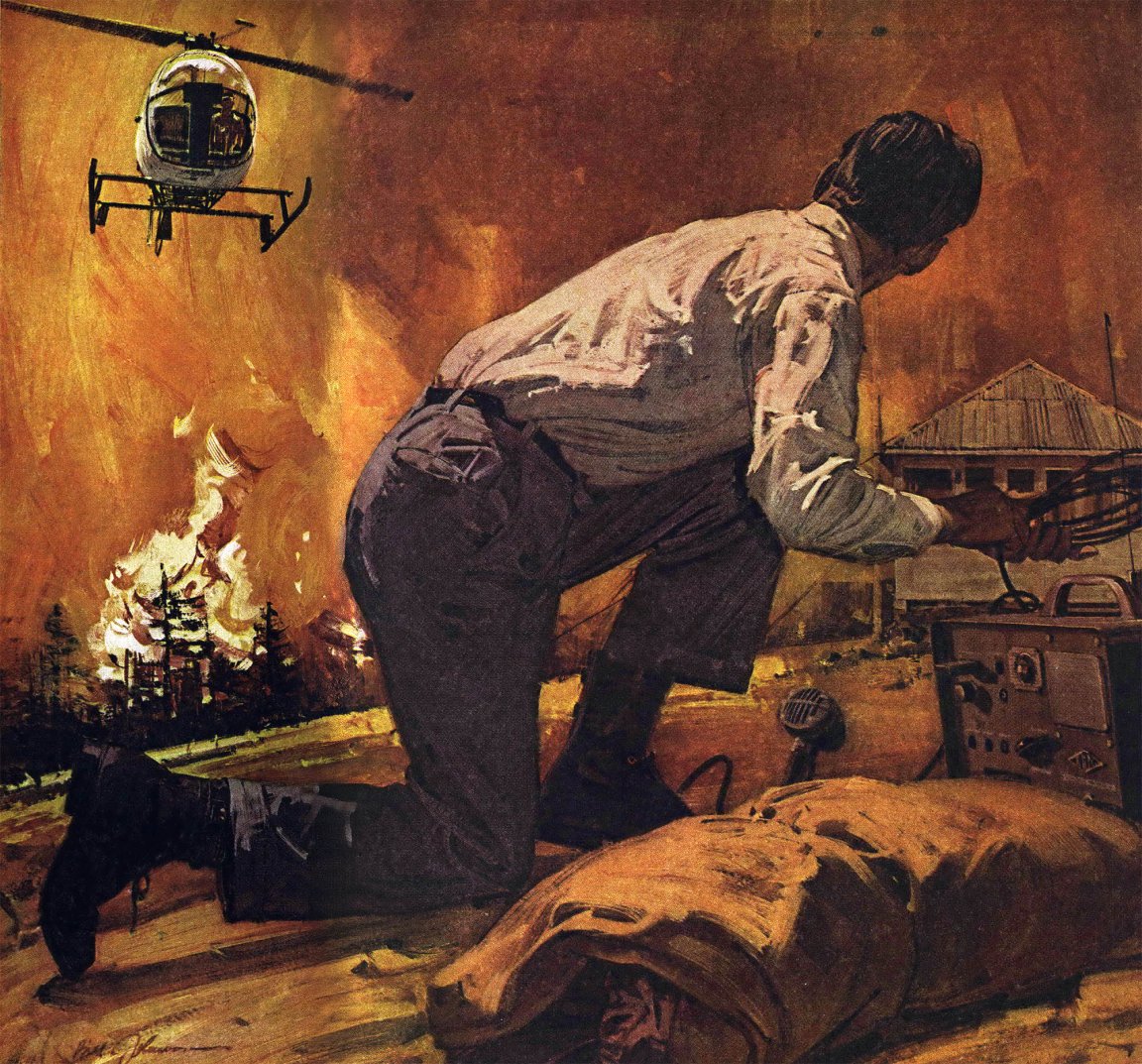
This two-part story, “I Watched a Forest Die” appeared in the June and July 1962 issues of Outdoor Life. This is the second part, and the conclusion. You can read the first part here. The following editor’s note accompanied Part II:
Perched in his lookout atop Mt. Alex Graham, Rod Diederick spotted the Nech fire Saturday morning, August 12, 1961. As related in Outdoor Life for June, the holocaust threatened not only the region’s main highway and valuable timber, but also the access road that was the lookout’s lifeline. As fire closed in, Sunday, August 13, Diederick was offered the chance to evacuate by jeep. But he was the only dependable radio link between forestry headquarters in Alexis Creek, B. C., and the fire-fighters, so he vowed to remain at his post until the fire was beaten beyond any question of doubt.
Next morning, Monday, August 14, only three chipmunks showed up for their breakfast. They trooped out from the cleft of a rock 20 feet from the lookout’s door. Not a single whisky jack came to perch on my shoulder; no red squirrel scampered excitedly across that patch of open ground between the lookout and the timber.
I’ve heard more than one version of how wildlife, large or small, reacts to a forest fire. Some say wildlife keeps at least one jump ahead of the flames and so saves its skin. Others say its wits and muscles become paralyzed by terror and that it will freeze in its tracks, not sensing what to do next. But certain old-time trappers with whom I’ve discussed the subject are perhaps closest to the truth; they say no two wild creatures will react exactly alike. One deer might turn and flee from the flames, while another will run blindly into them. Or a cow moose will leave at her first whiff of smoke while her calf will remain behind.
A trapper from the Peace River country in northeastern British Columbia once told me of seeing a she-bear with a cub fleeing from a fire that was crowning in the trees 100 yards behind her. Movement at the top of a spruce tree only a few yards from the flames turned out to be a second cub, which — instead of fleeing with its mother — sought safety by climbing the tree. A few seconds later the spruce went up in flames, and the cub tumbled to the ground and lay there kicking and crying, its every patch of fur burnt to the roots. The trapper put a .30/30 bullet through the luckless cub’s brain, then got away from there himself. So even if some wildlife succeeds in escaping a forest fire, a lot more, like the unfortunate cub, dies. Only the ash is left.
I guessed that the smoke had driven my whisky jacks off, for they had wings to fly with. But what had happened to the squirrels and the other chipmunks? Had they too made a get-away, or were they crouching at the bottom of their holes, too scared to venture above ground?
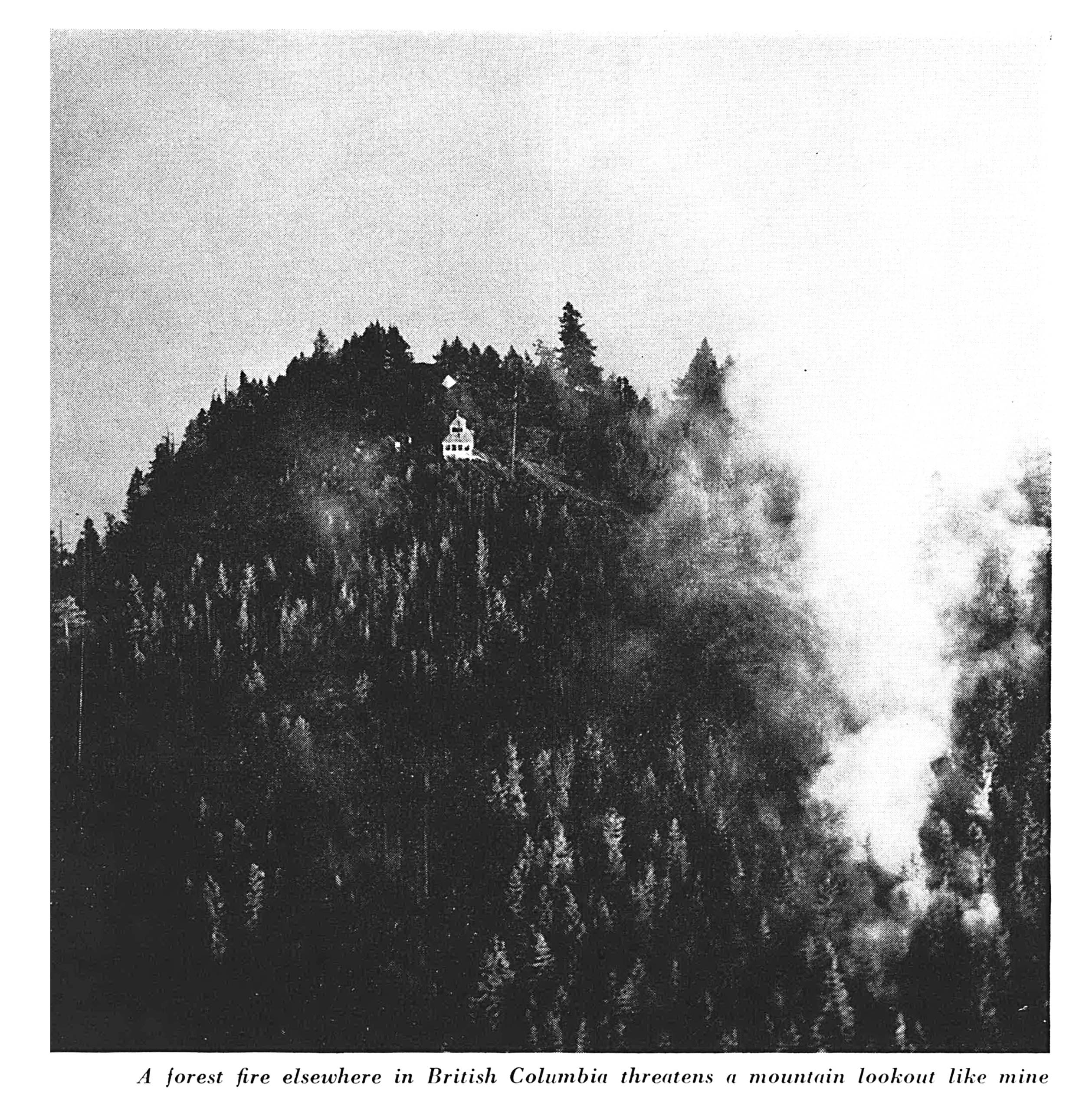
At 0715 hours, Assistant Ranger Skelhorne gave me a call from Car 26 with a rundown on how the general situation looked from below.
“Your access road,” he said, “is now impassable, with little likelihood we can open it up again for quite some time. The fire jumped the road in several places during the night, and the timber on either side of it is now a wall of flame. The heat prohibits any action whatsoever unless I took a chance and tried to get my only bulldozer through to you. It’s a chance I cannot take because we’d probably lose the ‘dozer as well as its driver. How’s your visibility up there now?”
“Only about 400 yards at the moment,” I said. “That situation should improve shortly though. Seems from up here that the fire shifted slightly north during the night as well as moving east. I can’t see what’s going on below the south slope of this mountain, but judge from the density and texture of the smoke up here that the northern edge of the fire is now within a mile of the lookout. How on that, Glenn?”
“From where I am, south slope of Alex Graham is blacked out by smoke,” Skelhorne came back. “Would judge, however, that you are right about northward drift of fire. Would you please contact me again as soon as you are able to take a reading on the whole area now covered by the fire, telling me approximately how many acres it covers and the extent and rate of its eastward drift? Seems to me that we’ll have to try and get far more men in here and set up another camp at Raven Lake (about 1½ miles long by ½ mile wide, lying five miles east of the lookout) and get guards in on that side to hold it back from the east.”
At 1045 hours, I was able to supply the required information. About 2,500 acres of timber was now either dead or in the process of dying. The flames, fanned by a strong west wind, were driving steadily east and northeast in the general direction of Raven Lake. I estimated that at its closest point, the fire was now only 1,400 yards from the lookout, but seemed to be moving very slowly my way.
“Will make contact with you again should the situation up here worsen,” I concluded.
Due east of the lookout and some 3½ miles away were three individual hills running east to west and separated from one another by narrow valleys. The ridges sheered up some 800 feet above the forest flanking them, and were themselves covered by heavy timber. It was on those hills that I focused my glasses after setting the mike down.
I judged that the fire, at its present rate of drift, would reach the foot of those hills by early evening at the latest. Once it got into the valleys, the hills on either side would generate their own upward draft for the fire, just as a chimney generates the draft for a fire in the fireplace below. The valleys then were the hearth, the hills the chimney. They would suck the smoke and the flame upward and send it mushrooming thousands of feet into the sky. That, I thought, would be a sight as spectacular as it would be awesome.
“Car 26, Car 26. Alexis Creek calling.” I was about to step outside the lookout to stretch my legs when my own radio picked up Whitecross’ call to Skelhorne. I sat down on the table, legs dangling, waiting to see if the contact was made. After half a dozen attempts, Alexis Creek managed to find its man.
“Alexis Creek, Car 26,” Skelhorne answered. “Had trouble bringing you in, but am reading you clearly now. Over to you Alexis Creek.”
The hills would form a chimney that would suck the smoke and the flame upward and send it mushrooming thousands of feet into the sky.
“We have notified District Forestry Office at Kamloops (a town on the Thompson River, 160 air miles and a great many more road miles southeast of Alexis Creek) that a state of acute emergency now exists at Nech fire. Forest Service there has gathered a fire-fighting force of 40 additional men in Kamloops, and a school bus has been chartered to carry them as near Mt. Alex Graham as bus can get. This further help should reach you sometime tonight. We have also obtained nine more bulldozers, and they too should arrive by nightfall. The primary object, of course, is to hold the fire back from the main road, but with this addition of men and machines, you may be able to split your forces in half, one crew operating at south end of the fire, the other to the east of it.
“You, of course, are the best judge of that,” Whitecross went on. “We presume that as long as wind holds from present quarter, you haven’t too much to worry about on your west flank, but there is grave concern here in regard to the lookout.”
Then switching from Car 26 over to me, Whitecross asked, “Is there any immediate danger of fire forcing you to abandon the station, Rod?”
“Am not anticipating anything of the kind at present,” I came back cheerfully. “Communication by road is now cut, but fire itself is still almost a mile south of me.”
“Just the same,” advised Whitecross, “you should at least make tentative plans for evacuation on foot in the direction of some muskeg or meadow to the north of you where we could later pick you up by helicopter.”
Evacuate northward on foot? I didn’t like the smell of that at all, at all. In the summer of 1959, the forest north and northwest of Mt. Alex Graham had been burned over by Carey fire, which partially or totally destroyed close to 25,000 acres of timber before finally being brought under control. One fire-fighter was killed instantly in that disaster, crushed by a falling tree. A second man had his back broken from similar cause, but lived to tell the tale.
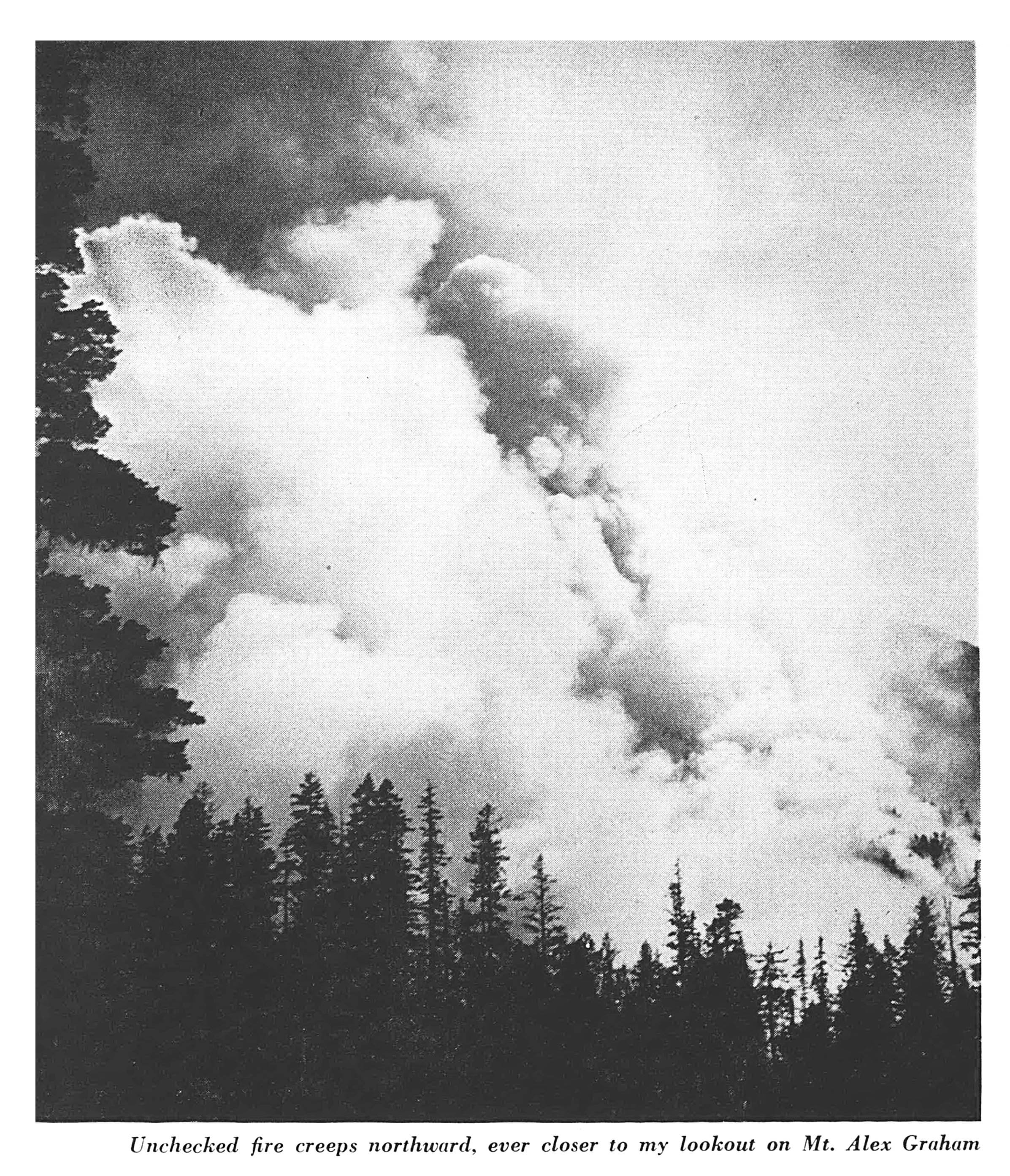
The southern sweep of Carey fire was halted on an east-west line running only two or three miles north of my lookout. Now, this old burn was choked with fallen timber through which only the sturdiest of moose could travel. A man on foot in those windfalls would never leave them alive if an abrupt change of wind should carry the flames of Nech fire over the ridge and summit of Mt. Alex Graham, down its northern slope, and into the scars of the 1959 burn beyond. Of that much I was sure.
“Prefer the lookout to your darned old moose pasture,” I returned. “Anyway, when Skelhorne has more ‘dozers to play around with, maybe he can get one through to the lookout and relieve the situation up here.”
But Assistant Ranger Skelhorne, like me, had his eyes — and thoughts — on those three hills. His own experience with forest fire warned him of the awful conflagration that would follow should the fire reach those valleys. By late afternoon, reinforced by five more bulldozers, Skelhorne sent two machines into action on the east side of the fire, trying to turn the flames north before they reached the threatened hills.
But at 1900 hours the wind strengthened, reaching a velocity of 35 m.p.h. and blowing from the southwest. With the wind as an ally, and again crowning in the treetops, the fire took off eastward at what I estimated to be a speed of six miles an hour.
The cataract of fire which, generated by its own intense heat, erupted out of the valleys and began racing up the sides of the three hills. Within 10 minutes, the ridges were on fire, the smoke boiling like some grotesque, black pillar 2,000 feet into the air above them.
At 1950 hours, it reached the valleys.
In June, 1941, I was stationed at Southampton, England, when the Germans staged a major night blitz on dock installations. The bombs, both demolition and incendiary, scored direct hits on a large fuel dump only half a mile away from where I and some of my buddies stood watching the fireworks. I never have been able to forget the spine-chilling spectacle of those thousands of gallons of fuel suddenly going up in smoke and flame, and I never expected to see anything like it again.
Yet the explosion of that fuel dump was now dwarfed by the cataract of fire which, generated by its own intense heat, erupted out of the valleys and began racing up the sides of the three hills. Within 10 minutes, the ridges were on fire, the smoke boiling like some grotesque, black pillar 2,000 feet into the air above them. A sheet of sorrel flame leaped across the skyline with a brilliancy that forced me to blink though I was more than three miles from it. From within the lookout, I heard the explosive roar of the fire as if it were scarce 100 yards off, and the crack of trees as the tempest created by the unnatural strength of the fire snapped them off at their roots. As if propelled by the force of some titanic whirlwind, hundreds of hot coals and flaming branches were sucked up into the maelstrom of smoke above and touched off countless spot fires when they fell to earth.
Within 20 minutes, the hills and valleys lay in blackened, smouldering ruin, their every tree dead, not a plant or shrub standing. The fire had killed all.
Watching that furnace from inside the lookout, it occurred to me that there might have been a sudden shift in the wind; now the fire about the hills seemed to be moving toward the lookout. I hurriedly went outside and took a reading on the wind gauge. Yes, momentarily anyway, the wind had switched and was now blowing in a northeasterly direction. At least, I thought, that should turn the fire away from Raven Lake and give Skelhorne a chance to get through to the lake with his bulldozers. That is, if there had been a similar change of wind down at the fire itself. That was something I should check on, so going back inside I picked up the mike and called, “Car 26, Car 26. Alex Graham lookout calling.”
“Alex Graham lookout — Portable 26 answering you,” quickly came Skelhorne’s reply. “I am reading you from my vehicle now parked 1,000 yards south of present hotspot. Over to you, Alex Graham.”
“It’s the wind,” I explained. “Up here it’s blowing more north than east. How is it down there?”
“Seems to be coming from every which way,” said Skelhorne. “But I figure that is due to the air turbulence caused by the fire. I do note however that the fire due south of the lookout seems to be moving steadily north, although at this distance I can’t tell how far from you it actually is. Seems to me though that your situation up there is becoming untenable.”
“Still no chance of your getting one ‘dozer and half a dozen men with chain saws through to the lookout?” I asked.
“Afraid not,” Skelhorne replied. “I need every man and machine I can spare from the south side of the fire to try and do something with this mess here. If it breaks away on us and gets to Raven Lake, some 1,500 head of cattle summer-ranging in the timber east and north of the lake will be trapped in the fire, and the ranchers would squawk a bit if we allowed that to happen. I’m watching the situation up there pretty closely and will try to break through to you on the west side of the burn as soon as more help arrives.”
At 0100 hours Tuesday morning, August 15, an AM radio identifying itself as Camp 2 Portable called to let me know that the 40 men picked up in Kamloops, and in charge of Assistant Ranger Murray Campbell, also of Alexis Creek, had now arrived. Prior to taking up their positions on the firelines, they were sorting themselves out at a camp hastily thrown up at Raven Lake. At 0230 hours, 10 bulldozers were in action along the southern and eastern perimeters of the fire, checking its strides in those directions and turning it steadily north.
My own position at the lookout was becoming more hazardous by the minute. Not only was the fire creeping ever nearer the summit of Mt. Alex Graham from the south, but it was also looping in on me from the east.
At 0415 hours, I heard Assistant Ranger Skelhorne trying to contact Alexis Creek. After a half dozen abortive attempts, he got through.
My own position at the lookout was becoming more hazardous by the minute. Not only was the fire creeping ever nearer the summit of Mt. Alex Graham from the south, but it was also looping in on me from the east.
“Situation at the top of Alex Graham has now become critical,” I heard him tell Whitecross. “Fire is closing in on the lookout from both south and east; it seems doubtful the building can be saved. I intend trying to get two bulldozers and a half dozen men through to the mountain sometime today, but by then it might be too late. Am therefore suggesting that Monteith notify divisional offices at Kamloops and that an attempt be made as soon as possible to evacuate Diederick by helicopter.”
For two or three minutes after Skelhorne had signed off, I stood staring at the scarred and rock-littered ground surrounding the lookout. Was it possible for anyone to set a ‘copter down on such a small patch of ground without cracking the machine up? Then I shrugged; no use worrying until I actually saw someone trying to do it.
By break of day, I estimated that the fire was burning over some 8,000 acres of forest, and while the suppression crew operating out of Camp 2 at Raven Lake was making some headway in beating it back from the east, nobody had so far been able to break through to the north and start fighting the fire from that end. South of the lookout, a dirty, grayish pall of smoke reduced my visibility in that quarter to a mere 80 yards, and I judged from reflections against the smoke that the fire there was little more than 1,000 yards away. Besides, a corridor of smoke and flame almost a mile wide was moving steadily in on the lookout from the east. I began trying to estimate how long it would take the two tentacles of fire to reach the top of the mountain and link up. My conclusion was that unless the wind strengthened considerably, the lookout was safe for a few more hours.
For the next 1½ hours, I was glued to my radio, relaying messages to Alexis Creek from radios down at the fire. The 10 bulldozers were consuming fuel at the rate of 30 gallons an hour, and supplies were petering out. When could more be expected to arrive? To this Whitecross replied, “A loaded oil truck left Williams Lake at 0600 hours and should reach you shortly.”
Camp No. 1 was down to its last gallon of water. “Crew is now quenching its thirst with fruit juices,” their radio said, “but that is going dry too.”
Camp No. 2 had no food at all, and the men were wanting their breakfast. “Who in hell’s looking after the catering end of this job anyway?” asked some unseen fire-fighter. A truck had left Alexis Creek at 0200 hours with provisions and bedding for the Raven Lake camp, but unexplainedly did not arrive until six hours later.
I began sizing up my personal belongings, deciding what to take.
I had just completed relaying to Alexis Creek an urgent request from Assistant Ranger Campbell for an additional four men with chain saws to clean away burned timber that had fallen across the access road to his camp, and I was to sign off when Whitecross suddenly cut in.
“Hold on a minute, Rod,” he said. “The following message has just been handed me which might be of some slight interest to you. Message reads: ‘Forest Service has decided that Alex Graham lookout must be abandoned, for the time being anyway, and you are therefore instructed to make preparations for immediate evacuation. A helicopter about to leave Kamloops will try to make a landing on top of the mountain, and you should put out some sort of a wind sock to furnish pilot an indication of your windage up there when he flies over you. You are also asked to lower all radio antennas, dismantle the radios and Forest Service fire finder, and bring these away with you.’ Are you reading me clearly up there?”
“Have a general idea of what you’re getting at,” I returned. “Is this an official order, or merely a friendly suggestion?”
“It is both an order and official.” And I could almost see the grin on Whitecross’s face as he added, “It’s not you we’re concerned about, old-timer. But Department of Lands and Forest would be peeved if all that expensive equipment you have there went up in smoke.”
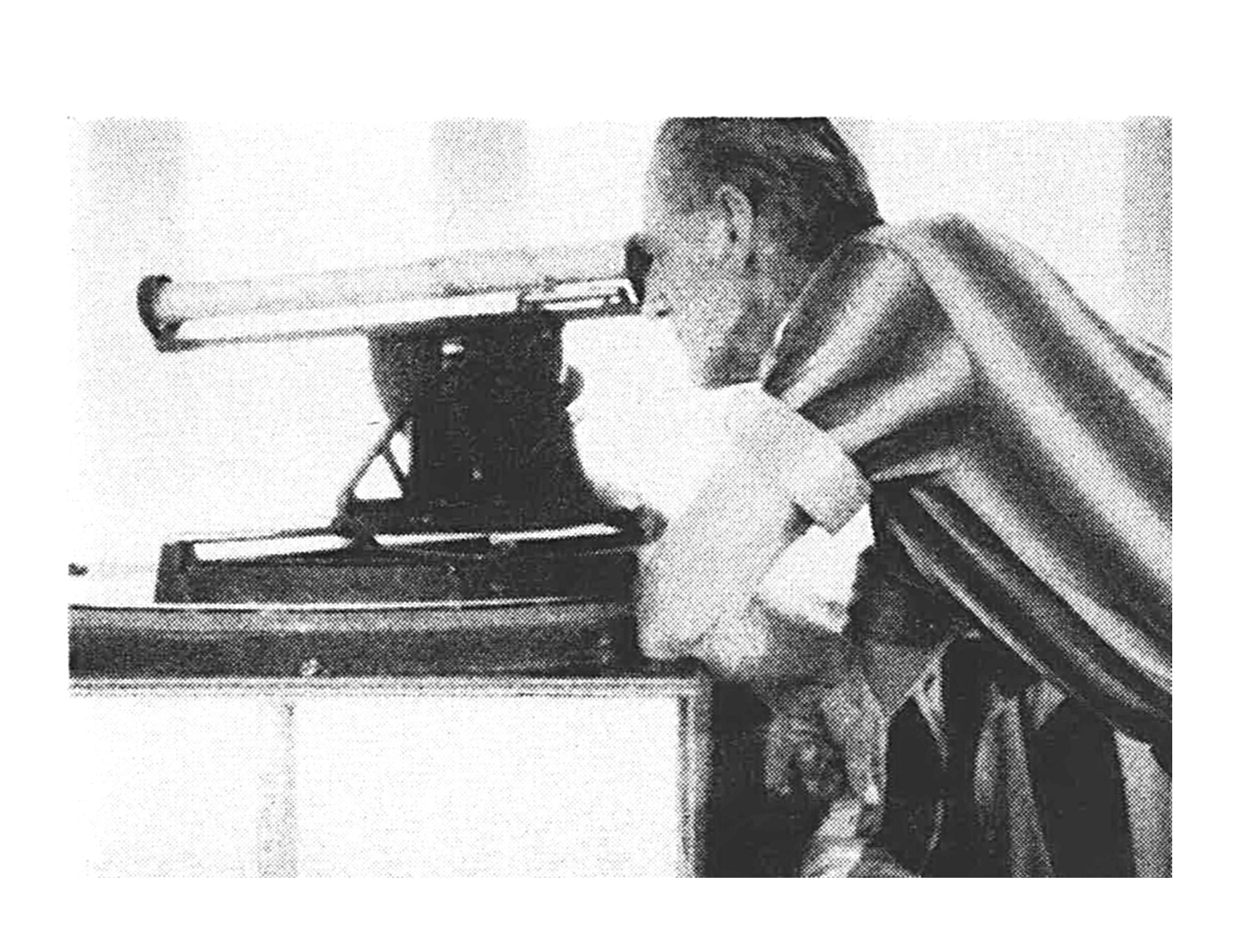
A dishcloth which still retained a little of its original whiteness served as a windsock. Then I dismantled the AM and repeater radios, leaving the FM in operation for last-minute transmission. I packed the fire finder, trying to recall just how many forest fires the instrument had sighted in on since my first fire season at the look-out in 1959. It was all there in my logbook on the table, but I didn’t bother flipping its pages to find out. Instead, I began sizing up my personal belongings, deciding what to take.
The .303 British rifle — that must go. Also the Hudson binoculars which had been paid for out of my own pocket. The sleeping bag (it didn’t weigh much anyway) and a few letters stuffed into a brown envelope — that was about the size of it. No, there was the log-book; that must go with me.
I slung the glasses around my neck, stowed the rifle and other stuff in my sleeping bag, zipped the bag up, and toted the bundle outside. Then I carted the AM and repeater radios and the fire finder to a flat rock just behind the lookout where they could quickly be loaded if and when the helicopter came. I was quite certain that if any pilot did succeed in setting his machine down on the bald crest of the mountain, he’d be impatient to get air-borne again.
I was standing with one foot on the rock, chin cupped in my hands, and staring moodily out over the ugly swath of flaming, smoking, and blackened ruin which only a few days ago was lush and verdant forest, when it seemed that I could hear the clatter of heavy machinery operating in the woods on the west side of the burn and perhaps four miles from the lookout. I tensed, listening, then focused the glasses and held them steadily on the spot from where the sound was coming. But there was far too much smoke above the forest in that quarter for me to see anything but the vague outline of the timber.
Then I heard something else from out of the same spot which I instantly recognized as the vibrant buzz of chain saws. I asked myself what bulldozers and chain saws were doing at the west side of the fire? Then suddenly I understood: Assistant Ranger Skelhorne was making his bid to break through to the lookout!
At 1045 hours I heard the drone of an aircraft approaching from out of the east. The helicopter, as it turned out to be, aimed straight for the mountain, hovering for a moment 2,000 feet above its peak before veering due north. It lost altitude rapidly as it approached an 80-acre buckbrush meadow five miles north of the lookout. Then the ‘copter hung 500 feet above the meadow for several seconds before slowly letting down and landing on a half-acre patch in the middle of the meadow that wasn’t cluttered by brush.
Watching through the binoculars, I saw someone leave the machine, step away from it several feet, and then wave an arm. At which gesture the plane’s motors revved up again and the helicopter slowly lifted. At a height of only 500 feet above the treetops, it came in straight for the top of the mountain.
The ‘copter was almost vertically above the lookout and only 300 feet from its roof when I picked up the mike of the FM radio and regretfully transmitted, “Alexis Creek and to any portables reading me down at Nech Fire: At 1115 hours this is Rod Diederick reporting temporary abandonment of the lookout. Am now signing off the air until further notice.” And having got that disagreeable chore off my chest, I quickly dismantled the radio and set it down on the rock with the other equipment.
There’s little more than an acre of ground at the sheer peak of Mt. Alex Graham entirely free of timber, and it’s littered with jagged outcroppings of rock and trenched by seasonal run-offs of melting snows. It would, I guessed, be tricky to set a ‘copter down on the mountaintop without damaging the machine, but after the pilot had made two attempts and withdrawals, and after a considerable amount of tipping and slipping, he finally managed to land 60 feet from the lookout.
The pilot, a stocky-built chap weighing about 175 lbs. and seeming to be in his mid 30’s, jumped down from the cockpit, palmed his swarthy features and said, “Greetings, Diederick. I’m Jack Godsbey. Why in hell hasn’t the forestry service leveled off the top of this mountain so a fellow can sit a ‘copter down without risking his neck? Say, if the insurance people knew I’d dropped this baby down on a spot like this. . .” he said, winking. “Well, what are we waiting for? The quicker I get the heck and gone out of here the happier I’ll be.”
“The equipment,” I said, indicating the gear piled on the rock. “Where’ll we load that?”
“Equipment!” he bellowed. “What in the name of a name is that trash anyway?”
“Radios,” I explained. “and other technical appliances, the property of H. M. Government.”
“Junk!” he exploded. “A lot of no-account junk.” Godsbey worked for a private company, Okonogan Helicopters, Ltd., and was on contract to the B. C. Forest Service. “We’ll break our fool necks trying to get off of here,” he said, lashing the gear down onto the side racks as I handed it to him. Two minutes later we climbed into the cockpit.
“How’s your belly?” he asked casually as he gunned the motors.
“Nothing wrong with it, thanks,” I said.
“Then keep it that way,” he grunted. “It’s rougher than billy-be-damned up aloft what with the updrafts and other whatnots caused by this bonfire of yours. And it sure makes me nervous having someone puke all over my instrument panel, that it does. O.K., here goes for double or nothing.” And on the fourth attempt he lifted the ‘copter off the mountain and steadied it in the air.
“This is your lucky day, isn’t it, brother,” he sang out when, 400 feet above the lookout, he headed the machine north again. “From the looks of that smoke south of the building, you might have roasted long before I arrived. And if it wasn’t for the lucky rabbit paw I keep in my pants pocket, this old bird would have foundered and broken both wings trying to get off again. Rabbit paw, that’s what did the trick. Do anything in the world for you will a rabbit paw, except make you money.”
We were now directly above the south end of the meadow, and I asked, “Who’s that down there, anyway?”
“My observer,” he replied. “Helluva good Joe, too, only he weighs 200 pounds in his stocking feet. That’s why I ditched him on the meadow; could never have lifted off the top of that mountain if he’d been aboard. Only trouble is, now I’ve got to perch down and pick him up again.”
“Know something?” he continued. “I’ve logged over 1,000 flying hours at the controls of one of these things, but today’s the first time I set one down in the middle of a muskeg. Well, here we go again.” And dropping vertically he set the ‘copter on the fragment of meadow where the observer was waiting to be picked up.
The observer scrambled up into the cockpit, looked at me and winked, and said, “In this thing, two’s company, three’s a crowd.”
“Never scare the passengers, Joe,” admonished the pilot. “How’re we going to make this racket pay if you scare the daylights out of the passengers before we get off the muskeg? Shucks. . . .”
He was silent for a few moments as he gunned the engines, then as the ‘copter shuddered and lifted, he went on: “We haven’t a worry in the world so long as nobody don’t puke all over my instrument panel.”
The ‘copter veered northeast for a few minutes after getting away from the meadow, because, explained the pilot, “I want to put 7,000 feet between me and that fire before I turn and fly directly over it.” After gaining the necessary altitude, he brought the machine around and held it to a southwest course on a beeline for Alexis Creek.
Now we were flying directly above the main area of the fire. I peered down in hopes of glimpsing some of the seething activity of men and machines, but all I saw was smoke — mountains of smoke, valleys of smoke, and here and there rolling prairies of smoke. Suddenly, however, on glancing back over my right shoulder, I glimpsed the top of Mt. Alex Graham standing out in sharp relief above the sea of smoke. Then the ‘copter began to drop and the mountain was gone. Five minutes later the skein of the Chilcotin River seemed to be lifting to meet us, and the ‘copter touched down on the forest service strip at Alexis Creek.
I peered down in hopes of glimpsing some of the seething activity of men and machines, but all I saw was smoke — mountains of smoke, valleys of smoke, and here and there rolling prairies of smoke.
Late that night, Skelhorne radioed Alexis Creek that two bulldozers and a crew of men had broken through to the top of Mt. Alex Graham from the west side of the burn in time to turn the flames back from my lookout. Though the fire was a scant 500 yards from it on the south side and half a mile away to the east, the fire-fighters succeeded in ringing the mountain top with a 15-foot-wide fire guard which stopped the flames.
Throughout the night, and for several days thereafter, this fire guard was patrolled 24 hours a day by fire-fighters with shovels on their shoulders and soot griming their faces, extinguishing flaming branches and similar burning debris which often jumped the guard.
But the lookout, without its radios and operator, was useless, especially so since more men had arrived during the night to be instantly thrown into the battle. Without reliable radio communication among the forestry vehicles operating around the perimeter of the fire, as well as with Alexis Creek, a great deal of unnecessary confusion must inevitably occur. So after getting his fire guard around the top of the mountain, Assistant Ranger Skelhorne immediately headed the two bulldozers south again to clear away the litter of charred and smoldering trees which blocked the access road to the lookout.
At 1130 hours Wednesday August 16, Whitecross received word that the access road to Mt. Alex Graham was again open to traffic. I piled the radios and other equipment into a waiting forestry jeep and climbed into the seat beside the driver. Two hours later we got back to the lookout.
It required the combined efforts of 11 bulldozers and 75 men fighting without pause for 14 days to gain control of the Nech fire. And not until September 7, more than three weeks after reporting the first wisp of smoke, was I able to pick up the mike of the FM radio and pass this word to Whitecross at Alexis Creek: “At 1400 hours, this is Mt. Alex Graham advising that Assistant Ranger Skelhorne now considers the Nech fire no longer burning and therefore considers it safe to withdraw remaining men and equipment from the area.”
Related: We’re Having Our Worst Wildfire Year in a Decade, and It’s Probably Going to Get Worse
That message dispatched and acknowledged, I stepped outside the lookout, squatted down on a rock, and swept the field of fire-devastated carnage below me with the Hudson binoculars.
“Sixteen thousand acres of it!” I exclaimed to myself.
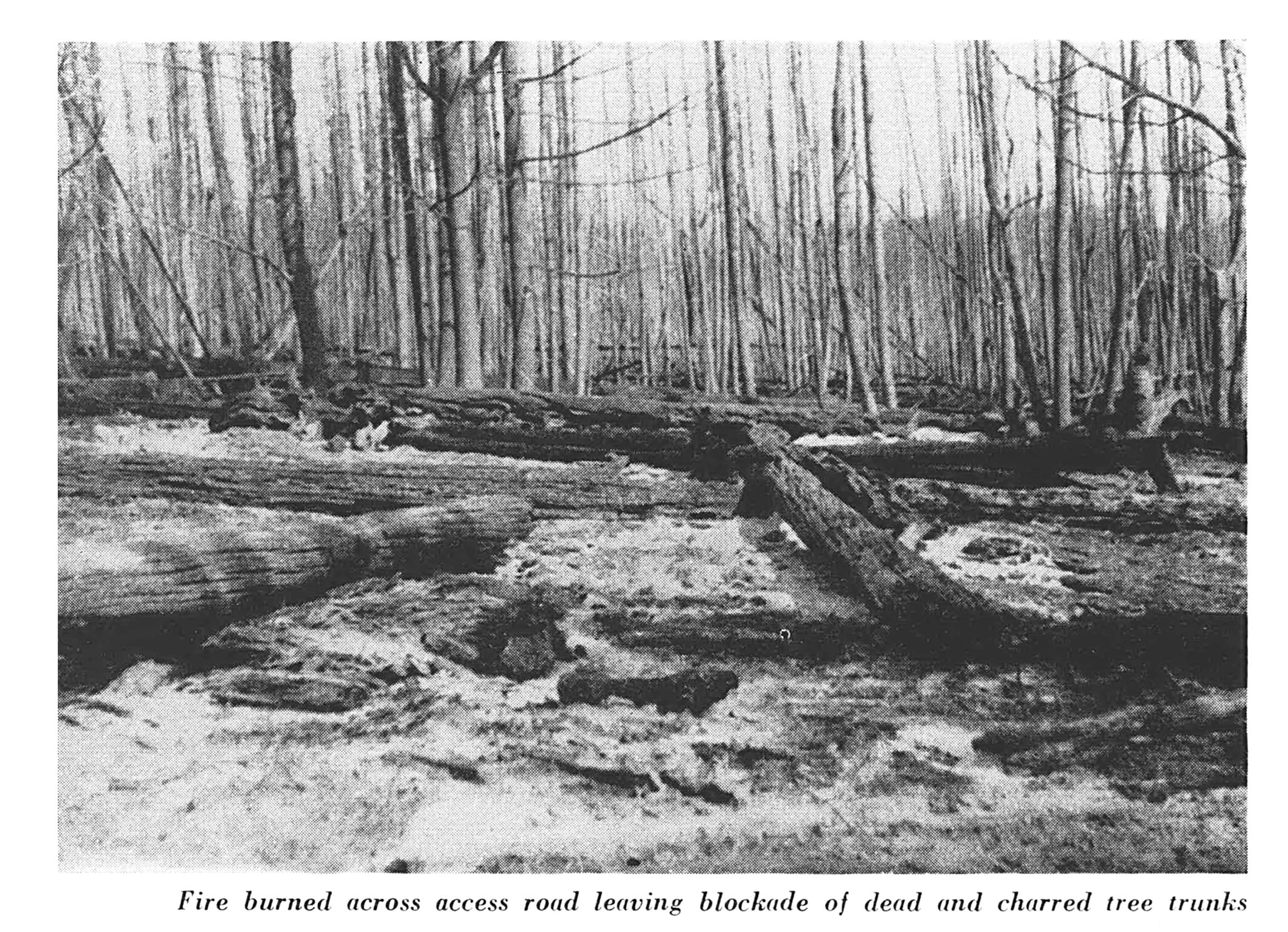
Yes, 16,000 acres of forest had died even as I watched. Eventually nature might heal the wounds and hide the scars, but for 25 years at least, no coniferous tree would again be able to take root in that cauterized, ash-covered soil.