
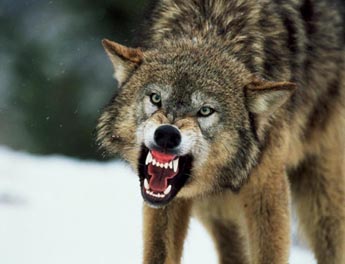
Kenton Carnegie probably recognized the wolves that followed him down the snowy Saskatchewan trail last November. They were likely the same timber wolves-two blacks and two grays-that he had photographed two days earlier on the edge of the north woods settlement where he was temporarily staying.
Timber wolves are a common sight at Points North Landing, an industrial outpost carved out of northern Saskatchewan’s spruce and jackpine taiga. They frequently lope across the airstrip, hang around outbuildings and scavenge in the camp’s unfenced garbage dump. Truckers often spot them along graveled Route 905, the only road in and out of the community.
Carnegie, a 22-year-old college student on a short-term contract to survey the area’s rich mineral deposits, was intrigued by the presence of wolves so close to the settlement. On one excursion into the woods near the compound, the Ontario man snapped photographs of nearly grown wolf pups. They approached to within just a few feet of him, leaving Carnegie curious but decidedly uneasy about their proximity.
On November 6, Carnegie showed his photos around Points North’s mess hall. Bill Topping was one of a half-dozen people who saw the pictures.
“I had supper with him and his buddy and they had these photographs,” says Topping, a trucker who hauls freight between northern camps and La Ronge, the regional trade center 275 miles to the southwest. “I told him he was lucky to be alive. I told him these wolves up here are hungry and they don’t fear people. They thought it was something to be that close to wolves.”
Death in the Snow
Two days later, on the cold night of November 8, Carnegie decided to take a walk along a trail that traces the east shoreline of the lake near Points North. He left the camp at about 5:30 p.m., saying he’d be back for supper at 7:00.
It was already dark. The gregarious student probably didn’t realize he was in trouble until it was too late. About 600 yards from the camp, he turned around on the trail and apparently saw a pack of wolves following him.
When Carnegie’s mangled body was discovered around 7:30 p.m., prints in the bloody snow told a graphic story of coordinated pursuit, then violent predation. The footprints indicated that four wolves had shadowed Carnegie, who stopped, turned around and then tried to elude the animals before breaking into a terrified sprint for safety. The tracks suggest that the man was knocked to the ground at least twice but struggled to his feet before he was taken down a final time. The wolves reportedly fed on a portion of his body in the hour or so before a search party from camp discovered the grisly scene, scared the wolves away and recovered Carnegie’s remains.
Royal Canadian Mounted Police, who arrived to investigate the following morning, don’t make their investigations public, but RCMP spokesperson Heather Russell says the incident is fairly straightforward.[pagebreak]
“There is nothing to lead us to believe that death was caused by anything other than injuries consistent with canine bites,” she says. “There were wolves near the body and wolf tracks all around, and there’s a history of wolves in the area.”
There was also little doubt among eyewitnesses that wolves had stalked and killed the young man.
“It wasn’t pretty,” says Topping. “It was just as though those wolves had taken down a moose or a caribou.”
Only it wasn’t an animal. The wolves’ victim was a human, and the incident has stunned the conservation community, which has almost universally maintained that wolves don’t, and won’t, attack people.
An Unlikely Candidate
By and large they haven’t. The death of Carnegie is the first documented wolf-caused fatality of a human in North America in at least 100 years, and maybe the first ever on this continent, period. While researcherhave documented more than 80 incidents of wolves attacking or injuring people over the last century, none of those instances resulted in death.
Kenton Joel Carnegie was an unlikely candidate to be the first. Tall, lanky and inquisitive, the geological engineering student from Oshawa, Ont., was in good health and had spent plenty of time outdoors, though none of it in wolf country. Carnegie was in the third week of a short-term contract to provide high-resolution aerial imaging for the mineral industry. Both gold and uranium are mined in northern Saskatchewan’s outback, and Carnegie was one of dozens of itinerant workers who service the industry from remote industrial hubs scattered across the region.
Points North Landing, where Carnegie bunked when he wasn’t helping with surveys, is one of the largest of these service hubs. Built about 150 miles south of the Northwest Territories border, Points North looks and functions like a frontier railroad boomtown. Goods are trucked from La Ronge to the camp, then loaded onto aircraft to be flown to mine sites and a string of remote communities in the bush.
The camp features a well-maintained dirt airstrip, a bunkhouse, a mess hall and buildings for storage and equipment repair. While no more than a couple dozen technicians and maintenance workers live at the settlement, Points North is a conduit for several hundred workers who fly in and out of the camp to work shifts at the mines. All those workers generate a mountain of garbage, which is dumped in a clearing about a half mile from the camp.
[pagebreak] Junkyard Dogs
Points North’s garbage dump, like those at the mine sites and communities across the north, can be an easy source of food for wolves, black bears, porcupines, hares and other wildlife, says Tim Trottier, wildlife biologist for Saskatchewan Environment and Resource Management in La Ronge.
According to Trottier, the wolves that killed Carnegie were acting less like wild timber wolves and more as opportunistic junkyard dogs. He is still surprised that they would stalk and kill a person but realizes they had become accustomed to living around humans and feeding on their refuse.
“These wolves lived in a very unnatural state, so it’s not that surprising that they might behave unnaturally,” says Trottier. “We don’t consider this a widespread problem in Saskatchewan. It’s localized abnormal behavior associated with these dump sites.” But Carnegie’s death isn’t the only incident that involves garbage-dump wolves in Saskatchewan’s hinterland. In January 2005, at a mine site less than 100 miles south of Points North, a 55-year-old Saskatoon man was attacked by a wolf at night as he jogged two miles from the Key Lake mine to the gated bunkhouse compound.
In the distance between the outposts, Fred Desjarlais reportedly heard a noise behind him and turned to see a lone wolf circling. After a brief standoff, the wolf lunged at Desjarlais’s head, fell to the ground and then sprang a second time. The wolf gripped the man’s back and started biting his shoulder.
The jogger told reporters that his heavy winter clothing prevented the wolf from doing serious damage, but his back suffered deep punctures and bruises. Unable to pull down Desjarlais, the wolf turned its attention to the man’s waist and lower body, biting the pelvic area before Desjarlais managed to grab the animal and put it in a headlock. Coworkers returning to the camp on a shuttle bus spotted Desjarlais and came to his aid. The wolf ran off into the woods. It was shot the next day.
Wolves around the Key Lake mine had been notorious garbage hounds for more than a decade. They were also brazen. In 1984, a wolf snapped at the sleeve of a worker in an attempt to steal his lunch. Last year a pack denned just a quarter mile from the camp’s gate. And during a visit to Key Lake just after the Desjarlais attack, Trottier counted 18 wolves on a ridge above the dump site, waiting for the garbage to arrive.
“To have that many wolves at one place in the winter is highly unnatural,” says the biologist. “In the wild, you might have six or eight wolves in a pack by the end of the winter, traveling a huge area to get enough to eat. These wolves didn’t consider humans a threat so much as a food source. But habituated wolves still have the characteristics and instincts of large predators, and that spells problems for people.”
In response to the Key Lake attack, Trottier’s agency worked with the mine to clean up the dump and discourage wolves from loitering nearby. Visitors and camp staff are educated about wolves and, so far at least, wolves are keeping a healthy distance, though people still don’t roam the area alone.
[pagebreak] Too Many Wolves
Instead of responding with an education campaign, Wayne Galloway would rather see Saskatchewan open a hunting season on wolves. He says the attacks on Carnegie and Desjarlais may be aberrant, but they’re predictable.
“We have too many wolves, and they have depleted their natural prey to such an extent that they’re seeking alternative food sources,” says Galloway, who operates a fishing and hunting lodge about 70 miles north of La Ronge. Galloway had his own wolf incident last fall. His 70-pound Airedale was killed and consumed by a wolf just 30 feet from his cabin door.
“That wolf was starving. It ate all but the ribcage and part of a hindquarter,” says Galloway. “If it had been a human instead of a dog, the human probably would have been in trouble.”
In Saskatchewan wolves are classified as furbearers, which allows trappers to harvest them but prohibits anyone from shooting them. The province has about 3,000 licensed trappers who annually harvest about 400 wolves.
“Nobody traps up here anymore,” says Topping. “The Indians don’t shoot wolves like they used to and numbers just keep increasing.”
Galloway started outfitting in 1982 and claims there were no wolves in the area at the time. Gradually he saw more and more wolf sign and fewer moose. Only 30 percent of his hunters have tagged moose in the last five years, and he blames wolves for their depletion.
“There’s very little hunting pressure on moose and we have millions of acres of prime habitat,” says Galloway. “Their decline coincided with the arrival of wolves. What else could cause their decline but wolves?”
Game densities are even lower to the north, in the Wollaston Lake area near Points North Landing.
“There isn’t even a rabbit up there,” stews Galloway. “So any predators up there are hungry. It’s no wonder they find the dumps. Wolves aren’t naturally garbage eaters, and it takes years of associating people with easy food to break their fear.”
Trottier r counted 18 wolves on a ridge above the dump site, waiting for the garbage to arrive.
“To have that many wolves at one place in the winter is highly unnatural,” says the biologist. “In the wild, you might have six or eight wolves in a pack by the end of the winter, traveling a huge area to get enough to eat. These wolves didn’t consider humans a threat so much as a food source. But habituated wolves still have the characteristics and instincts of large predators, and that spells problems for people.”
In response to the Key Lake attack, Trottier’s agency worked with the mine to clean up the dump and discourage wolves from loitering nearby. Visitors and camp staff are educated about wolves and, so far at least, wolves are keeping a healthy distance, though people still don’t roam the area alone.
[pagebreak] Too Many Wolves
Instead of responding with an education campaign, Wayne Galloway would rather see Saskatchewan open a hunting season on wolves. He says the attacks on Carnegie and Desjarlais may be aberrant, but they’re predictable.
“We have too many wolves, and they have depleted their natural prey to such an extent that they’re seeking alternative food sources,” says Galloway, who operates a fishing and hunting lodge about 70 miles north of La Ronge. Galloway had his own wolf incident last fall. His 70-pound Airedale was killed and consumed by a wolf just 30 feet from his cabin door.
“That wolf was starving. It ate all but the ribcage and part of a hindquarter,” says Galloway. “If it had been a human instead of a dog, the human probably would have been in trouble.”
In Saskatchewan wolves are classified as furbearers, which allows trappers to harvest them but prohibits anyone from shooting them. The province has about 3,000 licensed trappers who annually harvest about 400 wolves.
“Nobody traps up here anymore,” says Topping. “The Indians don’t shoot wolves like they used to and numbers just keep increasing.”
Galloway started outfitting in 1982 and claims there were no wolves in the area at the time. Gradually he saw more and more wolf sign and fewer moose. Only 30 percent of his hunters have tagged moose in the last five years, and he blames wolves for their depletion.
“There’s very little hunting pressure on moose and we have millions of acres of prime habitat,” says Galloway. “Their decline coincided with the arrival of wolves. What else could cause their decline but wolves?”
Game densities are even lower to the north, in the Wollaston Lake area near Points North Landing.
“There isn’t even a rabbit up there,” stews Galloway. “So any predators up there are hungry. It’s no wonder they find the dumps. Wolves aren’t naturally garbage eaters, and it takes years of associating people with easy food to break their fear.”
Trottier