
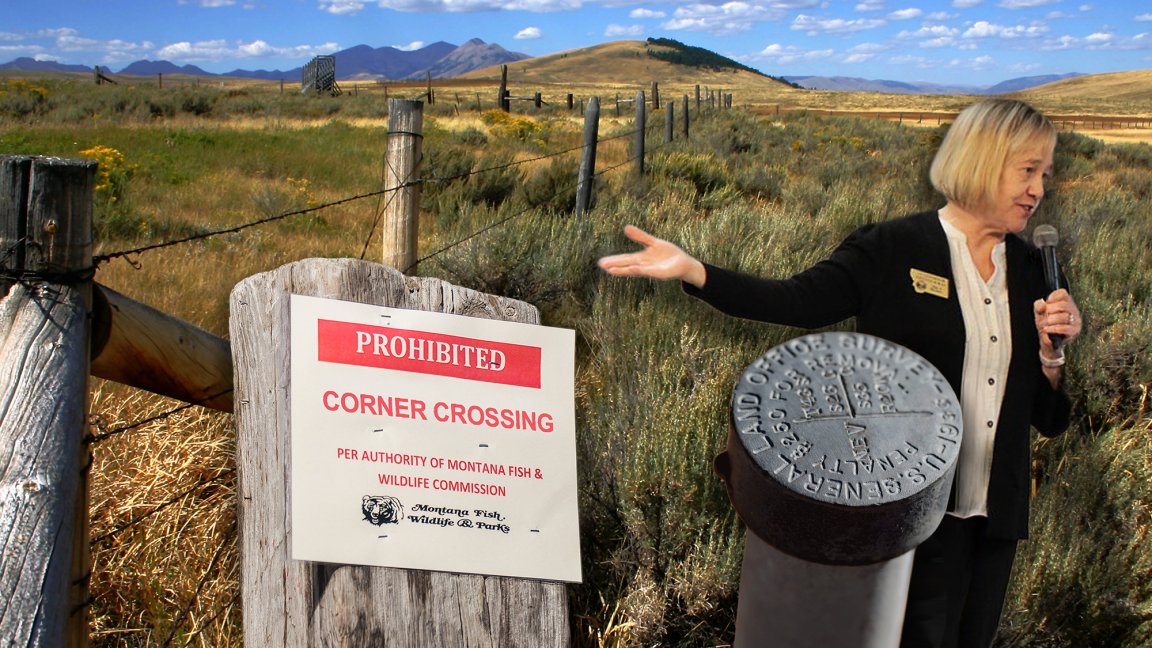
Two public-land groups sued the Montana government on Thursday to seek clarity on public access to roughly 871,000 acres of corner-locked federal public land.
Backcountry Hunters and Anglers and the Public Land Water Access Association jointly filed a legal complaint in Lewis and Clark County District Court “in an effort to cement the legality of corner crossing in Montana.” The lawsuit comes just a day after Montana’s Lieutenant Governor Kristen Juras told a legislative council in Helena that corner crossing is illegal. Critics suggested that Juras was simply offering a legal opinion rather than citing Montana law.
There are approximately 871,000 acres of federal public land in Montana that are “corner-locked,” according to a report from onX that has been widely referenced in the Montana corner-crossing debate. A clerk for the District Court in Lewis and Clark County confirmed the lawsuit was filed on May 14 against Montana Fish, Wildlife and Parks.
Representatives from BHA and PLWA have met with Montana FWP officials several times and “continue to advocate for a commonsense, collaborative solution that ensures private property is respected and public lands are not unlawfully enclosed,” according to a statement from BHA. A lack of progress on those talks has prompted both groups to sue.
Following the Supreme Court’s decision last year not to hear the Wyoming corner crossing case that legalized the practice in six states outside of Montana, MFWP director Christy Clark “reaffirmed” the agency’s position that corner crossing is illegal.
This position, however, is inconsistent with past legal memos that show game wardens were asked not to cite corner crossers since county attorneys in the state have not historically prosecuted corner crossers. BHA said it has filed suit as “a deliberate effort to keep the issue grounded in law and process rather than politics, ensuring clear direction for accessing Montana’s public lands — the cornerstone of Montana’s outdoor heritage and way of life.”
“I asked the director of FWP very directly last week, ‘In our point of view, there has been an escalation in the statements around corner crossing from the state. Why is that?’ The response is, because they’ve had an increase in people trespassing not at the corner,” says Ryan Callaghan, president and CEO of BHA. “But that doesn’t have anything to do with corner crossing. That’s akin to me going into the doctor’s office and saying I have a toothache and they amputate my arm. It’s a big procedure but it doesn’t address the issue.”
Walking on private ground without permission is clearly trespassing in Montana. Corner crossing, to Callaghan’s point, involves stepping from public land to public land without touching private property. The solution to trespassing problems, says Callaghan, is better education to resolve conflicts between private landowners and public users.
“It sounds like there is a trespassing issue. That’s a very serious thing in every state. We need to educate [hunters] on what trespassing is. It sounds like there’s frustrations with our agricultural community and people seeking access. We need to address that and provide that education.”
Another key point in the debate over respectful corner crossing are the practical problems that arise at corners with missing or damaged survey stakes, stakes on trees, places where corners don’t align with maps, and more. Juras has repeatedly pointed to these so-called “problem corners” as one reason corner crossing isn’t feasible in Montana.
“They are acknowledging, ‘If corner crossing is legal, what about all these problem corners, and all the problems that can come from this?’ We are aware that not every corner is visible, or straightforward, which is why we developed a tool to identify the problem corners. And once identified, we can work with adjacent landowners and agencies to find a solution,” says Callaghan. “The other thing that needs to be acknowledged is the vast majority of this happens where there are no fences, no private fences or BLM fences. These corners are out there in the great wide open.”
That mapping tool from BHA allows the public to report problem corners — both to alert potential users and to help identify locations for potential fixes.
Read Next: Montana’s Lt. Gov. Says Corner Crossing Is Illegal. Critics Say the Law Isn’t Clear
During a Montana State Bar webinar on Thursday, Lt. Gov. Juras said that she expects lawmakers to introduce legislation on corner crossing in the 2027 state legislative session, though she was not clear on what it might entail.