

After hours of impassioned debate on the Senate floor late Wednesday night, U.S. senators voted Thursday morning 50 to 49 to roll back key protections for the Boundary Waters Canoe Area Wilderness in northern Minnesota. It resurrects a proposal to develop of a foreign-owned copper-nickel mine at the headwaters of America’s most popular wilderness.
Senators Susan Collins (R-Maine) and Thom Tillis (R—N.C.) broke from their party to join the Senate’s 45 Democrats and two Independents to vote against the measure. Sen. Josh Hawley (R-Missouri) did not vote. The resolution will now go to President Trump’s desk for a signature.
Related: It’s a Dark Day for the Boundary Waters and the Future of Public Lands. Here’s How We Got Here
It was almost 9 p.m. in Washington D.C. before the debate began Wednesday night over House Joint Resolution 140, which was introduced by Rep. Pete Stauber (R-Minn.) and passed the House of Representatives in January. It overturns a 20-year mineral withdrawal in the Superior National Forest.
For more than three hours on Wednesday and again Thursday morning, Sen. Tina Smith (D-Minn.) urged her colleagues to vote against HJR 140. She hit on all the key reasons this mine is a bad trade for Americans: It would jeopardize the BWCA’s water and wildlife, threaten its outdoor economy, ignore public opinion, violate tribal treaties, support foreign mining interests over those of American citizens, ship raw ore overseas, and guarantee pollution of some of the most pristine waters in America. One poll showed about 70 percent of Minnesotans oppose the mine. About 98 percent of Americans who participated in a public-comment period (that brought in roughly 675,000 comments on the mineral withdraw) also opposed it.
“We are creating a pathway for this foreign company to build a mine, pollute the Boundary Waters, send the minerals to China, where they’ll be processed with this sweetheart deal, and then sold on the open market. And that is not an America-first strategy,” Smith said late Wednesday. “So I encourage my colleagues to take a look at who’s benefitting from this mine. And it certainly will not be, in the long run, Minnesotans. There are no real winners here except for this massive Chilean company.”
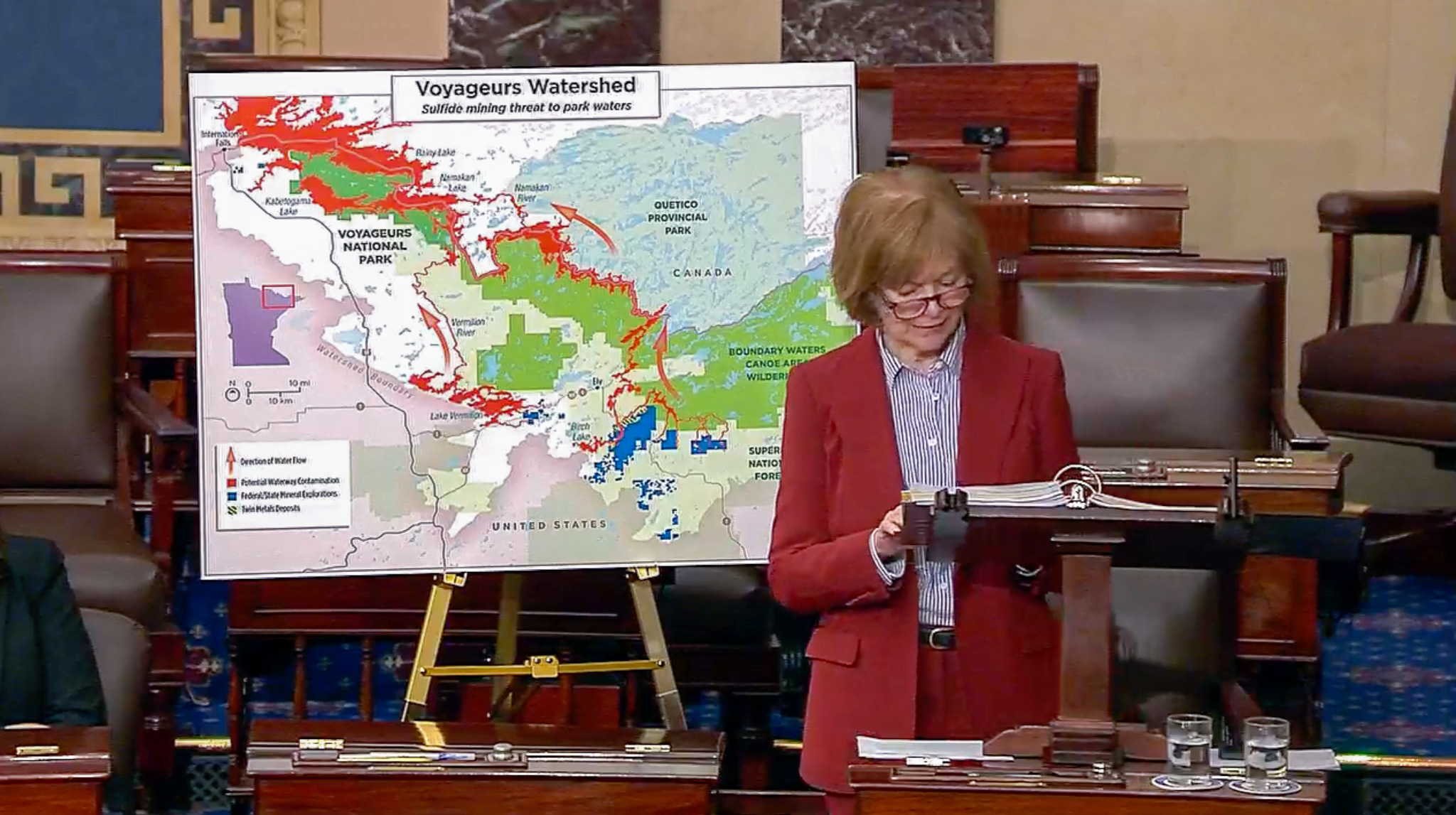
This vote also sets a dangerous precedent for the use of the Congressional Review Act, according to policy experts, to overturn the mineral withdrawal enacted in 2023. The CRA was intended to allow Congress to review agency rules in a 60-day legislative window; on Thursday it was used to throw out a public-land order from years before.
That’s a problem for our public lands, said Sen. Martin Heinrich (D-N.M.), speaking from the Senate floor late Wednesday.
“Instead of listening to Minnesotans and Americans from all over the country who care about this place,” Heinrich said, “Republicans today are using an unprecedented blunt-force legislative method that includes zero public comment — no comment period — to make decisions about our public land, without any input to whom those lands actually belong.”
Heinrich, whose voice broke while addressing the Senate Thursday morning, emphasized that this vote was not really about securing critical minerals for American national security.
“If we do this here, if we do it to the delegation from Minnesota who has spoken [against this], what about when it’s aimed at Montana? What about when it’s aimed at Alaska, when it’s aimed at South Dakota?” Heinrich said Thursday. “This is wrong.”
The decision is a reversal of an extensive environmental review of the proposed mine’s ecological footprint in the BWCA watershed. That, along with the public opposition, contributed to the 20-year moratorium Thursday’s Senate vote throws out. Smith says Thursday’s vote ushers in “chaos” and a lack of certainty whenever a different political party takes control of Congress.
“If this precedent is set, if we say, ‘Yep CRA can be used to undo a public land order,’ like we have here in the Boundary Waters,” Sen. Smith said Wednesday. “Well, then I would think some future Democratic Congress might think, ‘Hm let’s use the CRA to undo a fossil fuel lease, or a mining lease, or a timber lease we don’t think makes sense in South Dakota.’ This precedent would suggest you could use the CRA to undo a permit or undo a permit denial. It seems so broad, this precedent, that it could probably undo any determination on an administrative law matter. That seems to me to be really risky.”
Sen. Smith was joined in her opposition to the resolution with similarly impassioned speeches from Amy Klobuchar (D-Minn.) and Tammy Baldwin (D-Wisc.). While filibustering was not permitted under the particular constraints of the CRA, Smith spoke for roughly three of five allotted hours Wednesday. She concluded her arguments with tears in her eyes as she urged the Senate one final time to vote against HRJ 140.
Republicans hold the majority of 53 seats. In February Sen. Smith said she hoped to find four Republican senators to cross the aisle and vote with Democrats to uphold protections for the Boundary Waters. The Senators on the short list who might’ve been persuaded to break from their party, policy insiders say, included Senators John Boozman (R-Ark.), Lisa Murkowski (R-Alaska), Ron Johnson (R-Wisc.), and Todd Young (R-Ind.). Sen. Murkowski opposed development of the proposed Pebble Mine in her own state due its potential for ecological harm and resulting damage to the sporting and fishing industries.
All four of those senators voted in favor of stripping protections for the BWCA. None of these lawmakers immediately responded to requests for comment on their vote.
“Johnson could have been the swing vote on this whole thing,” says Land Tawney, co-chair of American Hunters and Anglers. “A bunch of people from Wisconsin go up to the Boundary Waters to recreate. He himself has fished up there a lot. I know that he was getting tons of phone calls from Republican donors, and he was telling them that he has concerns, and then he voted for this. He deserves the most accountability, I think, in a lot of ways.
Heinrich charged most Republican senators with ignoring their constituent’s wishes and voting instead for a short-sighted measure with long-term consequences. No Republicans addressed the Senate over HRJ 140 on Wednesday or Thursday.
“It’s incredibly disappointing after all of the work, after all of the conversations [we had] with these elected officials in D.C., and at the local and state levels,” says Lukas Leaf, executive director at Sportsmen for the Boundary Waters. “And knowing that there was an extreme apprehension from these offices, and yet they still voted this way.”
Despite the setback, says Leaf, he’s encouraged by the way the sporting and conservation communities rallied.
“It’s almost overwhelming seeing the groundswell of support that came out of this. Everybody came together on this and collectively pushed back as hard as they could. And I know from my standpoint, I am just proud to see that.”
Thursday’s vote permanently overturns the mineral withdrawal in three counties of the Superior National Forest. In anticipation of this Sen. Tina Smith and Rep. Betty McCollum (D-Minn.) introduced the Boundary Waters Wilderness Protection Act in the Senate this month and the House in January, respectively. It would remove 225,000 acres of federal lands and waters from sulfide-ore mining development.
“We have an opportunity to come together to protect our clean water future and public lands,” Trout Unlimited‘s public lands policy director Corey Fisher said in a statement Thursday. “Congress must pass the Boundary Waters Protection Act to ensure that the Boundary Waters remains a great place to hunt and fish for generations to come.”
Dac Collins contributed reporting. This story is developing.