
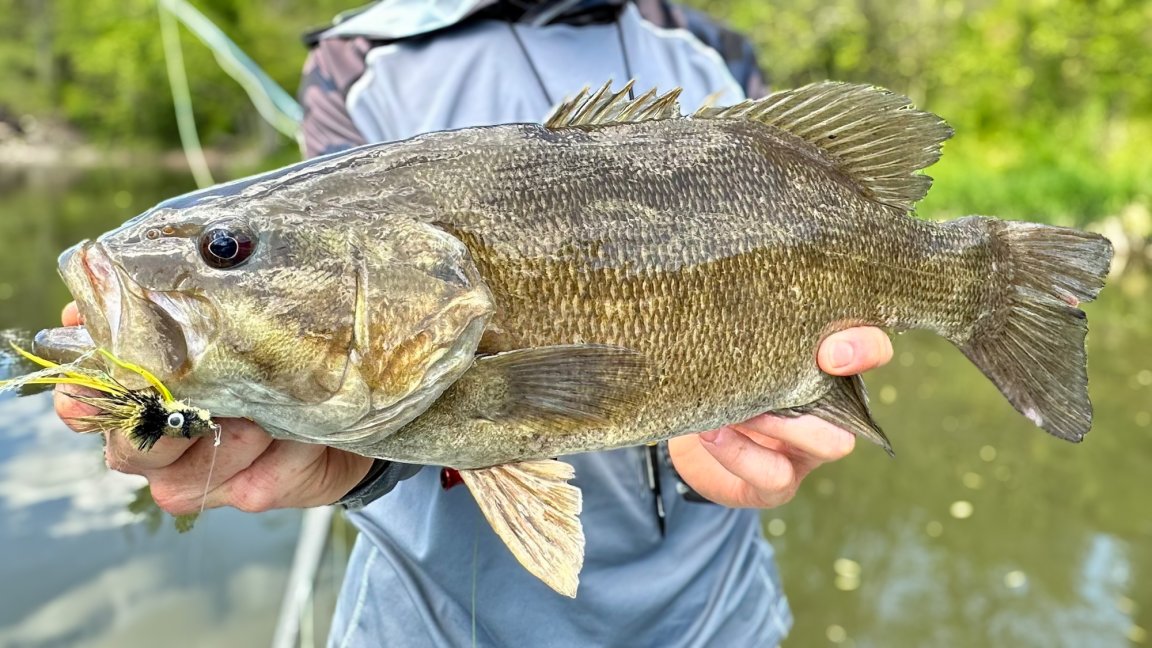
Fall is the perfect time to target river bass. That’s why this week on the Outdoor Life Podcast, I caught up with Jake Villwock of Relentless Fly Fishing for a complete nerd session on all things river smallmouth. Get out your pen and paper, because we’re going over the best lures, the best flies, and how to fish them. We also hit on invasive catfish, water quality, and more.
Listen to this week’s episode on Apple, Spotify, or wherever you get your podcasts.
Full Episode Transcript
Scott Einsmann: Jake, pleasure having you on the podcast. I had the opportunity to fish with Jake last year with a celebrity guest, P.J. Reilly. And we had a banger of a day. I forget how many fish we caught — over 60 smallies. And so Jake, you guide both for fly and gear, mostly rivers, right?
Jake Villwock: Yes. All, 100 percent rivers, yeah.
Scott: A hundred percent rivers. What are the main river systems that you’re fishing?
Jake: We’ve got the Susquehanna River here in Pennsylvania, and then the largest tributary to it, which is the Juniata River — which, if you’re on the Juniata River, it doesn’t really look like a quote-unquote tributary. It looks like a full-on river. But those are the main two that we fish. There’s plenty of other fisheries in the state as well. There’s some pretty good ones out on the western side, like the Allegheny and the Youghiogheny, out towards Pittsburgh and stuff. But the main two that we’re fishing are the two big ones on the east side, which are, like I said, the Susquehanna and Juniata.
Related: The 7 Best Smallmouth Lakes and Rivers
Scott: Okay. Right off the bat, people are gonna wanna know: as a smallmouth guide, what are your go-to lures? You know, your confidence baits — maybe like a top five.
Jake: Well, number one for conventional is gonna be the Ned rig — the Z-Man Ned rig in Green Pumpkin Goby. That’s the color that I find works the best. And for most of our system — I know I get asked this a lot too — it’s like, what size jighead do you use? On typical summer days when we’ve got flows in that kind of four-foot range, or 2,000 CFS range, the 1/20 is about all you need. Once you get about four and a half to five feet, that 1/15 is really good for most of our systems. But then if we get super low — they’re not Z-Man brand, but I did find some 1/32 jigheads that actually work really well when the water’s like under three feet, which we deal with a lot this year. That’s a pretty good one.
Another one is just a three-and-a-half to four-inch rubber fluke. Zoom makes the fluke. I mean, everybody has some sort of rubber baitfish. There’s another brand out there called River Rock. They’re out of Virginia, and they make a jerk minnow, which is a soft plastic, basically a jerk bait. And I run it on a kind of weedless, sled-style weighted hook, and you can dead-stick them — you can fish them just like a tube jig if you want, or you can actually fish them like a minnow. But those are super great because they have the action of a jerk bait that has nine hooks on it, three trebles, but you only have one hook, and they eat them really well.
So that’s number two. When it comes to top water, I’m a huge fan of the Megabass Dog-X Jr., and it’s basically a walking bait, you know, like a Dog-X or anything like that. But they’re only two and three-quarter inches, and you can launch them a country mile. So they’re heavy enough to get where you need to, but they are such a subtle presentation. Whopper Ploppers are also great. Everybody loves those things because they’re super funny when they go across the water and fish fly out of the water for them. But there’s a lot of times where the water we fish is just too clear, or those fish have just been pressured too much. And so that little Dog-X Jr. is awesome for that. When it comes to more subsurface stuff, the other one I really like is the Zoom Micro Speed Craw.
Related: The Best Smallmouth Bass Lures: The Only Baits You Need to Catch Giant Smallies
So Zoom makes a Speed Craw — they’ve had it forever. I run that one weedless as well. But they make a micro now that’s like two and three-quarters, three inches. I can’t remember the exact one. So I’ll back up and just give you the list now: Z-Man Neds, Micro Speed Craws by Zoom, those River Rock jerk minnows, the Dog-X Jr. And then, honestly, I love crankbaits. Crankbaits are one of my favorite ones to use. They’ve got different sizes obviously, but for most of the rivers that I fish, I like those — I think they’re 50s. Yeah, 50s or 55s. Like, they’re the smaller ones. They’re only like two and a half inches long. But there are times, like springtime, where I can get away with like a 75, or basically a full-size crankbait.
But those are my top five for sure.
Scott: And so you said the green pumpkin color for the classic Ned rig. What about some colors for the others?
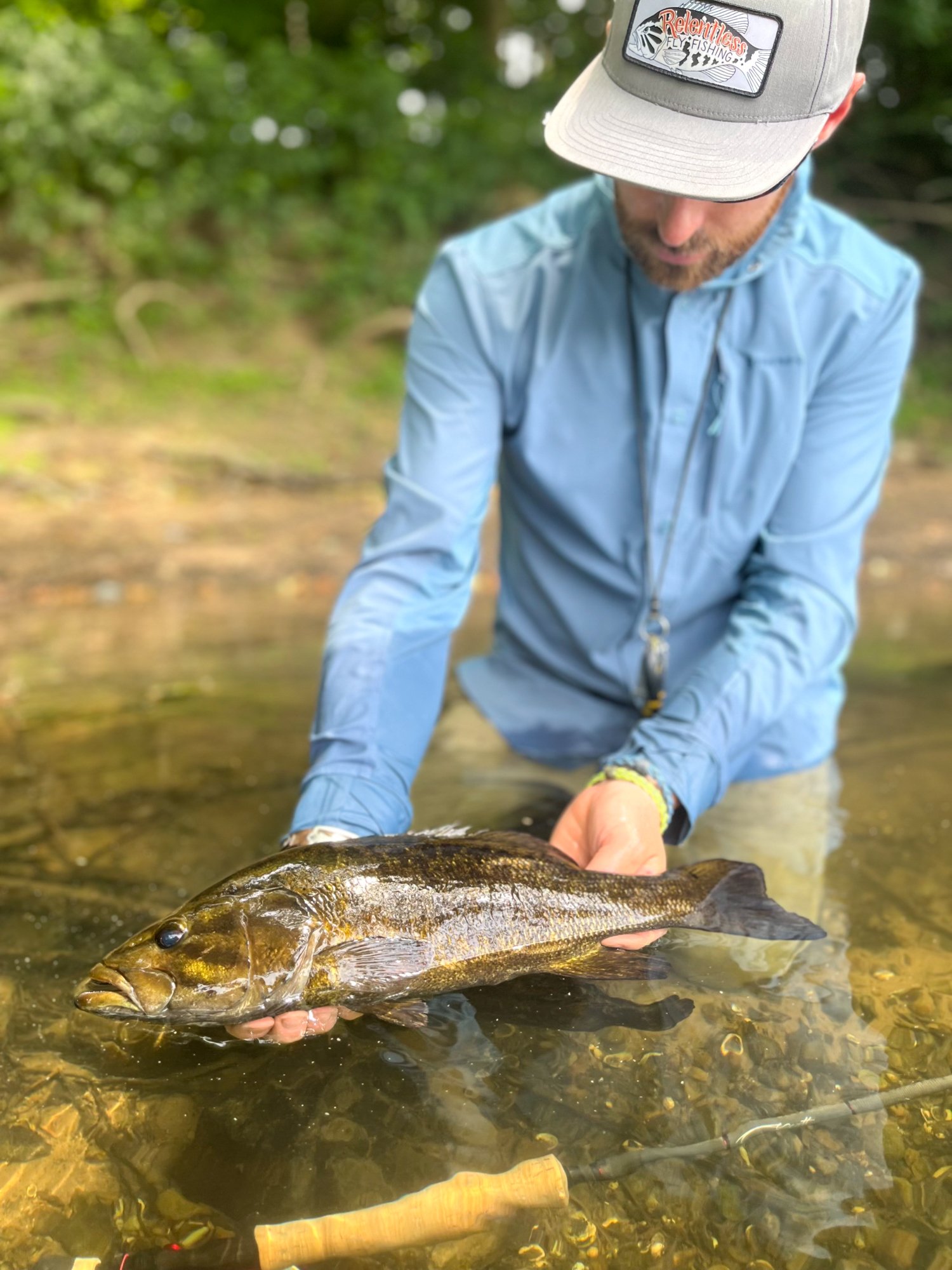
Jake: The Zoom Speed Craw — they have a Green Pumpkin Magic, which is basically green pumpkin, but it’s got some purple flakes in it. I absolutely love that color. Just plain green pumpkin is great. They have a black one, which is awesome for dirty water. And the standard sizes, they have a bunch of different colors. The micros, they don’t. But in the standard, when we do have higher water, I will use that black with purple flake. That one’s awesome. When it comes to the Z-Man: green pumpkin, Green Pumpkin Goby, California Craw, and peanut butter and jelly. Those are the four colors that I have the most of in my boat. For the jerk minnow, they have one, it’s called Blunt Nose Shiner. And it’s basically a white belly with like this brownish tan back with black, gold, and purple flake in it.
That one’s been my number one for the summer, but honestly, white — all white — is great. I was doing a fly presentation one time when I was talking about the color of the minnow patterns that we fish, and a guy asked me one time — because I would say white is like the number one color, because you can see it, you can stay active, you can watch it, you have that visual recognition of whether or not a fish eats it. And a guy asked me, he goes, “What minnow in real life is all white?” And I had to think for a second, because I never was asked that question. And I realized pretty quickly that every single minnow has a white or a light tan belly.
And most of the time when fish are chasing minnows, they’re coming up from the bottom. So white is kind of a color they see all the time. And the white on the top is just easier for us to see. So that’s really important for that. For the Dog-X Jr., honestly, they have so many colors and they have so many weird names to them that I can’t even remember. But basically anything that has a whitish hue to it. Or there’s one that’s called — it’s not wasabi, but it sounds like wasabi. And it’s kind of this —
Scott: It’s like Wakasagi?
Jake: Yeah, that’s it. Exactly. That color has been awesome. I had a — I think it was called Milky Shad, and it was like this pale color on it. That one’s awesome. And then for crankbaits, my favorite is like a chartreuse shad color that’s got a little bit of blue in it, some white. That’s always been my number one, but a bluegill-colored one is also awesome. And then if you’ve got some dirtier water, black — or honestly, orange and black is really good for dirty water. But I don’t go super deep in a lot of those different colors, just because the fish that we have and the system we have is not changing a lot for the bait. So once you know the confidence colors, you just stick with those.
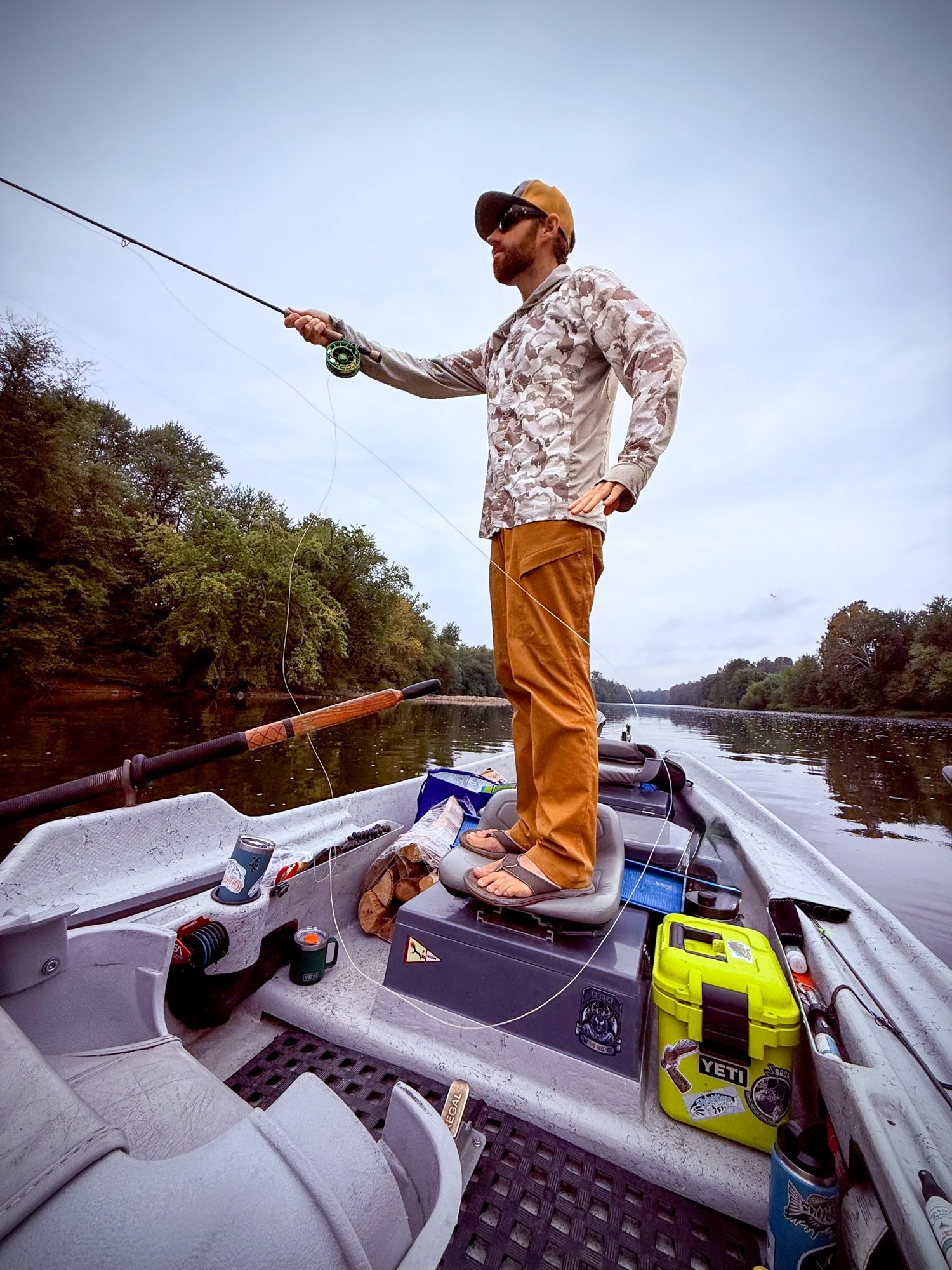
Scott: Yeah, that makes perfect sense. And are you throwing all those on spinning rods?
Jake: Spinning rods, and I throw a lot of baitcasters myself. I’ve gotten really big into, in the last couple years, the bait finesse system stuff. So like the micro baitcasters — and they are super fun, super accurate. And honestly, spinfishing is great. It’s taught me so much about fly design and presenting flies on that side. But I had a client show up that I spinfished with for years, and he brought one, and at first I said, “Do you know how to use that thing? ’Cause I’m not dealing with all your backlashes.” And he’s like, “No, this thing’s got a computer in it. It’s great.” And I was like, “What? Why?” I didn’t even know what BFS was. He was the one that introduced me to it.
And after that, I now have three of them. And I’ve got one set up for Neds, I’ve got one set up for smaller swimbaits, and I’ve got one set up for those like Dog-X Jrs. And they are just absolutely fantastic. And the brand that I like — now, everybody has one — but Cashion out of North Carolina makes a BFS rod. It’s a 6-foot-10 medium fast, and that rod is so accurate and so sensitive. It’s unbelievable.
Scott: What about for the reel?
Jake: The reel, I’m using the Shimano Curado BFS reel. I mean, again, there’s so many other reels out there, but I actually bought a Cashion crankbait-specific rod, and I just got the Curado DC for that as well. And they’re awesome. I mean, they’re super smooth, they’re super controlled. And honestly, I’ve put them in the hands of people that have really never done it, and they seem to be able to fish them great. So I get so excited about it that my spinfishing clients, I’m always like, “Hey, you guys, you gotta try this.” And I also have an extra spool of line in case I have to cut it all off and put more on. But it’s a phenomenal way to fish for sure.
Read Next: The Only Rod and Reel You Need for Bass Fishing
Scott: Yeah. It’s super fun. I got into BFS, I don’t know how many years ago, but back then you could only get like the really good stuff from Japan and have it shipped over. So I like the JDM version of that Curado BFS — such a great reel. Let’s move on to fly stuff. What about some of your go-to flies?
Jake: Ooh. There’s so many. There’s really not, actually. And especially in the summertime, I try to go super, super simple on my patterns. When it comes to top water, the top two that I use are the Boogle Bug, which is just a basic popper. They’re pretty expensive, but they’re also very durable, and for whatever reason, fish eat them five to 10 to one off of any other popper that I’ve ever fished. And then there’s a fly called the Ol’ Mr. Wiggly, which is basically just a foam grasshopper that was designed for smallmouth and not trout. And the guys at Tight Lines Fly Fishing up in Wisconsin came up with that. Those are my top two for top water. And then kind of going into the mid-column, one of my signature flies, the Roamer — it’s basically a fluke.
I mean, it’s designed to be able to hover, to be able to pause, to kind of have that side-to-side swimming action. And the cool part about that fly is you can tie it in a triple, so it’s got two hooks and a shank and it’s five or six inches long. You can tie it down to a single that’s only two inches long. So that fly platform can pretty much imitate any minnow size that you need, which is great. And then there’s so many different baitfish patterns, but that one’s definitely my favorite. Another one would be the Game Changer — Blane Chocklett’s Game Changer. I love the Feather Changer. It’s relatively easy to tie and get a good taper to it, but it’s also just super easy for a lot of people to fish, because it has so many joints in it that if you don’t know how to properly present a streamer — because there is a proper and an improper way to do it — but that fly will always move.
So you could give it to a kid and they can still have a great day with it, which is awesome. And then subsurface, on the bottom, crayfish. There’s a bunch of crayfish patterns out there, and I’m not ever gonna say that the pattern I’ve come up with is the best one, because it probably isn’t, but it works really well. It’s got some foam that separates the claws, so the claws never overlap or collapse over the — or, excuse me, wrap around the hook. And then to counterbalance that foam, I use a tungsten bead for the head. And you can feel tungsten way better because it’s much more dense than lead or brass. And so you can feel it bouncing on the bottom with a fly rod just like you could a Ned rig with a spinning rod.

And it works really well. It’s about two and a half inches long. That one is called the Crawl Daddy. And so that one and the Roamer will be available to purchase from Montana Fly Company here coming up pretty soon, which is kind of exciting. In the next two years, I’m gonna have nine of my patterns being released from Montana Fly Company, because they’re probably the largest, if not top two, fly manufacturers in the industry. So I’ll just say that again: Boogle Bug, Ol’ Mr. Wiggly, Roamer, Feather Game Changer, and the Crawl Daddy Crayfish.
Scott: Nice. Those are some good ones. What are some dos and don’ts for fishing a streamer?
Jake: I’d say one of the biggest don’ts is fishing it too fast. Especially a swim fly or a baitfish pattern. In the springtime — and that’s something we can kind of go off in left field on if you want to right now — but in the springtime, those fish are super aggressive. And so you can fish them a lot faster, a lot harder, strip them faster, jerk the rod tip to get the fly to move a little bit more aggressively. But in the summertime, which is three quarters of our smallmouth season, those fish have so much food that they don’t have to or want to chase bait going at Mach 7. And so the way I describe it is you’re basically just a minnow out for a stroll.
You’re an unsuspecting minnow that’s just swimming around. You’re not imitating a wounded minnow at this point. You’re just creating an easy meal for a fish to grab without thinking about it. And so I’ve seen it so many times where people just rip them through, and I’m like, you’re gonna catch fish. You’re gonna catch fish for sure. You’re gonna catch smaller fish, though. The big fish are gonna track it for a little bit and they’re gonna wait for that thing to pause, and they’re gonna eat it right on that pause and right as you go to strip it again. So don’t fish them too fast. You can’t fish them too slow. And always pause them. Always pause, because the pause is what really gets them. And a lot of times that pause is where the motion of that fly comes from.
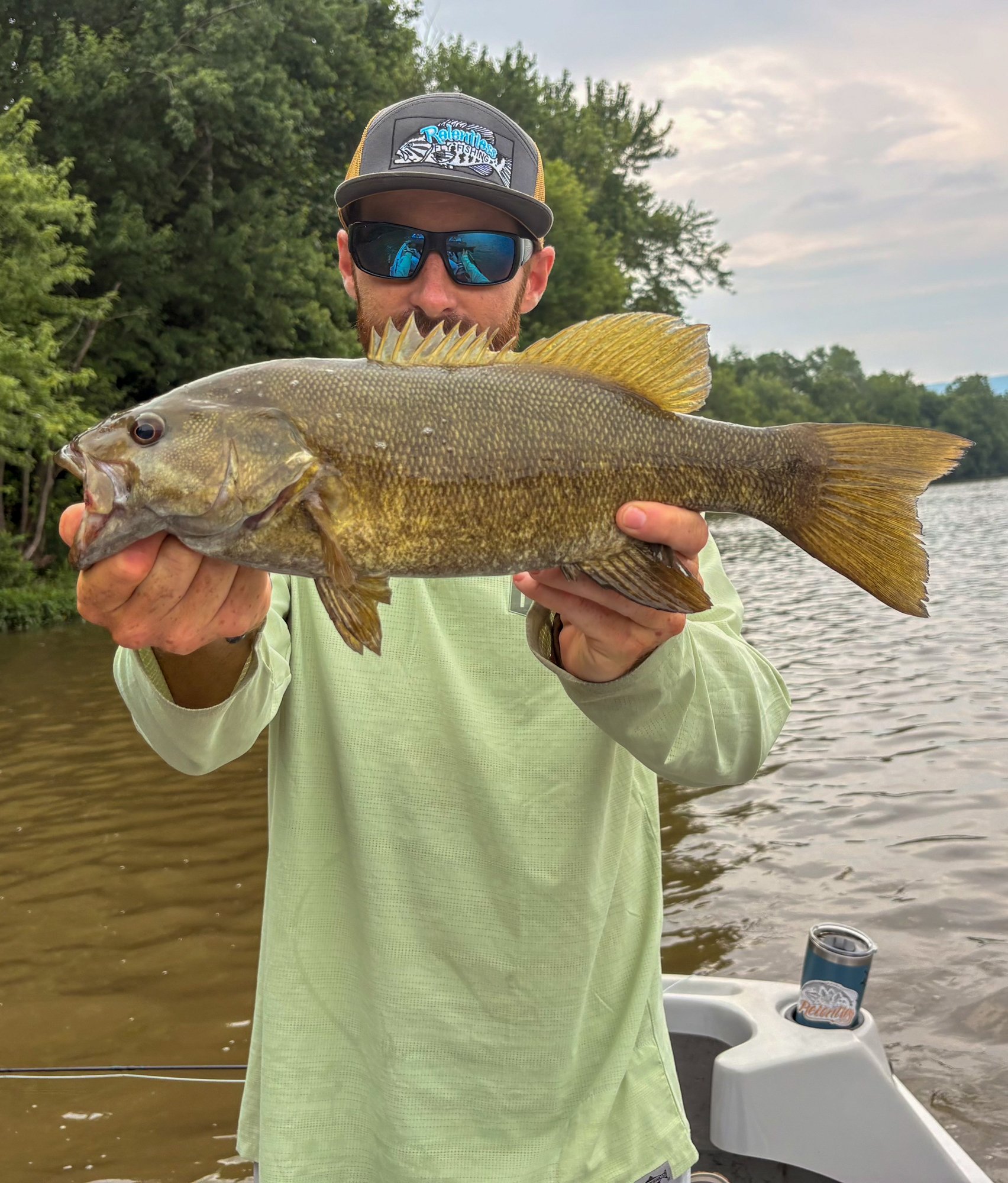
For instance, when you fish the Roamer, when you stop that fly, it’s such a light fly that when the water hits one side or the other of the head, it’s gonna push that water down the opposite side and it’s gonna move that fly to glide to the right or glide to the left. And then it’s just gonna sit there and kind of wiggle there in the current. And that’s very natural. And if you can create a fly, or you can get a fly to do that, that’s where you’re gonna get most of your fish. When it comes to crayfish, that’s super tough to kind of describe, because you wanna keep it on the bottom, but it’s the same thing: a natural crayfish only moves when it absolutely has to.
I mean, they’ll crawl around on the bottom, but a swimming — or what we call a crayfish hop, where it’s kind of bouncing up and down — those are crayfish that are being chased already. And so we really wanna create that crawling-around-on-the-bottom presentation, or occasionally flip it up over a rock or something. And so that really comes with practice, and knowing what it feels like to be moving too slow on the bottom, or getting stuck a lot. And so I tell people, the rule is, fish it as slow as you can until you’re getting stuck on every cast, and then speed it up 10 percent. And I don’t know what that 10 percent really is, but people seem to understand it and they just do it.
So slow is important for that too, but too slow is spending way too much time on the bottom, which is kind of no fun. And then top water — this year’s been super different compared to the last 10 years. So it’s kind of been an interesting summer and also a frustrating summer, because everything that I’ve learned in the last 10 to 15 years about fish and poppers and things like that has kind of been thrown out the window because of our water conditions. But typically when we fish poppers, the biggest rule of thumb is don’t pop the popper. Most fish, at least in our system, because they are extremely pressured — not only from float fishermen, but from kayak fishermen and jet boats and just bank fishermen; there’s plenty of anglers around — there’s nothing natural in life that goes across the water and sounds like bloop, bloop, bloop, bloop constantly.
And so they’re getting spooked off of that presentation, where if you’re just throwing it out there and twitching it, it’s more of a struggling bug than it is something that’s moving across the water at crazy speeds.
Scott: So a six-inch Dahlberg Diver is not gonna work?
Jake: Probably not. It might work in the springtime when they don’t really care, but summertime, not so much.
Scott: Yeah, that makes sense.
Jake: We can throw P.J. under the bus right now and talk about how much he loves throwing spinnerbaits when the water’s low and clear and there’s not a single fish in the river that wants to eat it. You know, they’re loud and obnoxious and they definitely have a time and a place. And I would say if I had a top six, a spinnerbait would be the sixth one, because there’s lots of times when that noise is really important, when the water’s dirty or high or whatever.
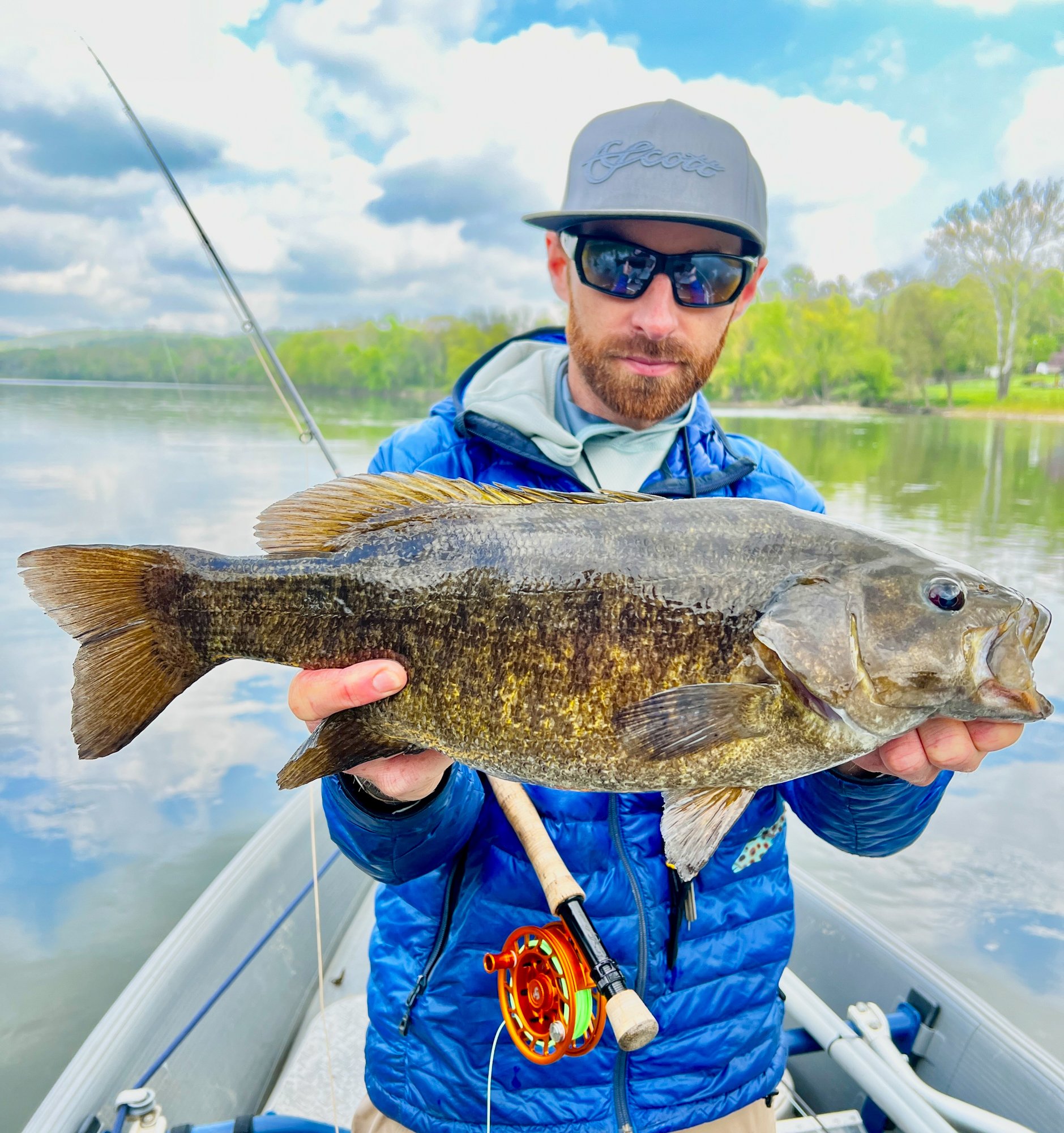
Scott: All righty. Well, I think river smallmouth fishing is one of the most fun things to do. You get numbers, you can get some quality, really great scenery. This is like a fun experience. So you run a whole outfit with a bunch of different guides. When do you think is the best time to come visit your outfit?
Jake: That’s a great question. And I tell people a lot, the last two weeks of April, first two weeks of May, if you wanna get into smaller creeks with bigger fish — that’s typically when the water levels are the most consistent, the weather’s the most consistent, and there’s enough fish in the systems that you can have really good days. But when it comes to summertime, which is kind of what you think is your classic smallmouth season, July and August are typically the best two months for smallmouth. This year, again, it’s all weather and flow dependent, but this year September was better than July. August is normally pretty consistent, but July through September is the summer months, and then the last two weeks of April, first two weeks of May for spring stuff.
Now, there’s shorter seasons too, and honestly, the entire month of April and the entire month of May are normally pretty good. But we’re in Pennsylvania, and so there are plenty of times where the first week of April we still get a snowstorm. So you don’t think about smallmouth fishing in a snowstorm, but there are days where we’re out there and it’s snowing all day and we’re like, “What are we doing?” But that’s why the last two weeks of April is typically what I like, because it’s the most consistent.
Scott: Would you say that late spring, late summer — it’s kind of true for like throughout the East Coast, because there’s a bunch of different river systems all up and down the East Coast, they’re similar?
Jake: Yeah. I would say, I mean, honestly, not even East Coast — like, full Midwest. All prime smallmouth fisheries are those two seasons. Sometimes when you have systems where, for instance, for us, all the little creeks that we fish, there’s always resident fish in there, right? So you can go fish the summertime and wade fish. I mean, they’re small, and typically in the summer there’s not enough water to even float a kayak down them, but there’s still plenty of fish. But in the springtime, that’s when those bigger fish are migrating from the Susquehanna and the Juniata to go spawn. And so we fish that migration of those fish coming in and going out, and we try to stay away from them during the spawn. But there’s a point where they’re gone from those things, like towards the end of May into early June.
But then there’s also — it totally depends on March. Like, if we have a warm March, you can be out fishing for smallmouth the last two weeks of March because there’s fish starting to trickle in. Now, you’re not gonna catch numbers of fish, but typically, I’ve found in the last 15 years, is that there’s a push of bigger females first in early season. And so you can get into some pretty big fish, but you might only catch 10 or 15 instead of 40 to 60. So it just depends on what you wanna do.
Scott: And you touched on this earlier, but what would be an ideal weather condition and water condition?
Jake: Water condition — I mean, clear is really cool, because it’s technical and you can sight-fish, right? So you can see fish sitting up on the flats and you can pick a fish and you can cast to it. And so honestly, I don’t look at feet a lot, but I look at CFS. And on our bigger river — or on the Juniata, I’ll just use that as an example — 1,000 CFS and clear is one of my favorite times. And high sun, because with high sun you can see them. And a lot of people talk about sun and shade angles and this or that, and I do think there’s a lot of merit to that, but when it comes to wanting to sight-fish, high sun, low clear water is the best conditions you can have.
dirty. Smallmouth hunt with their eyes primarily.That is their favorite sense to use to hunt. So if they can see, they’re gonna be the most aggressive.
But if you wanna go out and be able to have more options of presentations — meaning if you wanna be able to maybe pop a popper a little harder than normally, or throw a frog pattern, or throw a bigger streamer or something like that — that kind of 2,000 CFS, 1,800 CFS with a slight tinge of color, so what we describe as like big-fish green, where you can still see the bottom but there’s a little bit of sediment in there, that’s when those fish are probably the most aggressive. And on a falling water level, right? So like yesterday, for instance, the river came up 4,000 CFS in two days, and we caught fish in it, but when it started to drop the second day, we definitely caught more fish, and they were starting to get a little more active.
So falling water or consistent water level are the two where you’re gonna have the most consistent fishing. Rising water, it totally depends on how fast it’s coming up and what the color of it is. But that 1,000 to 2,000 CFS level — or I would say probably 3.8 feet to 4.7 feet, if you’re thinking about feet, and I could be slightly off, but that’s roughly what I would say. And then water temp, in the springtime you want like 60 to 65; that’s when they’re gonna get the most aggressive. And then in the summertime it doesn’t really matter, as long as it’s not 98-degree water temperature. I personally love high sun because you can fish shade lines or you can be out in the flats looking for them. But if you want the most forgiving fish, cloudy days are definitely better for not having to be perfect every cast.
Scott: Would low and clear water be the worst condition?
Jake: The worst condition would be super high, with trees floating down the river and not having more than one inch in visibility. I mean, dirty. Smallmouth hunt with their eyes primarily. I mean, that is their favorite sense to use to hunt. So if they can see, they’re gonna be the most aggressive. Now, they do use lateral lines. They do use sound — well, I guess that’s lateral line vibration. And they do use sense of smell. And so that’s where sometimes when the water is high and muddy, you can get away with still having a great day, as long as it’s not rising super fast. Fishing darker flies, like blacks and purples. Honestly, black and purple is really all you ever need. I’m not even gonna go down a rabbit hole of different color combinations.
But black and purple with a little bit of chartreuse accent has always been my number one for dark water. Another interesting thing about them when it comes to conditions like that is that in the trout world, everybody says dark water, dark day, dark fly; bright day, clear water, light fly. And that is totally true of smallmouth as well. However, when you have dirty water and you also have a high sun day, it’s kind of interesting to see this, but if you take a white or a white and chartreuse fly and you drop it in the water, you will see this glowing halo around that fly. So even though we can’t see, sunlight is still getting through that sediment, and those bass can actually see a brighter, lighter fly in dirty water if there’s sunlight coming through it.
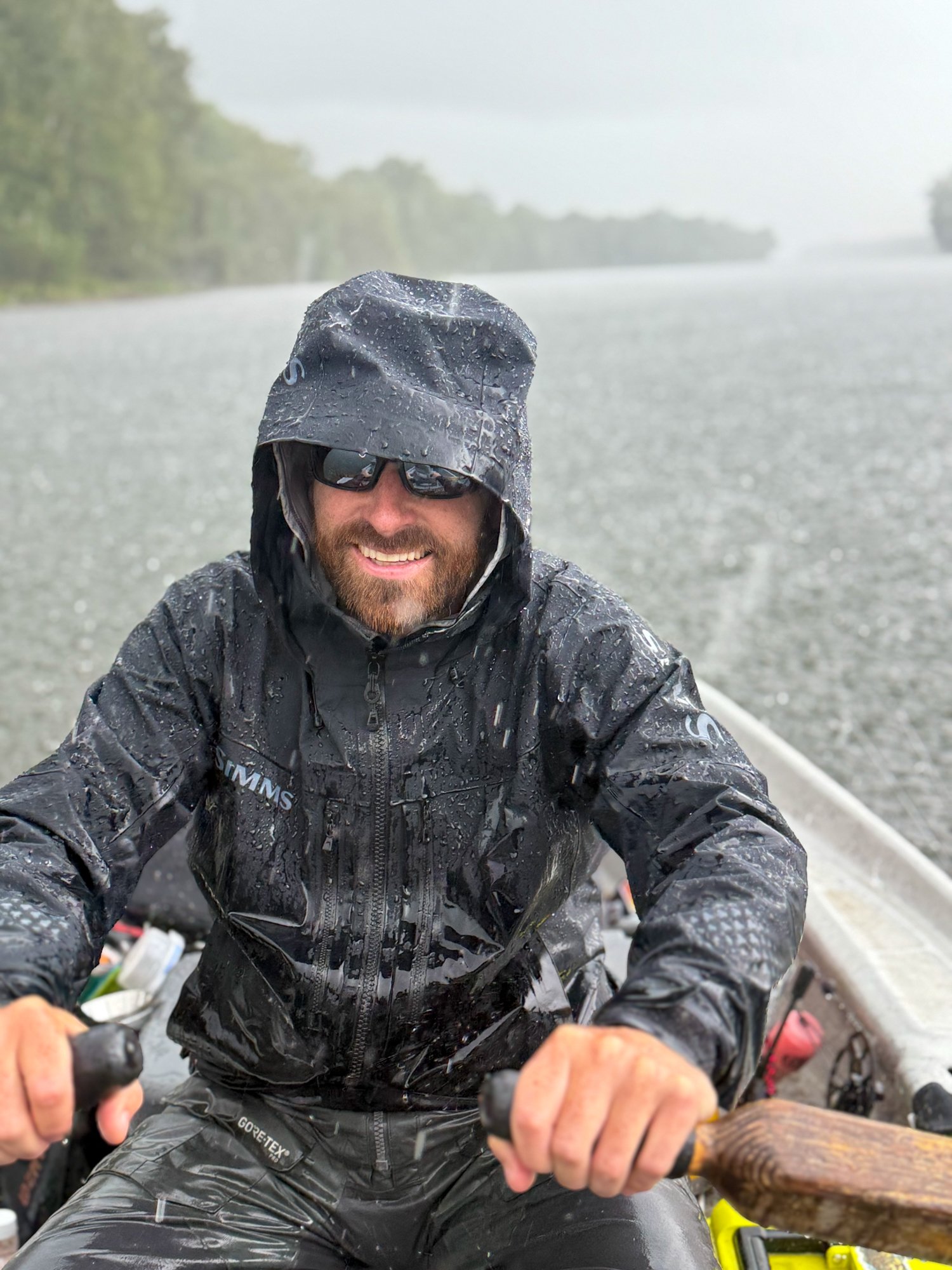
Now, if you throw that white fly in there on a dark day, like cloudy or rainy, it disappears immediately because there’s no sun grabbing it. And so I say if it’s dirty water on a bright day, go white or something super bright. And if it’s dirty water on a dark day, then go black and purple, because they’ll see that silhouette way better.
Scott: Man, you’re giving away all the secrets today. Love it. What about for that low water like you had all summer? What are you doing?
Jake: I’m primarily sight-fishing. We’re basically spring creek trout fishing for smallmouth. So we’re running six-weights instead of seven- or eight-weights. We’re running 10- to 12-foot leaders. We’re dropping down to eight-pound. I don’t go any lower than eight-pound on any of my spinning reels or my tippet for smallmouth, because yeah, you might catch or hook one or two more, but you get them in grass with six-pound and it’s gone immediately. And so you’re just losing flies and decorating fish at that point. So low clear water: smaller, lighter flies. I try to stay away from cork flies because — like Boogle Bugs, for instance, they are a cork popper head — and so they do hit the water a little hard if you’re not paying attention.
So I will typically switch to a foam popper because they hit the water softer. I’m running more natural stuff like those Mr. Wigglys, or actual — I’ve got like an entire row of grasshoppers and smaller Western terrestrial flies that we use a lot for that stuff. And so you go more natural, you go smaller, you go lighter, you go further. That’s kind of my checklist, if you will.
Scott: That makes perfect sense. All right. Let’s say you were to go on a trip somewhere, you wanna go fish for river smallies — what are some of the destination places that you would like to visit?
Jake: That’s a great question, because I’m trying to do that right now. Wisconsin — I would love to go up to Wisconsin and fish with the guys from Tight Lines. They’re on the Menominee River, which splits Wisconsin and Michigan. Honestly, spoiler, I have fished it one day, eight, nine, 10, 11 years ago, and it was phenomenal, and I’ve wanted to go back ever since. So that’s on my top list. Michigan, in the kind of Ann Arbor area, is really awesome. I’ve done that a couple times and I love that fishery. So Mike Schultz out there at Schultz Outfitters — he’s got a great program, and their fishery is so much different than ours, but also similar, right? So it’s smaller water.
You know, some of the rivers are so small that you physically cannot cast off the side of the boat. You have to cast out of the front of the boat, because they’re so skinny that if you were casting right off the side of the boat, you have spooked every fish ahead of time. So that’s a good one. And then Virginia. Virginia’s got some phenomenal water down there. I think that’s got some great stuff. So you’ve got the Shenandoah, you’ve got the New River and the James River. And those are pretty cool. I mean, I would love to someday get on like the Mississippi, like really big water. That would be super fun. I’m actually trying to get Dan McCarthy to bring me up to his house and run around on the jet boat, but our schedules haven’t quite aligned yet.
But that’s kind of the main three, if not four. New York has some great stuff too, but that Midwest area is definitely the coolest smallmouth fishing. And then Virginia’s just got some really cool, like, clear water, deep water, and it’s just kind of different, which is nice. And then of course PA.
Scott: Yes, of course. I mean, the Susquehanna has to be one of like the best-kept secrets in smallies. So —
Jake: I don’t even know if I’d call it a secret, but yeah, it’s definitely —
Scott: Yeah. Tell us a little bit about that river system and what makes it so special.
Jake: I mean, it’s huge. That’s one of the biggest things. It’s 440 miles long in the state of Pennsylvania, if you add the mainstem, the west branch, and the north branch and you put all those together. I think the most unique thing about it is how wide it is. If you’re down towards Harrisburg, it’s a mile wide. And that’s big water. I mean, the Juniata, for instance, is a quarter of a mile at its widest. So even that, if I’m going from one side to the other, it takes like five minutes. I’m like, man, if I wanted to go from the east side to the west side of the Susquehanna, it’d take me 25 minutes just to get there in a drift boat. Now, it’s a great jet boat fishery.
But the other thing that makes it super unique and special is the amount of islands and the amount of grass beds. There’s definitely a lot of water that’s consistent, where if you know it, you’re like, we’re gonna go here and we’re gonna catch them. But if you’re floating down the river in a drift boat or a raft or a kayak, you’re almost always fishing like a prospecting style, where you don’t really know where they are because they could be anywhere. But if you’ve read anything about smallmouth, they always talk about the points of islands, the tail ends of grass beds — you’re just fishing so much more structure. And I think that’s what’s really cool about it. You have targets to hit, you know?
And so you’ve got rock piles and you’ve got grass and all of this stuff. And then you’ve got the banks. And I think what’s super interesting — I guess the most interesting part of the Susquehanna — is that on a lot of bass fisheries, you’re just floating down the river fishing the banks, whether they’re 100 feet wide or 100 yards wide or a quarter mile wide; you’re still fishing the banks. Susquehanna, you could run straight down the middle of it and never touch the bank and still have plenty of opportunities. And I think that’s super cool. And then it’s got so many different creeks that dump into it. And so there’s always cold water in the summertime. You can run up some of these little creeks and float into the Susquehanna.
And so it just gives you so many options to fish. And there’s some giant smallmouth in there too, right? It’s a tough one to really calibrate with how many there are in there. But if you fish one of the tributaries to these creeks in the spring and you’re catching these fish and you’re like, “Wow, there’s so many fish in here,” I’m like, yeah, just think how many are actually in the Susquehanna. If this is 3 percent of the fish population coming into this one creek, it’s wild.
Scott: What would be a big fish for that river?
Jake: Twenty-two, 23. I mean, that would be your unicorn, but there’s plenty of 20-inch smallmouth in there. There’s plenty of 21s. And honestly, anything 20 inches or better is still kind of a unicorn.
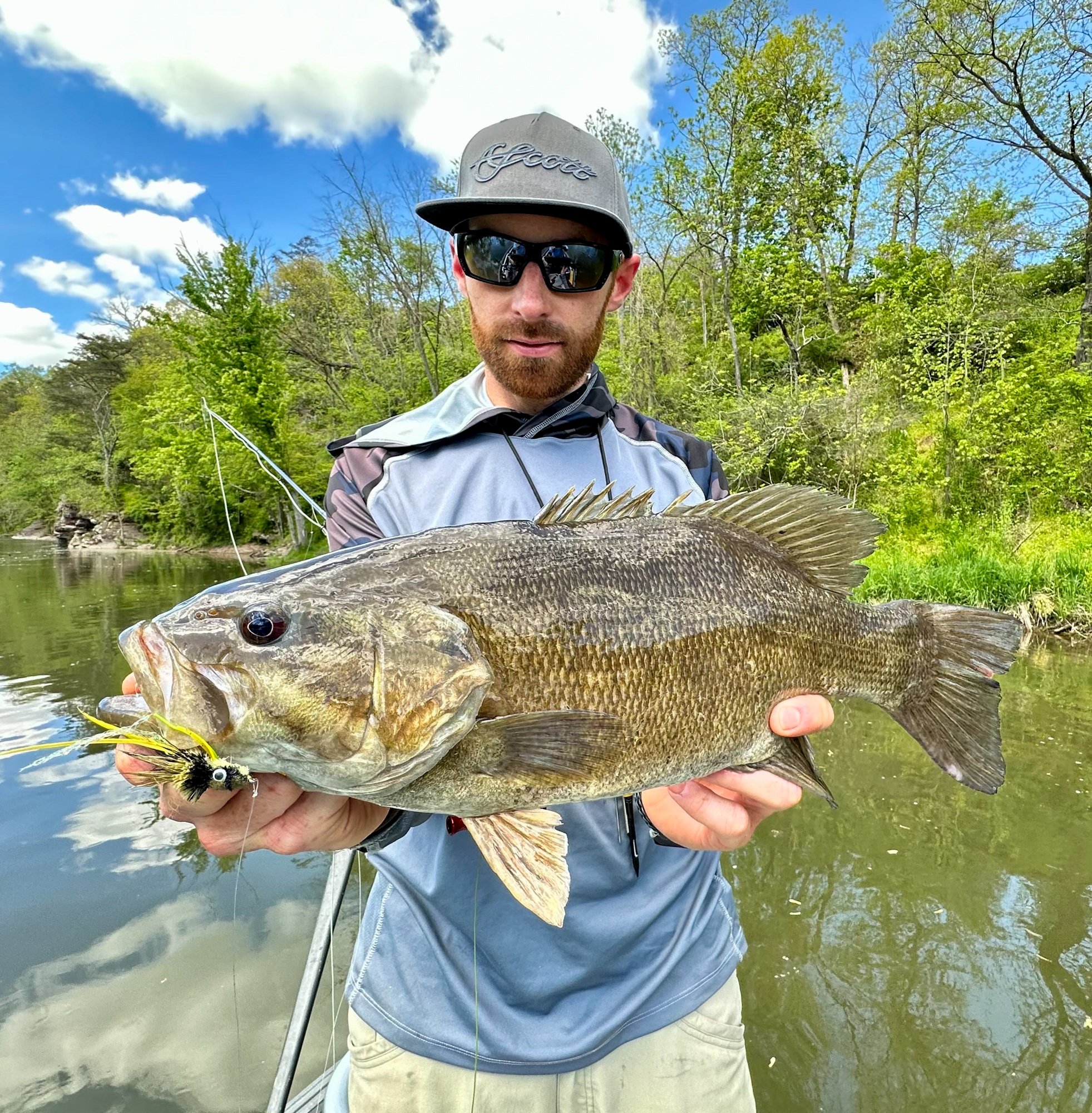
You’re not gonna catch a 20 every time you go fishing. But 17, 18, 19 — not that uncommon to catch. And I also think that the Susquehanna just has so many fish, where you may only catch four or five big ones or good ones — 16, 17, 18, 19, 20 — but you could catch 100 12-inch fish. So there’s so many fish. It’s crazy. And the Juniata is very similar to that as well. I think there’s probably more catchable small fish in the Juniata, so like six- to 12-inch fish, but there’s also so many fish in that 14- to 20-inch range in both of the systems, which I think is awesome. And so I think that’s another thing that really drives me to love this still after almost 20 years: every cast could be your biggest fish.
There’s no, “Oh, I caught a 20 here last week, it’s still there.” That’s the other really cool thing — smallmouth move a lot. They’re very nomadic. You almost never catch the same fish in the same spot. Like, holding water is holding water, so there’s probably always gonna be a fish there. But I can count on one hand the amount of times I can definitively say I’ve caught the same fish in the same spot twice, and then it’s gone. So you never know, which is really neat. And that’s one of the frustrating things about being a fishing guide: it’s like, oh yeah, we caught a random 21 right here, and then you never catch that fish there again. Ten years later, there’s still never that fish there.
So you’re kind of always hunting, which is really fun.
Scott: Nice. I really like that. When you were talking about going down the middle and catching fish, it reminded me of one of the best moments from our trip last year. It was right towards the end, we were catching them right in the middle — there’s like a big boulder pile out in the middle by the ramp. And we sight-fished a pretty good fish, and he’s just holding tight to the bottom, hopping the Ned rig along, and just watching him suck that in and set the hook. It was so cool. To sight-fish a smallie out in the middle in pretty deep water like that — you don’t get to do that every day. That was awesome.
Jake: Yeah. And that’s like the crazy part about this year. I mean, I’ve been on the water 60 days this summer, 70 days this summer, guiding, and I’ve had three sight-fishing days this year. Normally we have 70 of them. It’s just been — the water’s been so up and down this year, and it’s kind of reset the system, which is really nice. But I personally love the challenge of going out and hunting and looking for those fish. And so I haven’t really got to do that much this year, which kind of bums me out. But that’s mother nature for you.
Scott: Yeah. How is the health of the fishery overall?
Jake: The health is great. They had the big crash of the Susquehanna back in 2005, and that was kind of a perfect storm of a lot of different things. We had a lot of pollutants in the water. We had two really bad springs of high water, so we didn’t get great spawns. And then we had two — I think it might have been three — summers of just super low hot water, and lost the oxygen. And when smallmouth lose oxygen and they get too warm, their metabolism actually slows back down. And so there were all these bass that were getting cuts on them, or getting wounded some way, whether it was a hook in the mouth or they rubbed up against a rock or whatever.
And they couldn’t metabolize to fix that wound. It’s just like us getting a scab on a cut. They couldn’t metabolize. So they basically just got these open wounds on them, and then they would get infected and they would die. And I don’t know all of the science behind it. I just know in 2005 we had a huge crash, to the point where most fishing guides stopped guiding. And since then, the fishing has come back tenfold. And honestly, all we did as humans was leave them alone. They made it catch-and-release during the spring. They closed all of the tributaries, so you couldn’t go up the creeks and fish for those spawning fish. And we basically just left them be. And for about 10 years, they kept coming back and back.
And I remember we’d fish the Juniata and you may only catch 10 fish in eight miles, but they were all giants. And that was two or three years of that. And then all of a sudden you started catching some smaller fish. And then you caught a couple medium fish. And then all of a sudden you were catching all sizes, and you were catching 100-plus fish a day. I mean, I’ve had some days with some spin guys — and again, a lot of these fish are six to 12 inches — but we catch 150 to 200 fish in one day now. And that’s like going from 10 fish a day to 200. Obviously those are extremes, but the systems have come back crazy. And then in the sense of water quality, I don’t know about the Susquehanna so much as I do the Juniata, but there’s basically the giant black stonefly — or what the Western people talk about, the salmonfly, the giant black stone.
We have an East Coast version of that. It’s not quite as big, but they need the absolute healthiest water to survive in. And I’m finding them under rocks all of the time on the Juniata now. So just basic health, it’s phenomenal. And I think that’s one thing that makes the Juniata a little bit — not better, but I think it’s healthier than the Susquehanna in a lot of ways, because there’s not as much development, right? There’s a lot of farmfields and stuff like that, but there’s virtually no industry on that system, where the Susquehanna is basically built on industry — old mining towns and steel mills and things like that. And so I do know that the Susquehanna is significantly healthier than it used to be. But I can’t give you an actual thing.
But I know that I haven’t caught a fish with an open wound or a sore on it in 10 years probably.
[Related: — ]
Scott: Hey, that’s awesome to hear. So the river’s fishing good, a lot of fish in it. One thing that I wanted to touch on is, just talking to fishing guides, they’ll complain about people stacking rocks in the rivers, and catfish — those are two common gripes. And in the lower parts of the James where I live, it’s the blue cats, and then upriver it’s flatheads. Do you guys have any issues with invasive catfish, or native catfish populations that have grown?
Jake: Yeah. We do. We don’t have blues. We do have flatheads. And we don’t have as many in the Juniata as there are in the Susquehanna. I mean, there’s thousands of them, if not hundreds of thousands of them probably. But it’s a very touchy subject, I would say, in Pennsylvania, because there’s actually a pretty big industry now for flathead guides. And so obviously to them, they love it, right? Because you can catch these giant fish. But they do compete with smallmouth. I mean, there’s no question about it. Do they eat smallmouth? It’s hard to say. I’ve got some buddies that are like, “Oh, we’ve cut them open and found smallmouth, and they’ve eaten the panfish and stuff.” But the biggest problem is the crayfish.
Those things eat crayfish like crazy. And so now, even if they’re not eating smallmouth, they are eating all of the smallmouth food. And there could be a point where that scale is tipped to, there’s just not enough for both species. And it sucks to say, but the flatheads would probably win that battle. And so I do think there needs to be something done about it. But what that is, I don’t know. I mean, they tell us to kill them here. And there’s a couple guys that go out in the fall when they start to school up, and they will literally catch like 100 flatheads, and they go give them to farmers that have the permits to use fish waste as fertilizer, and they just give them to them.
But I don’t know. I mean, it is a problem for sure. I don’t see it as big of a problem on the Juniata because there’s not as many. But when it comes to channel cats, there’s a lot of channel cats around. You’ll see schools of them in the fall, but most of the time they’re just scattered — three or four here, one over here. And they’re actually a fun game fish, in my opinion. I mean, I love hooking a catfish because they’re super strong and they fight really hard. But I don’t see them really competing with smallmouth that much, because a lot of times they’re in the same holes, right? So they’re sitting right next to each other munching on stuff. But I think that’s one of the things that is also pretty important to know: yeah, they might eat all the crayfish and stuff like that, but especially in the summertime, there’s so much top water food that catfish — unless it’s a blanket white fly hatch — they’re not coming up and eating mayflies like smallmouth do.
So there’s plenty of food to go around, I think, for channels and for smallmouth. But when it comes to flatheads, they can eat so much more that they are a problem. I’ve only caught three on the Juniata in my career, maybe four. And I only know of about six other ones that have been caught. So I don’t think there’s a lot of them up there yet, but they’ll be there for sure. So I guess that long-winded answer is: I don’t have a politically correct answer for what to do, but something definitely needs to be done, because if it’s an unchecked resource, it’s gonna take over.
Scott: Gotcha. So are they native to that river system, or —
Jake: No. No, they’re invasive. I mean, the channel cats are native, but the flatheads are 100 percent invasive.
Scott: Yeah. And then someone’s gonna be like, “Oh, what about the musky?” Do you see muskies competing with smallies at all?
Jake: No. And people talk about this all the time, and this is something I do actually know, because I have a lot of friends that are musky guides in Virginia, Wisconsin, PA, and I’ve spent a lot of time chasing them as well. And the only recorded attacks from musky on smallmouth are when they are attached to somebody else’s line and they’re giving off that kind of, oh crap — whatever it is, I can’t even think of the word. But I’ve seen them attack a smallmouth then. But musky are pretty docile. It sounds weird to say that because they are super aggressive and they’re crazy big and mean, but musky can digest food three times better than most freshwater fish, which is why they’re so hard to catch sometimes, because they don’t have to eat as much.
And so they don’t like spines. They don’t like the spiky spines of a bluegill or a smallmouth. They like that softer fish — the fallfish, the suckers, the creek chubs. And there’s so much of that around that they’re just gonna eat that stuff because it’s easier for them to digest. It’s so funny, because I’ve seen this hundreds of times: you’ll float down to this hole that maybe has got a spring in it or something, and there’s just like a school of suckers in there, right? And you go to the very end of the pool and there’s three muskies sitting there. And they’re always there. They’re always in there. And they just literally will sit there, and when they’re hungry, they’ll shoot in there and eat something and then they’ll come back and sit there.
And the suckers don’t have any idea they’re behind them. So they’re there and they’re gone. And so there’s plenty of food for them. So I don’t think they’re a problem at all.
Scott: Yeah, they’re a lot like lions in that way. They’ll eat and then they’ll just basically take a nap until they’re hungry again. They’re not just gorging themselves constantly.
Jake: No. Yeah. I mean, that’s the allure of them. And they’re big, which is cool too. But I actually get more enjoyment out of just randomly seeing one while you’re fishing than being out there trying to catch them all the time.
Scott: Yeah. I was surprised how many we saw that day. We saw like six, most of them just stuck to the bottom, probably digesting something. But yeah, it’s super cool to see. I have a friend who fishes the James a lot here in Virginia, and he’ll catch muskies while he’s smallie fishing on Ned rigs all the time. And of course you have people throwing big baits for them and not catching them.
Jake: So I’ll say this — I totally agree with you on that. I mean, I’ve had that happen, maybe not as many times, but at least eight times I’ve had that happen where we’re fishing Ned rigs and all of a sudden we catch a muskie. Or, one time I was pretty mad at a musky and I was like, “I’m gonna throw this net out there and I’m gonna try to snag this thing in the face,” right? Because there was like six of them. And that net got like 10 feet in front of that fish’s face and it just shot up, bit my net off. And I’m like, “I can’t even snag these things.” And the reason I’m telling that story is because I did realize, I’m like, well, if they’re eating nets, they’ve gotta eat crayfish too, right? And so we have one system that we fish that is clear — it’s oftentimes more clear than it is dirty, right?
So there’s more days of clear, and you can actually go sight-fish musky with crayfish patterns. And it is wild to watch them. Sometimes they completely ignore them, but then other times they’ll come over and they’ll follow it on the bottom, sticking their nose down to it. And then I had one a couple years ago — we were smallmouth fishing and I saw this like 36-inch muskie in the middle of the river, and I was like, “Give me that crayfish rod.” And we had like 12-pound tippet on, right? So I was trying to trout-set it, basically, to get just the hook in its mouth. And it ate that probably three times before I actually hooked it. It was crazy to watch. And what’s so super funny, too, is they’ll come up on it kind of like a carp and nose down on it, but when they eat it, they actually turn their head sideways and suck it in sideways.
So it’s a definitive eat that you can see. And it does sometimes make it — you could easily snag one if you wanted to doing that, but it’s way more fun to watch them actually eat it. And my biggest muskie I’ve ever caught was on a crayfish, sight-fishing. It was crazy. It was, I think, 46 inches. And we had musky rods, we had bass rods, and we had one rod set up — we put 20-pound on the crayfish, which still isn’t gonna do anything for a muskie to get it in their mouth. But that’s what we were doing that day. And we were in a deep hole and we saw three of them and they wouldn’t leave the bottom, so we just kind of crayfished through, and the one followed it, like, literally turned around and ate it going downstream.
It was super cool. So yeah, they eat crayfish too. Everything eats a crayfish.
Scott: Yeah. Kind of like shrimp in salt water.
Jake: Exactly.
Scott: All right. So someone’s super psyched to book a trip with you, or wherever they live, catch some river smallies. Anything else that they would need to know?
Jake: Mm, not really. I mean, well, I’m sure there’s a whole long list of things, but the biggest thing I try to tell people is keep it simple, right? There’s so many fly patterns out there now. And if you’re gonna go out and fish by yourself, grab the stuff that I talked about or something similar. Simple stuff too, like Woolly Buggers — those are great if you’re just going out and wade fishing smaller creeks. Woolly Buggers are awesome. Little Zonkers, things like that. But if you’re going with a guide, just trust the guide. We’re all dialed into our systems, and like I said, I’ve gone other places, and I am a smallmouth guide and have been for almost 20 years, but I go with a guide somewhere else and I’m just like, “Set me up.”
Your fish are gonna eat different. Your fish are gonna potentially be in different places. Pretend I know nothing, right? And so always trust your guide on that. And start simple. Don’t go out and buy two or three rods and have an intermediate line and a floating line and a sinking line, a faster sinking line. Just go with a floating line, and buy an eight-foot bass leader that you can get prepackaged, 12-pound or 16-pound, and then add a little bit of fluoro tippet to it, and just go. And fish smallmouth just like trout. They are a moving-water predator. So think about brown trout when you’re fishing for smallmouth, and you’re gonna be very successful.
Scott: Yeah, that’s a great tip. Can you tell people where to find you, your guide service, all that?
Jake: Yeah. So Relentless Fly Fishing is the guide service that I own. Relentlessflyfishing.com — on the website, we have an online booking program. So if you have a specific day in mind that you’re looking for, you can just go see if we have a guide available and book it right then and there. Facebook, we have a Relentless Fly Fishing page. Instagram, Relentless Fly Fishing page as well. Google Relentless Fly Fishing and you’ll find us somewhere. So we’re pretty out there. Also, if you are interested in learning more about smallmouth, I have also published two books through Stackpole. One is called Smallmouth Bass Flies Top to Bottom. It is a fly-tying book, but it also is a fly encyclopedia, so there’s almost 400 patterns in there that are primarily all available for purchase somewhere online.
And then my most recent book is Favorite Flies for Smallmouth Bass. So I picked what I would consider the top 50 flies in the industry — not just mine — and interviewed a bunch of the guides that designed some of those flies, and basically asked them the same question: give me three sentences on why you designed it and how to fish it. So it’s more of a resource book than it is a tying book. There is a recipe if you’re into tying, and you can find a lot of those videos online as well. But yeah, I mean, just Google Relentless Fly Fishing and you’ll find all the stuff you need to know.
Scott: Nice. So if you wanna book a trip or you wanna dive deeper down the rabbit hole, there you go, folks.
Jake: Exactly.
Scott: Thank you so much. Really appreciate your time. Can’t wait to fish with you again.
Jake: Yeah, get up here.