
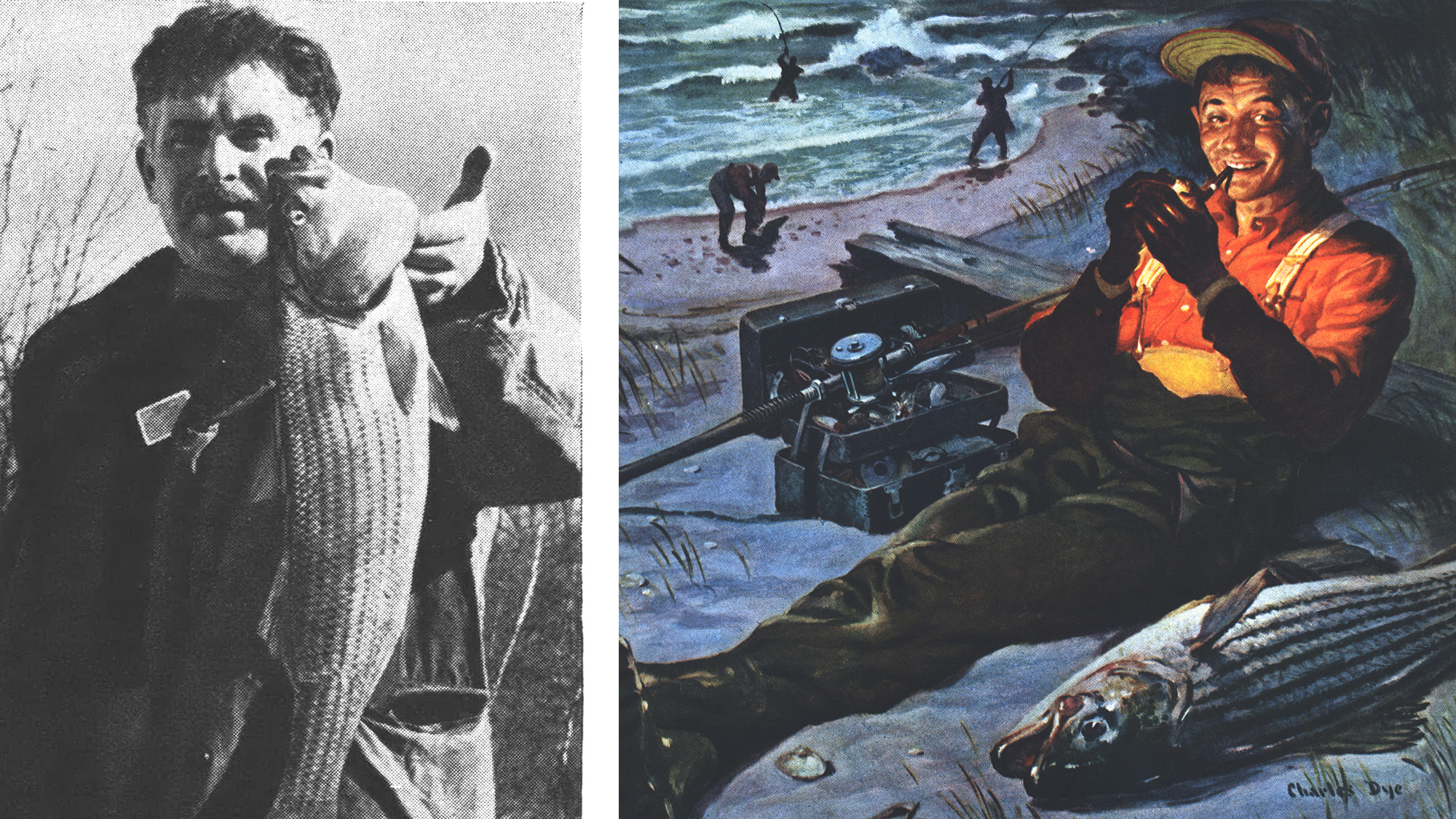
This story, “Striped Turkey,” appeared in the November 1955 issue of Outdoor Life.
Five minutes after the arrival of my Boston brother and his family at my home in East Hampton, Connecticut, we discovered a calamity. Neither of us had bought a turkey, and it was already 10 o’clock Thanksgiving Eve.
We thought they were to bring it, and they thought we were to get it.
Above the hysterical babble, I made a daring suggestion: “Maybe we can make do with something else.”
“Nonsense,” my wife snorted. “What would you like? Cranberry sauce, mashed potatoes, pumpkin pie, and beans?”
Brother Don raised a hand commanding silence.
“This is probably the best thing that could have happened,” he said. “Be a good lesson for the kids. Teach them to be resourceful. Now I have a plan. . . .”
“That’s crazy,” I interrupted as I saw his eyes fixed on my old single-shot .22 standing in the corner. “There hasn’t been a turkey shot in Connecticut for 200 years.”
“I wasn’t planning to hunt. You and I were figuring on fishing in the morning, right?” he asked.
“Right, but —”
“O.K.,” he said, “it’s simple, instead of fishing just for sport, we fish to eat.”
“That’s out!” both wives screamed.
“For weeks the children have been learning about Thanksgiving in school,” Cynthia informed us. “They’ve drawn pictures of turkeys, talked about turkeys, and written poems about turkeys. And it just won’t be Thanksgiving without a turkey.”
“That’s silly,” I replied. “If you figure that way, then we’ve got to find some Indians, too.”
“Sure,” Don added. “That bird guff is just propaganda cooked up by the turkey growers.”
“I’ll bet, if the truth were known, the pilgrims ate striped bass instead of turkey,” I said.
“Of course they did,” Don said. He rubbed his hands in satisfaction. “It’s all settled now. You girls sleep late in the morning and leave everything to us. We’ll be back by noon with a striper.”
“We’ll get some scallops while we’re at it, too,” I promised.
“Even some oysters,” Don injected.
The kids were snake dancing from room to room and shouting a song about gobble, gobble, gobblers as they went. The wives stood around, looking incredulous, so Don felt it necessary to add a clincher. When I got the drift of what he was proposing I gave him a kick, but it was too late. He promised that if we weren’t back by 1 o’clock — with the fish — we’d all go out to a fine restaurant for dinner.
When we were alone I told him, “You didn’t have to promise that. The bill for this mob will sink us.”
“Nonsense. Have some confidence. We’ll catch fish,” he countered.
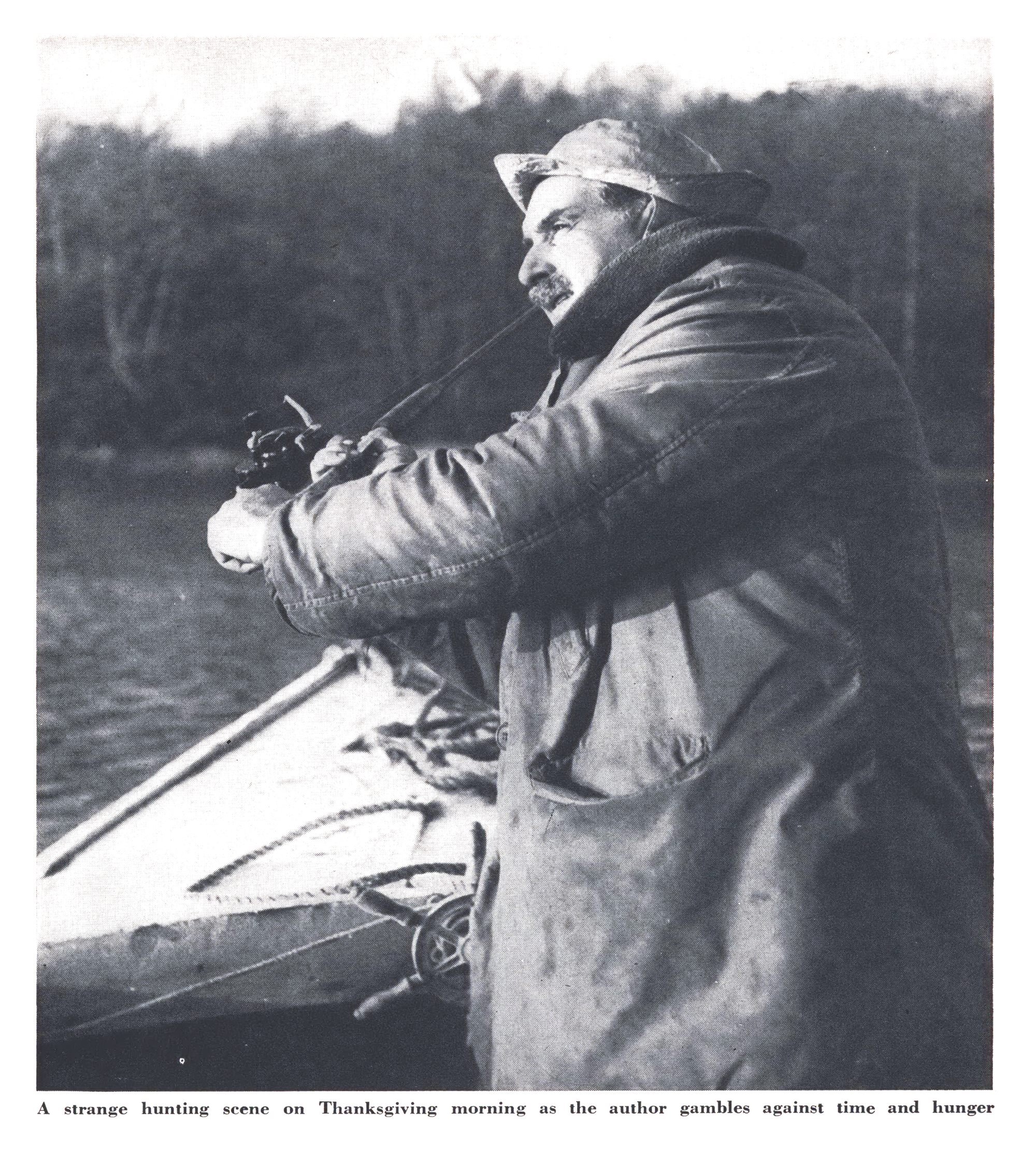
It was still dark when we left the house next morning, and you could smell the cold — just before your nostrils were pinched shut. While the car engine warmed up, I dashed back into the house, made some instant coffee, and poured it into a vacuum bottle. I must have awakened my sleeping wife.
“Take your time,” she called from upstairs. “We’ll be dressed and ready to go at 1 o’clock.”
In addition to our tackle, we stuck a long-handled scallop net into the car. Neither Don nor I said much as we drove the 25 miles to Niantic, where I keep my boat. He kept fiddling with the radio, tuning in each station’s weather report, no doubt figuring that eventually he’d hear a report that promised “fair and rapidly rising temperatures.”
I mulled over our chances for getting fish and the subject of frostbite striper fishing in general. Most of the bass caught in Connecticut are the small, school fish. During the warmer months these 2 to 10-pounders look like mighty small potatoes, compared to the 40 and 50-pounders taken in other coastal states. We get our compensation in the winter, when the giant bass of neighboring states have taken off for warmer climes. Our stripers stay with us. They’re natives and provide fishing in even the coldest weather. It’s surprising how large a 10-pound fish looks in the month of January.
When we arrived at the dock it was still dark, but my boat gleamed ghostlike in a heavy shroud of frost. Ice lay thick in the bottom.
Hot spot for this refrigerated striper angling is in the southeast corner of the state, in the Thames and Niantic rivers. In the past I got action almost 50 percent of the time. That is, every second trip I stood a good chance of taking fish. Unfortunately, that reckoning doomed this Thanksgiving-Day trip from the start, for I’d done very well the last time out. But then, who wants to quit when they’re ahead?
When we arrived at the dock it was still dark, but my boat gleamed ghostlike in a heavy shroud of frost. Ice lay thick in the bottom. I realized my boating season was about over. I’d have to haul it out within a few days, for the intermittent thaws and freezes hurt a boat. And anyway, most winter bass fishing is done from shore.
Instead of using a bailing can, Don chipped away on the ice with a screwdriver, while I attached the motor to the stern and loaded our gear. By the time we were under way, the sun had begun to light up the undersides of long, stringy clouds.
“Where shall we start operations?” I asked.
“Play the hunches,” Don suggested. “What goes with Thanksgiving?”
“O.K.,” I said, and swung the boat in the direction of Turkey Point, the most popular spot on the Niantic River. At that early hour we would have the place to ourselves. Speeding along, our boat left the slightly rippled surface of the channel and entered an area that looked somewhat like an oil slick.
“Ice,” Don said.
It was ice — a microscopically thin glaze of the stuff.
“This will cut our lines,” he warned.
I told him I didn’t think so. “It’s so thin, and it doesn’t seem to be around the point.”
A stronger current there had evidently prevented the ice formation. I killed the motor and we started casting to the deep water that lay along the edge of a submerged sandbar.
There are two popular and proven techniques used in the Niantic for stripers. One is to troll sand or bloodworms behind spinner blades, and the other is casting (usually with spinning tackle) white, weighted bucktails. These are often used with a trailing pork strip. We had worms, lures and tackle to exploit either system.
It was still bitter cold and the sun hadn’t made much progress harvesting our crop of frost. We cast with extra vigor to get warm.
Several other boats raced up the river, as though in fear we were cleaning out the fish. One boat eased up to within 50 feet of us, put out a trolling line, and before the worm was decently moist, had hooked a fish.
“How do you like that!” Don moaned as we watched a five-pounder swung aboard. “We’ve been here for an hour and haven’t even had a strike.”
“Maybe it’s going to take trolling to score this morning,” I said. I brought my bucktail in and prepared to fix a trolling rig.
“Hey, look,” Don said.
I glanced up and saw that another fellow in a different boat with a bowing rod — right where we’d drifted through. We watched his line slicing the water, and finally the flashing silver as he netted his catch.
“It isn’t just the trollers that are getting fish,” Don said.
I decided to stick with casting. I tried every retrieve I could think of — slow, fast, and in between; with action and without.
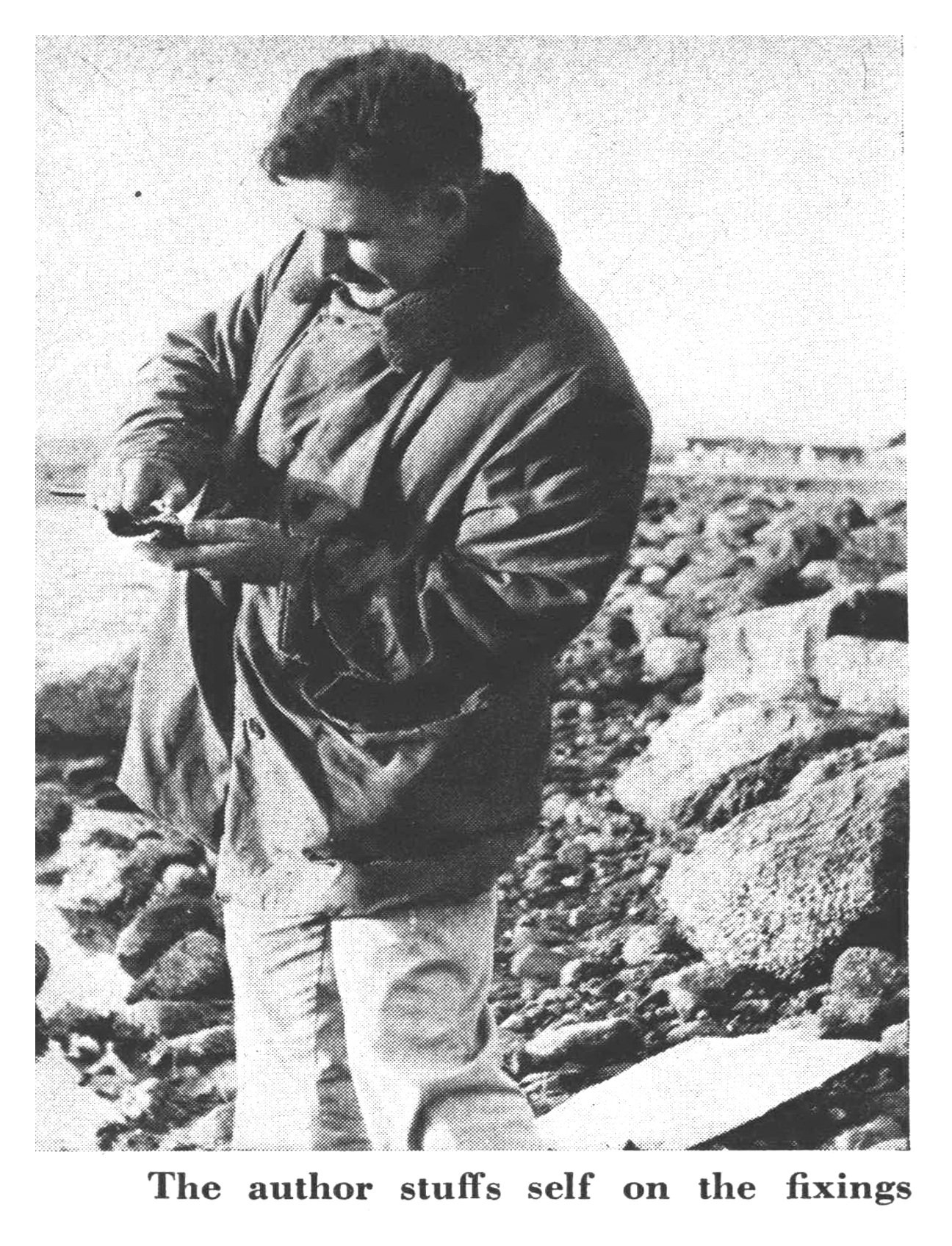
It had warmed up enough to shed one layer of clothing. The warmth was welcome, but each passing minute meant we were that much nearer our 1 o’clock deadline.
“Maybe we’re fishing too fast,” Don said. “Possibly, because so much depends on it, we’re rushing our retrieves.”
“That’s ridiculous,” I argued. “We’ve been trying everything.”
We couldn’t keep our eyes off the other boats. By then there were about a dozen, some trolling, others drifting as their occupants cast. Stripers were being caught by everyone, so it seemed, but us.
“This is justice,” Don groaned. “Here these guys are fishing for fun. They’ll go home, dump their fish into an icebox, mix a Martini, then sit down to a turkey dinner, while we . . .” he shrugged hopelessly.
“It doesn’t make sense,” I added. “We’re using the same lures, fishing the same water, and as fishermen we’re at least as good as they are.”
“Don’t place any bets on that,” Don kidded. “Let’s try trolling.”
We rigged up one line to go deep and the other to work shallow. I regulated the speed of the boat so the long sandworms trailed enticingly. Then, remembering a trip when a different technique had paid off, I rigged an extra outfit and stuck a shapeless gob of worms on that hook.
Time was passing; it was after 9:30 when we started trolling. We headed upriver. An acquaintance of mine was trolling downriver, and we killed motors to exchange confidences.
“How’s it going?” he asked.
“Pretty good,” I answered. “How’re you doing?”
“Pretty good. Got three or four — sort of slowing up now, though. Guess early in the morning is best.” My friend started his motor and waved farewell.
Don was fit to be tied. “Imagine that,” he said. “Three or four fish. Can’t he count? Is he a liar? ‘Sort of slowing up now,’ the man said. Well, anyway, for us things can’t get any slower.” Don disgustedly yanked his rod and started reeling in the line that had sunk to the bottom while we were talking. Suddenly his rod tip started twitching. “Holy cow!” he yelled. “I’ve got a fish.”
A second later he shook his head as the line came in too easily. “Guess not. Probably just some weed.”
He kept reeling and landed the smallest, most ridiculous-looking flatfish I’ve ever seen. He held it up in brief contempt before tossing it back. Lady luck wasn’t just ignoring us, she was giving us the bird.
All morning we’d noticed two men in a bright-green runabout who were having frequent action. Now, as they trolled by, I saw the chap at the motor slyly drop something over the stern.
“What’s he doing?” I asked.
“They’re chumming. I bet that’s the answer,” Don said. “I’ve seen it done before. Bits of worm are tossed over, the bass pick these up as appetizers, and when the large trolled worm comes by they grab it.”
“Should we give it a try?” I asked.
“We haven’t enough worms. Besides, others around here catch fish without chumming.”
I looked at my watch — 10 o’clock. We’d been fishing almost five hours with nothing to show but Don’s flatfish.
“Do you suppose any of these people would sell a couple —” A tremendous yank on my line shut me up fast. I reached down and snapped the motor into neutral. It stalled and suddenly everything was as quiet as a house without a TV set. Then I thought I heard the taut monofilament sizzling through the water, but it was my own excited breathing.
I knew it was a good fish. I loosened the drag to let it run, and the fish took my line in a wide circle around the boat. We were in the middle of the river and I couldn’t see anything around to cause a snag. All I had to do was keep my head. To be safe, I loosened the drag some more. And then, unbridled, the fish really took off.
“Put some weight on him!” Don yelled.
“Just keep cool and take it easy,” I kept telling myself. Using finger pressure against the spool, I brought the fish to a sluggish stop. I started pumping the rod and it felt as if I were bringing the heavy boat to the fish rather than the fish to the boat.
“It’s a good one.” Don had seen it.
Then I saw it, and it was a beauty. Don had the net deep in the water, and I held my breath as I led the tugging striper to him. With a “wooosh” of the net, the fish was ours. I let my breath go and flopped down on my open tackle box, immune to the pain of an upturned 8/0 hook.
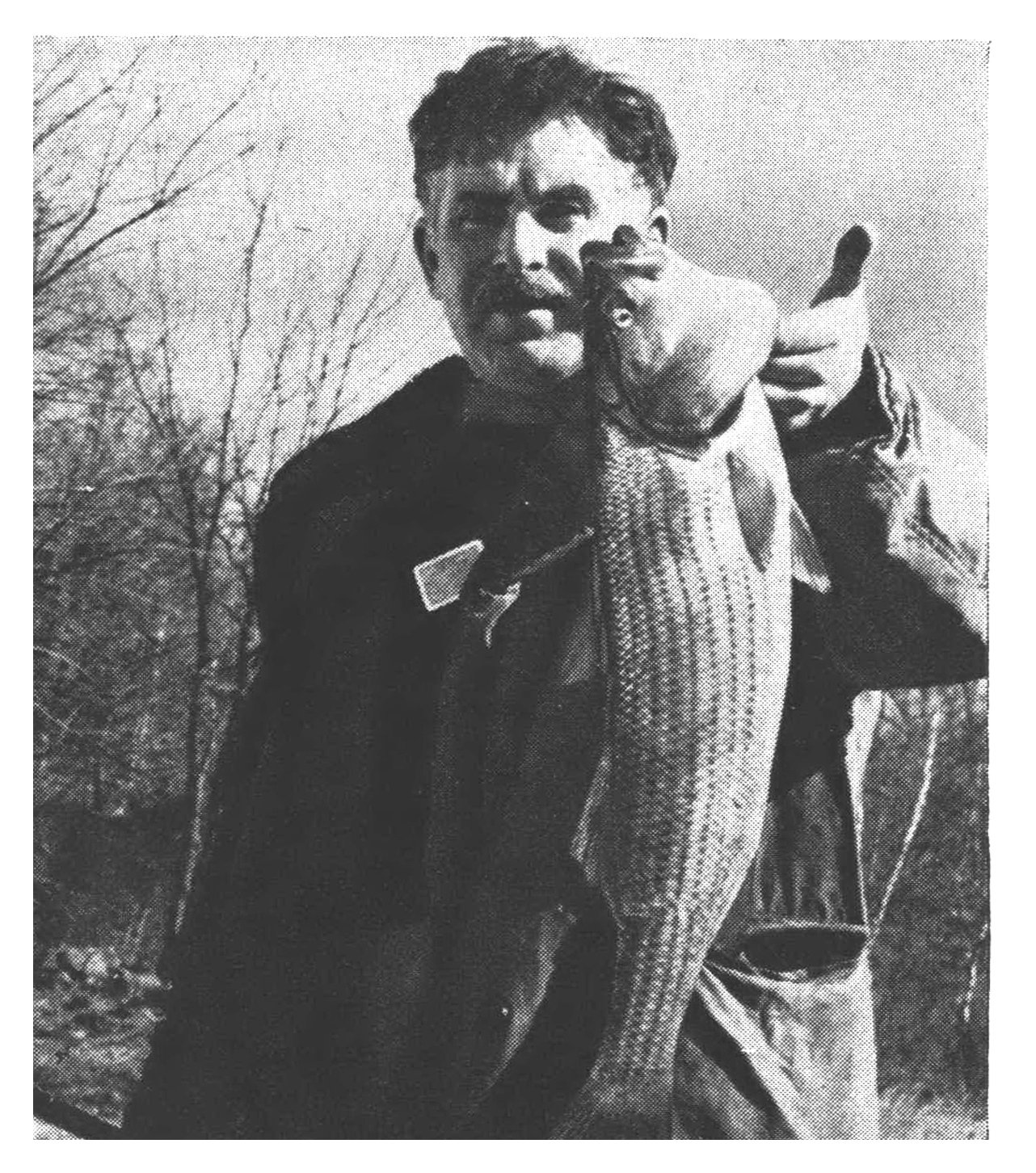
The fish pulled the pointer of my pocket scale below the 12-pound mark — the heaviest striped bass I’ve taken from that river. It was large enough for our requirements, and since time was at a premium, we decided to go after the scallops.
We gunned the boat back to the dock to get one of the 15¢ permits entitling you to one bushel of Niantic scallops. These scallops are considered a delicacy throughout Connecticut. The season opens in October, and by Thanksgiving the beds have been well worked over.
The technique for taking these shellfish is basically simple — one merely uses the long-handled net as a scoop over the bottom. Luck and skill determine the percentage of scallops in a net full of mud, seaweed, empty shells, and stones.
Luck played on our side for a change, and we came across an area where Don made one productive scoop after another. Within 30 minutes we had all we needed.
“We’re really cooking now,” Don said. “How about the oysters?”
I looked at my watch. “Suits me. The tide will be just about right.”
The oysters we had in mind were the small, rock variety that are found at low tide along stony beaches. We decided on a place a few miles down the coast, where we usually had good luck before. We moored the boat, got our gear, fish, and scallops into the car, and were on our way.
“I’m starving,” Don said. “Can we stop for a hamburger?”
I shook my head. “Nope, we’re running a tight schedule. It’s 11:30 already.”
This beach, like most of the Connecticut shoreline at this season, was deserted, the cottages boarded up. The day, by that time, was warm, and the sun made sand and water glisten with midsummer gaiety. It was a particularly low tide, and when we got to the rocky point we found oysters aplenty.
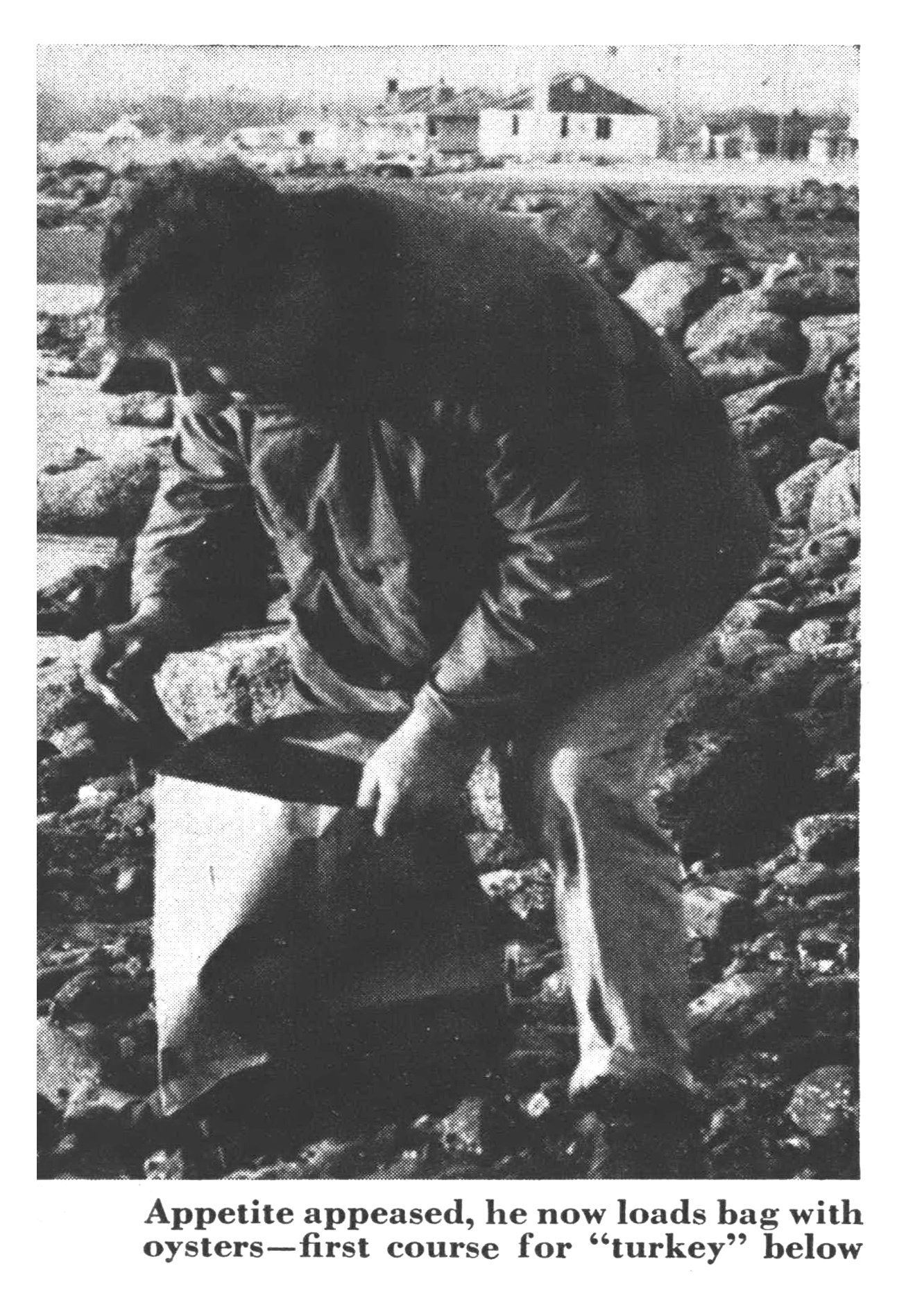
I was carrying a sack, but it was several minutes before anything went in it. With drawn knives and the appetites of shipwrecked sailors, we fell upon the oysters. Eaten right on the spot, the clean, saline taste is something you don’t ever get enough of. Oysters disappeared as fast as popcorn at a western movie.
We finally snapped out of this orgy and gathered stuffing for our bag.
We arrived home with five minutes to spare and everyone went to work. The women got busy in the kitchen, while Don and I opened oysters. The older kids readied the scallops. Soon the perfume of baking bass hinted at what was to come. By this time, the kids had forgotten all about turkeys.
Our first course was oysters on the half shell, followed by generous helpings of scallops, broiled in butter. Then came the bass — baked a delicate brown on the outside, fat with chestnut stuffing inside. It’s true there were no drumsticks to fight over, but on the other hand, there was no neck or tail.
Read Next: The Thanksgiving I Spent Alone in the Woods
Afterward, Don lay back on a couch and — after giving a gentle pat to his mid-section — said, “You know, this dinner was terrific, but next year we can improve on it.”
“How?” I asked.
“We’ll take the kids along, and while you and I are out snagging striped turkey, they can dig clams for a chowder.”